Fire and water checks
Ontario Fire Code monthly inspections: what is due, who does it, and the record
The Ontario Fire Code requires the building owner to have doors in fire separations, egress doors, portable extinguishers, hose stations, emergency lighting units, battery-backed exit signs and locked or supervised sprinkler valves inspected at least once a month, and to keep a record of each check for at least two years.
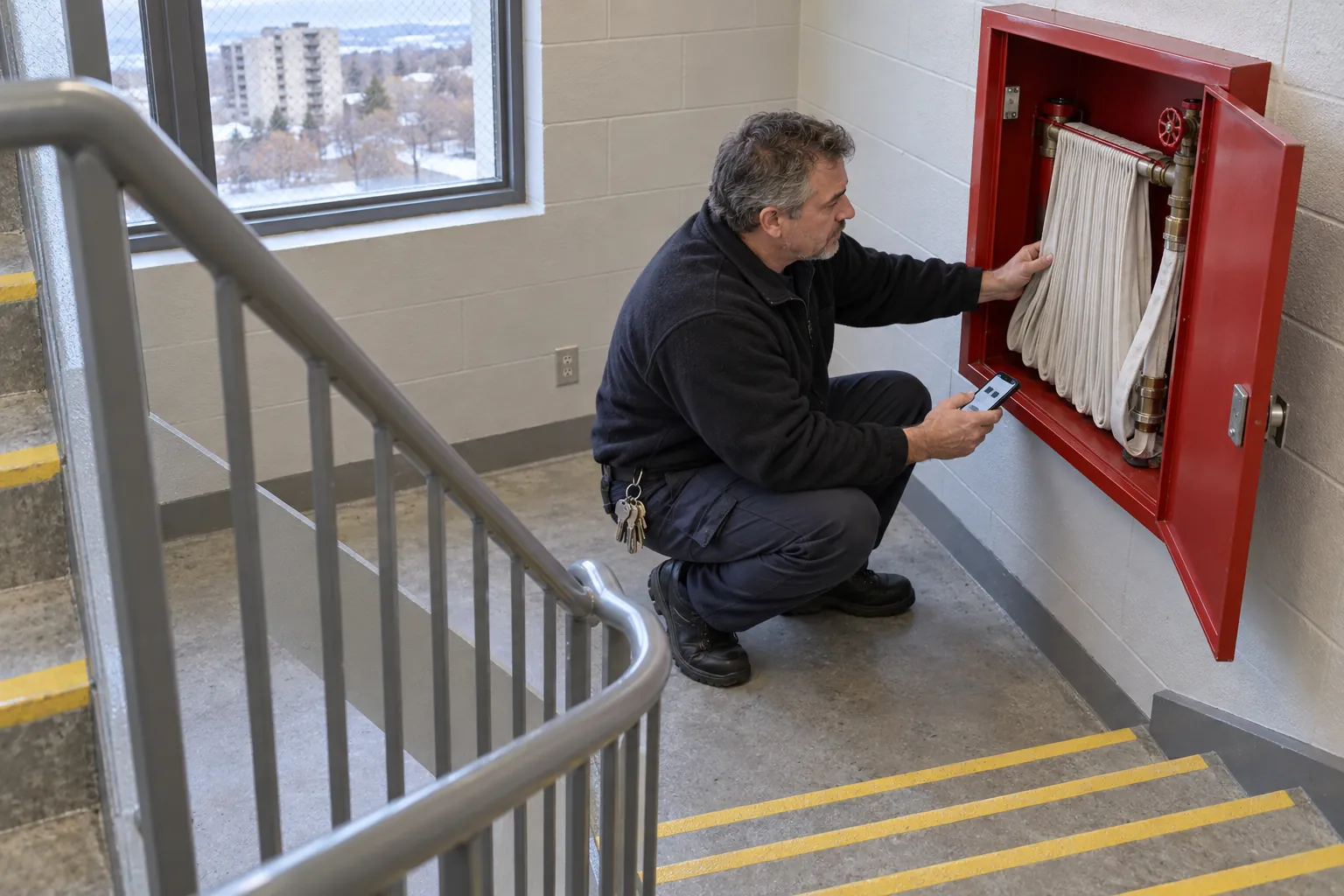
The requirements are scattered across Parts 2 and 6 of Division B, so they are easy to miss one at a time. This guide gathers every monthly inspection of fire protection equipment and means of egress in one list, in the code's own words, sets out the checks that sit around them, and explains what a fire inspector can ask to see.
01
What the Ontario Fire Code requires, and who answers for it
The Ontario Fire Code, O. Reg. 213/07 is a regulation made under the Fire Protection and Prevention Act, 1997. The province's page on fire safety legislation and Ontario's Fire Code calls it "a set of minimum requirements for fire safety within and around existing buildings and facilities", and is plain about the two roles that matter: "The owner of the building is responsible for complying with the Fire Code, except where otherwise specified. Municipal fire departments enforce the Fire Code." This guide follows the consolidation in force from 1 January 2026, last amended by O. Reg. 303/25.
The monthly inspections are in Division B: most in Part 6, which "applies to installation, checking, inspection, testing, maintenance and operation of fire protection equipment and life safety systems" (Article 6.1.1.1), and two in Part 2, which covers doors and means of egress.
Division A, Article 1.2.1.1 says: "Unless otherwise specified, the owner is responsible for carrying out the provisions of this Code." The owner is defined widely, as "any person, firm or corporation having control over any portion of the building or property under consideration", so a landlord, a condominium corporation, a tenant with its own floor or a property management company can each answer for the round. The owner rarely walks it personally, but answers for compliance.
One general rule shapes every inspection. Under Division B, Sentence 1.1.1.2.(3), "any appliance, device or component of a device that does not operate or appear to operate as intended when checked, inspected or tested as required by this Code shall be repaired or replaced if the failure or malfunctioning of the appliance, device or component would adversely affect fire or life safety." Finding a fault is not the end of the check; the record should show the repair.
02
Every monthly fire protection and egress inspection in the Ontario Fire Code
These are the Division B requirements due monthly, or "at intervals not greater than one month". A small office may have only doors, extinguishers and emergency lighting; a high-rise apartment building or hotel may have them all.
- Doors in fire separations. "A door in a fire separation shall be inspected monthly." (Sentence 2.2.3.4.(4)) A closure must not be "obstructed, blocked, wedged open, or altered in any way that would prevent the intended operation of the closure" (Article 2.2.3.3). See our guide to fire door inspection.
- Egress doors. "All doors forming part of a means of egress shall be checked at intervals not greater than one month to ensure that they are operable." (Sentence 2.7.2.3.(1)) Revolving doors, egress sliding doors and electromagnetic locks are tested yearly instead.
- Portable extinguishers. "Portable extinguishers shall be inspected monthly." (Article 6.2.7.2) An inspection in conformance with NFPA 10 is deemed to comply (Sentence 6.2.7.1.(2)). See our guide to the monthly fire extinguisher inspection.
- Hose stations, "to ensure that the hose is in proper position and that all of the equipment is in place and in operable condition" (Article 6.4.2.1).
- Locked or supervised control valves. Sprinkler and fire protection water supply valves that are sealed open are inspected weekly, but "valves which are locked open or valves which are electrically supervised shall be inspected monthly" (Sentences 6.5.4.5.(2) and 6.6.1.2.(2)).
- Sprinkler alarms. "The alarm on all sprinkler systems shall be tested monthly by flowing water through the test connection located at the sprinkler valve" (Sentence 6.5.5.2.(1)), except where electrical supervision is tested under Article 6.5.5.7 instead. See our guide to sprinkler system inspection.
- Gravity tanks. "The water level in gravity tanks shall be inspected monthly." (Article 6.6.2.8)
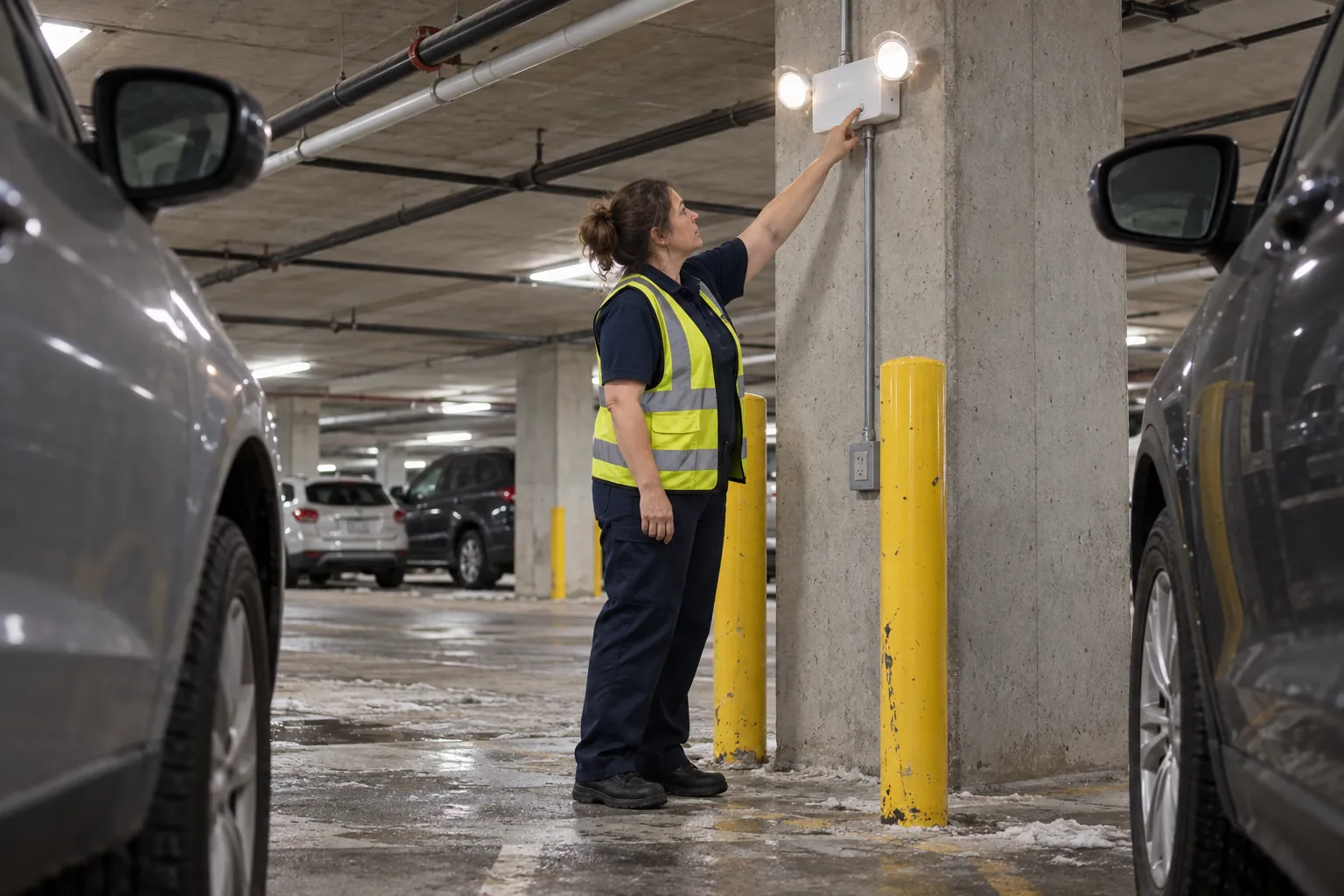
- Emergency lighting units. Self-contained units are inspected monthly for pilot lights, terminal connections and clamps, a clean, dry battery surface and electrolyte level (Sentence 6.7.1.6.(1)), and tested monthly "to ensure that the emergency lights will function upon failure of the primary power supply" (Clause 6.7.1.6.(2)(a)). See our guide to the emergency lighting test.
- Exit signs with battery back-up, inspected at intervals "not greater than one month to ensure the exit signs will be visible upon failure of the primary power supply" (Clause 6.7.1.8.(2)(a)).
- Voice communication systems not integrated with the fire alarm: loudspeakers tested monthly as an all-call, and one remote firefighter emergency telephone a month on rotation, so all are tested yearly (Article 6.3.2.5); the monthly test under Sentences (1) and (2) is not required where the system is regularly used for paging (Sentence 6.3.2.5.(4)).
- Interconnected smoke alarms in residential and care occupancies: "the operability of the interconnected system shall be confirmed monthly, by testing at least one smoke alarm using its test function, on a rotational basis" (Sentence 6.3.2.6.(4)).
In care occupancies, care and treatment occupancies, detention occupancies, retirement homes and many child care premises, the supervisory staff fire drill is monthly rather than yearly (Sentence 2.8.3.2.(2)); see our guide to fire drill requirements.
The fire alarm has no monthly line of its own. Article 6.3.2.2 requires it to be "inspected and tested in conformance with CAN/ULC-S536", and that standard sets the routine tests between annual inspections. Ask your fire alarm contractor which fall to the building's own staff, and add them to the round. See our guide to fire alarm testing.
Outside this list, two operational items are also monthly: hot work equipment is leak-tested with a leak test solution (Sentence 5.17.2.6.(2)), and the liquid level in an aboveground tank of flammable or combustible liquid that is out of service or unsupervised is measured and compared (Sentence 4.3.16.4.(2)).
03
The daily, weekly and annual checks around the monthly round
The monthly round is the middle of a calendar. Write the whole calendar down once for each building, so nothing falls between the superintendent's list and the contractor's.
- Daily: "The central alarm and control facility shall be checked daily for indication of trouble in the system." (Article 6.3.2.3)
- Weekly: valves sealed open (Sentence 6.5.4.5.(1)); sprinkler water supply and system pressure on the gauges (Article 6.5.3.2); fire pumps run at rated speed (Sentence 6.6.3.3.(1)), or monthly in a building containing a hotel (Article 6.6.3.6); and the power supply of an interconnected smoke alarm system, with written records kept for at least six months (Sentences 6.3.2.6.(3) and (6)).
- Every three months: the priming water in dry-pipe systems (Article 6.5.4.3); and the supervisory staff fire drill in a high building to which Subsection 3.2.6. of Division B of the Building Code applies, and in a laboratory (Sentences 2.8.3.2.(5) and (7)).
- Yearly, mostly by contractors: the fire alarm inspection and test, by a person who has completed a program or course acceptable to the Fire Marshal (Article 6.3.2.1; Division C, Article 1.2.1.2); the emergency lighting duration test (Clause 6.7.1.6.(2)(b)); hose and hose valves (Articles 6.4.2.4 and 6.4.2.5); dry-pipe trip tests and sprinkler head checks (Sentence 6.5.5.4.(2), Article 6.5.3.4); fire dampers, "annually or on an approved time schedule" (Article 2.2.3.5); the fire safety plan review (Sentence 2.8.2.1.(4)); and the supervisory staff fire drill in other buildings (Sentence 2.8.3.2.(1)).
Emergency generators are inspected, tested and maintained to CSA C282, with records kept as that standard requires (Articles 6.7.1.1 and 6.7.1.3). See our guide to generator testing.
04
Walking the monthly round: who, when and what to look at
The round usually falls to the building superintendent in an apartment building, the building operator in an office tower, custodial staff or a caretaker in a school, or a security guard on nights. Contractors and service technicians take the items that need tools, training or flowing water. Whoever does it, a few habits make it reliable:
- One route, one list by location. Walk the building in the same order each month, with every door, extinguisher, hose cabinet, emergency light and exit sign listed where it is. "Extinguishers: OK" cannot show which one was missed.
- A fixed week. "Not greater than one month" leaves little slack; a set week makes a late round visible before it becomes a missed one.
- Know what each check means. A fire separation door closes fully and latches, with its hardware adjusted or repaired so it does (Clause 2.2.3.2.(1)(c)), and the opening and the area around it are kept clear of anything that would obstruct the door (Sentence 2.2.3.4.(5)). For extinguishers, the City of Ottawa's pre-inspection guide lists what its inspectors expect: the gauge showing green, properly mounted and easily accessible, free of dust or grease, and the safety pin in place.
- Notify before you test. Tests on fire protection installations need a procedure that includes "notifying the fire department and the building occupants where necessary" (Division B, Article 1.1.1.1), and anyone who could be affected by a sprinkler flow test is told first (Article 6.5.5.1). Tell the monitoring station too.
- Fix faults, not next month. A device that fails a check in a way that would affect fire or life safety is repaired or replaced, not carried forward (Sentence 1.1.1.2.(3)), and a door that no longer latches has its hardware repaired (Clause 2.2.3.2.(1)(c)). Sprinkler water supplies may not be impaired for more than 24 hours without notifying the Chief Fire Official (Sentence 6.5.2.2.(1)).
- Cover the whole building. Locked electrical rooms, tenant suites, parking garages and roof-top mechanical rooms are where monthly items are skipped. If a room could not be entered, record it and when it will be done.
Where a building needs a fire safety plan, the plan must "provide for the maintenance of building facilities provided for the safety of occupants" (Clause 2.8.2.1.(2)(g)). The monthly round is how that is kept.
05
The record, and what a fire inspector can ask to see
"If this Code requires tests and corrective measures or operational procedures to be carried out, records shall be made noting what was done and the date and time it was done." (Division B, Sentence 1.1.2.1.(1)) Records stay at the building; "electronic records that can be made readily available to the Chief Fire Official upon request, are deemed to comply" (Sentence 1.1.2.1.(4)). Each is kept for at least two years, and at least the latest and the preceding record of each test are kept (Sentence 1.1.2.2.(1)). Some systems add their own: a permanent maintenance record for each extinguisher (Article 6.2.7.5), "an approved record" of sprinkler inspections (Article 6.5.1.8), and a fire alarm record showing whether each device, component and circuit "is in proper working order" (Sentence 6.3.2.2.(4)).
A good monthly record names the item and its location, the date and time, who checked it, the result, and, where something failed, what was done and when. Keep the documentation for the devices contractors service in the same place as your own round. Our guide to the fire log book covers how to organize it.
Under section 19 of the Fire Protection and Prevention Act, 1997, the Fire Marshal, an assistant to the Fire Marshal or a fire chief "may, without a warrant, enter and inspect land and premises for the purposes of assessing fire safety", and may "demand the production for inspection of a document or other thing that is relevant to the inspection". Under section 21 they may then order the owner or occupant "to take any measure necessary to ensure fire safety".
Municipal fire services publish what they look for. The City of Ottawa's Ontario Fire Code pre-inspection guide asks for records kept on the premises for at least two years, a daily visual check of the fire alarm panel, extinguishers inspected monthly and serviced annually, and emergency lights inspected monthly and tested annually.
Under section 28, contravening the regulations is an offence, as is giving an inspector information a person knows, or ought reasonably to know, to be false or misleading. An individual faces a fine of up to $50,000 for a first offence, up to a year in prison, or both; a corporation up to $500,000 for a first offence and $1,500,000 for a subsequent one. A back-filled record is worse than an honest gap.
06
Where monthly inspection records fail, and what SiteClara does about it
Monthly records fail in predictable ways. Extinguisher tags are initialled in a batch before the inspector's visit, twelve months in one pen. The round is one line in a binder, "all doors checked", with no way to tell which stairwell door was tried. The superintendent who knew the route leaves. A fault is written in the margin and never repaired. And the property manager for several buildings learns a round was missed only when an inspection order arrives.
SiteClara records routine checks where they happen. A printed QR poster, with an optional NFC tag behind it, goes at a point on the round, such as an extinguisher cabinet, a stairwell door or the fire alarm annunciator. Staff scan the code or tap the tag on their own phone, with no app to install, see the checks scheduled there, such as the monthly door inspection, and mark each done or say what stopped them, such as a locked electrical room. The named person and the time are recorded as it happens, with a photo when the check asks for one. A fault, such as a door that no longer latches, is reported there with a photo and goes onto the team's list of jobs until someone closes it.
The supervisor sees what is due, done and missed across the building, and records the reason a check was missed; a job that needs the building manager can be escalated to them to answer. Each day the supervisor reviews and approves a report that goes to nominated management or client contacts at 8 a.m. the next morning, showing what was reported, completed and still open, and how the scheduled checks went.
07
Questions people ask
Who is responsible for monthly fire inspections?
The building owner. Ontario's page on fire safety legislation and Ontario's Fire Code says: "The owner of the building is responsible for complying with the Fire Code, except where otherwise specified." Division A, Article 1.2.1.1 of the Ontario Fire Code, O. Reg. 213/07 puts the same duty on the owner, defined as anyone "having control over any portion of the building or property under consideration", so a landlord, a tenant or a property manager can answer for it. Staff or contractors can walk the round, but the duty stays with the owner, and municipal fire departments enforce it.
Who can perform a monthly fire extinguisher inspection?
The Ontario Fire Code, O. Reg. 213/07 sets no qualification for the monthly inspection itself, so the owner's own staff can do it. Division C, Section 1.2 requires a program or course acceptable to the Fire Marshal only for the annual tests and inspections of fire alarm systems, the testing and maintenance of fire alarm components that interconnect with other life safety systems, repairs, replacements and alterations of fire alarm components, the annual tests and maintenance of interconnected smoke alarm systems, the person who ensures the fire safety plan is implemented in a care occupancy, care and treatment occupancy or retirement home, and the Chief Fire Officials who approve those plans. Maintenance and testing follow NFPA 10 (Sentence 6.2.7.1.(1)), and each extinguisher's tag shows the maintenance or recharge date, the servicing agency and the signature of the person who performed the service (Sentence 6.2.7.4.(1)).
How many smoke alarms do you need in a house in Ontario?
At least one on every storey. Sentence 2.13.2.1.(1) of the Ontario Fire Code, O. Reg. 213/07 requires a smoke alarm in the hallway serving each sleeping area, or between the sleeping area and the rest of the dwelling unit where there is no hallway, and one on each storey without a sleeping area. In a rental unit the landlord, not the tenant, is responsible (Article 2.13.1.2). Section 2.13 does not apply where smoke alarms were installed to the Building Code as it read on or after 6 April 1998 (Sentence 2.13.1.1.(3)).
08
Where to read more, and a monthly list to take away
Read the code itself, free on e-Laws: Division B, Subsections 1.1.1 and 1.1.2, Articles 2.2.3.4 and 2.7.2.3, and Part 6 of the Ontario Fire Code. Inspectors' powers and penalties are in sections 19, 21 and 28 of the Fire Protection and Prevention Act, 1997. Your municipal fire service's pre-inspection checklist, such as Ottawa's Ontario Fire Code pre-inspection guide, shows what its inspectors ask for first.
Each month, where the building has them, check and record:
- every door in a fire separation: closing, latching, nothing wedging or blocking it;
- every egress door: operable;
- every portable extinguisher: in place, accessible, charged, pinned and tagged;
- every hose station: hose in position, equipment in place;
- every locked or supervised sprinkler and water supply valve: open;
- the sprinkler alarm, by flowing water at the test connection, unless supervision is tested under Article 6.5.5.7;
- the gravity tank water level;
- every emergency lighting unit: inspected, and tested on simulated power failure;
- every battery-backed exit sign: visible on simulated power failure;
- a non-integrated voice system not regularly used for paging, and one firefighter telephone on rotation;
- one interconnected smoke alarm on rotation, in residential and care occupancies;
- and for every fault: what was found, what was done, and the date it was put right.
Sources
Every document this guide quotes or links to, in the order it first cites them.
- Ontario Fire Code, O. Reg. 213/07 ontario.ca
- Fire Protection and Prevention Act, 1997 ontario.ca
- Fire safety legislation and Ontario's Fire Code ontario.ca
- National Fire Code of Canada 2025 nrc.canada.ca
- Ontario Fire Code pre-inspection guide ottawa.ca
Related guides
 Fire and water checksFire log book: what to record, who keeps it and how long, under Canadian fire codesWhat a fire log book should hold under the Ontario Fire Code and the National Fire Code of Canada: the tests, who records them, how long to keep them, and the form.
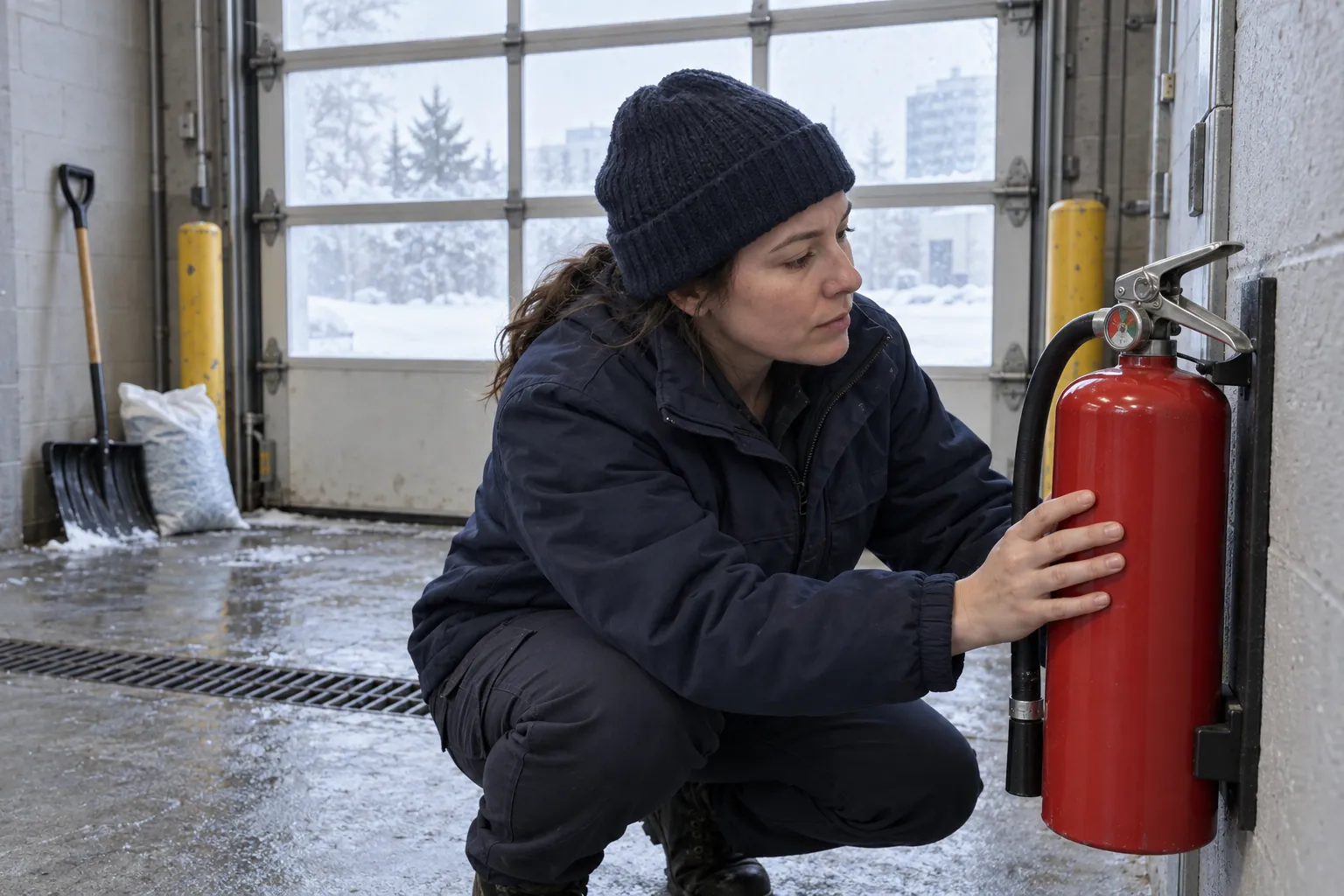 Fire and water checksFire extinguisher inspection: the monthly check, the service and the recordsWhat a monthly fire extinguisher inspection covers under the National Fire Code of Canada, the Ontario Fire Code and NFPA 10, and what the records must show.
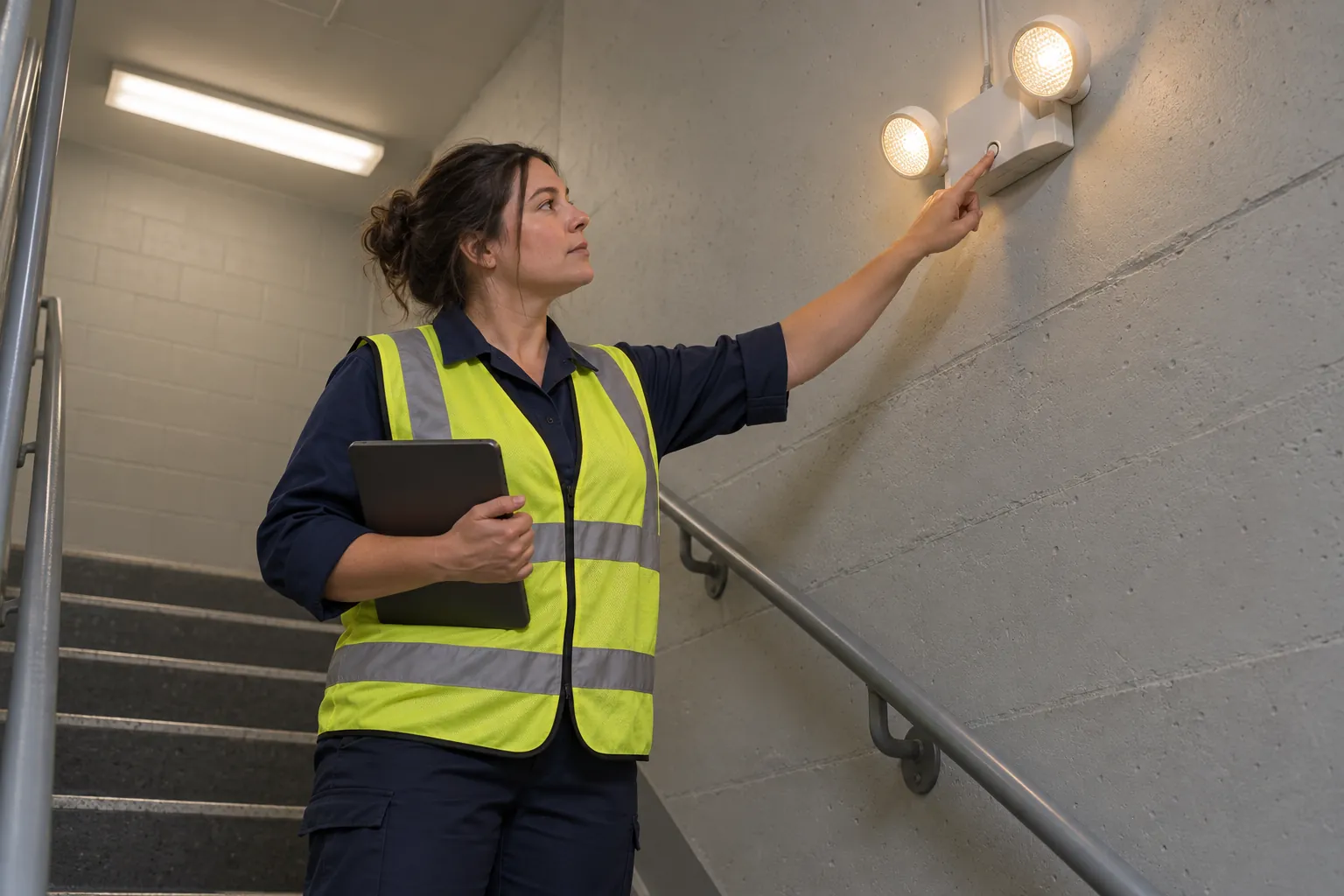 Fire and water checksEmergency lighting inspection in Canada: the monthly test, the annual test, and the recordEmergency lighting inspection in Canada: the monthly check and test, the annual duration test, what the fire code says about records, and how to keep them honest.
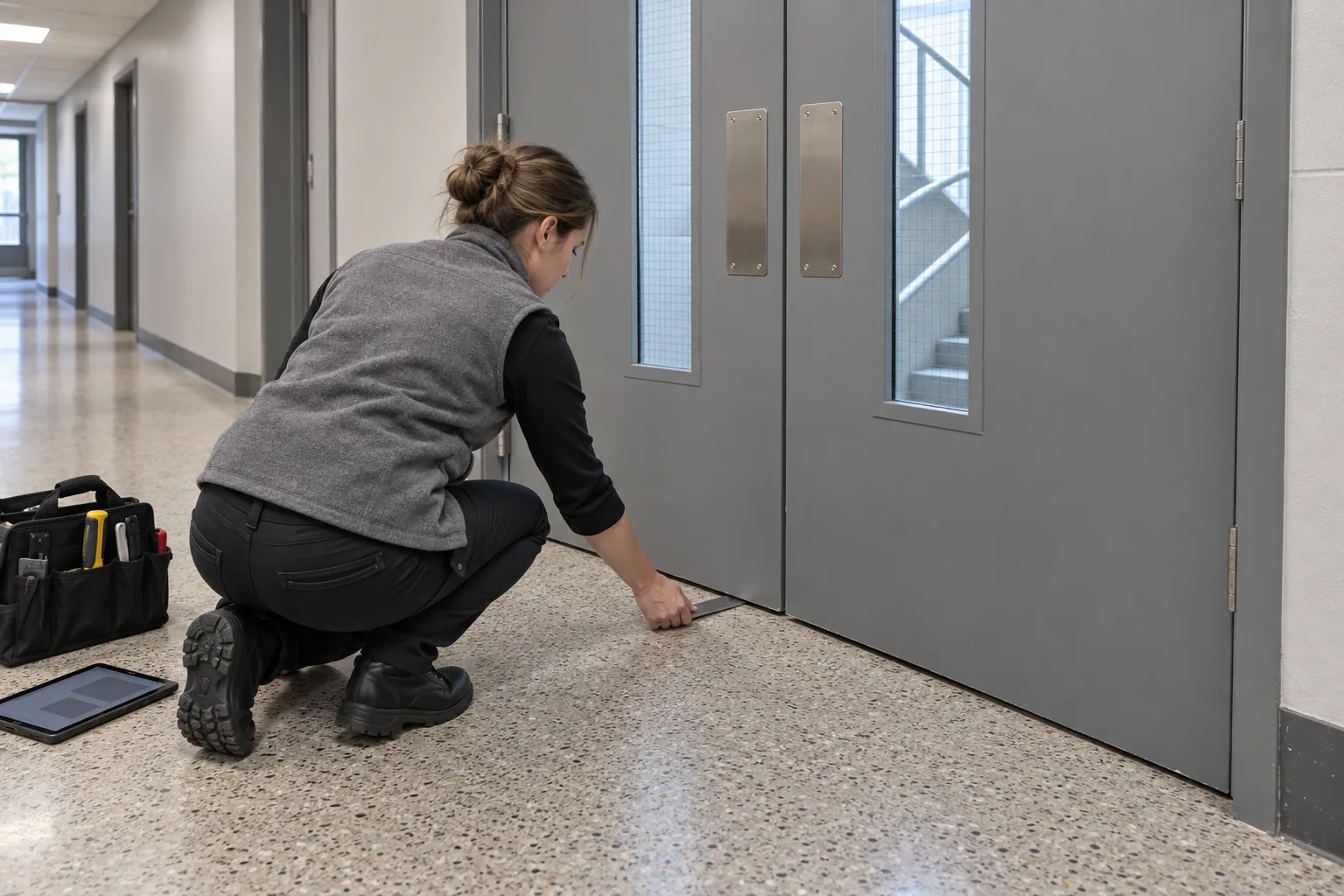 Fire and water checksFire door inspection in Canada: what the fire code asks for, and what a good record showsFire door inspection in Canada: the daily and monthly checks the fire code sets, the fuller inspection to NFPA 80, who does each, and what the record should show.