Fire and water checks
Fire drill requirements in Canada: how often, who takes part, and what to record
A fire drill is a practice run of a building's fire safety plan, in which the fire alarm sounds and the supervisory staff, and often every other occupant, carry out their part and leave quickly and safely as if the fire were real.
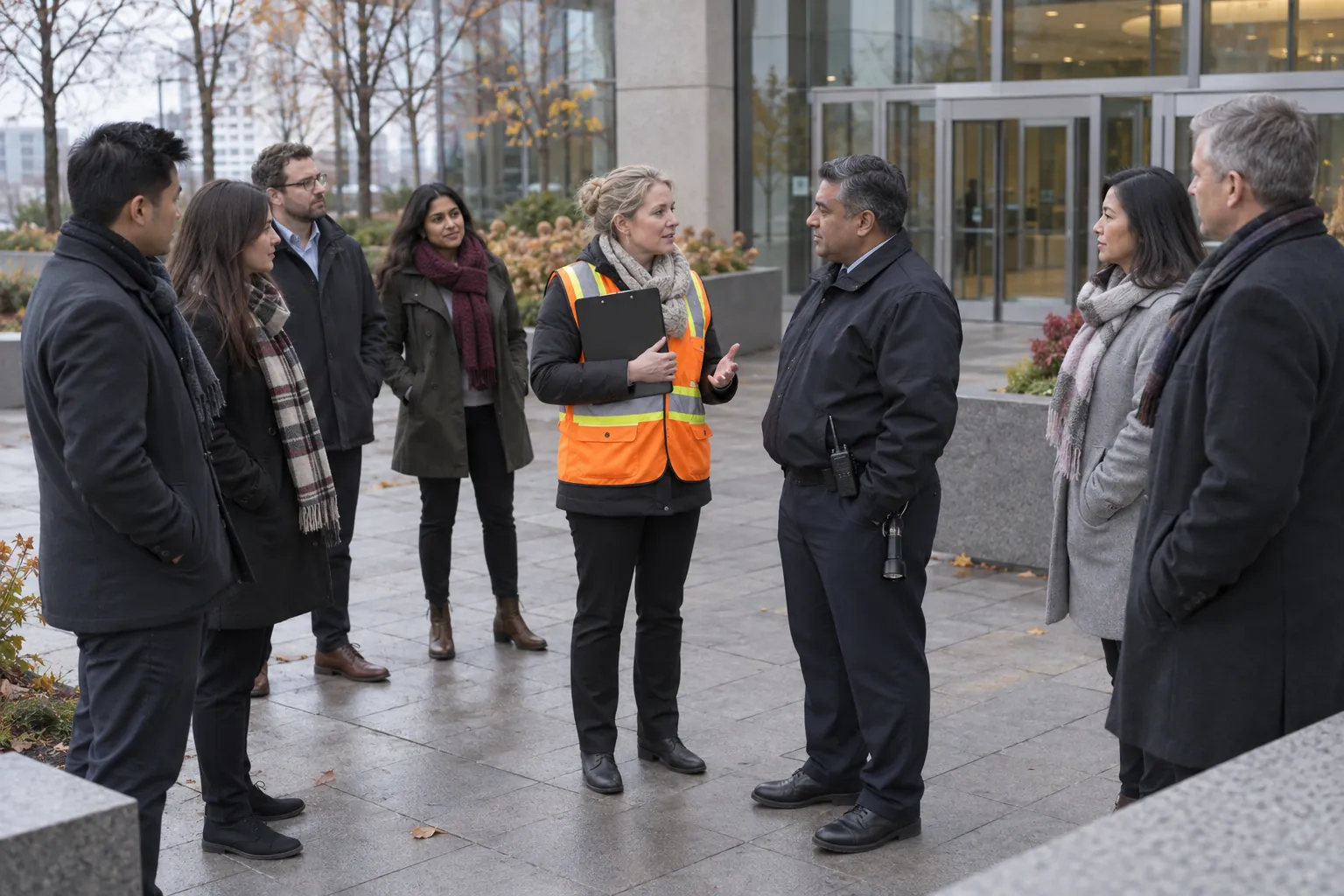
It is where the plan meets the people who have to carry it out. In Canada the requirement comes from the provincial or territorial fire code, most of them adopted from the National Fire Code of Canada, and the frequency depends on the building: once a year for supervisory staff in most, monthly in care occupancies and child care, three times a term in schools. This guide sets out what the codes actually say, who a drill is for, how to run one that tests something, and what the record should show.
01
Where the fire drill requirement comes from
Fire drills in Canada are a fire code requirement, and fire codes are provincial and territorial. The model is the National Fire Code of Canada 2020, developed by the Canadian Commission on Building and Fire Codes and published by the National Research Council. It has no force on its own: each province or territory adopts it, adapts it or writes its own, and the National Research Council's own advice is to check the right edition with the municipal, provincial or territorial official. Section 2.8 of Division B, Emergency Planning, is where the fire safety plan and fire drills live, and the provincial codes keep that numbering.
Ontario's code is a good example of how specific a province can be. The Ontario Fire Code (O. Reg. 213/07) requires a fire safety plan to be "prepared, approved and implemented" in the buildings Section 2.8 applies to, and says that plan must "provide for the holding of fire drills and set out fire drill procedures" (Article 2.8.2.1). The procedure for conducting fire drills must be in the fire safety plan and "prepared in consultation with the Chief Fire Official", which in practice means the local fire department (Article 2.8.3.1).
British Columbia shows the model wording more closely. The British Columbia Fire Code 2018, Division B, Section 2.8 has the procedure for conducting fire drills "determined by the person in responsible charge of the building", taking into account the occupancy, its hazards and safety features, the supervisory staff and the requirements of the fire department.
Federally regulated workplaces, such as banks, airports, telecoms and interprovincial transport, have a second layer. The Canada Occupational Health and Safety Regulations, Part XVII require, at least once every year and after any change to the emergency evacuation plan or procedures, a meeting of the emergency wardens, deputy emergency wardens, monitors and employees requiring special assistance, and an "evacuation or emergency drill" for the employees in the building, with the local fire department told at least 24 hours before the drill (section 17.10). That regulation covers federal work only; everyone else follows their province's fire code and occupational health and safety law.
02
Which buildings need fire drills, and who the drill is for
A fire drill is required where Section 2.8 applies, and Section 2.8 does not apply to every building. In Ontario, Article 2.8.1.1 lists the buildings, including those containing:
- an assembly occupancy, such as a school, arena, place of worship or restaurant;
- a care occupancy, a care and treatment occupancy, a detention occupancy or a retirement home;
- a residential occupancy where the occupant load exceeds 10, which takes in most apartment and condominium buildings;
- a business and personal services occupancy, or a mercantile occupancy, where the occupant load exceeds 300, the larger office buildings and stores;
- industrial occupancies above set occupant loads (25 for high-hazard, 100 for medium-hazard, 300 for low-hazard);
- any building of 4 storeys or more, counting storeys below grade, whatever its use.
A small single-storey office with a modest occupant load may be outside Section 2.8 altogether; a four-storey building of the same use is inside it.
The second point is the one most often misread. The codes require drills for the supervisory staff. The Ontario Fire Code defines supervisory staff as "those occupants of a building who have some delegated responsibility for the fire safety of other occupants under the fire safety plan": the fire wardens, floor wardens and deputies, the building superintendent, the security guards on the post orders, the charge nurse on a care unit. In most buildings the legal minimum is that these people practise their part in the plan. Whether everyone else leaves the building too is a decision for the fire safety plan, and the BC code lists "the desirable degree of participation of occupants other than supervisory staff" as one of the things to decide.
Schools and some child care programs are different: there the Ontario code requires a total evacuation fire drill. Elsewhere a full evacuation is good practice, because it shows whether occupants recognize the alarm and know the way out, but not a code minimum unless the approved fire safety plan says so.
03
How often: fire drill frequency by building type
Regular fire drills are not left to judgment: Ontario Fire Code Article 2.8.3.2 sets how often they must be held. In summary:
- Most buildings: a fire drill for the supervisory staff at least once during each 12-month period (Sentence 1).
- Monthly: for supervisory staff in care occupancies, care and treatment occupancies, detention occupancies, retirement homes, supported group living and intensive support residences, and premises where child care is provided, with some school-based programs excluded (Sentence 2).
- Schools and private schools: a total evacuation fire drill at least three times in the fall term and at least three times in the spring term, so at least six in the academic year, and during a summer session at least three times or once a month, whichever is less (Sentence 3). Extended day and third-party programs and school-based child care centres follow the same pattern (Sentence 4).
- High buildings: a fire drill for supervisory staff at least every three months in a building to which Subsection 3.2.6 of Division B of the Building Code applies, the high-building provisions (Sentence 5).
- Laboratories: at least every three months (Sentence 7).
- Care occupancies, care and treatment occupancies and retirement homes: in addition to the monthly drills, one drill each 12-month period for an approved scenario representing the lowest staffing level in the occupancy, to confirm there are enough supervisory staff to carry out the fire safety plan (Sentence 6). The Chief Fire Official must be told before that drill, within an approved time period (Article 2.8.3.3).
- Hotels: every employee in a hotel establishment must take part in at least one fire drill each 12-month period (Article 2.8.3.5).
The British Columbia Fire Code 2018 follows the same pattern with differences in the detail: drills for supervisory staff at intervals of not more than 12 months, monthly in day-care centres and Group B (care, treatment and detention) occupancies, at least three total evacuation drills in each of the fall and spring terms in schools attended by children, every two months in high buildings, and every three months in laboratories. Read your own province's code, not a summary written for another.
04
Planning and running a fire drill that tests something
A drill everyone knows about in advance, with the same wardens in the same places, tests very little. The codes leave the method to the fire safety plan, so the plan is where to write down a drill that is worth holding. A workable sequence:
- Pick the scenario. Where is the fire, which exit is blocked, who is away? Vary it from drill to drill: a night-shift drill, a drill with the main stair out of use, a drill in which the usual floor warden is absent and the deputy takes over.
- Arrange the fire alarm side. Tell the monitoring station, and the fire department where your procedure requires it, before the alarm is sounded, and arrange with your fire alarm contractor if the drill will use the fire alarm system. Confirm the system is back to normal afterwards.
- Brief observers, not participants. One or two people, with a copy of the procedure, placed where they can see the stairs, the assembly point and the fire alarm annunciator. Their job is to watch and write down, not to help.
- Start the drill as the plan says the real thing starts: the alarm, the voice communication message in a high building, the call to the fire department (simulated), the wardens sweeping their floors.
- Time it. From the alarm to the last floor warden reporting the floor clear, and to the last person at the assembly point, if occupants are taking part.
- Debrief straight away. CCOHS's advice on emergency planning is that "a thorough and immediate review after each exercise, drill, or after an actual emergency will point out areas that require improvement".
- Fix and follow up. A door that would not close, a warden who could not be heard, a person who needed help and was not on the list: each becomes a corrective action with an owner and a date, and the fire safety plan is revised if the drill showed it was wrong.
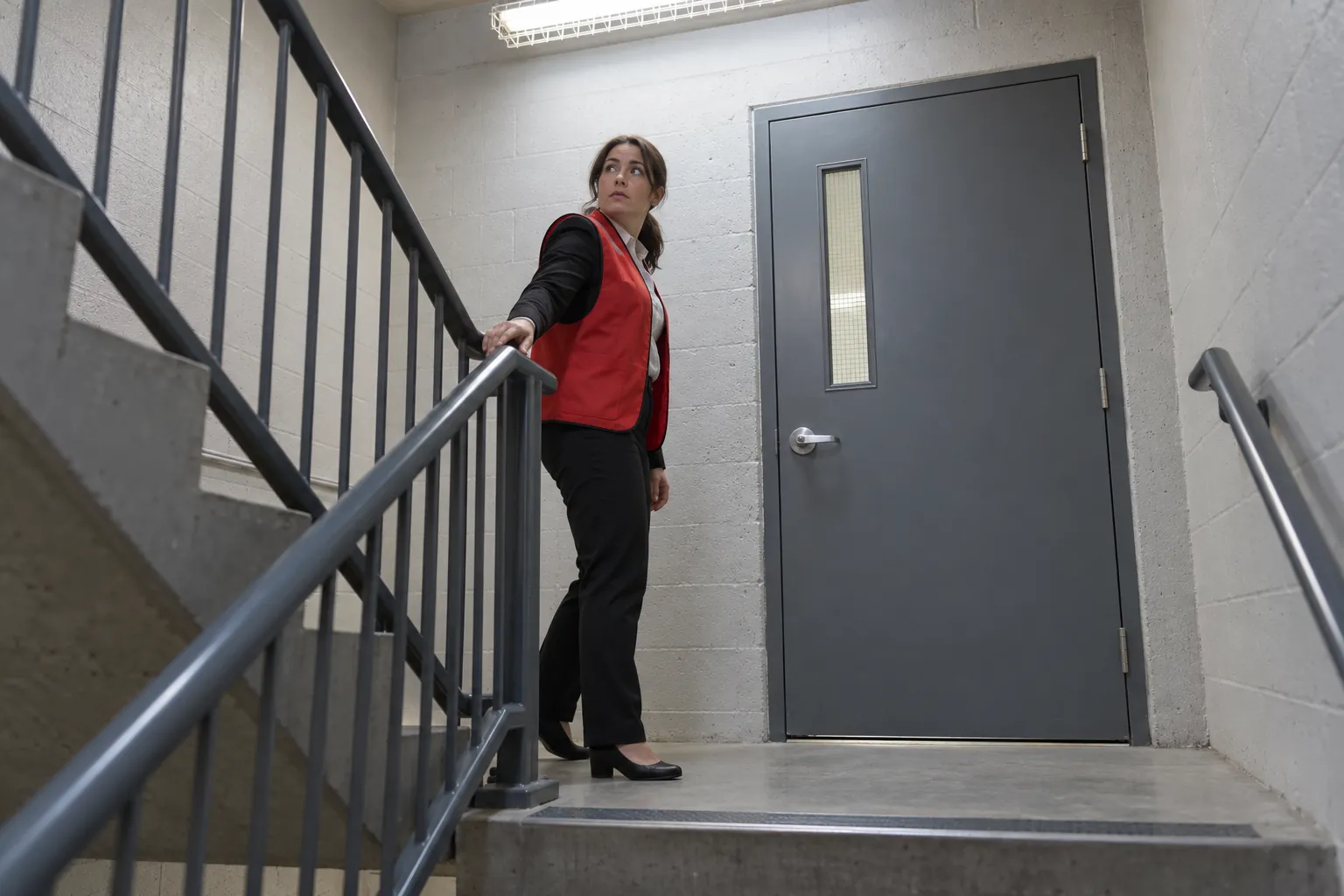
Watch in particular for the people who need help to get out. The fire safety plan must provide for "evacuating occupants, including special provisions for persons requiring assistance", and a drill is the only safe way to find out whether those provisions work, whether the person who is meant to help is on shift, and whether the refuge or the evacuation chair is where the plan says.
05
The fire drill record: what to write down and how long to keep it
Ontario is explicit. Article 2.8.3.4 requires that "a record shall be prepared of every fire drill conducted under Article 2.8.3.2", and that "the record shall be kept for at least 12 months after the fire drill". In care occupancies, care and treatment occupancies and retirement homes, any training of supervisory staff under the fire safety plan must also be recorded, and at least the most recent and the previous record kept in the building for at least two years and shown to the Chief Fire Official on request (Article 2.8.2.1, Sentences 7 and 8).
For federally regulated workplaces, section 17.10 of the Canada Occupational Health and Safety Regulations requires a record of each wardens' meeting and each drill, kept in the building for two years, including the date and time of the drill and, where applicable, the length of time taken to evacuate the building.
The codes do not prescribe a form, and a fire prevention officer inspecting the building will want to see a record that answers the obvious questions. A good fire drill record shows:
- the building, the date and the time the alarm sounded;
- the scenario, and whether the drill was announced or unannounced;
- which supervisory staff took part, by name and role, and who was absent;
- whether other occupants took part, and roughly how many;
- the times: alarm, each floor or area reported clear, last person out, all clear;
- whether the monitoring station received the signal, and whether the fire department was notified as the procedure requires;
- what went well, what went wrong, and the corrective actions: who is doing what about it by when;
- who observed the drill and who signed off the record.
Keep it with the fire safety plan or in the fire safety log book the fire department expects to see, and for longer than the minimum.
06
Where fire drill records fail, and what SiteClara does about it
Fire drill records usually fail in one of three ways. The drill happens and nobody writes it up until the fire prevention officer asks, so the record is a date and a signature and nothing else. The times on the record are one person's estimate, because nobody had a watch on the floor wardens. Or the actions from the debrief go into an email and are never seen again, so the same stair door fails to close at the next drill.
The drill is also only as good as the building it is held in. A warden who finds a propped fire door, a blocked exit or an extinguisher missing on the day of the drill has found something that was wrong for weeks, and the routine checks that should have caught it were ticked on a sheet on the back of a door.
SiteClara records checks at the location. A printed QR poster, with an optional NFC tag behind it, sits at each place a check is due: a stairwell door, an exit, a floor's warden point. Staff scan or tap on their own phone, with no app to install, see what is due there and mark it done, or say what stopped them. The time and the named person are recorded as it happens, with a photo when one is asked for, and a fault found on the way round goes onto the team's list of open jobs until someone closes it. During a drill, a floor warden can confirm the floor clear at that floor's tag, which gives the record a time from the floor rather than from memory.
The supervisor sees what is due, done and missed, records why a check was missed, and each day approves a short report that goes to the nominated managers the next morning. Between drills, that is the evidence that the exits, doors and equipment the drill depends on were checked, by whom and when.
07
Questions people ask
How many times should you do a fire drill?
As often as your province's fire code sets for the building. The British Columbia Fire Code 2018, Division B, Section 2.8 requires fire drills for the supervisory staff "at intervals not greater than 12 months", monthly in day-care centres and Group B occupancies, at least three total evacuation drills in each of the fall and spring terms in schools attended by children, every two months in high buildings and every three months in laboratories. Ontario's frequencies are similar and are set out above.
How many minutes is a fire drill?
The fire drill articles of the British Columbia Fire Code set how often a drill is held, not how many minutes it should take. What matters is that the time is measured and recorded: for federally regulated workplaces, the Canada Occupational Health and Safety Regulations, Part XVII require the drill record to show "the date and time of the drill, and where applicable, the length of time taken to evacuate the building" (section 17.10), and a time that gets longer from one drill to the next is a finding to act on.
How do you do a fire drill step by step?
Follow the procedure in the building's fire safety plan. Under the British Columbia Fire Code 2018, Division B, Section 2.8, that procedure is "determined by the person in responsible charge of the building", taking into account the occupancy and its fire hazards, the safety features, how far other occupants take part, the number and experience of the supervisory staff taking part, the fire emergency systems in a high building and the requirements of the fire department. CCOHS's advice on Emergency Planning adds that "a thorough and immediate review after each exercise, drill, or after an actual emergency will point out areas that require improvement".
08
Further reading, and a list to take away
The National Fire Code of Canada 2020 is a free download from the National Research Council, though your province's adopted edition is the one that applies. Ontario's fire code is the Ontario Fire Code (O. Reg. 213/07) on e-Laws, with Section 2.8 of Division B covering emergency planning and fire drills. British Columbia's is the British Columbia Fire Code 2018, Division B, Section 2.8. For federally regulated work, the fire drill and warden requirements are in the Canada Occupational Health and Safety Regulations, Part XVII. CCOHS has plain-language advice on Emergency Planning, including drills and reviewing the plan. Ontario's Office of the Fire Marshal lists its technical guidelines, including Fire Drills (TG-04-2016), on Fire safety legislation and Ontario's fire code.
Before your next fire drill, check that:
- you know which province's fire code applies and whether Section 2.8 applies to the building;
- the fire safety plan sets out the fire drill procedure, and it was prepared with, or approved by, the fire department where your code requires it;
- you know the frequency for this building: yearly, monthly, three a term, or every few months in a high building;
- every member of the supervisory staff has taken part in a drill within the required period, including night and weekend staff;
- the monitoring station, and the fire department where required, will be told before the alarm sounds;
- observers are briefed and someone is timing the drill;
- the scenario is different from the last one;
- the record is written the same day, with times, names and actions, and kept for at least as long as your code requires;
- last drill's actions have been closed, and the fire safety plan has been revised where the drill showed it was wrong.
Sources
Every document this guide quotes or links to, in the order it first cites them.
- National Fire Code of Canada 2020 nrc.canada.ca
- Ontario Fire Code (O. Reg. 213/07) ontario.ca
- British Columbia Fire Code 2018, Division B, Section 2.8 free.bcpublications.ca
- Canada Occupational Health and Safety Regulations, Part XVII laws-lois.justice.gc.ca
- Emergency Planning ccohs.ca
- Fire safety legislation and Ontario's fire code ontario.ca
Related guides
 Fire and water checksFire safety plan: what it must contain, who approves it, and how to keep it trueWhat a fire safety plan must contain under the National Fire Code of Canada and the Ontario Fire Code, who approves it, how often it is reviewed, and the records.
 Fire and water checksFire warden duties: the routine checks, the evacuation, and the law behind the roleWhat a fire warden does in a Canadian building: the fire code's supervisory staff, federal emergency wardens, the routine checks, the evacuation and the records.
 Fire and water checksFire alarm testing in Canada: what the owner checks, what the technician tests, and what to recordFire alarm testing in Canada: what the fire codes and CAN/ULC-S536 ask of owners daily and monthly, the annual test by a technician, and what the record must show.
 Fire and water checksFire log book: what to record, who keeps it and how long, under Canadian fire codesWhat a fire log book should hold under the Ontario Fire Code and the National Fire Code of Canada: the tests, who records them, how long to keep them, and the form.