Fire and water checks
Fire log book: what to record, who keeps it and how long, under Canadian fire codes
A fire log book is the record, kept at the building, of the fire safety tests and inspections a Canadian fire code requires: the monthly extinguisher inspection, the emergency lighting test, the fire door walk, the drill, the annual fire alarm inspection and every fault found along the way.

No Canadian fire code uses the words "log book", but every one requires records of the tests and inspections it sets. This guide covers what the Ontario Fire Code and the National Fire Code of Canada say about those records, what belongs in the book, who fills in each part, how long to keep it, and whether paper or an electronic record serves you better.
01
What a fire log book is, and the code behind it
A fire log book, also called a fire safety log or fire inspection log, is the running record of how a building's fire protection is checked, tested and maintained, and one of the first things a fire prevention officer asks to see on a routine inspection.
Fire safety in existing buildings is provincial and territorial law in Canada. The model is the National Fire Code of Canada 2025, published free by the National Research Council, which provinces and territories adopt, amend or replace with codes of their own. The one searched most is the Ontario Fire Code, O. Reg. 213/07, made under the Fire Protection and Prevention Act, 1997. As the province's page on fire safety legislation and Ontario's Fire Code puts it, "The owner of the building is responsible for complying with the Fire Code, except where otherwise specified. Municipal fire departments enforce the Fire Code."
Neither code requires a book. What they require is a record. In Ontario, Division B, Subsection 1.1.2, Records of Tests and Inspections, says:
- "If this Code requires tests and corrective measures or operational procedures to be carried out, records shall be made noting what was done and the date and time it was done." (Sentence 1.1.2.1.(1))
- The records "shall be retained at the building premises for examination by the Chief Fire Official". (Sentence 1.1.2.1.(3))
- "Electronic records that can be made readily available to the Chief Fire Official upon request, are deemed to comply". (Sentence 1.1.2.1.(4))
- Any record the code requires is kept at the building "for a period of at least two years after being prepared", and "so that at least the most recent and the immediately preceding record of a given test or inspection are retained". (Sentence 1.1.2.2.(1))
- "The initial verification or test reports for fire protection systems installed after November 21, 2007 shall be retained throughout the life of the systems". (Sentence 1.1.2.2.(2))
The National Fire Code puts the same duty in Division C, Article 2.2.1.2: where the code requires tests, inspections, maintenance or operational procedures on a fire safety system, "records shall be made and the original or a copy shall be retained at the premises for examination by the authority having jurisdiction". The initial verification or test reports are kept for the life of the system, at least the current and the immediately preceding records are kept, and "no record shall be destroyed within two years of having been prepared."
Who is responsible? Ontario's code (Division A, Article 1.2.1.1) says that "unless otherwise specified, the owner is responsible for carrying out the provisions of this Code", and defines the owner widely, as "any person, firm or corporation having control over any portion of the building or property under consideration". A tenant controlling its own floor or a condominium corporation can answer for the records too. The national code places the duty on "the owner or the owner's authorized agent".
02
What a fire log book should contain
In practice the code's test means a log book, or a set of records that together do the same job, with a section for each system in the building. For a typical office tower, school, plaza or apartment building, that is:
- Building details: the owner, the property manager, the supervisory staff named in the fire safety plan, and when the plan was last reviewed.
- Fire alarm system: the routine tests, the contractor's annual inspection and test report, and, where monitored, whether each test signal reached the monitoring station.
- Portable fire extinguishers: the monthly inspection and each extinguisher's maintenance history.
- Emergency lighting and exit signs: the monthly inspection and test of battery units and the annual full-duration test.
- Doors in fire separations and egress doors: the monthly inspection, and anything found wedged, damaged or failing to latch.
- Sprinklers and standpipes, where fitted: the weekly or monthly valve inspections, hose station checks and the contractor's inspection, testing and maintenance reports.
- Emergency generator, where fitted: the records kept under CSA C282.
- Fire drills: the date, who took part, how long it took and what went wrong.
- Faults, impairments and false alarms: what happened, what was done, and when it was put right.
- Visits: fire prevention inspections, any orders and how they were closed.
Keep each system in its own section, so that two years of emergency lighting tests can be read without leafing past drill notes, and file the contractors' reports with the log or say where each one is kept.
03
The routine entries, and how often each is due in Ontario
The frequencies come from the fire code and the standards it calls up. In the Ontario Fire Code, Division B, the most common routine entries are:
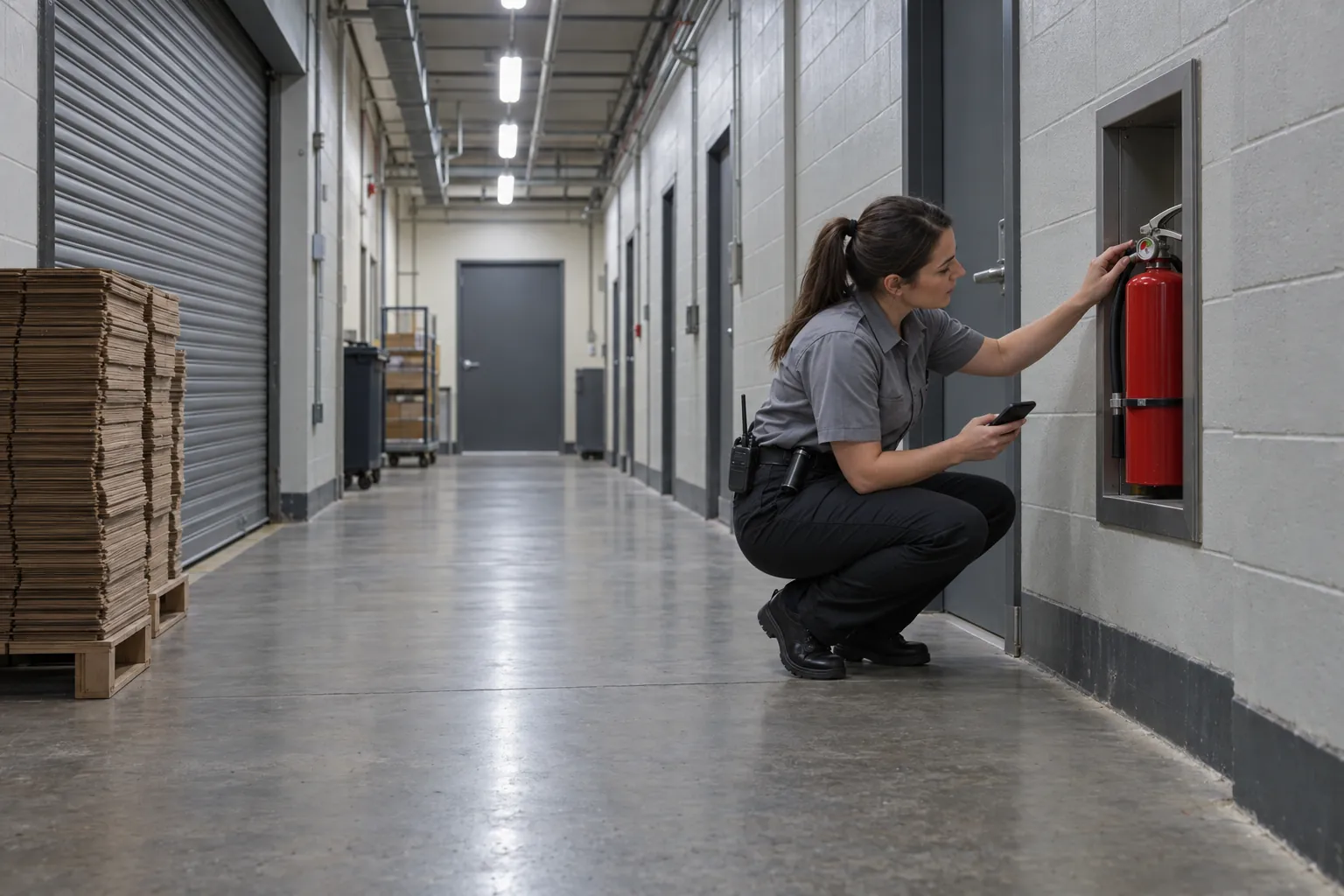
- Monthly: portable extinguishers. "Portable extinguishers shall be inspected monthly." (Article 6.2.7.2) A permanent record of each extinguisher's maintenance date, the examiner's name and any maintenance or hydrostatic testing is also required (Article 6.2.7.5).
- Monthly: doors. "A door in a fire separation shall be inspected monthly" (Sentence 2.2.3.4.(4)), and doors forming part of a means of egress "shall be checked at intervals not greater than one month to ensure that they are operable" (Sentence 2.7.2.3.(1)).
- Monthly: emergency lighting units. Self-contained emergency lighting unit equipment is inspected, and tested to show it works when the normal power fails, at intervals not greater than one month; it is tested at intervals not greater than 12 months to show it lasts for its design duration (Article 6.7.1.6). See our guide to the emergency lighting test.
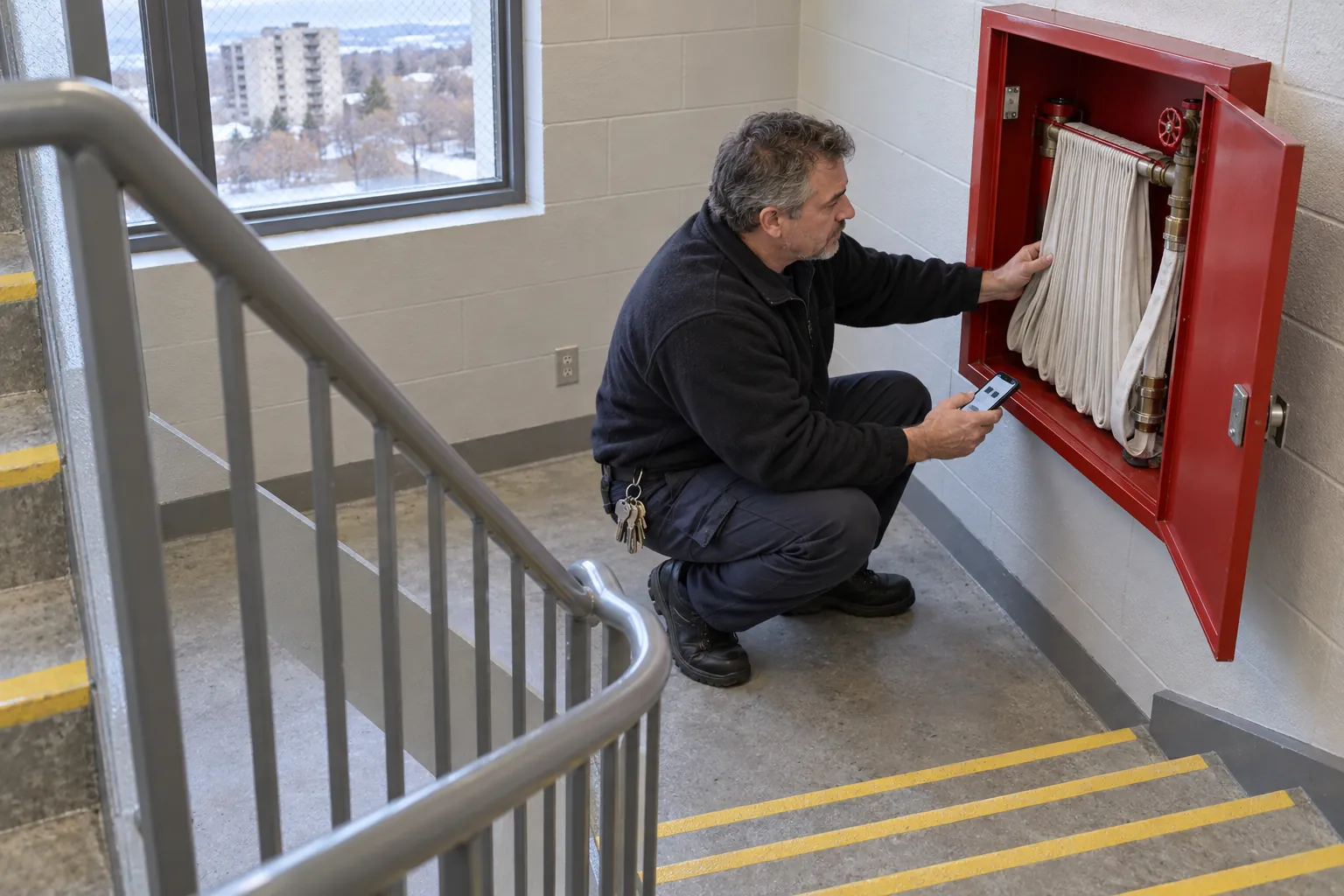
- Monthly: hose stations. "Hose stations shall be inspected monthly" (Article 6.4.2.1).
- Weekly or monthly: sprinkler valves. Valves controlling sprinkler water supplies or alarms are sealed open and inspected weekly, or monthly where they are locked open or electrically supervised (Article 6.5.4.5).
- At the intervals of CAN/ULC-S536: the fire alarm. A fire alarm system is inspected and tested in conformance with CAN/ULC-S536, Standard for Inspection and Testing of Fire Alarm Systems (Article 6.3.2.2), and the record for each device, component and circuit must say whether it is in proper working order. See our guide to fire alarm testing.
- At least once in each 12 months: the fire drill for supervisory staff, and at least monthly in care occupancies, retirement homes and several other occupancies (Article 2.8.3.2). A record is made of every drill and kept for at least 12 months (Article 2.8.3.4). See our guide to fire drill requirements.
The City of Ottawa's Ontario Fire Code pre-inspection guide shows how one fire service reads these rules: the fire alarm inspected and tested annually by a qualified fire alarm company, extinguishers serviced and tagged annually and inspected monthly, emergency lights inspected monthly and tested annually, and the records kept on the premises for at least two years.
Outside Ontario, the National Fire Code of Canada 2025 calls up NFPA standards for much of this work: under Division B, portable extinguishers are "inspected, tested and maintained in conformance with NFPA 10" (Article 6.2.1.1), and water-based fire protection systems, such as sprinklers and standpipes, in conformance with NFPA 25 (Article 6.4.1.1). The contractor's NFPA 25 reports belong in the log with the rest.
The log is also where anything unplanned goes: a false alarm, a pull station knocked by a cart, an extinguisher discharged and replaced, a stairwell door found wedged open. Article 1.1.1.2 of Division B requires anything that does not operate as intended when checked, inspected or tested to be repaired or replaced where its failure would affect fire or life safety, so a fault with no repair entry after it is a question waiting to be asked. See also our guide to Ontario Fire Code monthly inspections.
04
Who keeps it, where, and for how long
The owner answers for the records, but rarely writes all of them. In most buildings the entries come from several hands:
- the property manager or facility manager, who usually keeps the log and books the contractors;
- the building superintendent, building operator or custodial staff, who walk the monthly checks;
- security guards, who often check doors on their rounds and log alarms after hours;
- supervisory staff under the fire safety plan, such as fire wardens, who record drills;
- fire protection contractors, who leave their inspection and test reports;
- the fire prevention officer, whose reports and orders belong in the log with the date each was complied with.
Where: at the building, "at the building premises" in Ontario's words and "at the premises" in the national code's. Many buildings keep the log in the fire alarm room or the superintendent's office. Whoever is on shift when a fire prevention officer arrives, evenings and weekends included, should be able to find it and open it.
How long: at least two years after each record is prepared, with at least the most recent and the immediately preceding record of each test or inspection kept even where that reaches back further, and the initial verification or test reports for each fire protection system kept for its whole life. Your insurer, lease or records policy may ask for longer.
Where a building has several owners in the code's wide sense, such as a landlord and tenants who each control a floor, agree in writing who keeps which records.
05
Paper or electronic, and what makes the record believable
Ontario's code accepts electronic records in so many words: they are deemed to comply if they "can be made readily available to the Chief Fire Official upon request". The national code asks for "the original or a copy". So a paper binder, a spreadsheet, or an electronic system can all do the job. None of them shows compliance on its own. What matters is that the record is complete, can be produced on the day, and can be believed. A believable fire log book:
- is written at the time, with the date and time of each check, not filled in at the end of the month;
- names the person who did each check, and the company and technician for each service visit;
- is specific: which extinguisher, which door, which emergency light unit, not "all OK";
- records failures and what happened next, with the date the fault was fixed;
- has no unexplained gaps: a missed check with its reason beats a blank or a back-dated entry;
- keeps the supporting documents: contractors' reports, the fire alarm description kept under CAN/ULC-S536 and the initial verification reports.
Paper is simple and familiar, but it exists in one place and cannot tell anyone that the monthly checks were not done. Electronic records can be seen from anywhere and show gaps as they happen, but only if everyone uses them and the owner can show them to an inspector with no login. Many buildings run both. Either way, the log helps only if someone with the authority to get faults fixed reads it every month.
06
Where the fire log book fails, and what SiteClara does about it
Most fire log books fail in the same few ways. The monthly checks are initialled in a batch, twelve months in the same pen, the week before the inspection. The binder sits in one building while the property manager responsible for six others never opens it. A fault is written down and never closed off until the fire prevention officer reads the log and writes an order.
SiteClara records the routine checks that feed the log book at the place they happen. A printed QR poster, with an optional NFC tag behind it, goes at a location such as a floor's extinguisher cabinet, a stairwell door or the fire alarm annunciator. Staff scan the code or tap the tag on their own phone, with no app to install, see the checks scheduled there, such as the monthly extinguisher inspection or the emergency lighting test, and mark each one done or say what stopped them, such as a locked electrical room. The named person and the time are recorded as it happens, with a photo when the check asks for one. A fault, such as an extinguisher with a low gauge or a door that no longer latches, is reported there with a photo and goes onto the team's list of jobs until someone closes it.
The supervisor sees what is due, done and missed across the building, and records the reason a check was missed; a job that needs the building manager can be escalated to them to answer. Each day the supervisor reviews and approves a report that goes to nominated management or client contacts at 8 a.m. the next morning, showing what was reported, what was completed, what is still open, and how the scheduled checks went, for example 12 of 12 completed.
07
Questions people ask
What should be in a fire log book?
A record of every test, inspection, maintenance job and operational procedure the fire code requires. The City of Ottawa's Ontario Fire Code pre-inspection guide puts the rule this way: "Records of tests, inspections, maintenance or operational procedures required under the OFC shall be kept on the premise for a minimum of two years for examination by the Authority Having Jurisdiction (AHJ)." The same guide lists what its officers look at, including the fire alarm's annual inspection and test, the monthly extinguisher inspections and annual servicing, and the monthly emergency lighting inspections and annual test, so the log needs a section for each system, with drills, faults and false alarms, and the contractors' reports filed alongside.
Is there a PDF version of the Ontario Fire Code?
Yes. The Ontario Fire Code, O. Reg. 213/07, is published on Ontario's e-Laws website, and the province's page on fire safety legislation and Ontario's Fire Code says "A PDF Edition of the Fire Code Compendium can be downloaded at no cost through Publications Ontario." The Fire Code Compendium brings together the Fire Protection and Prevention Act, 1997, the regulations made under it, including the Fire Code, the Fire Code supplement FCS-1, and the appendices, tables and explanatory notes. Outside Ontario, the National Research Council publishes the National Fire Code of Canada 2025 as a free PDF.
08
Further reading, and a list to take away
Read the records rules in your own province's fire code: Division B, Subsection 1.1.2 of the Ontario Fire Code, or Division C, Article 2.2.1.2 of the National Fire Code of Canada 2025 and the edition your province has adopted. Many municipal fire services publish a pre-inspection checklist, such as Ottawa's Ontario Fire Code pre-inspection guide, which shows what their officers will ask to see. Your fire alarm contractor works to CAN/ULC-S536 and can explain what its annual report covers. Federally regulated employers should also read Part XVII of the Canada Occupational Health and Safety Regulations: where more than 50 employees work in a building, a qualified person inspects its exits, stairways and fire protection equipment every six months, and the record is dated, signed and kept for two years.
Check that your fire log book:
- names the owner, the property manager and the supervisory staff in the fire safety plan;
- has a section for each system: fire alarm, extinguishers, emergency lighting, doors, and sprinklers, standpipes or a generator where fitted;
- records every monthly check with the item, the date, the time, the result and the name;
- records each contractor visit, with the report or certificate kept with it;
- records every fault, impairment and false alarm, with the action taken and the date it was fixed;
- records every fire drill, and every fire prevention inspection and order;
- is kept at the building and can be produced on request, on paper or electronically;
- keeps each record for at least two years, the latest two of each test, and the initial verification reports for the life of each system.
Sources
Every document this guide quotes or links to, in the order it first cites them.
- National Fire Code of Canada 2025 nrc.canada.ca
- Ontario Fire Code, O. Reg. 213/07 ontario.ca
- Fire safety legislation and Ontario's Fire Code ontario.ca
- BC Fire Code 2024 www2.gov.bc.ca
- National Fire Code – 2023 Alberta Edition alberta.ca
- Canada Occupational Health and Safety Regulations laws-lois.justice.gc.ca
- Ontario Fire Code pre-inspection guide ottawa.ca
- Fire Code Compendium publications.gov.on.ca
Related guides
 Fire and water checksFire safety plan: what it must contain, who approves it, and how to keep it trueWhat a fire safety plan must contain under the National Fire Code of Canada and the Ontario Fire Code, who approves it, how often it is reviewed, and the records.
 Fire and water checksFire alarm testing in Canada: what the owner checks, what the technician tests, and what to recordFire alarm testing in Canada: what the fire codes and CAN/ULC-S536 ask of owners daily and monthly, the annual test by a technician, and what the record must show.
 Fire and water checksEmergency lighting inspection in Canada: the monthly test, the annual test, and the recordEmergency lighting inspection in Canada: the monthly check and test, the annual duration test, what the fire code says about records, and how to keep them honest.
 Fire and water checksOntario Fire Code monthly inspections: what is due, who does it, and the recordEvery monthly fire protection and egress inspection the Ontario Fire Code sets, article by article, the checks around them, and what a fire inspector can ask to see.