Fire and water checks
Fire warden duties: the routine checks, the evacuation, and the law behind the role
A fire warden is an employee or tenant appointed under a building's fire safety plan to watch their floor's exits and fire hazards between drills and to lead everyone on it out when the alarm sounds.
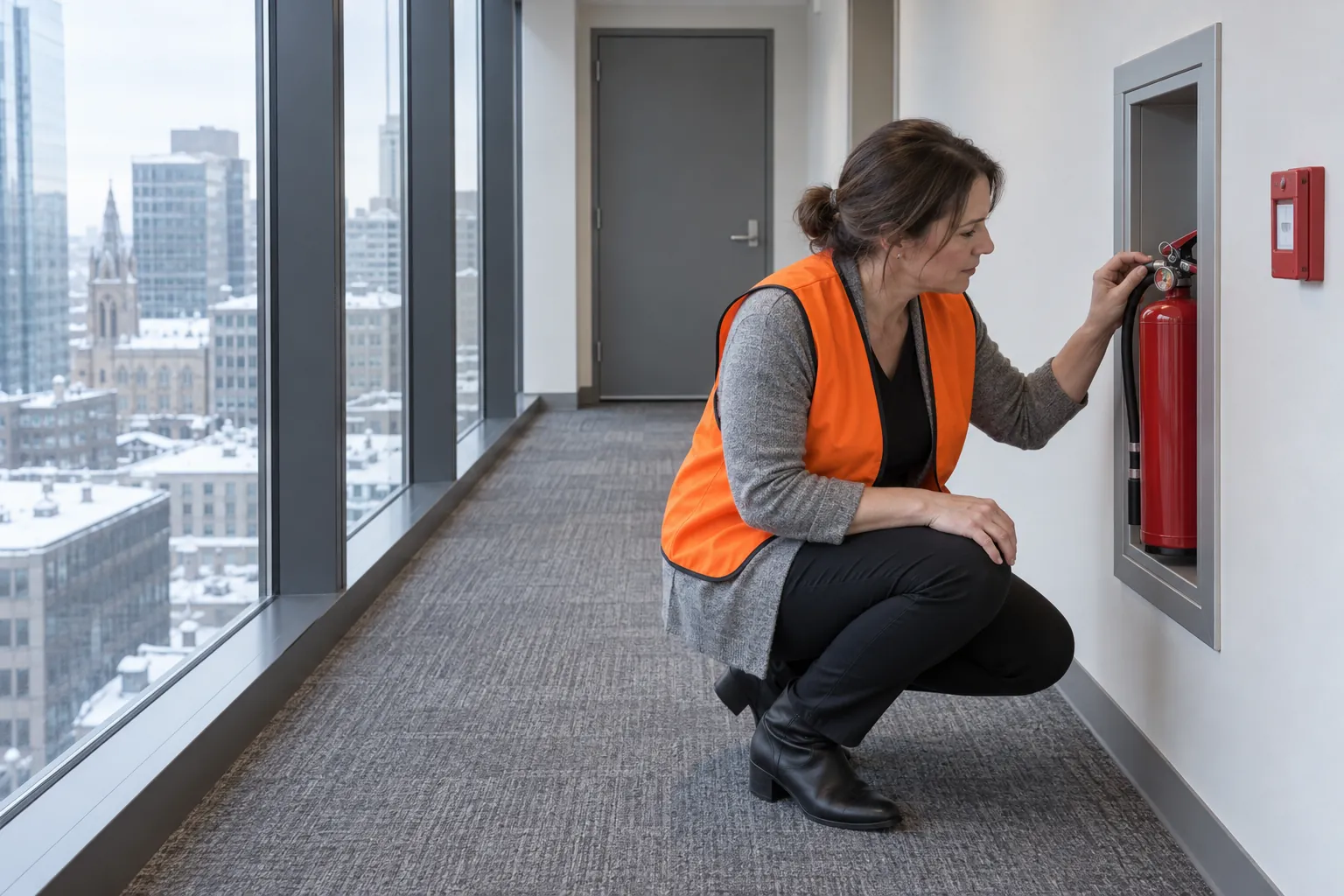
The fire codes require a fire safety plan in most Canadian office towers, schools, hospitals and larger condominiums, and the plan names who does the job. The fire codes call them supervisory staff; federal regulations call them emergency wardens. This guide covers where the role comes from, which province's rules apply, the routine checks a fire warden makes, what they do in an evacuation, and the records that show the job is being done.
01
The fire warden role, and the law behind it
Fire safety in existing buildings is provincial and territorial law in Canada. The model is the National Fire Code of Canada 2025, developed by the Canadian Board for Harmonized Construction Codes and published by the National Research Council. Provinces adopt it, sometimes with changes, and Ontario publishes its own: the Ontario Fire Code, O. Reg. 213/07. Alberta uses the National Fire Code (Alberta Edition), and Quebec and British Columbia have their own versions too.
Neither the national code nor the Ontario Fire Code uses the words fire warden. Both use supervisory staff, which the Ontario code defines as "those occupants of a building who have some delegated responsibility for the fire safety of other occupants under the fire safety plan". Where a building needs a fire safety plan under Section 2.8, the plan must "provide for the appointment and organization of supervisory staff to carry out fire safety duties" (Ontario Division B, clause 2.8.2.1.(2)(b)). The chief fire warden, the deputy, the floor wardens and the searchers named in a typical office fire safety plan are how most buildings organize those supervisory staff.
The code puts the duty on the owner. As Ontario's page on fire safety legislation and Ontario's Fire Code says, "The owner of the building is responsible for complying with the Fire Code, except where otherwise specified. Municipal fire departments enforce the Fire Code." In a multi-tenant building each tenant usually supplies wardens for its own floors.
Workplace health and safety law adds a second layer:
- Federally regulated workplaces, such as banks, airports, telecoms and interprovincial transport, follow the Canada Occupational Health and Safety Regulations (SOR/86-304), Part XVII. Where more than 50 employees work in a building at any time, the employer prepares an emergency evacuation plan (section 17.4) and must appoint "a chief emergency warden and a deputy chief emergency warden for that building", "an emergency warden and a deputy emergency warden for each floor of the building that is occupied by employees", and "monitors for any employee who require special assistance in evacuating the building" (section 17.7).
- Provincially regulated workplaces, which is most of them, follow their province's occupational health and safety rules. In British Columbia, for example, the WorkSafeBC Occupational Health and Safety Regulation, Part 4, section 4.13(2), says that where a risk assessment shows a need for evacuation or rescue, "appropriate written procedures must be developed and implemented, and a worker assigned to coordinate their implementation."
02
Who is appointed, and how many
No code sets a fixed number of fire wardens per head. The fire safety plan sets out the organization, and the building's layout, occupant load, shifts and the people who need help to leave decide how many are enough. A typical office fire safety plan names a fire warden team:
- A chief fire warden and a deputy, who take charge at the fire alarm annunciator or the lobby, meet the fire department and receive the floor reports;
- A floor warden and a deputy for each floor or tenant area, who lead that floor out;
- Searchers or sweepers, who check washrooms, meeting rooms, storage rooms and other enclosed spaces on the way out;
- Monitors or buddies for each person who needs assistance to evacuate, as the federal regulations require and as the fire code's special provisions for persons requiring assistance imply.
The federal regulations are specific about who: the chief and deputy chief emergency wardens "shall be employees who are normally employed in the building", and floor wardens and monitors are employees normally employed on that floor (section 17.7). Fire codes are less prescriptive, but the same logic applies everywhere: a warden who works from home three days a week, or on another floor, is not there when needed. The Ontario code says supervisory staff "are not required to be in the building on a continual basis" (Sentence 2.8.1.2.(3)), except where Article 2.8.2.2 says otherwise: care, care and treatment and detention occupancies and retirement homes must have enough of them available, and in a hotel over 3 storeys or 4000 m² they must be on duty whenever it is occupied. Everywhere, they "shall be available on notification of a fire emergency to fulfil their obligation as described in the fire safety plan" (Sentence 2.8.1.2.(2)).
Plan cover for vacations, sick days, evening and weekend shifts, and turnover. A list of wardens pinned to the wall that names two people who left last year protects nobody. Check the list whenever someone joins, leaves or changes floor, not only at the annual review of the fire safety plan that the Ontario code requires "at least every 12 months" (Sentence 2.8.2.1.(4)).
03
The routine checks a fire warden makes
Between drills, a fire warden's value is noticing what would slow an evacuation or make a fire worse, and reporting it. Section 2.8 expects the fire safety plan to provide for "the control of fire hazards in the building" and "the maintenance of building facilities provided for the safety of occupants" (clauses 2.8.2.1.(2)(f) and (g)); the warden's walk is one of the ways a plan does that. A floor walk usually covers:
- Exits and corridors: stairwells, exit doors and routes to them clear of boxes, furniture, carts and stored stock. The Ontario code says "Means of egress shall be maintained in good repair and free of obstructions" (Sentence 2.7.1.7.(1)).
- Doors in fire separations: stairwell and corridor doors closed, closing fully and latching. "Closures shall not be obstructed, blocked, wedged open, or altered in any way that would prevent the intended operation of the closure" (Article 2.2.3.3).
- Exit signs and exit lighting: lit, visible and not hidden by displays or signage.
- Portable extinguishers: on their hangers or in their cabinets, easy to see and reach, with the pin and seal in place.
- Manual pull stations: unobstructed and undamaged.
- Fire hazards: combustible waste building up, storage in stairwells or service rooms, extension cords run under carpets, space heaters near paper. The code says combustible materials "shall not be accumulated in or around a building in such quantity or such location as to create a fire hazard" (Sentence 2.4.1.1.(1)).
- Posted fire emergency procedures: present on the floor, and matching the current plan. At least one copy "shall be prominently posted and maintained on each floor area" (Sentence 2.8.2.8.(1)).
- People who need assistance: the list for the floor current, and each person's monitor still in place.
Keep the checklist to what a warden can see in a ten-minute walk; a long form is the one that gets skipped. Anything wrong is reported to the building's property management or operations team the same day, and the warden checks on the next walk that it has been put right.
04
How often, and which checks belong to someone else
The fire safety plan sets how often the wardens walk their floors; weekly or monthly suits most offices, and daily suits a busy floor where stock and deliveries change the exits every day. The Ontario Fire Code sets some frequencies that a warden's walk can support, although the owner remains responsible for each:
- a door in a fire separation "shall be checked as frequently as necessary to ensure that the door remains closed" and "shall be inspected monthly" (Sentences 2.2.3.4.(2) and (4));
- portable extinguishers "shall be inspected monthly" (Article 6.2.7.2);
- the central alarm and control facility "shall be checked daily for indication of trouble in the system" (Article 6.3.2.3), usually by security or the building operator rather than a floor warden.
Other work is for qualified contractors, not wardens: the annual tests and inspections of the fire alarm system, which the Ontario code requires to be carried out by a person who meets its qualification rules (Article 6.3.2.1), the annual maintenance of extinguishers, sprinkler inspections, and the repair of doors and closers. The warden's walk is what catches problems between those visits.
Federal workplaces add a visual inspection of "all fire escapes, exits, stairways and fire protection equipment" by a qualified person at least once every six months, recorded, signed and kept for two years (section 17.9).
Drills are the other fixed point. In Ontario, a fire drill is held for supervisory staff "at least once during each 12-month period" as the general rule, monthly in care occupancies, retirement homes and most child care premises, three times in each of the fall and spring terms in schools, and at least every three months in high buildings (Article 2.8.3.2). The national code differs in places, for example two months in high buildings. Federally, emergency wardens, deputies and monitors meet, and an evacuation or emergency drill is held, "at least once every year and after any change" in the plan (section 17.10). The fire drill requirements guide covers each province's frequencies in more detail.
05
The fire warden's job when the alarm sounds
What a warden does in an emergency is written in the building's fire safety plan, and a copy of "the fire emergency procedures and other duties for supervisory staff as laid down in the fire safety plan shall be given to all supervisory staff" (Ontario Article 2.8.2.4). In most office buildings it looks like this:
- Put on the vest or hat so people know who is directing them, and tell everyone on the floor to leave by the nearest safe exit stairwell, not the elevators, unless the plan provides for elevator use.
- Make sure the alarm has been raised and the fire department has been called, following the plan's procedure for notifying the fire department.
- Send the searchers through washrooms, meeting rooms, kitchens and storage rooms, without delaying anyone's own escape and without opening a door that is hot or has smoke behind it.
- Close doors behind you to hold back fire and smoke.
- Help people who need assistance, with their monitor, following the plan, which may mean waiting with them in the safe place the plan names until the fire department arrives, and report where they are.
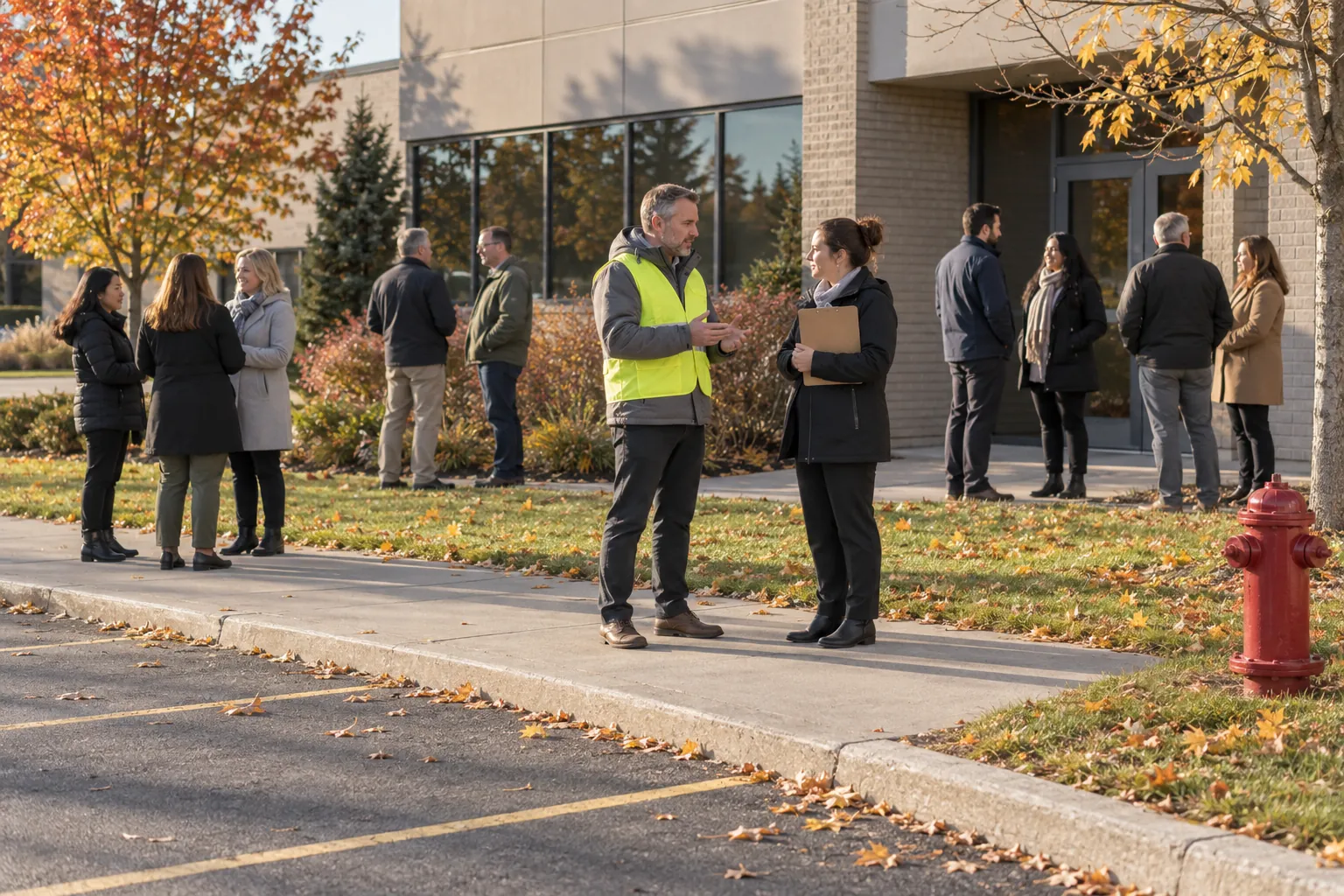
- Leave last by the exit stairs, and report to the chief fire warden at the lobby or the assembly area outside: whether the floor is clear, anyone who could not be checked, and anything seen.
- Keep people out until the fire department says it is safe to go back in.
The CCOHS guidance on emergency planning puts the same idea simply: specify safe locations "for staff to gather for head counts to ensure that everyone has left the danger zone".
A trained warden may try an extinguisher on a small fire only if the alarm is sounding, there is a clear way out behind them and the plan expects it.
06
Where the record fails, and what SiteClara does about it
The routine walk is the part least often recorded well. It lives in a binder at the security desk or a sheet on the back of a stairwell door, initialled in advance or in a batch before the fire prevention officer's visit. The door found wedged open on Tuesday is still wedged on Friday, because the note sends the problem to nobody. When a warden is on vacation, their floor is simply not walked, and nothing shows it.
SiteClara records the walk where it happens. A printed QR poster, with an optional NFC tag behind it, goes at the points on the route: the stairwell landing, the exit door, the extinguisher cabinet. The warden scans or taps with their own phone, with no app to install, and marks each check due there done, or says what stopped them. The time and the named person are recorded as it happens, with a photo when the check asks for one.
A problem found on the walk, such as a blocked exit or a door that will not latch, is reported there with a photo and goes onto the team's list of jobs until someone closes it. The supervisor sees which checks are due, done and missed, records why one was missed, and can escalate a job to the building manager to answer. Each day the supervisor reviews and approves a report that goes to nominated management or client contacts the next morning, showing what was reported, what was completed and what is still open.
07
Questions people ask
What is the responsibility of a fire warden?
To know the building's emergency procedures, lead their area out and make sure nobody is left behind. The Government of British Columbia's page on emergency wardens lists a warden's responsibilities as including "Ensuring employees are aware of the local emergency response procedures, evacuation routes and assembly (muster) areas", "Communicating directions during an emergency" and "Ensuring all employees are accounted for during an emergency", with the chief warden "Coordinating all designated emergency wardens within the worksite". In a federally regulated workplace, the Canada Occupational Health and Safety Regulations, section 17.8, require each warden, deputy and monitor to be instructed and trained in their responsibilities under the emergency evacuation plan, the emergency procedures and "the use of fire protection equipment". The exact duties are the ones written in your building's fire safety plan.
How often do you need to complete fire warden training?
Fire safety training comes first: Calgary's fire safety plan page says "Supervisory staff must be trained in fire emergency procedures before they are given responsibilities for fire safety." The same page says "These training requirements must be met annually for most buildings and every six months for high buildings." Federally, the Canada Occupational Health and Safety Regulations, section 17.10, require the emergency wardens to meet, and an evacuation or emergency drill to be held, at least once every year and after any change to the plan or procedures, with a record of each kept for two years. Provincial fire codes set drill frequencies by building type, from once a year to more often in high buildings, schools and care homes.
08
The records to keep, where to read more, and a list to take away
Under the Ontario Fire Code (Division C, Article 1.1.2.1), where the code requires "tests and corrective measures or operational procedures to be carried out, records shall be made noting what was done and the date and time it was done", kept at the building for the Chief Fire Official, and "electronic records that can be made readily available to the Chief Fire Official upon request, are deemed to comply". Records are kept for at least two years (Article 1.1.2.2). A record of every fire drill is kept for at least 12 months (Article 2.8.3.4), and in care occupancies, care and treatment occupancies and retirement homes, supervisory staff training is recorded too (Sentence 2.8.2.1.(7)). Federally, a record of the wardens' instruction and training is kept for two years (section 17.8), and each wardens' meeting and drill is recorded with the date, those present, and for a drill the time taken to evacuate (section 17.10). In British Columbia, "a record of the drills must be kept" (section 4.14(3)). A fire safety log book brings these together.
For the codes themselves, read Division B, Section 2.8 of the National Fire Code of Canada 2025 or your province's version, such as the Ontario Fire Code. Municipal fire departments publish their own guidance; Calgary's fire safety plan page, for example, says that "Supervisory staff must be trained in fire emergency procedures before they are given responsibilities for fire safety." The Government of British Columbia's page on emergency wardens, written for its own public service, shows a chief warden and warden structure.
For your fire wardens, make sure that:
- you know which fire code and which occupational health and safety rules apply, provincial or federal;
- the fire safety plan names a chief fire warden, a deputy, and a warden and deputy for every floor, with cover for vacations and every shift;
- each person who needs help to evacuate has a plan and a monitor on the same floor;
- every warden has been trained on the plan before taking on the role, and holds a copy of their duties;
- the routine walk fits ten minutes, is walked rather than signed, and records the date, time and person;
- problems found go to someone who will fix them, and the record shows when they were fixed;
- missed walks are recorded with a reason;
- drills are held at your code's frequency and recorded, and the list of wardens is reviewed at least every 12 months.
Sources
Every document this guide quotes or links to, in the order it first cites them.
- National Fire Code of Canada 2025 nrc.canada.ca
- Ontario Fire Code, O. Reg. 213/07 ontario.ca
- Fire safety legislation and Ontario's Fire Code ontario.ca
- Canada Occupational Health and Safety Regulations (SOR/86-304) laws-lois.justice.gc.ca
- WorkSafeBC Occupational Health and Safety Regulation, Part 4 worksafebc.com
- CCOHS guidance on emergency planning ccohs.ca
- Emergency wardens www2.gov.bc.ca
- Canada Occupational Health and Safety Regulations, section 17.8 laws-lois.justice.gc.ca
- Fire safety plan page calgary.ca
- Canada Occupational Health and Safety Regulations, section 17.10 laws-lois.justice.gc.ca
Related guides
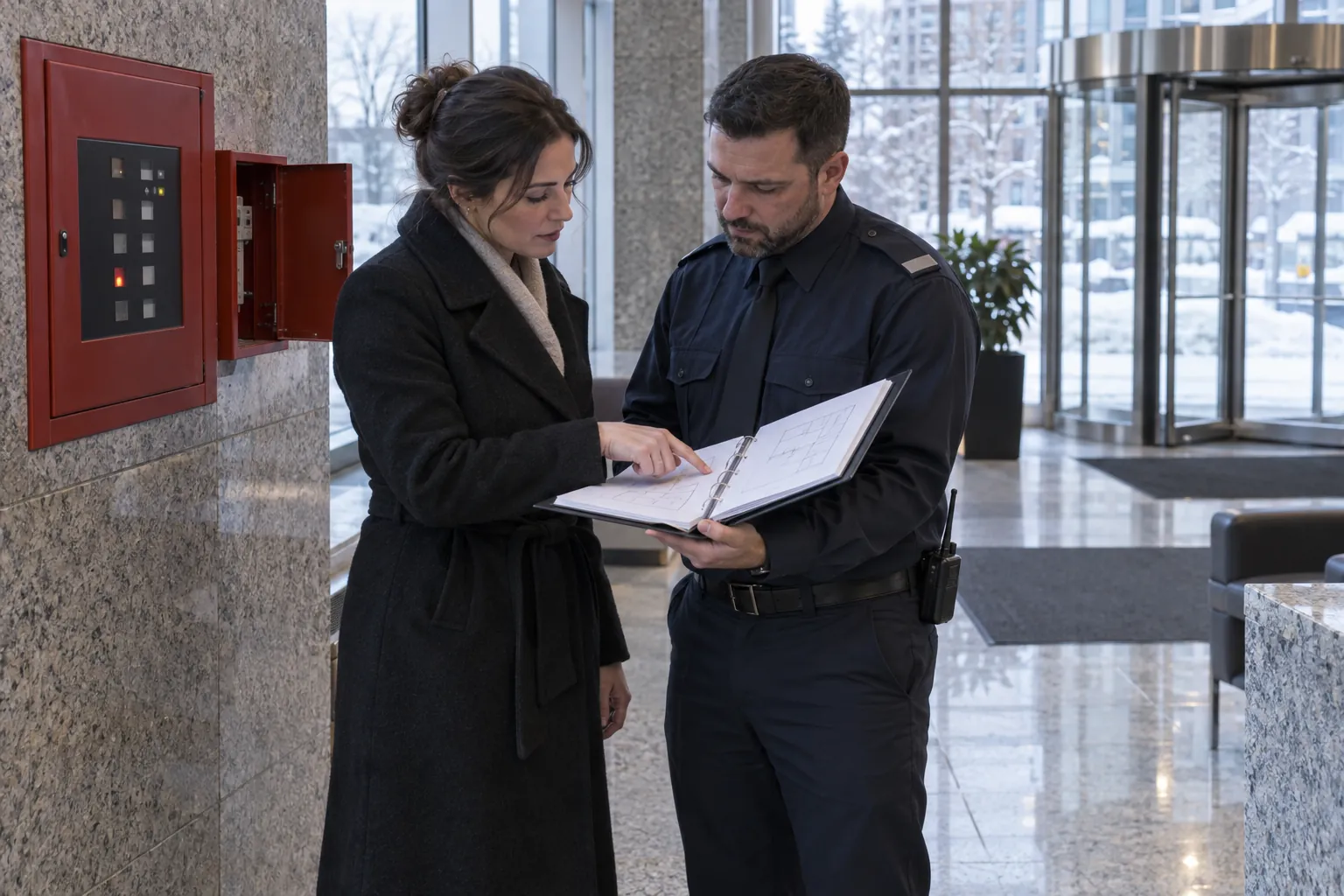 Fire and water checksFire safety plan: what it must contain, who approves it, and how to keep it trueWhat a fire safety plan must contain under the National Fire Code of Canada and the Ontario Fire Code, who approves it, how often it is reviewed, and the records.
 Fire and water checksFire drill requirements in Canada: how often, who takes part, and what to recordHow often fire drills must be held in Canada under the National Fire Code and Ontario Fire Code, who takes part, and what a fire drill record should show.
 Fire and water checksWorkplace fire safety checklist: what to check, how often, and who does it in CanadaA workplace fire safety checklist for Canadian buildings: the daily, monthly and annual checks the fire code sets, who does each one, and what the record shows.
 Fire and water checksFire log book: what to record, who keeps it and how long, under Canadian fire codesWhat a fire log book should hold under the Ontario Fire Code and the National Fire Code of Canada: the tests, who records them, how long to keep them, and the form.