Fire and water checks
Fire watch: when the code requires one, and how to run it properly
A fire watch is a person, or a team, who patrols a building or site to detect a fire early and raise the alarm while its normal fire protection is shut down, or while work such as welding creates a fire risk.
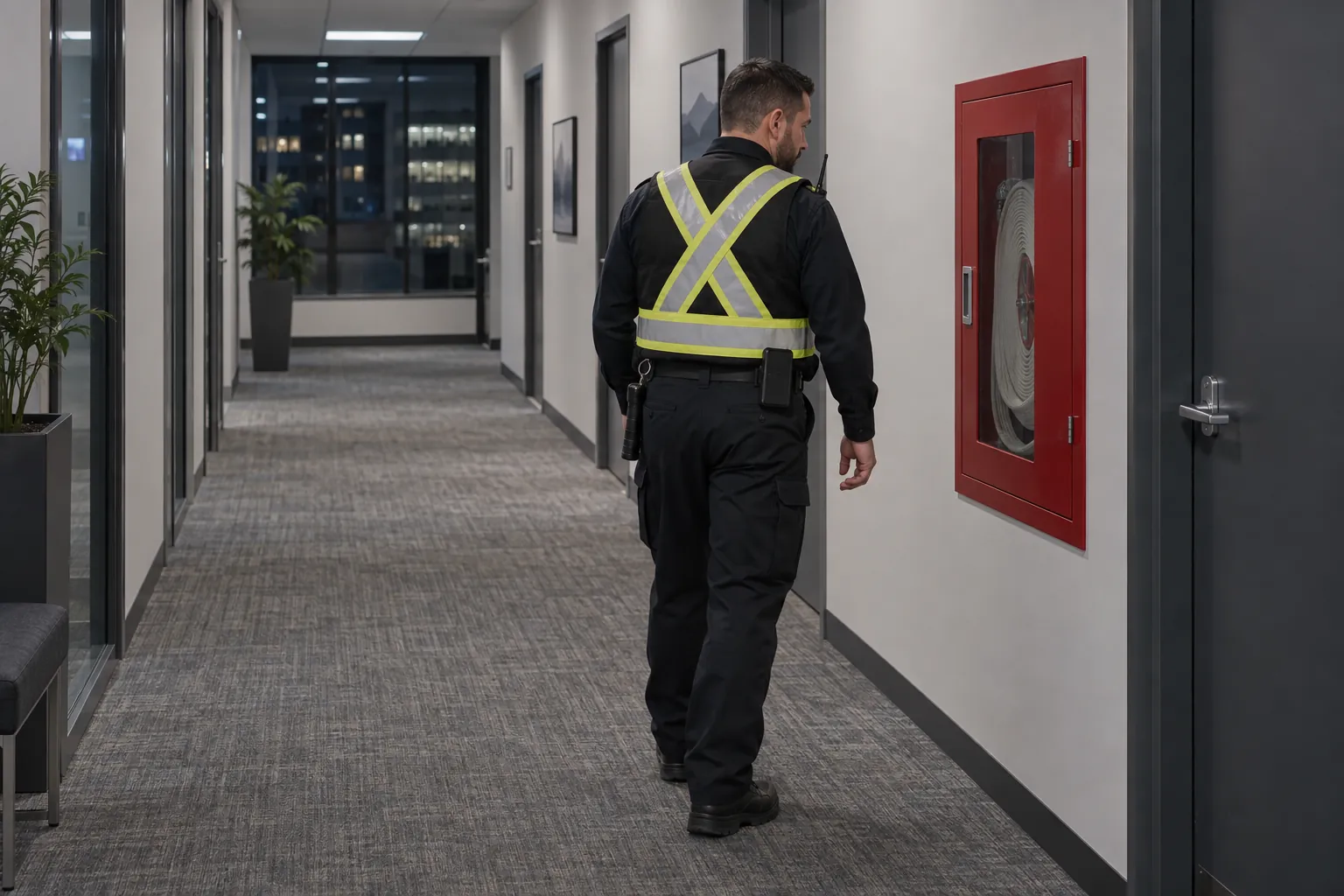
In Canada it is most often called for when a sprinkler or fire alarm system is shut down, during hot work, and on construction and demolition sites. This guide covers where the duty comes from in the National Fire Code of Canada and the Ontario Fire Code, when a fire watch is needed, who can do it, how often to patrol, and what a fire watch log should show.
01
What a fire watch is, and where the duty comes from
A fire watch stands in for fire protection that is missing or out of service. While a sprinkler system is drained, a fire alarm panel is down, or a welder is working near combustibles, somebody has to be looking for smoke and fire, able to warn the people in the building and call the fire department.
Fire codes in Canada are set by the provinces and territories, most of them by adopting the national model code with their own changes. The model is the National Fire Code of Canada 2025, published by the National Research Council of Canada (NRC). Its general rule on shutdowns is Sentence 6.1.1.4.(1) of Division B:
The explanatory note to that Sentence says that any interruption of normal operation, including inspection, testing, maintenance and repairs, counts as a temporary shutdown, and that when a sprinkler system is shut down the alternative measures can include "emergency hose lines and portable extinguishers, extra fire watch service and, where practicable, temporary water connections to the sprinkler system." For a fire alarm system, it says they should be worked out with the fire department.
Which edition applies depends on where the building is. The NRC's list of Codes Canada publications shows, for example, the National Fire Code – 2023 Alberta Edition, and Quebec's Safety Code, Chapter VIII – Building, which incorporates the National Fire Code of Canada 2020 with amendments. Ontario writes its own: the Ontario Fire Code, O. Reg. 213/07, made under the Fire Protection and Prevention Act, 1997. The references to it in this guide are to the consolidation current from January 1, 2026. Ontario spells the word as one, firewatch.
In Ontario the link to the building's fire safety plan is explicit. Under Sentence 2.8.2.1.(2) of Division B, a fire safety plan must "provide for alternative measures to be provided for the safety of occupants during a shutdown of any or all fire protection equipment or systems." In practice, the fire watch is usually the main alternative measure, and the fire safety plan is where it should already be written down, before anyone needs it.
02
When a fire watch is required
The codes name some situations outright and leave others to the alternative measures rule. The common triggers in a commercial or institutional building are these:
- A sprinkler system is impaired. Planned work on the system, a leak, a frozen or broken pipe, or a closed control valve all take protection away. The Ontario Fire Code requires the fire department, the building occupants and the supervisory staff to be notified when a sprinkler system or any part of it is shut down (Article 6.5.2.4.), and the Chief Fire Official to be notified before sprinkler control valves or water supplies are impaired for more than 24 hours (Sentence 6.5.2.2.(1)).
- A fire alarm or voice communication system is shut down, in whole or in part. Ontario requires the same notifications (Article 6.3.1.3.), and the national note expects alternative measures to be agreed with the fire department.
- A standpipe system or an emergency power system is shut down. Ontario applies the same notification rule to both (Articles 6.4.1.4. and 6.7.1.1.).
- Hot work is done where combustibles cannot be removed. Under Sentence 5.2.3.1.(2) of the National Fire Code 2025, when hot work cannot be done in an area free of combustibles, "a continuous fire watch shall be provided during the hot work and for a period of not less than 60 min after its completion."
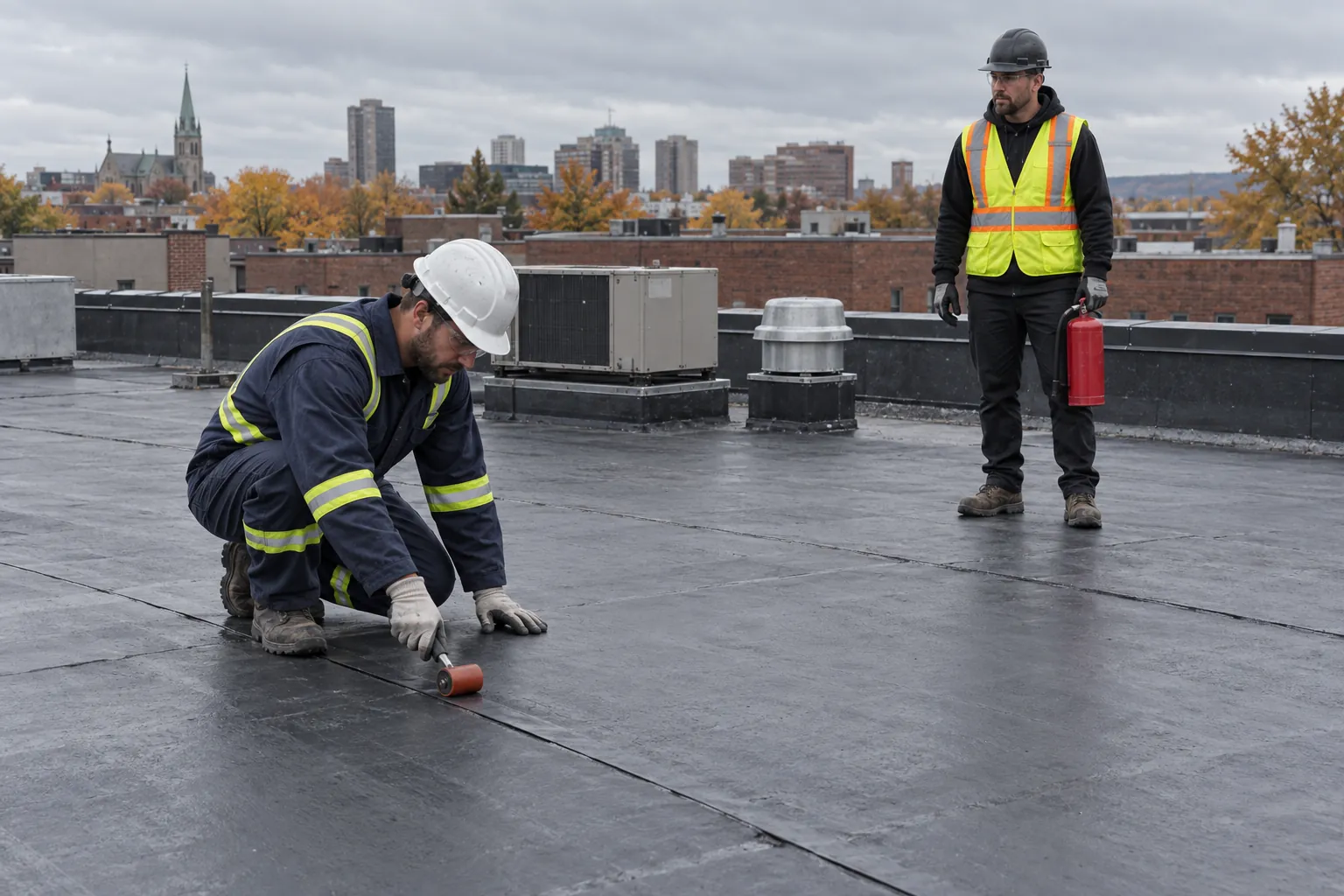
- Torch-applied roofing and other hot surface applications. The Ontario Fire Code requires a firewatch whenever an open flame torch or other ignition source is used for hot surface applications in or on a building (Article 5.11.2.5.). The watch covers any area where combustibles are within 5 m of the person using the torch, any area exposed through unprotected roof or wall openings within that distance, and any area where combustibles on the underside of roofs or the opposite side of walls might be ignited (Sentence 5.11.2.5.(1)): heat travels through a roof or a wall, and a fire can start out of the roofer's sight.
- Demolition that creates a fire hazard for the rest of the building, neighbouring occupied spaces or neighbouring properties (Ontario Fire Code, Article 8.1.2.2.).
- Tents and air-supported structures in Ontario that have neither a fire alarm system conforming to the Building Code nor an approved alternative system giving adequate early warning (Article 2.9.3.3.).
- An order from the fire department. A fire inspector can make a fire watch the condition for keeping a building occupied while a fault is put right, and the order's terms come first.
Planned shutdowns are the easy case, because the fire watch can be arranged before the valve is closed. A burst pipe at two in the morning leaves a building unprotected before anyone has decided what to do, which is why the procedure, the names and the log should be ready in advance.
03
Who can do a fire watch, and what they need
The fire code provisions quoted here describe what the person on watch must know, carry and be able to do, rather than a job title. Building staff, a building superintendent, trained occupants or security guards from a company offering fire watch security services may all be asked to do it; check any fire department order and your provincial rules on who may be hired for security work. Whoever it is, the person on watch should meet these conditions:
- They know the building. The Ontario Fire Code requires a person on firewatch duty in a tent to be familiar with all fire safety features, including the fire safety plan and the condition of exits (Sentence 2.9.3.4.(1)), and the National Fire Code 2025 says the same of the construction fire watch (Sentence 5.6.4.5.(7)). It is the right standard for any fire watch.
- They can raise the alarm and call for help. For roofing and demolition work, Ontario requires facilities that enable firewatch personnel to "ensure that a fire warning is sounded to notify occupants" and to "communicate with the fire department" (Sentences 5.11.2.5.(3) and 8.1.2.2.(3)). When the fire alarm is the system that is down, that means a charged phone, a known number and a practised way of warning each floor so that evacuation can start, such as an air horn or a door-to-door sweep.
- They are equipped. Ontario requires firewatch personnel on roofing and demolition work to carry portable illumination and protective equipment. For hot work, the National Fire Code 2025 requires the exposed areas to be continuously examined by personnel "equipped with and trained in the use of fire extinguishing equipment" (Article 5.2.3.3.).
- They are doing nothing else. A fire watch is not a side duty for a busy concierge or a welder's helper who is also passing materials. The Canadian Centre for Occupational Health and Safety (CCOHS) advises in its fact sheet Welding – Hot Work that a trained fire watcher be posted within the work area, including lower levels if sparks or slag may fall, including during breaks.
Where combustible materials exposed to hot work cannot all be seen from one place, the National Fire Code 2025 requires more than one person on the fire watch (Sentence 5.2.3.2.(3)). The same logic applies to an impairment covering several floors: the patrol route and the number of team members on the watch have to match the area that has lost its protection.
04
How often to patrol, and how long the fire watch lasts
The codes set frequencies for the situations they name, and they differ:
- Hot work (National Fire Code 2025): continuous during the work and for at least 60 minutes after it ends, then a final inspection of the hot work area and adjacent exposed areas either four hours after the work, or straight after the fire watch, in which case the inspection has to be more comprehensive (Sentence 5.2.3.1.(2)). CCOHS notes that some work needs monitoring for longer, up to three or more hours, until the fire hazards no longer exist.
- Torch-applied roofing (Ontario): the areas are toured at least once each hour, and the firewatch lasts from the start of the work until at least three hours after it stops, or at least two hours if a hand-held thermal imaging camera is used to look for hidden hot spots (Sentences 5.11.2.5.(2) and (5)).
- Demolition (Ontario): the site is toured at least once each hour while the fire hazard exists (Sentence 8.1.2.2.(2)).
- A shutdown of a fire protection system: neither code prints a patrol interval. The frequency comes from the fire safety plan, the fire department's direction, or your own assessment. Ontario's hourly interval for roofing and demolition is a sensible floor to plan from, with every affected area covered on each tour, and a continuous watch where the risk is higher, such as a residential building with a sprinkler system out overnight.
A fire watch for an impairment lasts until the protection is back. Ontario requires sprinkler shutdown work to be programmed by the contractor "to enable the sprinkler system to be operational as quickly as possible" (Article 6.5.2.3.), requires closed sprinkler control valves to be tagged or identified in an approved manner (Article 6.5.2.6.), and requires full sprinkler protection to be restored, or the valve identification kept in place, whenever work on the system stops (Article 6.5.2.5.). Buildings containing a hotel have a stricter rule: Ontario requires the Chief Fire Official to be notified of any sprinkler impairment, following a schedule in the approved fire safety plan for shutdowns of 24 hours or less (Sentence 6.5.2.2.(2)).
End the fire watch on a positive check, not on a phone call: someone competent confirms that the valve is open, the panel is back to normal, the monitoring company is receiving signals, and everyone told of the shutdown has been told it is over. The sprinkler inspection and fire alarm testing guides cover what that involves.
05
The fire watch log: what it should show
A fire watch nobody wrote down is hard to prove afterwards. The codes are firm about records in general. The Ontario Fire Code requires that where it calls for tests and corrective measures or operational procedures, "records shall be made noting what was done and the date and time it was done" (Sentence 1.1.2.1.(1)), retained at the building for the Chief Fire Official, and it accepts electronic records that can be made readily available on request (Sentence 1.1.2.1.(4)). Records must be kept for at least two years after being prepared, and so that at least the most recent and the immediately preceding record of a given test or inspection are retained (Article 1.1.2.2.). Division C of the National Fire Code 2025 has a similar rule in Article 2.2.1.2.
Whether or not a fire watch log is itself a required record in your province, keep one, and keep it with the building's fire safety records. A useful log shows:
- Why the fire watch is in place: which system or which work, the area affected, and who authorized it.
- Who was notified of the shutdown, and when: the fire department, the monitoring company, supervisory staff and occupants.
- Each tour: the start and finish time, the name of the person, and the areas checked, room by room or floor by floor rather than "building OK".
- What was found: blocked exits, a propped fire door, a smell of burning, stored materials against a hot work area, and what was done about it.
- Handovers from one watcher to the next, with both names and the time.
- The end: when protection was restored, who confirmed it, and when the notified parties were told.
The log is only as good as the moment it was written. A sheet filled in at 6 a.m. with neat hourly entries from midnight, all in the same pen, tells an investigator or an insurer that somebody sat down at the end of the shift and wrote a night's patrol from memory. Entries made at each point, as the patrol reaches it, are the ones that will stand up.
06
Where the fire watch record fails, and what SiteClara does about it
Fire watches tend to fail in the same way. The watch is arranged in a hurry, the route exists only in the watcher's head, and the log is a clipboard at the security desk, written up at the end of the shift. A missed round is never recorded as missed, and nobody reading the log next morning can tell whether the third floor was walked at 3 a.m.
SiteClara records the checks where they happen. A printed QR poster, with an optional NFC tag behind it, sits at each point on the round: a stairwell door, the sprinkler riser room, the far end of a corridor, the area under hot work. The person on watch scans or taps with their own phone, with no app to install, sees the checks due at that location and marks each one done, or explains what stopped them. The time and the named person are recorded as it happens, with a photo when one is asked for, such as a closed fire door or a clear exit. A problem found on the round goes onto the team's list of jobs until someone closes it.
The supervisor sees what was due, what was done and what was missed at each location, and records the reason for anything missed. Each day they review the record, add a note and approve a report that goes to nominated managers the next morning, so the property manager or the contractor responsible for the impaired system can see that the watch was kept, round by round, rather than taking it on trust.
07
Questions people ask
What does fire watch mean?
It means posting a person, or people, to patrol for fire and raise the alarm while a hazard or a gap in protection lasts. The Ontario Fire Code, O. Reg. 213/07, which writes it as one word, uses it in exactly that sense: where a tent has neither a conforming fire alarm system nor an approved alternative, "a person shall be employed for firewatch duty" (Article 2.9.3.3.), and that person must "patrol the area to ensure that the means of egress are kept clear" (Sentence 2.9.3.4.(1)). For roofing and demolition, firewatch personnel tour the areas and must be able to sound a fire warning and communicate with the fire department.
What are the requirements for a fire watch under the Ontario Fire Code?
The Ontario Fire Code, O. Reg. 213/07 requires a firewatch for a tent or air-supported structure that has neither a fire alarm system conforming to the Building Code nor an approved alternative system giving adequate early warning (Article 2.9.3.3.), for torch-applied roofing and other hot surface applications (Article 5.11.2.5.), and for demolition that creates a fire hazard to other parts of the building or to neighbouring occupied spaces or properties (Article 8.1.2.2.). For roofing and demolition, the areas must be toured by firewatch personnel "at least once each hour", facilities must be provided so they can sound a fire warning to occupants and communicate with the fire department, and they must be equipped with portable illumination and protective equipment. Roofing firewatch runs until at least 3 hours after the application ceases, or at least 2 hours if a hand-held thermal imaging camera is used (Sentence 5.11.2.5.(5)).
Does a fire watcher need training?
The guidance and the code both expect it. The Canadian Centre for Occupational Health and Safety's fact sheet Welding – Hot Work says to "post a trained fire watcher within the work area, including lower levels if sparks or slag may fall during welding", and to keep the watch "including during breaks, and for at least 60 minutes after work has stopped". For demolition, the Ontario Fire Code, O. Reg. 213/07 requires the demolition safety plan to include "the requirement to train site personnel to carry out fire safety duties, including a firewatch" and the emergency procedures (Clause 8.1.2.2.(6)(c)).
08
Where to read more, and a fire watch checklist
The National Fire Code of Canada 2025 is free to download from the NRC; Part 5 covers hot work and construction sites, and Part 6 covers fire protection equipment, with the explanatory notes at the end of each Part. Check the NRC's Codes Canada publications page, or your provincial fire marshal's office, for the edition your province enforces. In Ontario, read the Ontario Fire Code, O. Reg. 213/07 on e-Laws, especially Section 2.8 (fire safety planning), Article 5.11.2.5. (firewatch for roofing), Subsection 6.5.2. (sprinkler system shutdowns) and Subsection 1.1.2. (records). CCOHS publishes plain-language guidance on hot work in Welding – Hot Work. The fire safety log book guide covers the building's wider records.
Before a planned shutdown, or as soon as an emergency impairment is found, check that:
- the fire safety plan says what the alternative measures are, and who puts them in place;
- the fire department, the monitoring company, supervisory staff and occupants have been told, and the time is logged;
- closed valves are tagged, and the contractor has a plan to restore protection as quickly as possible;
- each fire watcher knows the building, the exits and the fire safety features, and has a phone, a light and a way to warn every floor;
- the tour frequency is set, and each tour is recorded with the time, the name and the areas checked;
- hot work has a continuous watch during the work and for at least 60 minutes after, followed by a final inspection;
- the watch ends only when protection is confirmed restored and everyone notified has been told;
- the log is kept with the building's fire safety records for at least two years.
Sources
Every document this guide quotes or links to, in the order it first cites them.
- National Fire Code of Canada 2025 nrc.canada.ca
- List of Codes Canada publications nrc.canada.ca
- Ontario Fire Code, O. Reg. 213/07 ontario.ca
- Welding – Hot Work ccohs.ca
Related guides
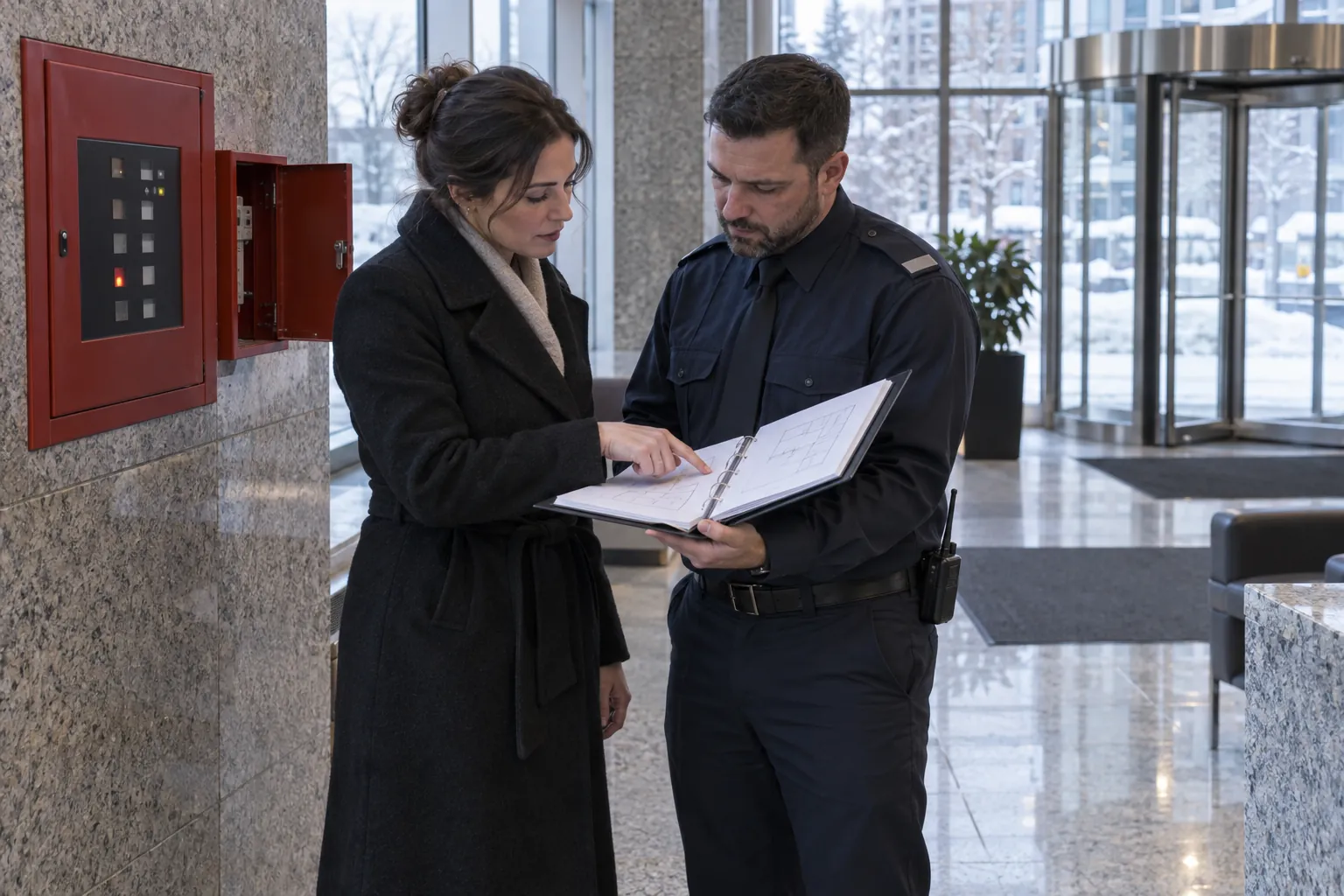 Fire and water checksFire safety plan: what it must contain, who approves it, and how to keep it trueWhat a fire safety plan must contain under the National Fire Code of Canada and the Ontario Fire Code, who approves it, how often it is reviewed, and the records.
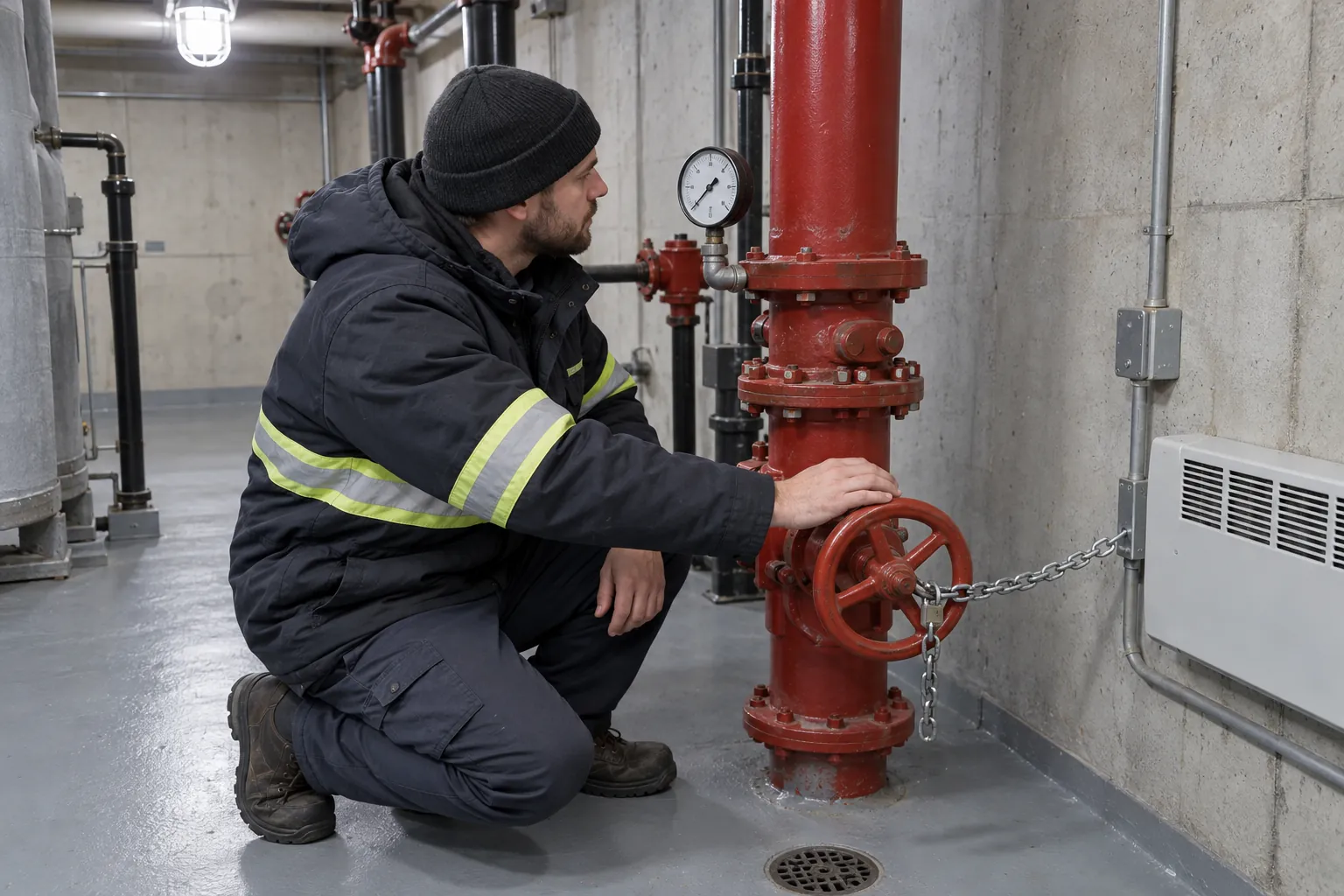 Fire and water checksSprinkler system inspection in Canada: what is checked, how often, and what the record must showSprinkler system inspection in Canada: what the fire codes and NFPA 25 ask, the weekly and monthly checks, the annual test, shutdowns and the records to keep.
 Fire and water checksFire alarm testing in Canada: what the owner checks, what the technician tests, and what to recordFire alarm testing in Canada: what the fire codes and CAN/ULC-S536 ask of owners daily and monthly, the annual test by a technician, and what the record must show.
 Fire and water checksFire log book: what to record, who keeps it and how long, under Canadian fire codesWhat a fire log book should hold under the Ontario Fire Code and the National Fire Code of Canada: the tests, who records them, how long to keep them, and the form.