Fire and water checks
Fire alarm testing in Canada: what the owner checks, what the technician tests, and what to record
In Canada, a fire alarm test is carried out to the national standard CAN/ULC-S536, which the fire codes require: the owner's staff check the panel daily and test the system on emergency power monthly, and a qualified technician tests every device once a year.
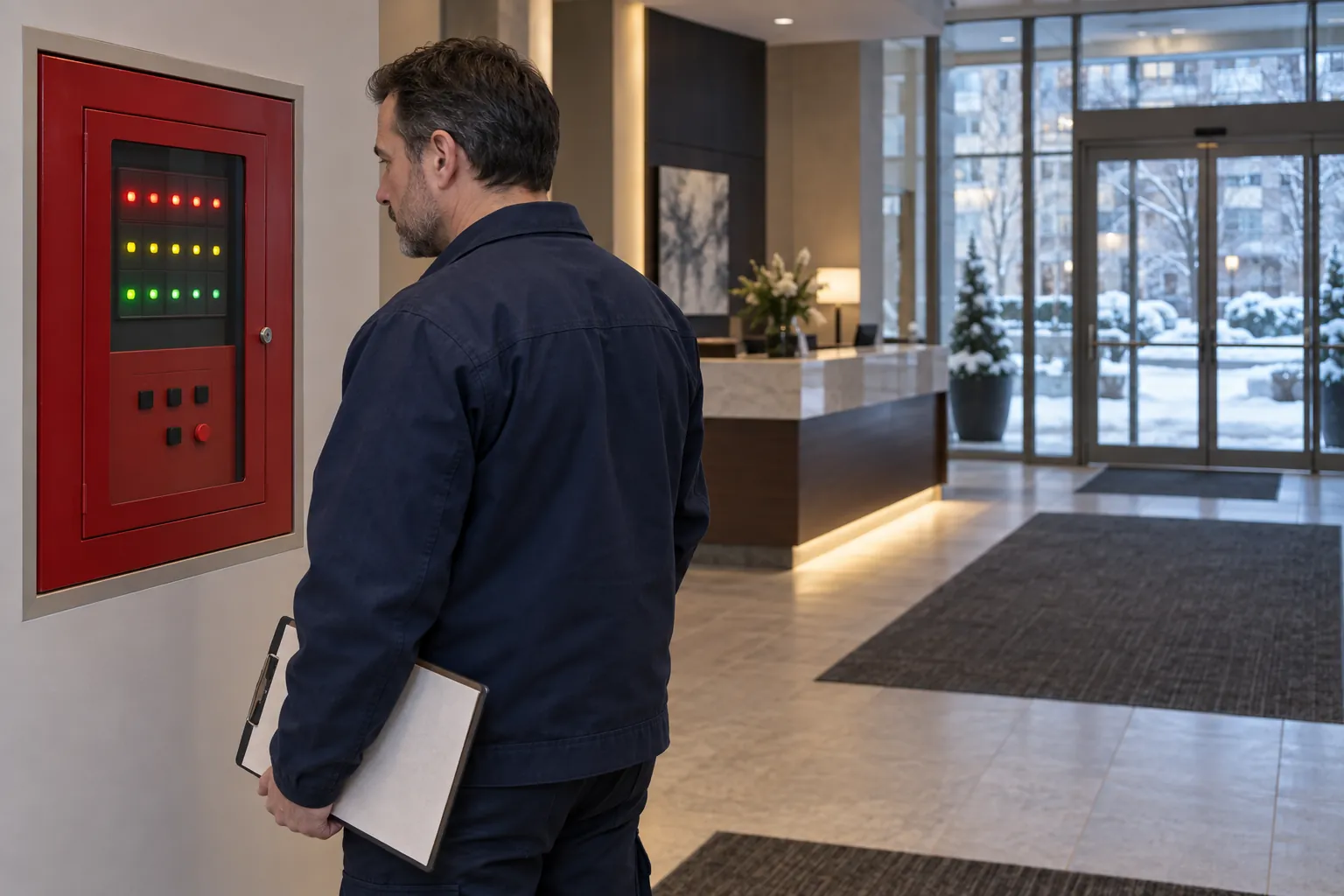
It is not the weekly pull station test many people picture. This guide sets out what the codes say, who performs which part, and what the record has to show when the fire prevention officer asks for it.
01
Where the fire alarm testing requirement comes from
Fire alarm testing in Canada is set by the fire code of the province or territory the building is in. Most of those codes are adoptions of the National Fire Code of Canada 2020, developed by the Canadian Commission on Building and Fire Codes and published by the National Research Council, which advises readers to check the edition in force with their municipal, provincial or territorial official. Section 6.3 of Division B deals with fire alarm and voice communication systems, and the provincial codes keep that numbering.
The codes do not write out a testing routine of their own. They hand it to a standard. The British Columbia Fire Code 2018, Division B, Section 6.3, since replaced by the BC Fire Code 2024 (an adoption of the National Fire Code 2020, in force March 8, 2024), shows the model wording plainly: "Fire alarm systems shall be inspected and tested in conformance with CAN/ULC-S536, 'Inspection and Testing of Fire Alarm Systems.'" It adds that the systems "shall be maintained in operable condition at all times", and Calgary's summary of the National Fire Code 2023 Alberta Edition gives the same two requirements.
The Ontario Fire Code (O. Reg. 213/07) says the same in Article 6.3.2.2 and goes further. A description of the fire alarm system, as CAN/ULC-S536 requires, must be "kept current and maintained in the building at an approved location". A record of each device, component and circuit inspected and tested must show "whether the device, component or circuit is in proper working order". And where the system is monitored to send a signal to the fire department, the owner must record whether all signals from the tests "are received by the monitoring station". Article 6.3.2.3 adds a daily duty: the central alarm and control facility "shall be checked daily for indication of trouble in the system."
CAN/ULC-S536 is the Standard for Inspection and Testing of Fire Alarm Systems, published by ULC Standards. Its own scope is to prescribe requirements for the inspection and testing of fire alarm systems and to specify "the devices and functions to be inspected, tested, and documented for the periodic inspection and test." It is revised from time to time, and the edition that binds you is the one your fire code names: Ontario's current Fire Code lists CAN/ULC-S536-2019 among its referenced documents, and the Calgary Fire Department's Fire Safety Maintenance Requirements say the National Fire Code 2023 Alberta Edition requires inspection and testing to CAN/ULC-S536:2019.
02
What fire alarm testing covers: daily, monthly and annual
The Calgary Fire Department's reference document sets out the CAN/ULC-S536:2019 routine as it applies under the Alberta edition of the code, clause by clause, and it is one of the clearest official summaries in the country. In outline:
- Daily (CAN/ULC-S536, Subsection 5.1): check for trouble on the primary or remote trouble indicators, and check that the primary power "on" indicator, or its equivalent, is showing.
- Monthly (Subsection 5.2): inspect and test on the emergency power supply to confirm the fire alarm system works on it, with written records kept. Calgary recommends coordinating it with the emergency generator test where there is one, and notes that the monthly test is not required in the month the annual inspection is done.
- Annual (Section 6): inspect and test the system as the standard requires, by qualified persons acceptable to the authority having jurisdiction, within a period not exceeding 12 months from the previous annual inspection.
- Voice communication: where a voice or public address system is part of the evacuation plan and is not electrically supervised, the model code has it tested at least monthly (as in the BC Fire Code 2018 and Calgary's summary of the Alberta edition), the loudspeakers so they can be heard in all parts of the building.
Ontario adds a routine for interconnected smoke alarm systems in residential and care occupancies (Article 6.3.2.6): the power supply checked weekly, one smoke alarm tested monthly on a rotational basis, each manual pull station tested annually, and written records of the weekly checks kept for at least six months.
Around the tests sit the duties that keep a system testable. Ontario's Article 6.3.1.1 requires access to components needing inspection or servicing to be "kept unobstructed", worth checking in storage rooms and tenant improvements, and Article 6.3.1.4 requires the system to be "maintained in operating condition" between visits, not just on the day of the test.
03
How to carry out the daily and monthly checks
The daily and monthly checks are the owner's part, and they are usually done by the building operator, the superintendent, a property manager or a security guard on the first round of the day. The City of Ottawa's Ontario Fire Code Pre-Inspection Guide puts it simply: "Maintenance personnel, property managers, or a representative of the owner shall conduct a visual inspection of the fire alarm panel daily to ensure the system is operational." Calgary's guidance says daily and monthly inspection and testing may be performed by building operators who have received, and can prove with a certificate or letter of competency, training from the manufacturer or service provider for their specific system.
A sensible daily check at the panel or annunciator:
- Look at the power indicator. The primary power "on" light, or its equivalent, should be lit.
- Look for trouble, supervisory and alarm signals on the panel and on any remote annunciator. A trouble light is the system telling you something is wrong: a ground fault, a disconnected device, a battery problem.
- Check nothing is bypassed or disabled without a reason and an end date.
- Record the result, including "normal", with the date, the time and your name.
- Report anything abnormal to the fire alarm service company the same day, and tell whoever the fire safety plan says must know.
The monthly test goes further: it proves the system works on its standby power, the power it will need if a fire takes out the building's supply. Do it the way your service provider has shown you, and write down what was tested and what happened. Where there is an emergency generator, doing both on the same day, as Calgary recommends, means one visit to the generator room.
Before any test that could set off the alarm or send a signal, tell the people who need to know. Ontario's Article 1.1.1.1 of Division B requires a notification procedure whenever tests, repairs or alterations are made to fire protection installations, including notifying the fire department and building occupants where necessary for safety: in practice the monitoring company, the security desk and any tenant who might otherwise evacuate or call 911.
04
The annual inspection and test by a qualified technician
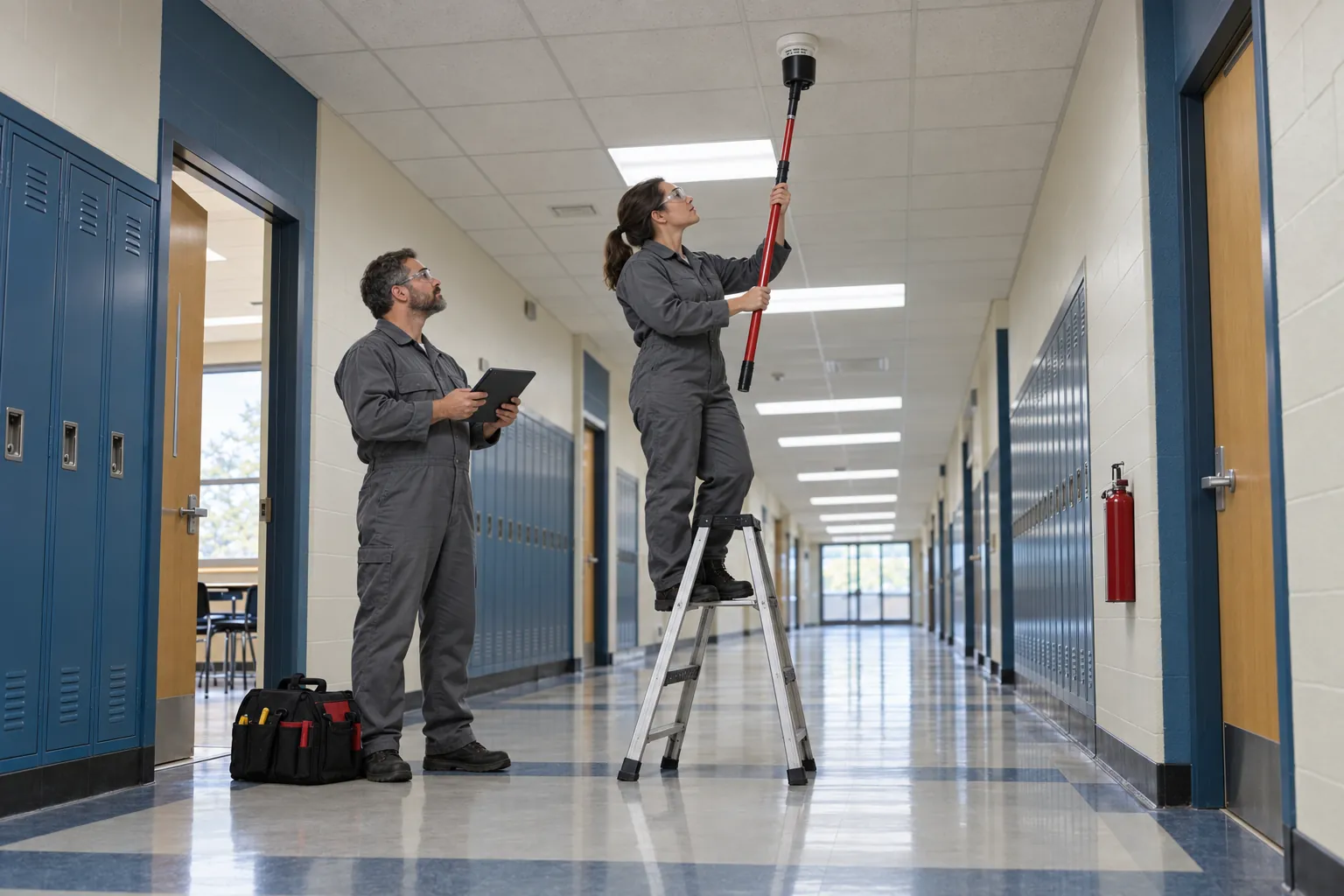
The annual inspection is where every part of the system is proved: the pull stations, the heat and smoke detectors, the signal devices, the panel's functions and the interfaces with other systems. It is not work for building staff. Ottawa's guide says fire alarm systems "shall be maintained, inspected and tested annually by a qualified & permitted fire alarm company", and invites owners to verify a technician's number with the Canadian Fire Alarm Association.
Older smoke detectors get extra attention. Under the Alberta edition, Calgary's document says a smoke detector more than 10 years old, where the fire alarm system does not test it automatically, is tested for sensitivity or replaced (Division B, Sentence 6.3.1.2.(4)); the annual sensitivity testing in Subsection 6.7.4 of CAN/ULC-S536 does not apply until a smoke detector has been in place for 10 years.
In Ontario the qualification is set in law. Article 6.3.2.1 makes the owner responsible for ensuring that anyone doing the annual tests or inspections, or repairing, replacing or altering the system, meets Division C, Subsection 1.2.1: the person must have "successfully completed a program or course acceptable to the Fire Marshal" and must show the certificate on request by the owner or the Chief Fire Official. Someone without it may do the work only under on-site supervision, with no more than two people supervised at once.
The owner's jobs around the annual visit are practical:
- Book it on time. The annual inspection is due within 12 months of the last one, so put the date in the calendar when the report arrives, not when the fire prevention officer asks.
- Arrange access to every suite, locked room, roof space and elevator machine room the technician needs. Devices that could not be reached are listed as not tested, and that is a gap in your record.
- Give notice to the monitoring company, occupants and anyone else the notification procedure names.
- Keep the system description current, so the technician tests the system you actually have after last year's renovations.
- Read the report, and act on its deficiencies. Ontario's Article 1.1.1.2 requires a device that does not operate as intended to be repaired or replaced where its failure would adversely affect fire or life safety.
05
What the fire alarm test record must show, and for how long
Ontario's rule on records is short and worth knowing by heart. Under Division B, Article 1.1.2.1, where the Fire Code requires tests and corrective measures or operational procedures, "records shall be made noting what was done and the date and time it was done." The records are kept at the building for examination by the Chief Fire Official, and "electronic records that can be made readily available to the Chief Fire Official upon request" are deemed to comply. Article 1.1.2.2 requires the original or a copy to be kept at the building for at least two years, and so that at least the most recent and the immediately preceding record of each test are there. The initial verification reports for systems installed after November 21, 2007 are kept for the life of the system.
Other provinces set their own periods. Calgary's document says records under the Alberta edition are kept so that the current and previous five years are available, and asks owners for a printed copy on site. Check your own code and your fire department's expectations before deciding what form the record takes.
For the owner's routine, each entry in the fire safety log book should show:
- the date and time of the check or test, as it happened;
- what was checked or tested: the daily panel check, the monthly emergency power test, a voice communication test;
- the result: normal, or the trouble or supervisory signal seen;
- whether the monitoring station received the signal, where the system is monitored and the test sends one;
- any fault, who it was reported to, and when it was cleared;
- the name of the person who did it.
The annual inspection report, the system description, the deficiency list with its repairs, shutdowns with their notifications and fire watch records, and false alarms with their causes belong in the same place; a pattern of false alarms from one detector is something the technician needs to see. The fire safety plan, which in Ontario is reviewed at least every 12 months, is the place to name who does the daily check and where the record lives, so a new superintendent can pick it up on day one.
06
Where fire alarm test records fail, and what SiteClara does about it
Fire alarm records usually fail in the owner's part, not the technician's. The annual report arrives in a tidy binder; the checks in between are a column of ticks. The daily check is done by whoever opens up, and on their day off nobody does it, or somebody fills the gap in on Friday. A trouble light is noted three days running and reported to nobody. And a property manager with twenty buildings cannot tell which of them looked at the panel today without calling around.
SiteClara records checks at the location. A printed QR poster, with an optional NFC tag behind it, sits where the check is due: beside the fire alarm panel or annunciator, in the generator room, at a floor's pull station. The person doing the check scans the code or taps the tag on their own phone, with no app to install, sees what is due there, such as the daily panel check or this month's emergency power test, and marks it done or says what stopped them. The time and the named person are recorded as it happens, with a photo when one is asked for, such as the panel display. A fault, such as a trouble signal that will not clear, is reported there and goes onto the team's list of open jobs until someone closes it.
The supervisor sees what is due, done and missed across the building or the portfolio, and records the reason a check was missed. Each day they review and approve a short report that goes to the nominated managers or client contacts the next morning, showing what was reported, completed and still open, and how the scheduled checks went.
07
Questions people ask
How do you test a fire alarm?
In a building with a fire alarm system, the test follows CAN/ULC-S536. The Calgary Fire Department's Fire Safety Maintenance Requirements set it out: each day, check the trouble indicators and the primary power "on" indicator; each month, inspect and test the system on its emergency power supply; each year, have qualified persons acceptable to the authority having jurisdiction inspect and test the whole system. Daily and monthly checks may be performed by building operators trained on their specific system by the manufacturer or service provider.
What are the legal requirements for fire alarm testing?
The fire code of your province or territory. The British Columbia Fire Code 2018, Division B, Section 6.3, since replaced by the BC Fire Code 2024, which adopts the National Fire Code 2020, shows the typical wording: fire alarm and voice communication systems "shall be maintained in operable condition at all times", fire alarm systems "shall be inspected and tested in conformance with CAN/ULC-S536", and components must be accessible for inspection or maintenance. Ontario's Fire Code adds records of each device tested and a daily check of the central alarm and control facility.
How often should you do a fire alarm test?
Daily, monthly and annually. The Calgary Fire Department's Fire Safety Maintenance Requirements list a daily check for trouble and power, a monthly test on emergency power (not required in the month of the annual inspection), and an annual inspection and test held within 12 months of the previous one. Where a voice communication system is part of the evacuation plan and is not electrically supervised, it is tested at least monthly as well.
How can I test if my smoke alarm is working properly?
A smoke alarm in a home or apartment is usually a separate device from the building's fire alarm system, and it is tested on its own. The City of Toronto's Smoke Alarms page says: "Test your smoke alarms monthly by pressing the test button and listening for the alarm." It also says landlords must give the tenant a copy of the manufacturer's maintenance instructions, so the instructions for your model are the ones to follow.
08
Further reading, and a list to take away
Start with your own province's fire code: the Ontario Fire Code on e-Laws, the BC Fire Code page, which explains that the BC Fire Code 2024 is read as the National Fire Code 2020 with BC's Ministerial Order, or the adoption in force where you are, alongside the National Fire Code of Canada, which the National Research Council publishes free. CAN/ULC-S536 is a paid standard; your fire alarm service company will have it. Many fire departments publish plain guides for owners: the Calgary Fire Department's Fire Safety Maintenance Requirements and the City of Ottawa's Ontario Fire Code Pre-Inspection Guide are two good examples, and your local fire prevention office is the one to ask about your building.
Before the fire prevention officer's next visit, check that:
- someone named, and a deputy, checks the panel every day, and the record shows it, normal days included;
- the monthly emergency power test is on the calendar, with the generator test where there is one;
- the monitoring company and occupants are told before tests, and the record says whether the signal was received;
- the annual inspection is booked within 12 months of the last, by a technician whose qualification you have checked;
- every deficiency from the last report has an owner, a date and proof it was fixed;
- the system description is current and kept where your fire department approved;
- shutdowns, notifications, fire watch and false alarms are recorded with the tests;
- records are kept at the building for as long as your code requires: two years in Ontario, five in Alberta.
Sources
Every document this guide quotes or links to, in the order it first cites them.
- National Fire Code of Canada 2020 nrc.canada.ca
- British Columbia Fire Code 2018, Division B, Section 6.3 free.bcpublications.ca
- BC Fire Code 2024 www2.gov.bc.ca
- Ontario Fire Code (O. Reg. 213/07) ontario.ca
- Standard for Inspection and Testing of Fire Alarm Systems shopulstandards.com
- Calgary Fire Department's Fire Safety Maintenance Requirements calgary.ca
- City of Ottawa's Ontario Fire Code Pre-Inspection Guide ottawa.ca
- City of Toronto's Smoke Alarms page toronto.ca
Related guides
 Fire and water checksFire log book: what to record, who keeps it and how long, under Canadian fire codesWhat a fire log book should hold under the Ontario Fire Code and the National Fire Code of Canada: the tests, who records them, how long to keep them, and the form.
 Fire and water checksFire safety plan: what it must contain, who approves it, and how to keep it trueWhat a fire safety plan must contain under the National Fire Code of Canada and the Ontario Fire Code, who approves it, how often it is reviewed, and the records.
 Fire and water checksFire watch: when the code requires one, and how to run it properlyWhen a fire watch is required under the National Fire Code of Canada and the Ontario Fire Code, how often to patrol, who can do it, and what the log should show.
 Fire and water checksEmergency lighting inspection in Canada: the monthly test, the annual test, and the recordEmergency lighting inspection in Canada: the monthly check and test, the annual duration test, what the fire code says about records, and how to keep them honest.