Fire and water checks
Emergency lighting inspection in Canada: the monthly test, the annual test, and the record
Emergency lighting inspection in Canada means inspecting and testing each self-contained emergency lighting unit and battery-backed exit sign at least once a month, and testing each unit at least once every 12 months to show it runs on battery for its full design duration, as the fire codes built on the National Fire Code of Canada require.
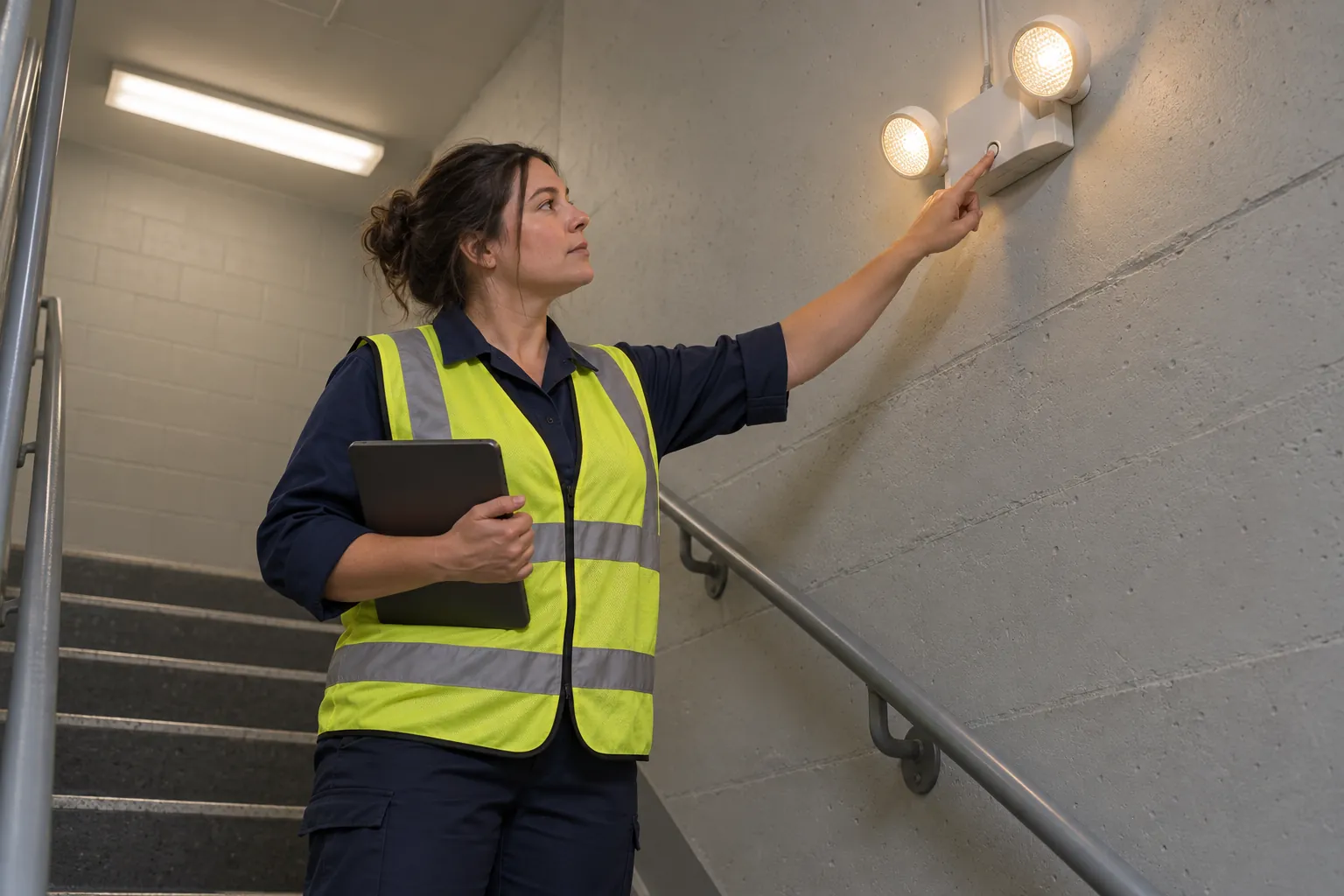
Emergency lights only prove themselves in a power outage, so the fire code asks the owner to prove them in the meantime. This guide sets out what the National Fire Code of Canada and the provincial codes require, who usually does each part, and what the record should show when the fire prevention officer asks for it.
01
Where the emergency lighting inspection requirement comes from
Emergency lighting inspection in Canada is a fire code duty, and the fire code that applies is the one adopted by your province or territory. Most of them are built on the National Fire Code of Canada 2020, developed by the Canadian Commission on Building and Fire Codes and published free by the National Research Council, which tells readers to check with the municipal, provincial or territorial official which edition is in force. The National Fire Code of Canada 2025 keeps the emergency lighting wording unchanged. The requirements sit in Division B, Section 6.5, Emergency Power Systems, Unit Equipment for Emergency Lighting, and Exit Signs.
The code separates emergency lighting systems into three kinds of equipment, and the difference matters when you plan the checks:
- Self-contained emergency lighting unit equipment (Article 6.5.1.6): the battery unit with its own charger and lamp heads, high on a stair or corridor wall, and any remote heads wired to it.
- Other emergency lights (Article 6.5.1.7): lights powered from a central source, such as an emergency generator or a central battery bank, rather than a battery in the fixture.
- Exit signs (Article 6.5.1.8): those with a battery back-up, and all others. (Ontario adds a sentence on self-luminous and photoluminescent signs; see below.)
Behind them sits the owner. Division C of the National Fire Code says that, unless otherwise specified, "the owner or the owner's authorized agent shall be responsible for carrying out the provisions of this Code." A contractor or the building operator may do the walk, but the duty stays with the owner.
Ontario has its own code, the Ontario Fire Code (O. Reg. 213/07), made under the Fire Protection and Prevention Act, 1997. Its numbering differs: the same requirements are in Section 6.7, and Article 2.7.3.3 ties them to everyday premises: "Emergency lighting and exit signs shall be maintained in operating condition in conformance with Section 6.7." Alberta applies the National Fire Code 2023 Alberta Edition, and the Calgary Fire Department's Fire Safety Maintenance Requirements summarize its emergency lighting articles for owners, with the same article numbers as the national code.
02
What the code asks for, month by month and year by year
Article 6.5.1.6 of the National Fire Code is short and specific. Self-contained emergency lighting unit equipment shall be inspected at intervals not greater than one month to ensure that:
- "pilot lights are functioning and not obviously damaged or obstructed,"
- "the terminal connections are clean, free of corrosion and lubricated when necessary,"
- "the terminal clamps are clean and tight as per manufacturer's specifications," and
- "the battery surface is kept clean and dry."
The Ontario Fire Code adds a fifth item to the monthly inspection: that the electrolyte level and specific gravity are maintained as per the manufacturer's specifications. In practice, this applies to batteries whose electrolyte can be checked.
The same article then requires two tests. The unit equipment shall be tested:
- monthly, at intervals not greater than one month, "to ensure that the emergency lights will function upon failure of the primary power supply"; and
- annually, at intervals not greater than 12 months, "to ensure that the unit will provide emergency lighting for a duration equal to the design criterion under simulated power failure conditions."
After the annual duration test, the code adds a third step: the charging conditions for voltage and current, and the recovery period, shall be tested to confirm the charging system is working to the manufacturer's specifications.
For the rest of the equipment:
- Emergency lights on a central supply are inspected at intervals not greater than 12 months to ensure they are functional. In Ontario, where their power comes from a system of batteries, the batteries are inspected and tested in the same way as unit equipment.
- Exit signs with a battery back-up are inspected monthly to ensure they will be visible when the primary power fails, and every 12 months to ensure they stay visible for the design duration.
- Other exit signs are inspected at intervals not greater than 12 months to ensure they will be visible when the primary power fails. Ontario adds that self-luminous and photoluminescent signs are maintained to the manufacturer's instructions and the conditions of their approval.
The Ontario Fire Code also says, in Article 2.7.3.2, that exit lighting and exit signs shall be illuminated during times when the building is occupied, and Calgary's guide lists the same everyday check under the Alberta code. A dark exit sign on an ordinary day is a fault to report that day.
03
Doing the monthly inspection and test
The monthly visit is two jobs in one walk: an inspection of each unit's condition, and a short function test. Calgary's guide says who is qualified for this work under the Alberta code: "Building operators/maintenance personnel, fire alarm technicians and electricians." In practice, the super, the building operator or an in-house maintenance person does it in many buildings, and a contractor does it in others. The City of Ottawa's Ontario Fire Code Pre-Inspection Guide expects emergency lights to be "inspected monthly and tested annually by a certified company," so check what your own fire department expects before you decide who does which part.
A sound monthly routine looks like this:
- Work from a list of every unit, remote head and battery-backed exit sign, each with a reference and a location, floor by floor. Without the list, nobody can say whether every unit was seen.
- Look at each unit: the pilot or charging light is on, the lamp heads are aimed along the path of travel and not knocked sideways, nothing blocks them, such as stacked stock, a new partition or a hanging banner, and the unit is not damaged.
- Open the units that need it, where the manufacturer's instructions allow, to check the terminals, clamps and battery surface the code lists. Sealed, maintenance-free batteries still need the pilot light and the function test.
- Test on loss of power, using the unit's test switch or by switching off the circuit that feeds it, and watch every head light. Keep it brief: this proves the changeover, not the battery.
- Check the exit signs with a battery back-up light on the same test.
- Restore the power and confirm the pilot light shows the unit is charging again.
- Record the result unit by unit: the date and time, who did it, what passed, and what failed, flickered or was dim.
In a large building the monthly work can be spread across the month, one floor or one wing at a time, as long as every unit is inspected and tested within the month and the record shows it. Where units test themselves and show the result on an indicator, somebody still has to read every indicator each month, record it and act on a fault.
04
The annual duration test, and after it
Once every 12 months, each unit is tested for its design duration under simulated power failure. The design criterion is the running time the lighting was designed for under the building code in force when it was installed, and it should be on the drawings or in the installer's documents. As an example of how it varies, Section 9.9 of the Ontario Fire Code, part of the retrofit requirements in Part 9, requires emergency lighting in hotels to run for at least 30 minutes, or at least 2 hours where the floor of the top storey is more than 18 m above grade.
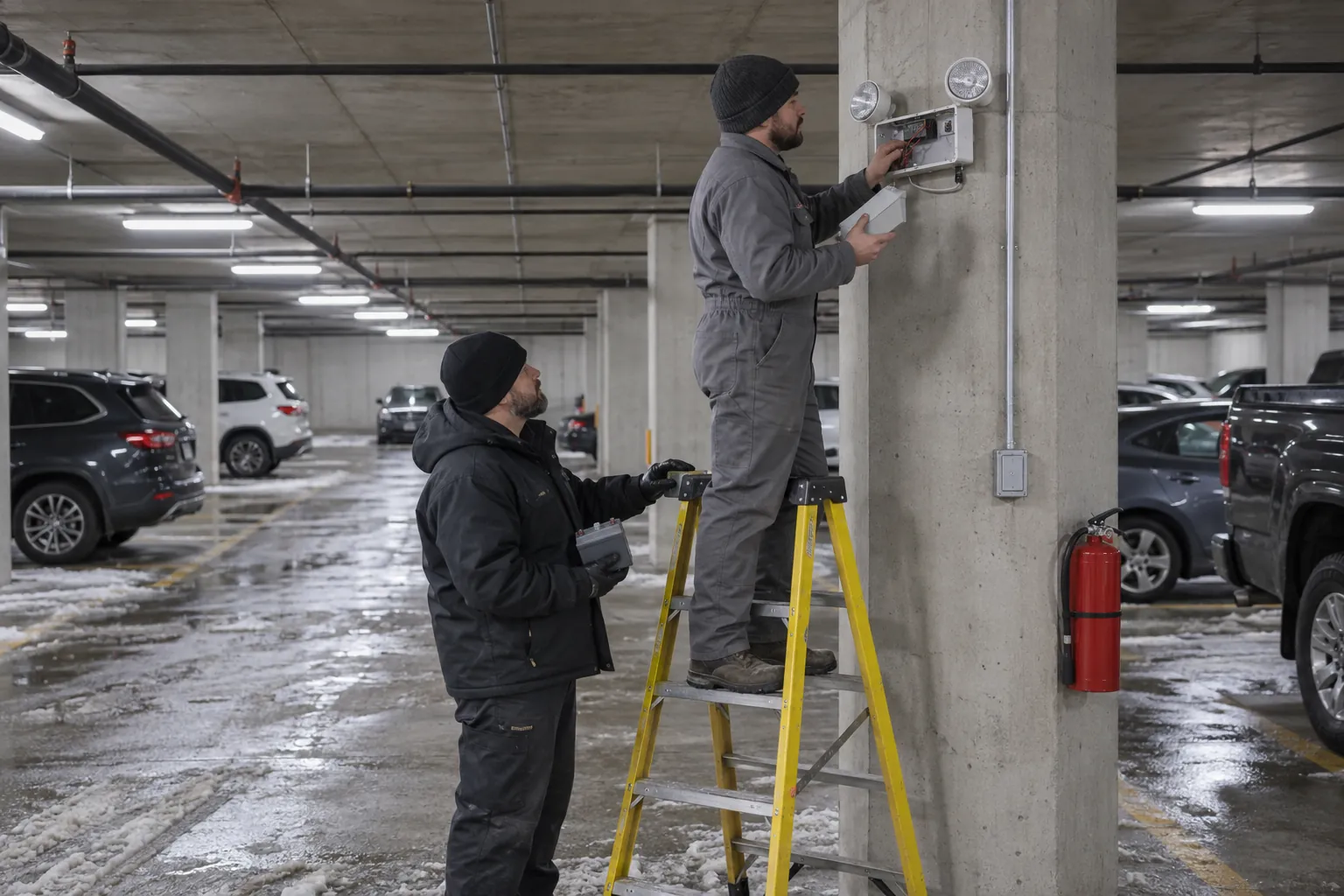
The annual test is usually done by an electrician or a fire and life safety contractor, who runs every unit on battery for the full duration, notes any that dim or go out early, then checks the charger and the recovery period as the code requires. Two practical points:
- Plan the recharge. Once the batteries are drained, the building has little or no emergency lighting until they recharge, which can take many hours. Test when the building will be empty or lightly used afterwards, or test alternate units on different days so every corridor and stair keeps some lighting.
- Expect failures. Batteries wear out, and an annual test that finds none, year after year, deserves a second look. Each failed unit needs a repair or a replacement battery or fixture, then a retest, with both on the record.
05
What the record has to show, and for how long
The National Fire Code's Division C, Article 2.2.1.2, covers records for every fire safety system. Where the code requires tests, inspections, maintenance or operational procedures, "records shall be made and the original or a copy shall be retained at the premises for examination by the authority having jurisdiction." The initial verification or test reports are kept for the life of the system; later records are kept so that at least the current and the immediately preceding ones are available; and "no record shall be destroyed within two years of having been prepared."
The provinces set their own periods on top of that:
- Ontario: Article 1.1.2.1 requires records "noting what was done and the date and time it was done," kept at the building for examination by the Chief Fire Official. Article 1.1.2.2 requires them to be kept for at least two years, so that at least the most recent and the immediately preceding record of a given test or inspection are there. Sentence 1.1.2.1(4) says electronic records that can be made readily available to the Chief Fire Official on request are deemed to comply.
- Alberta: Calgary's guide says written records for annual inspection, testing and maintenance are retained on site for five years, and its on-site records checklist lists emergency lighting as an annual record.
- Elsewhere: check your provincial or territorial code and ask the local fire department.
Whatever the period, a record the fire prevention officer will believe has the same features:
- It is made at the time, with the actual date and time and the name of the person who did the work.
- It is specific: which units were inspected and tested, by reference, and which failed, rather than a single "all OK".
- Every fault has an outcome: reported to whom, fixed when, retested by whom.
- Gaps are explained: a month missed because the building was shut is more believable than twelve identical entries.
- The annual report is filed with it, with the contractor's deficiency list and the proof each item was put right.
- Someone reads it: a property manager who looks every quarter will notice the unit that has failed three months running.
Many buildings keep emergency lighting in a combined fire safety log book with the fire alarm, extinguishers and drills. That works, as long as the emergency lighting pages are complete and current.
06
Where the emergency lighting record fails, and what SiteClara does about it
The monthly emergency lighting inspection is easy to put off. The log sits in the fire safety binder in the management office, where nobody else sees it. A property manager with a dozen buildings has no quick way to know which of them did this month's test until the fire prevention officer finds the gap.
SiteClara records checks at the location. A printed QR poster, with an optional NFC tag behind it, sits where the check is due: at a stairwell door, on each floor, in the electrical or generator room. The person doing the inspection scans the code or taps the tag on their own phone, with no app to install, sees what is due there, such as this month's emergency lighting inspection for that floor, and marks it done or says what stopped them. The time and the named person are recorded as it happens, with a photo when one is asked for. A failed or damaged unit is reported there, with a photo, and goes onto the team's list of open jobs until someone closes it.
The supervisor sees what is due, done and missed across the building or the portfolio, and records the reason a check was missed. Each day they review and approve a short report that goes to the nominated managers or client contacts the next morning, showing what was reported, completed and still open, and how the scheduled checks went.
07
Questions people ask
How often do emergency lights need to be inspected?
Self-contained emergency lighting units and exit signs with a battery back-up are inspected and tested every month, the units are given a full-duration test every 12 months, and emergency lights on a central supply and exit signs without a battery are inspected at least every 12 months. The Calgary Fire Department's Fire Safety Maintenance Requirements lists the monthly and annual checks against Articles 6.5.1.6, 6.5.1.7 and 6.5.1.8 of the Alberta edition, and adds an ongoing check that exit lighting and exit signs are illuminated while the building is occupied. The full-duration test is in Article 6.5.1.6 of the National Fire Code of Canada 2020. The City of Ottawa's Ontario Fire Code Pre-Inspection Guide expects the same rhythm in Ontario: emergency lights inspected monthly and tested annually.
Do you have to be qualified to test emergency lighting?
Yes, for the system in question, and the owner is responsible for checking. The Calgary Fire Department's Fire Safety Maintenance Requirements says people who inspect, test and maintain life safety systems "must be qualified for the specific system" and that owners are responsible for ensuring the people they hire are qualified. For emergency lighting and exit signs, it names "Building operators/maintenance personnel, fire alarm technicians and electricians." Other provinces and fire departments set their own expectations, so ask yours what it accepts.
Can I test my own emergency lighting?
Often the monthly inspection and test, yes; the annual test may need a contractor. Under the Alberta code, the Calgary Fire Department's Fire Safety Maintenance Requirements counts building operators and maintenance personnel among those qualified for emergency lighting. The City of Ottawa's Ontario Fire Code Pre-Inspection Guide expects emergency lights to be inspected monthly and tested annually "by a certified company," so in Ottawa plan on a contractor for the annual test at least, and ask the fire department who it accepts for the monthly inspection.
08
Further reading, and a list to take away
Start with the fire code where your building is. The National Fire Code of Canada 2020 and the National Fire Code of Canada 2025 are free from the National Research Council; Ontario owners read the Ontario Fire Code on e-Laws. Fire departments publish plain guides for owners: the Calgary Fire Department's Fire Safety Maintenance Requirements and the City of Ottawa's Ontario Fire Code Pre-Inspection Guide are two good examples. The equipment itself is built to CSA C22.2 No. 141, Emergency Lighting Equipment, and generator-fed systems to CSA C282, both sold by CSA Group; your contractor will have them.
Before next month's inspection, check that:
- every emergency lighting unit, remote head and battery-backed exit sign has a reference and a location on one list;
- the monthly inspection and test has a named person and a deputy, and a way to test without leaving occupants in the dark;
- the monthly record shows each unit, the date and time, who did it, and what failed;
- every failure has a matching repair and retest, with a date;
- self-test indicators, where you have them, are read and recorded each month;
- the annual duration test is booked within 12 months of the last, with time to recharge before the building fills;
- you know the design duration, and the contractor tests to it and checks the chargers afterwards;
- records are kept at the building for as long as your code requires: at least two years under the National Fire Code and in Ontario, five in Alberta according to Calgary's guide.
Sources
Every document this guide quotes or links to, in the order it first cites them.
- National Fire Code of Canada 2020 nrc.canada.ca
- National Fire Code of Canada 2025 nrc.canada.ca
- Ontario Fire Code (O. Reg. 213/07) ontario.ca
- Calgary Fire Department's Fire Safety Maintenance Requirements calgary.ca
- City of Ottawa's Ontario Fire Code Pre-Inspection Guide ottawa.ca
Related guides
 Fire and water checksFire log book: what to record, who keeps it and how long, under Canadian fire codesWhat a fire log book should hold under the Ontario Fire Code and the National Fire Code of Canada: the tests, who records them, how long to keep them, and the form.
 Fire and water checksFire alarm testing in Canada: what the owner checks, what the technician tests, and what to recordFire alarm testing in Canada: what the fire codes and CAN/ULC-S536 ask of owners daily and monthly, the annual test by a technician, and what the record must show.
 Premises and facilities managementGenerator testing: what CSA C282 and the fire code require, and how to show it was doneEmergency generator testing in Canadian buildings: what the fire code and CSA C282 require, the weekly and monthly checks, shutdowns, fuel and the records to keep.
 Fire and water checksFire extinguisher inspection: the monthly check, the service and the recordsWhat a monthly fire extinguisher inspection covers under the National Fire Code of Canada, the Ontario Fire Code and NFPA 10, and what the records must show.