Premises and facilities management
Building maintenance checklist: what to check, how often, and who does it
A building maintenance checklist is a schedule of the routine inspections, servicing and repairs that keep a building safe and in good repair, listed by how often each task is done and who does it.
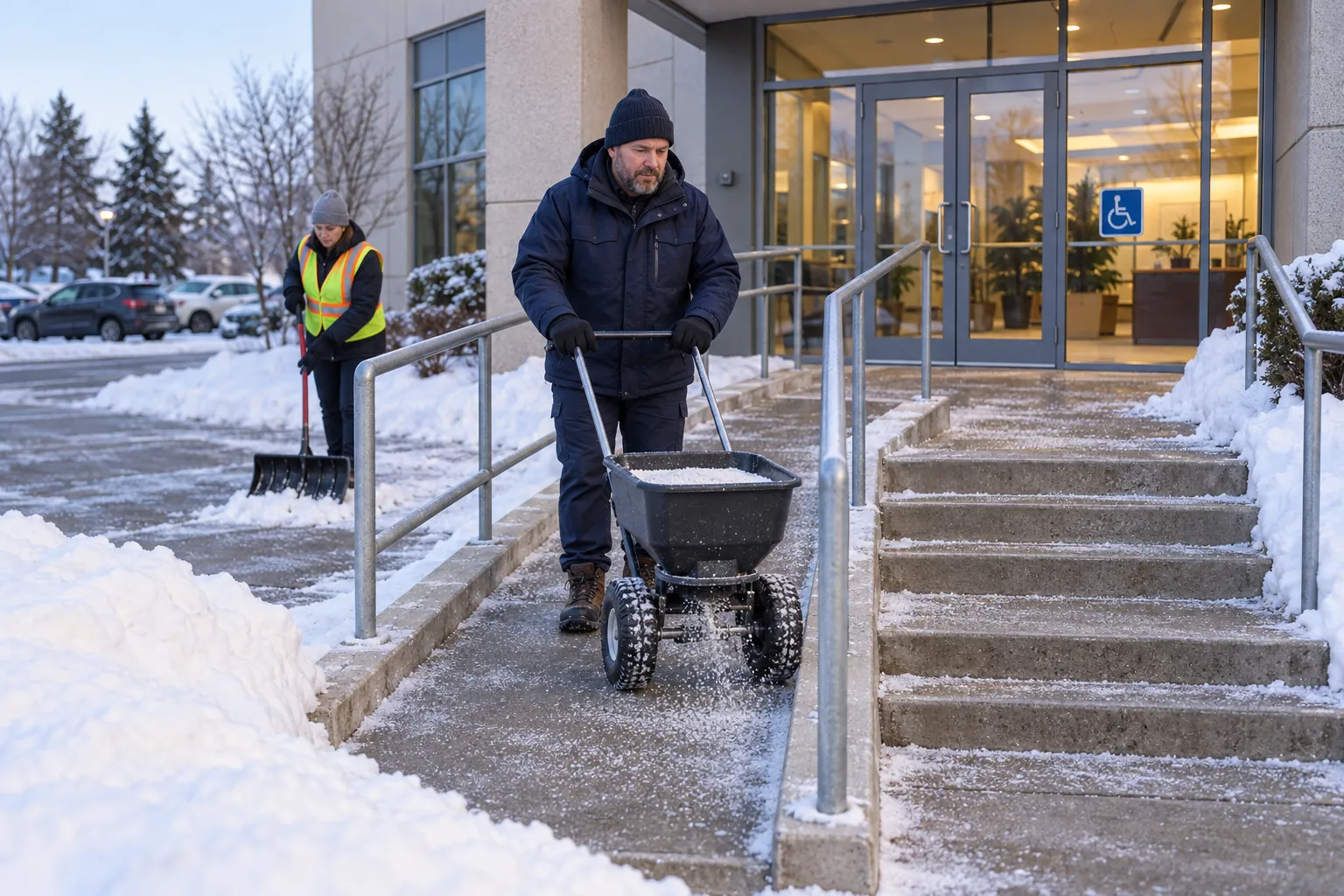
This one is written for Canadian offices, schools, retail plazas, apartment buildings and condominiums, from the daily walk-through to the annual inspections, with the seasons that shape the work in this country, and it marks the items that need a licensed technician or contractor rather than the building staff.
01
The duty behind a building maintenance checklist
In Canada the duty to maintain a building comes from three directions at once, and most of it is provincial or municipal rather than federal.
Municipal property standards. Many Canadian municipalities have a property standards (or maintenance standards) bylaw, passed under provincial law. In Ontario, section 15.1 of the Building Code Act, 1992 lets a council pass a bylaw "prescribing standards for the maintenance and occupancy of property" and "requiring property that does not conform with the standards to be repaired and maintained". Under section 15.2, an officer may inspect and order repairs, and under section 15.4 the municipality may carry out the repair if the order is not met, with a lien on the land for the cost. Toronto's version, Toronto Municipal Code Chapter 629, Property Standards, "applies to all property in the City of Toronto", commercial as well as residential, and requires the owner to "repair, maintain and keep clean the property in accordance with the standards and take immediate action to eliminate any unsafe condition".
The fire code. Each province and territory sets its own fire code. The National Fire Code of Canada 2025 is one of the national model codes published by the National Research Council of Canada, and the NRC's own advice is to ask the provincial or territorial authority which codes apply where the building is. In Ontario it is the Ontario Fire Code, O. Reg. 213/07, which sets many of the routine checks in this guide and says, in Division B, Sentence 1.1.2.1.(1), that where the code requires tests or corrective measures, "records shall be made noting what was done and the date and time it was done".
Workplace law. Where people work in the building, the province's occupational health and safety law applies. Ontario's Occupational Health and Safety Act, clause 25(1)(b), requires an employer to ensure that equipment, materials and protective devices it provides "are maintained in good condition", and section 11 of R.R.O. 1990, Reg. 851, Industrial Establishments requires a floor or other surface used by any worker to be kept free of "obstructions", "hazards" and "accumulations of refuse, snow or ice". In British Columbia, section 4.39 of the OHS Regulation, Part 4 says floors, platforms, ramps, stairs and walkways "must be maintained in a state of good repair and kept free of slipping and tripping hazards". Federally regulated workplaces, such as banks and airports, come under Part II of the Canada Labour Code instead.
Who owns the checklist depends on the building. In an owner-occupied office or school it is usually the facility manager, building operator or head custodian. In a multi-tenant building the property management company usually looks after the common areas and central plant, and each tenant its own space, as the lease sets out. In an Ontario condominium, section 90 of the Condominium Act, 1998 says "the corporation shall maintain the common elements and each owner shall maintain the owner's unit", subject to the declaration. Whoever it is, the checklist should name them.
02
What a building maintenance checklist covers
A complete checklist for a commercial, institutional or multi-residential building covers four areas, inside and out:
- Building envelope and structure: roof membranes and drains, flashing, eavestroughs and downspouts, exterior walls and caulking, windows and doors, balconies, and the parking garage slab.
- Building systems: heating (boilers, furnaces, unit heaters), ventilation and air conditioning (rooftop units, make-up air, air handlers), plumbing and drainage (hot water tanks, sump pumps, floor drains), electrical rooms and panels, lighting, elevators and emergency power.
- Life safety systems: fire alarm, sprinklers and standpipes, portable extinguishers, emergency lighting and exit signs, fire separation doors, and kitchen hood suppression where there is a commercial kitchen.
- Grounds and seasonal work: walkways, stairs and ramps, parking lots, catch basins, exterior lighting, garbage enclosures, landscaping, and snow and ice control.
The tasks split into two kinds. Building staff checks are visual checks and simple tests that a superintendent, building operator or custodian can do after training: walking the exits, checking fire doors close and latch, testing the sump pump float. Technician and contractor work needs a specific licence, certificate or registration, or a competence set by a standard: the annual fire alarm inspection, sprinkler testing, elevator maintenance, gas appliance servicing. In the lists below, items marked (T) are for a qualified technician or contractor. Regular care of the building staff items is what keeps small faults, such as a dripping plumbing fitting or a blocked roof drain, from becoming long-term damage.
CCOHS, in its fact sheet on effective workplace inspections, advises extra attention to items that wear, heat or corrode, and to areas nobody works in regularly, such as parking lots and storage areas.
03
Daily and weekly checks
Daily, usually as a walk-through when the building opens, and again at closing for security:
- exits, corridors and stairwells clear: the Ontario Fire Code, Sentence 2.7.1.7.(1), requires means of egress to be "maintained in good repair and free of obstructions";
- doors in fire separations closed when not in use, not wedged or propped (Sentence 2.2.3.4.(1)), and the area around them kept clear (Sentence 2.2.3.4.(5));
- exit signs lit while the building is occupied (Article 2.7.3.2.) and lighting in exits and corridors working (Sentence 2.7.1.7.(2));
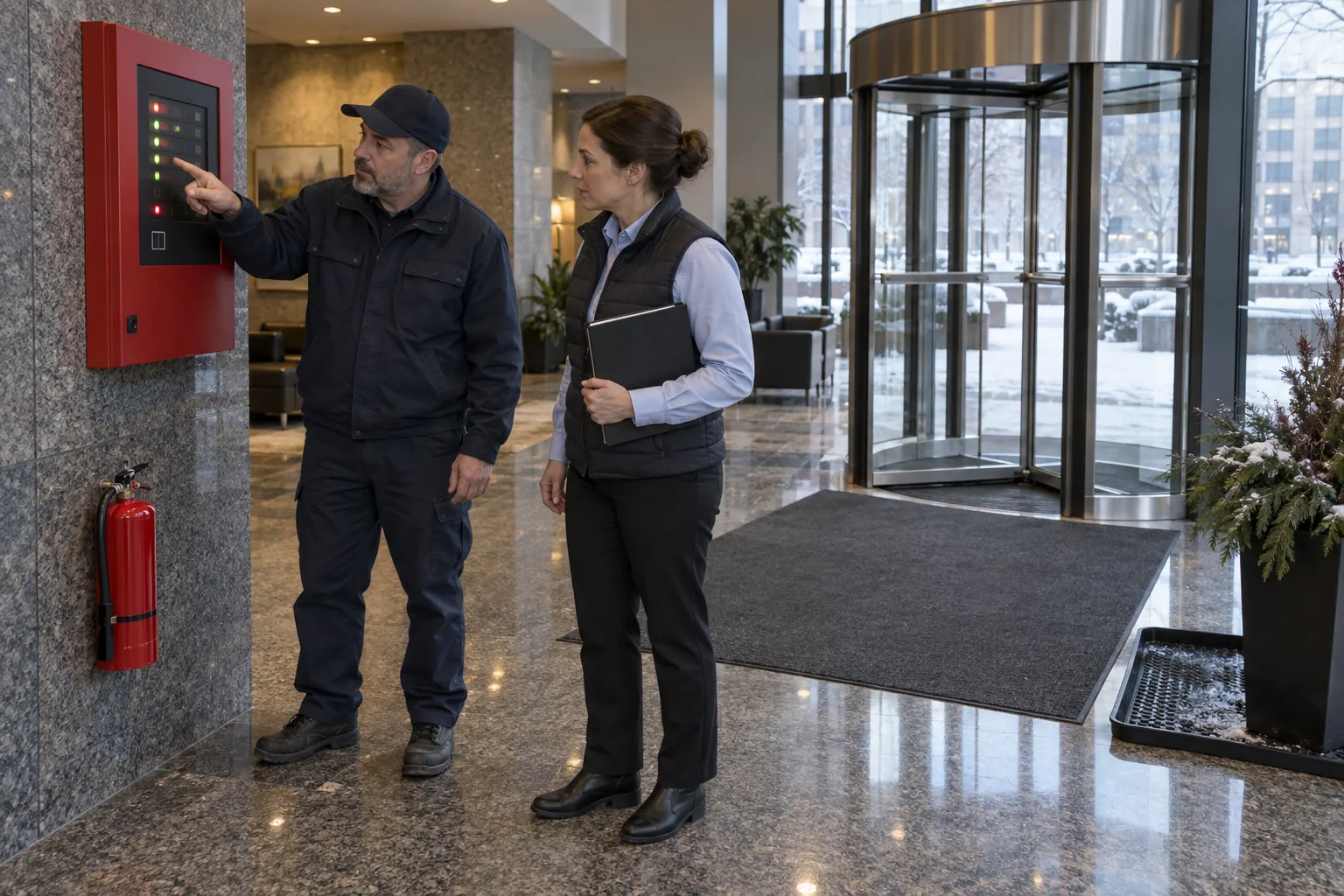
- fire alarm panel showing normal, with no trouble signals left unexplained;
- entrances, lobbies and floors dry and free of trip hazards, with mats down in wet or snowy weather;
- exterior stairs, ramps and walkways clear: Sentence 2.7.1.8.(1) requires exterior passageways, exterior stairways and fire escapes to be "kept free of snow and ice accumulations";
- washrooms working, with no leaks or blockages, and cleaned to schedule (in Ontario, many workplaces must now post their washroom cleaning records or make them available electronically: see our washroom cleaning checklist);
- no alarms on the building automation system;
- elevators in service, with the car phone and lighting working;
- garbage rooms tidy.
Weekly:
- mechanical and electrical rooms walked for leaks, noises, smells and alarms, and kept free of storage;
- in a commercial kitchen, hoods, ducts and filters checked for grease "at intervals not greater than seven days" (Sentence 2.6.1.3.(1));
- the fire alarm checks your contractor and fire alarm testing program call for between annual inspections;
- sump pits and floor drains checked, especially after heavy rain;
- parking garage walked: lighting, drains, standing water and spalling concrete;
- exterior: walkways, parking lot, fences, exterior lighting and graffiti, which Toronto's Chapter 629 requires to be removed;
- first aid kits restocked.
These frequent checks catch most of the problems that turn into complaints, and they are the ones most often done without a record. A walk-through that finds nothing is still worth recording.
04
Monthly checks, and the seasons
Monthly, with the Ontario Fire Code reference where there is one:
- every door that forms part of a means of egress checked to ensure it is operable (Sentence 2.7.2.3.(1));
- every door in a fire separation inspected (Sentence 2.2.3.4.(4)): closer, latch, seals and hardware; see our guide to fire door inspection;
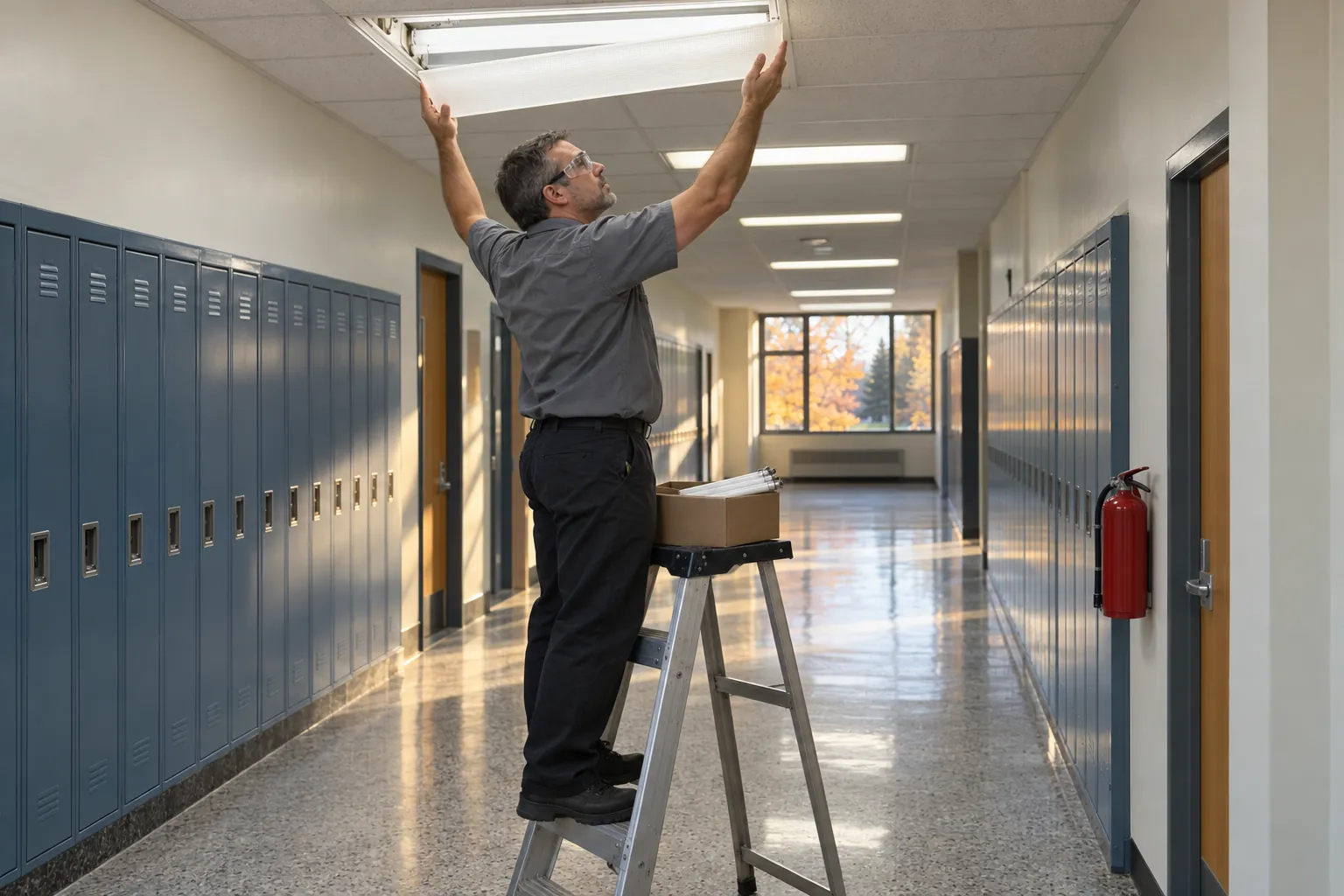
- self-contained emergency lighting units inspected and tested on simulated power failure "at intervals not greater than one month" (Article 6.7.1.6.), and exit signs with battery back-up inspected monthly (Sentence 6.7.1.8.(2));
- portable extinguishers inspected monthly (Article 6.2.7.2.), with maintenance and testing to NFPA 10 (Article 6.2.7.1.); see our fire extinguisher monthly inspection guide;
- the standby generator run and inspected as CSA C282 and the manufacturer require, the code requiring emergency power systems to be maintained in conformance with that standard (Sentence 6.7.1.1.(1)); see generator testing;
- HVAC filters checked and changed on the manufacturer's schedule (T where the plant needs it);
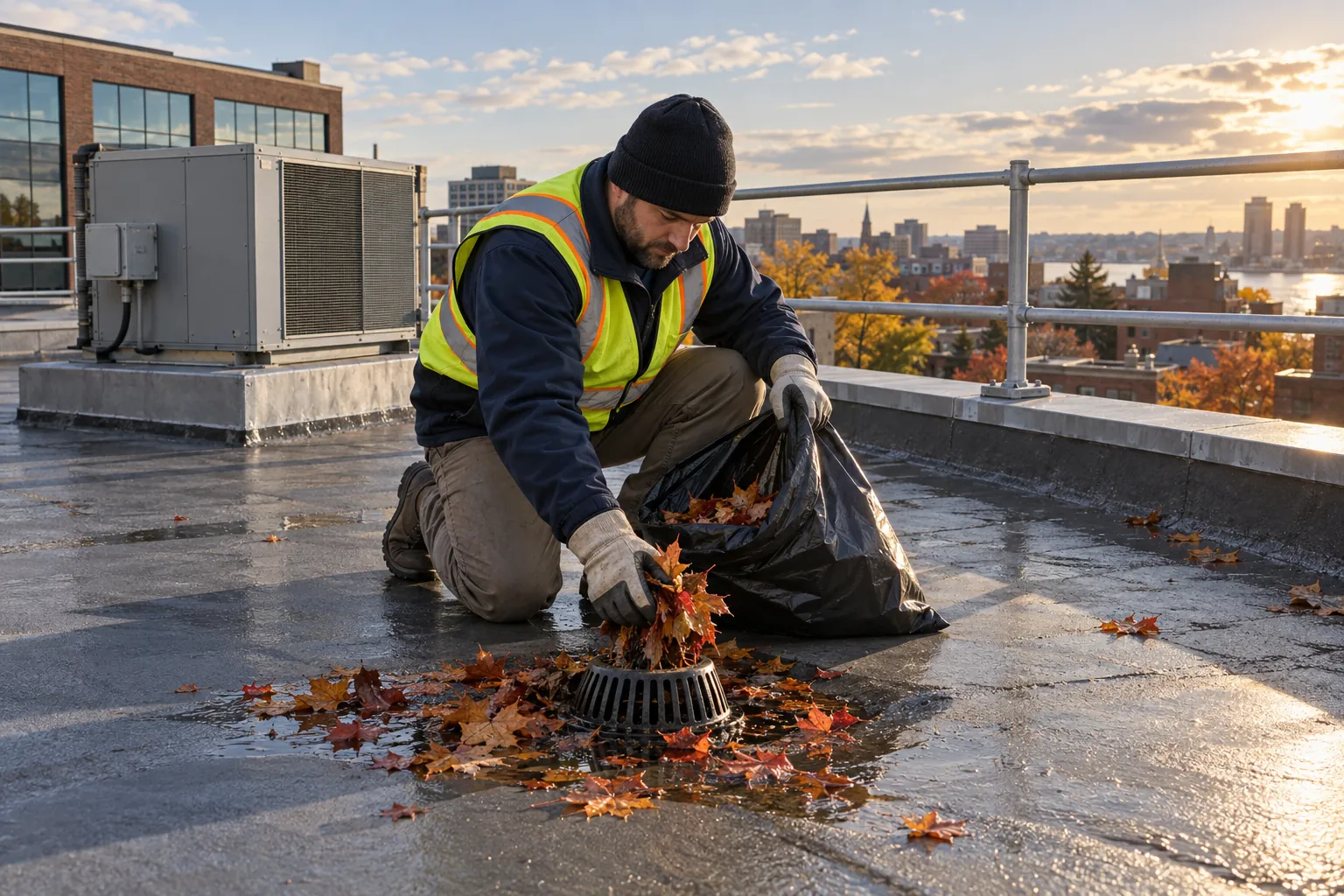
- roof drains and eavestroughs looked at from a safe viewpoint, more often in the fall;
- hydrants on the property kept free of snow and ice in winter (Article 6.6.4.2.).
In Canada the calendar matters as much as the frequency. A useful checklist has a seasonal page:
- Spring, after the thaw: walk the roof and the roof drains (see our roof inspection checklist); check eavestroughs and downspouts for ice damage; wash road salt off the parking garage slab and check for spalling; clear catch basins; check grading and drainage away from the foundation; start up and service the cooling equipment (T).
- Fall: heating start-up and boiler service (T); clean eavestroughs after leaf fall; shut off and drain exterior hose bibs and irrigation; check weather-stripping; line up snow removal and salt supply. Our winterization checklist covers this in detail.
- Winter: snow and ice control on every walkway, stair, ramp and exit, with a snow removal log; watch for ice dams and heavy snow on roofs, since Toronto's Chapter 629 requires roofs to be free from "dangerous accumulation of ice and snow"; keep unit heaters in garages, loading docks and stairwells running so pipes do not freeze.
05
Annual work, and the items for a qualified technician
Most of the items on this part of the checklist are carried out by a technician or contractor. Building staff make sure they are booked and that every deficiency reported is fixed.
- Fire alarm system (T): inspected and tested in conformance with CAN/ULC-S536, Standard for Inspection and Testing of Fire Alarm Systems (Ontario Fire Code, Sentence 6.3.2.2.(1)), with a description of the system kept current in the building (Sentence 6.3.2.2.(3)).
- Sprinklers and standpipes (T): inspected, tested and maintained by a qualified contractor; the code deems compliance with NFPA 25 to satisfy its own standpipe requirements (Article 6.4.1.6.). See our guide to sprinkler system inspection.
- Emergency lighting (T or trained staff): self-contained units tested "at intervals not greater than 12 months" for their full design duration under simulated power failure (Clause 6.7.1.6.(2)(b)), and other emergency lights inspected at the same interval (Article 6.7.1.7.).
- Chimneys, flues and flue pipes (T): inspected "at intervals not greater than 12 months" and whenever an appliance is added (Sentence 2.6.1.4.(1)).
- Boilers, furnaces and gas appliances (T): serviced before the heating season by a licensed gas technician or the boiler contractor.
- Elevators (T): maintained by the elevator contractor.
- Asbestos: where asbestos-containing material is present in an Ontario building, the owner must inspect it "at reasonable intervals in order to determine its condition" and update the record "at least once in each 12-month period", under section 8 of O. Reg. 278/05, Designated Substance – Asbestos on Construction Projects and in Buildings and Repair Operations.
- Roof (T where access needs it): a close inspection of the membrane, flashing, drains and rooftop units, ideally spring and fall.
- Building envelope: a walk of every elevation for cracked masonry, failed caulking, loose cladding and anything that could fall: Toronto's Chapter 629 requires exterior walls to be kept "free from loose or unsecured objects and materials".
- Fire safety plan: where the building needs one, the Ontario Fire Code requires it to be reviewed "as often as necessary, but at least every 12 months" (Sentence 2.8.2.1.(4)); see our guide to the fire safety plan.
Keep the reports. In Ontario, Article 1.1.2.2. of the fire code requires any record the code calls for to be kept at the building "for a period of at least two years after being prepared", and so that "at least the most recent and the immediately preceding record of a given test or inspection are retained". Electronic records that can be made readily available to the Chief Fire Official on request are deemed to comply (Sentence 1.1.2.1.(4)).
Replacement of the big items belongs in a capital plan or a condominium's reserve fund study. For how the scheduled service work fits together, see our preventive maintenance checklist; for the statutory side, our building compliance checklist.
06
Where the checklist fails, and what SiteClara does about it
The annual items usually have good records, because the contractor leaves a report. It is the daily, weekly and monthly checks that fail: a sheet initialled a week at a time, a wedged fire door mentioned to whoever was passing, a sump pump alarm nobody followed up. When a fire prevention officer, an insurer or a condo board asks when a check was last done, and by whom, nobody can say.
SiteClara records those routine checks where they happen. A printed QR poster at each location, such as a mechanical room, a stairwell exit, a washroom or a parking level, with an NFC tag behind it if you want staff to tap, lets staff scan or tap on their own phone, with no app to install, to see the checks due there and mark each one done or say what stopped them, such as a locked electrical room. The named person and the time are recorded as it happens, with a photo when the check asks for one. A problem, such as a blocked roof drain or a damaged handrail, is reported there with a photo and goes onto the team's list of jobs until someone closes it.
The supervisor sees what was due, done and missed across the building, and records the reason a check was missed. Each day the supervisor reviews and approves a report that goes to nominated management or client contacts at 8 a.m. the next morning, showing what was reported, completed and still open, and how the scheduled checks went, for example 12 of 12 completed.
07
Questions people ask
How do you create a preventive maintenance checklist?
Start from the building, not from a generic list. CCOHS, in Effective Workplace Inspections, says the schedule should state "when to inspect each area or item within the workplace, who carries out the inspection, what degree of detail to inspect each area or item", and that how often depends on the law where you are, past incidents, the work done, the equipment, the shifts and any new process or machinery. List every system and area, give each task a frequency from the fire code, the bylaw, the standard or the manufacturer, name who does it, and say where a fault goes when a check finds one.
Is there a free building maintenance checklist template?
CCOHS publishes sample inspection checklists, starting with Inspection Checklists – General Information, which covers buildings, electrical, fire protection equipment, walkways and roadways, and hygiene and first aid facilities among its headings, with separate samples for offices and outdoor areas. They are safety inspection lists rather than maintenance schedules, and CCOHS itself says "the best checklist for your workplace is one that has been developed for your specific needs", so use them alongside the frequencies in this guide.
What does a residential building maintenance checklist add?
Mostly the items tenants live with. Toronto's Toronto Municipal Code Chapter 629, Property Standards is an example: section 629-38 requires every dwelling and dwelling unit to have a heating system "capable of maintaining a room temperature of 21 degrees Celsius" in all habitable rooms, bathrooms and toilet rooms, and air-conditioning systems to be operated from June 1 to September 30 to keep the indoor temperature at not more than 26 degrees Celsius; section 629-9 requires all properties to be "kept free of pests". So an apartment building's checklist adds heating and cooling checks in the units, pest control, and the repairs tenants report, on top of the common areas and life safety systems.
08
Further reading, and a list to take away
Start with the rules where the building is: your municipality's property standards bylaw (in Toronto, Chapter 629), your province's fire code (in Ontario, the Ontario Fire Code, especially Section 2.7 on exits and Part 6 on fire protection equipment), and the National Fire Code of Canada 2025 where your province follows it. For the workplace side, read your province's occupational health and safety rules on floors, walkways and equipment. Your contractors should work to the edition of each standard your code names.
Before you adopt a building maintenance checklist, check that:
- it covers the envelope, the building systems, the life safety systems and the grounds;
- each task has a frequency, and the frequency comes from the fire code, a bylaw, a standard or the manufacturer;
- it has a seasonal page: spring thaw, fall start-up, and snow and ice;
- technician and contractor items are marked, booked and tracked to completion;
- each task names who is responsible: owner, property manager, superintendent, tenant or contractor;
- faults found on a check have a route to someone who will fix them;
- the daily, weekly and monthly checks are recorded with the date and time, not only the annual ones;
- records are kept at the building, on paper or electronically, for as long as the code requires;
- it is reviewed when the building, its use or its equipment changes.
Sources
Every document this guide quotes or links to, in the order it first cites them.
- Building Code Act, 1992 ontario.ca
- Toronto Municipal Code Chapter 629, Property Standards toronto.ca
- National Fire Code of Canada 2025 nrc.canada.ca
- Ontario Fire Code, O. Reg. 213/07 ontario.ca
- Occupational Health and Safety Act ontario.ca
- R.R.O. 1990, Reg. 851, Industrial Establishments ontario.ca
- OHS Regulation, Part 4 worksafebc.com
- Condominium Act, 1998 ontario.ca
- Effective workplace inspections ccohs.ca
- O. Reg. 278/05, Designated Substance – Asbestos on Construction Projects and in Buildings and Repair Operations ontario.ca
- Inspection Checklists – General Information ccohs.ca
- Offices ccohs.ca
- Outdoor areas ccohs.ca
Related guides
 Premises and facilities managementPreventive maintenance checklist: what to include, how often, and how to show it was doneA preventive maintenance checklist for Canadian buildings: what the fire code and provincial law require, what to include, how often, and the records to keep.
 Premises and facilities managementWinterization checklist: getting a building ready for a Canadian winterA winterization checklist for Canadian buildings: the freeze checks the fire code asks for, heating, plumbing, roofs, grounds, outdoor staff and the records to keep.
 Premises and facilities managementRoof inspection checklist: what to check, how often, and how to do it safelyA roof inspection checklist for commercial buildings in Canada: what to check, how often, who goes up, and the provincial fall protection rules on a roof.
 Premises and facilities managementBuilding compliance checklist: the legal picture for a Canadian buildingA building compliance checklist for Canadian commercial buildings: fire code, OHS, asbestos, elevators, boilers, accessibility and energy, who holds each duty.