Premises and facilities management
Ladder inspection checklist: what to check, how often, and the rules in Canada
A ladder inspection checklist is a list of the defects to look for before a ladder is used, such as missing or loose rungs, cracked, bent or twisted rails, worn non-slip feet, faulty spreaders and locks, corrosion and missing labels, so that a damaged ladder is tagged and taken out of service instead of climbed.
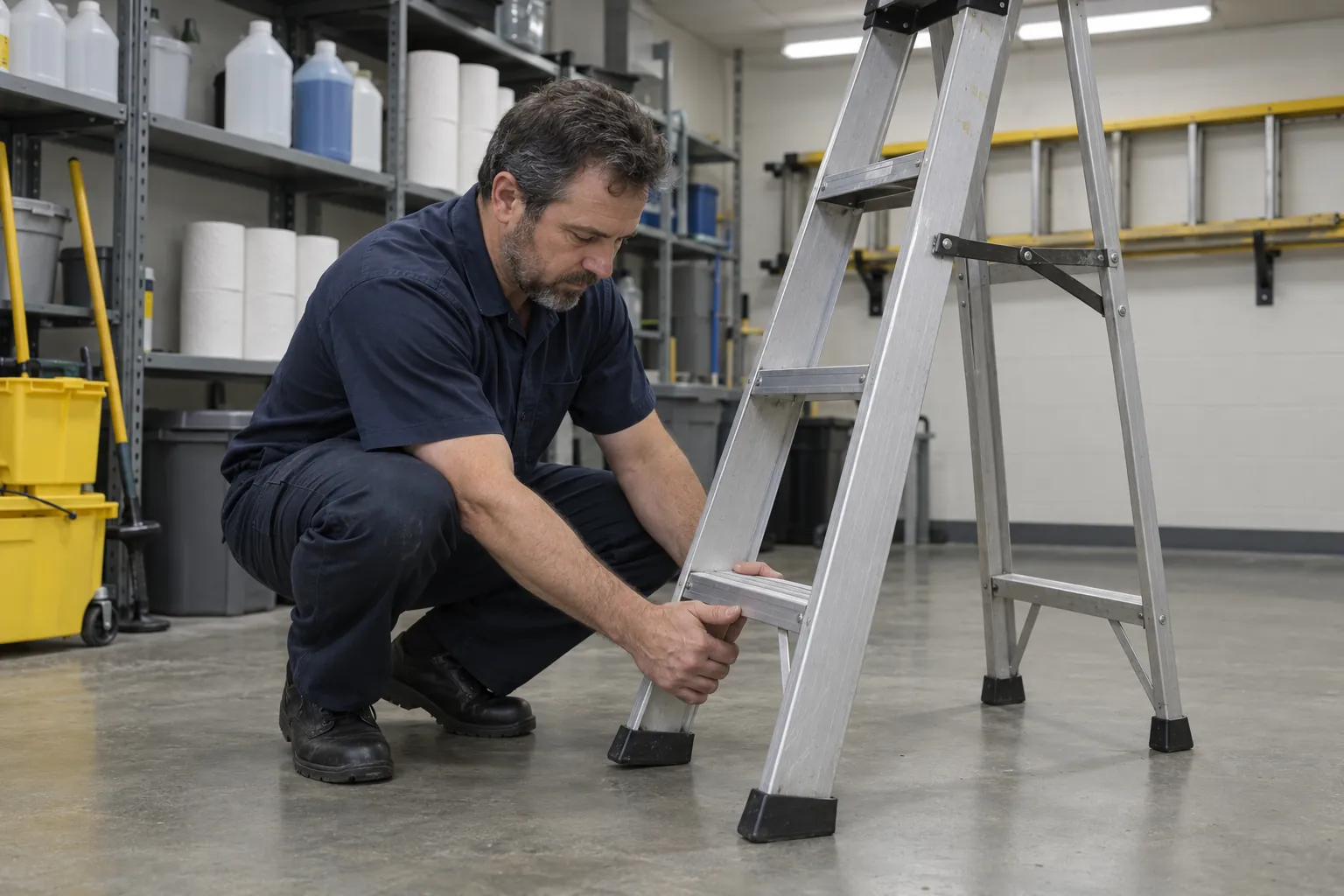
Ladders are among the most ordinary tools in a building: the custodian changing a light, the building operator reaching a ceiling access panel, the contractor up an extension ladder at the loading dock. Because they are ordinary, they are rarely looked at closely until one slips or folds. In Canada the rules that require a ladder to be sound are mostly provincial, and British Columbia requires a ladder to be inspected before use on each shift. This guide covers what Ontario, British Columbia, Alberta and federally regulated workplaces require, what a practical checklist includes for each type of ladder, how often to inspect, what to do with a defective ladder, and how to keep a record that shows the checks were done.
01
What the law says about ladders in Canada
Workplace safety law in Canada is mostly provincial, so the ladder rules that apply depend on where the building is. Federal rules cover only federally regulated workplaces, such as banks, airports and telecommunications. Everywhere, a ladder must be kept free of defects and taken out of use when it is not sound, and most jurisdictions also name the standard it is built to. The CCOHS fact sheet Ladders – Inspection notes that "most jurisdictions require that ladders be inspected before use".
In Ontario, the Occupational Health and Safety Act defines an industrial establishment as "an office building, factory, arena, shop or office", so most commercial buildings fall under the Industrial Establishments regulation (R.R.O. 1990, Reg. 851). Section 73 says a portable ladder shall "be free from broken or loose members or other faults", have non-slip feet and be placed on a firm footing. A ladder longer than six metres that is not securely fastened must be held by a worker while it is used, and an unfastened ladder is set with its foot between a quarter and a third of its length out from below the top support. The Act adds two general duties: under section 25(1)(b) the employer ensures that equipment it provides is "maintained in good condition", and under section 28(1)(c) a worker reports to the employer or supervisor any defect in equipment that may endanger them or another worker.
Where the work is a construction project, such as a renovation or fit-out inside an occupied building, the Construction Projects regulation (O. Reg. 213/91) applies instead. Section 79 requires a ladder to be "designed, constructed and maintained so as not to endanger a worker", section 80 requires a portable ladder at a project to be manufactured and to meet the requirements for a Grade 1, 1A or 1AA ladder in CSA Standard Z11-12, Portable Ladders (a custom-built single ladder is allowed only within strict limits), and section 81 requires it to be free from defective or loose rungs and used in accordance with the manufacturer's instructions.
In British Columbia, Part 13 of the Occupational Health and Safety Regulation sets an express inspection rule. Section 13.3 says a ladder "must be inspected before use on each shift, and after any modification, and any condition that might endanger workers must be remedied before the equipment is used." Section 13.2 requires a ladder to meet the CSA or ANSI standard in effect when it was manufactured, and section 13.4 requires a manufactured portable ladder to be marked for its grade of material and intended use.
In Alberta, Part 8 of the Occupational Health and Safety Code requires a portable ladder manufactured on or after July 1, 2009 to meet CSA Standard CAN3 Z11-M81 (R2005) or the 2007 editions of ANSI A14.1, A14.2 or A14.5 (section 135), forbids painting a wooden ladder other than with a transparent coating (section 126), and requires a non-conductive ladder when energized electrical equipment is serviced (section 127). For federally regulated workplaces, section 3.11 of the Canada Occupational Health and Safety Regulations requires commercially manufactured portable ladders to meet CSA Standard CAN3-Z11-M81 and forbids working from the three top rungs of a single or extension ladder or the two top steps of a stepladder.
The standards named in the regulations differ by age. The current edition, which the CCOHS fact sheet Ladders – Portable refers to, is CSA Z11-18 (R2022), Portable Ladders; buy to it.
02
What a ladder inspection checklist covers
The CCOHS inspection fact sheet is a good starting point in Canada, because it lists the defects by type of ladder; the checklist below builds on it, so that the user can confirm the ladder is safe before climbing it. Every item has the same answer when it fails: the ladder is not used.
- Every ladder: missing or loose steps or rungs; damaged or worn non-slip feet; loose nails, screws, bolts or nuts; cracked, split, worn or broken rails, braces, steps or rungs; twisted or distorted rails; sharp edges, rough or splintered surfaces; corrosion, rust or excessive wear, especially on the treads; and missing identification labels.
- By material: rot, decay or warped rails on a wooden ladder, and paint or an opaque coating that would hide a crack; cracks and exposed fibreglass on a fibreglass ladder; dents, bends and corrosion on an aluminum ladder.
- Stepladders: wobble when it is opened on a level floor; loose or bent hinges and hinge spreaders; a broken stop on a spreader; spreaders that do not lock; a loose pail shelf.
- Extension ladders: loose, broken or missing extension locks, or locks that do not set properly; worn or frayed ropes, cords or chains; a pulley or other moving parts that do not run freely; missing or defective pads or sleeves on the rail ends.
- Fixed access ladders, such as those to a roof hatch, mezzanine or mechanical platform: loose, worn or damaged rungs and side rails; a damaged or corroded cage; loose anchorages to the wall; slippery or cluttered landings; and a safety gate that closes.
- Labels and rating: the manufacturer's safety labels, the CSA or ANSI marking and the grade or duty rating are present and readable, and the rating suits the user, their tools and the task. A ladder whose label is missing or damaged cannot show its rating, so it is not used until the rating is confirmed.
- The setting: the ladder is the right height for the job, the floor where it will stand is firm, level and dry, and it will not be used near overhead electrical lines or energized equipment unless it is non-conductive.
The CCOHS fact sheet Ladders – Step adds the set-up checks: spreaders and shelf fully open and locked, feet on "a firm, level, and non-slippery surface", and "you have climbed too high if your knees are above top cap of the stepladder".
03
How often ladders should be inspected
The CCOHS fact sheet gives four triggers for an inspection; a building adds a fifth, for the record.
- On delivery. "Inspect new ladders promptly upon receipt", says CCOHS, and confirm the label and rating before the ladder joins the fleet.
- Before each use. CCOHS says "inspect ladders before each use", and in British Columbia section 13.3 requires an inspection before use on each shift. This is the user's look over the rungs, rails, feet, locks and spreaders, and it is quick.
- After a fall or a drop. A ladder that has been dropped or has fallen is inspected before it is used again; in British Columbia, so is one that has been modified.
- Before storage. CCOHS advises inspecting ladders before storing them, so that a damaged one is not put back on the rack for someone else to find.
- A scheduled, recorded inspection. No Ontario regulation fixes a number of weeks, but an employer that has to show its equipment is "maintained in good condition" needs a record that a competent person looked at each ladder. The interval belongs in the employer's own program; monthly or quarterly is a sensible choice, with heavier use, outdoor storage or a vehicle rack calling for the shorter interval. For fixed ladders, the CCOHS fact sheet Ladders – Fixed Access advises inspecting "periodically, and at least annually".
Storage affects how often defects appear. The CCOHS fact sheet Ladders – Storage and Handling advises storing ladders out of the weather, supported horizontally on racks or wall mounts every 2 m (6 ft). A ladder left in a parkade stairwell through the winter, or riding loose on a service truck, needs inspecting more often than one hung in the custodial room.
04
Who inspects, and what happens to a defective ladder
In most buildings, ladders are shared by the custodial team, the building operator and the superintendent, so responsibility has to be written down.
- The employer provides ladders built to the standard, keeps them in good condition, sets the schedule and trains workers.
- The supervisor, such as the custodial supervisor, chief building operator or property manager, makes sure the scheduled inspections happen, reads the results, and decides whether a damaged ladder is repaired by someone the manufacturer authorizes or destroyed.
- The worker checks the ladder before climbing it and, in Ontario, reports any defect to the employer or supervisor under section 28(1)(c) of the Act.
- The joint health and safety committee or health and safety representative can include the ladder store and ladders in use in its regular workplace inspections; see the guide to workplace inspections for JHSCs.
When a ladder fails a check, the CCOHS advice is plain: "Tag any defective ladders and take them out of service." In practice that means:
- Stop using it, and attach a tag that reads "Do not use" with the date, the defect and who found it.
- Move it out of the storeroom, or lock it away, so nobody takes it by habit. A tag on a ladder still standing in the rack is easily missed.
- Report it to the supervisor, who decides whether it can be repaired. CCOHS warns, "Do not make temporary or makeshift repairs", and says ladders that cannot be repaired safely by a person authorized by the manufacturer are destroyed.
- If it is destroyed, make sure it cannot be used again, and take it off the ladder list.
- If it is repaired, inspect it again before it returns to service and record that it was.

05
What a good ladder inspection record looks like
The CCOHS fact sheet on fixed ladders says "keep a record of every inspection", and the same sense applies to portable ladders. A record has two jobs: to show the inspections happened, and to show what was found and what was done about it.
- Which ladder: each ladder numbered or named, such as "8 ft fibreglass stepladder, B2 custodial room", so an entry points to one ladder rather than "ladders".
- When and who: the date and time of the inspection and the named person who did it, not a company or a department.
- The result: passed, or failed with the defect described, against the checklist for that type of ladder.
- A photograph where it helps, such as the label and rating, or the damaged foot or cracked rail on a ladder that failed.
- The action on each failed ladder: tagged, removed, repaired by whom and when, or destroyed.
Checking the record is part of the job: compare the ladder list with what is actually in the storerooms, the parkade and the service trucks, because ladders go missing and new ones arrive unannounced.
A good record is also honest about a missed inspection. "Ladder 4 not inspected: out on loan to the roofing contractor, checked on return" is worth more than a row of ticks for a ladder that was not in the building.
06
Where ladder inspection records fail, and what SiteClara does about it
Ladder records fail quietly. The inspection sheet taped inside the storeroom door is filled in for the month on the first day, or ticked from memory at the end. A damaged stepladder is mentioned to whoever was passing, put back in the corner, and found by the next person on the night shift. The quarterly inspection lapses when the person who did it moves on.
SiteClara records work at the location. A printed QR poster, with an optional NFC tag behind it, goes where the checks happen, such as the custodial room or the maintenance storeroom where the ladders are kept. Staff scan or tap on their own phone, with no app to install, see the checks due there, and mark each one done, with a photo when one is asked for, such as the label of each ladder. The time and the named person are recorded as it happens. If something stopped the check, such as a ladder out with a contractor, they say so, and the reason is recorded against that check.
Anyone on the team can report a problem at a location, such as a stepladder with a cracked rail, with a photo; it goes on the team's list of jobs and stays there until someone closes it. Checks can be scheduled, such as a monthly ladder inspection, and a missed one shows as missed. The supervisor adds a note and approves a daily report that goes to nominated management or client contacts the next morning, showing what was checked, what was reported and what is still open.
07
Questions people ask
How often do ladders have to be inspected?
Before each use, as a quick check by the user: the CCOHS fact sheet Ladders – Inspection says "inspect ladders before each use", and in British Columbia section 13.3 of the OHS Regulation requires an inspection before use on each shift and after any modification. Ontario's Act and regulations require a ladder to be free of faults and maintained in good condition without fixing an interval, so employers set a scheduled, recorded inspection in their own program, and the CCOHS fact sheet Ladders – Fixed Access advises inspecting fixed ladders "periodically, and at least annually".
What should be included in a ladder inspection checklist?
The defects that make a ladder unsafe to climb, by type of ladder. The CCOHS fact sheet Ladders – Inspection lists, for every ladder, "missing or loose steps or rungs", "damaged or worn non-slip feet", "loose nails, screws, bolts or nuts" and "worn or loose or faulty spreaders, locks, and other metal parts in poor repair", among others. It also says when to inspect: on receipt, before each use, after a ladder has been dropped or has fallen, and before storage.
Do ladders need inspection tags?
A defective ladder does: the CCOHS fact sheet Ladders – Inspection advises, "Tag any defective ladders and take them out of service." A tag on a serviceable ladder, with the date of each scheduled inspection and the inspector's initials, is good practice rather than a requirement of the Ontario, British Columbia, Alberta or federal rules described in this guide, and it only works if the inspections behind it are actually done and recorded.
08
Where to read more, and a checklist to take away
In Ontario, read section 73 of the Industrial Establishments regulation, sections 78 to 84 of the Construction Projects regulation for construction work, and sections 25 and 28 of the Occupational Health and Safety Act. In British Columbia, read Part 13 of the OHS Regulation; in Alberta, sections 124 to 137 of Part 8 of the OHS Code; in federally regulated workplaces, section 3.11 of the Canada Occupational Health and Safety Regulations. Elsewhere, start with your own province's or territory's regulator. The CCOHS fact sheets Ladders – Inspection, Ladders – Fixed Access and Ladders – Storage and Handling are plain ladder safety checklists to adapt.
Before the next inspection, check that:
- every ladder in the building is on a list, numbered or named, with where it is kept;
- each ladder carries a readable label with its CSA or ANSI marking and grade or duty rating;
- the checklist matches the ladder: stepladder, extension or fixed;
- users check every ladder before climbing it, and know how to report a defect;
- a scheduled inspection is set, recorded with the date, the ladder, the named inspector and the result;
- a defective ladder is tagged, removed from use the same day, and either repaired by someone the manufacturer authorizes or destroyed;
- ladders are stored on racks or wall mounts, out of the weather, and the list is compared with what is on site at least once a year.
Sources
Every document this guide quotes or links to, in the order it first cites them.
- CCOHS fact sheet Ladders – Inspection ccohs.ca
- Occupational Health and Safety Act ontario.ca
- Industrial Establishments regulation (R.R.O. 1990, Reg. 851) ontario.ca
- Construction Projects regulation (O. Reg. 213/91) ontario.ca
- Part 13 of the Occupational Health and Safety Regulation worksafebc.com
- Part 8 of the Occupational Health and Safety Code search-ohs-laws.alberta.ca
- Canada Occupational Health and Safety Regulations laws-lois.justice.gc.ca
- CCOHS fact sheet Ladders – Portable ccohs.ca
- CCOHS fact sheet Ladders – Step ccohs.ca
- CCOHS fact sheet Ladders – Fixed Access ccohs.ca
- CCOHS fact sheet Ladders – Storage and Handling ccohs.ca
Related guides
 Premises and facilities managementWorkplace inspection checklist: how a JHSC inspection should workA workplace inspection checklist for Canadian JHSCs and representatives: Ontario, BC, Alberta and federal rules, what to walk, how often and what to record.
 Premises and facilities managementRoof inspection checklist: what to check, how often, and how to do it safelyA roof inspection checklist for commercial buildings in Canada: what to check, how often, who goes up, and the provincial fall protection rules on a roof.
 Premises and facilities managementBuilding maintenance checklist: what to check, how often, and who does itA building maintenance checklist for Canadian buildings: daily to annual tasks, the property standards bylaws and fire code behind them, and who does each.
 Premises and facilities managementSlips, trips and falls: how to prevent them in the buildings you look afterPreventing slips, trips and falls in Canadian buildings: Ontario, BC, Alberta and federal rules, wet floors, winter entrances, stairs and the records to keep.