Premises and facilities management
Roof inspection checklist: what to check, how often, and how to do it safely
A roof inspection checklist is a list of what to examine on a roof and below it, from the access and fall protection to the surface, drains, flashings, penetrations and rooftop equipment and the signs of water inside, so that damage is found and repaired before it becomes a costly leak.
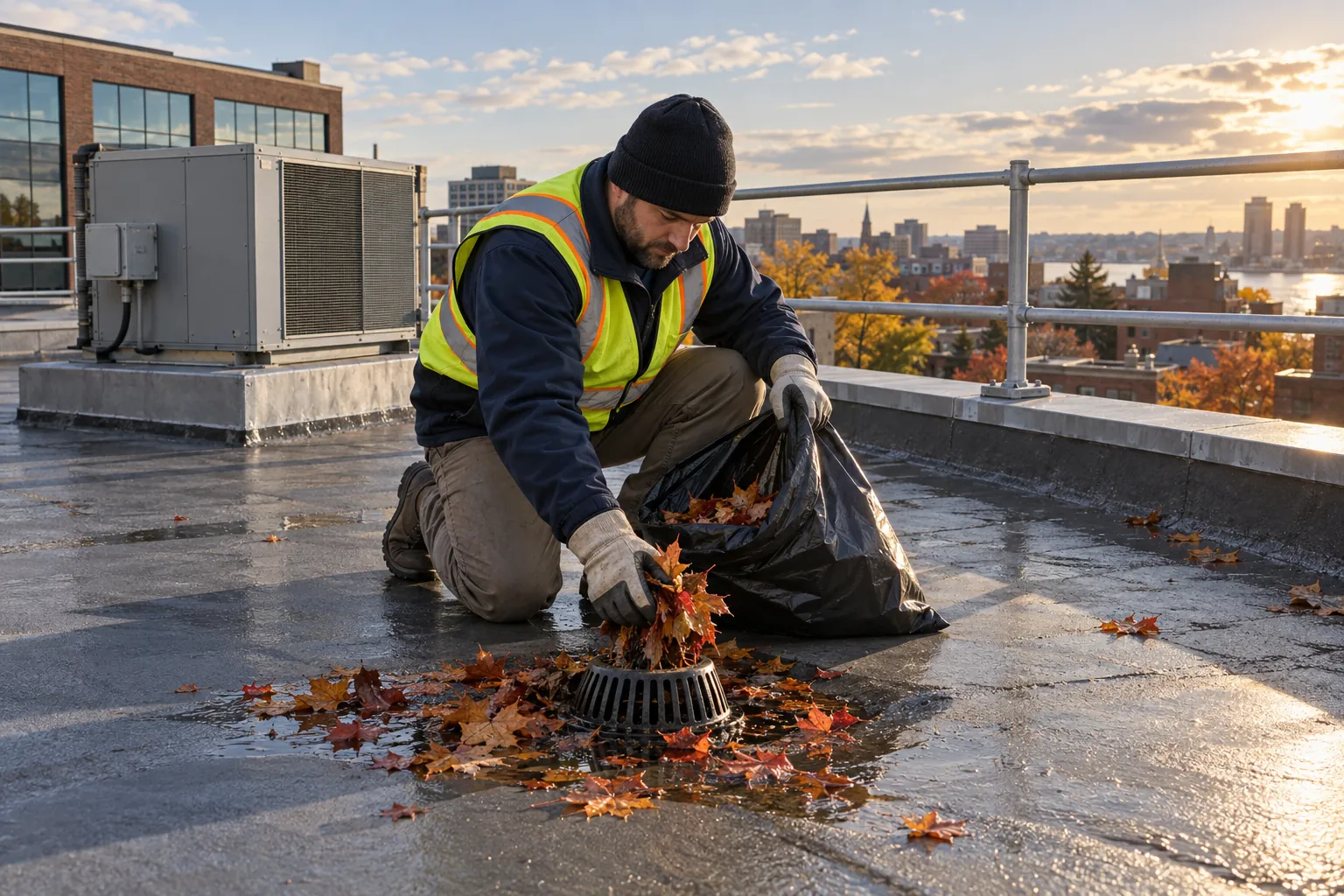
Most roof leaks start as something small that nobody went up to see: a drain choked with leaves, a split in the flashing behind a rooftop unit, a pitch pocket that dried out over the summer. The checklist is how a building operator or property manager catches those things in the fall rather than through a ceiling tile in February. A roof is also one of the places in a building where a worker can be seriously hurt, and the provinces regulate how people work up there. This guide covers what the rules in Ontario, British Columbia, Alberta and federally regulated workplaces ask, what a practical checklist covers, how often to inspect, who should go up, and how to keep a record that shows what was actually found.
01
What the law asks when someone goes up on the roof
No province sets a general schedule for inspecting the roof covering of an ordinary commercial building. The roof covering is a matter for the owner's maintenance program, the warranty and the insurer. What the law does regulate is the person who goes up to look. Workplace safety in Canada is mostly provincial, so the rules depend on where the building is; federal rules apply only to federally regulated workplaces such as banks, airports and telecommunications.
In Ontario, the Occupational Health and Safety Act defines an industrial establishment as an office building, factory, arena, shop or office, so for most commercial buildings the Industrial Establishments regulation (R.R.O. 1990, Reg. 851) applies. Section 13 requires a guardrail around an uncovered opening in a roof and at open sides, but exempts "a roof to which access is required only for maintenance purposes"; where there is no guardrail, the employer "shall develop and implement other measures and procedures to protect workers from the hazard of falling". Section 85 applies where a worker could fall more than three metres: a serviceable safety belt or harness and lifeline, adequately secured to a fixed support, so the worker cannot fall freely more than 1.5 metres.
Where roof work is a construction project, such as a re-roof, the Construction Projects regulation (O. Reg. 213/91) applies instead, with a guardrail system first and then, in order, travel restraint, a fall restricting system, fall arrest and a safety net (section 26.1). A worker who uses one of those methods needs approved training under the Working at Heights Training regulation (O. Reg. 297/13), valid for three years.
Ontario's Window Cleaning regulation (R.R.O. 1990, Reg. 859) applies to building owners where a window cleaner could fall three metres or more. Where a suspended scaffold, boatswain's chair or similar single-point suspension equipment is used, or sill work is done, the owner must prepare sketches of the anchor points, give them to whoever supplies the window cleaning services, and post them (for suspended equipment, near the entrance to the roof). Under section 41, the owner of such a building must have every anchor point inspected by a competent person before first use, then as often as necessary and no less often than the manufacturer recommends, "and in any case, at least once a year", and the owner keeps a log book of those inspections for as long as the anchors are used, with the date, the inspector's name and signature, and any repairs. Where a building has roof anchors for window cleaning, their condition and their log are part of any roof inspection.
In British Columbia, Part 11 of the Occupational Health and Safety Regulation requires fall protection where a fall of 3 m (10 ft) or more may occur, guardrails first where practicable, and a written fall protection plan where workers are not protected by permanent guardrails and could fall 7.5 m (25 ft) or more. In Alberta, sections 139 and 140 of Part 9 of the Occupational Health and Safety Code require protection at 3 metres or more, and a written fall protection plan, covering the hazards, anchors, inspection and rescue, wherever a worker may fall 3 metres or more without guardrails.
For federally regulated workplaces, section 12.07 of the Canada Occupational Health and Safety Regulations requires a fall-protection system for work from a structure at 3 m or more. The CCOHS summary of fall protection legislation lists the threshold in every other province and territory; it is about 3 metres almost everywhere.
02
What a roof inspection checklist covers
A useful checklist follows the order in which you meet things: the way up, the safety of the roof, the roof as a weather barrier, what sits on it, then the evidence inside. Adapt it to your roof: a low-slope membrane roof over a school or plaza needs different attention from a sloped metal roof.
- Access: roof hatch, door or fixed ladder in good condition, hatch opens and closes properly, access locked or controlled, and a sign at the access point saying who may go up.
- Fall protection: roof anchors undamaged and within their inspection date; guardrails and parapets secure; covers over openings fixed; skylights guarded or marked; warning lines where an edge is not guarded.
- Roof surface: blisters, splits, punctures, open seams, displaced ballast, ponding water left days after rain, soft spots underfoot, and debris.
- Drains, scuppers, eavestroughs and downspouts: clear of leaves, gravel and ice, strainers in place, downspouts connected and discharging away from walkways.
- Sloped roofs: missing, cracked, curling or blistered shingles, granules collecting in the eavestroughs, loose metal panels or fasteners, and the flashing around chimneys, skylights and vents.
- Flashings and parapets: flashings and counter-flashings secure, with no damage, corrosion, broken joints or lifted edges; coping or caps tight; caulking sound; masonry not in need of repointing.
- Penetrations: pitch pockets filled, pipe boots and vent stacks sealed, curbs around rooftop units and hatches watertight.
- Rooftop equipment: rooftop units and exhaust fans level on their curbs, panels closed, condensate running to a drain, walkway pads in place, and no screws, filters or tools left by the last contractor.
- Snow and ice in season: drifts against parapets and rooftop units, ice at drains and eaves, icicles over entrances.
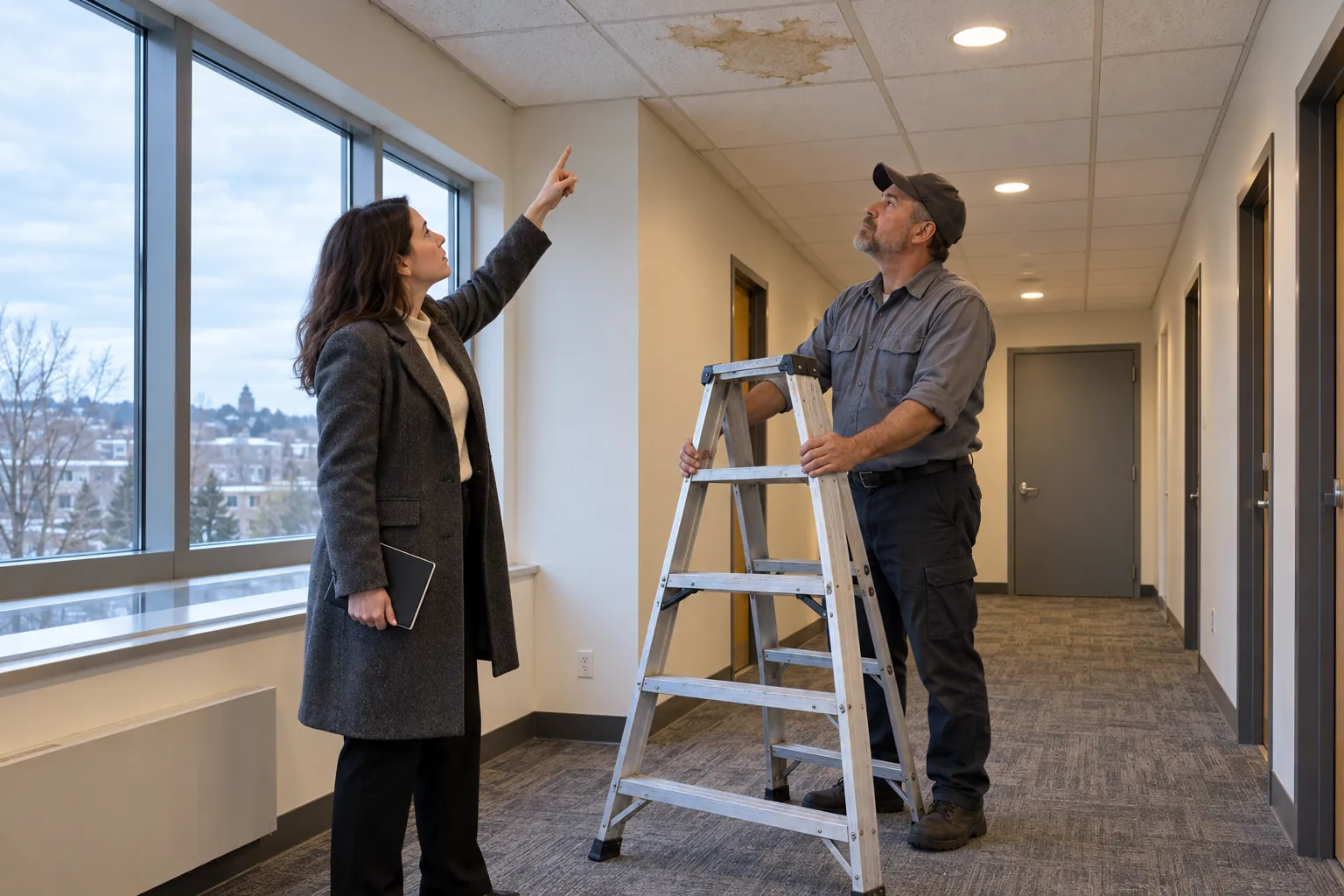
- Inside: stained or sagging ceiling tiles on the top floor, drips in stairwells and service rooms, and anything occupants have reported. Where there is an attic or roof space, examine it for signs of condensation, mould, daylight through the deck and blocked ventilation.
The Canadian Roofing Contractors Association's roof maintenance bulletin, first issued in 1970, gives an owner's list in the same spirit: gutters and downpipes, roof drains kept clear "to permit the easy flow of water", flashings checked for damage, corrosion and broken joints, the roof surface kept free of debris, parapet walls, pitch pans, vents and walkways.
03
How often to inspect a commercial roof
It helps to separate four kinds of inspection, each with its own trigger:
- A professional inspection, twice a year. The CRCA's 2014 bulletin Roofing Preventative Maintenance says "inspections should be completed twice a year; in the spring and fall", as its roof maintenance bulletin has advised since 1970. The spring inspection shows what winter did; the fall one makes sure drains, flashings and seams are ready for snow, ice and freeze-thaw. A roofing contractor finds what a layperson cannot see.
- A routine operator's check, monthly or quarterly. A trained building operator or superintendent walks the service routes, clears drains, picks up debris and looks over the equipment. With trees nearby, weekly drain checks through the leaf fall are common sense.
- A check after an event: a windstorm, hail, heavy snow or a rapid thaw, a leak reported inside, or any contractor work on the roof. Rooftop equipment service is a common source of membrane damage.
- A competent person's inspection of the anchors, at least once a year in Ontario on buildings where anchors are used for suspended window cleaning equipment or sill work (sections 39 to 41 of the Window Cleaning regulation). The CCOHS guidance on fall protection anchors says permanent anchors "should be inspected by a competent person at least once a year or according to the manufacturer's instructions", and tested by a professional engineer or the manufacturer after they have arrested a fall.
Winter adds its own watch. WorkSafeBC's article "Ask an officer: Snow removal plan reduces the risks of winter hazards" advises a plan with written procedures for roof snow removal, keeping workers off the roof where possible by using de-icing cables, extendable snow rakes or an aerial lift, knowing the roof's maximum load limits, clearing in uniform sections without piling snow, and cordoning off the ground below. A roof snow check is often best made from the ground or the hatch, with any decision to clear left to someone who knows the roof's design load.
Whatever the frequency, write it into the maintenance plan, and make each check a named task at a named place, so a missed month shows as missed rather than as a blank.
04
Who goes up, and on what terms
Roof access should be a controlled permission, not a door anyone can open. The CRCA bulletin advises owners to "restrict access to the roof to authorized persons". In practice that means a short list of who may go up, a key held by the building operator, and a sign at the hatch.
- The owner or condo corporation is responsible for the roof as an asset, for the anchors and, in Ontario, their log, and for choosing competent contractors.
- The property manager or facility manager keeps the schedule, commissions the spring and fall inspections, reads the reports and sees repairs through.
- The building operator or superintendent does the routine checks and drain clearing, controls access, and is often first to see a leak inside.
- The roofing contractor does the professional inspections and repairs and is the right person to judge the membrane and flashings.
- HVAC, electrical and window cleaning contractors sign in, follow the building's roof access procedure and report damage they cause or see. In Ontario, section 43 of the Window Cleaning regulation requires an employer, supervisor or worker who believes an anchor point or related structure is defective or inadequate to tell the building owner immediately.
- The joint health and safety committee or representative can include roof access and fall protection in its workplace inspections.
Before anyone goes up, the employer's arrangements should answer a few questions: is the route protected by a guardrail or parapet, and if not, what anchor and equipment will be used; has the equipment been inspected; who knows they are up there; and how would they be brought down if they fell and were left hanging. The CCOHS guidance on a working at heights rescue plan warns that suspension trauma "can occur in minutes" and that relying only on calling emergency services "is not appropriate". If the only way to see a drain is to walk to an unguarded edge, the answer may be a camera on a pole or a contractor with the right equipment, not a quick look.
05
What a good roof inspection record looks like
A roof record has two jobs: to show the checks happened, and to show the next person what has changed.
- Where: the roof divided into named areas on a simple plan, such as the north drain, the RTU-3 curb or the east parapet, so an entry points to one spot rather than "roof".
- When and who: the date and time, and the named person who went up, not a company name.
- The result: each item marked fine, needing attention, or not checked, with the reason when it was not checked, such as snow cover or no safe access.
- Photographs of each drain, penetration and known defect, taken from the same spot each time, so that a slow change such as a spreading blister shows up over months.
- Defects raised: each one with a location, a photo, a priority and an owner, carried until it is repaired and closed.
- The linked records: contractor reports, the anchor log, warranty inspections and leak reports from inside, filed so they can be read together.
Checking the record is part of the job. Read the routine checks against the leak reports: a leak under an area marked "fine" the week before means the check is not looking at the right thing, or not happening. Follow each open defect to its repair. Keep the anchor log exactly as the regulation describes where it applies; it is a statutory record and belongs with the owner.
A good record is honest about what could not be done. "East roof drains not checked: drift over the hatch, cleared 14:00 and checked" is worth more to a manager, an insurer or a roofing contractor than a column of ticks.
06
Where roof inspection records fail, and what SiteClara does about it
Roof records fail in familiar ways. The checklist on the clipboard in the penthouse is ticked from the hatch, or ticked in advance for the month. The monthly drain check stops in the winter and nobody notices until the spring thaw finds a blocked strainer. A contractor mentions a lifted flashing to whoever is at the front desk, and nobody can later say who was told or when.
SiteClara records work at the location. A printed QR poster, with an optional NFC tag behind it, sits at each place where checks are scheduled. For a roof, that place is the access point, inside the building at the hatch or penthouse door, never on the roof itself: nobody should walk to an edge to scan a poster. Staff scan or tap on their own phone, with no app to install, and mark the check done, with a photo when one is asked for, such as the main drain or the curb of a rooftop unit. The time, the place and the named person are recorded automatically. If something stopped the check, such as snow over the hatch or high wind, they say so, and the reason is recorded against that check.
Anyone on the team can report a problem at a location, such as a stained ceiling tile below the roof or a damaged flashing, with a photo; it stays on the team's list of jobs until someone closes it. Checks can be scheduled, such as a monthly drain check or a weekly one through the fall, and a missed one shows as missed. The supervisor adds a note and approves a daily report that goes to nominated management or client contacts the next morning, showing what was checked, what was reported and what is still open.
07
Questions people ask
What do they look for in a roof inspection?
The Canadian Roofing Contractors Association's bulletin Roofing Preventative Maintenance says "a typical inspection should include a review of the interior walls and ceiling for signs of water staining, exterior walls for cracking and signs of moisture and a review of the membrane, flashings and penetrations." It recommends roof inspections twice a year, in the spring and fall, "and also after any major weather events including heavy rains, high winds and ice storms", carried out by "a qualified, trained, roofing contractor who can properly assess the condition of the roofing components, identify defects and perform the necessary repairs."
What are the five most common roofing problems?
The CRCA does not rank five, but its bulletin Roofing Preventative Maintenance lists eight factors that cause "deterioration and aging of the roof components": exposure to ultraviolet radiation, wind, rain, snow, temperature and air pollution; structural movement such as settlement and thermal expansion and contraction; biological growth such as vegetation, fungus and algae; improper design, including drainage and flashings; manufacturing defects; lack of proper maintenance; changes in the building's use, such as higher interior humidity; and "roof top traffic, abuse or vandalism". Regular inspections can find the deterioration and defects these cause before they let water into the roof or the building.
What does a residential roof inspection checklist add?
Mostly the attic. The CRCA bulletin Ventilation (Technical Bulletin 53) explains that adequate ventilation can reduce the potential for "harmful condensation and the formation of ice dams during the heating season", that uncontrolled condensation can lead to "decay, or corrosion of the structural elements" and damage to interior finishes, and that "wet attics can provide an environment conducive to the growth of fungi and moulds". On a shingled roof, water can back up behind an ice dam and leak into the roof and walls. So a house or low-rise residential checklist adds the attic's vents, insulation and any staining or mould, and the eaves in winter.
What should I include on my roofing project checklist?
Before a re-roof, the CRCA bulletin Re-roofing Design Considerations lists structural loading, including any new rooftop equipment; the condition of the existing deck, above and below, for corroded steel, delaminated or spalled concrete and deteriorated wood; the roof's slope and drains, because "roofs are meant to shed water not hold water"; and any hazardous materials in the existing roofing, which the owner or property manager is responsible for having assessed and which the roofing contractor should be told about at the time of tendering. It advises owners to "obtain the advice of experienced professionals, particularly a structural engineer". In Ontario, a re-roof is construction work, so the fall protection rules of the Construction Projects regulation, described at the top of this guide, apply.
08
Where to read more, and a checklist to take away
In Ontario, read sections 13 and 85 of the Industrial Establishments regulation and sections 39 to 43 of the Window Cleaning regulation. In British Columbia, read Part 11 of the OHS Regulation; in Alberta, Part 9 of the OHS Code. Elsewhere, start with the CCOHS fall protection legislation page and your own regulator. For the roof itself, the CRCA roof maintenance bulletin, your roofing contractor and your warranty holder are the places to start.
Before the next inspection, check that:
- the roof has a simple plan with named areas, drains, penetrations, rooftop units, anchors and unguarded edges marked;
- roof access is controlled, with a list of who may go up and a sign at the hatch;
- the fall protection arrangements are written down, including rescue, and the anchors are within their inspection date;
- a roofing contractor inspects in the spring and the fall, and the reports reach the manager;
- routine drain and equipment checks are scheduled, more often in the fall, each recording the place, time, person and result;
- roof snow is watched from a safe place, and nobody clears it without a plan and the roof's load limits;
- leaks inside are reported with a location and followed back to the roof;
- each defect has an owner and stays open until it is repaired;
- the anchor log and other statutory records are kept by the owner, exactly as the regulation requires.
Sources
Every document this guide quotes or links to, in the order it first cites them.
- Occupational Health and Safety Act ontario.ca
- Industrial Establishments regulation (R.R.O. 1990, Reg. 851) ontario.ca
- Construction Projects regulation (O. Reg. 213/91) ontario.ca
- Working at Heights Training regulation (O. Reg. 297/13) ontario.ca
- Window Cleaning regulation (R.R.O. 1990, Reg. 859) ontario.ca
- Part 11 of the Occupational Health and Safety Regulation worksafebc.com
- Part 9 of the Occupational Health and Safety Code search-ohs-laws.alberta.ca
- Canada Occupational Health and Safety Regulations laws-lois.justice.gc.ca
- CCOHS summary of fall protection legislation ccohs.ca
- Canadian Roofing Contractors Association's roof maintenance bulletin roofingcanada.com
- Roofing Preventative Maintenance roofingcanada.com
- CCOHS guidance on fall protection anchors ccohs.ca
- WorkSafeBC's article "Ask an officer: Snow removal plan reduces the risks of winter hazards" worksafebc.com
- CCOHS guidance on a working at heights rescue plan ccohs.ca
- Ventilation (Technical Bulletin 53) roofingcanada.com
- Re-roofing Design Considerations roofingcanada.com
Related guides
 Premises and facilities managementPreventive maintenance checklist: what to include, how often, and how to show it was doneA preventive maintenance checklist for Canadian buildings: what the fire code and provincial law require, what to include, how often, and the records to keep.
 Premises and facilities managementBuilding maintenance checklist: what to check, how often, and who does itA building maintenance checklist for Canadian buildings: daily to annual tasks, the property standards bylaws and fire code behind them, and who does each.
 Premises and facilities managementWinterization checklist: getting a building ready for a Canadian winterA winterization checklist for Canadian buildings: the freeze checks the fire code asks for, heating, plumbing, roofs, grounds, outdoor staff and the records to keep.
 Premises and facilities managementWorkplace inspection checklist: how a JHSC inspection should workA workplace inspection checklist for Canadian JHSCs and representatives: Ontario, BC, Alberta and federal rules, what to walk, how often and what to record.