Cleaning
Garbage room and garbage chute cleaning: the routine, the rules and the record
Garbage chute cleaning is washing the inside of a building's garbage chute, also called a trash chute, from the top down with hot water, a degreaser and a disinfectant, together with the rooms at each end, as often as it takes to keep them clean and odour-free.
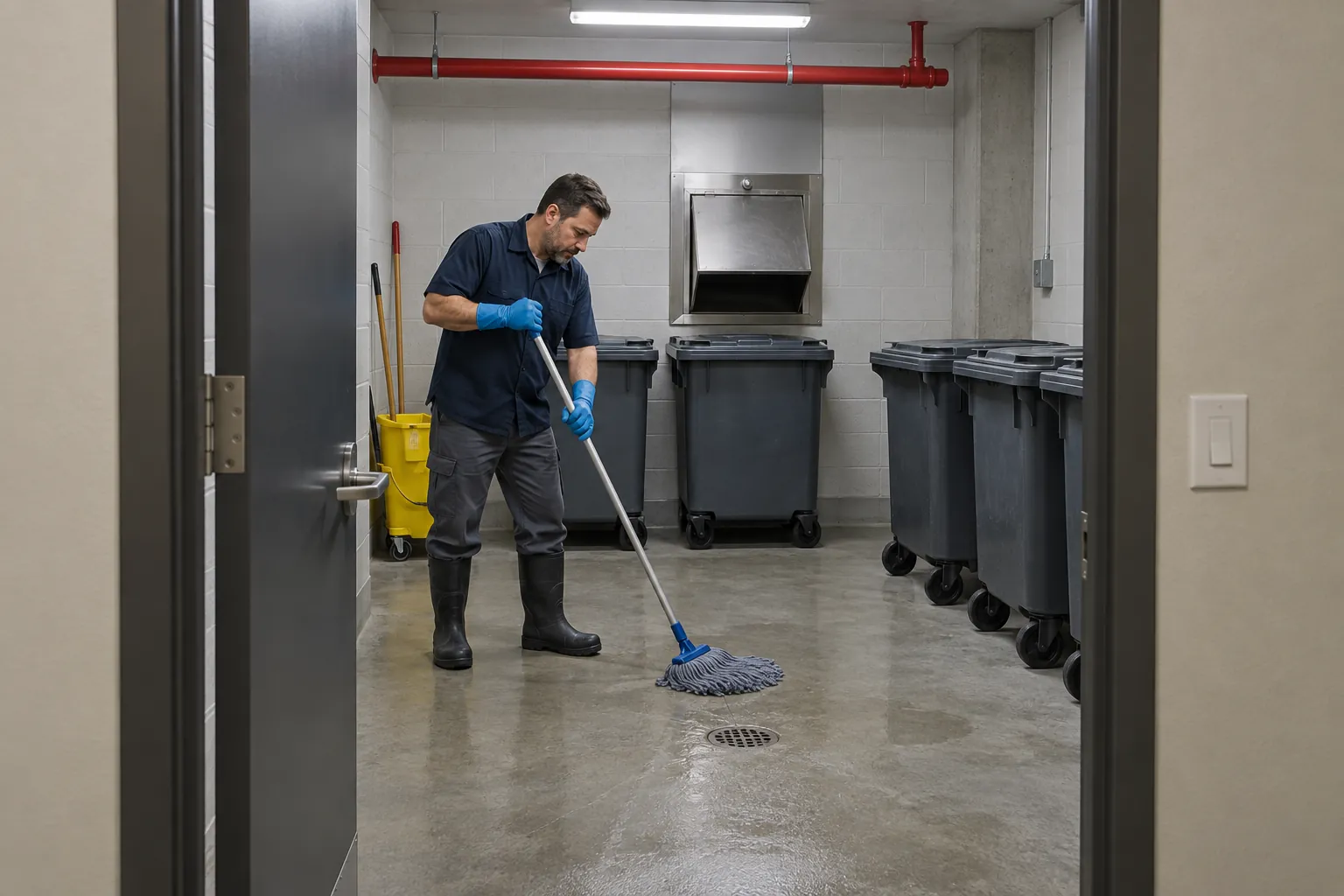
The garbage room is the part of a building nobody wants to think about until it smells, draws mice or catches fire. In an apartment tower or condo it is a chain: an intake room with a hopper door on every floor, a chute running the height of the building, and a discharge room with a compactor or bins at the bottom. In an office, school or plaza it is a room off the loading dock and a bin enclosure outside. This guide sets out what the Ontario Fire Code and municipal by-laws expect, a routine that keeps the rooms clean and safe, how chute washing is done, and what a useful record looks like.
01
What the rules say about garbage rooms and chutes
No single Canadian law is called a garbage chute cleaning rule. The duty comes from the fire code, which treats refuse as a fire load; municipal property standards, which set the cleanliness test; the law that makes someone responsible for shared spaces; and workplace health and safety law. Most of it is provincial or municipal. Ontario is the worked example below; elsewhere, read your own province's fire code and your city's property standards by-law.
The Ontario Fire Code (O. Reg. 213/07) starts with housekeeping. Sentence 2.4.1.1.(1) says that combustible materials "shall not be accumulated in or around a building in such quantity or such location as to create a fire hazard", and Sentence 2.4.1.1.(2) forbids accumulating them in a means of egress, service room or service space "unless the location, room or space is designed for those materials". A refuse storage room is designed for them; the corridor outside it is not. Sentence 2.4.1.1.(6) adds that dumpsters and other outdoor receptacles must be located so they do not create a fire hazard to buildings.
The same code protects the fire separations that make a garbage room safe to have. Article 2.2.3.3. says closures "shall not be obstructed, blocked, wedged open, or altered in any way that would prevent the intended operation of the closure", and Article 2.2.3.2. requires closures to be kept operable, including by "keeping fusible links and heat or smoke-actuated devices undamaged and free of paint and dirt". Under Article 2.2.3.4., a door in a fire separation must be kept closed when not in use and inspected monthly. For existing residential buildings, Part 9 (the retrofit part) sets chute rules; in a residential building over six storeys, for example, Article 9.6.2.13. requires sprinklers at the top of each refuse chute, at alternate floor levels and in the room or bin it discharges into, although an existing chute with a fusible-link closure at the outlet, a sprinklered discharge room and a sprinkler at the top is deemed to comply. It also requires the discharge room to be separated by a fire separation of at least 1 h.
Municipal property standards set the cleanliness test. In Toronto, Toronto Municipal Code Chapter 629, Property Standards, section 629-22 is a clear statement of it:
The same section requires receptacles that are "water-tight, equipped with a tight-fitting cover, pest-proof" and kept clean, and section 629-9 requires every property to be kept free of pests "and from conditions which may encourage infestation by pests". The test is an outcome, not a frequency: the chute is washed as often as it takes to stay clean and odour-free.
In a condominium, section 90 of Ontario's Condominium Act, 1998 says "the corporation shall maintain the common elements", which normally include garbage rooms and chutes; in a rental building the duty is the landlord's, and in a commercial building the owner's or whoever the lease names. A contractor may do the work, but the owner answers for the result. For the workers, the Ontario Occupational Health and Safety Act requires an employer to "take every precaution reasonable in the circumstances for the protection of a worker" (clause 25(2)(h)) and places a matching duty on supervisors (section 27).
02
What garbage room cleaning covers
List every space the garbage passes through, because each has its own tasks and its own way of going wrong:
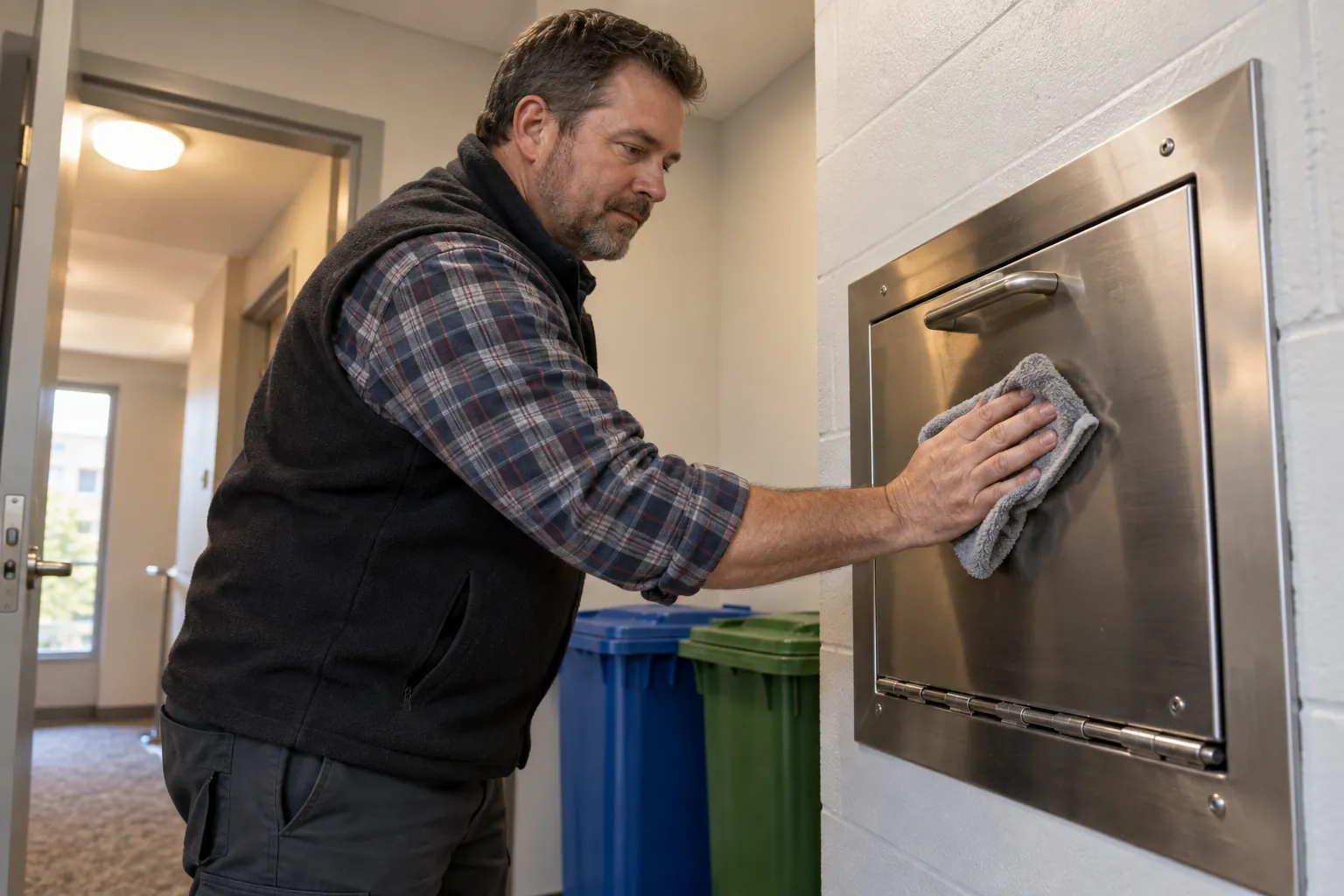
- Chute intake rooms on each floor: the floor, walls, the hopper door and its frame, the recycling and organics containers that often sit beside it, the room door and its closer, and the light.
- The chute itself: the inside walls, which build up grease and residue from bags that split on the way down, the hopper doors and their seals, and the sprinklers and any flushing spray ring at the top. A linen or laundry chute in a hotel or care home is built under the same Ontario Building Code article as a refuse chute (Article 3.6.3.3, "Linens and Refuse Chutes") and is cleaned the same way.
- The discharge room at the bottom: the chute outlet and its discharge door (the closure that shuts in a fire), the compactor or tri-sorter, the carts and bins, the floor, the floor drain and the walls around the outlet where the splash lands.
- Bins, carts and totes, washed inside and out, with their lids and wheels.
- Recycling and organics, which sour and draw flies faster than garbage, especially in summer.
- The loading area and outdoor enclosure: the dumpster or front-end bin pad, the gate, lids closed, and nothing stacked against the building.
- Bulky items left by residents or tenants, which are combustible and block routes.
- Pest monitoring: bait stations, gaps around pipes and doors, droppings and flies.
An office tower or school usually has no chute, but it has a waste room off the dock and a baler; a plaza has a shared bin enclosure that belongs to nobody in particular. Food service, health care and long-term care add their own waste rules; follow those first.
Write the list into the janitorial scope of work by name, with a frequency for each space. "Garbage room" as one line in a contract tends to mean the discharge room gets swept and the upper intake rooms are never touched.
03
A routine that keeps the rooms clean and safe
Outside a few by-laws there is no prescribed frequency, so the right routine is whatever keeps each space litter-free, odour-free and free of pests. The schedule below is a starting point for an apartment or condo building with a chute; adjust it to your volume, season and complaints.
How often a chute needs washing has no fixed answer. A large building whose chute takes food waste needs it far more often than a small one. Set a starting interval with your contractor, then let the evidence move it: odour complaints, flies in the intake rooms or residue behind the hopper doors say it is due sooner.
Some buildings have their own rules. Toronto's Municipal Code Chapter 354, Apartment Buildings, which applies to purpose-built rental buildings of three or more storeys and ten or more units, requires the owner or operator to inspect the common areas for cleanliness at least once every day, to have a written cleaning plan with a schedule for each common area, to inspect common areas for pests at least once every 30 days and within 72 hours of a report, and to have a waste management plan that covers the Chapter 629 garbage requirements. If your building is covered, your routine has to match your plans.
Seasons matter. In summer a missed day becomes a smell in the corridors. In winter the enclosure gets buried and bags pile up beside a bin nobody can reach, so the path to the bins belongs on the snow clearing route and in the snow removal log.
04
Chute washing, and keeping the people doing it safe
Garbage chute cleaning is normally done from the top down: a contractor lowers a rotating spray head, or uses a built-in flushing ring, to wash the chute with hot water and a degreaser, then a disinfectant or deodorizer, and the run-off drains in the discharge room. Agree a few things first:
- Tell residents and staff when the chute is out of use, and lock or sign the hopper doors.
- Lock out the compactor and other powered equipment, following the building's lockout procedure and the manufacturer's instructions.
- Agree the work with the fire protection contractor. The chute is sprinklered; the crew should know where the heads are and not strike them. If any fire protection has to be shut off, follow the building's fire safety plan.
- Protect the closures. Keep fusible links free of paint and dirt, and do not leave the chute discharge door tied open. Report a damaged closure so it can be repaired or replaced before the chute goes back into use.
- Manage the water. Check the floor drain is clear, and clean the discharge room last.
The people who clean garbage rooms daily face hazards an office cleaner does not, and the employer's and supervisor's duties mean these are planned for, not left to each worker:
- Sharps. Needles turn up in household and commercial garbage. Workers should never push down on a full bag or carry one against the body, should wear puncture-resistant gloves, and should report every sharp found. CCOHS's page on needlestick and sharps injuries says "all staff should report every incident in which they find needles or sharps left at the bedside or thrown into the regular garbage", and lists puncture- and cut-resistant gloves for waste disposal.
- Rodent droppings. Do not dry-sweep them. The CCOHS page on hantavirus advises ventilating the space first, wearing a fit-tested N95 respirator, disposable gloves and boots or shoe covers, and soaking the material with a solution of 1 part household bleach to 9 parts water, or a household disinfectant, for around 10 minutes before cleaning.
- Chemicals. Degreasers and disinfectants are used in small, poorly ventilated rooms. Use only products the employer supplies, read the label and safety data sheet, and never mix products.
- Lifting and moving equipment. Full carts are heavy and floors wet; compactors, balers and bin lifts crush. Only trained workers operate them, with the guards in place.
05
What a good garbage room record looks like
Some records are required. Chapter 354 in Toronto requires the owner or operator of an apartment building to keep "logs of all scheduled or unscheduled cleaning activities" and of activities under the waste management plan, each recording the nature of the activity "and the date and location on which it occurred", plus logs of pest inspections and treatments, and to keep them "for a period no less than 24 months". Elsewhere, a record is how an owner, a condo board or a contractor shows the work was done when a complaint, an inspection or a claim arrives.
A good entry, on paper or otherwise, answers the questions someone will actually ask later:
- Which space: the floor's intake room by number, the discharge room, the enclosure, not just "garbage".
- When: the actual time the work was done, not the time the sheet was filled in.
- Who: a name that identifies one person, not a company or a set of initials nobody can trace.
- What was done: a daily check, a wash, a cart rotation, a chute wash, a pest service.
- What was found: a hopper door that will not close, a door wedged open, droppings, bulky items dumped.
- What happened next: who it was reported to, and when it was fixed.
- A photo where a picture settles an argument, such as dumped furniture or a damaged closure.
A column of checkmarks says someone was in the room; the problems written down, and the date each was put right, show the building is being managed. A missed day should show as missed, with the reason.
Someone also needs to read the record. The superintendent or janitorial supervisor should check the rooms unannounced and compare what they see with what was signed. The property manager or condo manager should look for repeat problems: the same wedged door, the same smell complaint every August.
06
Where the garbage room record fails, and what SiteClara does about it
Garbage room records fail in the same few ways. The sheet inside the discharge room door is signed for the whole week on Monday. The upper intake rooms are marked done because the discharge room was. A complaint about a smell on the 14th floor goes to whoever was in the lobby and is never written down. When the fire inspector finds the outlet closure tied open, the binder shows checkmarks and nothing else.
SiteClara records the work at the place it is done. A printed QR code in each intake room and in the discharge room, with an NFC tag behind it if staff would rather tap than scan, lets the custodian or superintendent mark the scheduled check or cleaning for that room done on their own phone, with no app to install, or say what stopped them. Their name and the time are recorded as it happens, and they can add a photo when one is asked for. A problem found, such as a hopper door that will not close or droppings behind the carts, goes onto the team's list of open jobs until someone closes it.
The supervisor sees what is due, done and missed in each room, and can record the reason a check was missed. At the end of the day they review it, add a note and approve the report, which goes to nominated client or management contacts, such as the property manager or the condo manager, at 8 a.m. the next morning, showing what was completed, what is still open and how the scheduled checks went.
07
Questions people ask
How often should garbage chutes be cleaned?
As often as it takes to keep them clean and odour-free; the rule sets an outcome, not an interval. Section 629-22 F of Toronto Municipal Code Chapter 629, Property Standards requires every garbage chute, garbage disposal room, garbage storage area and receptacle to be "washed and disinfected as often as is necessary to maintain a clean and odour-free condition". In a rental apartment building covered by Toronto Municipal Code Chapter 354, Apartment Buildings, section 354-3.5 also requires the owner or operator to inspect the common areas "at least once every day for cleanliness".
How do you get rid of garbage chute smell?
Wash and disinfect the chute and the rooms at both ends, and keep litter out of them. Section 629-22 of Toronto Municipal Code Chapter 629, Property Standards uses odour as the test: subsection F requires chutes, garbage rooms and receptacles to be washed and disinfected as often as is necessary to stay odour-free, and subsection G requires the garbage storage place to be kept "in a litter-free and odour-free condition". If the smell comes back within days, the washing interval is too long.
Are garbage chutes hygienic?
Only as hygienic as the building keeps them. Section 629-22 G of Toronto Municipal Code Chapter 629, Property Standards requires the place where garbage is stored to be maintained in a manner that will not "attract pests, create a health or other hazard", and subsection D requires receptacles to be water-tight, pest-proof and kept clean. Subsection E requires a chute system originally installed in a multiple dwelling to be "maintained operative", so the answer to a dirty chute is cleaning it, not locking it, unless the city has issued a permit to close it under subsection E.1.
08
Further reading, and a list to take away
In Ontario, read Subsections 2.4.1 and 2.2.3 of the Ontario Fire Code. Elsewhere, provincial fire codes are largely based on the National Fire Code of Canada, free from the National Research Council; the latest edition is the National Fire Code of Canada 2025, but your province may still adopt an earlier one, so ask your local fire official which edition applies. For the cleanliness standard, read your city's property standards by-law; in Toronto that is Chapter 629, and for rental apartment buildings Chapter 354. For the workers, read the CCOHS pages cited above.
Before you rewrite the garbage room routine, check that:
- every intake room, the chute, the discharge room, the carts and the outdoor enclosure are named in the scope of work, each with a frequency;
- someone walks every intake room daily, not just the discharge room;
- doors and the chute outlet closure are never wedged or tied open, and fusible links are clean and unpainted;
- the chute has a washing interval, the date of the last wash is on record, and complaints can bring the next one forward;
- pest stations are checked and serviced by a licensed operator, with the results kept;
- workers have puncture-resistant gloves, know not to compress bags, and know how to clean up droppings safely;
- the compactor is locked out before anyone cleans near it;
- problems found are written down with who they went to and when they were fixed;
- in a Toronto apartment building, the cleaning, waste and pest logs match the plans and are kept for at least 24 months.
Sources
Every document this guide quotes or links to, in the order it first cites them.
- Ontario Fire Code (O. Reg. 213/07) ontario.ca
- Toronto Municipal Code Chapter 629, Property Standards toronto.ca
- Condominium Act, 1998 ontario.ca
- Occupational Health and Safety Act ontario.ca
- Municipal Code Chapter 354, Apartment Buildings toronto.ca
- Needlestick and sharps injuries ccohs.ca
- Hantavirus ccohs.ca
- National Fire Code of Canada 2025 nrc.canada.ca
Related guides
 Premises and facilities managementBuilding superintendent duties: what the super does, and how to show it was doneWhat a building superintendent does in Canada: the landlord's duties a super carries out, heat and vital services, fire safety, working alone and the daily record.
 Premises and facilities managementCondo maintenance: looking after the common elements, and proving itWho maintains a condo's common elements under Ontario's Condominium Act and other provinces' laws, what the work covers, how often, and what the record should show.
 CleaningCleaning log sheet: what to record, who fills it in, and what the law in Canada asks forWhat a cleaning log sheet should record, where Canadian workplaces use one, what Ontario and federal rules require, and how to keep a log people believe.
 CleaningJanitorial scope of work: what it should say, and how to show it is metWhat a janitorial scope of work should contain in Canada: areas, tasks, frequencies, standards, winter care, WHMIS and products, and how to show the work was done.