Premises and facilities management
Condo maintenance: looking after the common elements, and proving it
Condo maintenance is divided by law: the condominium corporation maintains the common elements, such as the corridors, the garage, the roof, the garbage room and the mechanical systems, and each owner maintains their own unit, unless the declaration changes the split.
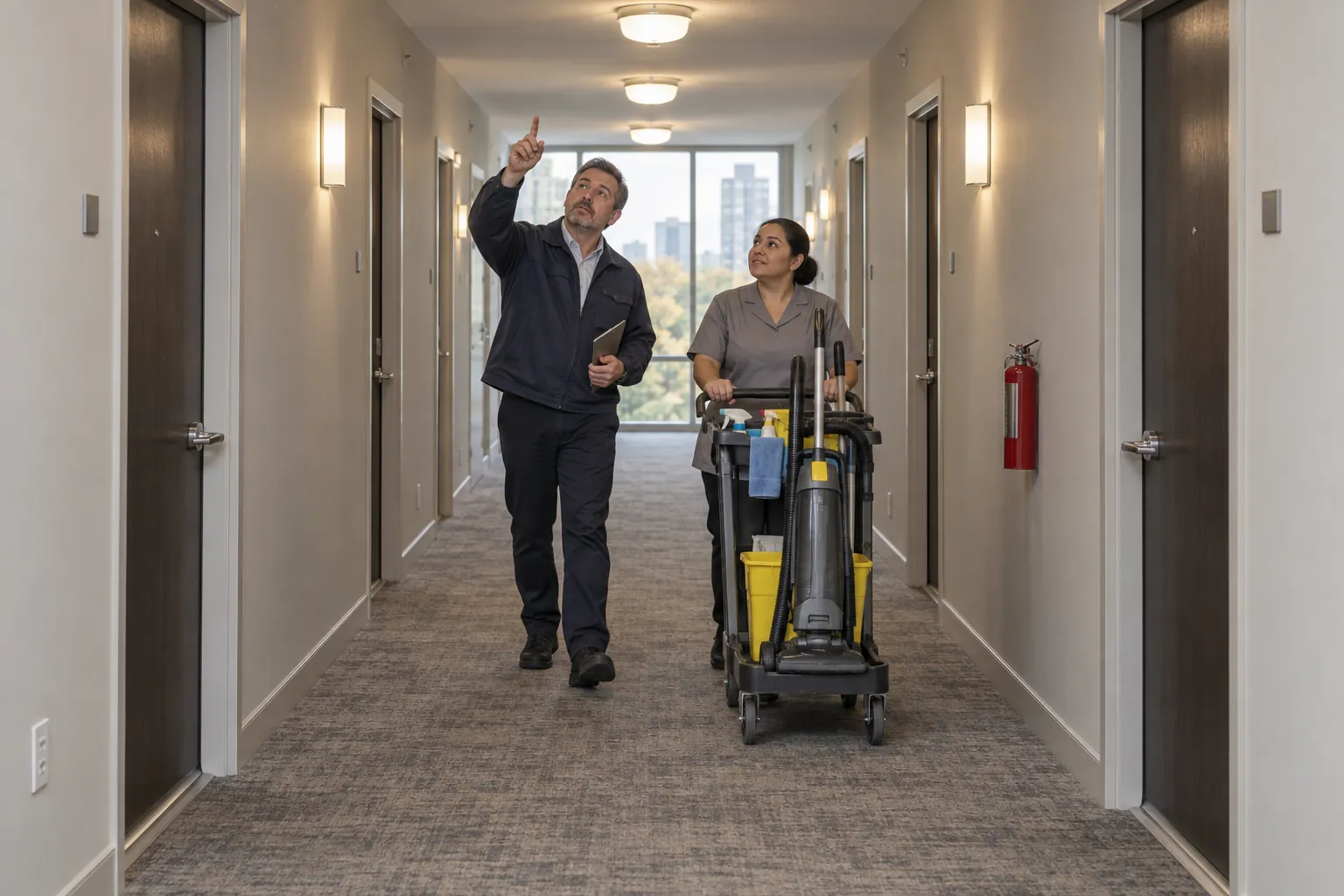
The law says who must maintain them, but not how, how often or how to show it was done. This guide covers the duty in Ontario and the other large provinces, what condo maintenance of the common elements takes in practice, a workable calendar, who does what between the board, the manager, the super and the contractors, and what a record of it should show when an owner, an insurer or a reserve fund planner asks.
01
Who must maintain the common elements: the law in Ontario and elsewhere
In Ontario the rule is in the Condominium Act, 1998. Section 1 defines the common elements as “all the property except the units”, and section 90(1) divides the work: “Subject to section 91, the corporation shall maintain the common elements and each owner shall maintain the owner’s unit.” Section 90(2) says what maintenance means: it “includes the obligation to repair after normal wear and tear but does not include the obligation to repair after damage.”
Repair after damage is a separate duty. Under section 89(1), “the corporation shall repair the units and common elements after damage”, subject to sections 91 and 123, and section 89(2) says that includes repairing and replacing “after damage or failure”, but not improvements made to a unit beyond the standard unit. Section 91 lets the declaration change the split, for example by making each owner maintain and repair the exclusive-use common elements they use. So the first document to read for any building is its own declaration.
Section 17(2) gives the corporation “a duty to control, manage and administer the common elements and the assets of the corporation”, and section 117(1) forbids anyone, “through an act or omission”, to cause a condition in the units or common elements that is likely to damage the property or cause injury or illness. Separately, the Occupiers’ Liability Act defines an occupier to include a person with “responsibility for and control over the condition of premises”, which describes a corporation’s position in its common elements; section 3(1) makes the occupier take “such care as in all the circumstances of the case is reasonable” to see that people entering are reasonably safe.
Maintenance is also distinct from the reserve fund, the corporation’s long-term fund for major work. Section 93(2) of the Ontario Act says a reserve fund “shall be used solely for the purpose of major repair and replacement of the common elements and assets of the corporation”. Day-to-day maintenance and repair after wear and tear come out of the operating budget, and both are paid for by the owners’ condo fees, their contributions to the common expenses. The line matters because poor maintenance brings major replacement forward, and the reserve fund study, which in Ontario must be repeated at least every three years under Ontario Regulation 48/01, then has to plan for it.
02
What condo maintenance of the common elements covers
The Condominium Authority of Ontario describes common elements as “shared areas of the condo property, like hallways, elevators, piping, amenities, etc.”, and names balconies as the usual exclusive-use common element: owned by the corporation, used by one owner. Its page What are common elements in a condo and can you change them explains more. In a typical corporation the work falls into these groups:
- Entrances, lobby and corridors: floors and mats, entry doors and closers, the intercom, lighting, handrails and the cleanliness of the route from the street to each unit door.
- Elevators: maintained by the elevator contractor under its contract, with the site team reporting faults and keeping the cars clean.
- Garbage and recycling: the chute, the chute rooms on each floor, the garbage room and the bins, which need regular cleaning, pest control and a clear route for collection.
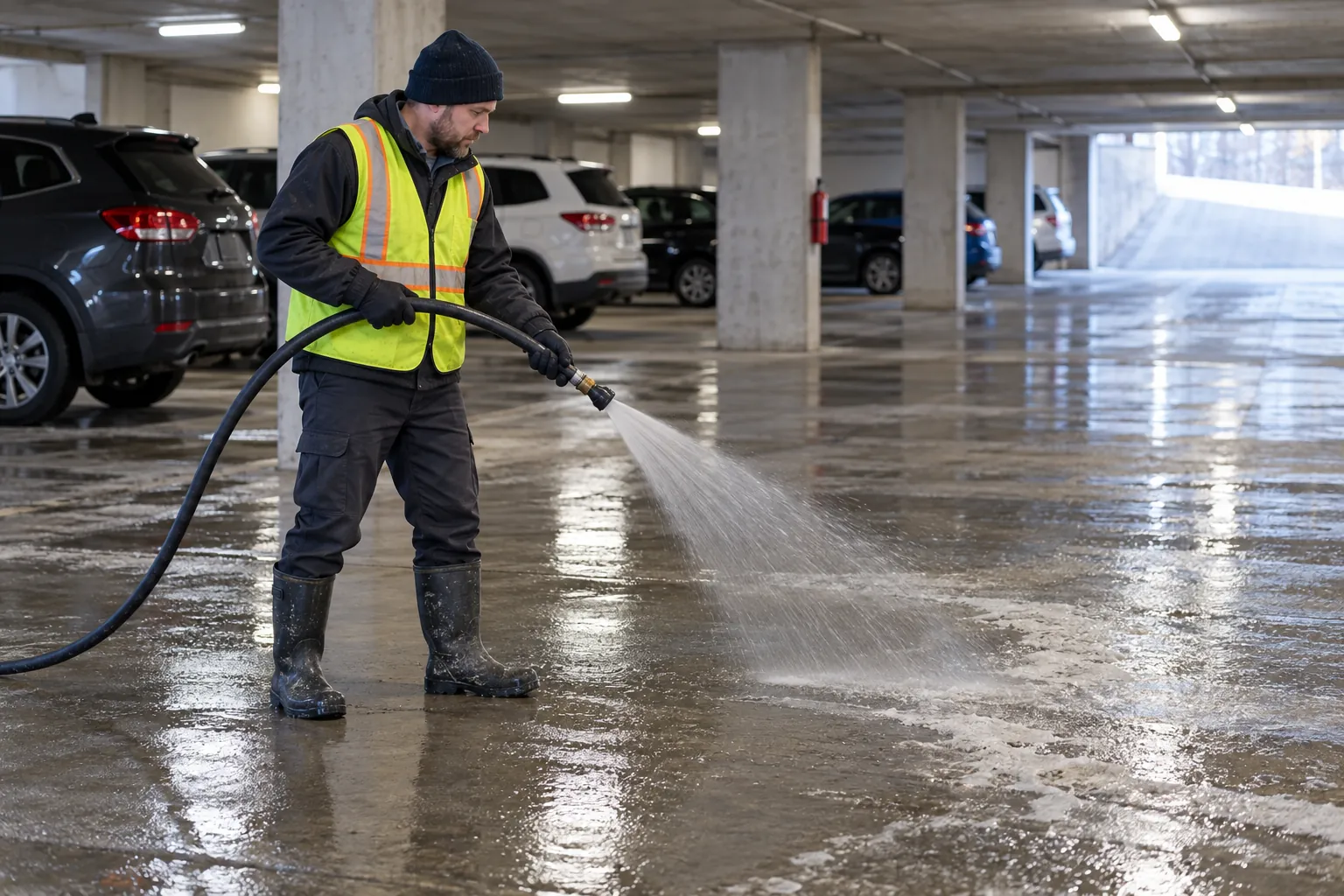
- Parking garage: lighting, drains and trench grates, the ramp and its heating cables where fitted, the overhead door, sweeping and the spring wash-down that removes road salt.
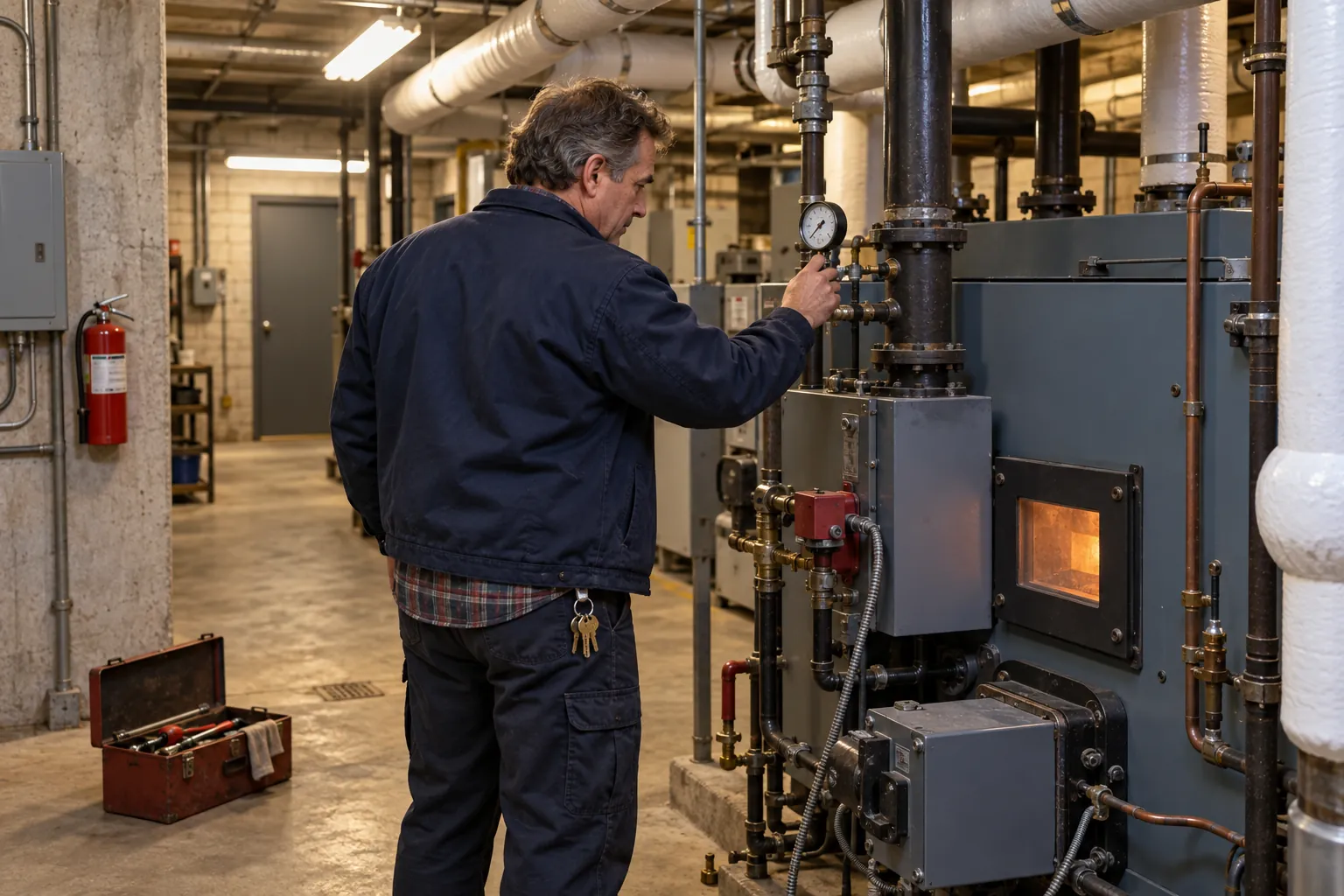
- Mechanical and electrical rooms: boilers or heat pumps, make-up air units, pumps, the generator and the electrical rooms, serviced by contractors and checked daily by the super or building operator.
- Building envelope and roof: roof drains, flashings, sealants, common windows and doors, balcony guards and exterior walls.
- Grounds and exterior: walkways, landscaping, lighting, the driveway and, in winter, snow and ice; see the snow removal log.
- Amenities: the party room, gym, pool, guest suites and bicycle storage, which get heavy use.
- Fire and life safety: fire alarm, sprinklers, extinguishers, emergency lighting, fire doors and exits, maintained under the provincial fire code and the building’s fire safety plan.
Exclusive-use areas are where arguments start. Whether a balcony, terrace or parking space is maintained by the owner or the corporation depends on the declaration in Ontario (section 91) or the bylaws in British Columbia (section 72(2)), and the maintenance plan should say which is which.
03
How often: a working maintenance calendar
No statute gives one maintenance calendar for condo common elements. Frequencies come from the fire code for life safety systems, manufacturers’ instructions and service contracts for equipment, and judgment about use for everything else. A workable calendar for a mid-sized building, adjusted for its own plant, looks like this:
- Daily: a walk of the lobby, corridors, garbage rooms, garage and amenities looking for spills, leaks, lights out, doors not closing, damage and anything unsafe; mechanical room readings and alarms; lobby cleaning.
- Weekly: corridor vacuuming and floor care on a rota, amenity room cleaning, chute room cleaning, a check of exit routes and stairwell doors, and a look at roof and garage drains before forecast rain.
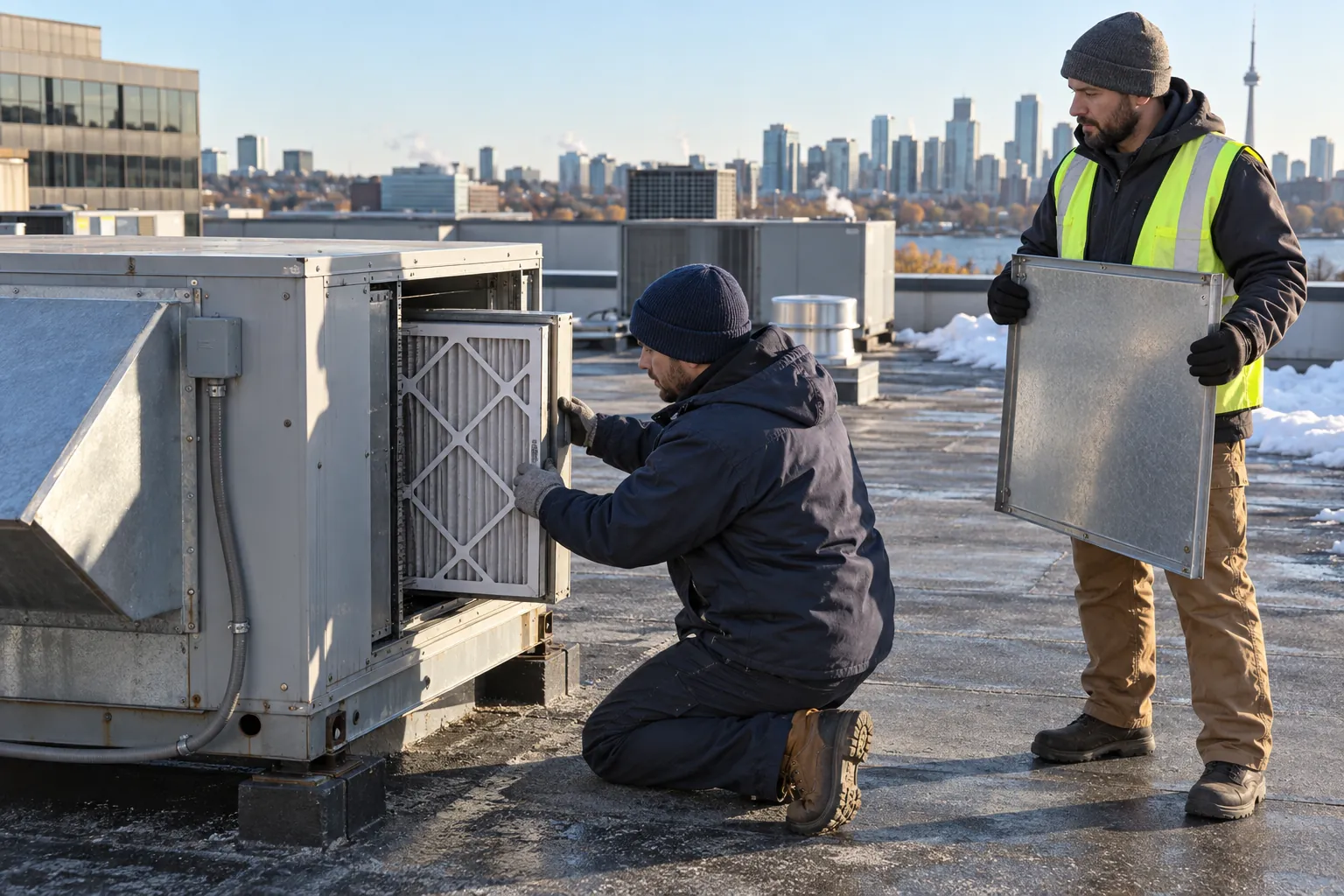
- Monthly: fire extinguisher and emergency lighting checks where the fire code requires them (see the fire safety log book), filter changes on the schedule the equipment needs, and the generator run where the contract sets it.
- Seasonally: winterizing in the fall (hose bibs, irrigation, heat tracing, garage door seals, snow contract ready) and a spring wash of the garage and exterior, balcony and window inspections, and landscaping start-up. The preventive maintenance checklist covers the planned tasks in more detail.
- Annually: the fire alarm, sprinkler and other life safety inspections by qualified contractors, dryer vent and exhaust cleaning where the corporation owns them, a roof inspection, and a review of all service contracts against what was delivered.
The daily walk most often goes missing on paper, yet it finds the leak before it becomes a repair after damage and the spill before it becomes an injury claim. Give it a route and a time, and record it at each location, not once at the end of the day.
04
Who does what: board, manager, super, contractors and owners
The corporation acts through its board of directors, the condo board, which under section 27(1) of the Ontario Act shall “manage the affairs of the corporation”, but directors do little of the work themselves. In a typical building the split is:
- The board approves the budget, the maintenance plan and the contracts. Delegating the work does not delegate the corporation’s duties.
- The condominium manager runs the plan day to day. In Ontario, supervising “employees or contractors hired or engaged by the corporation” is a condominium management service under the Condominium Management Services Act, 2015, and section 34(1) says no one may provide those services “unless licensed as a condominium management provider or as a condominium manager”.
- The superintendent or building operator does the daily walk, the plant checks and small repairs, and lets contractors in. See building superintendent duties.
- Contractors do the specialist and heavy work: janitorial, elevators, HVAC, fire protection, snow and ice, landscaping, pest control, garage cleaning. Each contract should say what is done, how often and how completion is shown.
- Concierge or security staff take resident reports at the desk, often at night and on weekends.
- Owners and residents maintain their own units, and exclusive-use areas where the declaration says so, and report problems in the common elements.
Two sections of the Ontario Act connect the owner’s work to the corporation’s. Section 19 lets the corporation, “on giving reasonable notice”, enter a unit or an exclusive-use common element “at any reasonable time” to carry out its duties; the Condominium Authority’s page Who is responsible for repairs and who can enter your unit notes that in emergencies, such as a fire or water leak, immediate access may be needed without notice. Section 92 covers an owner’s work not done within a reasonable time: the corporation must do repair after damage that the declaration gives to the owner (92(1)), and may do maintenance of common elements that the declaration gives to owners (92(2)) and maintenance of the owner’s own unit where the failure risks damage to the property or injury (92(3)), with the cost added to that owner’s common expenses (92(4)). Both depend on a record of when the problem was found, when the owner was told and what happened next.
The weak point is the handover: a resident tells the concierge, the concierge tells the super, the super calls a trade, and the manager hears at the next board meeting. A single list of open jobs, fed by a maintenance request form and by the site team’s own checks, is what keeps a leak from falling between them.
05
What good maintenance records look like
Section 55(1) of the Ontario Condominium Act requires the corporation to “keep adequate records”, and lists the financial records, minutes, the governing documents, all agreements and the reserve fund studies among them; section 55(2.1) lets records be kept “in electronic or paper form”. The Act does not prescribe a maintenance log, but the regulation on reserve fund studies expects the corporation to have maintenance records: section 30(3)(e) of Ontario Regulation 48/01 says the person conducting a comprehensive study, or an update based on a site inspection, shall review “the repair and maintenance records and schedules in the custody or under the control of the corporation”. An insurer, a lawyer defending a slip-and-fall claim or a new board will ask for the same.
In Quebec the logbook is mandatory. The Québec government’s page on managing divided co-ownerships says the carnet d’entretien holds a detailed inventory of the common portions, a separate section on major repairs and replacements planned over the next 25 years, an assessment of condition and remaining useful life, and a list of the major repairs and replacements already carried out; the board must update it at least once a year with information on all maintenance carried out. It must be prepared by a qualified professional with no direct link to the co-ownership, revised at least every five years (every ten for some smaller buildings), and existing syndicates have three years and a day to have one prepared under the regulation in force since August 14, 2025. It is a professional’s document; the building’s everyday records feed it.
Whatever the province, a useful maintenance record shows, for each check or job:
- where: the location in the building, down to the floor, room or piece of plant;
- what: the check done, or the fault found, in plain words;
- who and when: the named person and the date and time it was done, recorded at the time and not filled in later;
- the result: done, or not done and why (no access, part on order, contractor did not attend);
- a photograph where the condition matters later, such as a leak or a damaged door;
- the follow-up: who the job went to, and when it was closed.
Contractors’ service reports belong with this record but do not replace it: a contractor’s report says what the contractor did on the day they attended; the corporation’s own record shows that someone looked in between. Where a statute or code requires its own record, such as fire code test records or the washroom cleaning records Ontario employers must keep, maintain and make available under section 25.3(3) of the Occupational Health and Safety Act (see the washroom cleaning checklist), keep that record in the form the rule requires.
06
Where the record fails, and what SiteClara does about it
Condo boards usually have good records of what they decided and paid for, and weak records of what happened in the corridors. The sign-off sheet in the chute room is filled in for the week on Monday. The super’s daily walk is a habit, not a record. A resident reports a leak at the desk on Saturday night and the note never reaches the manager. The snow contractor’s invoice says the ramp was salted, and nobody on site can say when. When a claim or a reserve fund study asks what was done, the answer is a pile of invoices.
SiteClara puts a printed QR poster at each location, such as a lobby entrance, a garbage room, a garage ramp, a stairwell or an amenity room, with an optional NFC tag behind it. The super, the janitorial staff or a contractor scan the code or tap the tag with their own phone, with no app to install, see the scheduled checks due there, and mark them done or say what stopped them, with a photo when one is asked for. An issue reported at the poster goes onto the team’s list of open jobs until someone closes it. The supervisor’s queue groups open jobs by building and floor, and a supervisor can escalate a job to the building manager, who can answer it.
Each day the supervisor approves a report that goes to the manager and other nominated contacts the next morning, showing what was reported, what was completed, what is still open and how the scheduled checks went, with the reason where one was missed.
07
Questions people ask
Are condo owners responsible for maintenance?
For their own units, yes; for the common elements, the corporation is. In Ontario, section 90(1) of the Condominium Act, 1998 says “the corporation shall maintain the common elements and each owner shall maintain the owner’s unit”. Section 91 lets the declaration change that, for example by providing that each owner shall maintain and repair after damage the parts of the common elements of which the owner has the exclusive use, such as a balcony or terrace.
What repairs are condo owners responsible for in Ontario?
Under section 90(2) of the Condominium Act, 1998, an owner’s duty to maintain the unit “includes the obligation to repair after normal wear and tear”. Repair after damage is the corporation’s under section 89 unless the declaration, under section 91, makes each owner repair their own unit after damage. If an owner fails to maintain the unit within a reasonable time and the failure presents a potential risk of damage to the property or of personal injury, section 92(3) lets the corporation do the work, and section 92(4) adds the cost to that owner’s contribution to the common expenses. The Condominium Authority of Ontario’s page Who is responsible for repairs and who can enter your unit makes the same point: it depends on the corporation’s governing documents.
What do condo maintenance fees cover?
Condo fees are the owners’ contributions to the common expenses. Section 1 of Ontario’s Condominium Act, 1998 defines common expenses as “the expenses related to the performance of the objects and duties of a corporation and all expenses specified as common expenses in this Act, in the regulations or in a declaration”. That takes in maintaining the common elements, the insurance the corporation must carry under section 99(1) for damage to the units and common elements caused by major perils, and, under section 93(4), the contributions to the reserve fund. Under section 105, the part of an insured loss that falls within the deductible of the corporation’s policy is also a common expense, but if an owner, the owner’s tenant or someone living in the unit with the owner’s permission or knowledge causes damage to the unit through an act or omission, the lesser of the cost of repairing it and the deductible is added to that owner’s common expenses. Whether a particular building’s fees also include items such as utilities depends on its declaration and budget.
How are condo maintenance fees calculated?
Each owner pays a share of the common expenses: section 84(1) of Ontario’s Condominium Act, 1998 says “the owners shall contribute to the common expenses in the proportions specified in the declaration”. The reserve fund part follows the reserve fund study: after the first study, section 93(6) requires contributions “reasonably expected to provide sufficient funds for the major repair and replacement of the common elements and assets of the corporation”. Under section 84(3), an owner is not exempt from contributing even if they do not use the common elements or are making a claim against the corporation.
08
Where to read more, and a list to take away
In Ontario, start with the Condominium Act, 1998 (sections 17, 19, 55 and 89 to 94), Ontario Regulation 48/01 for reserve fund studies, the Occupiers’ Liability Act and the Condominium Authority of Ontario’s plain-language pages, What are common elements in a condo and can you change them and Who is responsible for repairs and who can enter your unit. In British Columbia read Part 2 and Part 5 of the Strata Property Act; in Alberta, section 37 of the Condominium Property Act; in Quebec, Règles en matière de gestion des copropriétés divises. Elsewhere, go to your own province’s or territory’s condominium statute, and always to your own corporation’s declaration and by-laws.
Before the next board meeting, check that you can answer:
- which parts of the building the corporation maintains, and which the declaration gives to owners, including balconies, terraces and parking spaces;
- what is checked daily, weekly, monthly, seasonally and yearly, and by whom;
- how a resident’s report reaches the person who fixes it, and how you know it was closed;
- what each contractor must do, how often, and how completion is shown before the invoice is paid;
- whether the maintenance records would satisfy the next reserve fund study, an insurer or a claim.
Sources
Every document this guide quotes or links to, in the order it first cites them.
- Condominium Act, 1998 ontario.ca
- Occupiers’ Liability Act ontario.ca
- Strata Property Act, Part 2 bclaws.gov.bc.ca
- Strata Property Act, Part 5 bclaws.gov.bc.ca
- Condominium Property Act kings-printer.alberta.ca
- Règles en matière de gestion des copropriétés divises (Gouvernement du Québec) quebec.ca
- Ontario Regulation 48/01 ontario.ca
- What are common elements in a condo and can you change them condoauthorityontario.ca
- Condominium Management Services Act, 2015 ontario.ca
- Who is responsible for repairs and who can enter your unit condoauthorityontario.ca
- Occupational Health and Safety Act ontario.ca
Related guides
 Premises and facilities managementCondo manager duties: the licence, the code and the recordWhat a condo manager does in Canada: licensing in Ontario, BC and Alberta, the code of ethics, the management contract, site oversight and the records to keep.
 Premises and facilities managementBuilding superintendent duties: what the super does, and how to show it was doneWhat a building superintendent does in Canada: the landlord's duties a super carries out, heat and vital services, fire safety, working alone and the daily record.
 Premises and facilities managementPreventive maintenance checklist: what to include, how often, and how to show it was doneA preventive maintenance checklist for Canadian buildings: what the fire code and provincial law require, what to include, how often, and the records to keep.
 Premises and facilities managementMaintenance request forms: what to capture, how fast to answer, and what to keepWhat a maintenance request form should capture, how requests are prioritized and closed, and what Ontario, Toronto and BC rules say about repairs and records.