Cleaning
Sanitation plan: the written cleaning procedures a food premises needs, and the record behind them
A sanitation plan is a food premises' written cleaning procedures: what is cleaned and sanitized, how, how often, with which products at what concentration, and who does it.
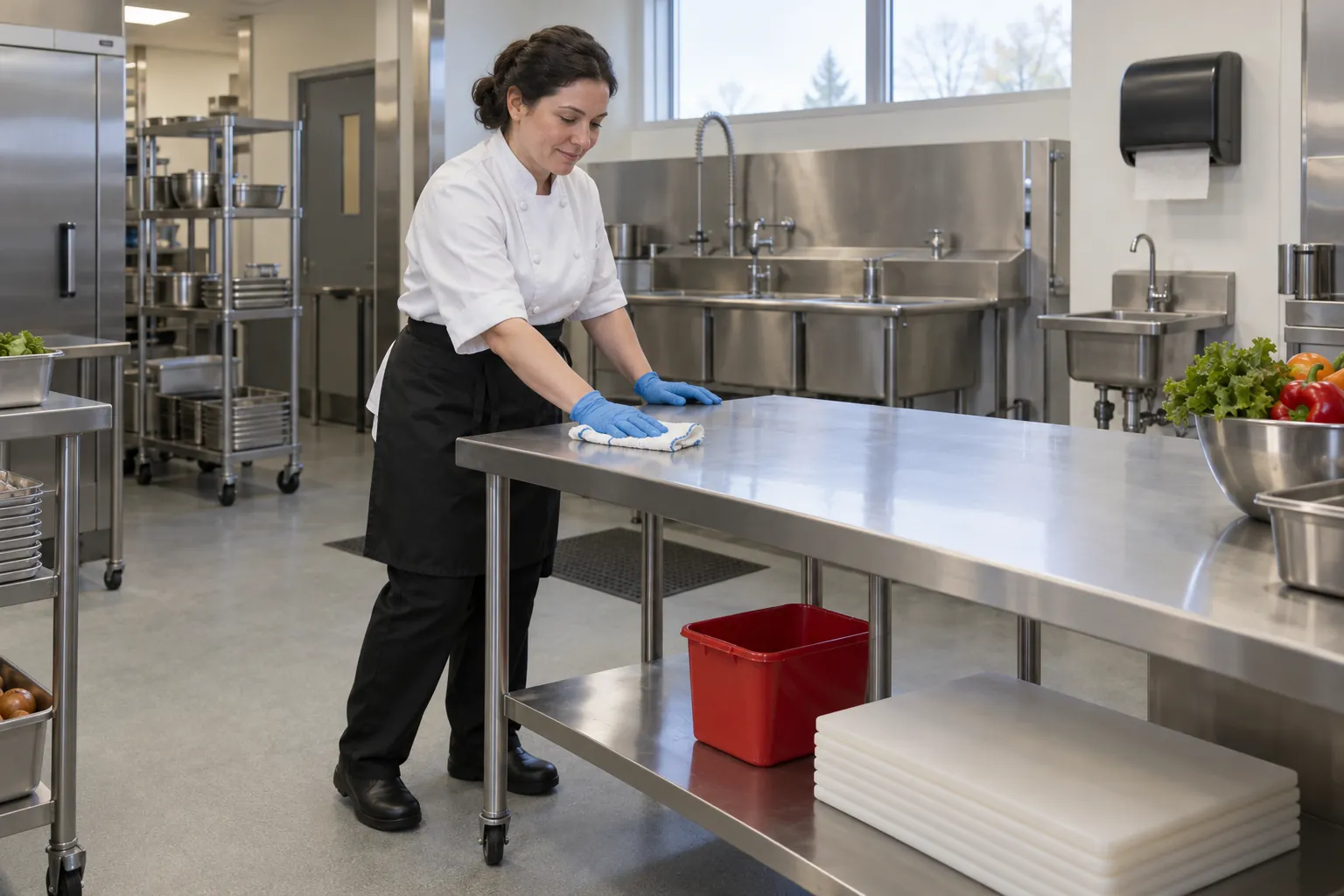
British Columbia, Alberta and Prince Edward Island each require one in their food regulations, and in B.C. the local health authority approves it before a permit is issued. A business licensed under the federal Safe Food for Canadians Regulations covers the same ground in its cleaning and sanitation program. This guide is for the people who write and run the plan in restaurants, catering kitchens and institutional food services, and the janitorial crews who clean them: the rules, what goes in the plan, how to write a procedure someone can follow at closing, and the record that shows it is being followed.
01
What a sanitation plan is, and which rules require one
Island Health's guide Writing a Sanitation Plan puts it simply: a set of written cleaning procedures that lay out what is to be cleaned, when, by whom and with what. Food premises law in Canada is provincial and enforced by local public health, so whether the plan must be written down, and who sees it, depends on the province.
- British Columbia. Section 24 of the Food Premises Regulation, B.C. Reg. 210/99 requires every operator of a food service establishment to have written procedures for its safe and sanitary operation, including the cleaning and sanitizing requirements for the establishment and all its equipment and utensils, the cleaning and sanitizing agents with their concentrations and uses, and every pesticide with its uses and storage. Where food is processed or prepared, section 24(3) requires the procedures to be approved by a health officer. The province's Food Safety & Sanitation Plans page says the plan goes to the local health authority for approval, and Interior Health and Island Health both say it must be approved before the Environmental Health Officer (EHO) issues a permit.
- Alberta. Section 29 of the Food Regulation, Alberta Regulation 31/2006 requires a commercial food establishment to have written procedures for its safe and sanitary operation and maintenance: the cleaning and sanitizing requirements for the premises and for equipment and utensils not normally washed in a dishwasher, and a list of every cleaning and sanitizing agent with its concentration and use. Section 21(2) separately requires a written record of all pest control measures.
- Prince Edward Island. Section 14 of the Public Health Act Food Premises Regulations requires a licence holder to develop, maintain and follow written procedures for maintenance, cleaning and sanitation, naming each cleaning and sanitizing agent and each pesticide with its uses, concentration and storage.
- Federally licensed food businesses. Section 50 of the Safe Food for Canadians Regulations (SOR/2018-108) requires an establishment and its equipment to be clean and sanitary, and cleaned in a way that does not risk contaminating food; section 86 requires a licence holder, with some exceptions for small businesses and exports, to keep a written preventive control plan. The CFIA's guidance on a cleaning and sanitation program helps businesses meet these requirements.
Other provinces set cleaning duties without always asking for a written plan; Ontario's are in our restaurant cleaning checklist. Ask your public health unit what an inspector expects to see.
A sanitation plan is not a food safety plan. In B.C., section 23 requires a separate food safety plan built around critical control points such as cooking and cooling; the sanitation plan covers cleaning, sanitizing, chemicals and pests. Health authorities usually ask for both.
02
What goes in a sanitation plan
The templates differ in layout but agree on content. Interior Health's Writing a Sanitation Plan has five parts:
- Cleaners and sanitizers. Every product, what it is used for, its concentration and how to mix it. Island Health adds safety precautions, and says every chemical stored on site belongs on the list.
- Cleaning and sanitizing procedures. For each area, piece of equipment and utensil: the method, the product and concentration, and the frequency. Food contact surfaces are cleaned and sanitized; floors and walls usually only need cleaning.
- Warewashing. The three-compartment sink or the dishwasher, with the temperatures and sanitizer strength it must reach and how they are checked.
- Pesticides. Each product or measure, its use and its storage. Interior Health notes that chemical pesticides are not suitable in food preparation and storage areas, and P.E.I.'s template says a professional pest control company is highly recommended.
- Cleaning schedule. Daily, weekly, monthly and annual tasks by area, from cutting boards and slicers to walk-in coolers, the fume hood, behind equipment, the servers' station and the washrooms.
B.C.'s Sanitation Plan Workbook, written for food processors, adds two things worth copying in any kitchen: who does each task, and the cleaning records themselves.
Write the plan for your own premises. A hospital tray line, a school cafeteria and a banquet kitchen have different equipment. Alberta Health Services' Introduction to a Sanitation Program says a place that does more food handling and preparation needs a more extensive plan. Include the outside: Interior Health's completeness questions ask whether garbage and recycling areas are covered.
03
Writing a procedure someone can follow
A line that says "clean slicer daily" tells a new prep cook nothing. The B.C. workbook's sample procedures name what is cleaned, how, when and by whom, and the "how" is a numbered method. For a piece of equipment it runs:
- Prepare: protective equipment on, power off and locked or tagged out, food removed, the machine taken apart, solutions mixed and checked with a test kit or test paper.
- Pre-rinse with hot water to loosen soil.
- Apply detergent and scrub, without letting it dry.
- Rinse the detergent off.
- Inspect: no visible soil or food residue; if there is, go back to the pre-rinse.
- Sanitize, and in the sample, do not rinse the sanitizer off.
- Reassemble, remove the lockout and put chemicals and tools away.
Cleaning and sanitizing are two steps. Interior Health explains that cleaning agents such as soap and degreaser remove dirt and grease but do not destroy harmful micro-organisms; sanitizing agents such as chlorine bleach and quats (quaternary ammonium compounds) do, at the right concentration. Check with your EHO before switching to a new type of sanitizer.
Set frequencies by risk. The CFIA's guidance says to choose the frequency based on the risk of contaminating food. AHS gives the range: food preparation surfaces constantly, equipment that holds potentially hazardous food, such as a meat slicer, completely at the end of each day, and walk-in coolers, metal shelves and ceilings perhaps monthly.
Put chemical safety in the procedure. CCOHS's Cleaning Products – Working Safely says to read the label or safety data sheet, never mix products containing bleach and ammonia, always add the concentrate to the water, and wear the gloves and goggles the product calls for.
04
Who does what: kitchen staff, the janitorial contractor and the operator
Every procedure needs a name or a position against it. The CFIA's guidance starts there: identify all persons or positions responsible for cleaning and sanitizing, then each room or area. In a small restaurant that is the closing cook and the dishwasher. In a hospital or university food service it is often three parties: food service staff who clean as they go, a janitorial or environmental services crew working overnight, and contractors for hood cleaning and pest control.
Write down where each party's work starts and stops, because the gaps are where things are missed:
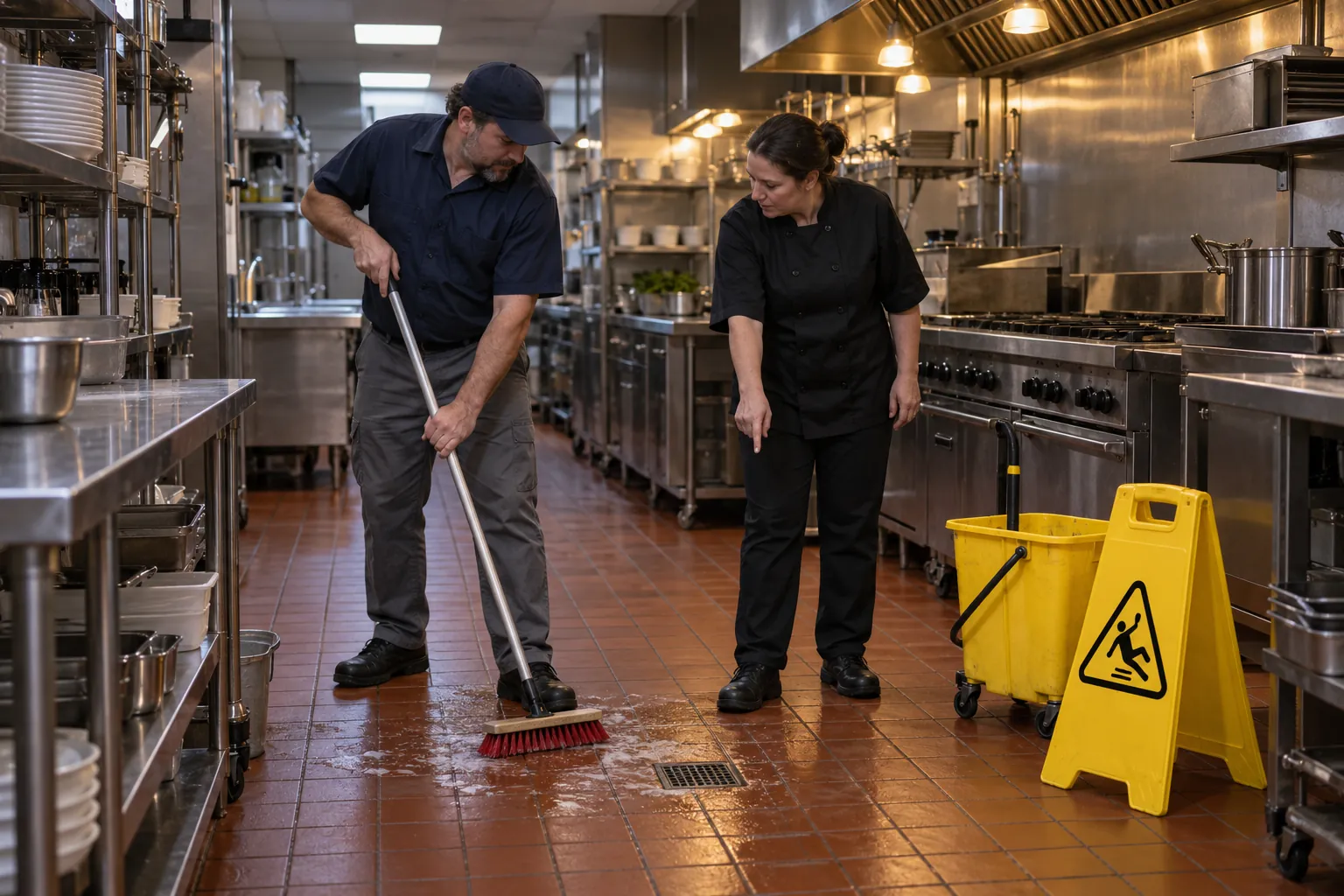
- Floors and drains: the kitchen mops at close; the janitorial crew scrubs floors and cleans drains on a set night.
- Equipment: the kitchen cleans and sanitizes food contact surfaces, and the janitorial scope says the crew does not.
- Walls, vents and high areas: the contractor on a cycle, with the kitchen moving and covering food first.
- Hoods and pests: filters degreased in house, ducts by a specialist; pest sightings reported to one named person between the contractor's visits.
Where a catering company runs the kitchen in a client's building, the contract and the plan should match; our guide to a janitorial scope of work covers the cleaning side.
Training is part of the plan: the CFIA's guidance says training people on chemicals and cleaning procedures reduces health and safety risks and helps ensure procedures are followed. A food safety certificate, such as FOODSAFE in B.C., does not replace walking a new worker through your own plan.
05
Records, verification and review
A plan says what should happen; the record says what did. Island Health's daily, weekly and monthly sheets say "staff initial when tasks completed & supervisor check", and its dishwashing sheet records date, temperature, sanitizer concentration, corrective action and who it was reported to. Interior Health's example for a low-temperature dishwasher tests the sanitizer concentration twice daily and records it on a log sheet.
The CFIA's guidance says a cleaning record should show who is responsible, the cleaning and sanitizing activities to be completed, the chemicals, solution temperatures and concentrations, the date and time, and verification that the work was satisfactorily completed. For a federally licensed business, section 89 of the Safe Food for Canadians Regulations requires the documents showing the preventive control plan has been implemented to be kept for two years.
Records only help if someone reads them. AHS recommends reviewing your records, equipment service reports and EHO reports weekly, and warns: "Don't fall into the trap of doing your paper work and filing it away!"
Review the plan too. Interior Health advises keeping a copy on site for staff, updating it as needed and reviewing it annually. Review it sooner when the menu, equipment, chemicals or cleaning contractor change, and tell your EHO if they approved the original.
06
Where the sanitation record fails
The plan is approved and filed. The sheet beside the dish pit has every box initialled for the week by Tuesday. The slicer line says "done" but not when. The overnight crew works to a contract nobody in the kitchen has read, so drain 4 belongs to neither side. A cook writes "gasket torn" in the margin, and the sheet goes into a binder that is opened at the next inspection.
A record that holds up is written at the time, names one person, shows what was not done and why, and reaches whoever has to act. That is hard on paper when the cook, the janitorial crew and the supervisor work different shifts, sometimes for different employers.
SiteClara is built for that gap. Each place in the plan, such as the line, the dish pit, the slicer station, the walk-in, the garbage room or a washroom, gets a QR code poster, with an NFC tag if staff prefer to tap. Enrolled staff scan it on their own phone, answer the short checklist written for that place and mark it done, so the time and the person are recorded as it happens. A problem, such as a torn gasket or a blocked drain, is reported there with a note and a photo, and stays on the team's list of open jobs until someone closes it. Scheduled checks show what is due, and a worker who cannot do one records why. A supervisor reviews the day's report and approves it, and it goes to the manager or the client the next morning. Where a janitorial contractor cleans part of the kitchen, both sides see the same record.
07
Questions people ask
Where can I find a sanitation plan template?
Start with your own health authority's template, because it uses the figures your EHO expects. Island Health's Writing a Sanitation Plan has a template in its appendix, P.E.I. publishes a two-page Sanitation Plan Template, and B.C.'s templates page offers Word templates for a food processing facility's food safety plan and sanitation plan.
What is a sanitation program?
A sanitation program is the whole system for keeping a food premises clean and sanitary: the written plan, schedules, training, records and checks that the cleaning works. AHS's Introduction to a Sanitation Program recommends one file or binder for the procedures, records and chemical information, reviewed weekly, and the CFIA's Cleaning and sanitation program guidance builds one from who cleans, where, what, when and how, then record templates and training.
What are the steps of sanitation?
There is no single official list, but the sample procedures in B.C.'s Sanitation Plan Workbook use seven for a room or a machine: prepare, pre-rinse, apply detergent, rinse, inspect, sanitize, then clean up or reassemble; its utensil sample adds a scrape for eight. For dishes in a three-compartment sink, Island Health's Writing a Sanitation Plan uses five: scrape, wash, rinse, sanitize and air dry.
08
Official guidance, and a short list to take away
In British Columbia, read sections 23 and 24 of the Food Premises Regulation, the Sanitation Plan Workbook and your health authority's template. In Alberta, read sections 21 and 29 of the Food Regulation and AHS's Introduction to a Sanitation Program. In Prince Edward Island, read section 14 of the Food Premises Regulations. A federally licensed business should start with the CFIA's cleaning and sanitation program guidance.
Before you submit the plan, or before the next inspection, check that:
- every area, piece of equipment and utensil is listed, including garbage and recycling areas;
- every cleaner, sanitizer and pesticide is listed with its use, concentration and storage;
- each procedure is a numbered method a new worker could follow, with its frequency;
- there is a test strip or kit for each sanitizer, and readings are written down;
- each task names a person or position, and the split with the janitorial contractor is in writing;
- the record is initialled when the work is done and checked by a supervisor;
- the plan is kept on site and reviewed yearly or when the menu, equipment or chemicals change.
Sources
Every document this guide quotes or links to, in the order it first cites them.
- Writing a Sanitation Plan islandhealth.ca
- Food Premises Regulation, B.C. Reg. 210/99 bclaws.gov.bc.ca
- Food Safety & Sanitation Plans www2.gov.bc.ca
- Food Regulation, Alberta Regulation 31/2006 kings-printer.alberta.ca
- Public Health Act Food Premises Regulations princeedwardisland.ca
- Safe Food for Canadians Regulations laws-lois.justice.gc.ca
- Cleaning and sanitation program inspection.canada.ca
- Writing a Sanitation Plan interiorhealth.ca
- Sanitation Plan Workbook www2.gov.bc.ca
- Introduction to a Sanitation Program albertahealthservices.ca
- Cleaning Products – Working Safely ccohs.ca
- Sanitation Plan Template princeedwardisland.ca
- Templates page www2.gov.bc.ca
Related guides
 CleaningRestaurant cleaning checklist: back of house, front of house and a record that holds upA restaurant cleaning checklist for Canadian kitchens and front of house: daily, weekly and monthly tasks, sanitizer rules in Ontario and B.C., and records to keep.
 CleaningCleaning log sheet: what to record, who fills it in, and what the law in Canada asks forWhat a cleaning log sheet should record, where Canadian workplaces use one, what Ontario and federal rules require, and how to keep a log people believe.
 CleaningHealth Canada approved disinfectants: what the DIN tells you, and how to use itHow to tell a Health Canada approved disinfectant: the DIN, what the label must show, how to check it, and what the Biocides Regulations changed.
 Premises and facilities managementFridge temperature log: the 4°C rule, the vaccine fridge and a record that holds upFridge temperature logs for Canadian kitchens, clinics and care homes: the 4°C food limit, +2°C to +8°C for vaccines, twice-daily readings and what to do when out.