Cleaning
Cleaning log sheet: what to record, who fills it in, and what the law in Canada asks for
A cleaning log is a dated record, kept for one area, of each time it was cleaned, what was done and who did it.
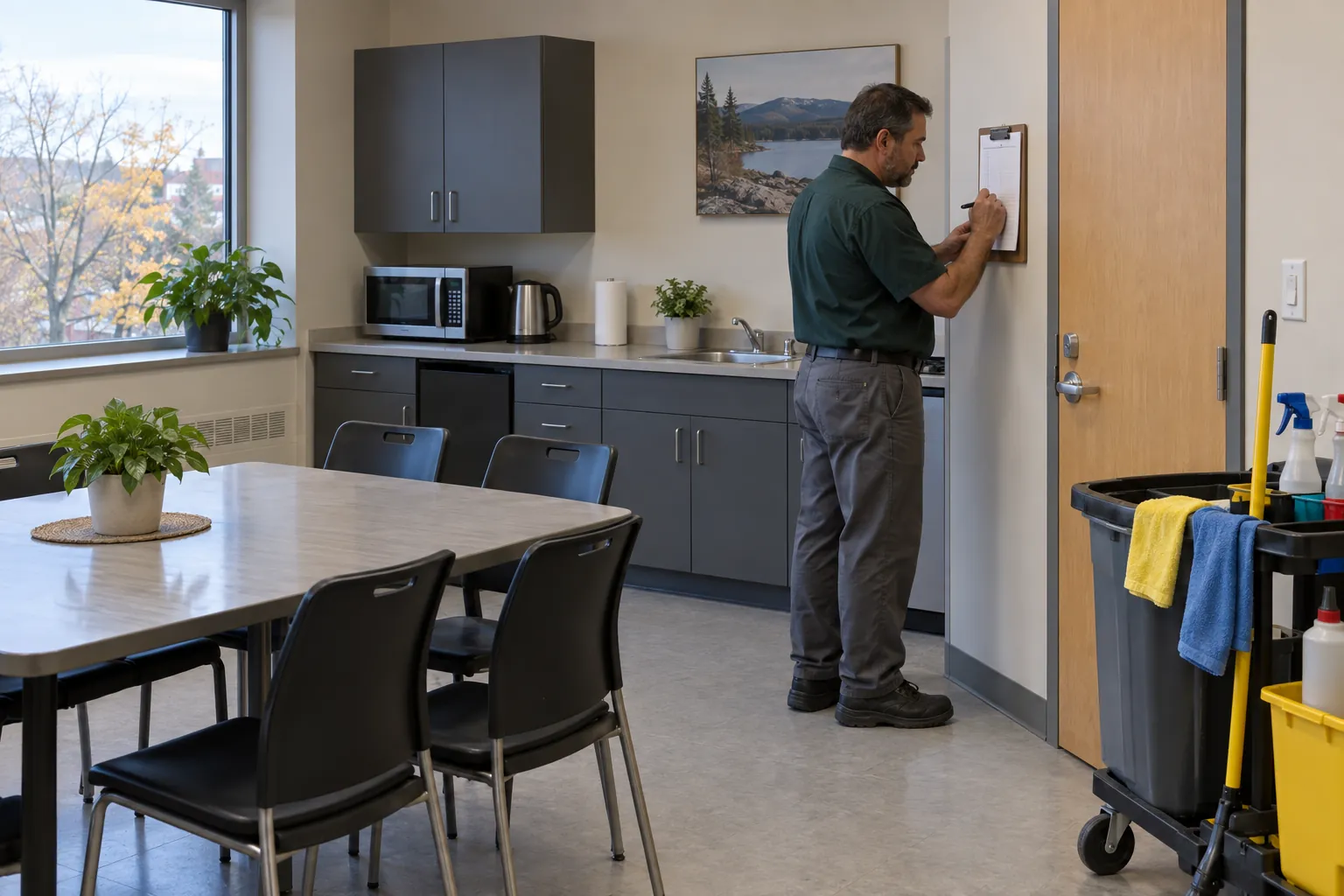
It is the sheet in the washroom, the lunchroom, the lobby or the food prep area that fills up through the day. This guide covers what Canadian law asks for, where logs are used, what each entry should carry, how often to fill one in, and how to keep a log a client or an inspector will believe.
01
What a cleaning log is, and what the law in Canada asks for
A cleaning log sheet records repeated cleanings of one area: the date, the time, what was done and who did it, one line per visit. It differs from a checklist, which says what to do, and from a sign-off sheet, which closes a single job such as a deep clean. A log answers the question people actually ask: when was this place last cleaned, and by whom?
Most Canadian workplace law is provincial, so the first question is which rules apply to your building. Very few of them name a cleaning log. Most set a standard of cleanliness and leave the employer to show it is met. In Ontario:
- Offices, shops, factories and arenas. The Occupational Health and Safety Act (OHSA) defines an industrial establishment as an office building, factory, arena, shop or office, other than an office in a private residence. R.R.O. 1990, Reg. 851 (Industrial Establishments) applies to them. Section 11 requires every floor or other surface used by a worker to be kept free of obstructions, hazards and accumulations of refuse, snow or ice. Section 137 requires protective clothing worn next to the skin to be cleaned and disinfected before another worker wears it.
- Washrooms provided for workers. Section 25.3 of the OHSA requires an employer to ensure that the washroom facilities, if any, that it provides for workers are maintained in a clean and sanitary condition, and subsection 25.3(3) requires it to keep, maintain and make available records of the cleaning of those facilities as prescribed. O. Reg. 480/24 (Washroom Facilities – Records of Cleaning), in force from 1 January 2026, says the record may be posted in a conspicuous place in or near the washroom, or posted electronically with directions for workers on where and how to find it, and must include the date and time of the two most recent cleanings. This is the one Ontario workplace rule that describes a cleaning log by its contents. Our washroom cleaning checklist guide covers it in detail.
- Restaurants, cafeterias and other food premises. O. Reg. 493/17 (Food Premises) under the Health Protection and Promotion Act requires every room where food is handled to be maintained in a sanitary condition (section 7), garbage to be removed as often as is necessary to keep the premises sanitary (section 12), multi-service articles to be cleaned and sanitized after each use (section 21), and food contact surfaces to be cleaned and sanitized as often as necessary (section 22). Section 13 requires the operator to keep records of all pest control measures for at least one year. It does not require a general cleaning log.
So a cleaning log is rarely a statutory form. It is how an employer, a janitorial contractor or a property manager shows, day after day, that a duty to keep a place clean is being met.
02
Where cleaning logs are used
A log belongs wherever an area is cleaned more than once a day, or where someone other than the cleaner needs to know when it was last done:
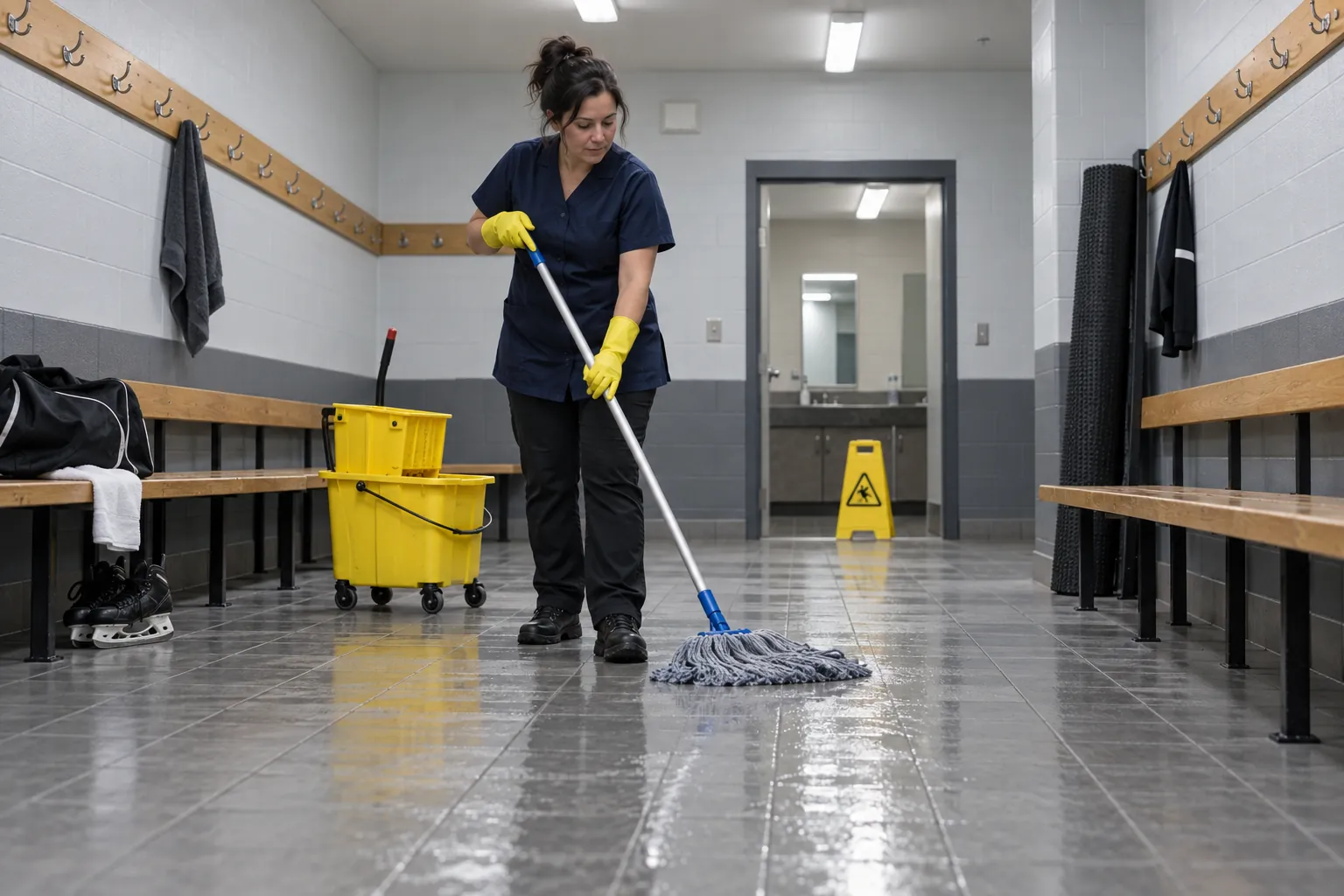
- Washrooms and change rooms. The most common log of all, often called a bathroom cleaning log, and in Ontario the one with a prescribed minimum record. Showers and clean-up facilities count as washroom facilities under the OHSA.
- Lunchrooms, kitchenettes and staff rooms. Tables, counters, sinks, microwaves, fridge handles and kettles: the surfaces everyone touches.
- Food premises. Prep surfaces, slicers, dish areas and floors in a restaurant, cafeteria or food court, logged alongside the temperature and sanitizer checks the operator already keeps.
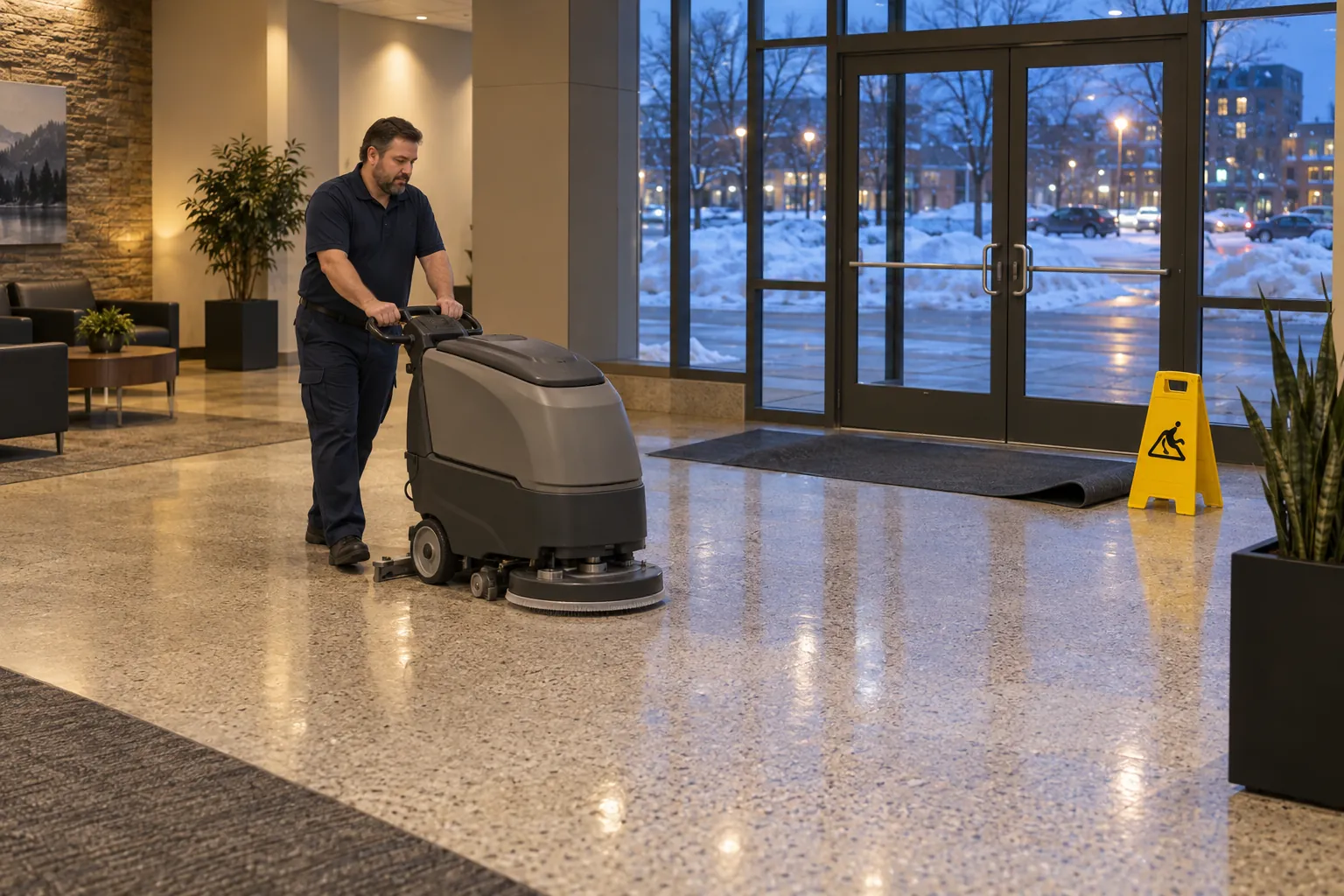
- Entrances, lobbies and other public spaces. In winter, salt, slush and meltwater tracked in from the street make an entrance the busiest floor in the building. A log of mat changes and floor mopping sits naturally beside a snow removal log guide for the walkways outside.
- Elevators and stairwells. Push buttons, handrails and door hardware in office towers and condominium common elements.
- Garbage and recycling rooms. Bins emptied, floors washed, chute doors wiped, spills cleared.
- Health care, long-term care and child care. Cleaning records set by the facility's infection prevention and control program, not by a janitorial scope of work alone.
Keep one log per area. A single sheet for the whole floor, filled in at the janitor's closet, says someone was in the building, not that each room was cleaned. The same holds for a small business with one washroom and a kitchenette: a sheet in each beats one sheet for both.
03
What a cleaning log sheet should record
Start from what the area needs, not a cleaning log template made for another building, and keep the columns few enough to fill in honestly. A useful cleaning log carries:
- The area, named at the top so there is no doubt: "2nd floor lunchroom, east", not "lunchroom".
- The date and the actual time the cleaning was finished, written at that moment, not the scheduled time.
- Who did it: a name, or initials that identify one person, not "night crew" or the contractor's name.
- What kind of visit it was: a quick check and restock, a full cleaning, or a disinfection. A walk-through that only topped up paper towels is not a cleaning.
- The tasks, where they vary by visit: floors, touch points, garbage, supplies.
- The product where it matters, such as the sanitizer and its concentration on a food contact surface.
- Deficiencies found: a leak, a plugged toilet, a burnt-out light, a broken dispenser, and who it was reported to.
- Anything not done, and why: room locked, area closed for a repair, product out of stock.
- A supervisor line: initials and a time from someone who did not do the cleaning, on an unannounced check.
Keep a signature list with each set of logs: every name and set of initials used, so that an entry can be traced to one person months later. A log whose initials nobody can identify is a record of nothing.
04
How often to clean, and who fills in the log
The frequency belongs in the janitorial scope of work, and the log should follow it. Federally regulated workplaces must clean each personal service room at least once every day it is used. Beyond that:
- CCOHS guidance: clean at least once a day, more often (every two to three hours) where needed, and between shifts or at least once during each shift where workers work in shifts. Its Workplace Housekeeping – Basic Guide says washroom facilities require cleaning once or more each shift, and that cleaning and organizing must be done regularly, not just at the end of the shift.
- Ontario washrooms: no fixed frequency, but inspectors may consider the actual condition of the washroom and how often it is cleaned given its type and level of use, as the province's guidance, Maintaining clean washroom facilities for workers, explains.
Beyond those floors, schedule by use, not by the clock alone: after the morning arrival, after lunch, after a shift change, after an event in the lobby. An hourly entry through a quiet afternoon and none over the noon rush makes a tidy log and a dirty lunchroom.
Who fills it in matters as much as how often. CCOHS's housekeeping guide says a good program identifies and assigns responsibility for cleanup during the shift, day-to-day cleanup, waste disposal, removal of unused materials, and inspection to make sure cleanup is complete. On the log itself:
- The person who did the cleaning writes the entry, at the time, for their own work only. Never for a colleague, and never before the work is done.
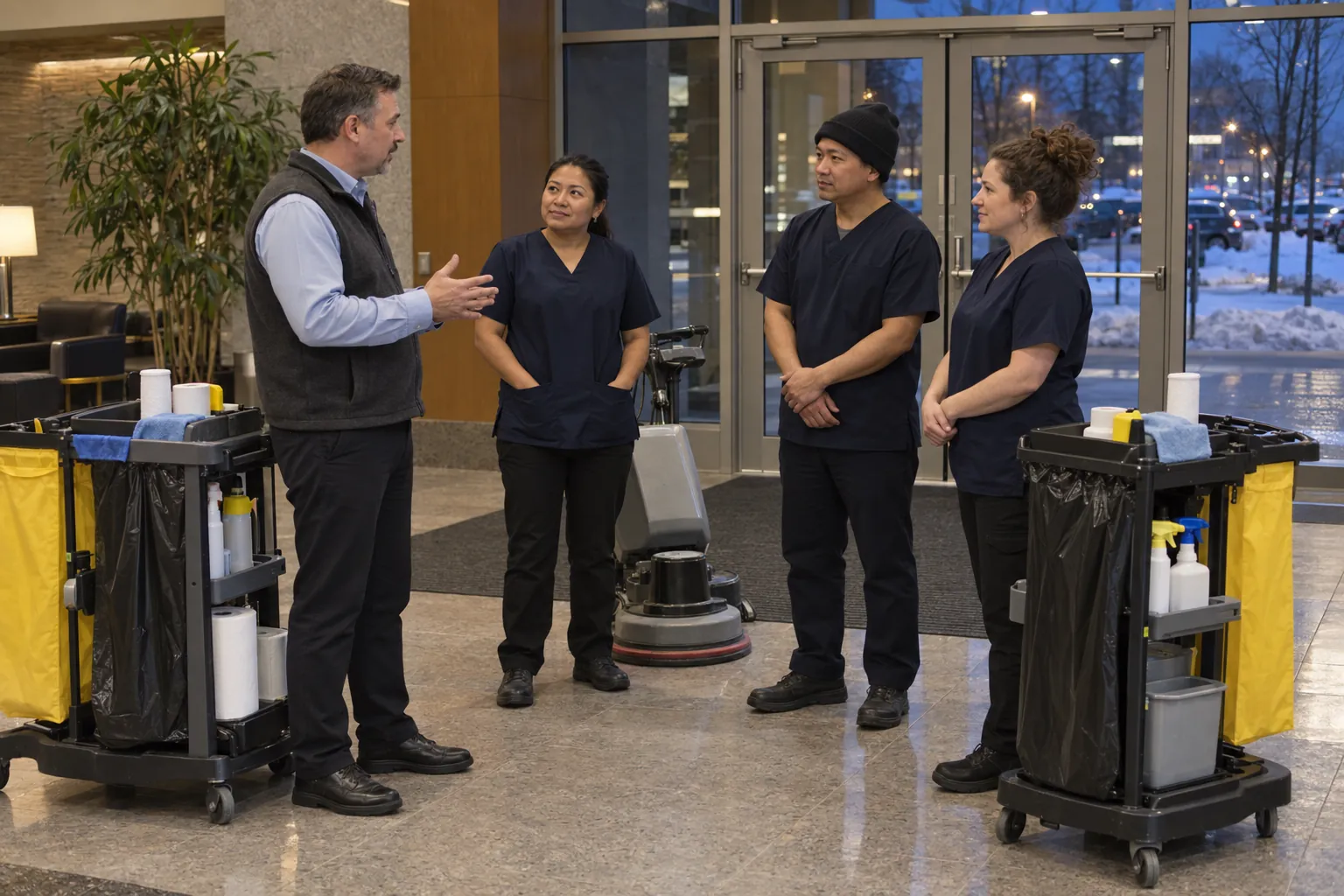
- The janitorial supervisor or lead hand checks the area, not just the sheet, and initials a separate line with the time of their check.
- The client or property manager reviews the logs on an agreed schedule, and raises gaps with the contractor.
- The joint health and safety committee or health and safety representative, where there is one, will see the logs on its workplace inspections. In Ontario, section 9(26) of the OHSA requires a designated committee member to inspect the physical condition of the workplace at least once a month, and section 8(6) sets the same for a representative; see our JHSC workplace inspection guide.
05
What makes a cleaning log believable, and how long to keep it
Anyone who has run a janitorial contract has seen a log filled in ahead of time, or a whole day of entries in the same pen at the same slant. Now that Ontario workers can read the two most recent washroom cleanings on the wall, an entry that does not match the room is more visible than it used to be. A log people believe has these features:
- It is written at the time. The time on the entry is when the cleaning finished.
- It names one person. An individual's initials carry weight; a crew name does not.
- It shows exceptions. A log where the soap never ran out and nothing ever broke is not believed. "Mats changed 7:40 a.m., meltwater at main entrance" or "fridge leaking, reported to building operator 2:15 p.m." shows that someone looked.
- Someone else checks it. A supervisor who walks the area unannounced a few times a week gives the log its independence.
- Gaps are explained. "Closed for plumbing repair" or "covering a spill on level 3" is more credible than a log with no gaps at all.
- Problems go somewhere. The log should say who was told about a fault, and the fault should be tracked until it is fixed.
Retention is rarely set by law. Ontario's washroom rule only asks for the two most recent cleanings to be posted, and O. Reg. 493/17 sets one year for pest control records in food premises, not for cleaning. That leaves it to the contract and to your own judgment. A sheet thrown away every Monday cannot settle a dispute about Thursday, so agree a period with the client, write it into the scope of work, and say where the logs are kept.
In a multi-tenant building or a condominium, settle who owns the log. The contract, the lease or the property manager's instructions should say who keeps each log, who reviews it and who a worker or resident tells when an area is not clean.
In Ontario health care, PIDAC's Best Practices for Environmental Cleaning for Prevention and Control of Infections in All Health Care Settings, published by Public Health Ontario, is written for those who manage cleaning services there, and the log sits inside the facility's infection prevention and control program.
06
Where the paper log fails, and what SiteClara does about it
Paper logs fail in predictable ways. They are filled in at the end of the shift from memory and kept in a binder the client never sees. A missed cleaning is noticed only when the next person finds the area dirty. When a complaint arrives weeks later, nobody can show whether an entry was written at 10 a.m. or at 5 p.m.
SiteClara records the cleaning at the place where it was done. A printed QR code at each area, with an NFC tag behind it if staff would rather tap than scan, lets the custodian or cleaner mark the scheduled cleaning for that location done on their own phone, with no app to install, or say what stopped them. Their name and the time are recorded as it happens, and they can add a photo when one is asked for. A problem found goes onto the team's list of open jobs until someone closes it.
The supervisor sees what is due, done and missed at each location, and can record the reason a cleaning was missed. At the end of the day they review it, add a note and approve the report, which goes to nominated client or management contacts at 8 a.m. the next morning, showing what was completed, what is still open and how the scheduled cleanings went.
07
Questions people ask
Do cleaning logs really work?
Only as well as the entries match the room. CCOHS's Sanitation and Infection Control for Cleaning Staff tells cleaning staff to create a checklist of the surfaces to clean and to "record when cleaning and disinfection has occurred". But in Ontario, the province's guidance, Maintaining clean washroom facilities for workers, says an inspector may consider the actual condition of the washroom, such as visible soiling, how often it is cleaned for its type and level of use, and whether the cleaning practices are appropriate. A tidy log beside a dirty room shows the log is wrong, not that the duty is met.
What should a bathroom cleaning log sheet include in Ontario?
For washrooms provided for workers, Maintaining clean washroom facilities for workers explains that O. Reg. 480/24 requires employers and constructors to keep, maintain and make available records of cleaning, and that the posted record must include the date and time of the two most recent cleanings. The record can be posted in a conspicuous place in or near the washroom, or electronically, in which case workers must be told where and how to find it.
Is there an official cleaning log template?
Not in Ontario's washroom rules. Maintaining clean washroom facilities for workers explains what the record must show, the date and time of the two most recent cleanings, and where it can be posted, but does not supply a form. CCOHS's Sanitation and Infection Control for Cleaning Staff likewise tells you to build your own checklist of surfaces, especially touch points. A template is a starting point; the columns should follow the area.
08
Further reading, and a list to take away
In Ontario, read Reg. 851, sections 1, 8, 9 and 25.3 of the OHSA, O. Reg. 480/24 with the province's washroom guidance, and O. Reg. 493/17 for food premises. Federally regulated workplaces should read Part IX of the Canada Occupational Health and Safety Regulations; elsewhere, start with your own province's general conditions regulation, such as WorkSafeBC's Part 4. CCOHS's housekeeping guide and its page for cleaning staff are short and practical.
Before you print the next batch of paper logs from a cleaning log template, or replace them, check that:
- there is one log per area, named clearly, not one per floor or per building;
- each area's cleaning frequency is in the scope of work and follows how the area is used, at least daily or once a shift;
- each entry carries the actual time and a name or initials that identify one person;
- the log separates quick checks from cleanings, and cleanings from disinfection;
- deficiencies have a column, with who they were reported to;
- a supervisor initials the log after checking the area, on unannounced visits;
- in Ontario, the bathroom cleaning log for each workers' washroom shows the date and time of the two most recent cleanings, posted or available electronically;
- a signature list lets any initials be traced to a person;
- someone reviews the logs on a set schedule and acts on gaps;
- you know how long the logs are kept, and where.
Sources
Every document this guide quotes or links to, in the order it first cites them.
- Occupational Health and Safety Act ontario.ca
- R.R.O. 1990, Reg. 851 (Industrial Establishments) ontario.ca
- O. Reg. 480/24 (Washroom Facilities – Records of Cleaning) ontario.ca
- O. Reg. 493/17 (Food Premises) ontario.ca
- Canada Occupational Health and Safety Regulations laws-lois.justice.gc.ca
- Occupational Health and Safety Regulation, Part 4 worksafebc.com
- Sanitation and Infection Control for Cleaning Staff ccohs.ca
- Workplace Housekeeping – Basic Guide ccohs.ca
- Maintaining clean washroom facilities for workers ontario.ca
- Best Practices for Environmental Cleaning for Prevention and Control of Infections in All Health Care Settings publichealthontario.ca
Related guides
 CleaningWashroom cleaning checklist: what to check, how often, and Ontario's new cleaning recordsWhat a workplace washroom cleaning checklist should cover, how often to clean, and Ontario's posted cleaning records required since January 1, 2026.
 CleaningJanitorial quality control: how to inspect, correct and show the standard heldHow janitorial quality control works in Canada: QA versus QC, inspections, sampling, corrective action, CIMS, the PIDAC audit model and records that hold up.
 CleaningJanitorial supervisor duties: what the role involves in Canada, and what good looks likeWhat a janitorial or cleaning supervisor does in Canada: the main duties, a typical shift, the legal duties of a supervisor, WHMIS, checking the work and reporting.
 CleaningCommercial cleaning checklist: area by area, for Canadian buildingsA commercial cleaning checklist for Canadian offices and shared buildings, area by area, with the provincial rules behind it, what to record and how to check it.