Premises and facilities management
Fridge temperature log: the 4°C rule, the vaccine fridge and a record that holds up
A fridge temperature log is the dated record of each fridge, walk-in cooler and freezer's temperature, who read it and what was done when it was out of range, kept in Canada to show that potentially hazardous food stayed at 4°C or colder, the limit in the Ontario, British Columbia and Alberta food premises rules, and that vaccines stayed between +2°C and +8°C.
Also written for United Kingdom · United States · Australia
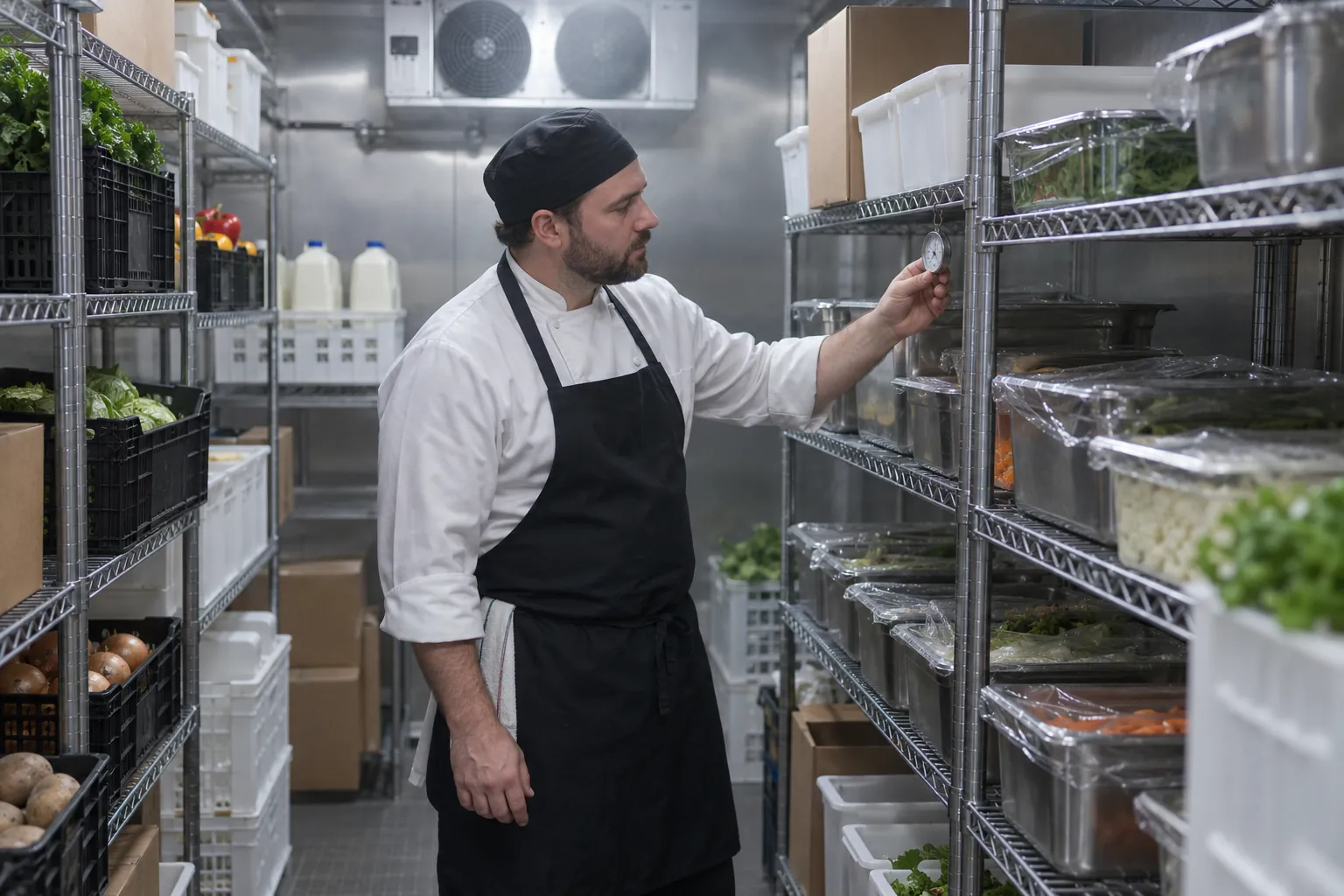
Restaurant, hotel, school and long-term care kitchens keep one for food; clinics, pharmacies and care homes keep a separate one for the vaccine fridge, which the Public Health Agency of Canada's 2026 national guidelines say is read and recorded at least twice a day. This guide covers the provincial rules and the national guidelines, what a temperature log sheet should record, how and when to take a reading you can trust, and what to do when the figure is wrong.
01
The rules behind a fridge temperature log: 4°C for food, +2°C to +8°C for vaccines
Two sets of rules lie behind a fridge temperature log, and many buildings have both: kitchen coolers and freezers come under the province's food premises rules, and the vaccine fridge under national and provincial immunization guidance.
Ontario. Section 27(1) of Ontario Regulation 493/17, Food Premises, made under the Health Protection and Promotion Act, says potentially hazardous food shall be distributed, maintained, stored, transported, displayed, sold and offered for sale only where its internal temperature is "4° Celsius, or lower" or "60° Celsius, or higher". Section 27(2) sets aside periods of no more than two hours needed to prepare or process the food, and section 28 says food meant to be sold or stored frozen must be kept frozen. Section 30 requires refrigeration equipment to be big enough to hold the food at the section 27 temperature and to "contain accurate indicating thermometers that may be easily read".
British Columbia. Section 14 of the Food Premises Regulation, B.C. Reg. 210/99 requires potentially hazardous food to be stored or displayed at not more than 4°C or not less than 60°C, and frozen food to be stored, displayed or transported at not more than -18°C. Section 19 requires all refrigeration equipment to be capable of holding those temperatures and to have a thermometer accurate within 1°C. Section 23 requires every food service establishment to develop, maintain and follow written food handling procedures that identify its critical control points, set critical limits for them, say how the limits will be kept, and say what will be done when they are not.
Alberta. Section 25 of the Food Regulation, Alberta Regulation 31/2006 requires high-risk food to be stored, displayed and transported at not more than 4°C or not less than 60°C, unless an executive officer stipulates otherwise, and frozen food to remain frozen. Section 18 requires refrigeration equipment to be capable of those temperatures and equipped with an accurate thermometer.
None of the three regulations uses the words "temperature log". The duty is the temperature and the thermometer. A log is how the operator shows the cooler held 4°C yesterday and last week, and in British Columbia how a written procedure with a 4°C critical limit is seen to be followed. Other provinces have their own rules; ask your public health inspector what they expect to see.
Vaccines. The Public Health Agency of Canada's National Vaccine Storage and Handling Guidelines for Immunization Providers, 2026, published in September 2026, replace the 2015 edition and the 2021 interim guidance for COVID-19 vaccines. They give the usual range for refrigerated vaccines as +2°C to +8°C and complement, rather than replace, provincial, territorial and local immunization policies. In Ontario, the Ministry of Health's Vaccine Temperature Log Book tells providers to monitor refrigerator temperatures and record them twice daily.
02
What a fridge temperature log sheet should record
Each entry should let someone who was not there see the reading, where and when it was taken, who took it and what happened next.
For a kitchen cooler or freezer. The Eastern Ontario Health Unit's 2-day temperature log sheet is a good model. It names the premises, prints the criteria at the top (refrigerator units 4°C or colder, freezer units -18°C or colder), asks who to contact immediately if they are not met, and has a row per unit with several times through the day, initials, a column for corrective actions and comments, and a line for who reviewed it and when. Put together, a food log needs:
- the date and actual time of each reading;
- which unit, named so nobody can confuse them: walk-in cooler, line reach-in, bar cooler, dessert display case, chest freezer 2;
- the temperature, in °C or °F but never a mix, and whether it came from the unit's thermometer or a probe;
- the initials or name of the person who took it, written at the time;
- if it was out of range, what was done, who was told and when the unit was back at 4°C or colder;
- the supervisor's review, dated and initialled.
For a vaccine fridge, the national guidelines ask for the current, minimum and maximum temperatures of the refrigerator, the freezer if there is one, and the room, with the date and time, the initials of the person recording and comments where appropriate. They add one rule every log should borrow: when a reading is missed, the log entry is kept as a blank, not filled in later.
Alberta Health Services' Temperature Monitoring Log shows the shape of a monthly vaccine fridge temperature log sheet in Celsius: a new form each month, the site and fridge serial number at the top, and an a.m. and a p.m. entry each day for the time, the current, high and low temperatures and the recorder's initials. It also asks for an explanation on the log of any excursion that does not lead to a cold chain break report, such as the door left open while vaccine was being put away.
Keep the kitchen log apart from the vaccine log: they have different limits, people and retention, and a care home's kitchen walk-in and treatment room vaccine fridge should never share a sheet.
03
How often to check, and how to take a reading you can trust
For food, none of these regulations sets a frequency, so it is the kitchen's own decision, written into its procedures; the health unit form above has spaces for morning and afternoon readings. A sensible pattern is opening, before service and close, at fixed times. What matters is a set time, a reading taken at it by a named person, and a missed reading that shows as missed.
- Read before the rush. Read when the door has not just been opened for a delivery, and note a defrost or clean when it happens.
- Check the built-in thermometer. Ontario requires accurate indicating thermometers and British Columbia one accurate within 1°C. In a kitchen cooler, compare the display with a separate probe thermometer, and if they disagree by more than that, find out which is right before relying on either. For a vaccine fridge, the national guidelines advise the slush test below instead of checking against a reference thermometer.
- Probe the food when the air reads high. A clean, sanitized probe in the centre of a product tells you whether the food itself has passed 4°C.
- Test the thermometer. The national vaccine guidelines describe a slush test: fill a cup two-thirds with cold water and freeze it until a fine layer of ice forms (about two hours), put the probe in the middle without touching the sides or bottom, and stir gently; it should drop to 0°C within two minutes. If it is more than 1°C out at 2 to 3 minutes, replace the battery and test again, then contact the manufacturer about recalibration or replace it. They say to do this at least once a year.
Freezers need the same routine: British Columbia's limit is -18°C or colder, and the Eastern Ontario form prints the same criterion.
04
Vaccine fridges in clinics and care homes: twice a day, minimum and maximum
A vaccine fridge in a clinic, pharmacy, long-term care or retirement home is held to a tighter routine than a kitchen cooler. The national guidelines expect:
- A named coordinator and a delegate. Each site designates one staff member as the primary vaccine coordinator and another as a delegate, both trained in storage procedures and cold chain breaks, who monitor the equipment twice daily.
- The right fridge. Purpose-built (pharmacy or laboratory grade) refrigerators are preferred; a domestic frost-free unit is acceptable only once validated, and only when a purpose-built one is unavailable. The guidelines say bar-style fridges are not capable of consistently holding +2°C to +8°C and should not be used. No food, beverages or biological specimens go in a vaccine storage unit.
- The middle of the range. Set the refrigerator to average about +5°C, the best safety margin, and act as soon as readings trend towards either limit.
- The right thermometer. Continuous digital data loggers are strongly recommended; min/max thermometers are acceptable only when data loggers are not available or for short transitional periods.
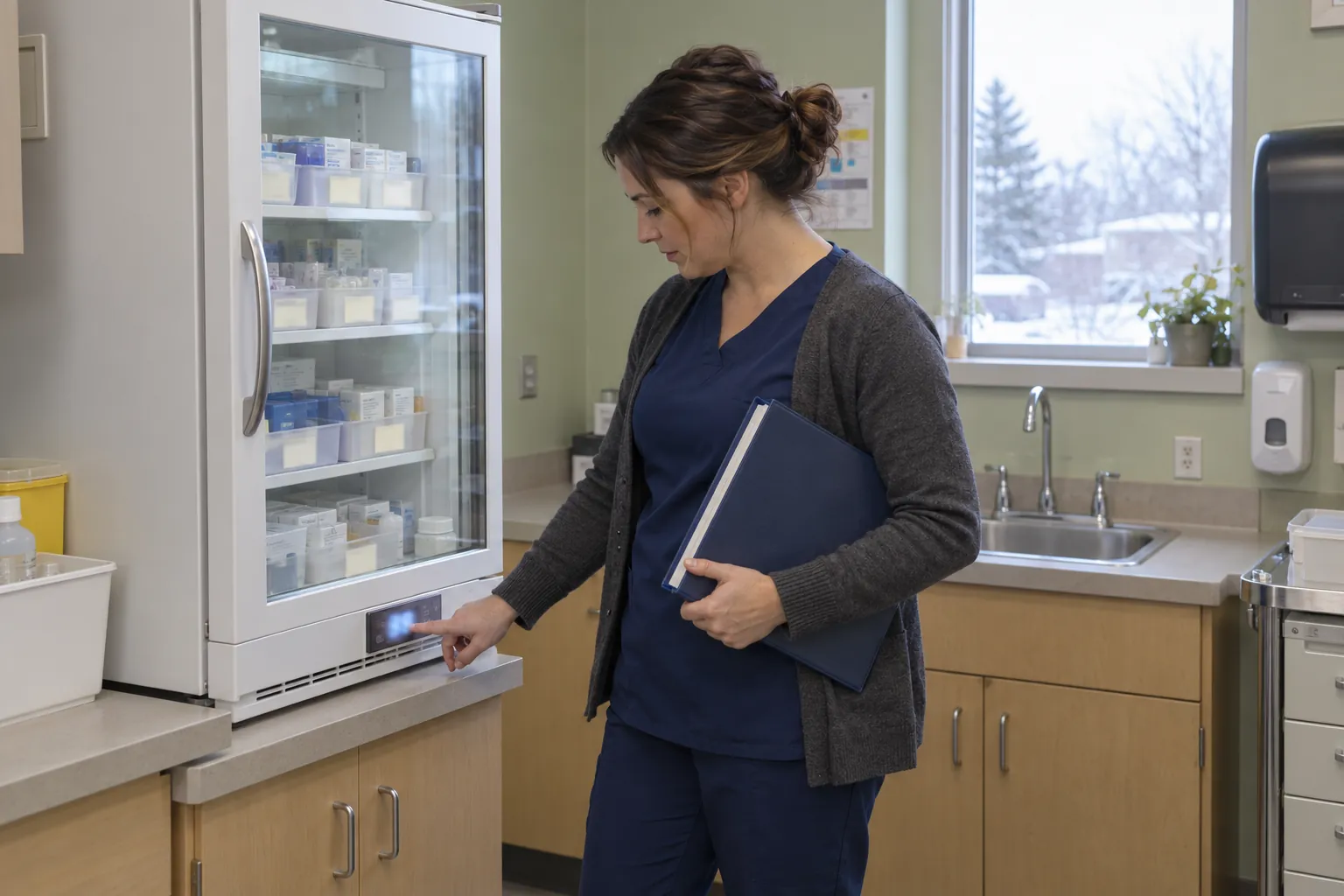
The minimum, maximum and current temperature inside each compartment are checked and recorded numerically on a temperature log at least twice a day: in the morning before the fridge door is first opened, and at the end of the day when it is closed for the last time. A min/max thermometer is reset after every reading is recorded, and the room temperature is read at the same time.
The minimum and maximum are the point. A current reading of 5°C at 9 a.m. says nothing about the night the door was left ajar; a maximum of 11°C does. A vaccine fridge temperature log with only one column is not doing the job.
Automated recorders do not replace the reading: the guidelines warn that data loggers can malfunction, so staff should still verify and record temperatures twice daily. Where a site is not staffed seven days a week, devices can be monitored remotely with notifications on. The coordinator or delegate should review the log weekly, and in some jurisdictions logs must be submitted before vaccine can be ordered.
05
When the reading is out of range, and how long to keep the log
One entry showing a problem found and dealt with proves more than a month of perfect numbers.
A kitchen cooler above 4°C. Probe the food to see whether only the air is warm. If the unit has failed, move potentially hazardous food to a cooler holding 4°C, call for service and write down when the fault was found, the readings, where the food went and who decided what to keep. Ontario's two-hour allowance covers preparation, not a failed cooler, and British Columbia's section 13 forbids storing or selling food unfit for human consumption. If you do not know how long the food has been warm, ask your public health inspector before serving it.
A vaccine fridge outside +2°C to +8°C. Ontario's log book says to call your public health unit immediately, never to give or discard exposed vaccine until the unit has assessed the situation, and to keep exposed vaccine in the refrigerator in a labelled container marked with the date and time and "DO NOT USE". The national guidelines add the order of work: notify the vaccine coordinator or delegate immediately; quarantine the affected vaccines in a working unit or cooler with a "Quarantine" sign and the date of the break; move the supply if the unit is at fault and then find the cause; and report the break on the forms your public health office or immunization program uses.
For a breakdown or power outage, record when it was found and how long it lasted, the current, minimum and maximum unit and room temperatures, the cause, the actions, the results and the coordinator's initials.
How long to keep the log. The national guidelines say completed vaccine temperature logs should be kept for the period set by your public health office or immunization program; describing chart recorders, they say temperature monitoring records should be kept for at least three years unless local guidelines differ. Ontario's food regulation sets no period for temperature logs, though section 29(2) requires food purchase records to be kept for a year; keeping the cooler log as long is sensible, longer if your health unit or plan says so.
06
Where the fridge log fails, and where SiteClara fits
The fridge log fails in familiar ways. A week of 3°C entries in the same pen, written on Friday. A 7°C reading written down and never acted on, because the sheet has no column for what happened next. A vaccine fridge read at 5°C each morning, its maximum never reset. Each tells an inspector the same thing: the record was filled in, not kept.
SiteClara records routine checks at the place they happen. A printed QR poster, with an optional NFC tag behind it, sits beside each cooler, freezer or vaccine fridge that has a scheduled check. Staff scan or tap with their own phone, with no app to install, answer the checklist set for that location, such as the reading and whether it is in range, and mark it done or say what stopped them, with a photo of the display when one is asked for. The time and the named person are recorded as it happens, and a check never done shows as missed.
A fault, such as a cooler running warm or a torn door gasket, is reported at the location and stays on the team's list of jobs until someone closes it. The kitchen manager or supervisor sees which checks are due, done and missed, records why one was missed, and approves a daily report that goes to nominated managers at 8 a.m. the next morning. Facilities, kitchen and nursing staff work from the same record. It is the working record of the round: where your public health unit issues its own vaccine temperature log book, or your food safety plan names a form, keep that as they require.
07
Questions people ask
What temperature should a commercial fridge be in Canada?
4°C or colder for potentially hazardous food. That is the limit in section 27 of Ontario Regulation 493/17, section 14 of British Columbia's Food Premises Regulation and, for high-risk food, section 25 of Alberta's Food Regulation; hot-held food must be 60°C or hotter.
How often should fridge temperatures be checked?
For a vaccine fridge, at least twice a day, in the morning before the door is first opened and at the end of the day, under the National Vaccine Storage and Handling Guidelines. For food, the provincial regulations set no frequency, so the kitchen sets fixed times in its own procedures, such as opening and close.
What freezer temperature is required?
British Columbia's Food Premises Regulation sets not more than -18°C for frozen food; Ontario and Alberta require frozen food to be kept frozen, and the Eastern Ontario Health Unit's log sheet prints -18°C or colder as its criterion.
How long should vaccine fridge temperature logs be kept?
For the period your public health office or immunization program sets. The National Vaccine Storage and Handling Guidelines leave the period to them and, describing chart recorders, say temperature monitoring records should be kept for at least three years unless local guidelines differ; Alberta Health Services' Temperature Monitoring Log says its logs must be kept for five years.
08
Official guidance, and a fridge log checklist to take away
For kitchens, read sections 27 to 30 of O. Reg. 493/17 in Ontario, sections 14, 19 and 23 of the Food Premises Regulation in British Columbia, or sections 18 and 25 of the Alberta Food Regulation, and ask your health unit for its own form, such as the Eastern Ontario Health Unit's temperature log sheet. For vaccines, read the National Vaccine Storage and Handling Guidelines for Immunization Providers, 2026 and, in Ontario, the Ministry of Health's Vaccine Temperature Log Book or, in Alberta, the Alberta Health Services Temperature Monitoring Log. Our restaurant cleaning checklist covers the cleaning record that sits beside it.
Before relying on your fridge temperature log, check that:
- every cooler, freezer and vaccine fridge is named on the unit and on the log;
- food coolers hold 4°C or colder, freezers -18°C or colder, and vaccine fridges aim for +5°C;
- readings are taken at set times by a named person who writes them then;
- vaccine fridges are read for current, minimum and maximum twice a day, and the thermometer reset;
- every out-of-range reading has an action, a name and a time back in range beside it;
- a missed reading stays blank, not filled in later;
- completed logs are kept as long as your health unit, plan or insurer requires.
Sources
Every document this guide quotes or links to, in the order it first cites them.
- Ontario Regulation 493/17, Food Premises ontario.ca
- Food Premises Regulation, B.C. Reg. 210/99 bclaws.gov.bc.ca
- Food Regulation, Alberta Regulation 31/2006 kings-printer.alberta.ca
- National Vaccine Storage and Handling Guidelines for Immunization Providers, 2026 canada.ca
- Vaccine Temperature Log Book ontario.ca
- 2-day temperature log sheet eohu.ca
- Temperature Monitoring Log albertahealthservices.ca
Related guides
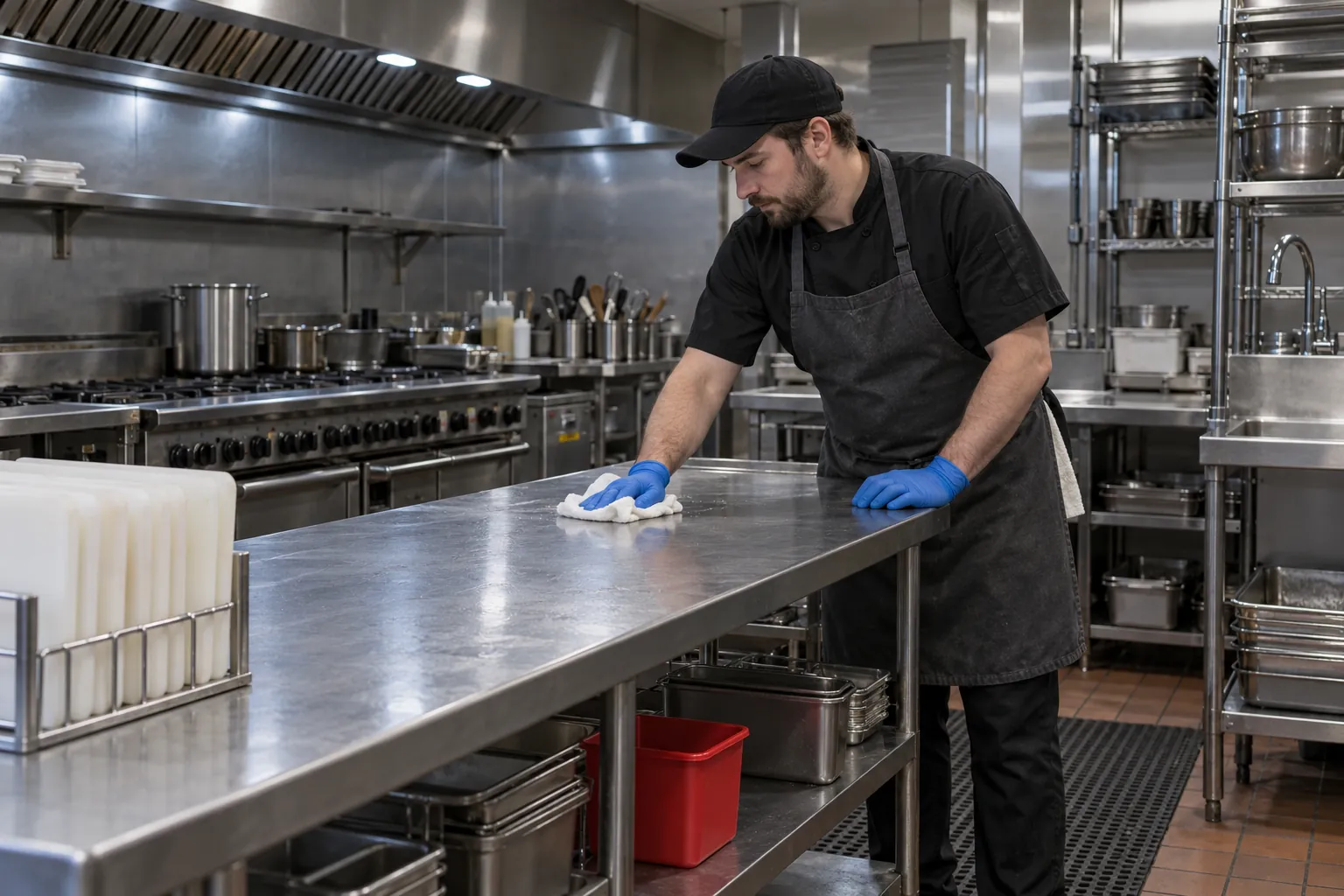 CleaningRestaurant cleaning checklist: back of house, front of house and a record that holds upA restaurant cleaning checklist for Canadian kitchens and front of house: daily, weekly and monthly tasks, sanitizer rules in Ontario and B.C., and records to keep.
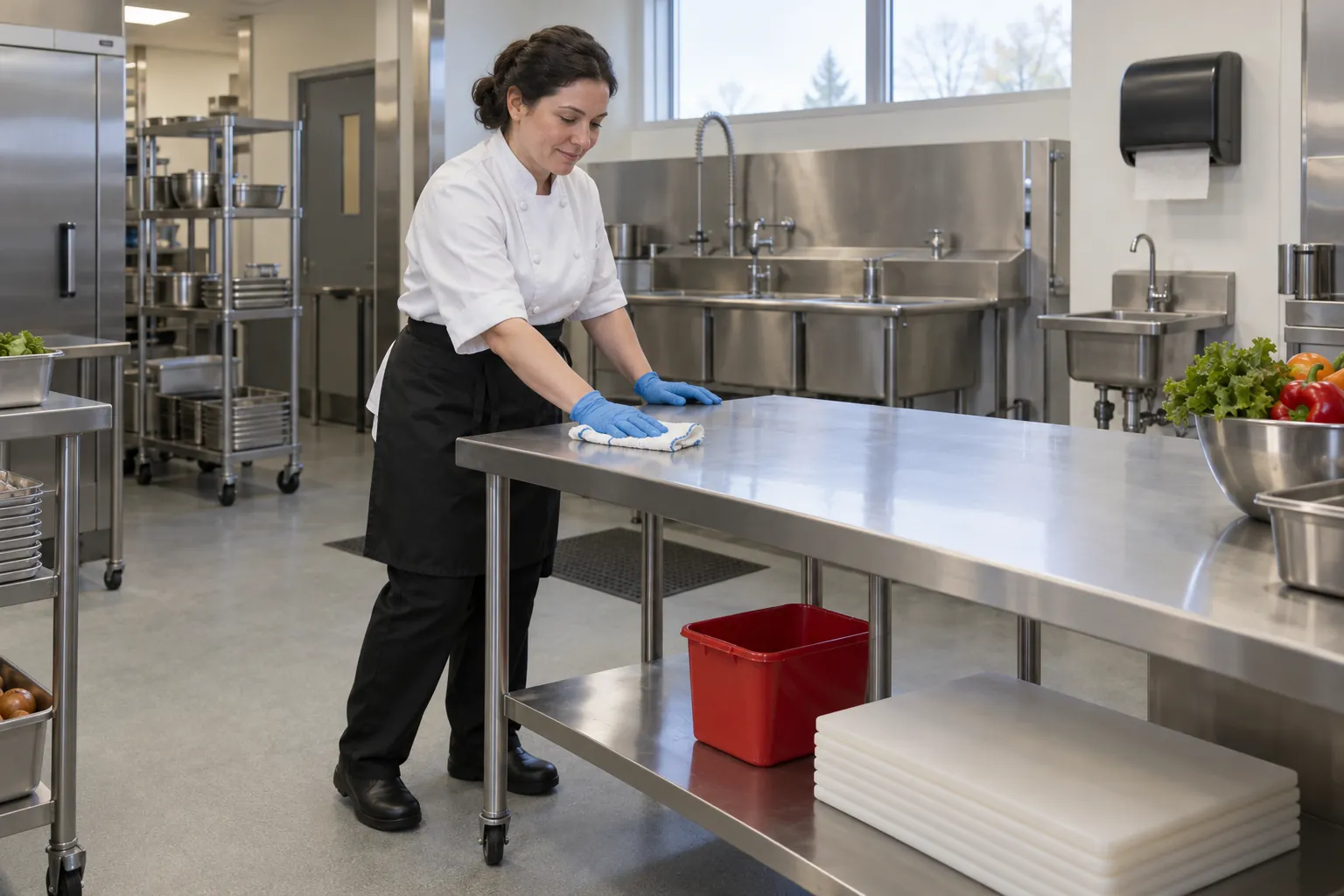 CleaningSanitation plan: the written cleaning procedures a food premises needs, and the record behind themA sanitation plan for a Canadian food premises: the B.C., Alberta and P.E.I. rules, what goes in it, templates, sanitizer checks and the cleaning record behind it.
 CleaningLong-term care cleaning: the rules, the frequencies and a record that holds upLong-term care cleaning in Ontario: the housekeeping duty in O. Reg. 246/22, PIDAC cleaning frequencies, who does what, and records that show it was really done.
 Premises and facilities managementPreventive maintenance checklist: what to include, how often, and how to show it was doneA preventive maintenance checklist for Canadian buildings: what the fire code and provincial law require, what to include, how often, and the records to keep.