Cleaning
Restaurant cleaning checklist: back of house, front of house and a record that holds up
A restaurant cleaning checklist is the written list of the cleaning tasks in a restaurant's kitchen, dining room, washrooms and garbage areas: what is cleaned and sanitized, how often, with which product and by whom.
Also written for United Kingdom · Ireland · United States · Australia
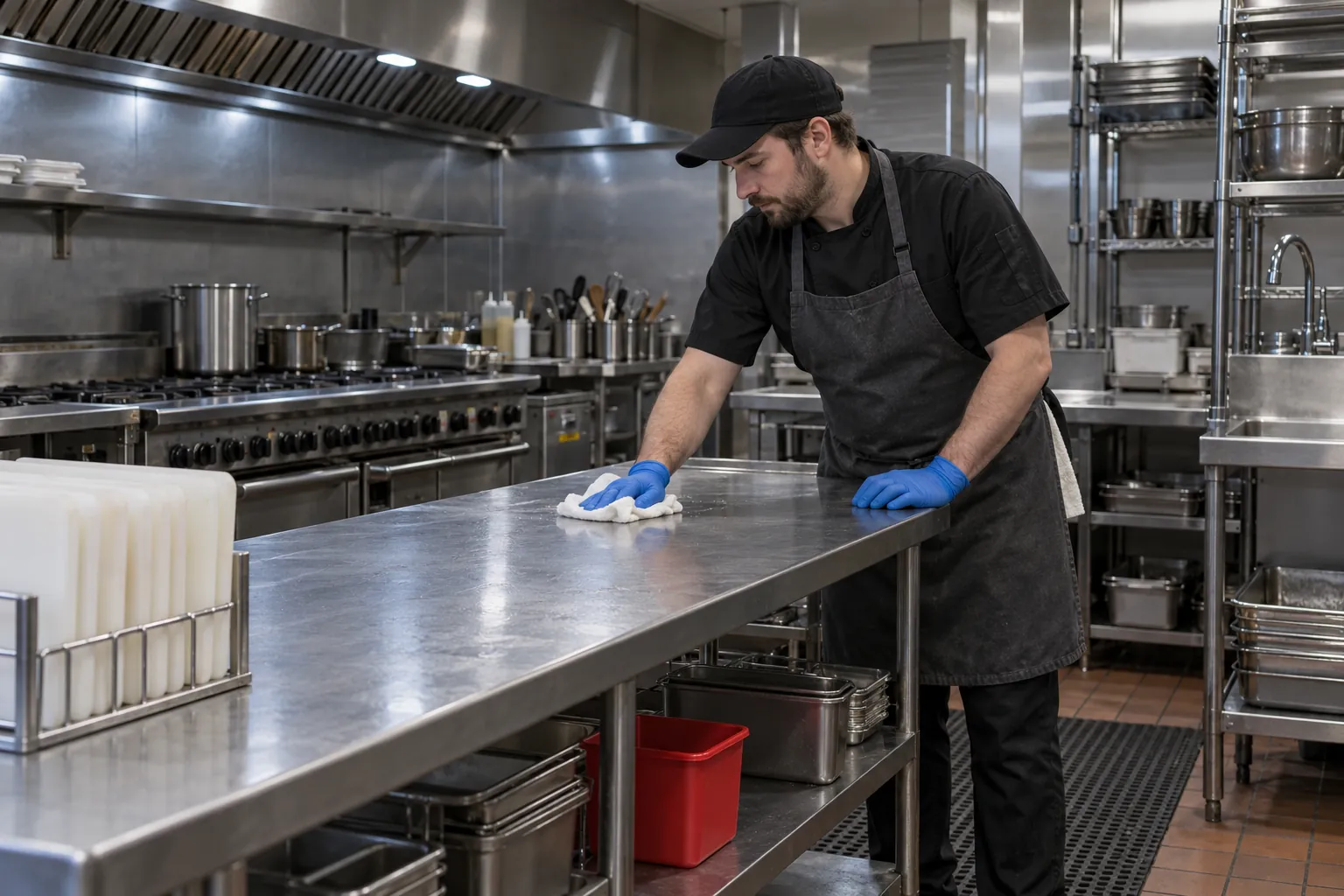
In Canada it is how an operator shows the public health inspector that the restaurant meets its province's food premises rules, such as Ontario Regulation 493/17 or British Columbia's Food Premises Regulation. Those rules are written as outcomes: surfaces that touch food are cleaned and sanitized as often as needed, dishes, glasses and cutlery after each use, and the premises kept sanitary. In British Columbia and Alberta the operator must also have written sanitation procedures. This guide covers the provincial rules, a back-of-house and front-of-house checklist, the daily, weekly and monthly schedule, and how to keep a record an inspector, a manager or a cleaning contractor can rely on.
01
The rules behind a restaurant cleaning checklist, province by province
Restaurant sanitation in Canada is set by each province and enforced by local public health, so start with the province. The rules say what must be true and leave the operator to decide how; the cleaning checklist is the operator's answer.
In Ontario, section 16 of the Health Protection and Promotion Act requires every person who operates a food premise to maintain and operate it in accordance with the regulations. The regulation is Ontario Regulation 493/17, Food Premises. For cleaning, the parts that matter are:
- Section 7: every room where food is prepared, served or displayed is kept sanitary, and its floors, walls and ceilings clean and in good repair; handwashing stations are maintained, kept supplied and used only for employees' handwashing.
- Section 12: garbage and liquid wastes are removed as often as necessary to keep the premises sanitary.
- Section 13: the premises are protected against pests, and records of all pest control measures are kept for at least one year.
- Section 16: cloths and towels used on utensils or food contact surfaces are clean, in good repair and used for no other purpose.
- Part IV (sections 18 to 23): utensil sanitizing, dishwashers, cleaning and sanitizing multi-service articles after each use and food contact surfaces as often as necessary, and the storage of cleaning chemicals.
- Section 25: every sanitary facility is kept sanitary, properly equipped and in good repair at all times.
In British Columbia, the Food Premises Regulation, B.C. Reg. 210/99 goes further. Section 17 requires equipment, utensils and food contact surfaces to be washed and sanitized in a manner that removes contamination. Section 24 requires every food service establishment to have written procedures covering the cleaning and sanitizing requirements for the establishment and all its equipment and utensils, the cleaning and sanitizing agents with their concentrations and uses, and every pesticide with its uses and storage. That is the sanitation plan, and the province's Food Safety and Sanitation Plans page says it must be approved by the local health authority.
Alberta's Food Regulation, Alberta Regulation 31/2006 is similar: section 28 requires food contact surfaces to be washed and sanitized in a manner that removes contamination, and section 29 requires written sanitation procedures listing every cleaning and sanitizing agent with its concentration and use. Other provinces and territories have their own rules; ask the local health unit or environmental health officer what applies and what they expect to see.
02
A restaurant kitchen cleaning checklist for back of house
Write the back-of-house list around your own kitchen: its stations, equipment and menu. A list copied from another restaurant will miss the slicer, the ice machine or the walk-in yours depends on, so group the items by station. Each line needs the item to clean and sanitize, the method, the product and dilution, the frequency and the person responsible.
- Prep tables, cutting boards and food contact surfaces: washed, rinsed and sanitized between tasks, after raw meat, poultry or fish, and at close. "As often as necessary" means more than once a day on a busy line.
- Dishes, glassware, cutlery, pots, pans and utensils: through the dishwasher or the sink. Ontario's section 21 requires dishes, glasses and other multi-service articles to be cleaned and sanitized after each use, and other utensils, such as pots and pans, as often as necessary to keep them clean and sanitary; section 18 allows a two-compartment sink only where it is not used for multi-service articles.
- Slicers, mixers and grinders: unplugged, taken apart, washed, rinsed, sanitized and air dried. Toronto Public Health's guide to cleaning and sanitation of food contact surfaces and equipment sets out the steps for a meat slicer and says one used at room temperature should be cleaned and sanitized at least every four hours.
- Cooking equipment: grills, flat tops, ranges, fryers and ovens, cleaned to the manufacturer's instructions once safe to handle; fryer boil-outs on their own line.
- Coolers, walk-ins and freezers: spills wiped at once, handles, doors and gaskets daily, shelves, racks and walls weekly with food moved and protected.
- Ice machine and beverage equipment: scoops kept clean and out of the ice; the machine cleaned and sanitized on the manufacturer's schedule.
- Handwashing stations: cleaned, and soap and paper towels restocked; kept clear of dishes, because hand hygiene depends on a sink staff can reach.
- Floors, walls and drains: sweep and mop at close; splash zones wiped; floor drains and covers cleaned to a written method.
- Hood filters: degreased on a fixed cycle to remove grease buildup. Ontario's section 11 requires ventilation to be maintained to remove odours, fumes, vapours, smoke and excessive heat; a contractor's exhaust cleaning is a separate, scheduled job.
- Garbage, recycling and organics: garbage cans and recycling bins emptied and lined, containers and the garbage area washed.
- Cloths, mops and buckets: wiping cloths kept in sanitizer or swapped through laundry; mops rinsed and hung to dry; colour coding to prevent a washroom mop reaching the kitchen.
The chemical shelf needs a line too. Ontario's section 23 requires cleaning chemicals to be kept separate from food, in labelled containers, and used so they cannot contaminate food. An unlabelled spray bottle fails that on sight.
03
Front of house and washrooms
The front-of-house (FOH) checklist is still a food safety list wherever food or tableware is handled, and Ontario's section 15 requires table covers, napkins and serviettes to be clean and in good repair.
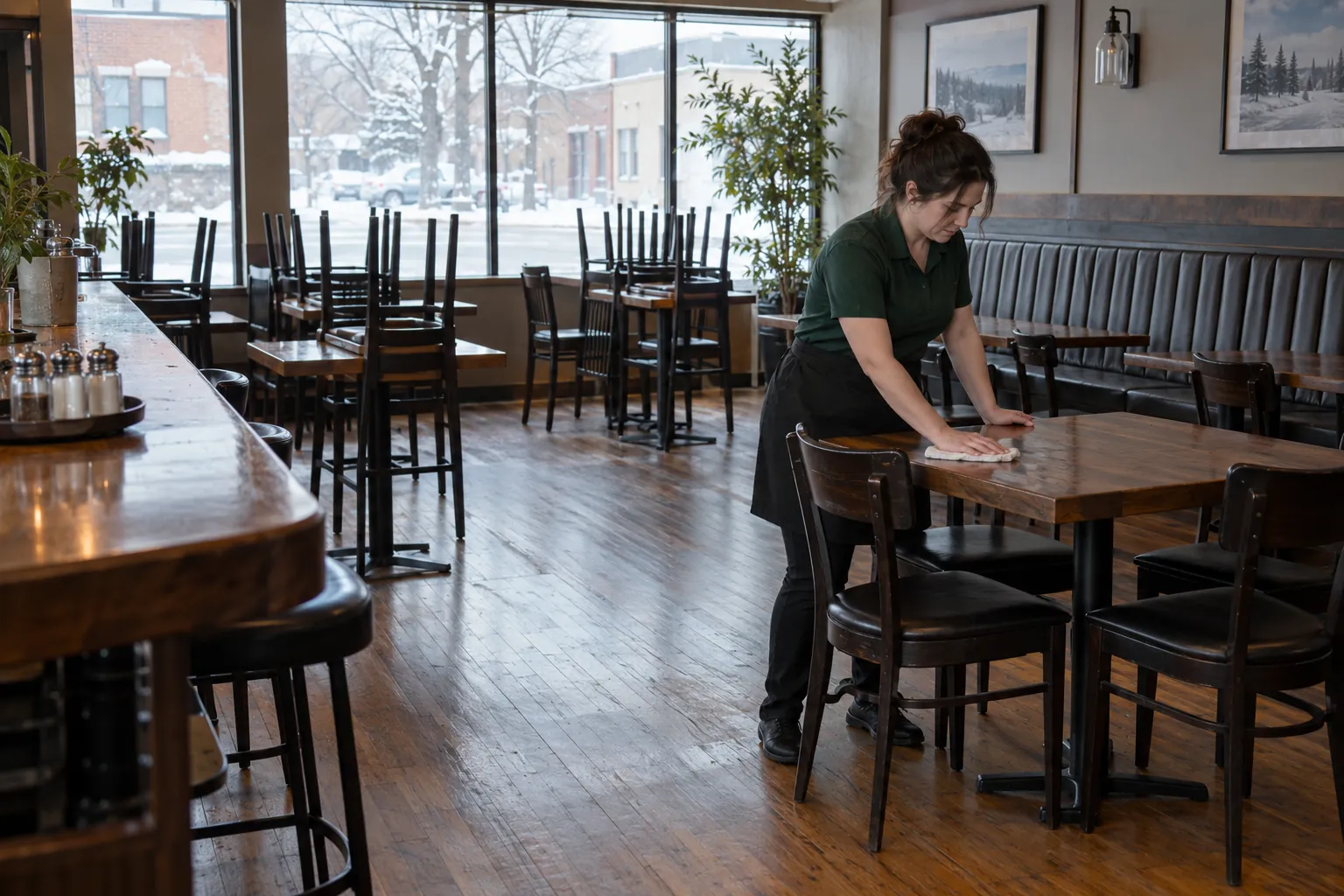
- Tables and seating: tables cleaned and sanitized between customers with a cloth kept for that purpose; chairs, booths and high chairs wiped.
- Condiments and menus: wipe bottles, shakers and holders daily and wash them on a schedule; laminated menus wiped.
- Bar and service stations: bar tops, sinks, soda guns, coffee makers and the POS screen.
- Touch points: wipe door handles, push plates, railings, payment terminals and light switches regularly through the day.
- Floors: swept during service, mopped at close with the wet area coned off; carpet vacuumed daily; dining room garbage cans emptied.
- High and low dusting: light fixtures, vents, ledges and baseboards, weekly or monthly.
- Patio: tables, chairs and the ground around them, when it is open.
Washrooms need their own list. Ontario's section 25 requires hot and cold running water, toilet paper, soap, single-service towels or a hot-air dryer, and an easy-to-clean waste receptacle in every sanitary facility. Check them through service, not only at close, and disinfect taps, flush handles and door handles with a disinfectant that carries a Health Canada Drug Identification Number (DIN).
04
Daily, weekly and monthly tasks, and how to sanitize
Frequencies for cleaning tasks come from use and risk. Ontario's rule is "as often as necessary" and British Columbia's is a plan the health authority approves, so treat these intervals as a starting point, not a legal minimum.
- During service: food contact surfaces between tasks; spills at once; tables between guests; washrooms and handwashing stations checked and restocked.
- Daily, at close: line equipment, prep tables and boards; sinks; cooler handles; floors and mats; garbage out; dining room tables, chairs and condiments; washrooms fully cleaned.
- Weekly: walk-in and reach-in shelves; dry storage; oven interiors; drains; hood filters on a busy line; dining room dusting; the garbage area washed.
- Monthly or on a set cycle, the deep clean: freezers, behind and under heavy equipment, walls, ceilings and vents, the ice machine, carpet shampooing and the contractor's hood cleaning.
Cleaning and sanitizing are two steps. Interior Health's Writing a Sanitation Plan explains that cleaning agents remove dirt, oil and grease but do not destroy harmful micro-organisms, and sanitizing agents do; food contact surfaces must be cleaned and sanitized, while floors and walls usually only need cleaning. The order is scrape, wash, rinse, sanitize, air dry.
For utensils, Ontario's section 19 accepts water at 77°C or more for at least 45 seconds, or a solution at not lower than 24°C for at least 45 seconds of chlorine at not less than 100 parts per million (ppm), quaternary ammonium (quat) at not less than 200 ppm, or iodine at not less than 25 ppm. Any other sanitizer must be approved by Health Canada, the Canadian Food Inspection Agency or the medical officer of health, used to the manufacturer's instructions, with a test reagent for its concentration readily available.
Under section 20, a mechanical dishwasher keeps its wash water between 60°C and 71°C and gives a sanitizing rinse at 82°C or more for at least 10 seconds, or a chemical sanitizer, with thermometers showing both temperatures; a dishwasher certified by NSF International for commercial use is exempt. Other provinces set their own figures: Interior Health's sample plan shows a 100 ppm chlorine sink for 10 seconds and a 200 ppm bleach spray made fresh daily and checked with a test strip. Write your province's figures into the plan and follow the label.
CCOHS's Cleaning Products – Working Safely covers the chemicals: read the label or safety data sheet, never mix products containing bleach and ammonia, add the concentrate to the water when diluting, work with good ventilation and wear the gloves and goggles the product calls for. Train staff in WHMIS for the products they use.
05
A restaurant cleaning checklist template, and the record that goes with it
Keep two documents. The plan (in British Columbia, the sanitation plan) says what should happen; the record says what did. A weekly sheet can do both if its columns are clear, but a blank row is evidence of nothing.
- Plan fields: item or area; method; product, concentration and mixing; how concentration is checked; frequency; who does it; who verifies it; date last updated.
- Record fields: date and actual time; item; who did it; anything not done and why; what was found, such as a fault, a pest sign or a low sanitizer reading; who was told; the verifier's initials.
Interior Health advises keeping the plan on site for staff to refer to regularly, updating it as needed and reviewing it annually. Its completeness questions work in any province: is every cleaner and sanitizer listed with its concentration, is there a way to check sanitizer strength, are equipment and outside areas such as garbage covered, and are pesticides and their storage identified?
Records the law requires sit beside the checklist: in Ontario, pest control records kept for a year; in British Columbia and Alberta, the written procedures themselves. Keep cleaning records as long as the business, its insurer or a client contract needs, and ask the health unit if in doubt.
06
Where the restaurant cleaning record fails
The closing sheet is signed at 9:30 p.m. for work that finishes at 11:00. One tick reads "kitchen clean" when the fryer boil-out was skipped. The overnight janitorial crew works to a contract nobody in the kitchen has read, so the floor drain belongs to neither side. A cook notes a cracked gasket on the sheet, and the sheet goes into a binder nobody opens until the next inspection.
A good record is written at the time, names one person, shows the exceptions and reaches whoever has to act. That is hard on paper when the person who cleans, the person who verifies and the person who fixes things work different shifts or for different companies.
SiteClara is built for that gap. Each place that is cleaned, such as the line, the dish pit, the walk-in or a washroom, gets a QR code poster, with an NFC tag if staff prefer to tap. Enrolled staff scan it on their own phone, answer the short checklist for that place and mark it done, so the time and the person are recorded as it happens. A problem is reported there, with a note and a photo, and stays on the team's list of open jobs until someone closes it. Scheduled checks show what is due, and a worker who cannot do one records why. A supervisor reviews the day's report and approves it, and it goes to the manager or the client the next morning. Where a cleaning contractor does part of the work, both sides see the same record.
07
Questions people ask
What should I include on my restaurant cleaning list?
Include every area, piece of equipment and utensil, how each is cleaned and sanitized, how often, the product and its concentration, and who does it. Section 24 of British Columbia's Food Premises Regulation requires a food service establishment's written procedures to set out its cleaning and sanitizing requirements, each cleaning and sanitizing agent with its concentration, and each pesticide with its use and storage, which is a sound outline in any province.
Where can I find a free cleaning checklist template?
Interior Health's Writing a Sanitation Plan is a free PDF with a template covering cleaners and sanitizers, sanitation procedures, dishwashing, pesticides and a cleaning schedule. The Government of British Columbia's Food Safety and Sanitation Plan templates page also offers a Sanitation Plan Template in Word, with a Sanitation Plan Workbook to guide it; they are written for food processing facilities, but a restaurant can adapt them.
08
Official guidance, and a short list to take away
In Ontario, read Part IV of O. Reg. 493/17 and your public health unit's guidance, such as Toronto Public Health's page on cleaning and sanitation of food contact surfaces and equipment. In British Columbia, read sections 17 and 24 of the Food Premises Regulation and your health authority's template, such as Interior Health's Writing a Sanitation Plan. In Alberta, read sections 28 and 29 of the Food Regulation.
Before the next health inspection, check that:
- every area, piece of equipment, utensil and item is on the list, back and front of house;
- each line names the method, the product, its concentration and how that is checked;
- food contact surfaces are sanitized during service, not only at close;
- dishwasher temperatures or sanitizer strength are checked and written down;
- chemicals are labelled and stored away from food;
- pest sightings and pest control visits are recorded;
- the split between kitchen staff and the cleaning contractor is written down;
- someone other than the cleaner verifies the work and initials the record;
- the plan is kept on site and reviewed yearly, or when the menu or equipment changes.
Sources
Every document this guide quotes or links to, in the order it first cites them.
- Health Protection and Promotion Act ontario.ca
- Ontario Regulation 493/17, Food Premises ontario.ca
- Food Premises Regulation, B.C. Reg. 210/99 bclaws.gov.bc.ca
- Food Safety and Sanitation Plans www2.gov.bc.ca
- Food Regulation, Alberta Regulation 31/2006 kings-printer.alberta.ca
- Cleaning and sanitation of food contact surfaces and equipment toronto.ca
- Ontario Regulation 480/24 ontario.ca
- Maintaining clean washroom facilities for workers ontario.ca
- Writing a Sanitation Plan interiorhealth.ca
- Cleaning Products – Working Safely ccohs.ca
- Food Safety and Sanitation Plan templates www2.gov.bc.ca
Related guides
 CleaningCommercial cleaning checklist: area by area, for Canadian buildingsA commercial cleaning checklist for Canadian offices and shared buildings, area by area, with the provincial rules behind it, what to record and how to check it.
 CleaningWashroom cleaning checklist: what to check, how often, and Ontario's new cleaning recordsWhat a workplace washroom cleaning checklist should cover, how often to clean, and Ontario's posted cleaning records required since January 1, 2026.
 CleaningHealth Canada approved disinfectants: what the DIN tells you, and how to use itHow to tell a Health Canada approved disinfectant: the DIN, what the label must show, how to check it, and what the Biocides Regulations changed.
 CleaningCleaning log sheet: what to record, who fills it in, and what the law in Canada asks forWhat a cleaning log sheet should record, where Canadian workplaces use one, what Ontario and federal rules require, and how to keep a log people believe.