Premises and facilities management
Fault reporting system: how faults are reported, prioritised and closed
A fault reporting system is the agreed way a fault in a building, such as a broken light, a leaking tap or a door that will not lock, gets from the person who finds it to the person who fixes it, with a priority, an owner and a record at each step.
Every building has one, even if it is only the person who happens to be passing reception. The question is whether a report reaches someone who can fix it, gets fixed in the right order, and leaves a record, whether the system is software, an email address or a paper log. This guide covers how occupants should report faults, how a facilities team should log, prioritise and close them, and how to tell whether yours is working.
01
Why a building needs a fault reporting system
In Great Britain regulation 5 of the Workplace (Health, Safety and Welfare) Regulations 1992 requires the workplace, and the equipment, devices and systems the regulation applies to (those in which a fault is liable to cause a breach of the Regulations, mechanical ventilation systems, and equipment and devices intended to prevent or reduce hazards), to be maintained in an efficient state, in efficient working order and in good repair, and, where appropriate, under a suitable system of maintenance. The Provision and Use of Work Equipment Regulations 1998 say the same of work equipment. Leases and management agreements add their own repairing obligations, and for housing, landlords have statutory repair duties of their own.
None of those laws uses the words "fault reporting system", but a suitable system of maintenance has two halves. Planned maintenance finds faults on a schedule, before they cause trouble. Reactive maintenance deals with faults as they appear, and it depends entirely on someone noticing and reporting them. A building where faults are reported to whoever happens to be passing will fix the ones that are noticed by the right person, and miss the rest.
A fault reporting system is simply the agreed way a fault gets from the person who finds it to the person who fixes it, with a record at each step. In a large estate it is usually part of a facilities management helpdesk and its software; in a small building it may be an email address, a phone number and a spreadsheet. The size matters less than whether the workflow works: whether it can resolve faults in the right order and show that it did.
02
What a fault reporting system should cover
Whatever the tools, a fault reporting system that works has the same parts:
- A way in that everyone knows: one route, or a small number, that occupants, visitors, cleaners, security officers and contractors can all use, easily accessible at the moment they notice the fault.
- Enough detail to act on: where the fault is, what it is, how serious, and ideally a photo, so that nobody has to go back and ask.
- Fault types: a short list of categories, such as lighting, heating, plumbing, doors and locks, lifts, cleaning and security, so reports reach the right trade or team.
- A priority, set by someone who understands the building, not only by the person reporting.
- An owner: a named person or team responsible for each report until it is closed.
- Updates to the person who reported the fault, at least when it is fixed or if it cannot be.
- A record of each report, and of any incident it caused, from when it was raised to when it was resolved, that can be searched and reported on.
The organisation responsible for each kind of fault should be clear from the start. In a multi-let building a fault in a tenant's own space may be the tenant's problem, while the same fault in the common parts belongs to the landlord or managing agent. A fault reporting system that does not know the difference sends reports to the wrong place.
03
How occupants report faults
The best reporting route is the one people will use at the moment they notice the fault. Common options, each with its trade-offs:
- A phone number or a helpdesk: quick for urgent faults, and a person can ask the right questions, but only while it is staffed.
- An email address: easy to set up, but reports arrive without a location or a priority, and a shared inbox is easy to lose track of.
- A web portal or form: gives structure, fault types and a reference number, but people must remember where it is and often a password, for something they may use twice a year.
- A mobile app: good for staff who use it every day, less so for visitors or occupants who will not install something to report a dripping tap.
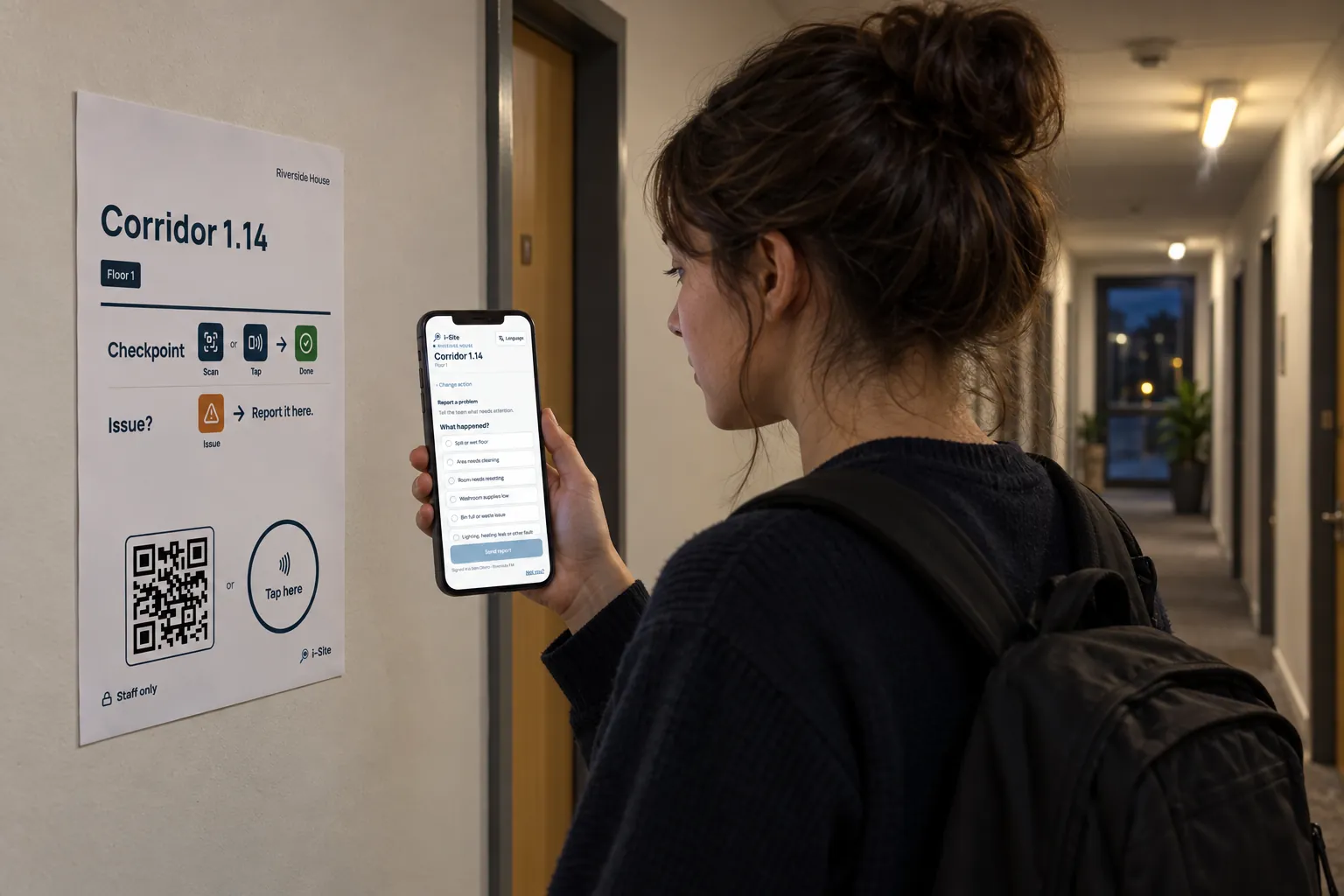
- A QR code or tag at the location: the person reporting scans it with their phone, and the report arrives already knowing where it is from.
- Word of mouth: a cleaner tells the caretaker, who tells the site manager. It works until one of them is off, and it leaves no record.
Most buildings need more than one: a phone number for emergencies, and a structured route for everything else. What matters is that people know which to use, that every route ends in the same record, and that anything urgent reaches a person straight away rather than sitting in a queue.
04
Logging, prioritising and assigning faults
Once a fault is reported, someone has to decide how urgent it is and who will deal with it. Most organisations use three or four priority levels, set out in the maintenance contract or the service level agreement. As an example only:
- Emergency: an immediate risk to health, safety or security, or to the building, such as a flood, a failed fire door on an escape route, a person trapped in a lift or a building that cannot be locked. Attend at once and make safe.
- Urgent: a fault that seriously affects the use of the building, such as no heating in winter, no hot water in a kitchen or a whole floor without lighting.
- Routine: a fault that is a nuisance but not a risk, such as a single light out, a sticking door or a dripping tap.
- Planned: work better grouped with other jobs or done at a quiet time.
The times attached to each level, for attending and for completing the fix, belong in the contract. Two measures are worth separating: the response time, when someone attends or makes the fault safe, and the fix time, when the fault is resolved. A contract that measures only the first can look green while faults stay open for weeks.
Assigning the fault means giving it to a named person or contractor, not to a team inbox. For a building with its own maintenance team this may be a conversation; for a large estate it is usually a work order raised in a CAFM or CMMS system, which records the asset, the engineer, the time and cost, and feeds asset management and planned maintenance activities. Repeat faults on the same faulty piece of equipment are a sign that something needs replacing rather than repairing again, and a record that links reports to the asset is how you spot them.
05
Closing a fault, and checking the system works
A fault is closed when it is fixed, not when an engineer has visited. A good close-out records what was done, by whom and when, and ideally a photo of the result; if the fault needs a part or a second visit, it stays open with a note, rather than being closed and reopened. The person who reported it should hear that it has been resolved, which does more for confidence in the system than anything else.
To check whether a fault reporting system is working, look at:
- Open faults by age: how many are older than a week, a month, three months, and why.
- Response and fix times against the priority levels in the contract.
- Repeat reports of the same fault, which usually mean the first fix did not work or nobody told the reporter it was in hand.
- Faults found by staff on routine checks compared with faults reported by occupants. If occupants find most of them, the routine checks are not looking.
- Faults that bypassed the system: the ones reported in a corridor conversation and fixed, or not, with no record.
Transparency helps. Occupants who can see that their report was logged and is being dealt with stop reporting it three times, and a facilities team that reviews its open faults each week stops them piling up.
06
Where the record fails, and what SiteClara does about it
Most fault reporting failures happen before the fault reaches any system. The cleaner who notices the leak has no easy way to report it; the visitor who finds the broken lock does not know who to tell; the report arrives by email as "the light is out on the stairs" with no floor or building. Faults found by cleaning and security teams on their rounds are often the most useful and the least recorded.
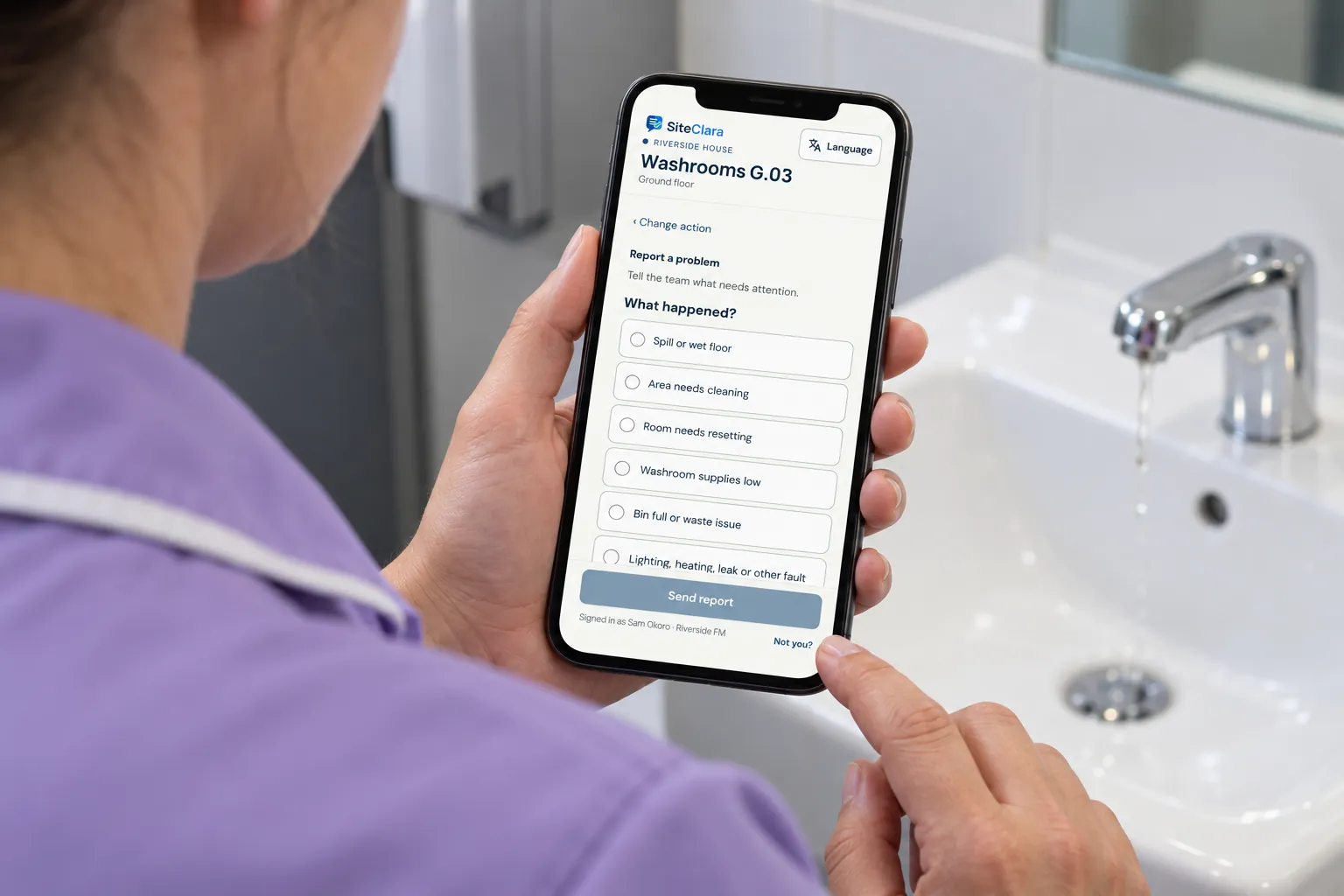
SiteClara puts a printed QR poster, with an NFC tag behind it if you want staff to tap, at each location. Staff scan or tap with their own phone, with no app to install, and report an issue with a photo; it arrives already knowing the building and the location, and goes onto the team's list of jobs until someone closes it. On sites led by the building owner, public reporting can also be switched on, so occupants and visitors can report a fault at a tag; provider sites start with staff-only tags.
The supervisor's queue groups open jobs by building and floor, and a supervisor can escalate a job to the building manager, who can answer it. Each day the supervisor approves a report that goes to nominated management or client contacts at 8am the next morning, showing what was reported, what was completed and what is still open.
07
Further reading, and a list to take away
The Health and Safety Executive publishes the Approved Code of Practice Workplace health, safety and welfare (L24), which explains the maintenance duty, and guidance on PUWER for work equipment. The Institute of Workplace and Facilities Management (IWFM) publishes guidance on facilities management practice, and BS EN ISO 41001 sets out requirements for a facility management system. SFG20, the industry standard maintenance specification, covers the planned side that sits alongside reactive fault reporting.
To review your own fault reporting system, check that:
- everyone who uses the building knows how to report a fault, including out of hours;
- every reporting route ends in one record;
- reports carry a location and, where it helps, a photo;
- priority levels and the times attached to them are written down;
- each fault has a named owner until it is closed;
- response and fix times are measured separately;
- the person who reported a fault hears when it is resolved;
- open faults are reviewed by age every week.
Sources
Every document this guide quotes or links to, in the order it first cites them.
- Workplace (Health, Safety and Welfare) Regulations 1992 legislation.gov.uk
- Provision and Use of Work Equipment Regulations 1998 legislation.gov.uk
- Workplace health, safety and welfare hse.gov.uk
- BS EN ISO 41001 knowledge.bsigroup.com
Related guides
 Premises and facilities managementFacilities helpdesk: what it does, and how to run one wellWhat a facilities helpdesk does, how it logs, prioritises and closes jobs, the people and systems behind it, and how to tell whether it is working.
 Premises and facilities managementBuilding manager responsibilities: the duties, the daily work and the recordWhat a building manager is responsible for in UK commercial and residential buildings: legal duties, daily work, contractors and the records that prove it.
 Premises and facilities managementFacilities management monthly report: what to include, and what makes it believableWhat an FM monthly report should contain: compliance, planned and reactive maintenance, KPIs, health and safety, costs, and the evidence behind them.
 Premises and facilities managementManaging agent responsibilities in residential block managementWhat a managing agent does for a block of flats in England and Wales: service charges, the RICS code, repairs, fire safety in common parts, and records.