Premises and facilities management
Emergency generator testing: what to check, how often, and what to record in an Irish building
Emergency generator testing in an Irish building means checking the set's fuel, oil and coolant levels every week and, once a month, simulating a failure of the mains so that the generator starts and carries the load for at least an hour, as the Department's Fire Safety Guide for Building Owners and Operators recommends.
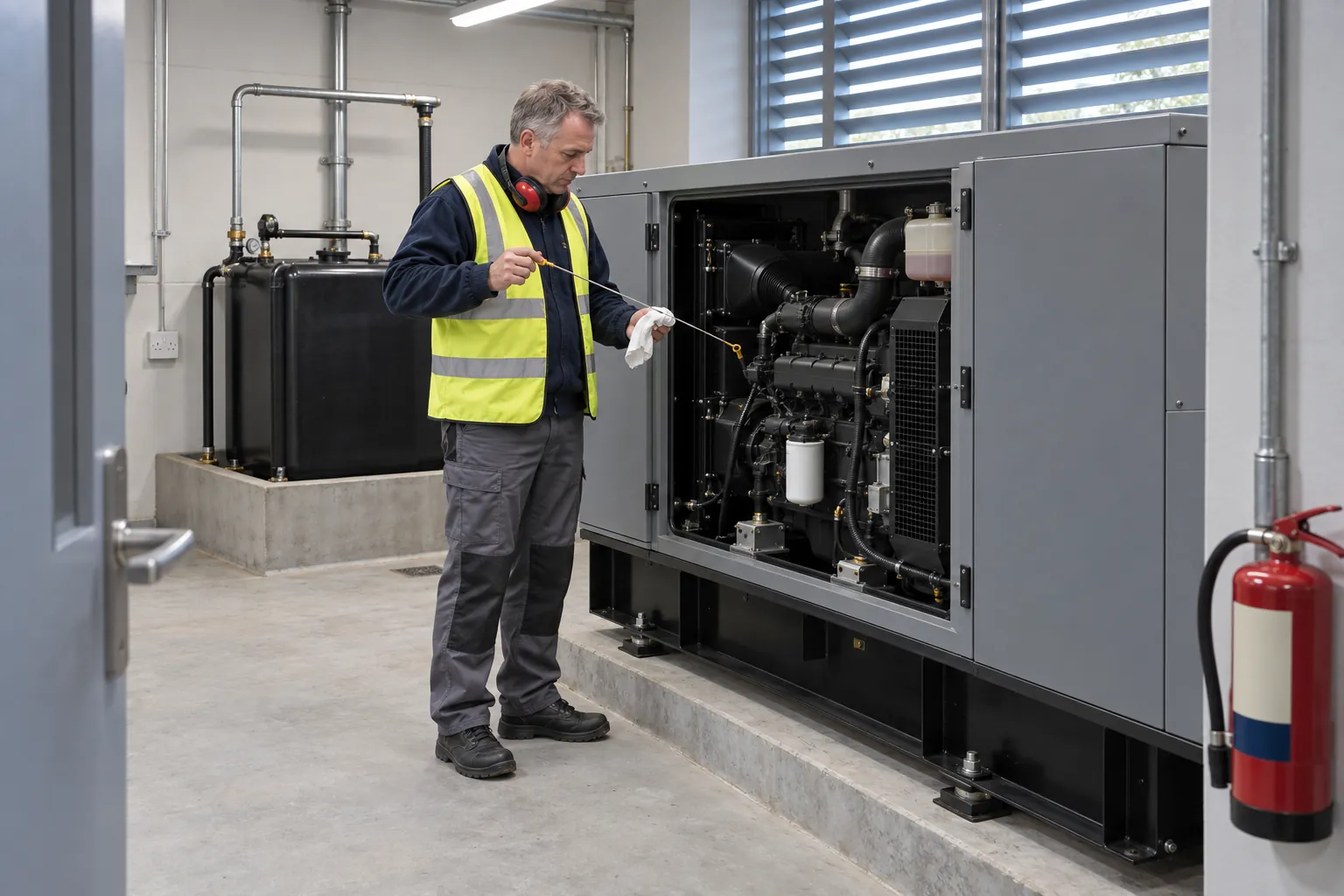
A standby generator is only worth having if it starts when the mains fails and carries the load it was installed for, and the only way to know is to test it, on a schedule, and write down what happened. This guide covers emergency generator testing in offices, schools, health centres, hotels, retail units and apartment blocks in Ireland: the duties in the General Application Regulations 2007 and the Fire Services Acts, the weekly checks and the monthly run set out in the Department's Fire Safety Guide, the competent person's service, and the record that shows it was done.
01
The duty behind emergency generator testing in Ireland
No Irish statute sets a generator test frequency. The duty comes from three places; the frequencies come from guidance, the Irish Standards and the manufacturer.
The first is Part 3 of the Safety, Health and Welfare at Work (General Application) Regulations 2007 (S.I. No. 299 of 2007), which deals with electricity. Regulation 84, headed "Auxiliary generator and battery supply", requires an employer to ensure that "appropriate precautions are taken to prevent danger (i) when operating, installing, maintaining, transporting or storing auxiliary power supply batteries or auxiliary generators", and to people who install, maintain or use an installation where they are fitted. Regulation 84(b) adds a duty that is easy to forget: where a generator is fitted, appropriate precautions must be taken "to prevent danger to persons working on the external electrical network supplying an electrical installation". In plain terms, a standby set must never feed back into the mains while network crews think the line is dead.
The Health and Safety Authority's Guide to Part 3: Electricity of the General Application Regulations 2007 explains that the design, installation, maintenance, transport and storage of standby supplies "have safety implications and must be carried out so as to prevent danger", including the changeover from normal to auxiliary supply. For detail it refers to the Electro-Technical Council of Ireland's code of practice for low voltage generators.
The second is the work equipment chapter of the same Regulations. A generator is a machine used at work. Regulation 30 requires periodic inspection and, where appropriate, testing of work equipment exposed to conditions causing deterioration, by a competent person, with the results "recorded and kept available for 5 years". Regulation 31 requires work equipment to be kept, "by means of adequate maintenance", in a safe condition, and "a maintenance log for any machine" to be kept up to date.
The third is fire safety. Section 18 of the Fire Services Act 1981, as amended by section 29 of the Fire Services Act 2003, applies to buildings used for sleeping accommodation, care, teaching, entertainment, public access and, since 2003, any workplace. The person having control must "provide reasonable fire safety measures" and "ensure that the fire safety measures and procedures ... are applied at all times". Where a generator backs up the fire alarm, emergency lighting, smoke control, firefighting lifts or sprinkler pumps, it is part of those measures, and a generator that does not start is a fire safety measure that is not being applied.
02
What emergency generator testing covers
A typical standby generator is a diesel set with an automatic mains failure (AMF) panel and a transfer switch, which together provide emergency power to the building's critical services: when the mains drops, the set starts and takes the essential load; when the mains returns, it hands the load back and runs on to cool down. Testing has to prove every component in that chain, not only that the engine turns over.
- Starting: the starter batteries, their charger and its fault indication. A flat battery is the classic reason a set fails to start.
- Fuel: the day tank and any bulk tank, the transfer pump, leaks and bunding, and the fuel itself, since stored diesel can degrade and collect water.
- Engine fluids and heating: oil and coolant levels, and the coolant heater that keeps the engine ready to take load.
- Controls: the panel left in automatic, alarms and warning lamps, and any remote signal to a building management system or the fire alarm panel.
- Changeover: the transfer switch, its circuit breakers and its interlocking, so the set can never connect onto a live mains or back-feed the network.
- Air, exhaust and room: louvres clear, the exhaust intact and discharging outside, the room secure, lit and free of combustible storage.
- The load: what the set actually supplies, whether the fire alarm, emergency lighting and a firefighting lift, or a server room or a nursing home's essential circuits. The test has to show that load carried.
The fire alarm panel's standby batteries and self-contained emergency luminaires have their own checks, covered in the guides on fire alarm testing and emergency lighting testing.
03
How often to test: weekly, monthly and yearly
The Department of Housing, Local Government and Heritage's Fire Safety Guide for Building Owners and Operators (August 2023), written for persons having control under section 18(2), is the most useful single reference. Its Table 2, the Maintenance Programme Schedule for Buildings, has a row for standby generators. It says that "any standby generator should be started up once a month by simulating failure of the normal power supply, and allowed to energize the system for at least 1 h, while the system is monitored for any malfunctioning caused by the use of the generator". After the normal supply is restored, "the charging arrangements for the generator starting battery should be tested", with appropriate action if they are not working, and "the oil and coolant levels should be topped up and the fuel tanks filled".
The same table's weekly fire detection and alarm row, referring to I.S. 3218, asks that "the fuel, oil and coolant levels of any standby generators are correct, topping up as necessary". The Guide explains that many of the daily, weekly and monthly activities, marked in green in the table, can be carried out "without expert knowledge of the equipment or system", while the quarterly, six-monthly and yearly work should be done by persons who are competent in that area and can certify it.
In practice, a schedule for most buildings looks like this:
- Weekly (designated person): panel in automatic with no alarms, charger healthy, fuel, oil and coolant correct, coolant heater on, no leaks, louvres clear.
- Monthly (designated person, or a contractor for a complex set): the simulated mains failure test on load for at least an hour, with the checks after the run.
- Periodic service (competent person): at the manufacturer's intervals, often by running hours as well as by calendar.
- Yearly (competent person): a full service and inspection, with a load bank test, which loads the set towards its nameplate rating, where the building's load cannot exercise the set properly.
- Periodic electrical inspection and testing (competent person): of the installation the generator forms part of, under regulation 89(b) as amended by S.I. No. 732 of 2007, at intervals the employer decides by risk assessment having regard to the installation's nature, location and use, or whenever an HSA inspector requires it.
The manufacturer's instructions govern the detail. The Guide itself says that the definitive maintenance requirements for fire safety equipment and systems "should be sought from the equipment or system manufacturers, suppliers, their technical advisers, and or specialised competent contractors", and that electrical installations should be inspected and tested periodically as recommended by I.S. 10101, the National Rules for Electrical Installations, published by NSAI. A hospital, a data room or a building with sprinkler pumps on generator supply may have a more exacting regime in its design or insurance, and that takes precedence.
Test again after a real power outage or any work on the set or the changeover. Regulation 30 also calls for special inspections after "exceptional circumstances" such as modification work, accidents or prolonged inactivity.
04
Running the monthly test safely, and who does what
The monthly test is the one that proves the set works, and the one most often skipped because it disturbs the building. Plan it rather than avoid it.
- Agree the time and tell people. A simulated mains failure drops the normal supply to whatever the generator carries. Tell occupants, IT, security, the lift contractor, and the alarm receiving centre if the fire alarm panel will signal a fault.
- Check before starting. Do the weekly checks first, so a low coolant level is found before the run.
- Simulate the failure the way the design intends, usually by a test switch or the incoming supply isolator, so the automatic start and changeover are tested, not a start by hand.
- Time and observe. Record how long the set took to start and take load, and watch the panel, the exhaust and the room.
- Run on load for at least an hour and check that the essential services work on generator supply.
- Restore the mains, confirm the load transfers back, the set runs on and stops, and the panel is left in automatic.
- Check afterwards: charger working, oil and coolant topped up, fuel filled, any fault written down and reported.
A set left in automatic can start without warning, so the room needs a warning sign, and anyone working on the set needs it isolated under regulation 85 of the 2007 Regulations. Exhaust fumes contain carbon monoxide, so the exhaust and ventilation must be sound. Manufacturers commonly warn against long runs on a very light load; if the essential load is small, ask the service contractor whether a periodic load bank test is needed.
Back-feed is the hazard regulation 84(b) is written for. ESB Networks' Conditions Governing Connection to the Distribution System at Medium Voltage (DTIS-250701-BDW, version 2), written for MV and 38kV connections and embedded generators, states that standby generators "do not have the facility to operate in parallel with ESBN therefore the rules of the Electro-Technical Council of Ireland shall apply". Nobody on site should bypass or alter the changeover interlocking.
Write down who does what. The person having control, often the employer, the landlord or, in an apartment development, the owners' management company (OMC), carries the duty. The OMC usually appoints a managing agent, who arranges the service contract and may ask the caretaker to do the weekly checks. A competent contractor services the set, and electrical work is for a competent electrical contractor: regulation 88 requires that nobody does electrical work needing technical knowledge and experience unless competent or suitably supervised.
05
What good evidence of generator testing looks like
A test that is not recorded cannot be shown to a fire officer, an HSA inspector or an insurer. A good record answers who, when, what, and what was done about it.
- Weekly checks: date, time, name, each item passed or not, and the levels found.
- Monthly tests: start and changeover time, length of run in minutes, load carried, what worked on generator supply, the return to mains, and any fault.
- Service visits: the contractor, the work done, running hours and the service report.
- Defects: what was found, who it was reported to, and when it was put right. Regulation 89(d) requires defects found on testing and inspection of an electrical installation to be rectified promptly.
- Real power outages: when, how long, whether the set started and carried the load, and anything that went wrong.
Where should it live? The Fire Safety Guide describes the Fire Safety Register as "a living document – with daily, weekly, monthly, quarterly and annual records of fire safety checks of procedures and the life safety systems within the premises", kept on the premises and available to an authorised officer of the fire authority. Larger, more complex premises may list other engineering fire safety systems, with records of their maintenance and certification. Where the generator supports life safety systems, its tests belong in or alongside the fire safety register.
The HSA's Guide to Chapter 2 of Part 2: Use of Work Equipment notes that regulation 31(d) does not of itself require a log to be kept, but that a maintenance log will be necessary for many items of equipment "in order to show that adequate maintenance procedures are in place". For a standby generator, the service contractor's reports and the site's own weekly and monthly records together make that log.
06
Where the record fails, and what SiteClara does about it
Service certificates are usually on file, because a contractor leaves one. It is the building's own checks that fail. The weekly check is a clipboard in the plant room, initialled for four weeks at once. The monthly run is put off because it disturbs the building, then forgotten. A charger fault lamp is mentioned to whoever is passing and is still lit at the next service. When the fire officer asks when the set last ran on load, the answer is a guess.
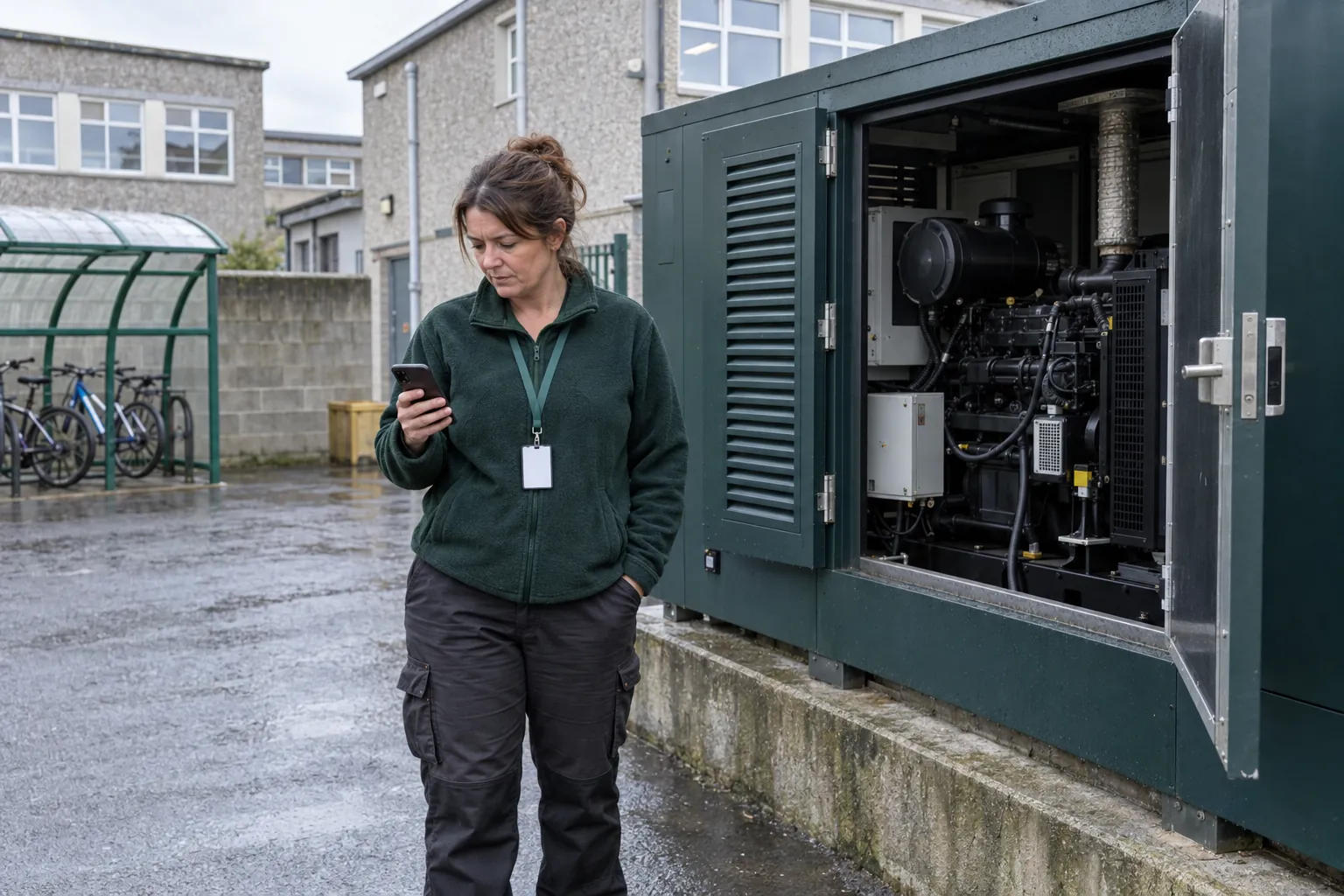
SiteClara records those routine checks where they happen. A printed QR poster at the generator room or enclosure, with an optional NFC tag behind it, lets the caretaker or facilities operative scan the code or tap the tag with their own phone, with no app to install. They see the checks due there, such as the weekly generator check or the monthly on-load run, and mark each one done, or say what stopped them, with a photo when one is asked for, such as the panel in automatic or the fuel gauge. A fault found on the check, such as a charger alarm or a leak in the bund, goes onto the team's list of jobs until someone closes it, and the supervisor can escalate it to the building manager, who can answer it.
The supervisor sees what was due, done and missed, and records the reason for anything missed. Each day they approve a report that goes the next morning to nominated managers or client contacts, such as the facilities manager, the managing agent or the OMC's directors: what was reported, completed and still open, and how the scheduled checks went.
07
Questions people ask
What are the requirements for emergency generator testing?
No Irish statute sets a test frequency, but the law requires the set to be safe and maintained. Regulation 84 of the Safety, Health and Welfare at Work (General Application) Regulations 2007 requires an employer to take "appropriate precautions ... to prevent danger" when "operating, installing, maintaining, transporting or storing" auxiliary generators, and to protect "persons working on the external electrical network". Regulation 30 requires work equipment exposed to deterioration to be inspected by a competent person, with the results "recorded and kept available for 5 years from the date of inspection", and regulation 31 requires adequate maintenance and that "a maintenance log for any machine is kept up to date", which the HSA says many items will need to show that maintenance is adequate. Where the generator supports fire safety systems, the test frequencies come from the Department's Fire Safety Guide for Building Owners and Operators.
How often does a generator need to be tested?
Weekly and monthly, then as the manufacturer and the competent person advise. Table 2 of the Department's Fire Safety Guide for Building Owners and Operators asks for a weekly check that "the fuel, oil and coolant levels of any standby generators are correct, topping up as necessary", and says that "any standby generator should be started up once a month by simulating failure of the normal power supply". The Guide leaves the quarterly, six-monthly and yearly work to persons competent in that area, and says the definitive maintenance requirements should be sought from the manufacturers, suppliers or specialised competent contractors.
How long should you load test a generator?
For at least an hour each month. The Department's Fire Safety Guide for Building Owners and Operators says the generator should be "allowed to energize the system for at least 1 h, while the system is monitored for any malfunctioning caused by the use of the generator". A longer load bank test may be part of the competent person's service where the building's own load is too light to exercise the set.
How do I perform an on-load test on an emergency generator?
Simulate a failure of the normal supply, let the generator take the load and watch it. The Fire Safety Guide for Building Owners and Operators describes the monthly test: start the set "by simulating failure of the normal power supply", let it energise the system for at least an hour, then, after restoring the normal supply, test "the charging arrangements for the generator starting battery", top up "the oil and coolant levels" and fill "the fuel tanks". Tell the building beforehand, and never bypass the changeover interlocking.
08
Further reading, and a list to take away
The HSA publishes its guides to the 2007 Regulations, including the Guide to Part 3: Electricity. The Department of Housing, Local Government and Heritage publishes the Fire Safety Guide for Building Owners and Operators, whose Table 2 has the standby generator row and the other fire and life safety systems from daily to yearly. The Irish Standards named here, I.S. 10101, I.S. 3218 and I.S. 3217, are published by NSAI. The manufacturer's manual is the first place to look for your set's service intervals and test method, and the building maintenance checklist puts the generator among the building's other checks.
Before you rely on a generator testing regime, check that:
- you know exactly what the set supplies, and the monthly test proves that load is carried;
- the weekly checks and the monthly on-load run are scheduled, named to a person and recorded, not only the annual service;
- the test simulates a mains failure and exercises the automatic start and changeover;
- the service intervals come from the manufacturer's instructions and the contractor's report is filed;
- the changeover interlocking prevents back-feed, and nobody on site alters it;
- faults found on a check reach someone who will fix them;
- responsibilities are clear between owner or OMC, managing agent, caretaker and contractor;
- the records reach the fire safety register where the set supports life safety systems.
Sources
Every document this guide quotes or links to, in the order it first cites them.
- Safety, Health and Welfare at Work (General Application) Regulations 2007 (S.I. No. 299 of 2007) irishstatutebook.ie
- Guide to Part 3: Electricity of the General Application Regulations 2007 hsa.ie
- Section 18 of the Fire Services Act 1981 irishstatutebook.ie
- Section 29 of the Fire Services Act 2003 irishstatutebook.ie
- Fire Safety Guide for Building Owners and Operators gov.ie
- Table 2 assets.gov.ie
- I.S. 10101, the National Rules for Electrical Installations nsai.ie
- Conditions Governing Connection to the Distribution System at Medium Voltage esbnetworks.ie
- Guide to Chapter 2 of Part 2: Use of Work Equipment hsa.ie
Related guides
 Fire and water checksEmergency lighting testing in Ireland: the checks, the tests, and the recordEmergency lighting testing in Ireland: the legal duty, the daily and weekly checks, quarterly and annual tests to I.S. 3217, and what the logbook should show.
 Fire and water checksFire alarm testing in Ireland: the checks, the servicing, and the recordFire alarm testing in Ireland: the legal duty, the daily and weekly checks, quarterly servicing to I.S. 3218, and what the fire safety register should show.
 Premises and facilities managementBuilding maintenance checklist: what to check in an Irish building, how often, and who byA building maintenance checklist for non-domestic buildings in Ireland: daily to annual checks under the 2005 Act, the 2007 Regulations and the Fire Services Acts.
 Fire and water checksFire safety register: what to record, who keeps it and how to make it credibleWhat a fire safety register should hold under section 18(2) of the Fire Services Acts, the routine checks behind it, who keeps it, and what makes it credible.