Fire and water checks
Fire alarm testing in Ireland: the checks, the servicing, and the record
In Ireland a fire alarm test is a weekly check, by a trained person on site, that the fire alarm system's control panel receives a fire signal from a trigger device such as a manual call point and starts the evacuation alarm, recorded with the device used.
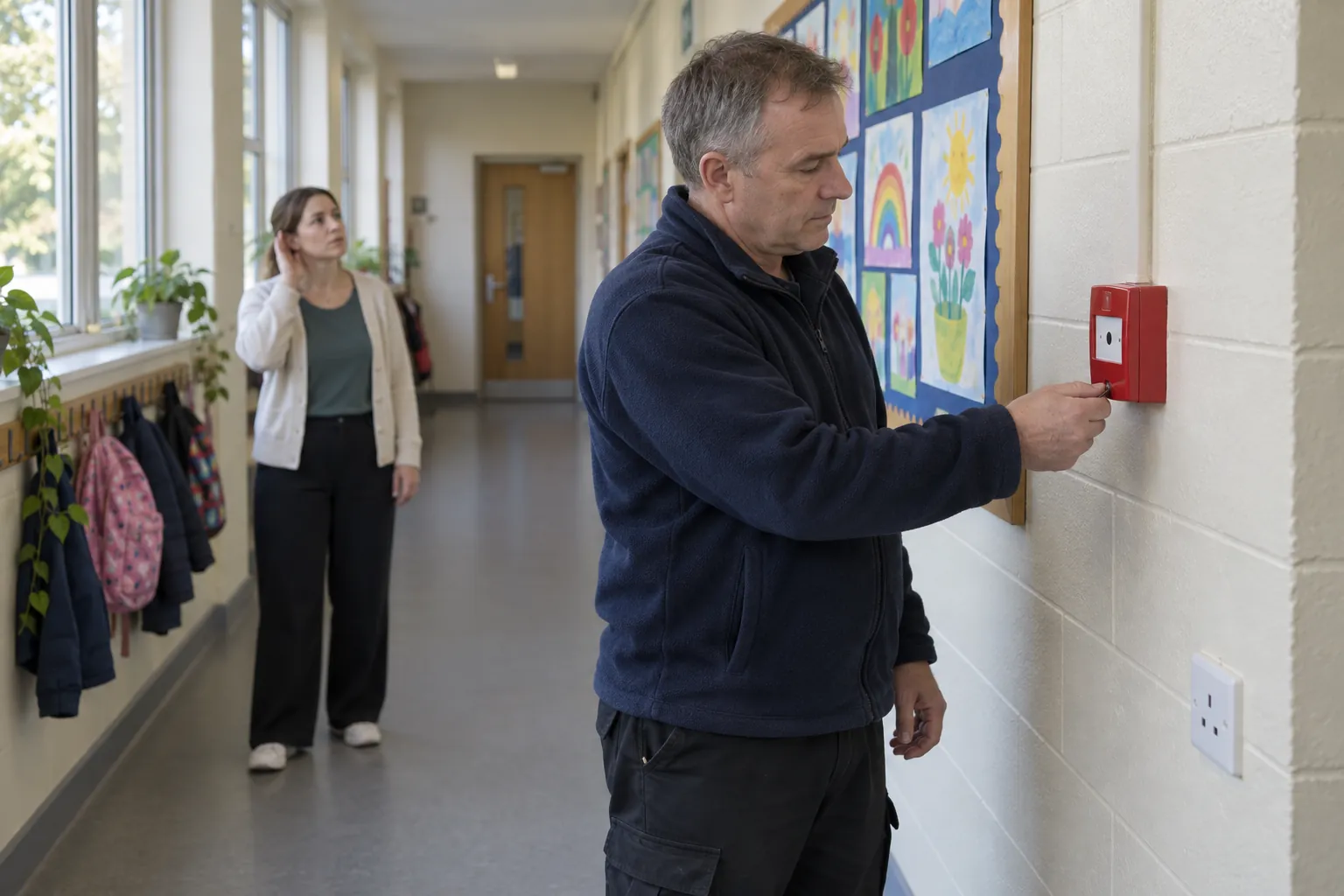
The Department's guide says it can be done without expert knowledge of the system, so it usually falls to someone on site. The test is short and easy to do, and just as easy to do badly: the same break glass unit every time, nobody listening at the far end of the building, the register filled in afterwards. This guide sets out where the duty comes from, what the Department of Housing's guide expects daily, weekly and quarterly, who can do which part, and what the fire safety register should show.
01
Where the duty to test the fire alarm comes from
No Irish statute says “test the fire alarm every week”. The duty comes from two general laws, and the weekly test is how the official guidance says to meet them.
The first is fire law. Section 18 of the Fire Services Act 1981 applies to premises used for sleeping accommodation, treatment or care, entertainment and recreation, teaching and training, and any use involving access by the public. The Licensing of Indoor Events Act 2003, section 29 added “any workplace” to that list and substituted a new subsection (2), so that every person having control over such premises must “take all reasonable measures to guard against the outbreak of fire”, “provide reasonable fire safety measures”, prepare appropriate fire safety procedures, and “ensure that the fire safety measures and procedures … are applied at all times”.
The second is workplace law. Regulation 13 of the Safety, Health and Welfare at Work (General Application) Regulations 2007 requires every employer to equip a place of work, as necessary, with “fire detectors and an alarm system”, taking account of the size and use of the building, what it contains and how many people may be there, and to ensure that fire detection equipment is “inspected and maintained as frequently as necessary to ensure that it is in good working order” and “serviced by a competent person as frequently as necessary”.
The practical detail is in the Department of Housing, Local Government and Heritage's Fire Safety Guide for Building Owners and Operators (August 2023), written for persons having control under section 18(2). Its section 6.2 says fire detection and alarm systems “should be inspected and maintained in accordance with the recommendations of the Irish Standard IS 3218”, and its Table 2 maintenance schedule sets out what that means day by day.
02
What the maintenance schedule asks for, day by day
Table 2 of the Department's guide splits the work in two: regular checks by a designated person on site, and planned inspection and maintenance by a competent person. For fire detection and fire alarm systems it sets out the following.
- Daily. All fire detection and fire alarm systems “should be checked daily”, to ensure that the control and indication panel “indicates normal operation or, if any fault is indicated, that it has been logged and the appropriate action(s) taken”, and that “any fault recorded the previous day has received attention.”
- Weekly. All systems “should be checked weekly”, to ensure that “the control equipment is able to receive a fire signal and to initiate the evacuation procedure, recording which trigger device has been used, in accordance with I.S 3218”, and that any standby batteries are in good condition and the fuel, oil and coolant levels of any standby generator are correct.
- Quarterly. The inspection and servicing in section 9.2.2.5 of I.S. 3218, with a test or servicing certificate “issued by the competent person upon completion”.
- Yearly. The annual inspection and servicing in section 9.2.2.6 of I.S. 3218, again with a certificate from the competent person.
The guide adds that the quarterly and yearly work “should be carried out by persons who have competency in their specific areas and can provide certification to the relevant standard for the work carried out”. The daily and weekly checks are for the premises: its section 3.1 says general daily routines such as “checking the fire alarm panels” can be done by persons who have had suitable training.
The HSA's page on fire detection and warning says the same from the employer's side: “An employer or nominated employee can carry out checks and routine maintenance work”, but the reliability of installed systems such as fire alarms “is best done by using a competent person to carry out periodic servicing and any necessary repairs.” Its checklist asks whether the warning “can be clearly heard and understood throughout the whole premises when initiated from any single point”, which is what the weekly test should show.
03
How to carry out the weekly fire alarm test
The weekly test proves the chain from a trigger device to the panel to the sounders, and the Department's schedule asks the record to say which device was used. What follows is a common routine, not a quotation from the standard; your servicing company will say what your panel needs.
- Pick the next device on the list. Number every manual call point, the break glass units, on a list or the zone plan, and work through them in order, so that over the weeks every one is proved.
- Test at a set time, announced to staff, so a short alarm then is known to be the test and an alarm at any other time is not ignored.
- Tell whoever needs to know. If the system is monitored, call the monitoring centre before you start. Tell reception, and anyone in an area where a sudden alarm matters, such as a theatre, a lab or a nursing home unit.
- Operate the call point with its test key, not by breaking the glass.
- Check the control panel shows the right zone or device. A panel that reports the wrong place sends wardens and the fire service the wrong way.
- Listen across the building. Have a colleague confirm the alarm sounders can be heard in the plant room, the toilets, the stairs and any noisy area, not just beside the panel, so that everyone in the building would hear a real alarm. Keep the alarm short.
- Silence and reset the panel and reset the call point. Check the panel returns to normal with no fault showing, and that any doors held open on magnetic devices have released and been reset.
- Confirm with the monitoring centre that the signal was received, and put the system back on line.
- Check the standby supply as the schedule asks: batteries in good condition and, where there is a standby generator, its fuel, oil and coolant levels.
- Record it in the fire safety register straight away, including anything that did not work.
If anything fails, a sounder that stayed quiet, a wrong zone, no signal at the monitoring centre, record it and ring the servicing company that day. The Department's guide is plain about why: “Faults are a life safety issue – not simply a maintenance issue to be dealt with later; faults should be entered in the fire safety register and corrected promptly.”
04
What the fire safety register should show
In Ireland the record lives in the fire safety register. Section 5.6.1 of the Department's guide says a register “should be maintained for all premises where section 18 applies”, kept on the premises, kept up to date and available to an authorised officer of the fire authority, and that it “should be a living document – with daily, weekly, monthly, quarterly and annual records of fire safety checks”. Among its indicative contents is information on the fire detection and alarm system: “zones, detectors, manual call points, inspections, false alarms, maintenance, and works carried out”.
For the weekly test, a useful entry shows:
- the date and time of the test;
- the device used, by its number or location, which is the one detail the Department's schedule names;
- the result: correct zone on the panel, sounders heard throughout, signal received by the monitoring centre where there is one, doors released;
- the standby supply check: batteries and, where fitted, the generator;
- any fault, who it was reported to and when, and when it was cleared;
- the name of the person who did the test.
The daily panel check needs only a line: normal, or the fault shown and what was done.
Record false alarms too, with their cause and the action taken; the register's contents list includes “details of all fire incidents and false alarms that occur and the actions” taken. A pattern of false alarms from one detector or one kitchen is something the servicing company needs to see. As the HSA points out, a fire brigade answering a false call is not so readily available to tackle a real fire.
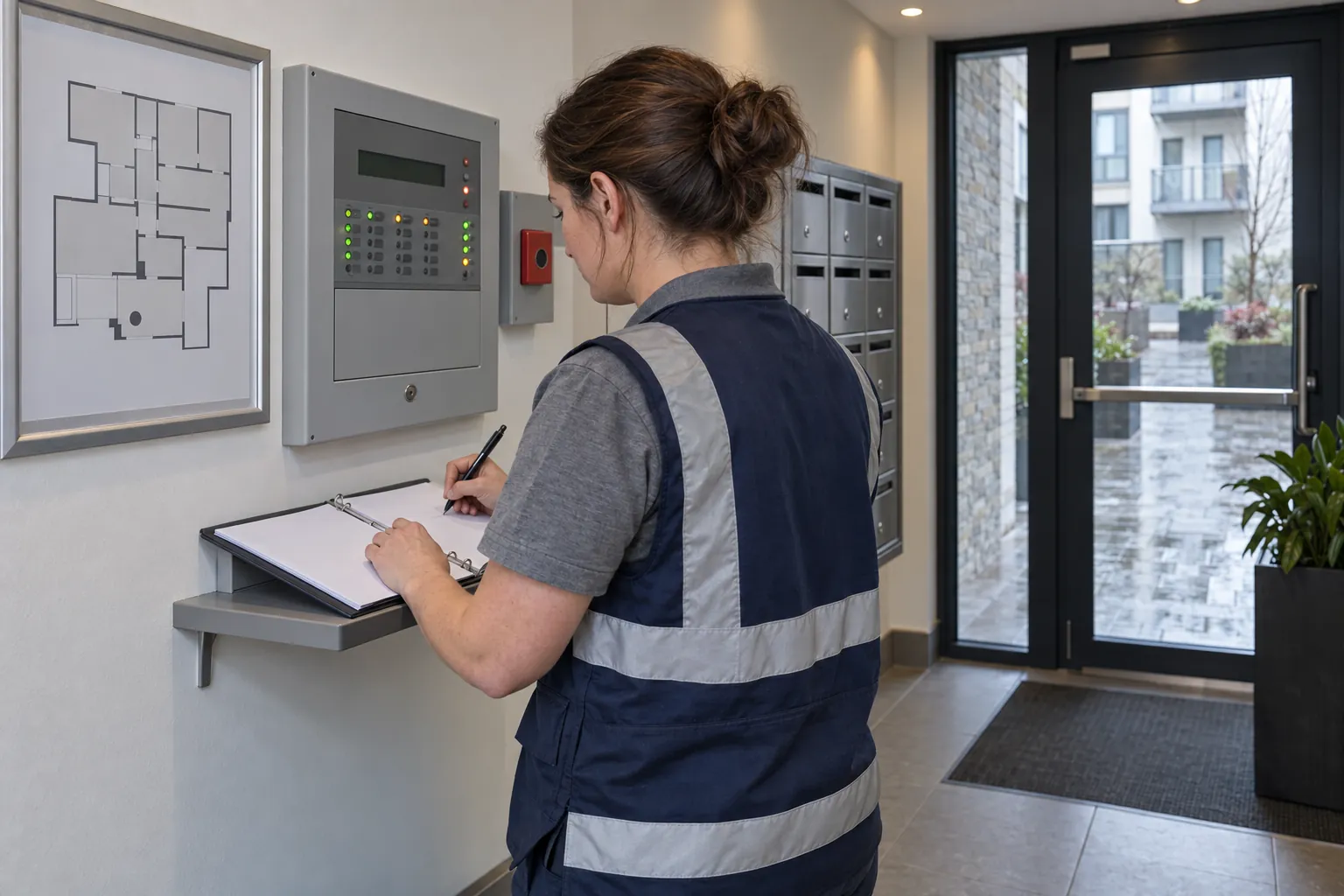
Section 6.2 of the guide also asks for a zone plan beside the panel, with “the schedule of servicing/testing” displayed there.
05
Quarterly servicing, and apartment buildings
The quarterly and annual visits are the competent person's inspection and servicing under sections 9.2.2.5 and 9.2.2.6 of I.S. 3218, and they reach what a weekly test from one call point cannot, such as the smoke and heat detectors and the panel's programmed actions, like releasing doors. None of that is the site team's job. After each visit the competent person should leave a test or servicing certificate; Appendix J.4 of the Department's guide shows a model certification of a fire detection and alarm system. File it in the register, and read it: a defect listed on the certificate is still a defect until it is fixed.
Section 8 of the guide adds that the contractors doing this work “should be part of a registered contractor's association where relevant for their trade”. Some things always go to them: a fault that will not clear, isolating a zone for building work, changing the system after a fit-out, and anything to do with the panel's programming.
Some regulated settings add their own words. In nursing homes and other designated centres for older people, regulation 28 of the Health Act 2007 (Care and Welfare of Residents in Designated Centres for Older People) Regulations 2013 requires the registered provider to make adequate arrangements for “testing fire equipment” and for “giving warning of fires”, and to train staff in, among other things, the “location of fire alarm call points”.
06
Where the weekly test fails, and what SiteClara does about it
Weekly alarm tests go wrong in familiar ways. The same call point is used every week because it is beside the panel, so a break glass unit in a basement plant room has not been operated since the building was handed over. The caretaker who does the test is on leave and nobody else knows the routine. The register is filled in on a Friday for a test on Tuesday, or for one that did not happen. A sounder that did not work was mentioned to whoever was passing and never reached the servicing company. And a managing agent with a dozen buildings cannot tell which tested this week without ringing round.
SiteClara records routine checks where they happen. A printed QR poster, with an optional NFC tag behind it, sits at the panel or at each call point on the rotation. The person doing the test scans the code or taps the tag on their own phone, with no app to install, sees the check due at that location, such as this week's call point test, and marks it done or says what stopped them. The named person and the time are recorded as it happens, with a photo when one is asked for. A fault found during the test becomes a job on the team's list and stays open until someone closes it, so a sounder that was not heard can be matched to the day it was fixed.
The supervisor sees what is due, done and missed, and records the reason a check was missed. Each day they review the checks and photos, add a note and approve a report that goes to nominated contacts the next morning, so the person having control, the OMC's managing agent or a client's facilities manager sees the weekly tests as they were done, not as they were remembered.
07
Questions people ask
How do you test a fire alarm?
Operate one trigger device, usually a manual call point with its test key, and check that the control panel shows the right zone and the alarm sounders are heard throughout the building. Table 2 of the Department of Housing's Fire Safety Guide for Building Owners and Operators asks the weekly check to ensure that “the control equipment is able to receive a fire signal and to initiate the evacuation procedure, recording which trigger device has been used”, and that any standby batteries are in good condition.
How often does a fire alarm need to be tested?
The Department of Housing's Fire Safety Guide for Building Owners and Operators sets four intervals in its Table 2: the panel “checked daily”, the system “checked weekly” from a trigger device, and inspection and servicing by a competent person quarterly and yearly under I.S. 3218, each with a test or servicing certificate.
What qualifications do you need to test fire alarms?
For the daily and weekly checks, none is named. Section 3.1 of the Department of Housing's Fire Safety Guide for Building Owners and Operators says routines such as “checking the fire alarm panels” can be done by persons “who have received a suitable level of training”. The quarterly and yearly servicing is for competent persons who “can provide certification to the relevant standard”, and section 8 says the contractor “should be part of a registered contractor's association where relevant for their trade”.
08
Where to read more, and a list to take away
Start with the Department of Housing, Local Government and Heritage's Fire Safety Guide for Building Owners and Operators (August 2023): section 3 on the person having control and competent persons, section 5.6 on the fire safety register, section 6.2 on fire detection and alarm systems, section 7 for apartment buildings, and Table 2 in section 8 for the daily, weekly, quarterly and yearly schedule. The HSA's page on fire detection and warning covers the employer's side, with a checklist. Under section 18(4) of the 1981 Act, the fire authority may give advice on a particular building.
Before next week's fire alarm test, check that:
- every manual call point is numbered on a list or the zone plan, with the date it was last used for the test;
- the test happens at a set time each week, and a named deputy knows the routine;
- the monitoring centre is told before the test and confirms the signal after it;
- someone listens for the sounders away from the panel, including plant rooms, toilets and stairs;
- the standby batteries, and any generator, are checked as part of the weekly routine;
- the panel is checked every day, and yesterday's fault has been dealt with;
- each test, fault and false alarm goes into the fire safety register, with the device used;
- faults go to the servicing company the same day;
- the quarterly and annual visits are booked, and their certificates are filed in the register.
Sources
Every document this guide quotes or links to, in the order it first cites them.
- Section 18 of the Fire Services Act 1981 irishstatutebook.ie
- Licensing of Indoor Events Act 2003, section 29 irishstatutebook.ie
- Regulation 13 of the Safety, Health and Welfare at Work (General Application) Regulations 2007 irishstatutebook.ie
- Fire Safety Guide for Building Owners and Operators assets.gov.ie
- I.S. 3218:2024 nsai.ie
- Fire detection and warning hsa.ie
- Regulation 28 of the Health Act 2007 (Care and Welfare of Residents in Designated Centres for Older People) Regulations 2013 irishstatutebook.ie
Related guides
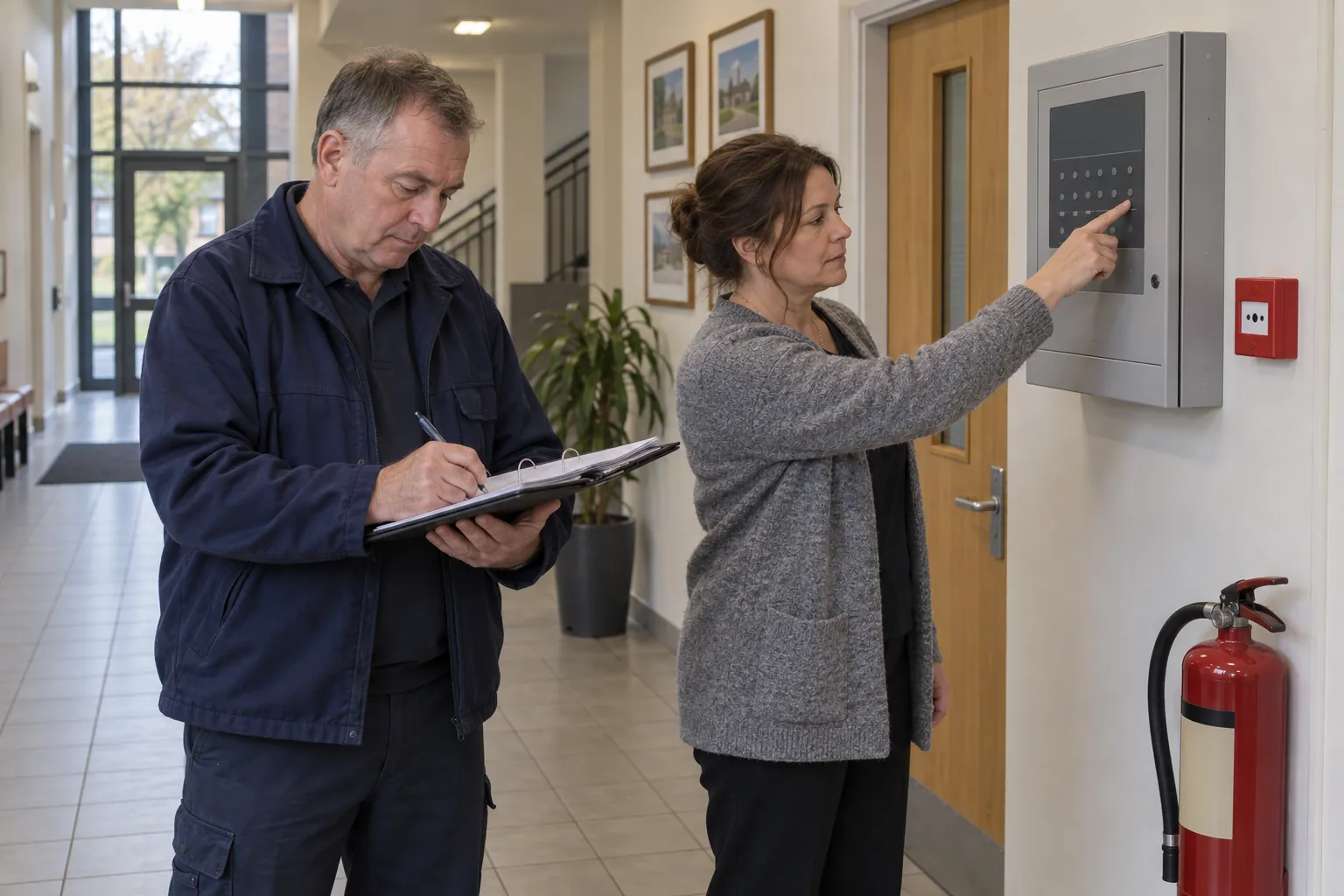 Fire and water checksFire safety register: what to record, who keeps it and how to make it credibleWhat a fire safety register should hold under section 18(2) of the Fire Services Acts, the routine checks behind it, who keeps it, and what makes it credible.
 Fire and water checksFire warden duties: the daily checks, the evacuation and the recordWhat a fire warden does in an Irish workplace: the law behind the role, the daily and weekly checks, the job in an evacuation, and a record that stands up.
 Fire and water checksFire drills in Ireland: the duty, how to run one, and what to recordFire drills in Ireland: the Fire Services Acts and 2005 Act duties, how often to hold one, how to run and review it, and what the fire safety register should show.
 Fire and water checksEmergency lighting testing in Ireland: the checks, the tests, and the recordEmergency lighting testing in Ireland: the legal duty, the daily and weekly checks, quarterly and annual tests to I.S. 3217, and what the logbook should show.