Fire and water checks
Emergency lighting testing in Ireland: the checks, the tests, and the record
An emergency lighting test in Ireland follows the Department of Housing's fire safety guide and the Irish Standard it points to: a trained member of staff gives the emergency lights a daily look and checks a quarter of them each week, so that every fitting is seen within four weeks, and a competent person inspects and tests the system every quarter and every year, when it is tested for its full rated duration.
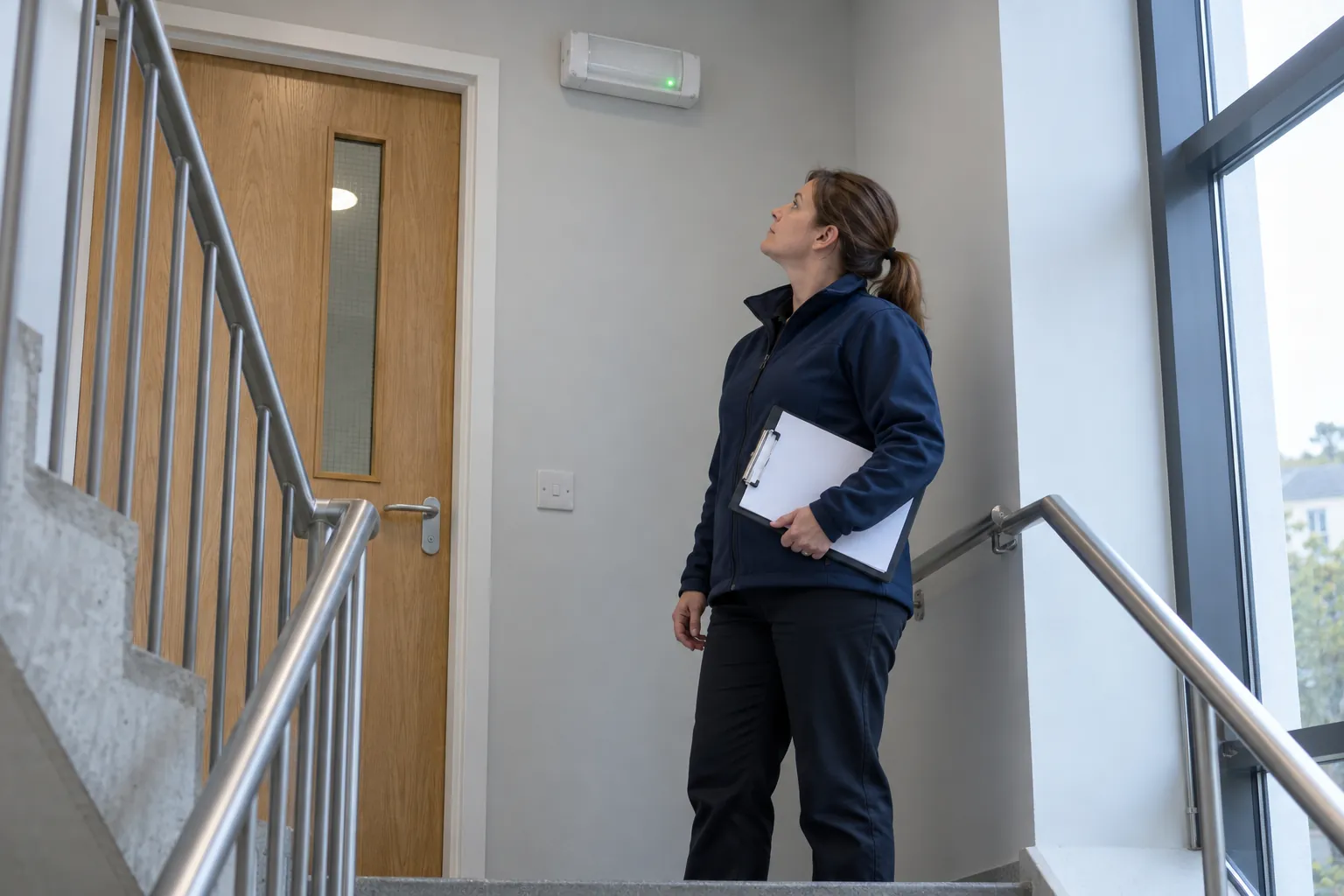
That is more on-site checking than many people expect, and because emergency lighting only proves itself on the night the power goes, the testing and the record of it are the only evidence in the meantime that it would work. This guide sets out where the duty comes from, who does which part, how to carry out the routine checks, and what the logbook and the fire safety register should show.
01
Where the duty to test emergency lighting comes from
No Irish statute sets a timetable for testing emergency lighting. The duty comes from fire law and workplace law, and the schedule is how the official guidance and the Irish Standard say to meet it.
The fire law is section 18 of the Fire Services Act 1981, which covers premises such as those used for sleeping accommodation, care, entertainment and teaching, and premises the public has access to. The Licensing of Indoor Events Act 2003, section 29 added “any workplace” and substituted a new subsection (2), under which every person having control over such premises must “provide reasonable fire safety measures”, prepare appropriate fire safety procedures, and “ensure that the fire safety measures and procedures … are applied at all times”.
The workplace law is the Safety, Health and Welfare at Work (General Application) Regulations 2007. Three regulations name emergency lighting:
- Regulation 12(i): an employer shall ensure that “emergency routes and exits requiring illumination are provided with emergency lighting of adequate intensity in case the lighting fails”.
- Regulation 8(c): places of work in which employees “are especially exposed to risks in the event of failure of artificial lighting are provided with emergency lighting of adequate intensity”.
- Regulation 87(b): “emergency lighting is fitted in all switchrooms in order to give an adequate degree of lighting in the event of a loss of electrical supply”.
The practical detail is in the Department of Housing, Local Government and Heritage's Fire Safety Guide for Building Owners and Operators (August 2023), written for persons having control under section 18(2). Its section 6.3 says that buildings are generally required to have an emergency lighting system, “typically used to illuminate escape routes, common areas, corridors, stairways and service rooms”, and that such systems “should be inspected and maintained in accordance with the recommendations of Irish Standard I.S. 3217”. Its Table 2 maintenance schedule turns that into daily, weekly, quarterly and yearly work.
02
What emergency lighting covers in practice
The Department's guide defines emergency escape lighting as “lighting that provides illumination for the safety of people leaving the building when the normal lighting fails”. In an ordinary non-domestic building, that usually means emergency luminaires or illuminated signs in:
- escape routes: corridors, stairways, lobbies and landings, and the route to each final exit;
- exit and directional signs;
- common areas such as receptions, open-plan offices, canteens and shared circulation in apartment blocks;
- service rooms: plant rooms and, under regulation 87(b), every electrical switchroom;
- places where a sudden blackout is dangerous in itself, such as a kitchen or a workshop, which is what regulation 8(c) is about;
- open shared balconies in apartment buildings, where section 7.2 of the guide asks for emergency escape lighting along the route to a final exit.
Before testing anything, the site team needs to know what the system is, and the first page of the logbook should say:
- Self-contained or central battery. Most buildings have self-contained luminaires, each with its own battery and indicator; larger buildings may have a central battery system with its own panel.
- Maintained or non-maintained. A maintained fitting is lit all the time; a non-maintained one is dark until the power fails. Some self-contained fittings test themselves automatically.
- Rated duration. Each system is designed to run for a stated time on battery, which the annual test proves.
A schedule of luminaires underpins everything that follows: every fitting and sign with a number, a location and a type, marked on a floor plan. Without it, nobody can show that the weekly checks covered the whole system.
03
The testing schedule: daily, weekly, quarterly and yearly
Table 2 of the Department's guide divides the work into “regular checks to be carried out by designated person” and “planned inspection and maintenance to be carried out by a competent person”. For emergency and escape lighting systems it sets out the following, citing the clauses of I.S. 3217 for each.
- Daily. “The minimum operational requirements shall be checked as set out in section 16.2.1 of I.S. 3217”, adding that further checks “may be necessary, due to either the type of system installed or as a result of other factors”. The same table's daily check of escape routes includes making sure that “the emergency lighting indicator in each emergency light fitting is operative” and that escape routes are “clearly indicated, sign-posted and adequately illuminated”.
- Weekly. In addition to the daily checks, the checks in clause 16.2.2 “shall be carried out on at least 25 % of the emergency lighting system so that 100 % of the system is check[ed] at least every 4 weeks”: visually checking that each lamp in maintained and sustained luminaires is “operational and illuminated”; checking that self-contained and ATS luminaires have their LED status indicators “illuminated and showing healthy condition/status”; and ensuring “that all non-illuminating lamps are replaced”.
- Monthly. The table points to clause 16.2.3 of I.S. 3217, in addition to the weekly routine. Your contractor will say what it asks for your system.
- Quarterly. The inspection and test in clause 16.2.4. On completion, a report for inspection, testing and servicing “shall be issued to the owner or occupier”, a copy “shall be placed in the emergency lighting logbook”, and the schedule of due dates for periodic inspections and tests updated.
- Yearly. The inspection and test in clause 16.2.5, “carried out once in every 1 year period subsequent to the completion of 3 three monthly (quarterly) inspections and tests”, and “all emergency lighting systems shall be tested to their rated duration”.
Two things stand out. The on-site routine is weekly, not monthly: a quarter of the system each week, rotating, so that every fitting is seen within four weeks. And the full-duration test is a yearly job for a competent person, not for the site team.
Section 3.1 of the guide says that general daily routines can be undertaken “by persons who have received a suitable level of training”, and that for “the planned periodic maintenance of fire protection systems, such as … emergency lighting systems … or for repairs to fire protection systems, the person having control should engage competent persons”.
The Health and Safety Authority's page on emergency escape and fire fighting puts the same split from the employer's side: “An employer or nominated employee can carry out checks and routine maintenance work”, and adds that “it is important to ensure the reliability and safe operation of fire-fighting equipment and installed systems such as fire alarms and emergency lighting. This is best done by using a competent person to carry out periodic servicing and any necessary repairs.”
04
How to carry out the daily and weekly checks
What follows is a common routine for the designated person, built around the Department's schedule. It is not a quotation from I.S. 3217; your contractor or the system's documentation will say what your fittings need.
- Split the schedule into four groups of roughly a quarter each, by floor, zone or circuit, so that four weeks cover every fitting. Mark the groups on the floor plan.
- Do the daily look on the way round. Walking the escape routes, glance at each fitting: maintained fittings lit, indicators healthy, signs lit, nothing broken or hidden by stock or a new partition.
- Walk this week's group properly. At each fitting, check that a maintained or sustained lamp is lit and that a self-contained or automatic test fitting shows a healthy status. Check that each exit sign still points the right way after any change of layout.
- Read any automatic test results, and a central battery panel where there is one. A fault light nobody reads is not a check.
- Deal with failed lamps. The schedule asks that non-illuminating lamps are replaced; a fault in a battery, charger or wiring goes to the contractor that day.
- Record it at the time: the date, the group checked, each fitting by number that was faulty, what was done, and your name.
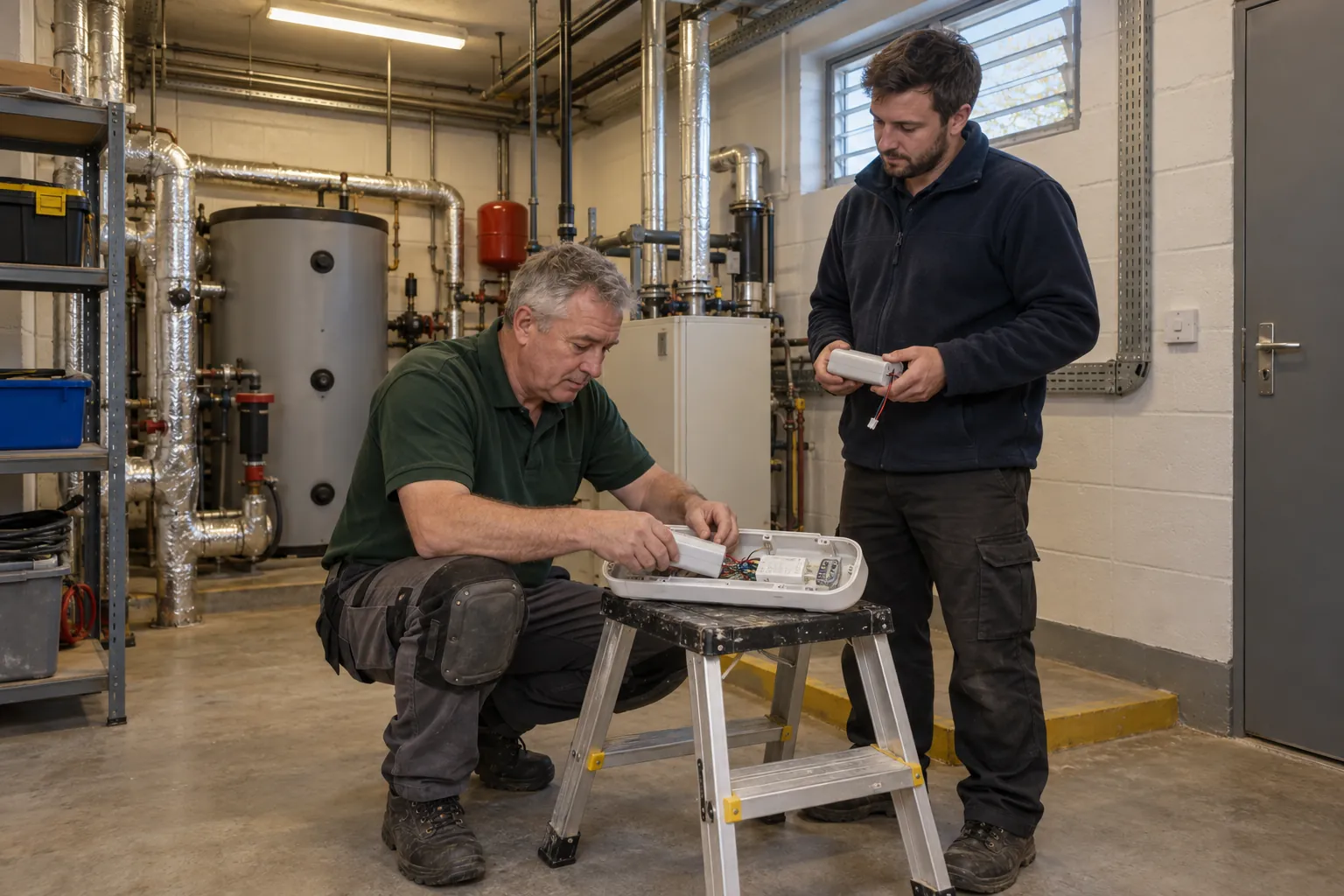
Never simulate a mains failure by pulling fuses or switching off a board that serves anything else. Operating a test switch is for someone trained on the system, and a long test leaves the batteries discharged for hours afterwards, so it is not one to run while the building is occupied.
Section 5.3 of the guide includes, among the things staff should be trained in, the “action to be taken where fault, damage or ineffective operation of fire protection systems (for example, fire detection and alarm systems, emergency lighting) … is noticed”. That includes the cleaner or security officer who passes a dark exit sign at night.
05
The emergency lighting logbook and the fire safety register
The Department's schedule refers to an emergency lighting logbook, where the contractor's quarterly report is placed, and Appendix J of the guide includes a model Emergency Lighting Log Sheet and Emergency Lighting Check List. The wider record is the fire safety register: section 5.6.1 says one should be kept for all premises where section 18 applies, and lists among its contents information on “emergency lighting systems (Installation, Inspection, maintenance, and works carried out)”. The guide asks that the register be kept on the premises and up to date; whether the logbook is filed inside it or kept beside it is a matter of practice, and either works as long as both are complete and current.
A logbook that stands up holds:
- the system details and where the drawings are;
- the schedule of luminaires and signs, numbered, with the four weekly groups;
- the daily and weekly check records: the date, the group, each faulty fitting by number, and who checked;
- the quarterly and annual reports from the competent person, with the schedule of due dates kept up to date;
- faults and repairs: what failed, who it was reported to, what was done, and when it was cleared;
- alterations: fittings added, moved or removed in a fit-out.
The HSA's page makes the point plainly: “A record of the work carried out on such equipment and systems will help to demonstrate compliance with the law.” Its checklist asks: “Are all fire doors and escape routes and associated lighting and signs regularly checked?” and “Are those who test and maintain the equipment properly trained to do so?”
What makes the record believable: entries made at the time; faults recorded by fitting number rather than “all OK”; every fault with a matching repair; gaps explained; and the quarterly reports actually read, because a defect on a contractor's report is still a defect until it is fixed.
06
Where the weekly checks fail, and what SiteClara does about it
Emergency lighting checks go wrong in familiar ways. Reception and the ground floor are checked every week, and the plant room, the back stairs and the switchroom are missed for months. The logbook is written up at the end of the month for four weeks at once. A security officer on nights notices a dark exit sign, tells whoever is on in the morning, and it never reaches the contractor. And a managing agent with a dozen buildings cannot tell which did their checks this week until the quarterly visit finds the gap.
SiteClara records routine checks where they happen. A printed QR poster, with an optional NFC tag behind it, sits at each point on the round, such as a stairwell, a floor or a switchroom. The person doing the check scans the code or taps the tag on their own phone, with no app to install, sees the checks due at that location, such as this week's emergency lighting check for that floor, and marks each one done, or says what stopped them. The named person and the time are recorded as it happens, with a photo when one is asked for. A failed fitting or a dark sign reported there goes onto the team's list of jobs and stays open until someone closes it.
The supervisor sees what is due, done and missed, and records the reason a check was missed. Each day they review the checks and photos and approve a report that goes to nominated contacts the next morning, so the person having control, the OMC's managing agent or a client's facilities manager sees the checks as they were done, not as they were remembered.
07
Questions people ask
Do you have to be qualified to test emergency lighting?
Not for the routine checks, but you do need training, and the periodic tests are for a competent person. Section 3.1 of the Department's Fire Safety Guide for Building Owners and Operators says general daily routines can be undertaken “by persons who have received a suitable level of training”, while for “the planned periodic maintenance of fire protection systems, such as fire detection and alarm systems, emergency lighting systems”, the person having control “should engage competent persons”. The Health and Safety Authority's page on emergency escape and fire fighting agrees: “An employer or nominated employee can carry out checks and routine maintenance work”, but for the reliability of installed systems “such as fire alarms and emergency lighting” it advises “using a competent person to carry out periodic servicing and any necessary repairs”.
How do I test my emergency lights?
The site team's weekly test is a visual check, not a mains failure. Table 2 of the Department's Fire Safety Guide for Building Owners and Operators asks for the checks to be carried out “on at least 25 % of the emergency lighting system” each week, so that the whole system is checked every four weeks: check that each lamp in maintained and sustained luminaires is “operational and illuminated”, check that self-contained and automatic test luminaires have their LED status indicators “illuminated and showing healthy condition/status”, and “ensure that all non-illuminating lamps are replaced”. Record each check in the logbook.
How do you perform a 90 minute emergency light test?
A test that runs the emergency lighting on battery for its full rated duration is the annual test, and it is a job for a competent person rather than the site team. Table 2 of the Department's Fire Safety Guide for Building Owners and Operators places it in the yearly inspection and test under clause 16.2.5 of I.S. 3217, carried out once a year after three quarterly inspections and tests, and says that “all emergency lighting systems shall be tested to their rated duration”. Whether that is 90 minutes or another period depends on what your system was designed for, which the logbook should record.
Is there an emergency lighting certificate in Ireland?
Not for emergency lighting as such: the Department's guide asks for a report after each quarterly visit. Table 2 of the Fire Safety Guide for Building Owners and Operators says that on completion of the quarterly inspection and test, “a report for inspection, testing and servicing” as set out in the annexes of I.S. 3217 “shall be issued to the owner or occupier”, and that “a copy of the report shall be placed in the emergency lighting logbook”. Appendix J of the same guide includes a model Emergency Lighting Log Sheet and Emergency Lighting Check List for the routine checks, but, unlike fire detection and alarm systems, no model certificate.
08
Where to read more, and a list to take away
Start with the Department of Housing, Local Government and Heritage's Fire Safety Guide for Building Owners and Operators (August 2023): sections 3, 5.6, 6.3 and 7, Table 2 for the schedule, and Appendix J for the model log sheet and check list. The HSA's page on emergency escape and fire fighting has a checklist. I.S. 3217 itself is sold by the NSAI. Under section 18(4) of the 1981 Act, the fire authority may give advice on a particular building.
Before this week's emergency lighting check, make sure that:
- every emergency luminaire and exit sign is numbered on a schedule and a floor plan, including plant rooms, switchrooms and any open shared balconies;
- the schedule is split into four weekly groups, so that every fitting is checked at least every four weeks;
- a named person and a deputy know the rotation;
- each weekly check records the group, the date, the person and every faulty fitting by number;
- faults go to the contractor the same day and are entered in the fire safety register;
- the quarterly and annual visits are booked, their reports filed in the logbook, and the due dates kept up to date;
- you know which edition of I.S. 3217 the system is maintained to;
- in a shared building or an apartment block, who does each part is written down.
Sources
Every document this guide quotes or links to, in the order it first cites them.
- Section 18 of the Fire Services Act 1981 irishstatutebook.ie
- Licensing of Indoor Events Act 2003, section 29 irishstatutebook.ie
- Safety, Health and Welfare at Work (General Application) Regulations 2007 irishstatutebook.ie
- Fire Safety Guide for Building Owners and Operators assets.gov.ie
- The NSAI's announcement of I.S. 3217:2023 nsai.ie
- Emergency escape and fire fighting hsa.ie
Related guides
 Fire and water checksFire alarm testing in Ireland: the checks, the servicing, and the recordFire alarm testing in Ireland: the legal duty, the daily and weekly checks, quarterly servicing to I.S. 3218, and what the fire safety register should show.
 Fire and water checksFire safety register: what to record, who keeps it and how to make it credibleWhat a fire safety register should hold under section 18(2) of the Fire Services Acts, the routine checks behind it, who keeps it, and what makes it credible.
 Fire and water checksFire extinguisher checks: the monthly check and the annual serviceFire extinguisher checks in Ireland: the section 18(2) duty, the monthly check, annual servicing to I.S. 291 by a competent person, and the record to keep.
 Fire and water checksWorkplace fire safety checklist: what to check, how often, and who does itA workplace fire safety checklist for Ireland: the daily, weekly and monthly checks under the Fire Services Acts, who does each one, and what to record.