Premises and facilities management
Grease traps in Ireland: what the law asks of a kitchen, and how to keep the trap working
A grease trap is a tank or unit in a kitchen's drainage that holds back fats, oils and grease (FOG) before the waste water reaches the sewer, and in Ireland a food business that discharges grease to a public sewer needs a trade effluent licence from Uisce Éireann whose conditions cover the design, operation and maintenance of its grease removal.
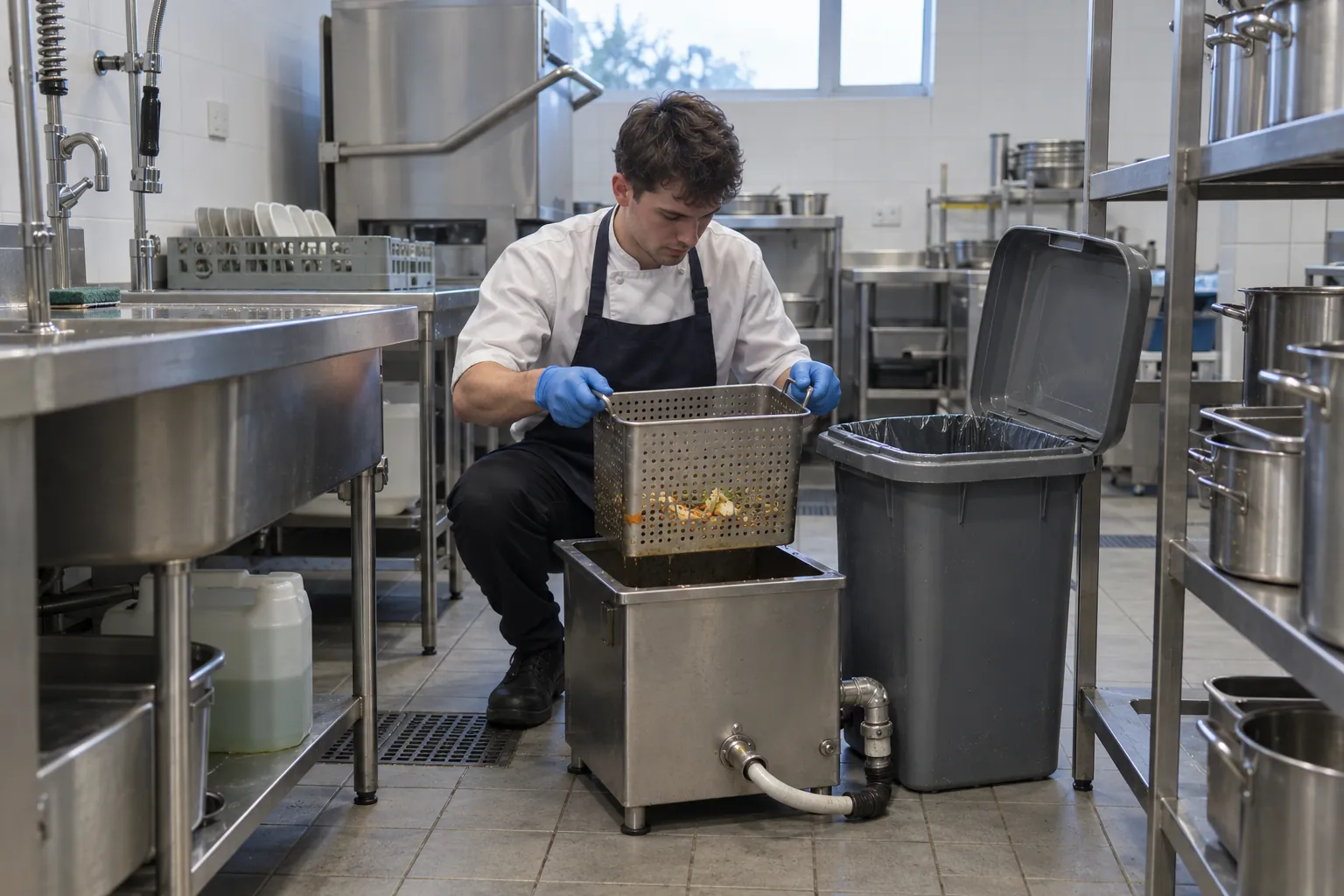
The trap only works if somebody empties and services it. A unit nobody has opened since the fit-out is full of set fat, and the next thing to fill is the drain. This guide covers the Irish law behind grease traps, what maintenance involves, how often it is done, who does it, and what a useful record looks like.
01
Are grease traps a legal requirement in Ireland?
No Irish statute says in so many words that every kitchen must have a grease trap. The duty comes through the licence to discharge to sewer, the rules on what may go down a drain, and the building guidance for new drainage.
- The trade effluent licence. Section 16 of the Local Government (Water Pollution) Act 1977 says a person shall not discharge any trade effluent or other matter, other than domestic sewage or storm water, to a sewer except under and in accordance with a licence. The licensing function now sits with Uisce Éireann (formerly Irish Water). Its fats, oils and grease page for businesses says a licence under that section "is a legal requirement if your business discharges trade effluent to a public sewer".
- Grease is not domestic waste water. The Water Services Act 2007 defines domestic waste water so that it does not include fats, oils, grease or food particles discharged from a premises in the course of, or in preparation for, providing a related service or carrying on a related trade. A commercial kitchen's waste water is therefore trade effluent, which is why Uisce Éireann's guide tells food businesses: "If you operate a Food Service Establishment you produce trade effluent".
- What may go down a drain. Section 70 of the Water Services Act 2007 forbids anyone to pass into a sewer or drain any matter by which the free flow of its contents may be interfered with, and requires the owner of a premises to keep its drains, manholes, gully traps and waste water treatment systems so that they do not cause a risk to health or the environment or a nuisance through odours. Failing to comply is an offence.
The licence is where the grease trap appears. Uisce Éireann's booklet, Your guide to the Fats, Oils and Grease (FOG) Reduction and Licensing Programme, says a FOG licence sets out conditions on "the standards and practices associated with the design, operation and maintenance of grease and FOG removal", and that "you may need to install an appropriately sized grease trap". Section 16 itself allows conditions on the maintenance of apparatus and inspection chambers and on the keeping of records.
The penalties are real. Under section 16(8) of the 1977 Act, as substituted by the Water Services Act 2007, discharging without a licence carries a fine of up to €5,000 or three months' imprisonment, or both, on summary conviction, and up to €15,000,000 or five years on indictment. Uisce Éireann's trade effluent licensing page puts it simply: "Discharging trade effluent without a licence is an offence."
For drainage being built or altered, the Building Regulations guidance Technical Guidance Document H – Drainage and Waste Water Disposal (2016) says at paragraph 1.3.2.6 that drainage serving kitchens in commercial hot food premises should be fitted with a grease separator complying with I.S. EN 1825-1 and designed in accordance with I.S. EN 1825-2, "or other effective means of grease removal". Where a building is not on a public sewer, paragraph 2.9.1 of the same document says excessive fats, oils and grease should be kept out of a waste water treatment system, because they impair treatment and mean more frequent desludging, and that where this is not practicable, as in commercial kitchens, a grease trap should be used.
02
What grease trap maintenance covers in practice
Uisce Éireann's guide lists the food service establishments it has in mind: restaurants, takeaways, pubs which serve cooked food, cafés, coffee shops, hotels, B&Bs, convenience stores, and supermarkets or forecourt shops with delicatessen counters. The list is "not limited to" those, so a staff canteen, school kitchen or nursing home that cooks on site and drains to a public sewer is in the same position.
Grease removal equipment comes in a few forms: a small passive grease trap under the pot-wash sink, a larger grease separator in the ground outside, and powered grease removal units that separate the fat and move it into a container for collection. Whatever is fitted, the routine for cleaning and maintaining it usually includes:
- Keeping grease out in the first place: plates, pans and utensils wiped and scraped into a bin before washing, sink strainers in place, and no cooking oil poured down a sink or floor gully.
- Daily or per-shift checks on a grease removal unit: the solids basket emptied, the collection container emptied before it overflows, and the unit switched on and running.
- Regular emptying of a passive trap: the fat layer and the settled food solids removed and the trap cleaned and closed again as the manufacturer's instructions describe.
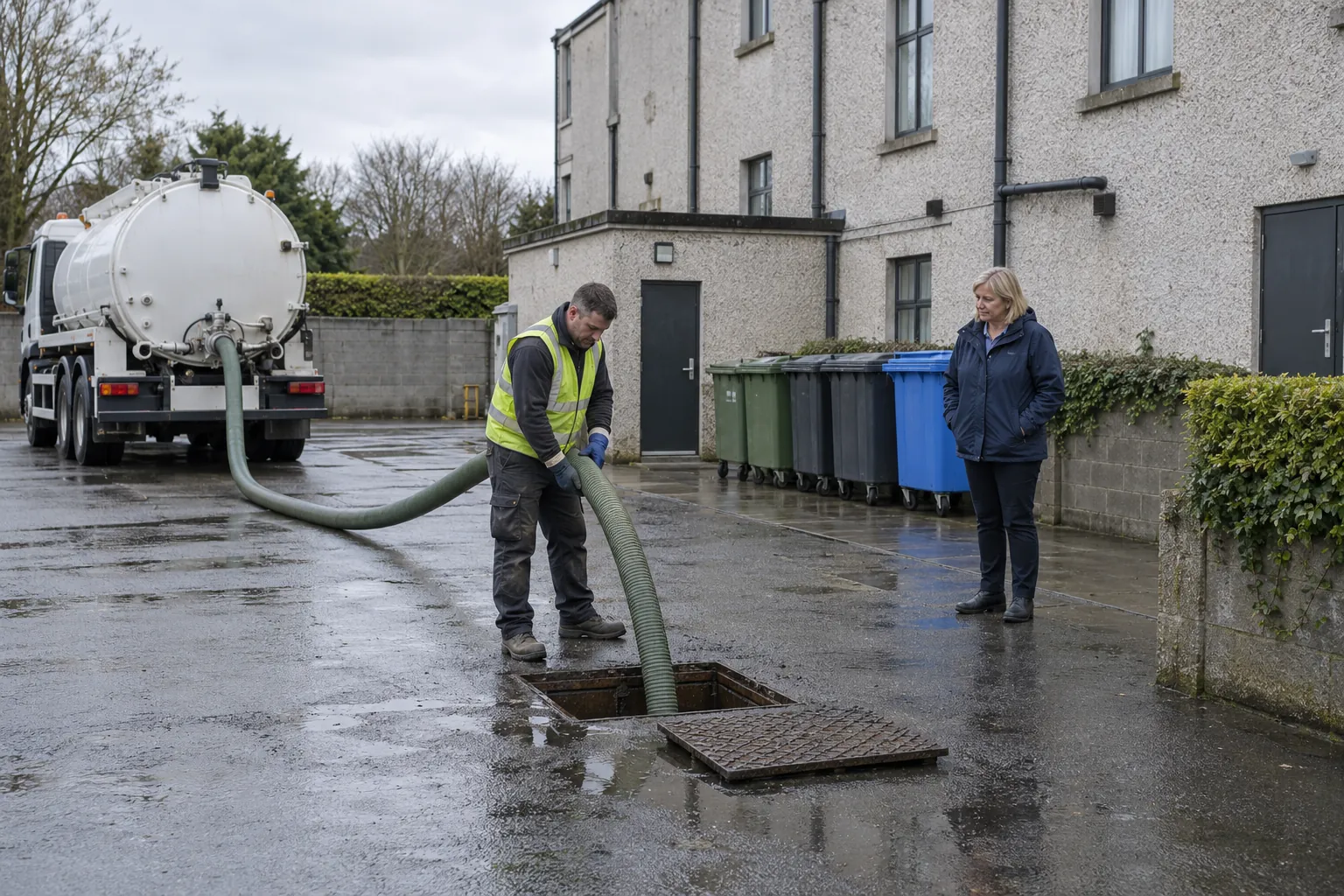
- Pump-outs of a below-ground separator by a contractor with a tanker, with the contents taken away as waste.
- Servicing to the manufacturer's recommendations: seals, baffles, sensors, heaters and any dosing pump checked and topped up.
- Used cooking oil kept in a suitable container and collected separately, never added to the trap.
- Watching the drain downstream: slow sinks, gurgling, smells and a rising level in the inspection chamber are reported, not left for the next shift.
Uisce Éireann's page for businesses asks for two of these in so many words: that grease trapping equipment is "properly maintained by kitchen staff/authorised contractors and maintenance details are recorded", and that the trap or unit "is kept fully serviced in accordance with manufacturer's recommendations". Its advice for kitchens is to "Wipe and scrape plates, pans and utensils into a suitable bin before washing" and to collect oil "into a suitable container and arrange for its collection by an appropriately authorised collector".
03
How often a grease trap should be emptied and serviced
There is no single legal interval for emptying a grease trap in Ireland. Three things set it for a particular kitchen:
- The licence conditions, where a FOG licence has been issued. Read the licence itself: it is the document Uisce Éireann will check against.
- The manufacturer's recommendations for the unit fitted, which Uisce Éireann asks businesses to follow.
- The kitchen's own use. I.S. EN 1825-2, the standard Technical Guidance Document H names, covers the selection of nominal size, installation, operation and maintenance of grease separators. A trap sized for a café and fed by a busy hotel kitchen fills faster than its schedule assumed.
In practice the daily jobs fall to the kitchen, the emptying of a small trap follows the manufacturer's interval, and the pump-out of a large separator follows a contractor's schedule. Each needs a named owner, and the interval is tightened when the checks show the trap filling faster than expected.
A trap half full of set fat at every emptying, a separator that smells between pump-outs, or a drain that backs up on a Saturday night means the interval or the equipment is wrong. Uisce Éireann's FOG advisors visit premises when the programme reaches an area, assess the risk from the kitchen's discharge to the wastewater network and advise on best practice, which is the moment to ask whether the equipment and the schedule fit the kitchen.
04
Who does what
Grease trap maintenance fails when the kitchen, the building and the contractor each think one of the others has it.
- The licence holder, usually the food business operator, applies for the FOG licence and is bound by its conditions. Section 16(5) of the 1977 Act makes the conditions binding on any person discharging or causing or permitting the discharge.
- The head chef or kitchen manager owns the daily routine, and the kitchen porters and cleaners who do most of it need to know what to empty, where it goes and what to report.
- The facilities manager, caretaker or landlord usually owns the below-ground separator, the drains and the inspection chambers, especially in a shopping centre, hotel or office block where several kitchens share one drain. Section 70(2) of the Water Services Act 2007 puts the duty to keep drains, manholes and gully traps on the owner of the premises. A lease or a service charge agreement should say who empties what, and who pays.
- The grease trap contractor pumps out separators, services grease removal units and leaves a service report. Ask for that report every time.
- The waste collector takes the used cooking oil and the trap's contents. Ask for the collector's waste collection permit and check it on the National Waste Collection Permit Office's permit search, which the public can use to confirm that a collector holds a valid permit.
Large separators in the ground are a safety question as well as a drainage one. The Health and Safety Authority's guidance on confined spaces includes any tank, pit or chamber which, by its enclosed nature, creates a risk of serious injury needing emergency action, from hazards such as harmful gas or a lack of oxygen, and lists the disturbance of sludge and other deposits as one source of a toxic atmosphere. Under the Safety, Health and Welfare at Work (Confined Spaces) Regulations 2001, nobody should enter such a space if the work can reasonably be done another way, and entry needs a risk assessment, a safe system of work and emergency arrangements. Kitchen staff lift the lid of an under-sink trap; they do not climb into a separator chamber.
05
What a good grease trap maintenance record shows
Uisce Éireann's guide expects a business operating to best practice to be "servicing this equipment in accordance with manufacturer's recommendations, recording how your used cooking oil is recycled and keeping records of all maintenance and servicing". Its trade effluent licences can include conditions on notifications, record keeping and reporting. When a FOG advisor or inspector calls, the record is how the kitchen shows that the trap is being looked after between visits.
A useful record carries:
- The equipment, named the same way every time: "under-sink trap, pot wash", "grease removal unit, main kitchen", "external separator, yard".
- The date and time each check or emptying was done, written at the time.
- The person who did it.
- What was found, briefly: how full the trap was, whether the basket was emptied, anything broken. A photograph of the open trap or the emptied basket says more than a tick.
- Contractor visits: the date, the work done, the service report and the waste docket, filed together.
- Used cooking oil collections: the date, the quantity where the collector records it, and the collector.
- Problems and what happened next: a slow drain, a smell, a blockage, who was told, and when it was cleared.
- Missed checks, with the reason: the kitchen closed, the porter off, the unit out of service awaiting a part.
The weak point is usually the daily layer. The contractor's report is printed and filed, but the basket emptied every shift and the under-sink trap emptied between visits leave no trace unless somebody writes them down.
06
Where the record fails, and what SiteClara does about it
Most grease trap failures are not failures of equipment. They are an emptying that stopped when the kitchen porter left, a grease removal unit switched off because it was noisy, a slow drain mentioned to whoever was passing. On paper nobody sees the gap until the drain backs up or an inspector asks for the records.
SiteClara puts a printed QR poster, with an NFC tag behind it if staff should tap, at the locations in the kitchen's routine: the pot-wash sink, the grease removal unit, the external separator. Staff scan or tap with their own phone and see the checks due at that location. They mark each one done, or explain what stopped them, with a photo when one is asked for, such as the emptied basket or the open trap. The time and the person are recorded as it happens.
The supervisor sees which checks are due, done and missed, and can record why one was missed. A problem found on a check, such as a sink draining slowly or a smell from the yard chamber, is reported there and stays on the team's list of jobs until someone closes it, and can be escalated to the building manager. Each day the supervisor approves a report that goes to nominated management or client contacts the next morning, showing how the scheduled checks went.
07
Questions people ask
What does a grease trap do?
It holds back the fats, oils and grease in a kitchen's waste water, so that they are emptied from the trap instead of reaching the sewer. Uisce Éireann's Your guide to the Fats, Oils and Grease (FOG) Reduction and Licensing Programme explains why: hot FOG pours easily down a sink, but when it cools it solidifies and builds up inside the pipes, and combined with other debris it forms a solid material that can block a drain and lead to flooding.
Is it illegal not to have a grease trap in Ireland?
Not in itself. The offence is discharging trade effluent to a sewer without a licence, under section 16 of the Local Government (Water Pollution) Act 1977, and the Water Services Act 2007 defines domestic waste water so that it leaves out fats, oils, grease or food particles discharged in the course of, or in preparation for, providing a related service or carrying on a related trade. Uisce Éireann's FOG licence then sets conditions on the design, operation and maintenance of grease removal, and may require an appropriately sized grease trap.
How often should a grease trap be cleaned?
No Irish law sets a single interval. Uisce Éireann's fats, oils and grease page for businesses asks that the trap or grease removal unit is the correct size and "kept fully serviced in accordance with manufacturer's recommendations", and a FOG licence can add conditions of its own. The interval comes from the manufacturer, the licence and how quickly the kitchen fills the trap, and it is shortened when the trap is found full at every cleaning.
Can I empty my own grease trap?
For a small trap or grease removal unit in the kitchen, usually yes. Uisce Éireann's fats, oils and grease page for businesses asks businesses to make sure grease trapping equipment "is properly maintained by kitchen staff/authorised contractors and maintenance details are recorded", following the manufacturer's recommendations. A large separator in the ground is normally left to an authorised contractor.
What dissolves grease in a grease trap?
Nothing that should be poured in. Uisce Éireann's fats, oils and grease page for businesses says "You should never pour harmful chemicals down the sink or drain to try and dissolve fats, oils or grease". Grease is kept out by wiping and scraping plates, pans and utensils into a bin before washing, and what the trap catches is removed when it is emptied.
08
Further reading, and a list to take away
Start with Uisce Éireann's fats, oils and grease page for businesses and its guide to the FOG Reduction and Licensing Programme, which explain the licence and how to apply; the trade effluent licensing page lists what licence conditions cover. The law is in section 16 of the Local Government (Water Pollution) Act 1977 and section 70 of the Water Services Act 2007, both in the Law Reform Commission's revised versions. For new or altered drainage, read paragraph 1.3.2.6 of Technical Guidance Document H.
For the grease trap in your kitchen, make sure that:
- you know whether your kitchen holds a FOG licence, where it is kept, and what its conditions say about the trap;
- every trap, grease removal unit and separator is listed, with the manufacturer's instructions on how to clean and maintain it to hand;
- each daily, weekly and contractor task has a named owner, including in a shared building where the landlord owns the drains;
- used cooking oil is stored in a sealed container and collected by a permitted collector;
- contractor service reports and waste dockets are filed with the date of each visit;
- a slow drain or a smell is reported and followed up, not left for the next shift;
- nobody enters a below-ground separator chamber without a confined space risk assessment and safe system of work.
Sources
Every document this guide quotes or links to, in the order it first cites them.
- Local Government (Water Pollution) Act 1977 revisedacts.lawreform.ie
- Fats, oils and grease page for businesses water.ie
- Water Services Act 2007 revisedacts.lawreform.ie
- Your guide to the Fats, Oils and Grease (FOG) Reduction and Licensing Programme water.ie
- Trade effluent licensing page water.ie
- Technical Guidance Document H – Drainage and Waste Water Disposal (2016) gov.ie
- Permit search nwcpo.ie
- Health and Safety Authority's guidance on confined spaces hsa.ie
Related guides
 CleaningCommercial kitchen cleaning checklist: the law, the tasks and the recordA commercial kitchen cleaning checklist for Ireland: what Regulation 852/2004 and the FSAI expect, tasks by frequency, safe methods and the records to keep.
 Premises and facilities managementPlanned preventative maintenance: how to plan it in an Irish building and prove it was donePlanned preventative maintenance (PPM) in Ireland: the duty behind it, building a PPM schedule, the statutory tasks and the records that prove it was done.
 Premises and facilities managementBuilding maintenance checklist: what to check in an Irish building, how often, and who byA building maintenance checklist for non-domestic buildings in Ireland: daily to annual checks under the 2005 Act, the 2007 Regulations and the Fire Services Acts.
 Premises and facilities managementCaretaker duties in Ireland: what the job involves, and how to show it was doneCaretaker duties in Irish schools, parish halls, offices and apartment developments: the law behind the job, the daily and weekly checks, lone working and records.