Cleaning
Commercial kitchen cleaning checklist: the law, the tasks and the record
A commercial kitchen cleaning checklist is the working list of what kitchen staff clean, how, how often and who checks it, and in Ireland it is how a food business shows it meets Regulation (EC) No 852/2004, which requires food premises to be kept clean and food-contact equipment to be effectively cleaned and, where necessary, disinfected.
Also written for United Kingdom · United States · Canada · Australia
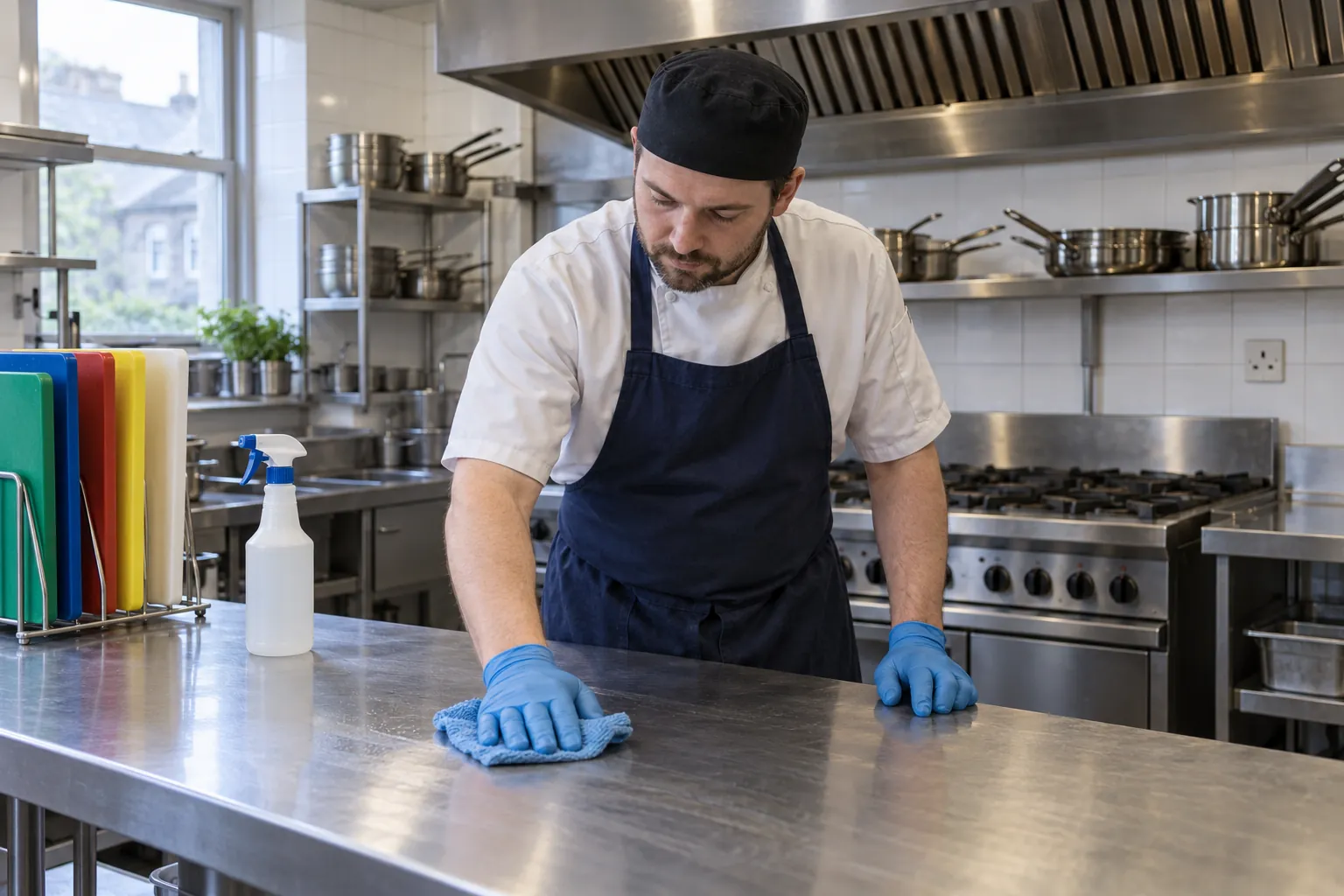
This guide sets out the law and the Food Safety Authority of Ireland (FSAI) guidance behind it, a restaurant kitchen cleaning checklist by frequency, safe methods for chemicals, fryers and floors, and the kitchen cleaning schedule and record that an inspecting officer may ask to see.
01
The law behind a kitchen cleaning checklist in Ireland
No Irish law requires a document called a commercial kitchen cleaning checklist. The law requires a clean kitchen and clean equipment; the checklist and the cleaning schedule behind it are how a kitchen plans that work and shows it was done.
The rule is EU law, which applies directly in Ireland: Regulation (EC) No 852/2004 on the hygiene of foodstuffs, in the consolidated version of 24 March 2021. The FSAI's page on the hygiene of foodstuffs lists the Irish regulations that give effect to it, beginning with S.I. No. 369 of 2006 for the businesses the HSE supervises. Annex II holds the general hygiene requirements, and five of them are the backbone of any kitchen cleaning list:
- Chapter I, point 1: "Food premises are to be kept clean and maintained in good repair and condition."
- Chapter I, point 10: "Cleaning agents and disinfectants are not to be stored in areas where food is handled."
- Chapter V, point 1(a): all articles, fittings and equipment with which food comes into contact are to "be effectively cleaned and, where necessary, disinfected. Cleaning and disinfection are to take place at a frequency sufficient to avoid any risk of contamination".
- Chapter VI, point 1: food waste and other refuse are to be removed from rooms where food is present "as quickly as possible, so as to avoid their accumulation".
- Chapter XII, point 1: food handlers are to be "supervised and instructed and/or trained in food hygiene matters commensurate with their work activity".
Article 5 requires a food safety management system based on HACCP principles. The FSAI's page on how to meet the HACCP requirement gives three ways: for low-risk businesses, the basic hygiene rules in Article 4 and Annex II may be enough; a recognised guide to good practice, such as I.S. 340:2007 Hygiene in the Catering Sector; or a formal HACCP system, usually required of big businesses such as large restaurants, hotels and hospital canteens. Whichever is chosen, "the responsibility for safe food lies with the food business operator". Cleaning and sanitation is one of the FSAI's prerequisite programmes, the foundation of that system.
I.S. 340 is the National Standards Authority of Ireland's voluntary standard on compliance with Regulation 852/2004 for businesses "where food is prepared and served to consumers", such as restaurants, hotels, cafes and licensed premises. The current edition is I.S. 340:2007; the NSAI announced a revision of I.S. 340 and I.S. 341 in November 2023.
The FSAI's list of competent authorities says the HSE inspects businesses like restaurants, delis, retailers, mobile food businesses and food stalls, working for the FSAI under the service contracts with official agencies that section 48 of the FSAI Act 1998 provides for. Food inspectors can close a business or stop it handling food if the premises is not hygienic, and the FSAI lists businesses served with Closure, Improvement or Prohibition Orders on its enforcement orders page.
A kitchen is also a workplace. Regulation 18 of the Safety, Health and Welfare at Work (General Application) Regulations 2007 (S.I. No. 299 of 2007) requires every place of work to be "kept in a clean state" and the floor of every workroom cleaned "by a suitable method as frequently as necessary to maintain an appropriate level of safety and health". One checklist serves both laws.
02
What a commercial kitchen cleaning checklist covers
Build the list by walking the kitchen with the head chef and whoever does the closing clean, item by item. The FSAI's butchers' guidance on safe food handling says the cleaning schedule "details all the equipment, fixtures and fittings that need to be cleaned". A typical restaurant or canteen kitchen has these groups of cleaning tasks:
- Food-contact surfaces and small equipment: benches and prep counters, chopping boards, knives, slicers, mixers and the probe thermometer.
- The cooking line: ranges, flat-tops, grills, combi ovens, microwaves, bains-marie and hot cupboards.
- Fryers and extraction: fryers, the canopy, its grease filters and its oil and condensation channels.
- Refrigeration: fridge and freezer handles, door seals, shelves, the cold room and the ice machine.
- Wash-up: the dishwasher, pot wash sinks, glasswasher and clean-utensil storage.
- Wash-hand basins: separate from the food sinks, cleaned and stocked.
- The structure: floors, walls, splashbacks, drain covers, ceilings, lights and flyscreens.
- Stores and waste: the dry store, the chemical store, kitchen bins and the outside bin store.
- Staff facilities: staff toilets and changing areas.
- The cleaning kit itself: cloths, mops, buckets and other tools, kept clean and, where colour coded, kept to their area, and the cleaning supplies, kept stocked in the chemical store.
Keep the dining room, bar and customer toilets on a separate restaurant cleaning checklist, with their own equipment: nothing used in a toilet should travel into the kitchen.
Where a contractor does the night clean of floors and walls, or a specialist the canopy ductwork, write down which tasks are theirs. The food business operator stays responsible for all of it, so each item on the commercial kitchen cleaning schedule needs one named role, not "kitchen" or "cleaners". Grease trap emptying is drainage maintenance with its own record, not a nightly tick.
03
The checklist by frequency: during service, closing, weekly and periodic
The FSAI's sample cleaning schedule has five frequency columns: after use, every shift, daily, weekly and other. The legal test is a frequency "sufficient to avoid any risk of contamination", so the menu, the volume and what the equipment touches decide it. The intervals below are a starting point, not a legal minimum. Many kitchens split the list into daily cleaning, done during service and at every close, and deep cleaning on a weekly and monthly cycle for what the daily work does not reach.
After each use and during service
- Clean and disinfect boards, knives, benches and other food-contact surfaces between raw and ready-to-eat food to prevent cross-contamination, unless the two are kept to separate areas and equipment.
- Clean and disinfect the probe thermometer before and after each use.
- Clean as you go: wipe spills, clear scraps into closed bins and deal with oil on the floor at once.
- Keep wash-hand basins clear of utensils and stocked with soap and paper towels.
Every shift or at closing
- Clean and disinfect every food-contact surface through the six stages in the next section.
- Take apart, clean and disinfect slicers: the FSAI's butchers' guidance asks for cleaning and disinfection at least daily, with detachable parts left to air dry.
- Switch off, isolate and cool the cooking line, then clean hobs, flat-tops, grills and ovens as the schedule sets.
- Drain bains-marie, and empty and clean the dishwasher and glasswasher as the manufacturer instructs.
- Clean sinks, taps and wash-hand basins, and wipe fridge handles and door seals.
- Empty bins, clean lids and take waste to the bin store.
- Sweep, then wet-clean the floor last, so it can dry before the kitchen is used again.
First thing in the morning
- Filter or change fryer oil: the HSA's guidance says manual oil filtering and cleaning is best done as a first task of the day rather than as part of closing down, once the oil has cooled.
- Check that last night's closing list was actually done before food preparation starts.
Weekly
- Remove and clean the canopy grease filters weekly, or more often where use is heavy; the HSA asks for filters to be cleaned regularly, with a spare set where use is heavy.
- Empty and clean fridge shelves in rotation, protecting the food while it is done.
- Clean walls, splashbacks, drains and drain covers, the dry store and the bin store.
Monthly or periodic
- Clean behind and under heavy equipment, ceilings, lights and flyscreens.
- Defrost freezers that need it.
- Have extract ductwork and fan blades cleaned regularly by trained people; the HSA points to section 7 of the TR/19 guide to good practice on the internal cleanliness of ventilation systems.
04
Cleaning methods, chemicals and safe working
The FSAI's safe food handling guidance sets out six stages of effective cleaning, which suit every food-contact surface in a kitchen:
- Pre-clean: get rid of loose material and scraps.
- Clean with detergent.
- Rinse.
- Clean with disinfectant, following the manufacturer's instructions.
- Rinse.
- Allow surfaces and equipment to air dry.
The FSAI adds that detergent and disinfectant often come combined as a sanitiser, so the manufacturer's instructions decide the dilution, the contact time and whether a rinse is needed. Put those details on the schedule beside each item.
Annex II keeps cleaning agents and disinfectants out of areas where food is handled. The HSA's Safety in Contract Cleaning notes that the safety data sheet says which chemicals must never be mixed: bleach, for example, should not come into contact with ammonia, toilet cleaners or drain cleaners, because a harmful gas can be created.
The HSA's Safety, Health and Welfare in Hotels, Restaurants, Catering and Bars, Part 2: Kitchen Equipment asks for machines to be isolated from power before cleaning, and ovens and ranges switched off, isolated or the gas turned off, and allowed to cool. For fryers it advises letting the oil cool, ideally for at least six hours, and not draining it above 40 °C. Only trained staff, with safe access, should clean grease from hoods, ducts and extraction equipment.
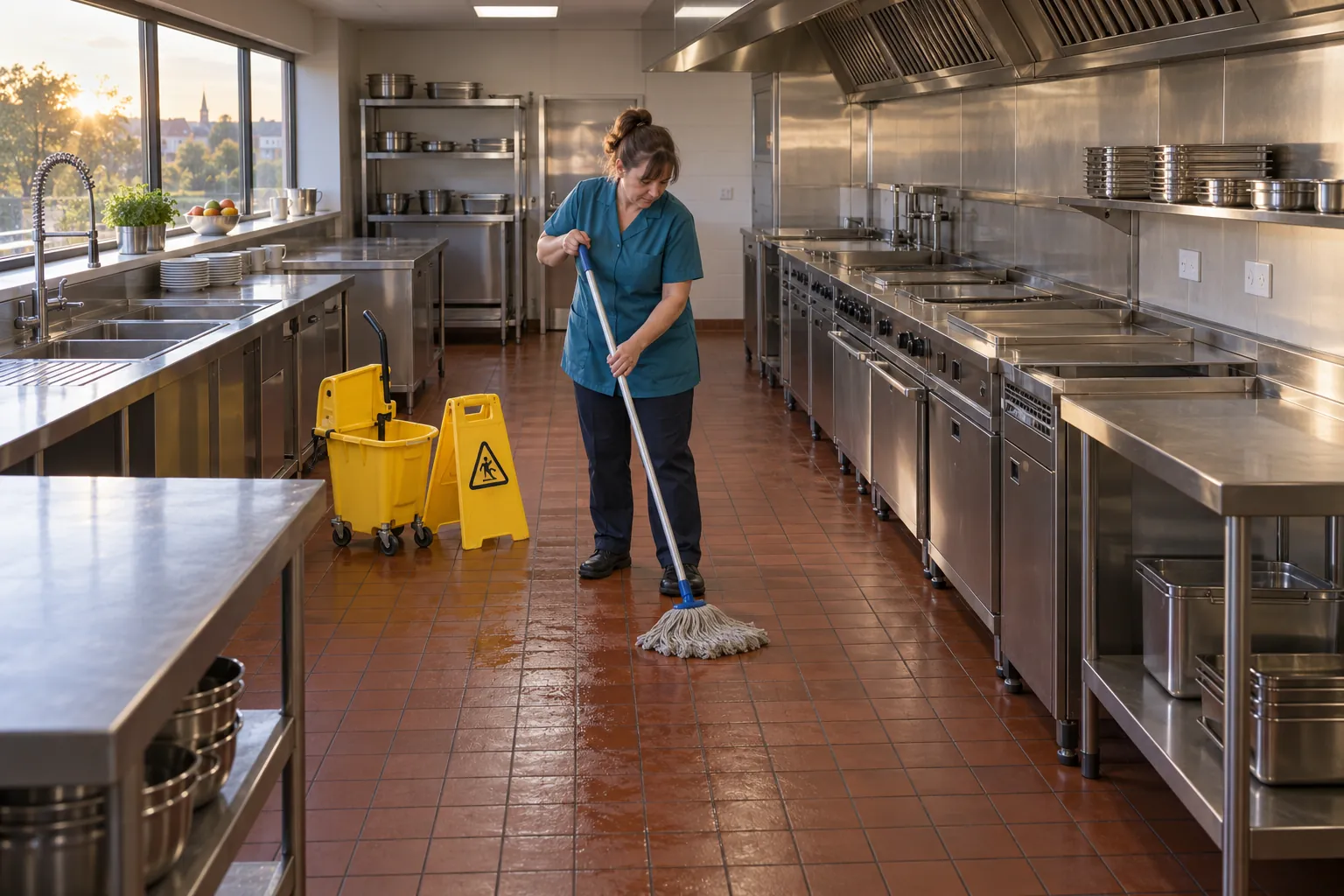
Floors are where cleaning causes accidents. The HSA's advice on rescheduling floor wet-cleaning is to clean at a low-traffic time and, where possible, as the last operation before leaving, so the floor can dry overnight. Its page on segregating wet and damp floors warns that "mop-dry" floors can look dry but still be slippery, and advises a physical barrier until the floor is bone-dry, never one that blocks an emergency exit.
Training is part of the law. The FSAI's butchers' guidance says a formal course is not necessary and owners can train their own staff if they feel confident to do so. Check competence by watching a new kitchen porter clean a slicer or a board and asking what they would do if the product ran out.
05
The kitchen cleaning schedule and the record behind it
Keep two documents. The FSAI puts it simply: "In the schedule you write down how you clean your business and use the cleaning records to record when this is done." It advises keeping the schedule where staff can easily see it, and reviewing it regularly, for example when new equipment arrives. Its sample schedule and record sheet, written for butcher shops, are free PDFs that work as a template for a kitchen once the items listed are your own.
- The schedule, from the FSAI's sample: the item to be cleaned; the frequency (after use, every shift, daily, weekly or other); the precautions, such as gloves and goggles; the method; the chemicals used, including the dilution; and the person responsible.
- The record, from the FSAI's sample cleaning record sheet: the equipment or area down the side, the time and initials for each day of the week, and a line where someone signs that the sheet was checked and verified.
- Exceptions, which the samples leave to you: what was not done, why, who was told and when it was put right.
The manager's own look is a separate record. The Hygiene Inspection Checklist (SC5), Recording Form 5 of the FSAI's Safe Catering Pack, lists "simple checks of the premises which should be carried out by the Manager or Supervisor regularly", weekly, fortnightly or monthly. It asks whether staff "clean as they go including difficult areas", whether chemicals are stored correctly and cloths regularly cleaned and disinfected, and whether record forms are "up-to-date, checked and verified", with space for the action taken.
A checklist ticked in full every night, never with an exception, can mean nobody reads it. A record that shows a missed item, a reason and a fix shows a kitchen that is being run. Agree how long cleaning records are kept as part of the food safety management system.
06
Where the kitchen cleaning record fails
The paper record sheet is usually filled in by the last person out, from memory, for the whole kitchen at once. It cannot say which fryer was left, whether the slicer was dismantled or only wiped, or who was told about the split seal.
SiteClara puts a printed QR poster at each location on the schedule, such as the wash-up or the cold room, with an optional NFC tag behind it. A member of the team scans the code or taps the tag on their own phone, with no app to install, and sees the scheduled checks due there. They mark each one done, or say what stopped them, and can add a photo where one is asked for. The person and the time are recorded as it happens. A fault found while cleaning, such as a split seal or a blocked sink, can be reported at that location and stays on the team's list of jobs until someone closes it.
The supervisor sees what is due, done and missed, records why a check was missed, and reviews the day's checks and photos before approving the daily report, which goes to nominated managers the next morning. The cleaning schedule, the methods and the food safety management system remain the business's own; where those require a record, such as the Safe Catering forms, that record stays the statutory one and SiteClara is the working record beside it.
07
Questions people ask
Is a kitchen cleaning schedule a legal requirement in Ireland?
Not by that name: Regulation (EC) No 852/2004 on the hygiene of foodstuffs does not use the words cleaning schedule, but it requires food premises to be kept clean and food-contact equipment to be cleaned and, where necessary, disinfected at a frequency sufficient to avoid any risk of contamination. The FSAI's Safe Food Handling guidance says that "having a proper cleaning schedule in place is essential", and that "in the schedule you write down how you clean your business and use the cleaning records to record when this is done".
Who inspects restaurant kitchens in Ireland?
The HSE inspects restaurants and similar food businesses, according to the FSAI's page on competent authorities, acting under a service contract with the FSAI, which its page on official agencies says "is responsible for the enforcement of all food legislation in Ireland". Food inspectors can close a business or stop it handling food where the premises is not hygienic, and the FSAI lists businesses served with those orders on its enforcement orders page.
08
Official guidance and a list to take away
The law is Regulation (EC) No 852/2004, Article 5 and Annex II, quoted here from the text as consolidated on 24 March 2021, with Regulation 18 of the General Application Regulations 2007 for the workplace. The FSAI's Safe Catering Pack and its record books are its practical system for caterers, and I.S. 340:2007 is available from the NSAI. Discuss anything unclear with the inspecting officer.
Before you pin a commercial kitchen cleaning checklist to the wall, check that it:
- lists every item of equipment, fixture and fitting, found by walking the kitchen;
- gives each item a frequency, a method, a product and dilution, the precautions and one responsible role;
- keeps food-contact cleaning to the six stages, and chemicals out of food areas;
- has hot equipment isolated and cooled before it is cleaned;
- plans wet floor cleaning last, with a barrier until the floor is bone-dry;
- names the contractor's tasks and the specialist ones, such as ductwork;
- has room for what was not done, why and who was told;
- is checked by someone other than the person who did the work, with the manager's own regular inspections recorded on a form such as SC5;
- is reviewed whenever the menu, the equipment or the people change.
Sources
Every document this guide quotes or links to, in the order it first cites them.
- Regulation (EC) No 852/2004 on the hygiene of foodstuffs eur-lex.europa.eu
- Hygiene of foodstuffs fsai.ie
- How to meet the HACCP requirement fsai.ie
- Prerequisite programmes fsai.ie
- Announced a revision of I.S. 340 and I.S. 341 nsai.ie
- Competent authorities fsai.ie
- Official agencies fsai.ie
- Enforcement orders fsai.ie
- Safety, Health and Welfare at Work (General Application) Regulations 2007 irishstatutebook.ie
- Safe food handling fsai.ie
- Sample cleaning schedule fsai.ie
- Safety in Contract Cleaning hsa.ie
- Safety, Health and Welfare in Hotels, Restaurants, Catering and Bars, Part 2: Kitchen Equipment hsa.ie
- Rescheduling floor wet-cleaning hsa.ie
- Segregating wet and damp floors hsa.ie
- Cleaning record sheet fsai.ie
- Hygiene Inspection Checklist (SC5) fsai.ie
- Safe Catering Pack fsai.ie
- Record books fsai.ie
Related guides
 CleaningCommercial cleaning checklist: area by area, for Irish workplacesA commercial cleaning checklist for Irish offices and shared premises, area by area: the 2007 Regulations behind it, using it on shift and checking it is followed.
 CleaningCleaning specification: what it should say in Ireland, and how to show it is metWhat a cleaning specification should contain in Ireland: the 2007 Regulations behind it, frequencies by area, checks to I.S. EN 13549 and a change of contractor.
 Premises and facilities managementGrease traps in Ireland: what the law asks of a kitchen, and how to keep the trap workingGrease traps in Irish kitchens: the Uisce Éireann FOG licence, emptying and servicing, who does what, and the maintenance records a food business should keep.
 CleaningCleaning supervisor duties: what the role involves in Ireland, and what good looks likeWhat a cleaning supervisor does in Ireland: the duties, a typical shift, the 2005 Act and 2007 Regulations, the contract cleaning ERO, checking work and reporting.