Fire and water checks
Personal emergency evacuation plans in Ireland: make assistance workable
A personal emergency evacuation plan, or PEEP, sets out how a particular person will receive the warning, reach safety and get any assistance they need during a building emergency.

Irish guidance also calls it a Personal Emergency Egress Plan. It connects the person's needs with the actual building, its emergency procedures and the people available to help. A generic evacuation notice cannot settle those details. This guide explains how a workplace can prepare, practise and maintain a plan with the person concerned, without turning it into a public medical record.
01
What a PEEP does, and the Irish workplace duty
A PEEP is an individual plan within the building's emergency arrangements. It may explain an accessible warning method, a route the person can use, assistance at a particular point and how the person will be accounted for. It should describe a workable evacuation, rather than simply recording that a person has a disability. Two people with the same diagnosis may need different assistance in the same office.
The Irish workplace duty comes from section 11 of the Safety, Health and Welfare at Work Act 2005, as enacted. Employers must prepare and revise adequate emergency plans, provide appropriate evacuation measures for employees and other individuals present, and designate people to implement the arrangements with adequate numbers, training and equipment. The Act does not prescribe a single PEEP form for every building.
The HSA's Emergency Escape and Fire Fighting guidance says that the needs of disabled people on the premises must be considered in the evacuation strategy. Its Employees with Disabilities guide (2021) specifically recommends individual consultation and documented Personal Emergency Egress Plans for people who require them. That is Irish guidance for employers, rather than a British residential PEEP requirement imported into an Irish office.
The building manager, employer and competent fire safety adviser need to agree how the personal plan fits the building's fire strategy. A plan cannot compensate for an unsuitable escape route or assistance that will never be available. Where control is shared, establish who maintains the common parts, who organises assistance and who ensures the person's arrangements work across tenant areas.
02
Who may need assistance, including temporary needs
Start with the tasks of evacuation: noticing the warning, understanding what to do, moving along the route, using doors or stairs, communicating a difficulty and reaching the agreed place of safety. Invite people to discuss a difficulty privately. Do not decide solely from appearance that someone can leave without assistance, or that every wheelchair user needs the same response.
Consider the practical effect of an impairment. Can a person who is hard of hearing hear the fire alarm in every working area? Can a person with a visual impairment follow the available exit routes in an unfamiliar meeting room? What additional assistance would let them evacuate safely? Answer those questions with the people involved and competent advice, rather than assigning a standard response from the name of a condition.
An Irish institutional example is Trinity College Dublin's PEEP guidance. It describes plans as advisable for students requiring evacuation assistance and lists mobility, sensory, medical, fatigue-related and temporary conditions. Trinity identifies needs through its Disability Service and works with its Fire Officer and building owners. Those are Trinity's arrangements; an ordinary employer needs to name its own responsible people.
University College Dublin's Personal Emergency Egress Plans guidance also recognises temporary and long-term needs, and asks staff to consider all their working locations. That is a useful planning question for a cleaner working across floors, a lecturer moving between buildings or an office worker visiting meeting rooms. A plan for the usual desk alone leaves a gap when the person is elsewhere.
- Can the person recognise the alarm or other emergency warning in each place they use?
- Can they understand and follow the evacuation instructions under emergency conditions?
- Can they use the planned exit route, doors and changes of level safely?
- Does their ability change with fatigue, a temporary injury or particular working conditions?
- What assistance do they say works, and what equipment or communication method needs competent assessment?
- Are they present during early, late or weekend work when the normal helpers may be absent?
Make arrangements for visitors and contractors who may need assistance as part of the wider emergency procedure. A personal plan for a regular employee is not a complete visitor policy. Reception staff should know how someone can ask for help and who can assess an unfamiliar need, without asking for private details in front of a queue.
03
What should be included in a personal emergency evacuation plan?
A useful personal emergency evacuation plan template prompts a discussion and a building check. It should be completed with the individual and the people responsible for the emergency arrangements. The following is a practical planning structure, not an approved statutory form or a ready-made evacuation instruction.
- Person and scope: the plan reference, the individual, relevant building locations, working arrangements and who coordinates the plan. Identify any temporary period or condition requiring reassessment.
- Warning and communication: how the person receives the alarm, understands instructions and reports their location or a problem. Verify the method where they actually work.
- Routes and destination: the primary and assessed alternative arrangements for each relevant location, including the place of safety or assembly point. Match these to the building's emergency strategy.
- Assistance: what the individual can do, what help is agreed, the responsible helpers and the cover when they are absent. State how helpers are alerted and how they communicate with the person.
- Equipment: any assessed evacuation or communication equipment, its location, the trained users and the associated checks. A purchase alone does not establish that the equipment is suitable.
- Handover and accounting: who confirms the person's location and status to the person directing the evacuation, and what to do if the planned route or assistance is unavailable.
- Practice, distribution and review: how the agreed arrangements are rehearsed safely, who receives the necessary instructions, who keeps the controlled copy and which changes trigger review.
A refuge area is a feature of an assessed building strategy, not any convenient landing. If the plan uses one, the competent adviser must settle how it is used, how communication works and how onward assistance is provided. 'Wait by the stairs for someone' leaves the person, helpers and evacuation controller guessing. Do not invent a refuge or a carrying method to make a template look complete.
Use lifts only where the assessed building strategy specifically permits the appropriate evacuation use. Do not assume that an ordinary passenger lift is available during a fire. Trinity's guidance identifies appropriate evacuation lifts, while UCD's guidance prohibits use of its building lifts during a fire alarm. Those campus arrangements illustrate why the actual building strategy matters. Similarly, an evacuation chair needs a suitable method, trained assistance and attention to the individual's needs; it is not a universal answer to mobility difficulties. Record unresolved requirements and make safe interim arrangements rather than signing off an unworkable plan.
04
A planning example, with clear roles and privacy
This fictional planning record illustrates the questions to resolve for an office worker with a temporary mobility restriction. It deliberately does not give a stair-transfer technique or choose equipment: those decisions require the person and competent advisers to assess the actual building. A reader should not use this example as an evacuation procedure.
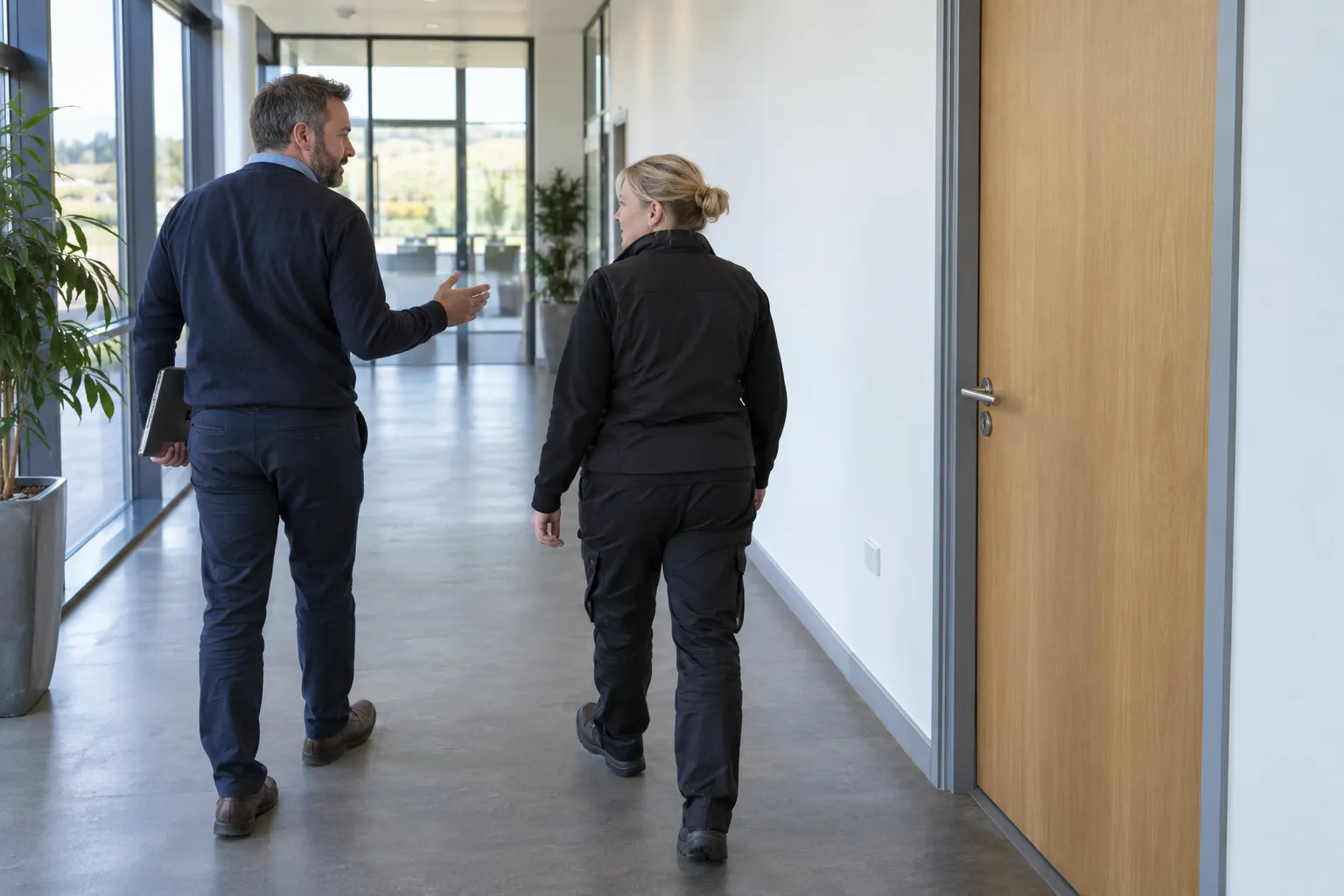
Keep ownership clear. The individual explains their practical needs and participates in the discussion. The employer provides the workplace arrangements. The building manager supplies information about the building and its common systems. The competent adviser assesses technical suitability. Helpers need the relevant instructions and training, including absence cover. A fire warden is not automatically trained or available to provide every kind of personal assistance.
Treat privacy as part of making the plan usable. The Data Protection Commission's data protection principles require necessary and relevant information, appropriate confidentiality and justified storage periods. Its Data Security Guidance calls for access according to need. Agree who needs the functional instructions for safe evacuation and keep unnecessary diagnoses or medical documents out of the operational copy. Explain the information handling to the person and obtain appropriate data protection advice where needed.
Keep the current controlled plan in the organisation's suitable restricted records. Decide how authorised helpers can access the instructions they need during an emergency, including a systems outage. A plan locked in a cupboard that only an absent manager can open creates an access problem; an unrestricted group email creates a confidentiality problem. Test the chosen arrangement with the people who must use it.
05
Practise the arrangements and review what changes
Walk through the plan with the individual and the relevant helpers before relying on it. Depending on the assessed needs, safe practice may involve checking the warning, walking an agreed accessible route, rehearsing communications or a supervised exercise with trained people. Do not improvise a lift, transfer or carrying technique, or create distress to make a drill realistic. Agree the rehearsal with the individual and competent advisers.
Keep personal emergency evacuation plans connected to the building's evacuation procedures. If PEEPs name different helpers or routes, check that the arrangements can operate together when everyone needs to evacuate. A change that improves one person's plan may affect another route or the assistance available elsewhere. The person directing the emergency response needs a coordinated picture, without being given unnecessary private information.
The HSA's Employees with Disabilities guide recommends changing or developing PEEPs in response to problems found during routine fire drills and reviewing plans regularly as needs change. It does not set one monthly or annual PEEP review interval for every employer. Set a review programme appropriate to the person, the building and the working arrangements, with a named coordinator who acts on changes.
- A change in the person's ability or temporary support needs may alter the route or assistance.
- A move to another floor, building, meeting room or shift may put the person outside the plan's scope.
- A helper leaving, being absent or changing duties may remove essential cover.
- Building works, a changed exit or unavailable equipment may invalidate an agreed arrangement.
- A drill or actual emergency may expose a warning, communication or handover that did not work.
Use the fire drill record to capture the exercise, observations and actions, while keeping sensitive personal details in the appropriate restricted plan. Record the plan version practised, whether the intended assistance and communication were available, what needs changing, the responsible person and the completion evidence. Speed alone is not a sufficient test of a safe evacuation.
Check that the revised instructions reach the affected people and that superseded copies are withdrawn. A review signed without changing an unavailable helper's name leaves the original problem in place. If the rehearsal shows that the arrangement cannot work, escalate it promptly and agree a safe response; a new review date does not make the existing plan adequate.
06
Where the record fails, and where SiteClara fits
A personal plan depends on ordinary building arrangements remaining usable. An agreed route can be blocked by storage, a door can become difficult to open, or a change in the common parts can go unreported. The restricted PEEP may be well written while the people responsible for routine checks have no record of a problem or its repair. Keep those building tasks visible without exposing the individual's support needs.
SiteClara records routine checks and reported issues at building locations. Staff scan a QR poster or tap an NFC tag with their phone to record a due check, explain a difficulty or report a problem with an optional note and photographs. A job remains on the team's list until closed. At a provider-led site, a supervisor reviews the day's recorded work before approving a next-morning report for nominated readers.
That can support the ordinary escape-route and door checks specified by the building's procedures, and the follow-up when something needs attention. Describe the physical problem, such as storage obstructing a corridor, rather than naming the person whose plan uses the route. Keep the PEEP, assistance instructions and personal consultation record in the organisation's appropriate controlled system.
07
Official guidance and a checklist to take away
Start with the HSA's Employees with Disabilities guide, page 8 on safe evacuation, and its Emergency Escape and Fire Fighting guidance. Read section 11 of the 2005 Act for the employer's emergency duty. The Trinity and UCD PEEP pages provide Irish university examples; their campus contacts and procedures are not a substitute for your workplace's own arrangements.
Before treating a personal plan as ready for use, check that:
- the person has participated and the plan addresses practical needs in every relevant location;
- the warning, route, assistance and destination fit the assessed building strategy;
- trained assistance and cover will be available whenever the person is present;
- any equipment and communication arrangements have been assessed and made usable;
- the evacuation controller knows how the person's location and status will be reported;
- the instructions have been practised safely and identified problems have been resolved;
- access to the plan is useful to authorised people and respects the person's privacy;
- changes in the person, helpers, work or building trigger review, with a current version and an accountable coordinator.
Sources
Every document this guide quotes or links to, in the order it first cites them.
- Section 11 of the Safety, Health and Welfare at Work Act 2005 irishstatutebook.ie
- Emergency Escape and Fire Fighting guidance hsa.ie
- Employees with Disabilities guide (2021) hsa.ie
- Trinity College Dublin's PEEP guidance tcd.ie
- University College Dublin's Personal Emergency Egress Plans guidance ucd.ie
- Data Protection Commission's data protection principles dataprotection.ie
- Data Security Guidance dataprotection.ie
Related guides
 Fire and water checksFire drills in Ireland: the duty, how to run one, and what to recordFire drills in Ireland: the Fire Services Acts and 2005 Act duties, how often to hold one, how to run and review it, and what the fire safety register should show.
 Fire and water checksFire warden duties: the daily checks, the evacuation and the recordWhat a fire warden does in an Irish workplace: the law behind the role, the daily and weekly checks, the job in an evacuation, and a record that stands up.
 Fire and water checksWorkplace fire safety checklist: what to check, how often, and who does itA workplace fire safety checklist for Ireland: the daily, weekly and monthly checks under the Fire Services Acts, who does each one, and what to record.
 Premises and facilities managementSafety statement: what the 2005 Act requires, and how to show it is followedWhat a safety statement must contain under section 20 of the Safety, Health and Welfare at Work Act 2005, who needs one, when to review it and how to show it works.