Fire and water checks
Fire drills in Ireland: the duty, how to run one, and what to record
A fire drill is a practice evacuation that simulates a fire, so that the people in a building rehearse raising the alarm, leaving by the escape routes and being accounted for at the assembly point.

It is how a building finds out whether its fire plan works before the day it has to. In Ireland the duty comes from two directions: the Fire Services Acts, which bind whoever controls the premises, and the Safety, Health and Welfare at Work Act 2005, which binds every employer. This guide sets out what each requires, how often to hold a drill, how to run and review one, and what the fire safety register should show afterwards.
01
Where the duty to hold fire drills comes from
No Irish statute says that every building must hold a fire drill every so many months. The duty is built from two general obligations, and the official guidance on each says drills are how you meet them.
The first is fire law. Section 18 of the Fire Services Act 1981 applies to premises used for sleeping accommodation, treatment or care, entertainment and recreation, teaching and training, and any use involving access by the public; the Licensing of Indoor Events Act 2003, section 29 extended it to “any workplace” and substituted a fuller subsection (2). Under the Fire Services Acts 1981 and 2003, every person having control over such premises must “take all reasonable measures to guard against the outbreak of fire”, “provide reasonable fire safety measures for such premises and prepare and provide appropriate fire safety procedures for ensuring the safety of persons on such premises”, “ensure that the fire safety measures and procedures … are applied at all times”, and ensure, as far as is reasonably practicable, the safety of people on the premises if a fire breaks out.
The Department of Housing, Local Government and Heritage explains what that means in practice in its Fire Safety Guide for Building Owners and Operators (August 2023), written for persons having control under section 18(2). Its section 5.3.2 is direct: “drills which simulate fire and emergency situations should be carried out on a regular basis”, “all staff must be involved”, “Each drill should be reviewed afterwards, and procedures revised if necessary. All drills should be recorded in the Fire Safety Register.”
The second is workplace law. Under section 11 of the Safety, Health and Welfare at Work Act 2005, every employer must prepare and revise adequate plans and procedures for an emergency or serious and imminent danger, provide the measures needed for “first aid, fire-fighting and the evacuation of employees and any other individual present in the place of work”, and designate employees to put the plans into effect, with adequate numbers, training and equipment. The Health and Safety Authority's guidance on emergency escape and fire fighting says “emergency drills should be used regularly” to practise the escape routes, and its checklist asks: “Are regular fire drills conducted and monitored to put improvements in place?”
02
Premises where the rules are more specific
Some sectors have regulations that name fire drills or their records, on top of the general duties above.
- Nursing homes and designated centres for older people. Regulation 28 of the Health Act 2007 (Care and Welfare of Residents in Designated Centres for Older People) Regulations 2013 (S.I. No. 415 of 2013, as made) requires staff training in fire prevention and emergency procedures, and requires the registered provider to ensure, “by means of fire safety management and fire drills at suitable intervals”, that staff and, so far as reasonably practicable, residents know what to do if there is a fire.
- Crèches and other early years services. Under regulation 26 of the Child Care Act 1991 (Early Years Services) Regulations 2016 (S.I. No. 221 of 2016, as made), a registered provider must keep a written record of “any fire drill that takes place in the premises”, open to inspection by parents, employees and an authorised person, and retain it for five years.
- Places of assembly. The Fire Safety in Places of Assembly (Ease of Escape) Regulations 1985 (S.I. No. 249 of 1985) cover cinemas, restaurants, canteens, gymnasiums, licensed premises, swimming pools and similar. They do not mention drills, but require escape routes kept unobstructed and exit doors easily opened while the place is in use, which a drill will test.
- Workplaces generally. Under section 20 of the 2005 Act, the safety statement must specify “the plans and procedures to be followed and the measures to be taken in the event of an emergency or serious and imminent danger”.
The Department still publishes its older Guide to Fire Safety in Existing Nursing Homes and Similar Type Premises (1996), which says “Practice fire drills should be carried out at least twice a year”, rehearsing raising the alarm, checking escape routes, a simulated evacuation “using staff as ‘residents’” and the use of extinguishers, with each drill reviewed and recorded in the fire safety register. It was written for nursing homes; the 2013 regulations now ask for drills at suitable intervals rather than a fixed number.
03
How often to hold a fire drill
Outside the sector rules, the law and the Department's guide ask for drills “on a regular basis” and leave the interval to the person having control. A single-storey office and a hotel with night staff do not need the same programme. Let the fire risk assessment and the emergency plan set the programme. Hold drills more often, or add one, where any of these apply:
- Sleeping risk. Hotels, student accommodation, hostels and care settings, where people may be asleep, unfamiliar with the building or dependent on staff.
- Shift patterns. A mid-morning drill tests the day shift. Night, weekend and early cleaning and security teams need their own, even if it is a walk-through rather than a full evacuation.
- High turnover. Retail, hospitality and contract cleaning teams change fast. Section 10 of the 2005 Act requires safety training on recruitment and on a change of task, adapted to new or changed risks and, as appropriate, repeated periodically, and that includes “the measures to be taken in an emergency”.
- Changes to the building. A refit, a closed stair, a new tenant or a new assembly point means the plan has changed and should be tried again.
In a school, college or crèche, time a drill early in the year so that each new intake of children or students walks the route before they need it. In a multi-tenant building, agree the whole-building drill with the landlord or managing agent, so each tenant's wardens sweep their own floor while the landlord's team handles the alarm and the common parts. Whatever interval you choose, write it into the emergency plan and the safety statement.
A fire drill is not the same as the weekly fire alarm test. The weekly test, made to the Irish Standard for fire detection and alarm systems, I.S. 3218, checks that the control equipment can receive a fire signal and start the evacuation procedure; the Department's guide says it should record which trigger device was used. A drill tests people: whether they leave by the right route, close doors and are accounted for. See the guide to fire alarm testing for the weekly test.
04
How to plan and run a fire drill
The Department's guide gives four objectives for a drill: to familiarise persons in control with their assigned roles, to test the availability and effectiveness of staff training, to test the arrangements for an emergency, and to identify shortcomings in the emergency procedures. A workable sequence:
- Decide what you are testing. A full simultaneous evacuation, a single floor, a night-time scenario, a blocked stair, a missing person at roll call. Write the objective down; the register should record it.
- Brief the people who must know. The wardens, reception, the security officer on duty, anyone assisting a person with a disability, and the contract cleaners and caterers. Under section 21 of the 2005 Act, employers who share a place of work must co-operate and co-ordinate their actions on safety. Most staff can be left to react as they would on a real day.
- Tell the alarm receiving centre. If the fire alarm is monitored, tell the monitoring company before the drill and again when it is over, so the fire service is not called out.
- Sound the alarm from a call point, as a real discovery would, and start the clock.
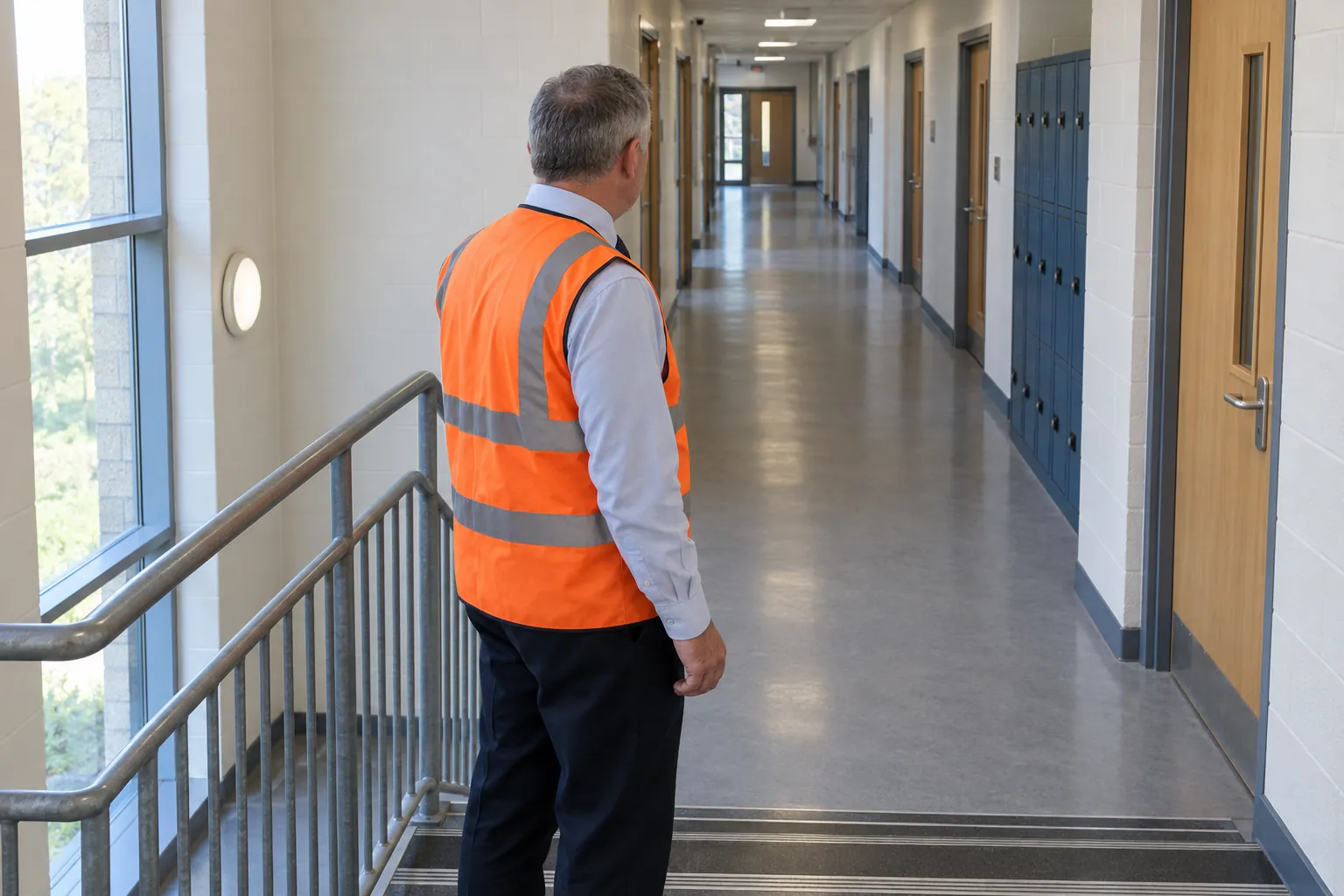
- Watch, do not lead. Put observers at the stairs, the final exits and the assembly point. They note the routes used, fire doors left open, anyone using a lift or going back for belongings, and any exit locked, blocked or hard to open.
- Sweep and account. Fire wardens sweep their areas, including toilets, meeting rooms, stores and plant rooms, then report to the person in charge at the assembly point. Roll call is checked against the visitors' book, the contractors' sign-in and any staff attendance list.
- Rehearse the assisted evacuation. Anyone with a personal emergency egress plan should practise it with the people who will help. In care settings, staff play the residents, as the 1996 nursing homes guide suggests.
- Stop the clock and reset. Record the time the building was clear and the time roll call was complete. Reset the alarm and tell the monitoring company it is over.
- Debrief the same day. Revise the procedures where needed, as the Department's guide asks.
Unannounced drills show what really happens; announced ones are gentler in a nursing home or a crèche, and better than no drill at all. Never create real danger to prove a point: do not block a stair without a marshal standing at it.
05
What the fire safety register should show
The fire safety register is the Irish name for the fire log book. The Department's guide says one should be kept for all premises where section 18 applies, kept on the premises, kept up to date and available for inspection by an authorised officer of the fire authority. It calls the register “a living document” and lists what it should hold on drills: “details of each fire and evacuation drill, the date thereof, the names of those taking part, and the type, objective and results of exercises held”. It should also record the training given to staff on fire safety, and by whom.
A drill entry that will stand up to a fire officer or a HIQA inspector usually carries:
- the date and the time the alarm was raised, and which call point or zone was used;
- the type of drill and what it was meant to test;
- who took part, including the wardens and the contractors on site, and who observed;
- the time to clear the building and the time roll call was complete;
- what went well and what went wrong, in plain words: the fire door wedged open on the second floor, the visitor nobody could account for, the exit door that stuck;
- each action arising, who owns it and by when;
- the date each action was closed, and how;
- the signature or name of the person responsible for the drill.
The last three lines are where most registers fall short. A drill that found a locked exit and a warden who did not know the assembly point, with no record that either was put right, is a drill that has created evidence of a known problem and nothing else. The Department's guide also asks for escape routes to be checked every day, with any obstruction removed and steps taken to stop it recurring.
06
Where the drill record fails, and what SiteClara does about it
The drill itself is usually written up. The weakness is everything around it. The daily escape route walk is ticked on a sheet at reception at the end of the week. The actions from the last drill sit in an email that the facilities manager left behind. The cleaner who found the fire exit blocked by deliveries told whoever was passing, and nobody wrote it down. When the fire officer asks whether the problems were fixed, nobody can say.
SiteClara records routine checks where they happen. A printed QR poster, with an optional NFC tag behind it, sits at each place a check is scheduled: a stair, a final exit, a fire door, the alarm panel. Staff scan or tap on their own phone, with no app to install, see what is due there and mark each check done or explain what stopped them. The named person and the time are recorded as it happens, with a photo when one is asked for. A problem found on the round, or an action from the drill debrief, becomes a job on the team's list and stays open until someone closes it, so the next drill can show that last time's blocked exit was cleared and when.
The supervisor sees what is due, done and missed, and records the reason a check was missed. Each day they review the checks and photos, add a note and approve a report that goes to nominated contacts the next morning, so the person having control or the managing agent sees the escape route checks as they were done, not as they were remembered.
07
Questions people ask
What is a fire drill?
A rehearsal of the building's fire emergency plan. Section 5.3.2 of the Department's Fire Safety Guide for Building Owners and Operators describes drills “which simulate fire and emergency situations”, carried out “to assess the effectiveness of the predetermined plan and preparatory training given”. It says they can be timed to cause minimum disruption, “but all staff must be involved”.
What is the procedure for a fire drill?
The drill follows the building's own fire emergency plan. Section 5.3.1 of the Department's Fire Safety Guide for Building Owners and Operators says the plan should set out a procedure for raising the alarm, an evacuation procedure for the occupants, including persons with disabilities, a procedure for calling the fire service, reporting to the assembly point and informing the designated person, accounting for each person on the premises, and assisting the fire service when it arrives. A drill practises each of those steps.
How often should you have a fire drill?
No Irish law sets one interval for every building. The Department's Fire Safety Guide for Building Owners and Operators asks for drills “on a regular basis”, and the Health and Safety Authority's guidance on emergency escape and fire fighting says “emergency drills should be used regularly” so that employees practise the escape routes. The fire risk assessment and the emergency plan should set the interval, with more drills where people sleep on the premises, work shifts or change often.
How long should a fire drill take?
There is no fixed number of minutes. The Health and Safety Authority's guidance on emergency escape and fire fighting sets the principle: the time available for escape, before fire makes the escape routes unsafe, must be greater than the time needed for everyone to evacuate once the warning is given. The Department's guide says occupants should be able to leave “quickly and safely, by way of routes protected from fire and smoke and free from obstruction”. Record the time to clear the building and to complete roll call at every drill, and compare them.
08
Where to read more, and a list to take away
Start with the Department of Housing, Local Government and Heritage's Fire Safety Guide for Building Owners and Operators (August 2023): section 3 on the person having control, section 5.3 on training, the emergency plan and drills, section 5.6 on the fire safety register, and section 8 for the routine maintenance schedule. The Health and Safety Authority's pages on emergency escape and fire fighting cover the employer's side, with a checklist. The statutes quoted above are all on the Irish Statute Book. Under section 18(4) of the 1981 Act, your local authority fire service may give advice on a particular building.
Before your next fire drill, check that:
- you know who the person having control is, and who holds which duties if control is shared;
- the emergency plan and the safety statement say how often drills are held and who organises them;
- night, weekend and early-morning staff, including contract cleaners and security officers, are covered by a drill or an exercise of their own;
- wardens know their sweep areas and the assembly point, and there are enough of them on every shift;
- anyone who needs help to leave has a plan, and the people helping have practised it;
- the register records the date, type, objective, participants, times and results;
- every action from the last drill has an owner, a date and a record that it was closed;
- the daily escape route checks the drill depends on are actually being done, and recorded when they are.
Sources
Every document this guide quotes or links to, in the order it first cites them.
- Section 18 of the Fire Services Act 1981 irishstatutebook.ie
- Licensing of Indoor Events Act 2003, section 29 irishstatutebook.ie
- Fire Safety Guide for Building Owners and Operators assets.gov.ie
- Section 11 of the Safety, Health and Welfare at Work Act 2005 irishstatutebook.ie
- Health and Safety Authority's guidance on emergency escape and fire fighting hsa.ie
- Regulation 28 of the Health Act 2007 (Care and Welfare of Residents in Designated Centres for Older People) Regulations 2013 irishstatutebook.ie
- Regulation 26 of the Child Care Act 1991 (Early Years Services) Regulations 2016 irishstatutebook.ie
- Fire Safety in Places of Assembly (Ease of Escape) Regulations 1985 irishstatutebook.ie
- Section 20 of the 2005 Act irishstatutebook.ie
- Guide to Fire Safety in Existing Nursing Homes and Similar Type Premises assets.gov.ie
- Section 10 of the 2005 Act irishstatutebook.ie
- Section 21 of the 2005 Act irishstatutebook.ie
Related guides
 Fire and water checksFire warden duties: the daily checks, the evacuation and the recordWhat a fire warden does in an Irish workplace: the law behind the role, the daily and weekly checks, the job in an evacuation, and a record that stands up.
 Fire and water checksFire safety register: what to record, who keeps it and how to make it credibleWhat a fire safety register should hold under section 18(2) of the Fire Services Acts, the routine checks behind it, who keeps it, and what makes it credible.
 Fire and water checksFire alarm testing in Ireland: the checks, the servicing, and the recordFire alarm testing in Ireland: the legal duty, the daily and weekly checks, quarterly servicing to I.S. 3218, and what the fire safety register should show.
 Fire and water checksWorkplace fire safety checklist: what to check, how often, and who does itA workplace fire safety checklist for Ireland: the daily, weekly and monthly checks under the Fire Services Acts, who does each one, and what to record.