Fire and water checks
Fire warden duties: the daily checks, the evacuation and the record
A fire warden, also called a fire marshal, is an employee designated by their employer to help carry out the workplace's fire emergency plan: checking escape routes and fire doors day to day, and sweeping their area and helping people evacuate when the alarm sounds.
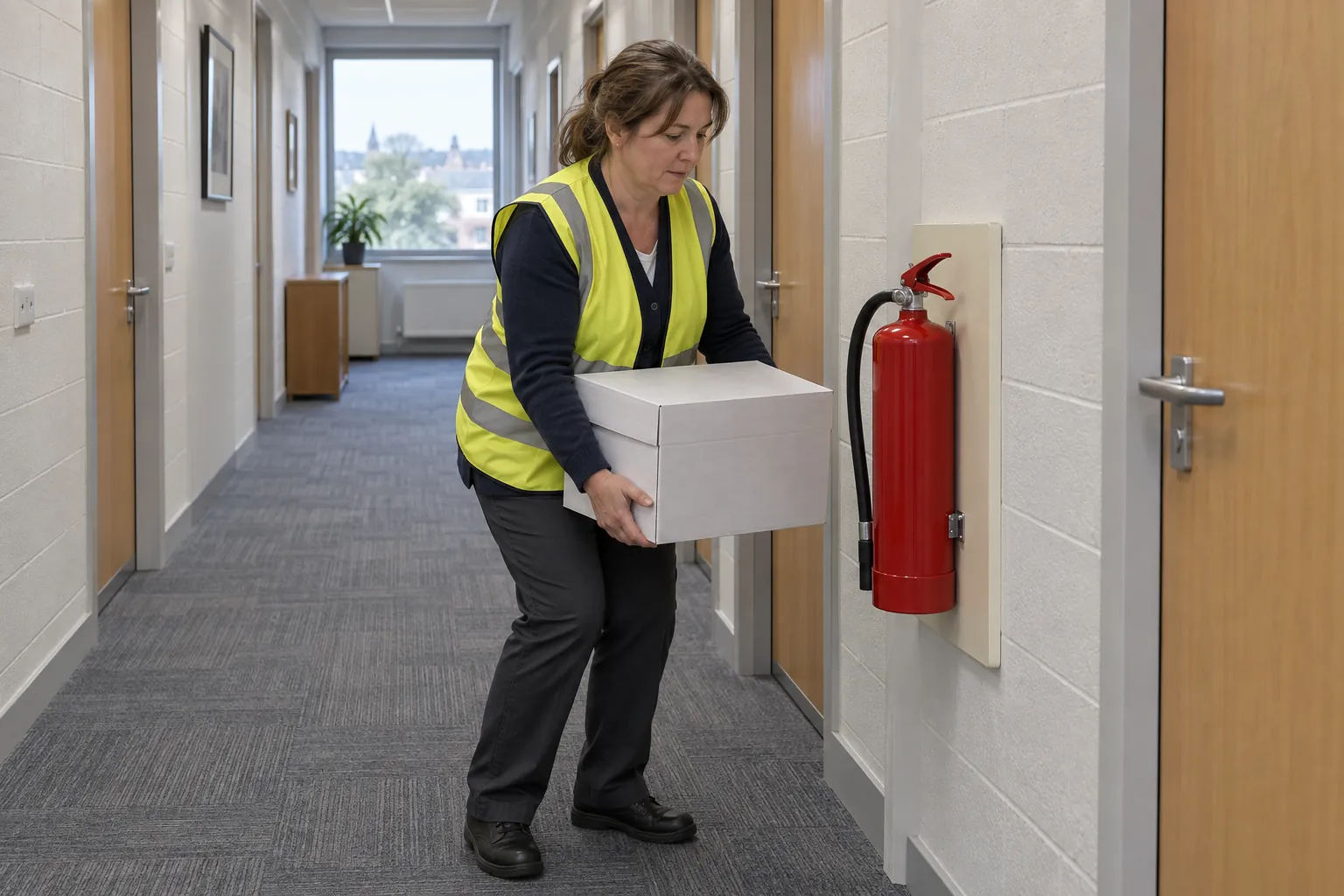
Usually that is a member of staff who knows their floor, keeps a hi-vis vest in a drawer and has had fire warden training. Most of the job happens on ordinary days: a walk along the escape routes, a look at the fire alarm panel, a word with whoever has parked a trolley against a fire door. This guide covers the law behind the role, the checks a fire warden makes, what they do when the alarm sounds, and how both are recorded.
01
The fire warden role, and the two laws behind it
The Acts below never use the words "fire warden". The role exists because two duties, one under health and safety law and one under fire services law, both need people on the ground.
The first is section 11 of the Safety, Health and Welfare at Work Act 2005. It requires every employer, when preparing and revising emergency plans and procedures, to "provide the necessary measures to be taken appropriate to the place of work for first aid, fire-fighting and the evacuation of employees and any other individual present", and to "designate employees who are required to implement those plans, procedures and measures". Their number, training and equipment must be "adequate" for the size and hazards of the place. Those designated employees are what Irish workplaces call fire wardens, or sometimes fire marshals, and whoever co-ordinates them on the day is usually the chief fire warden.
The second is section 18 of the Fire Services Act 1981, as amended in 2003. Section 18(2) puts the duty on "every person having control over premises". The Department of Housing, Local Government and Heritage's Fire Safety Guide for Building Owners and Operators (August 2023) sets out the amended wording: to take all reasonable measures to guard against the outbreak of fire, to "provide reasonable fire safety measures" and "prepare and provide appropriate fire safety procedures", to ensure those measures and procedures "are applied at all times", and to ensure, as far as is reasonably practicable, the safety of persons on the premises in the event of a fire. The guide notes that the 2003 amendments brought any workplace into scope.
The person having control can be the owner, the occupier, a tenant, a facilities manager or, for the common areas of an apartment development, the owners' management company. The same guide says that person "may delegate specific fire safety duties to members of staff" but "should retain overall responsibility for ensuring delegated tasks are carried out." The duty stays with the employer and the person having control; the warden is how they meet it.
Neither law sets a number of wardens. Section 11 ties the number to the size of the place and its hazards, so it belongs in the fire safety risk assessment and the safety statement, allowing for every floor, shift, part-time hours and leave. A floor with one warden who works three days a week has no warden for the other two.
02
What a fire warden checks
A fire warden's routine checks are visual and short. The gov.ie guide says that for most premises the daily routines, "such as checking the fire alarm panels and ensuring that escape routes are available for egress, and doors on escape routes are in working order", can be done by people with suitable training, and it lists regular checks for a "designated person" in its maintenance schedule. That is the fire warden's list. On a walk round their area, a warden looks at:
- Escape routes: not obstructed, not used for storage, and immediately available for use. The guide adds that batteries and battery-powered devices should not be charged in corridors, lobbies, stairways or landings.
- Final exits: capable of being readily opened, with doors and gates across escape routes easily and immediately openable, and the ground outside the exit clear so people can get away to a place of safety.
- Fire doors: kept closed, unless fitted with a hold-open device that releases on the fire alarm, and not wedged, propped or held with a mat. The guide recommends that doors on automatic release mechanisms are released daily.
- Signs and lighting: escape routes clearly indicated, sign-posted and lit, and the indicator on each emergency light fitting showing it is working.
- The fire alarm panel: showing normal operation or, if a fault is shown, that it has been logged and acted on, and that any fault recorded the day before has received attention.
- Fire extinguishers and hose reels: in place, visible, accessible and marked, with nothing stacked in front of them.
- Housekeeping: no waste building up in stairways or escape routes, and smoking confined to its approved area.
- The assembly point, and the fire service's access: not taken over by parked cars, skips or deliveries.
The Safety, Health and Welfare at Work (General Application) Regulations 2007 (S.I. No. 299 of 2007) are the employer's side of the same list. Regulation 12 requires that emergency routes and exits "are kept clear at all times", that emergency doors are not "so locked or fastened that they cannot be easily and immediately opened", and that routes requiring illumination have emergency lighting. Regulation 13 requires fire-fighting equipment to be "easily accessible and simple to use", and fire detection and fire-fighting equipment to be "inspected and maintained as frequently as necessary" and "serviced by a competent person". A warden's walk round is how the first half of that happens between the contractor's visits. Keep it to what can be seen in ten minutes: a long form makes the walk slower, and the slow check is the one that stops happening.
03
Daily, weekly, and the work that is not the warden's
Table 2 of the gov.ie guide, its maintenance programme schedule, splits every fire safety system into daily, weekly, monthly, quarterly, six-monthly and yearly work. It marks which checks a designated person can do and which need a competent person who can certify the work:
- Daily, usually by the fire warden or the premises staff: escape routes and final exits, fire doors, the fire alarm panel, the emergency lighting indicators, and any hold-open doors released.
- Weekly: the fire alarm test, which the guide describes as checking that the control equipment can receive a fire signal and start the evacuation procedure, "recording which trigger device has been used", in line with I.S. 3218. The same schedule points to I.S. 3217 for weekly and monthly emergency lighting checks, and a warden may do either where they are trained and asked to.
- Monthly: every point where an extinguisher or hose reel should be, checked, with any missing one replaced immediately (the guide notes a risk assessment may call for more frequent checks); hose reels looked over for leaks; and hold-open devices tested by simulating a mains failure or the alarm, with the result recorded.
- Quarterly, six-monthly and yearly: servicing of the fire alarm under I.S. 3218 (quarterly and yearly) and of the emergency lighting under I.S. 3217 (quarterly inspections and a yearly full-duration test), portable extinguishers maintained under I.S. 291 at intervals the guide puts at no more than 12 months, give or take one, plus the sprinkler, riser and door work. This belongs to competent contractors, who leave a certificate or report. It is not a warden's job.
The Health and Safety Authority's guidance on emergency escape and fire fighting puts the division plainly: "any defects should be put right as quickly as possible", and "an employer or nominated employee can carry out checks and routine maintenance work", while periodic servicing and any necessary repairs of fire-fighting equipment and installed systems such as fire alarms and emergency lighting are best done by a competent person. The warden's part is to notice, report and follow up, not to repair.
Whoever does each check, the results belong together, in the fire safety register for the premises. The gov.ie guide calls the register "a living document" with daily, weekly, monthly, quarterly and annual records. It should be kept on the premises and made available for inspection by an authorised officer of the fire authority.
04
The fire warden's job when the alarm sounds
The gov.ie guide asks for a predetermined fire emergency plan: raising the alarm, evacuating everyone including people with disabilities, calling the fire service, reporting to the assembly point, accounting for everyone, and assisting the fire service. The HSA adds that an escape plan "may include duties for employees to check areas are clear, close doors and assist others". For a fire warden that usually means:
- Put on the vest so people can see who is directing them, and send people to the nearest safe exit.
- Sweep the area on the way out, including toilets, meeting rooms and store rooms, without delaying your own escape or opening a door with signs of fire behind it.
- Close doors behind you to hold back fire and smoke.
- Keep people away from lifts. The gov.ie guide says fire notices should draw particular attention to the general advice that lifts should not be used in a fire.
- Help anyone who needs it along the route set out in their personal emergency egress plan, and tell the chief fire warden where anyone waiting for help is.
- Report at the assembly point to the chief fire warden: area clear, or which rooms could not be checked and why.
- Keep people at the assembly point, and stop anyone going back in until the fire service, or the person in charge, says it is safe.
The HSA says fire-fighting equipment must be there for employees to use "without exposing themselves to danger, to extinguish a fire in its early stages". A warden trained to use an extinguisher may tackle a small fire with the alarm raised and a clear way out behind them; in many buildings the plan is simply to get everyone out.
The plan is only proven by a fire drill. The gov.ie guide asks for drills "on a regular basis" that involve all staff, reviewed afterwards with the procedures revised where needed, and says "all drills should be recorded in the Fire Safety Register": the date, the names of those taking part, and the type, objective and results.

05
Training, and what a good record shows
Section 11 requires the designated employees' training to be adequate, and the HSA points to sections 8, 9 and 10 of the 2005 Act on information, instruction, training and supervision. The gov.ie guide lists what staff should be trained in where it is relevant to their role. For a fire warden that includes:
- fire prevention: good housekeeping, the control of ignition sources and the regular removal of waste, so fire hazards are dealt with before they start a fire;
- the action to take on hearing the alarm, and on discovering a fire;
- the evacuation procedure and the layout of the building, including every escape route;
- the role of fire doors in holding back fire and smoke and protecting escape routes;
- where the manual call points, the fire-fighting equipment and the main fire alarm panel are, and how the panel works;
- calling the fire service and helping it on arrival;
- the safe use of first aid fire-fighting equipment;
- what to do on noticing a fault, damage or a system not working, such as a detector, an emergency light or a fire door.
Training goes in the fire safety register, with who gave it, and the guide says instruction should reach "all staff, including part-time and temporary staff". Refresh a warden's training when the building, layout or procedures change.
A good record of the warden's checks lets anyone reading it, from the person having control to the fire authority's officer, see whether the checks were done, by whom, and what happened to the problems found. Each entry carries:
- the date and time of the check, written at the time rather than at the end of the week;
- the area or route checked, and the warden's name;
- what was found, including the fire door wedged open and the boxes on the landing, not just ticks;
- who each problem was reported to, and when it was put right;
- checks that did not happen, and why, such as the warden being on leave with no cover;
- drills, with the time taken, anyone unaccounted for, and what will change.
The gov.ie guide asks the register for the same: routine checks "with comments on the results" and the "actions taken (and by whom) to address defects". Exceptions make a record believable. A year of daily checks with nothing ever found does not describe a perfect building; it describes a form being signed rather than a route being walked.
06
Where the record fails, and what SiteClara does about it
On paper, the fire warden's daily check is a line in the fire safety register at reception, or a sheet on a clipboard behind the security desk. It is easy to initial without walking the route, easy to miss when the warden is on leave, and hard to follow up. The wedged fire door noted on Tuesday is still wedged on Friday, because the register records the problem but does not send it to anyone.
SiteClara puts a printed QR poster, with an NFC tag behind it if staff prefer to tap, at the points on the route: the stairwell landing, the final exit, the fire alarm panel. The fire warden scans or taps with their own phone, with no app to install, sees the checks due at that point and marks each one done, or says what stopped them. The time and the name are recorded as it happens, with a photo when one helps.
A problem found on the walk round, such as a blocked exit or a door that will not close, is reported there, with a photo. It goes onto the team's list of jobs until someone closes it. The supervisor sees which checks are due, done and missed, can record why one was missed, and can escalate a job to the building manager. Each day the supervisor approves a report that goes to nominated management or client contacts the next morning, showing how the scheduled checks went and what is still open.
07
Questions people ask
What is a fire warden?
An employee designated to help put the workplace's emergency plan into effect. Irish law does not use the term: section 11 of the Safety, Health and Welfare at Work Act 2005 requires every employer to "designate employees who are required to implement" its emergency plans, procedures and measures, including those for fire-fighting and evacuation, and to ensure that "the number of those employees, their training and the equipment available to them are adequate". Those designated employees are the fire wardens, sometimes called fire marshals.
What are the roles and responsibilities of a fire warden?
Routine checks on ordinary days, and helping in an evacuation. The Health and Safety Authority's guidance on emergency escape and fire fighting says an "employer or nominated employee can carry out checks and routine maintenance work", and that an escape plan "may include duties for employees to check areas are clear, close doors and assist others". It counts fire wardens among the people "who will be assisting in overseeing any emergency evacuation". Responsibility for fire safety stays with the employer and the person having control of the premises: the warden notices, reports and helps, and does not service or repair equipment.
How long is fire warden training?
No Irish law sets a length or a syllabus. Section 11 of the Safety, Health and Welfare at Work Act 2005 requires only that the designated employees' training is "adequate", taking into account the size and specific hazards of the place of work, so what is adequate depends on the building and the role. The Department of Housing, Local Government and Heritage's Fire Safety Guide for Building Owners and Operators asks for instruction and training for "all staff, including part-time and temporary staff", where relevant to their roles, covering the action on hearing the alarm or discovering a fire, the evacuation procedure, calling the fire service and the safe use of first aid fire-fighting equipment, with a record kept in the fire safety register. Its worked example, a licensed premises with a flat above, gives that training "at recruitment, and at regular periods".
08
Further reading, and a list to take away
The Department of Housing, Local Government and Heritage's Fire Safety Guide for Building Owners and Operators is the most complete single guide to the section 18(2) duty. The HSA's page on emergency escape and fire fighting covers the employer's side and ends with a checklist, and the law itself is on the Irish Statute Book. Your local authority fire service can advise on fire safety, and the Irish Standards I.S. 3218, I.S. 3217 and I.S. 291, published by NSAI, are the reference for alarms, emergency lighting and extinguishers.
For your fire wardens, make sure that:
- the risk assessment and safety statement say how many wardens are needed, with cover for every floor, shift and absence;
- each warden knows their area, their route and their part in the fire emergency plan, and a chief fire warden is named;
- the daily checklist fits a short walk round, and is walked, not initialled;
- problems found go to someone who will fix them, and the record shows when they were fixed;
- missed checks are recorded with a reason;
- the weekly fire alarm test records which call point was used;
- fire doors are checked closed, with a fire door inspection routine, and released daily where they are held open;
- fire drills are held, involve all staff, are reviewed and are recorded;
- training and refreshers are recorded in the fire safety register, with who gave them.
Sources
Every document this guide quotes or links to, in the order it first cites them.
- Section 11 of the Safety, Health and Welfare at Work Act 2005 irishstatutebook.ie
- Section 18 of the Fire Services Act 1981 irishstatutebook.ie
- Fire Safety Guide for Building Owners and Operators gov.ie
- Safety, Health and Welfare at Work (General Application) Regulations 2007 irishstatutebook.ie
- Health and Safety Authority's guidance on emergency escape and fire fighting hsa.ie
Related guides
 Fire and water checksFire drills in Ireland: the duty, how to run one, and what to recordFire drills in Ireland: the Fire Services Acts and 2005 Act duties, how often to hold one, how to run and review it, and what the fire safety register should show.
 Fire and water checksFire safety register: what to record, who keeps it and how to make it credibleWhat a fire safety register should hold under section 18(2) of the Fire Services Acts, the routine checks behind it, who keeps it, and what makes it credible.
 Fire and water checksFire alarm testing in Ireland: the checks, the servicing, and the recordFire alarm testing in Ireland: the legal duty, the daily and weekly checks, quarterly servicing to I.S. 3218, and what the fire safety register should show.
 Fire and water checksFire door inspection: the duty, the checks and the recordFire door inspection in Ireland: the section 18(2) duty, the six-monthly check in the Department's guide, what a competent person looks at, and the register.