Fire and water checks
Sprinkler system inspection: what Irish guidance asks for, week by week
In Ireland, sprinkler system inspection is a set routine rather than a single visit: the Department of Housing's fire safety guide for building owners recommends weekly, monthly, quarterly, six-monthly and yearly inspections and tests of a commercial system, each by a competent person, and an annual inspection and test of a domestic or residential system.
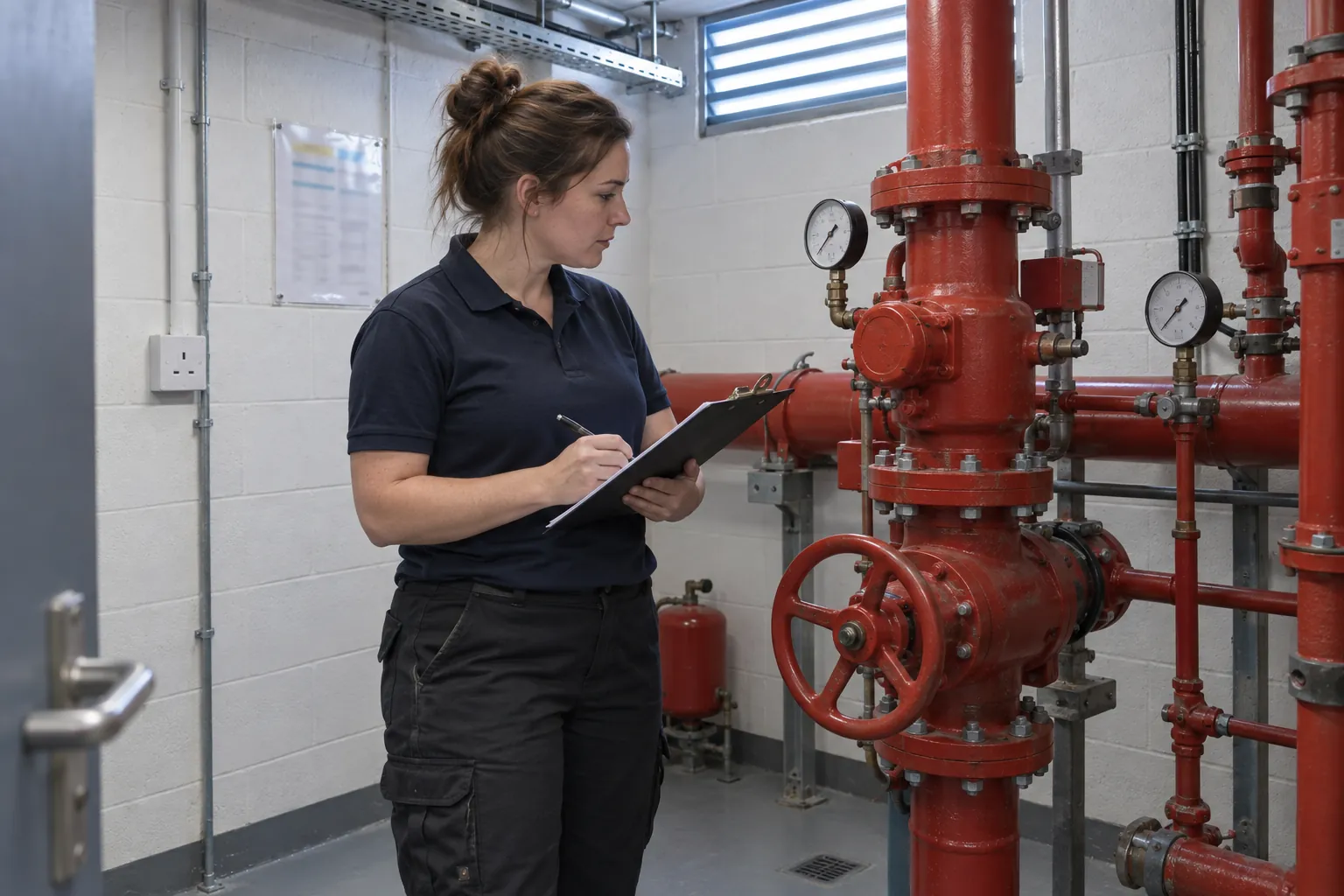
A sprinkler system is the one piece of fire protection that fights the fire by itself, before anyone arrives. It only does that if the water is there, the valves are open, the pumps start and nothing has been built, stacked or painted over the heads. This guide sets out where sprinklers come from in Irish building guidance, the inspection and test schedule the Department of Housing recommends under I.S. EN 12845, who carries out each part, and what the fire safety register should show.
01
Sprinkler systems in Ireland: the standard and the duty
An automatic fire sprinkler system is a network of pipes fed from a water supply, with sprinkler heads that open individually when the heat of a fire reaches them. The Department of Housing, Local Government and Heritage's Technical Guidance Document B 2024 – Fire Safety, Volume 1: Buildings other than Dwelling Houses (reprinted edition, January 2026) says such systems "can reduce the risk to life and control the growth or development of fire in a building".
The main standard for commercial systems in Ireland is I.S. EN 12845:2015+A1:2019 Fixed firefighting systems – Automatic sprinkler systems – Design, installation and maintenance, the Irish adoption of the European standard, published by the National Standards Authority of Ireland. NSAI describes its scope as requirements and recommendations "for the design, installation and maintenance of fixed fire sprinkler systems in buildings and industrial plants, and particular requirements for sprinkler systems that are integral to measures for the protection of life". Its maintenance section, section 20, is where the inspection and test routine comes from.
The Building Regulations, through TGD B, decide whether a building needs sprinklers and to what design. TGD B stops there: "The Building Regulations do not relate to the management of fire safety in buildings", and its guidance assumes "that buildings and systems will be maintained adequately". Once the building is in use, the duty passes to the Fire Services Acts 1981 and 2003. Section 18(2), as substituted by section 29 of the Licensing of Indoor Events Act 2003, makes it the duty of every person having control over premises to which the section applies to "provide reasonable fire safety measures for such premises" and to "ensure that the fire safety measures and procedures referred to in paragraph (b) are applied at all times".
In a workplace there is a third layer. Regulation 13 of the Safety, Health and Welfare at Work (General Application) Regulations 2007 requires an employer to ensure that fire detection equipment and fire-fighting equipment is "inspected and maintained as frequently as necessary to ensure that it is in good working order" and "serviced by a competent person as frequently as necessary". The Health and Safety Authority's page on Fire notes that the wider fire legislation "is generally enforced by the local authority fire officers".
02
Which Irish buildings have sprinklers, and which standard applies
Section 8 of TGD B 2024 sets out where a sprinkler system should be provided. In summary:
- buildings containing flats with a topmost floor height of more than 15 m (paragraph 8.2.1);
- residential care facilities, such as nursing homes, throughout, where there are bed spaces on any level other than the ground level (paragraph 8.2.2);
- student accommodation with a topmost floor height of more than 15 m (paragraph 8.2.3);
- covered shopping centres, throughout, with limited exceptions such as a mall with no combustibles (paragraph 8.2.4);
- separated stages, including the dressing rooms, scene docks, stores and workshops (paragraph 8.2.5);
- offices, shops, assembly buildings, industrial, storage and car park buildings and other non-residential uses with a topmost floor height of more than 30 m (paragraph 8.2.6).
Paragraph 8.3 lists more than two dozen other places where sprinklers form part of the design, among them open-plan flats, longer travel in common corridors, larger compartments and atria. In those buildings the sprinklers are what allowed the longer escape route or the bigger floor, so if they are out of action the rest of the fire strategy may no longer hold.
The design standard depends on the building. For all purpose groups other than hospitals, flats and residential buildings, TGD B paragraph 8.4.4 asks for design and installation to I.S. EN 12845, "or an equivalent sprinkler system"; it states that "Direct supply of the sprinkler system by town mains is not appropriate". For flats, residential care facilities and other residential buildings, paragraphs 8.4.1 to 8.4.3 point instead to BS 9251, to I.S. EN 16925 where the topmost floor is less than 18 m, or to "an equivalent sprinkler system".
In a block of flats, TGD B adds that "An isolation valve should be provided to each individual flat", inside the flat near the entrance door. The heads are inside people's homes.
TGD B 2024 applies to works, or a material change of use, that commence or take place on or after 1 May 2025, though under its transitional arrangements TGD B 2006 (as amended) may still be used for some works started after that date, such as where a planning application was made or a fire safety certificate granted on or before 30 April 2025. Existing buildings were designed to TGD B 2006 or an earlier edition, or before the Building Regulations applied, so check the system's own design documents.
03
The inspection and test schedule, weekly to yearly
The Department's Fire Safety Guide for Building Owners and Operators (August 2023), written for persons with section 18(2) responsibilities and advisory rather than statutory, says in section 6.9 that "Sprinkler systems should be inspected and maintained in accordance with the recommendations in Section 8, Table 2". For commercial systems, Table 2 refers each interval to a clause of section 20 of I.S. EN 12845:2015+A1:2019:
- Daily: the table refers to section 20 of I.S. EN 12845 for maintenance requirements and says: "The installer shall provide the user with a documented inspection and checking procedure for the system." That programme "shall include instruction on the action to be taken in respect of faults, operation of the system, with particular mention of the procedure for emergency manual starting of pumps, and details of the maintenance routines."
- Weekly: "a weekly inspection and test as detailed in Section 20.2.2", by a competent person.
- Monthly: "a monthly inspection and test as detailed in Section 20.2.3", by a competent person.
- Quarterly: "a quarterly inspection and test as detailed in Section 20.3.2", by a competent person.
- Six-monthly: "a half annual inspection and test as detailed in Section 20.3.3", by a competent person.
- Yearly: an inspection and test as detailed in section 20.3.4, by a competent person.
For residential systems, the same table refers to section 18 of I.S. EN 16925 for maintenance requirements, and says a domestic or residential system "should be subject to an annual inspection and test as detailed in Section 7.1.2 of BS 9251" by a competent person.
I.S. EN 12845 sets out what each inspection and test involves; this guide does not repeat its clauses. Nobody should have to guess: the installer's documented procedure should tell whoever does the weekly and monthly routine what to look at, what readings to note and what to do when something is wrong, and the contractor's reports should say which clauses they worked to.
The introduction to Section 8 explains that "Many of the daily, weekly and monthly activities can be carried out without expert knowledge of the equipment or system", while the quarterly, six-monthly and yearly work "should be carried out by persons who have competency in their specific areas and can provide certification to the relevant standard for the work carried out". The sprinkler rows name a competent person from the weekly column onwards, so the weekly routine should be done by someone trained on that installation, not whoever is on shift. The guide adds that contractors "should be part of a registered contractor's association where relevant for their trade".
04
Who does what: the person having control, the site team and the contractor
Responsibility sits with the person having control under section 18(2). The owners' guide says this may be an individual, several people or an organisation, such as an owners' management company, an approved housing body or a property services company, and that the person having control "should retain overall responsibility for ensuring delegated tasks are carried out". In practice there are three roles:
- The person having control, or their facilities manager or managing agent, who appoints the maintenance contractor, holds the installer's documented procedure, decides who on site does the routine checks and keeps the fire safety register.
- The trained site person, often a caretaker, facilities technician or duty manager, who carries out the weekly and monthly routine set out in the procedure and reports anything wrong the same day.
- The competent contractor, who carries out the quarterly, six-monthly and yearly inspections and tests, certifies the work to the standard and repairs faults.
Between those routines, anyone walking the building can spot what quietly disables a system. A walk-round is not a test, but problems are often first seen there:
- Sprinkler heads: none painted over, taped, bagged, damaged or used to hang things from;
- Storage and alterations: nothing stacked up towards the heads, and no new partitions or ceilings beneath them without the sprinkler contractor being asked;
- The valve set: accessible, secure, and the control valves as the procedure says they should be in normal use;
- Pumps and tanks: the pump house clear, no warning lights or alarms showing, no obvious leaks.
Apartment blocks need their own arrangements. The owners' guide says, in section 7.3, that where sprinklers are provided in flats, "there are maintenance requirements for these systems" and that "Reasonable access should be allowed to each flat/apartment for maintenance of individual sprinkler systems." It points to section 18(3) of the Fire Services Acts, the duty on each occupant not to expose anyone to danger from fire by any act or omission. For an owners' management company, that means giving residents notice of the annual visit, keeping a list of flats the contractor could not get into and following each one up, and reminding residents not to paint or cover the heads or turn off the isolation valve.

05
Records, faults and when the system is out of action
The owners' guide says a fire safety register should be maintained for all premises where section 18 applies, that it "should be kept on the premises at all times, be kept up-to-date, and should be available for inspection by an authorised officer of the fire authority", and that it should be "a living document – with daily, weekly, monthly, quarterly and annual records of fire safety checks of procedures and the life safety systems within the premises". Its indicative contents list includes information on sprinkler systems. For a sprinkler system, the register should hold:
- the installer's documented inspection and checking procedure, and the design and commissioning documents;
- each weekly and monthly entry: the date, who did it, what was checked and any readings the procedure asks for, such as gauge pressures;
- the contractor's report for each quarterly, six-monthly and yearly visit, naming the clauses followed and every defect found;
- every fault, when it was found, who was told, when it was put right, and any period the system or part of it was out of action.
Faults are where records most often go quiet. The owners' guide is direct: "Faults are a life safety issue – not simply a maintenance issue to be dealt with later; faults should be entered in the fire safety register and corrected promptly."
Sometimes a system is turned off on purpose, for a repair, a fit-out or a leak. TGD B asks for systems to be "designed to ensure its continued effectiveness during maintenance periods", but a closed valve still leaves part of the building unprotected. Treat any shutdown as planned: record when, why, who authorised it and which areas are affected, ask your competent adviser what is needed until it is back, tell the people on site, and record when it was restored. A valve left closed after the job leaves the building unprotected, and nobody sees it unless someone looks.
06
Where the sprinkler record fails, and what SiteClara does about it
The contractor's visits usually happen. What fails is the week-to-week routine and what is seen in between: a weekly test ticked in the pump house with no reading written down; a monthly entry filled in from memory; a painted-over head in a new tenant's office; a valve closed for a leak repair on a Friday and not reopened; a list of flats the contractor could not access that never reached the managing agent.
SiteClara records checks at the place they are done. A printed QR poster, with an optional NFC tag behind it, sits at the valve set, the pump house and any other point on the routine. The caretaker, facilities technician or security officer scans or taps with their own phone, with no app to install, sees the checks due there and marks each one done or says what stopped them. The time and the named person are recorded as it happens, with a photo when the check asks for one, such as the gauges.
Anything found, such as a painted head or a warning light at the pump panel, can be reported from the same tag and stays on the team's list of open jobs until someone closes it. A supervisor sees what was due, done and missed across the building, records the reason for a miss, reviews the day's checks and photos, and approves a report that goes to nominated contacts, such as the facilities manager or the OMC's managing agent, the next morning, showing what was completed and what is still open.
07
Questions people ask
How often do sprinkler systems need to be inspected?
The Department of Housing's Fire Safety Guide for Building Owners and Operators recommends, in Section 8, Table 2, a weekly, monthly, quarterly, half annual and yearly inspection and test of a commercial system, each by a competent person and each to a clause of section 20 of I.S. EN 12845. A domestic or residential system "should be subject to an annual inspection and test as detailed in Section 7.1.2 of BS 9251" by a competent person. The guide is advisory, written for those with section 18(2) duties.
How do you inspect a sprinkler system?
By following the installer's written procedure for that system. Table 2 of the Fire Safety Guide for Building Owners and Operators says: "The installer shall provide the user with a documented inspection and checking procedure for the system", covering the action to take on faults and "the procedure for emergency manual starting of pumps". Section 8 of the same guide says the quarterly, six-monthly and yearly work should be done by persons who "have competency in their specific areas and can provide certification to the relevant standard for the work carried out".
Is there a sprinkler system inspection checklist?
The Department's Fire Safety Guide for Building Owners and Operators gives a schedule rather than a checklist: Section 8, Table 2 refers each interval from weekly to yearly to a clause of I.S. EN 12845, and the installer's documented procedure says what to check on your own system. The same guide says the fire safety register should be "a living document – with daily, weekly, monthly, quarterly and annual records of fire safety checks of procedures and the life safety systems within the premises", so each check belongs there.
08
Further reading, and a list to take away
For where sprinklers are needed and how they are designed, read Section 8 of Technical Guidance Document B 2024, Volume 1. For running a building, the Department's Fire Safety Guide for Building Owners and Operators is the most useful single document, with sprinklers in sections 6.9 and 7.3 and the schedule in Section 8, Table 2. The standard, I.S. EN 12845:2015+A1:2019, is available from NSAI. The duty in law is section 18(2) of the Fire Services Acts 1981 and 2003, as substituted by section 29 of the Licensing of Indoor Events Act 2003, and, in a workplace, regulation 13 of the General Application Regulations 2007.
For your building's sprinkler system, check that:
- it is clear in writing who holds the section 18(2) duty – owner, OMC, landlord or tenant – and who appoints the contractor;
- you hold the installer's documented inspection and checking procedure;
- named, trained people carry out the weekly and monthly routine, and write down what they checked and the readings asked for;
- a competent contractor carries out the quarterly, six-monthly and yearly inspection and testing to I.S. EN 12845 (or, for a residential system, the annual inspection and test to BS 9251 or I.S. EN 16925, as the system was designed), and each report names the clauses followed and every defect;
- heads are never painted, covered or crowded by storage;
- in apartments, every flat is reached for the annual visit and any missed flat is chased;
- every shutdown is planned, recorded and reversed, and every fault is entered in the fire safety register and put right promptly.
Sources
Every document this guide quotes or links to, in the order it first cites them.
- Technical Guidance Document B 2024 – Fire Safety, Volume 1: Buildings other than Dwelling Houses assets.gov.ie
- I.S. EN 12845:2015+A1:2019 Fixed firefighting systems – Automatic sprinkler systems – Design, installation and maintenance shop.standards.ie
- Section 18(2), as substituted by section 29 of the Licensing of Indoor Events Act 2003 irishstatutebook.ie
- Regulation 13 of the Safety, Health and Welfare at Work (General Application) Regulations 2007 irishstatutebook.ie
- Fire hsa.ie
- Fire Safety Guide for Building Owners and Operators (August 2023) assets.gov.ie
Related guides
 Fire and water checksDry risers: what the Irish guidance asks for, and how to keep one readyWhat a dry riser is, when Irish buildings need one under TGD B, how often it is inspected and tested under I.S. 391, and what the record should show.
 Fire and water checksFire safety register: what to record, who keeps it and how to make it credibleWhat a fire safety register should hold under section 18(2) of the Fire Services Acts, the routine checks behind it, who keeps it, and what makes it credible.
 Fire and water checksFire alarm testing in Ireland: the checks, the servicing, and the recordFire alarm testing in Ireland: the legal duty, the daily and weekly checks, quarterly servicing to I.S. 3218, and what the fire safety register should show.
 Premises and facilities managementOwners' management companies: what an OMC must do, and how to show the common areas are looked afterWhat an owners' management company (OMC) is under the Multi-Unit Developments Act 2011, what it must do, who does the work, and the records that show it was done.