Fire and water checks
Fire alarm testing in New Zealand: what the compliance schedule asks, and what the building team can do
Fire alarm testing in a New Zealand building is the regular inspection and testing of the fire alarm, a specified system known as SS 2, by an independent qualified person (IQP) to the procedures on the council's compliance schedule, usually monthly and annually to NZS 4512, with the owner vouching for it on the building warrant of fitness every year.
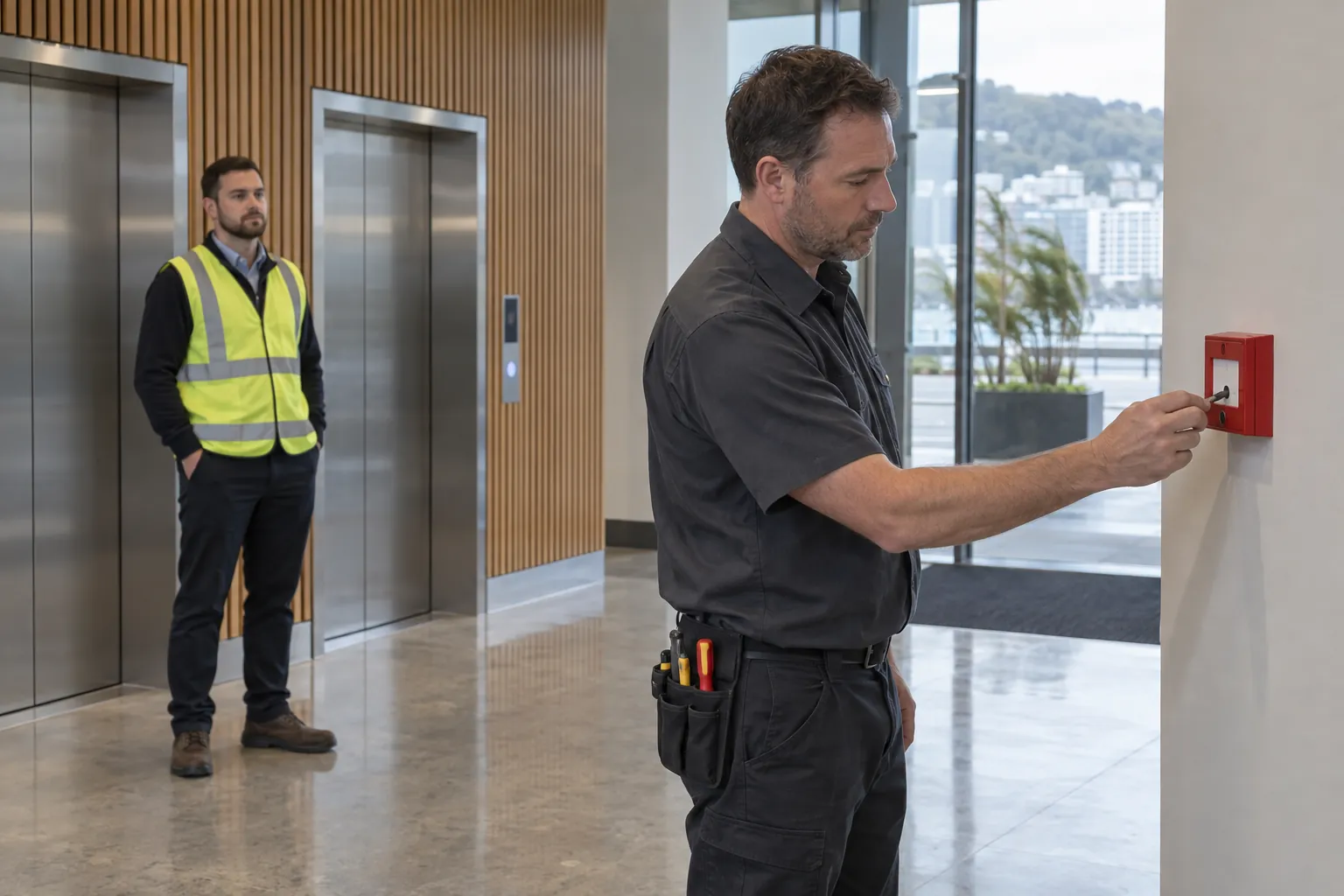
The smoke alarms in a house or a rental property are tested more simply, by pressing the test button, and follow separate rules. This guide explains where the testing comes from, what it covers, who does which part, what the records should show, and what the people who walk the building every day can usefully add between the service visits.
01
Where fire alarm testing comes from in New Zealand
Fire alarm testing in New Zealand starts with the building's compliance schedule, not with a habit or a checklist. Under the Building Act 2004, a building that contains any of the specified systems listed on MBIE's Specified systems and compliance schedules page (fifteen kinds of system, plus cable cars) needs a compliance schedule issued by the council, and the second system on that list is "automatic or manual emergency warning systems for fire or other dangers". The trade calls it SS 2.
MBIE's Compliance Schedule Handbook (amendment 3, 14 February 2014) leaves no room for doubt: "An emergency warning system is required to be listed on a compliance schedule in all cases." Its content guideline for SS 2 says these systems "require regular inspection and testing to ensure the system will operate as required by the performance standard in the event of fire or other danger", and it names the documents a schedule may use to set that testing:
- NZS 4512, the New Zealand Standard for fire detection and alarm systems in buildings;
- AS 1851, the Australian Standard for routine service of fire protection systems;
- a specifically designed solution "prepared by a person who, on the basis of experience and qualifications, is competent to do so".
The current edition of the New Zealand Standard is NZS 4512:2021 Fire detection and alarm systems in buildings, listed on MBIE's Building CodeHub as valid from 14 May 2021; it replaced the 2010 edition. MBIE has sponsored free access to it. It covers design, installation, commissioning, documentation and maintenance, but not the smoke alarms in houses, which are NZS 4514.
From there the owner's duties follow the schedule. The handbook says it is "the owner's responsibility to satisfy the obligations under section 105 of the Building Act", including making sure the inspection, maintenance and reporting procedures are carried out. Each year the independent qualified person (IQP) certifies those procedures on a Form 12A, and the owner issues the building warrant of fitness (BWoF). MBIE's Managing your BWoF pages put it plainly: "A building owner needs to renew a building's warrant of fitness (BWoF) every 12 months, signing, issuing and publicly displaying it."
Two other duties touch the same alarm: an evacuation scheme's trial evacuations start with it, and under the Health and Safety at Work (General Risk and Workplace Management) Regulations 2016 a PCBU's emergency plan must include plans for testing the emergency procedures, including how often; WorkSafe's guidance on workplace emergency plans says they "should be tested at least yearly".
02
What fire alarm testing covers
The handbook's examples of SS 2 are the three familiar types: a manual warning system (Type 2), an automatic fire alarm with heat detectors and manual call points (Type 3), and an automatic fire alarm with smoke detectors and manual call points (Type 4). Council templates such as Westland District Council's Specified Systems Guidance (WBCA 003, 16 September 2025) also list Type 5, with modified smoke detection, and Type 1, the domestic smoke alarm system to NZS 4514.
The testing reaches every part of the chain:
- Manual call points, each one operated in turn over the testing cycle, with the sign beside it that explains how to use it (the handbook suggests listing that sign under SS 14 as part of the SS 2 installation);
- Detectors, including the ones in ceiling voids and plant rooms that nobody sees;
- The fire indicator panel, and any mimic panel, showing the right zone or device and returning to normal afterwards;
- Sounders and visual warning devices, audible and visible throughout;
- The connection to Fire and Emergency, where the alarm is monitored through a certified Automatic Fire Alarm Service Provider;
- Batteries and power supplies, so the system keeps working when the mains fails;
- Interfaces with other specified systems: interfaced fire and smoke doors (SS 3/3), automatic doors, lifts, ventilation in fire mode, and emergency lighting.
The interfaces are easy to forget and matter a great deal. The handbook says that where emergency lighting is connected to the emergency warning system, "testing of the interface between the two systems should be carried out annually."
03
Who tests the fire alarm, and how often
There is no single national frequency written into the Act. The schedule sets it, system by system. MBIE's page on inspection and maintenance of specified systems explains the general pattern: "Most specified systems require at least an annual inspection by an IQP but in some cases they may inspect more frequently such as 6 monthly or quarterly." An IQP is "a person (or firm) approved by the territorial authority as qualified to inspect certain specified systems", and each council keeps a register.
Fire alarms sit at the frequent end. Westland's template, the wording its applicants put on a building consent for Types 2 to 5, gives the frequency as "Monthly and annual by Independent qualified person (as required by NZS 4512)", and points to NZS 4512:2021 Section 6, Maintaining systems in compliance and good working order, and Section 8.5, Inspection and maintenance records.
Several parties share the work, and it helps to know which is which:
- The building owner holds the duty and issues the BWoF; in a unit title development, usually through the body corporate and its body corporate manager.
- The IQP carries out the inspection and testing procedures on the schedule and signs the Form 12A.
- The fire alarm service agent maintains and repairs the system; a firm offering fire alarm testing services may act as both the IQP and the service agent. Fire and Emergency's Code of Practice: Automatic Fire Alarm System (version 1.9, March 2019) makes service agents responsible for "ensuring fire alarm tests are satisfactory and if not, appropriate corrective action is taken."
- The monitoring provider, where the alarm is connected, is one of the certified Automatic Fire Alarm Service Providers listed on Fire and Emergency's automatic fire alarm connection page.
- The building team: facilities manager, caretaker, cleaners, security officers. MBIE notes that "a building owner may be responsible for undertaking some less complex and more frequent inspection tasks." If the schedule gives the owner a task on SS 2, it is part of what the Form 12A certifies.
Nobody on the building team should put the panel into test, isolate a zone or operate a call point unless the schedule gives them that task and they have been shown how. Under the Code of Practice, the monitoring provider must ensure that "all parties to tests are aware that testing is in progress and of the result of the testing".
04
What the building team can do between service visits
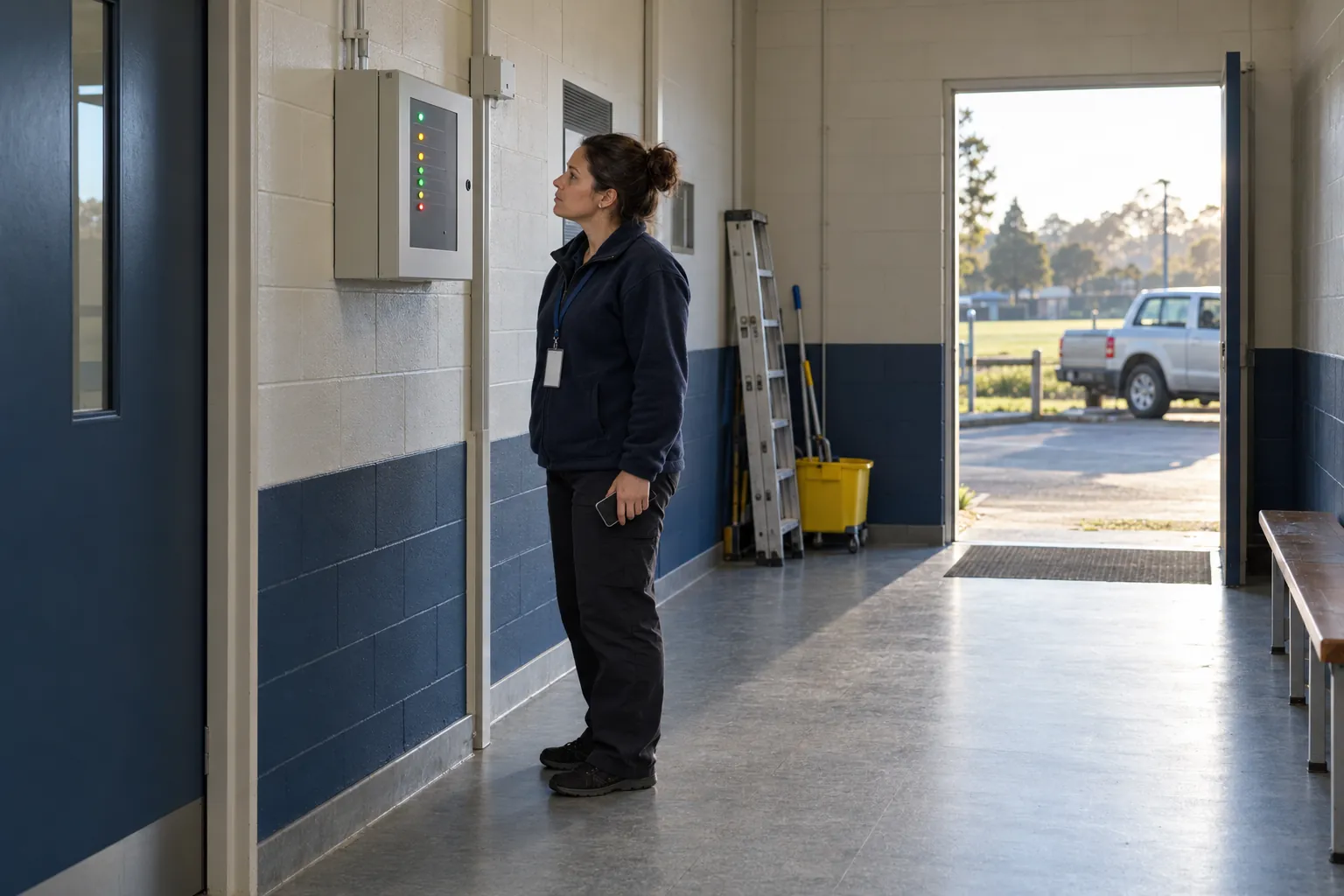
A month is a long time in a busy building. A detector is left with its dust cover on, a partition goes up in front of a call point, a fire door is wedged open, the panel shows a fault that everybody walks past. A short, regular walk-round by the building team, separate from the IQP's procedures, catches most of it. On each floor or route, look for:
- The panel: showing normal, with no fault, isolate or test indication left on. Anything else is written down and reported the same day.
- Call points: visible, reachable, undamaged, with their sign in place, and not blocked by furniture, stock or displays.
- Detectors: not covered, painted, bagged or knocked off their bases; no new shelving or partitions too close to them.
- Sounders and beacons: present and uncovered, especially in rooms that have been refitted.
- Fire and smoke doors on hold-open devices: nothing preventing them closing when the alarm releases them.
- Building work: whether contractors on site know where the detectors are and whether any isolation has been arranged.
Building work is the moment to be most careful. Fire and Emergency's guidance on preventing unwanted alarms lists building contractors among the main causes, and asks owners to "warn contractors about alarm systems and advise them how to prevent unwanted alarms", to discuss dust, fumes and smoke, and to contact the fire alarm contractor if "assistance may be required to temporarily isolate an alarm system". An isolation that is not reversed at the end of the day leaves part of the building without a working alarm overnight.
Schools have their own routine. The Ministry of Education's page on school fire evacuation and fire alarm or sprinkler system shutdowns says contractors must complete a shutdown notice, sent to the property advisor, the monitoring company, Fire and Emergency's Regulatory Compliance Group and the insurers, and that the school needs a plan for alerting the affected areas during it.
Agree in writing who walks the building, how often, and who a fault goes to: the service agent, the facilities manager, or the body corporate manager.
05
The records behind the Form 12A
The Building Act makes the records the owner's responsibility, though the handbook accepts that "for practical reasons, it may be appropriate for the IQP to keep the records on the owner's behalf." It also suggests that "it may be appropriate to keep records in a log book at the installation, with a summary report held in the designated location with the compliance schedule." For a fire alarm, that usually means a log book at the fire indicator panel and the IQP's reports in the BWoF folder. MBIE says the reports must be "kept with the compliance schedule for at least two years."
The handbook's example reporting statement is a good model for what a schedule will ask:
Fire alarm records that an IQP, a council officer or an insurer will believe share a few features:
- Every test is dated, with the devices tested named by reference and location, so a call point or detector can be traced, not "level 2 – ok".
- Every fault has an outcome: who reported it, when the service agent attended, what was done, and the retest.
- Every isolation has a start and an end: which zone, why, who asked for it, and when it was restored.
- False and unwanted alarms are recorded with their cause, so a pattern from one detector or one kitchenette can be dealt with.
- Changes are written in: devices added, moved or removed in a fit-out.
- Owner-side checks match the schedule: if the schedule gives the owner a task, the record shows it done at the interval it sets.
The handbook says a failure needing responsive maintenance "may be identified during inspection, testing, planned preventative maintenance or reported by building users." A covered detector found on a walk-round and passed to the service agent that day is exactly that. At the anniversary, the Form 12A can only be issued if the procedures were fully carried out for the previous twelve months, and it "cannot be amended or altered to create exceptions".
06
Where the record fails
The service agent's visits are usually well recorded. The weak part is everything between them. The walk-round sheet by the panel is filled in for the month in one sitting. A cleaner sees a bagged detector after the painters have gone and mentions it to whoever is passing. An isolation is arranged for a fit-out and nobody can say when it ended.
SiteClara is built for that everyday part. A tag at each point on the route, such as the fire indicator panel, a stair lobby, a plant room or a call point by a final exit, lets the person doing the walk-round scan it with their own phone and confirm what they checked, with a photograph when one is asked for, so the record shows which point was looked at, by whom and when. A walk-round that was due and not done shows as not done, and the supervisor records why. A fault reported at the tag, such as a panel showing a fault or a call point behind new shelving, goes to the team responsible and stays on the list until it is closed, and a daily report tells the building manager what was checked and what is still open.
It is just as important to say what SiteClara does not do. It does not connect to, test, isolate or monitor a fire alarm, and it sends nothing to Fire and Emergency or a monitoring provider. It is not an IQP and does not inspect, maintain or certify SS 2 or any other specified system. It is not a Form 12A or a building warrant of fitness and sends nothing to the council. It does not replace the compliance schedule, the IQP's reports, the fire alarm log book or the evacuation scheme: where the Building Act or the compliance schedule requires a particular record, SiteClara is the working record of the building team's checks between service visits, not the statutory one. It is not a CAFM system and does not manage assets, planned maintenance, rostering or time and attendance.
07
Questions people ask
How do you test a fire alarm?
In a building with a fire alarm system, the IQP and the fire alarm service agent test it to the procedures on the compliance schedule: over the testing cycle each call point and detector is operated in turn, and the panel, sounders, batteries, interfaces and monitoring connection are checked. Nobody else should put the panel into test. A household smoke alarm is simpler: Fire and Emergency's Smoke alarms page says to press the test button to sound the alarm, and to use a broom handle if you cannot reach the button.
How often should I test smoke alarms?
Once a month, according to Fire and Emergency's Smoke alarms page, which also says to replace the battery every year in a 9V battery alarm and to replace all smoke alarms every 10 years with new long-life photoelectric ones. A building's fire alarm system is different: its compliance schedule sets the frequency, typically monthly and annual inspections by the IQP.
What qualifications do you need to test fire alarms?
For a fire alarm on a compliance schedule, the tester must be an IQP. MBIE's page on inspection and maintenance of specified systems defines an IQP as "a person (or firm) approved by the territorial authority as qualified to inspect certain specified systems", and says the council's IQP register "identifies which specified systems the IQP is competent to inspect". Check that the person signing for your fire alarm is on that register for SS 2.
What are the standard requirements for smoke alarms in New Zealand?
For a rental home, Tenancy Services' page on smoke alarms in rental properties sets them out under the Residential Tenancies (Smoke Alarms and Insulation) Regulations 2016: every new smoke alarm must be photoelectric, have a battery life of at least eight years or be hard-wired, and be installed according to the manufacturer's instructions, within 3 metres of each bedroom door or in every room where a person sleeps, and on each level of the home. The landlord must make sure the alarms work at the start of each tenancy, and tenants must replace dead batteries in older alarms and tell the landlord about any problem as soon as possible. A commercial building's fire alarm follows its compliance schedule instead.
08
Where to read more, and a list to take away
MBIE's Specified systems and compliance schedules and Inspection and maintenance of specified systems pages are the owner's starting point, and the Compliance Schedule Handbook sets out the SS 2 content guideline and the example reporting statement. NZS 4512:2021 is free to view through Building CodeHub. Your council's building team administers the compliance schedule, the BWoF and the IQP register. See also our guides to specified systems and IQPs, the compliance schedule and trial evacuations.
Before the service agent's next visit, check that:
- you have read the SS 2 lines of your compliance schedule and know which standard, edition and frequency they name;
- you know which parts, if any, the schedule gives the owner, and each has a named person and a record made at the time;
- the panel is looked at daily when the building is open, and any fault, test or isolate indication is reported the same day;
- call points, detectors and sounders are walked on a route, with faults going straight to the service agent;
- contractors are briefed on the detectors before work starts, and every isolation has an agreed end;
- false and unwanted alarms are recorded with their cause;
- the IQP's reports and the log book for the last two years are with the compliance schedule, where the warrant says they are.
Sources
Every document this guide quotes or links to, in the order it first cites them.
- Specified systems and compliance schedules building.govt.nz
- Compliance Schedule Handbook building.govt.nz
- NZS 4512:2021 Fire detection and alarm systems in buildings codehub.building.govt.nz
- Managing your BWoF building.govt.nz
- Workplace emergency plans worksafe.govt.nz
- Specified Systems Guidance (WBCA 003, 16 September 2025) westlanddc.govt.nz
- Inspection and maintenance of specified systems building.govt.nz
- Code of Practice: Automatic Fire Alarm System fireandemergency.nz
- Automatic fire alarm connection fireandemergency.nz
- Preventing unwanted alarms fireandemergency.nz
- School fire evacuation and fire alarm or sprinkler system shutdowns education.govt.nz
- Maintaining your approved evacuation scheme fireandemergency.nz
- Smoke alarms fireandemergency.nz
- Smoke alarms in rental properties tenancy.govt.nz
Related guides
 Fire and water checksIQPs and specified systems: who inspects what, and what the owner must keepWhat an IQP is, the specified systems SS 1 to SS 16, how to engage IQPs, what they inspect and what is left to the owner, and how the Form 12A works in New Zealand.
 Fire and water checksThe compliance schedule: what it lists, and how to keep a building to itWhat a New Zealand compliance schedule lists, which buildings need one, how it is issued and amended, who does the checks and the records behind every BWoF.
 Fire and water checksFire drill: how to plan, run and report a trial evacuationHow New Zealand buildings plan, run and report a fire drill, called a trial evacuation, under the 2018 FENZ Regulations: timing, what to check, the 10-day report.
 Fire and water checksEmergency lighting testing in New Zealand: what the compliance schedule asks, and what the building team can doEmergency lighting testing in New Zealand: Building Code F6, specified system SS 4, AS/NZS 2293.2, the IQP's six-monthly and annual checks, and the BWoF records.