Fire and water checks
Fire warden duties: the everyday checks, and the job when the alarm sounds
A fire warden is a trained member of staff who keeps their area of a building ready for an evacuation and, when the fire alarm sounds, tells people to leave, checks every room is clear and reports to the chief warden.

In a typical New Zealand office, school or shared building, the warden is an ordinary employee with a coloured cap or vest kept to hand and a floor they know well. No law says a building must have one, but where a building's evacuation scheme uses wardens, it has to say what they do and how people will recognise them. This guide covers where the role comes from, the checks a warden makes between alarms, the job on the day, and the record that shows it was done.
01
The fire warden role, and where it comes from
Fire safety in New Zealand buildings is governed by the Fire and Emergency New Zealand Act 2017 and the Fire and Emergency New Zealand (Fire Safety, Evacuation Procedures, and Evacuation Schemes) Regulations 2018. Buildings that the public can enter, or that are workplaces, must have an evacuation procedure. A relevant building, such as one providing employment facilities for 10 or more people, or used for gatherings of 100 or more, must also have an evacuation scheme approved by Fire and Emergency New Zealand (FENZ). Our guide to the fire evacuation scheme explains which buildings need one.
Neither the Act nor the Regulations requires fire wardens. FENZ's Evacuation Scheme Application Reference Guide says so plainly: "Wardens are not a requirement of the Act or Regulations; however, they are commonly used to effectively evacuate people" in multi-occupancy buildings, buildings with large numbers of occupants, theatres and cinemas, hospitals and airports.
The legal requirement is that the scheme describes how the evacuation will be run. The same guide says that if your building has wardens, the application should "describe their duties and how they are identified in a fire emergency", and that the training content must cover the "roles, responsibilities, duties and identified wardens (if any)" and the "supervision of the evacuation (usually by a chief warden) and where this person will be located". Once the scheme is approved, the wardens it describes are part of how the owner meets it.
There is a second source of duty. Under the Health and Safety at Work (General Risk and Workplace Management) Regulations 2016, made under the Health and Safety at Work Act 2015, every PCBU (person conducting a business or undertaking) must have an emergency plan for its workplace. WorkSafe's page on workplace emergency plans says the plan must include evacuation procedures, procedures for notifying emergency services at the earliest opportunity, plans for testing the procedures, and the "information, training, and instruction to be given to relevant workers". It adds: "All workers should know who is responsible for activating and coordinating emergency procedures and what they must do to keep themselves and others safe in an emergency." In most workplaces that is the wardens.
02
What a fire warden is responsible for
A warden's duties fall into three parts: keeping their area ready for an evacuation, leading their area out when the alarm sounds, and reporting what they found. FENZ's Office Building Example Evacuation Scheme Document shows how one building might write them. In that example:
- each area has a warden who is "responsible to physically check every room is clear and then report the area is evacuated to the Head Warden";
- all occupants must follow the instructions of wardens, who may also ask occupants to help people who need assistance to evacuate;
- area wardens wear a yellow cap and the head warden a red cap, kept in a named place (the kitchen, in the example);
- the head warden goes to the fire alarm panel, confirms that the 111 call has been made, collects the area wardens' reports and briefs the officer in charge when FENZ arrives;
- wardens are trained when they take on the role and given refreshers every six months, alongside the six-monthly trial evacuations.
The example is an illustration, not a rule, but it is a useful test. If a new warden cannot say where their cap is kept, which rooms are theirs to check, and who they report to, the scheme describes a building that does not exist.
Wardens also carry duties the scheme may not spell out. FENZ's guide notes that where a building has a secondary place of safety, occupants may be told to use it "with verbal direction from wardens", and that where people must cross a road to reach it, traffic management may be "performed by building staff or wardens".
03
The everyday checks between alarms
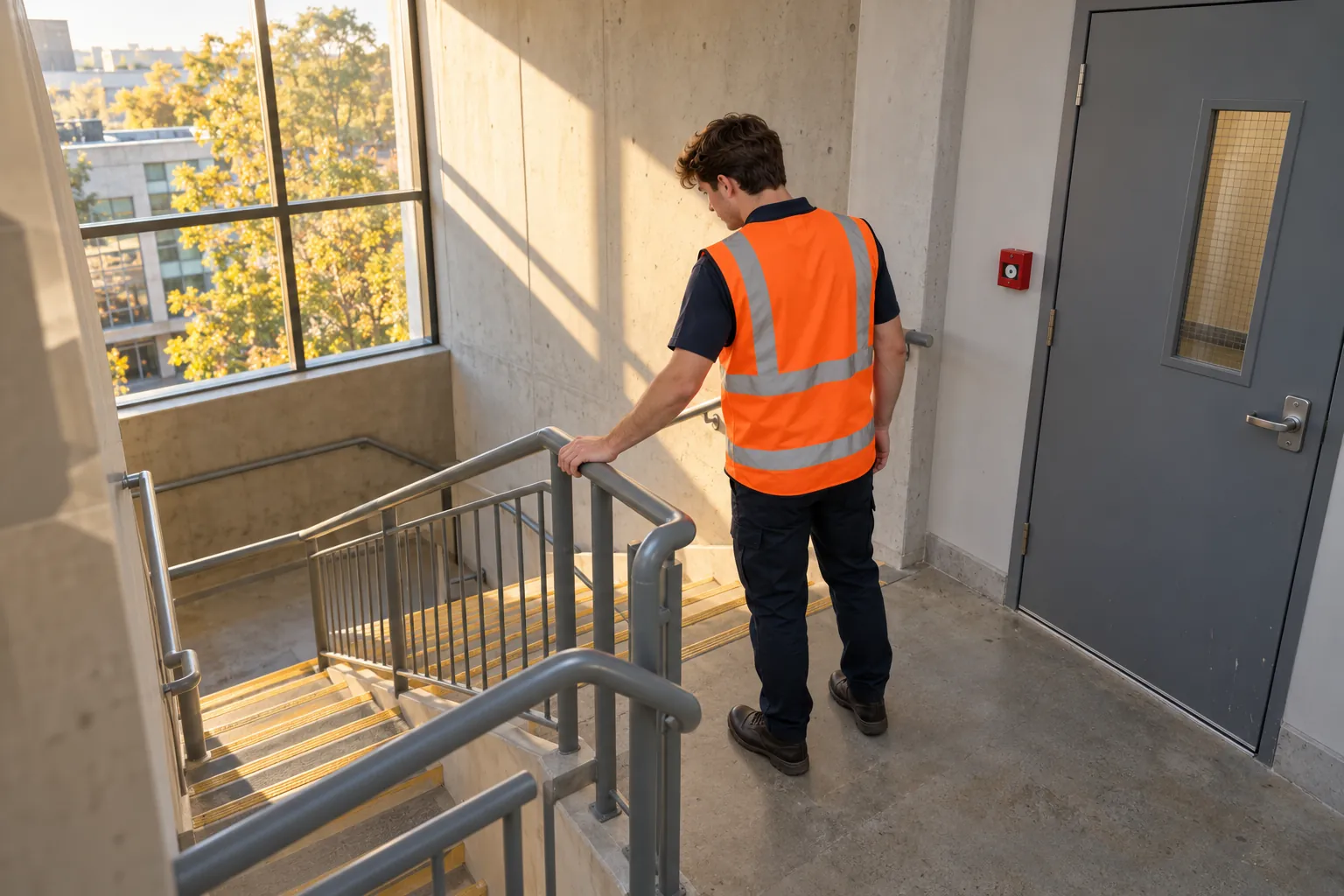
Most of a warden's year is fire prevention: a short walk round their area, looking for what would slow people down or make a fire worse. Part 1 of the Regulations sets out fire safety responsibilities that apply to buildings generally, and FENZ's info sheet Fire safety, evacuation procedures and evacuation schemes puts it as ensuring "stairwells, passageways and exits from your buildings are free from obstacles and unlocked in case they are required in an emergency". A warden's walk round usually covers:
- Escape routes: corridors, stairwells and landings clear of boxes, trolleys, furniture, bikes and stored stock.
- Exit doors: unlocked while the building is occupied, openable from inside without a key, and clear on the outside too, not blocked by a skip, a parked ute or a delivery.
- Fire doors and smoke-stop doors: closed, not wedged or propped, closing onto the latch, and not damaged. More detail is in our guide to fire door inspection.
- Firefighting equipment: fire extinguishers and hose reels in their places, unobstructed and apparently undamaged.
- Manual call points: visible, reachable and not covered.
- Fire action notices: displayed beside the call points, and correct for the building. The approved scheme includes copies of them.
- Fire hazards: flammable materials or liquids stored near the means of escape, rubbish building up, heaters beside paper, overloaded multi-boxes. FENZ's Maintaining Approved Evacuation Schemes lists keeping the means of escape clear of obstacles and flammable materials away from it among the owner's other fire safety responsibilities.
- The place of safety: the assembly point still usable, and not turned into a builder's compound or a car park.
How often is for the building to decide: a daily look at escape routes and exits suits a busy building, a weekly walk a quieter office. Keep the list to what can be seen in ten minutes. A long checklist makes the check slower, and a slow check is the one that stops happening.
Some things are not the warden's to check. The fire alarm, sprinklers, emergency lighting and other specified systems are on the building's compliance schedule, inspected and maintained by independent qualified persons (IQPs) and contractors, and certified each year in the building warrant of fitness. A warden who notices a fault light on the alarm panel, or an emergency light that is out, reports it; they do not sign off the system.
04
The warden's job when the alarm sounds
The approved scheme sets the procedure for each building, and FENZ asks that it is written for "a real fire emergency – not a trial evacuation or a false alarm". Drawing on the example office scheme, an area warden's job usually runs like this:
- Put on the identification the scheme describes, so people can see who is leading.
- Tell people to leave by the nearest safe exit, using the stairs from upper floors.
- Search the area on the way out: every room, including storerooms, meeting rooms, kitchens and toilets, without putting yourself at risk.
- Help, or arrange help for, anyone who needs it, following the scheme's provision for people requiring particular assistance.
- Report to the chief or head warden that the area is clear, or what could not be checked, and anything known about the fire.
- Go to the place of safety and keep people there. Nobody goes back in until the chief warden or FENZ gives the all-clear.
The chief warden's job is different: go to the fire alarm panel or the agreed point, note where the alarm was activated, make sure the 111 call has been made, collect the reports from each area, and brief the officer in charge when FENZ arrives. FENZ's guide says a 111 call should always be made "even if the alarm is connected to Fire and Emergency or a fire alarm service provider". It also asks the scheme to say who will liaise with FENZ on arrival, and to avoid naming individuals "because they may not necessarily be onsite during a fire emergency".
The scheme must also describe how the building is determined to be clear, "e.g. building cleared by wardens", and that information is passed to the attending firefighters. This is where warden arrangements most often fail: a floor whose warden is on leave, a tenant who never appointed one, a night shift with no wardens at all. The example office scheme has a separate after-hours procedure for exactly this reason.
05
Training, trial evacuations and what a good record shows
Wardens have to be trained for the role in the building they are in. A general fire warden training course is a useful start, but the practical part is the building itself: its exits, its alarm panel, its place of safety and its own procedure. FENZ's application guide says the content of a training programme should include "roles and responsibilities of wardens" alongside the evacuation procedure and training on evacuating people who require assistance. The example office scheme adds fire and smoke behaviour, calling 111, managing visitors, checking rooms, closing doors to restrict fire spread and using extinguishers.
An approved scheme is maintained by trial evacuations or by an evacuation training programme, at the frequency chosen in the application: every six months or more often. FENZ's guidance on maintaining your scheme says a report must reach FENZ within 10 working days of the trial, and that false alarms and real emergencies can count as trials if reported in the same time. During a trial, FENZ's Maintaining Approved Evacuation Schemes guide asks you to check that "all staff, occupants, and wardens (if used) perform their roles as expected", that everyone is accounted for, that people needing particular assistance were supported to safety, that the evacuation was calm and orderly, and that someone made a 111 call. The practical side is in our guide to the trial evacuation.
The trial report is the formal record. The everyday record of the wardens' checks sits underneath it, and shows how the means of escape are kept clear between trials. A useful record answers three questions: was the check done, by whom, and what happened to the problems found? Each entry carries:
- the date and time, written when the check was made, not at the end of the week;
- the area or route checked, and the warden's name;
- what was found, including the propped fire door and the pallet in the rear corridor, not just ticks;
- who each problem went to, and when it was put right;
- checks that were missed, and why, such as the warden being on leave with no deputy;
- warden appointments, deputies and training dates, so gaps show before they matter.
Exceptions make the record credible. A year of warden checks with nothing ever found does not describe a perfect building; it describes a sheet being signed rather than a route being walked.
06
Where the record fails, and what SiteClara does about it
On paper, the warden's check is a column of initials on a clipboard at reception. It is easy to fill in for the week on a Monday and hard to follow up: the wedged fire door noted on Tuesday is still wedged on Friday, because the sheet records the problem but sends it to nobody. In a shared building the difficulty doubles. WorkSafe's page on overlapping duties says "Businesses that work together will likely share health and safety duties in relation to the same matter", and the owner, the tenants, the cleaning company and the security company each see a different part of the building on a different shift.
SiteClara records the checks at the location. A printed QR poster, with an optional NFC tag behind it, sits at each place a check is scheduled: a stairwell landing, a rear exit, the fire alarm panel, the assembly point. The warden, caretaker or cleaner scans or taps with their own phone, with no app to install, sees the checks due there, and marks each one done or explains what stopped them. The time and the named person are recorded as it happens, with a photo when one is asked for.
A problem found on the round, such as a blocked exit or a fire door that will not close, is reported there, with a photo, and goes onto the team's list of open jobs until someone closes it. The supervisor sees which checks are due, done and missed, records the reason one was missed, and can escalate a job to the building manager. Each day the supervisor approves a report that goes to nominated management or client contacts the next morning, showing what was reported, what was completed and what is still open, so the property manager and the contractors read the same record.
07
Questions people ask
What does a fire warden do?
Keeps their area ready for an evacuation and leads it out when the alarm sounds. In FENZ's Office Building Example Evacuation Scheme Document, each area has a warden "who will be responsible to physically check every room is clear and then report the area is evacuated to the Head Warden"; on hearing the alarm they put on their identification, tell other occupants to evacuate, search the area including storage areas and bathrooms, report to the head warden at the alarm panel, and make sure nobody re-enters the building until the all-clear is given.
What is the responsibility of a warden?
Whatever the building's evacuation scheme says it is. FENZ's Evacuation Scheme Application Reference Guide says "Wardens are not a requirement of the Act or Regulations", but "If your building has wardens, describe their duties and how they are identified in a fire emergency." Once the scheme is approved, the duties it describes are the ones the wardens are trained for.
How do you identify a fire warden?
By the identification the evacuation scheme describes, such as a coloured cap. FENZ's Evacuation Scheme Application Reference Guide asks every scheme with wardens to say how they are identified in a fire emergency, and the Office Building Example Evacuation Scheme Document gives area wardens a yellow cap and the head warden a red cap, both kept in the kitchen.
How long is fire warden training?
No New Zealand law sets a length. FENZ's Evacuation Scheme Application Reference Guide sets out what the training programme should contain, including the "roles and responsibilities of wardens", and in its Office Building Example Evacuation Scheme Document staff appointed as wardens "are given training on their adoption of the role and are given refreshers every six months".
08
Further reading, and a list to take away
FENZ's pages on evacuation schemes and procedures are the place to start, with its Evacuation Scheme Application Reference Guide for what a scheme must say about wardens, the Office Building Example Evacuation Scheme Document for a worked set of warden duties, and Maintaining Approved Evacuation Schemes for trials and reports. The law is the Fire and Emergency New Zealand (Fire Safety, Evacuation Procedures, and Evacuation Schemes) Regulations 2018 on legislation.govt.nz, and every PCBU should read WorkSafe's page on workplace emergency plans.
For your fire wardens, check that:
- the evacuation scheme or procedure describes the warden roles, what each does and how each is identified, by role rather than by name;
- every area has a warden and a deputy, with cover for leave, part-time staff and every shift, and an after-hours procedure for when there are none;
- each warden knows their area, every room in it, where their identification is kept, and who they report to;
- the chief warden knows where to stand, how the 111 call is confirmed, and what to tell FENZ on arrival;
- the everyday checks fit a short walk round, and are walked, not signed in advance;
- problems found on a check go to someone who will fix them, and the record shows when they were fixed;
- missed checks are recorded with a reason;
- warden training and refreshers are kept up, and trial evacuations test the wardens as well as the alarm;
- trial and training reports reach FENZ within 10 working days, false alarms included.
Sources
Every document this guide quotes or links to, in the order it first cites them.
- Fire and Emergency New Zealand (Fire Safety, Evacuation Procedures, and Evacuation Schemes) Regulations 2018 legislation.govt.nz
- Evacuation Scheme Application Reference Guide fireandemergency.nz
- Workplace emergency plans worksafe.govt.nz
- Office Building Example Evacuation Scheme Document fireandemergency.nz
- Fire safety, evacuation procedures and evacuation schemes fireandemergency.nz
- Maintaining Approved Evacuation Schemes fireandemergency.nz
- Guidance on maintaining your scheme fireandemergency.nz
- Overlapping duties worksafe.govt.nz
- Evacuation schemes and procedures fireandemergency.nz
Related guides
 Fire and water checksFire evacuation scheme: which buildings need one, and how to keep it workingWhich New Zealand buildings need an approved fire evacuation scheme, what it contains, how it is kept up with trial evacuations or training, and what to tell FENZ.
 Fire and water checksFire drill: how to plan, run and report a trial evacuationHow New Zealand buildings plan, run and report a fire drill, called a trial evacuation, under the 2018 FENZ Regulations: timing, what to check, the 10-day report.
 Fire and water checksFire extinguisher inspection in New Zealand: the owner's duty, NZS 4503 and the checks in betweenWhat the law asks of fire extinguishers in New Zealand, what NZS 4503:2005 maintenance means, and how the building team inspects them between service visits.
 Fire and water checksFire door inspection: the compliance schedule checks, the IQP and the owner's partFire door inspection in New Zealand: the SS 15/3 and SS 15/5 checks on a compliance schedule, how often they fall due, the IQP's part and the records an owner keeps.