Fire and water checks
Fire drill: how to plan, run and report a trial evacuation
A fire drill, which New Zealand law calls a trial evacuation, is a practice evacuation of the whole building: the alarm is sounded, everyone leaves, and every occupant is accounted for at the place of safety.
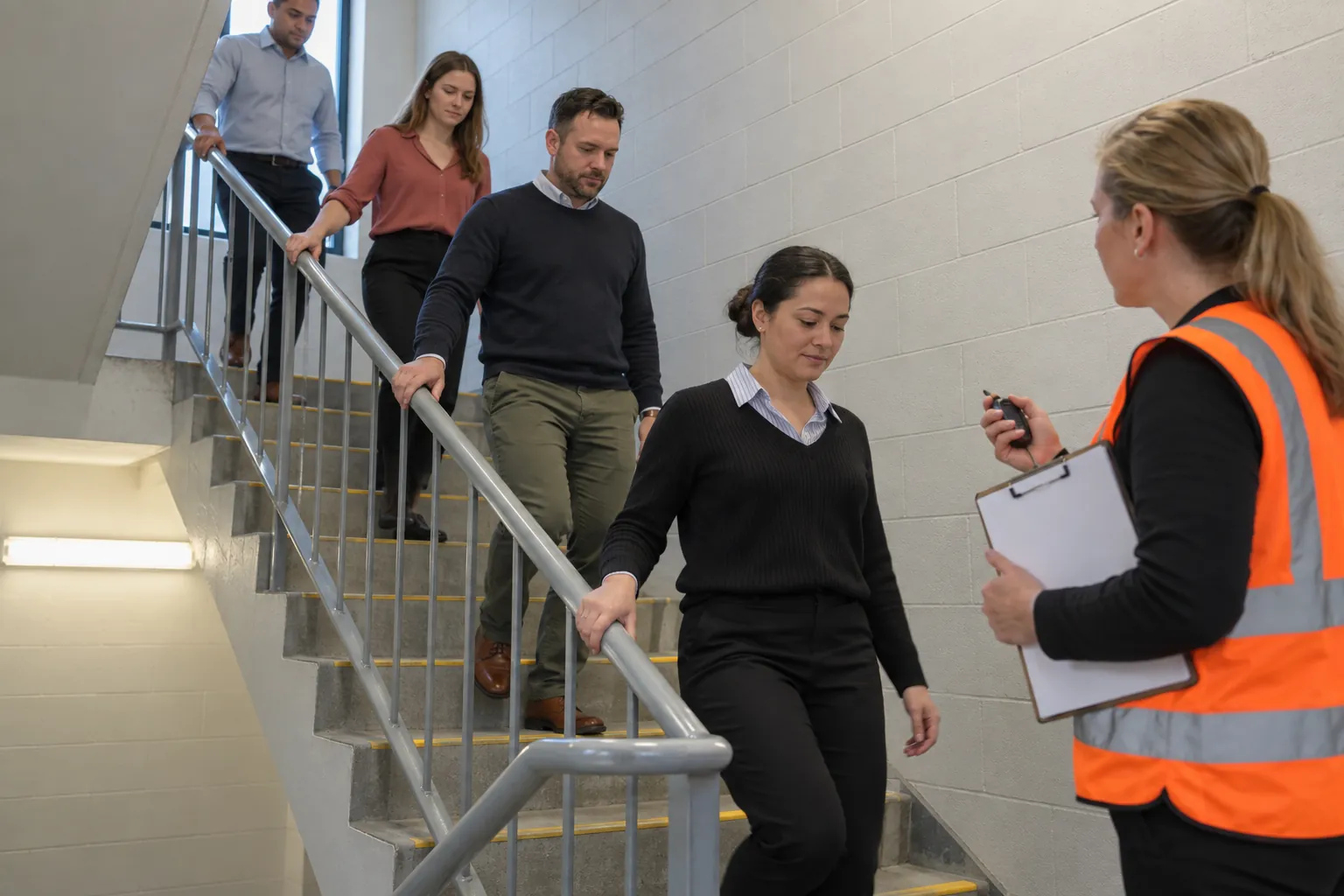
For a school, an early childhood centre and many other buildings with an approved evacuation scheme, it has to happen at least every six months, and the result has to reach Fire and Emergency New Zealand (FENZ) within 10 working days. This guide covers who has to hold one, how to plan it so it tests something real, what to watch on the day, how to report it, and what to do about what it shows.
01
What a trial evacuation is, and who has to hold one
Most people call it a fire drill. The law calls it a trial evacuation, and it belongs to the building's fire evacuation scheme. The rules are in the Fire and Emergency New Zealand (Fire Safety, Evacuation Procedures, and Evacuation Schemes) Regulations 2018 (LI 2018/96), which FENZ sets out on its page of regulations for evacuation schemes.
FENZ's Evacuation Scheme Application Reference Guide describes a trial evacuation as all the building occupants taking part "in an evacuation that simulates a fire emergency, i.e. sounding the alarm, evacuating the building, accounting for all occupants, etc." It is the whole building leaving as it would in a fire, not an alarm test or a walk round the exits.
Who has to hold one depends on the building and on the choice made when its scheme was approved:
- Early childhood centres and schools. The Regulations, as FENZ quotes them, require these owners to "undertake trial evacuations of the building's occupants at intervals of not more than 6 months; and at any other additional time as required by Fire and Emergency through written notice." A training programme is not an alternative for them.
- Other buildings with an approved scheme. Offices, shops, warehouses, halls, hotels and other relevant buildings choose, at question 4.3 of the scheme application, whether the scheme is maintained by trial evacuations or by an evacuation training programme. FENZ says a training programme is "often the most suitable option for buildings whose occupants are likely to be transient (e.g. motels, theatres) or need assistance to evacuate (e.g. hospitals, retirement homes)." Either way, FENZ can still require a trial.
- Buildings with no approved scheme. FENZ says evacuation procedures for buildings that are not relevant buildings "do not require Fire and Emergency approval". The PCBUs working there still need an emergency plan, and WorkSafe's page on workplace emergency plans says plans "should be tested at least yearly", for example by "staging a mock emergency such as a fire drill".
Six months is a ceiling. The application guide says trials "must take place at least every six months. Where a shorter period is nominated as part of the application, that will become the frequency at which you must legally carry out trial evacuations." Check section 4 of your approved scheme before assuming six months.
02
What a trial evacuation is meant to test
The easiest way to see what a trial is for is to read what FENZ asks afterwards. The report required by the Regulations, as FENZ sets it out, must include:
- the name and address of the building;
- the date and time of the evacuation;
- the time taken to complete the evacuation;
- whether any person was injured during the evacuation and, if so, the nature of the injuries;
- whether all evacuation alarm systems worked (whether audible or non-audible), exit ways were clear, signs were in place, and all equipment worked;
- whether all occupants were evacuated in accordance with the evacuation scheme;
- whether the evacuation was completed safely;
- whether systems were in place to assist anyone who could not self-evacuate and, if so, whether the systems functioned;
- when the last training session for permanent occupants was held.
So a trial tests the alarm reaching everyone, including toilets, plant rooms and basement car parks; escape routes usable on an ordinary day, not only on inspection day; evacuation signs and notices where the scheme says they are; wardens, where the building uses them, doing what the procedure says; people who need help getting it; and a count at the place of safety that is complete and quick.
It also tests training. The application guide says that under a trial regime "permanent occupants must be trained to manage an evacuation. This can be run separately, or as part of a debrief following a trial evacuation."
People who need particular assistance are treated differently. FENZ quotes the Regulations: "In a trial evacuation, persons who require particular assistance and persons under control or supervision are not required to go outside the building; but if they do not go outside the building, must be gathered as close as is reasonably possible to an exit from the building or in a place of safety" that meets the Regulations. The trial still has to show the plan for them works: who goes to them, with what equipment, and how the person supervising knows they are safe.
03
Planning a fire drill that tests something real
A drill everyone saw coming proves only that people can walk downstairs. FENZ's guide Maintaining Approved Evacuation Schemes says the trial "should be a surprise to staff and occupants and resemble a real emergency as closely as possible", and that if you tell some key staff or occupants beforehand, "we recommend this number of people is kept to a minimum."
Plan these in advance, and tell only the people who need to know:
- The date. FENZ recommends holding the trial at least two to three weeks before the due date, leaving room if the day falls through. Its reminder goes to the nominated contact person; diarise the due date as well.
- The time. Vary it. A building that always drills at 10am on a Tuesday never tests the lunchtime reception cover, the early cleaning shift or the evening class.
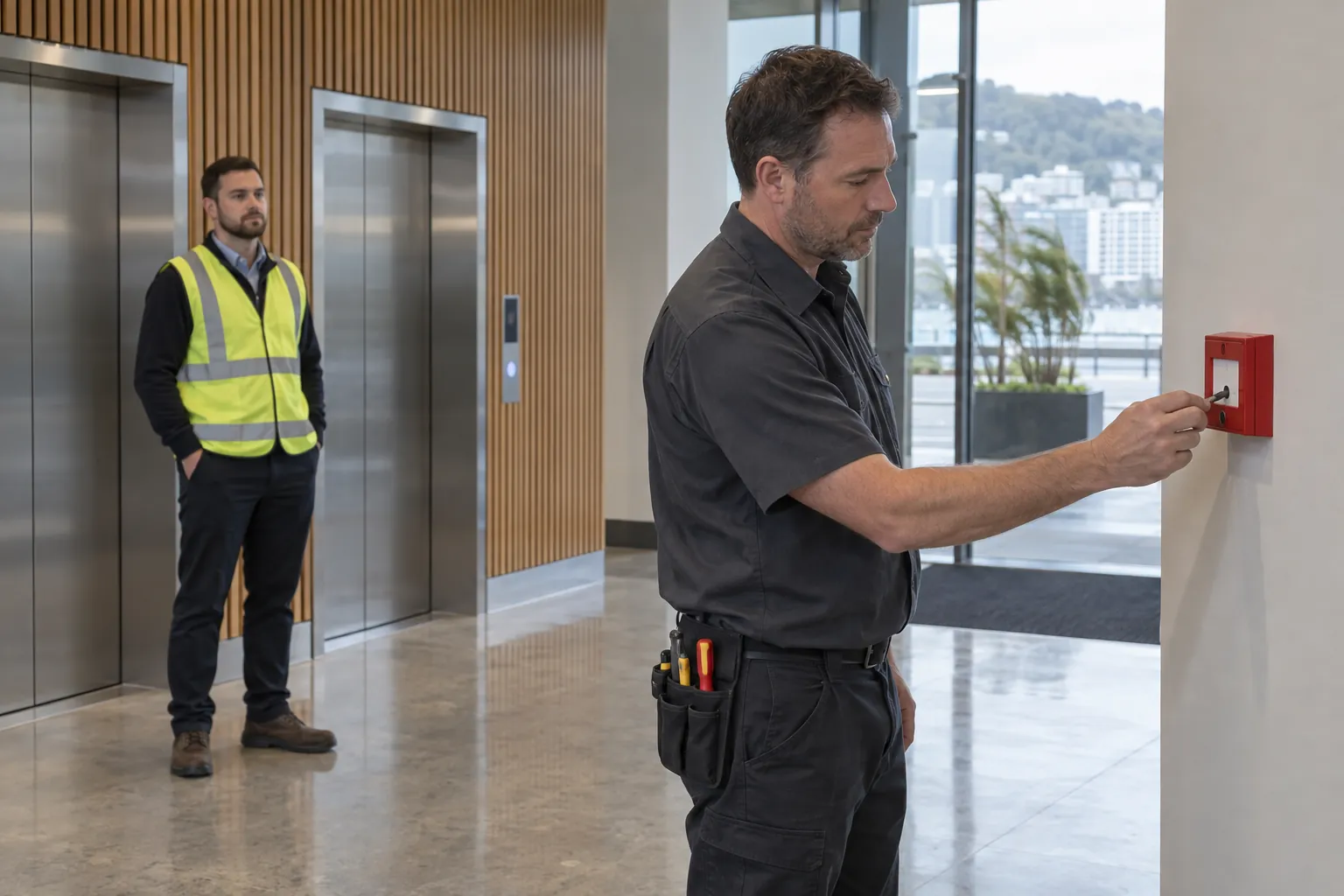
- Who starts it. FENZ says: "If your building has a fire alarm system, ensure the person who will activate the alarm knows how to do this." Agree with the alarm contractor how it will be set off and reset.
- Who watches. Observers at the exits, on each floor and at the place of safety, and one timekeeper. Observers do not usher people out; they watch and write down.
- A scenario. A plausible fire location, and where it is safe to do so, one route treated as unusable, shows whether people use the alternative. Never create a real hazard to make a point.
- People who need help. Read the scheme's plan for them and check who is in today. The application guide says to allow for "visitors who may enter your building, or occupants who suffer an injury during an evacuation".
- Tenants and contractors. Tell each tenant's nominated person enough to take part, but not the time. Contractors working at height or on live systems need to know an alarm may sound.
The Fire Communications Centre must be told. FENZ's page on maintaining your scheme says to contact it 10 to 15 minutes beforehand, and its guide says to do so "immediately after your trial" as well, because "warning the FCC prevents the unnecessary dispatch of a fire engine". The guide gives 0800 336 922 (0800 FENZCALL) and the web page lists regional centres; use the number FENZ currently publishes. FENZ says there has been no need to notify it in writing before a trial since 1 July 2018.
04
On the day: what to watch and time
FENZ's maintenance guide lists the points to check during the evacuation:
- all staff, occupants and wardens (if used) perform their roles as expected;
- everyone is accounted for: everyone reached the relevant place of safety, and people identified as needing particular assistance were supported to safety;
- the evacuation is calm and orderly;
- someone made a 111 call;
- the evacuation is timed.
The 111 call is easy to overlook in a drill. FENZ's web guidance recommends "that the person managing the trial evacuation calls 111 as part of the trial evacuation", and its application guide says a 111 call "should always be made even if the alarm is connected to Fire and Emergency or a fire alarm service provider". The point is to prove someone knows it is their job.
Give each observer a short sheet that follows the report's questions:
- Alarm. Heard everywhere in their area, including toilets, plant rooms and stairwells?
- Routes. Exit ways clear, doors openable from inside without a key, fire doors closing, signs in place?
- Behaviour. Did anyone use the lift, go back for a bag, or stay put?
- Wardens. Was each area swept and reported to the chief warden?
- Assistance. Was each person who needed help reached, by whom, and how quickly?
- Place of safety. Did people go to the right place and stay until the all clear? Was anyone hurt?
Time the evacuation from the alarm to the moment whoever supervises can confirm the building is clear; the report asks for it in minutes and seconds. A quick time that left someone in a plant room is a failed trial.
When everyone is accounted for, give the all clear, reset the alarm, and phone the Fire Communications Centre again.

05
After the trial: the debrief, the report and the fixes
Hold a short debrief the same day with the wardens, the observers and someone from each tenant. It can double as the permanent occupants' training; if it does, record who attended.
Then report. FENZ's maintain your scheme page says to "complete an online trial evacuation report on the result of the trial evacuation within 10 working days after your trial evacuation, or otherwise advise Fire and Emergency in writing". From its maintenance guide:
- Only the nominated contact person can report. When a property manager or facilities provider changes, transfer the scheme through FENZ's Regulatory Compliance Group first.
- Online leaves a copy. Reporting online produces a confirmation email and a PDF of the report to keep "for other compliance purposes"; a report by email or post is not usually acknowledged.
- Explain every No. The guide asks for "as much information as possible when you answer No to any question(s)", and there is a box to ask FENZ to contact you.
- Give the last training date. Question 8 asks when permanent occupants were last trained.
A real alarm counts too. FENZ says false alarms and actual fire emergencies "can be treated as trial evacuations", but "you must provide a report of the evacuation to Fire and Emergency for it to be counted", within the same 10 working days, and the next due date is then adjusted. Treat every unplanned evacuation as a trial: time it, count heads, note what went wrong, and report it.
Then act on what the trial showed. Most findings are ordinary: a door that sticks, a stairwell used as a store, a sounder nobody hears in the washroom, a warden who has left. Each needs an owner and a date. Alarm faults go to the alarm contractor, and changes to the means of escape may need notifying to FENZ.
Schools should also read the Ministry of Education's page on school fire evacuation and fire alarm or sprinkler system shutdowns, which tells schools to "hold trial evacuations every 6 months" and to "train staff to manage an evacuation and make a 6-monthly assessment of their preparedness".
06
Where the record fails, and what SiteClara does about it
The trial report is usually in order, not least because FENZ emails a reminder before each trial is due to schemes applied for online. What fails is everything around it. The debrief finds the rear exit corridor half blocked by a delivery, and the fix is agreed out loud and never recorded. The stuck door on level 2 is mentioned to whoever was passing. Six months later the next trial finds the same things, and the report answers No to the same question.
Between trials, the exit ways and signs FENZ asks about are passed every day by the caretaker, the cleaners and the security officer on lock-up. Unless someone checks them at a set time and writes it down, the first honest answer comes on the day of the drill.
SiteClara records checks at the location. A printed QR poster, with an optional NFC tag behind it, sits at each place a check is scheduled, such as a stairwell door, a rear exit corridor or an assembly point. Staff scan or tap on their own phone, with no app to install, see the checks due there, and mark each one done or explain what stopped them. The time and the named person are recorded as it happens, with a photo when one is asked for. A blocked exit or sticking door found on a round, or in a debrief, is reported at that location and goes onto the team's list of open jobs until someone closes it.
The supervisor sees what is due, done and missed, records the reason a check was missed, and approves a daily report that goes to nominated management or client contacts the next morning, showing what was reported, what was completed and what is still open. Where a cleaning or security company does the rounds in a building the property manager looks after, both read the same record.
07
Questions people ask
How often are you required to do a fire drill?
As often as the building's approved evacuation scheme says, and at least every six months where the scheme is maintained by trial evacuations. FENZ's page on maintaining your scheme says "the frequency will be indicated in your evacuation scheme" and "the period must not be greater than six months." Early childhood centres and schools must hold one at least every six months under FENZ's regulations for evacuation schemes, and any building must hold one when FENZ requires it. A workplace with no approved scheme should still test its emergency plan at least yearly, according to WorkSafe's page on workplace emergency plans, and regular fire drills are one way to do it.
What are the regulations regarding fire drills in New Zealand?
Fire drills in buildings that need an evacuation scheme are governed by the Fire and Emergency New Zealand (Fire Safety, Evacuation Procedures, and Evacuation Schemes) Regulations 2018, made under the Fire and Emergency New Zealand Act 2017. FENZ's page of regulations for evacuation schemes says they apply to "relevant buildings" as defined in section 75(1) of the Act, which must have "an approved evacuation scheme". Other workplaces fall under WorkSafe's guidance on workplace emergency plans.
What are the steps of a fire drill?
FENZ's page on maintaining your scheme sets out two: undertake the trial on or before its due date, phoning the Fire Communications Centre 15 minutes beforehand "to avoid fire appliances being dispatched to your trial evacuation in error" and again immediately after, then "complete an online trial evacuation report on the result of the trial evacuation within 10 working days". An evacuation in response to a real fire or a false alarm can count as a trial, if FENZ receives a completed report within 10 working days of the evacuation.
08
Further reading, and a list to take away
Start with FENZ's page on maintaining your scheme and its guide Maintaining Approved Evacuation Schemes, then the regulations for evacuation schemes and the Evacuation Scheme Application Reference Guide. The law is the Fire and Emergency New Zealand (Fire Safety, Evacuation Procedures, and Evacuation Schemes) Regulations 2018. Every PCBU should read WorkSafe's page on workplace emergency plans, and the warden roles are in our guide to fire warden duties.
For your next fire drill, check that:
- you know from section 4 of the approved scheme whether the building uses trials or training, and how often;
- the trial is booked two to three weeks before it is due, at a time that tests a different part of the day;
- only the people who must know are told, and the person starting the alarm knows how;
- observers and a timekeeper have a sheet that follows FENZ's report;
- the plan for each person who needs particular assistance is known, and visitors are allowed for;
- the Fire Communications Centre is phoned before and after, and someone makes the 111 call;
- the report goes in within 10 working days from the nominated contact person, every No explained;
- false alarms are timed, counted and reported the same way;
- every finding becomes a job with an owner and a date, and escape routes are checked at set times between trials, with a record of who and when.
Sources
Every document this guide quotes or links to, in the order it first cites them.
- Fire and Emergency New Zealand (Fire Safety, Evacuation Procedures, and Evacuation Schemes) Regulations 2018 legislation.govt.nz
- Regulations for evacuation schemes fireandemergency.nz
- Evacuation Scheme Application Reference Guide fireandemergency.nz
- Workplace emergency plans worksafe.govt.nz
- Maintaining Approved Evacuation Schemes fireandemergency.nz
- Maintaining your scheme fireandemergency.nz
- School fire evacuation and fire alarm or sprinkler system shutdowns education.govt.nz
Related guides
 Fire and water checksFire evacuation scheme: which buildings need one, and how to keep it workingWhich New Zealand buildings need an approved fire evacuation scheme, what it contains, how it is kept up with trial evacuations or training, and what to tell FENZ.
 Fire and water checksFire warden duties: the everyday checks, and the job when the alarm soundsWhat a fire warden does in a New Zealand building: where the role sits in the evacuation scheme, the everyday checks, the job when the alarm sounds, and the record.
 Fire and water checksFire alarm testing in New Zealand: what the compliance schedule asks, and what the building team can doFire alarm testing in New Zealand: SS 2 on the compliance schedule, NZS 4512:2021, the IQP's monthly and annual visits, and what the building team records.
 Fire and water checksThe building warrant of fitness: what a New Zealand owner signs each year, and how to make it trueWhat a New Zealand building warrant of fitness declares, who signs it, the Form 12 and Form 12A cycle, the records behind it, and the checks that keep it true.