Cleaning
EHO inspection checklist: what the food safety officer checks, and the records behind it
An EHO inspection checklist is the list of what a local authority environmental health officer or food safety officer checks on a food hygiene inspection: how hygienically food is handled, the physical condition and cleanliness of the premises, and how the business manages food safety, the three elements that decide its food hygiene rating.
Also written for United States
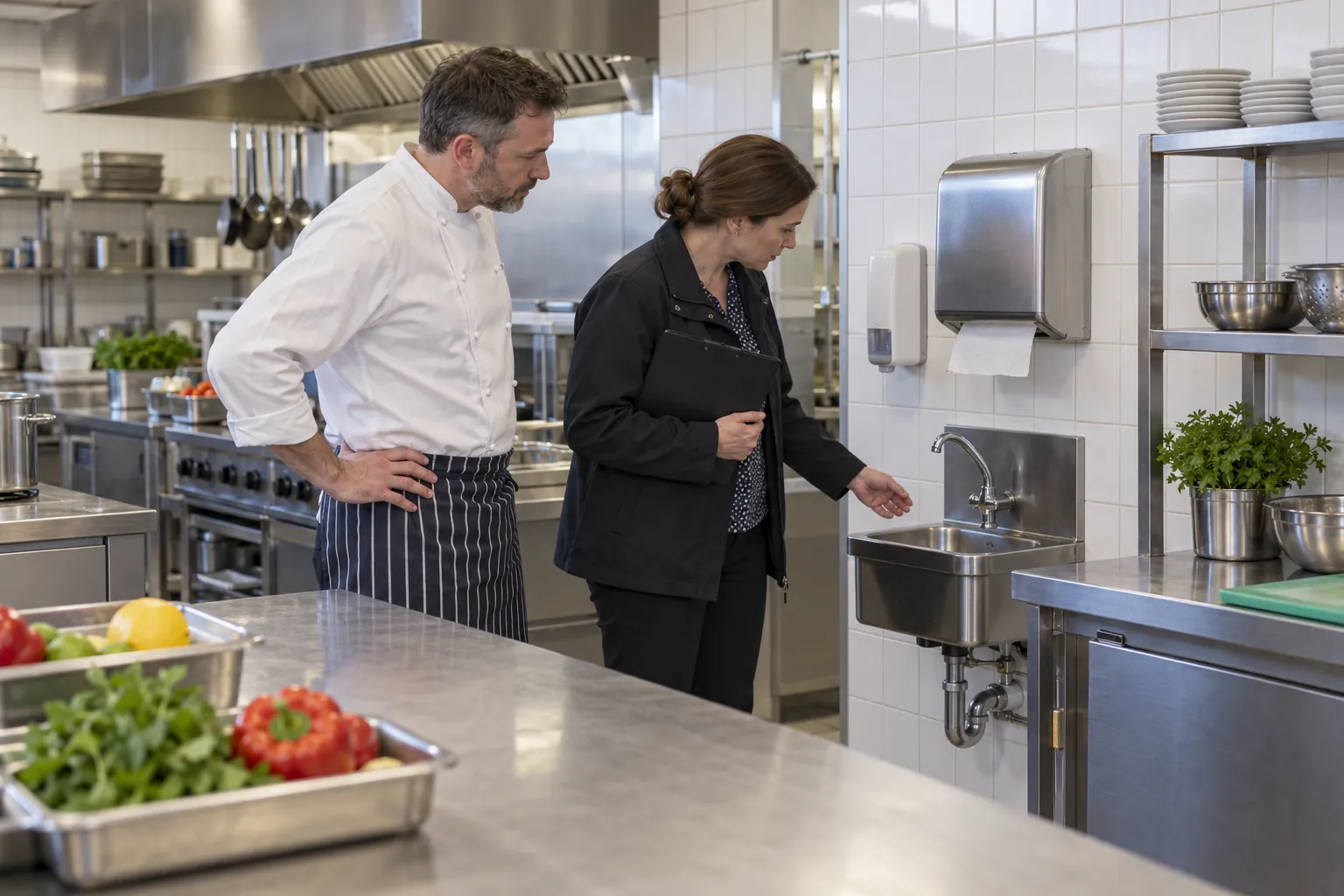
Inspections are normally unannounced, so the way to prepare is not a tidy-up the night before but a kitchen, records and everyday practices that hold up on any day. This guide covers the law behind the visit, what the officer looks at, the records to have ready, how the 0 to 5 rating is worked out, and what follows.
01
What an EHO inspection is, and the law behind it
A food hygiene inspection is an official control carried out by the local council. Environmental health officers (EHOs) and food safety officers authorised by the local authority carry out the visit; kitchens call both the EHO. Caterers and food retailers of every kind are inspected: the FSA's Food Hygiene Rating Scheme page lists canteens, schools, hospitals, care homes and food shops as well as restaurants and takeaways. GOV.UK's page on food inspections says you can be inspected at any point in the food production and distribution process.
The visit rests on a short list of instruments:
- Powers of entry. Section 32 of the Food Safety Act 1990 lets an authorised officer enter premises at all reasonable hours. The officer may inspect records in any form, including those held on a computer, require electronic records to be produced in a form that can be taken away, and seize records needed as evidence.
- The hygiene rules themselves. Annex II of Regulation (EC) No 852/2004, the assimilated food hygiene regulation, says that "food premises are to be kept clean and maintained in good repair and condition", and covers hand-washing, lighting, ventilation, waste, personal hygiene and training.
- Food safety management. Article 5 of the same regulation requires a food business operator to "put in place, implement and maintain a permanent procedure or procedures based on the HACCP principles", with documents and records commensurate with the nature and size of the business.
- How councils inspect. The Food Standards Agency's Food Law Code of Practice (England), issued on 23 October 2025, tells councils how to plan and carry out official controls, including that they are "performed without prior notice, except where notice is necessary and duly justified".
In England, Wales and Northern Ireland the result is a food hygiene rating from 0 to 5. Display is voluntary in England. In Wales, under section 7 of the Food Hygiene Rating (Wales) Act 2013, and in Northern Ireland, under section 7 of the Food Hygiene Rating Act (Northern Ireland) 2016, it is a legal duty, and the FSA's guidance says the rating goes at or near each customer entrance. Every rating is also published online, where customers can look it up. Scotland runs the Food Hygiene Information Scheme, where the result is Pass or Improvement Required.
02
What the officer checks: the inspection checklist
The FSA's Food Hygiene Rating Scheme guidance for businesses names three elements: "how hygienically the food is handled – how it is prepared, cooked, re-heated, cooled and stored"; "the physical condition of your business – including cleanliness, layout, lighting, ventilation, pest control and other facilities"; and "how you manage ways of keeping food safe, looking at processes, training, and systems to ensure good hygiene is maintained". A practical EHO checklist follows the same three headings.
- Hygienic food handling. Temperature control in fridges, freezers and display, and when cooking, cooling, reheating and hot holding; raw and ready-to-eat food kept apart in storage and preparation, with separate equipment where the method needs it; date marks; handwashing at the right times; clean protective clothing; cloths used as the safe method says.
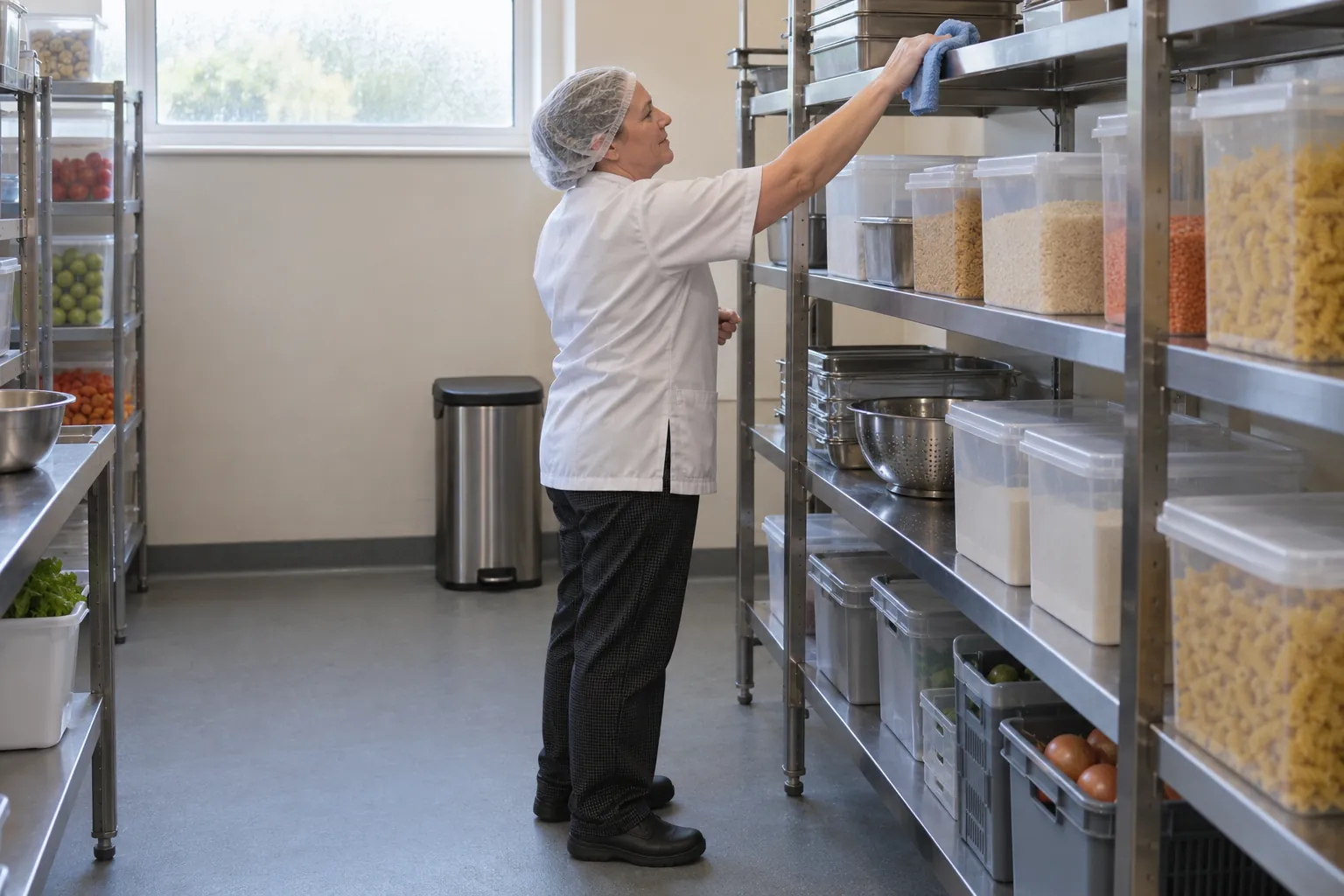
- The physical condition of the premises. Cleanliness of surfaces, equipment, floors, walls and the places behind and under equipment; surfaces in good enough repair to clean; wash-hand basins with hot and cold water, soap and drying; lighting and ventilation; pest proofing and any sign of pests; waste removed before it builds up; cleaning chemicals stored safely.
- Confidence in management. A documented food safety management system that fits the business, such as the FSA's free Safer food, better business pack for caterers or a HACCP plan; records that are kept and current; staff trained and supervised for the work they do; and whether last time's advice was acted on.
The environmental health officer will look and ask: how a dish is cooled, where the probe thermometer is and how it is checked, what happens when a fridge runs warm, who trains a new starter. Officers may also take samples and photographs. Expect them in the stores, the wash-up, the staff toilets and the bin area, not only at the pass.
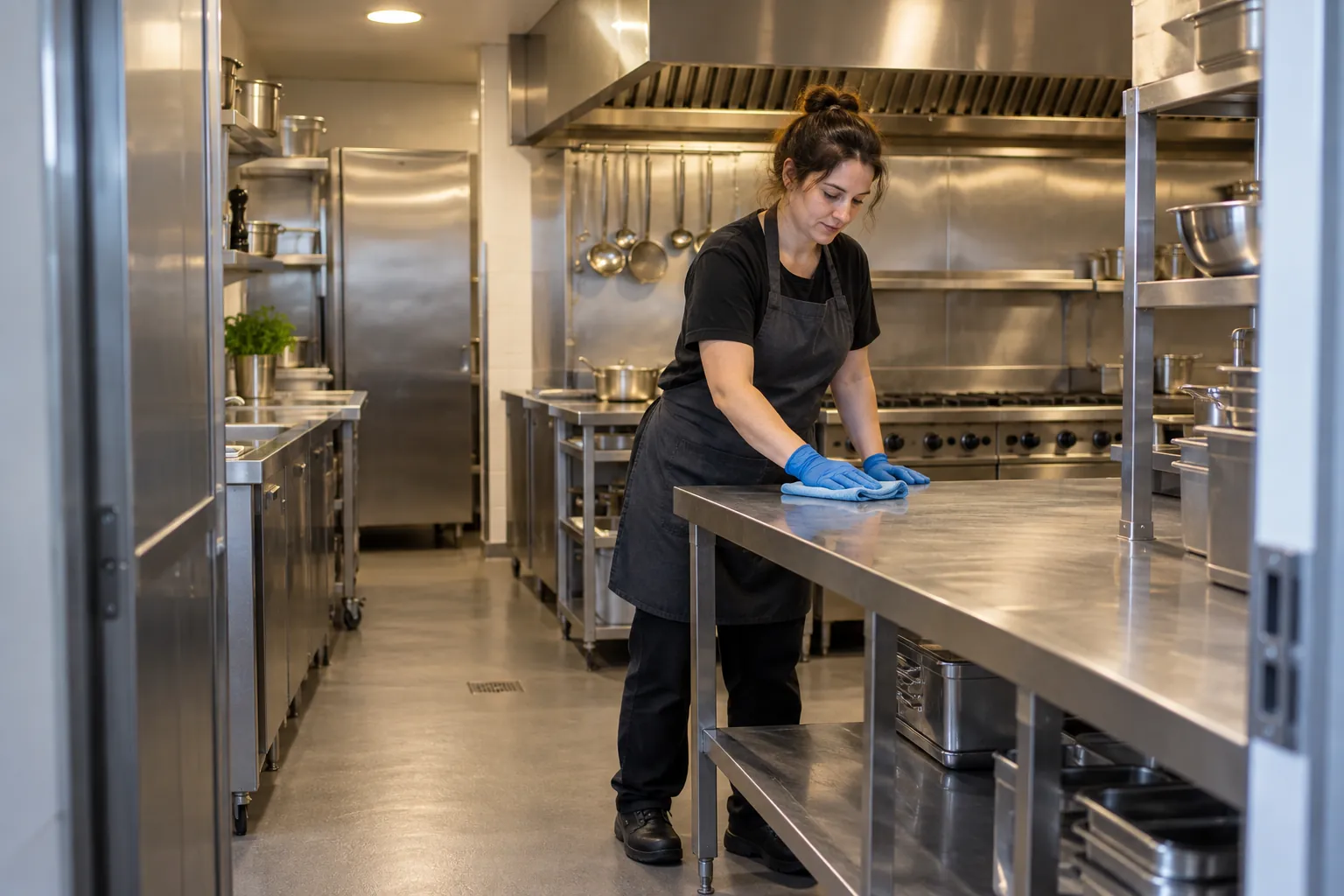
The cleaning element is where many kitchens lose marks without noticing. GOV.UK's food hygiene cleaning guidance says you must be able to prove that you are cleaning effectively, that the cleaning schedule must cover what needs to be cleaned or disinfected, how often and with which products, and that disinfectants should carry BS EN 1276 or BS EN 13697 on the label. Our guide to the restaurant cleaning checklist covers the tasks themselves.
03
The records to have ready, and preparing for an EHO inspection
Under section 32 the officer can ask for any food business record, on paper or on screen. What you need depends on your system and size; for a small business with only basic hazards, the Code of Practice says documentation "may not be necessary under the flexibility afforded by article 5". For most caterers, though, the officer will expect to see:
- The food safety management system: the completed SFBB safe methods, or the HACCP plan with its hazards, critical control points, limits and corrective actions.
- The day-to-day records the system calls for. In the SFBB caterers pack: opening and closing checks, the diary, the 4-weekly review and the cleaning schedule.
- Temperature records where your method relies on them, and the cleaning schedule and its record: what is cleaned, how often, with which product, by whom and when.
- Training records for each food handler, because Annex II, Chapter XII requires food handlers to be "supervised and instructed and/or trained in food hygiene matters commensurate with their work activity".
- Contractor reports: pest control visits and equipment maintenance.
- The last inspection report, with what was done about each point and when.
Because the visit is usually unannounced, preparing for an EHO inspection means making the ordinary day inspection-ready rather than staging one:
- Read your last inspection report and close every point, with evidence that it was closed.
- Walk the premises as the officer would, from deliveries to the bin store, using the three headings above.
- Check that the records are filled in on the day, by the person who did the work, and that a missed check is written down as missed, with what was done to correct it.
- Make sure whoever is in charge on every shift, including the manager's day off, can find the records and explain the safe methods, and that the whole team knows them.
- Put periodic cleaning on the schedule with dates, and fix small faults such as cracked tiles before they become a pattern.
- Ask a colleague to run regular internal checks against the same headings; our guide to the hygiene audit covers how.
04
How the food hygiene rating is worked out
The rating comes from the intervention rating scheme in Annex 1 of the Food Law Code of Practice. The officer scores compliance with food hygiene and safety procedures from 0 to 25, compliance with structural requirements, including cleanliness, from 0 to 25, and confidence in management from 0 to 30. Low is good: 0 means a high standard.
The FSA's Food Hygiene Rating Scheme Brand Standard (Revision 8, June 2023) then maps the three scores to a rating, using both the total and the highest single score:
- 5, very good: total 0 to 15, with no individual score above 5.
- 4, good: total 20, with no individual score above 10.
- 3, generally satisfactory: total 25 to 30, with no individual score above 10.
- 2, improvement necessary: total 35 to 40, with no individual score above 15.
- 1, major improvement necessary: total 45 to 50, with no individual score above 20.
- 0, urgent improvement necessary: total above 50.
If one score is higher than its column allows, the rating drops until it fits. A business scoring 0, 5 and 10 has a total of 15, but because one score is above 5 it is rated 4, not 5. The Brand Standard adds that "any business should be able to achieve the top rating as it requires basic compliance with food hygiene law".
The Brand Standard's descriptions show what the structural scores look like in practice. A score of 10 might mean "some cracked and missing wall tiles near to a food preparation surface" or food-contact surfaces thoroughly cleaned but "some areas where cleaning inadequate and needs to be improved". A score of 5 might mean "a few cracked wall tiles in a non-critical area, a minor lapse in cleaning of a hard to reach/inaccessible area".
Confidence in management is a judgement about the future. The Code asks the officer to weigh the track record and complaint history, the "willingness to act on previous advice and enforcement", management's attitude, hygiene and HACCP knowledge, and whether the food safety procedures are satisfactory. Effective self-checks score well; a thick folder does not.
The same scheme sets how often you are inspected, adding a potential hazard score for the food, the processes and the consumers at risk, with extra weight for vulnerable groups such as the under-fives. Annex 1 of the Code runs from category A, at least every 6 months, to category E, at least every 36 months; the FSA's business guidance says the gap between inspections varies from six months for the highest-risk businesses to two years for lower-risk ones.
05
After the inspection: the report, notices, appeals and re-rating
The FSA's business guidance says you will be told your rating in writing "at the time of inspection or within 14 days of it", and that the officer will explain what you can do to improve it. For a lower rating, the letter sets out the improvements needed and when.
Where things are serious, the council can take formal action. In England, a hygiene improvement notice under regulation 6 of the Food Safety and Hygiene (England) Regulations 2013 must state the officer's grounds, specify the failures and the measures needed, and give a period of not less than 14 days to put them right. Where a process, a piece of equipment or the state of the premises involves an imminent risk of injury to health, an officer can serve a hygiene emergency prohibition notice under regulation 8 of the Food Safety and Hygiene (England) Regulations 2013, prohibiting the use of that process, equipment or premises.
The rating scheme has three safeguards for the business, all set out in the FSA's guidance for businesses:
- Appeal. If you think the rating is wrong, appeal in writing within 21 days of being notified. The council's lead officer for food or their deputy decides, not the officer who gave the rating, within 21 days of receiving it.
- Right to reply. You can publish a response, for example on what you have since put right, shown online beside your rating until the next one.
- Re-rating. Once you have accepted the rating and made all the improvements, you can ask for a re-rating inspection. Some councils in England charge for it; where they do, or where you ask after the first three months, the visit is within three months, without a set date. In Wales and Northern Ireland it is within three months of your written request.
06
Where the record fails, and where SiteClara fits
Records are how an officer judges the days they were not there. The weak points are familiar: a cleaning schedule initialled for the whole week on Monday, a diary filled in from memory before the 4-weekly review, closing checklists ticked by whoever locked up, and a fault noticed by three people and reported by none. An entry that cannot be true does more harm than a gap, because it tells the officer the record cannot be relied on, and confidence in management is that judgement. As our guide to the cleaning sign-off sheet explains, the sheet on the back of the door records a signature, not the work.
SiteClara records routine checks as they happen. A printed QR poster at each location, with an optional NFC tag, lets enrolled staff confirm a scheduled check on their own phone, with no app to install: they answer the task checklist for that place, mark it done, or say what stopped them. They can report an issue, such as a cracked tile, with a note and a photo, and it stays on the team's list of jobs until someone closes it. The supervisor sees what was due, done and missed, reviews the day's report, and the approved report goes to nominated managers or the client at 8am the next morning.
In a kitchen it can be the working record of the cleaning schedule and the faults found along the way, each entry made at the place and time by the person who did the work. The food safety management records the law requires stay where the business keeps them.
07
Questions people ask
What questions are typically asked during an EHO inspection?
The Food Law Code of Practice (England) tells officers to gather information from observations, examinations and discussions with the food business operator and their employees, to assess the food safety management system and how it is put into practice, and to question staff who have been given specific responsibilities for compliance, to verify that they understand their duties and are carrying them out effectively. The officer then discusses with you anything that does not comply, the corrective action needed and the timescale for it.
How do you pass an EHO inspection?
In England, Wales and Northern Ireland there is no pass or fail: the business is given a food hygiene rating from 0 to 5. The FSA's Food Hygiene Rating Scheme guidance for businesses says all businesses should be able to achieve the top rating of 5, and that to get it you must do well in all three elements: food handling, the physical condition of the premises and how food safety is managed. After a low rating you must make urgent or major improvements to hygiene standards, and where hygiene standards are very poor and food may be unsafe to eat, the officer can stop part of the business or close it down until it is safe to reopen.
How does an EHO inspection work in Scotland?
Every food outlet in Scotland has a food hygiene inspection by its local authority. Under Food Standards Scotland's Food Hygiene Information Scheme the result is Pass, meaning the business meets the legal requirements for food hygiene, or Improvement Required, meaning it does not and needs to make improvements. The business is given a certificate or sticker to display, and every result is published on the Food Standards Scotland website.
Do EHOs give notice before an inspection?
Usually not, and EHOs can enter at all reasonable hours. The Food Law Code of Practice (England) says official controls are performed without prior notice, except where notice is necessary and duly justified. Under section 32 of the Food Safety Act 1990, entry to premises used only as a private dwelling-house cannot be demanded as of right without 24 hours' notice to the occupier.
08
Official guidance, and an EHO checklist to take away
Read the FSA's Food Hygiene Rating Scheme guidance for businesses, then the Safer food, better business pack for caterers and GOV.UK's food hygiene cleaning guidance, and for scoring, Annex 1 of the Food Law Code of Practice (England) and the Brand Standard. In Scotland, see Food Standards Scotland's Food Hygiene Information Scheme.
Before the next inspection, check that:
- every point in the last inspection report is closed, with evidence;
- fridge, cooking, cooling and hot-holding temperatures are controlled and recorded where your method needs it;
- raw and ready-to-eat foods are kept apart in storage, preparation and equipment;
- wash-hand basins have hot and cold water, soap and drying, and are clear of clutter;
- the cleaning schedule names the item, frequency, product and person, and the record is filled in on the day;
- pest proofing is sound and the pest contractor's recommendations are done;
- the food safety management system matches what the kitchen does now;
- each food handler's training is recorded, and the person in charge on every shift can explain the safe methods.
Sources
Every document this guide quotes or links to, in the order it first cites them.
- Food Hygiene Rating Scheme gov.uk
- Food inspections gov.uk
- Section 32 of the Food Safety Act 1990 legislation.gov.uk
- Annex II of Regulation (EC) No 852/2004 legislation.gov.uk
- Article 5 of the same regulation legislation.gov.uk
- Food Law Code of Practice (England) gov.uk
- Section 7 of the Food Hygiene Rating (Wales) Act 2013 legislation.gov.uk
- Section 7 of the Food Hygiene Rating Act (Northern Ireland) 2016 legislation.gov.uk
- Food Hygiene Information Scheme foodstandards.gov.scot
- Food Hygiene Rating Scheme guidance for businesses gov.uk
- Safer food, better business pack for caterers gov.uk
- Food hygiene cleaning guidance gov.uk
- Food Hygiene Rating Scheme Brand Standard gov.uk
- Regulation 6 of the Food Safety and Hygiene (England) Regulations 2013 legislation.gov.uk
- Regulation 8 of the Food Safety and Hygiene (England) Regulations 2013 legislation.gov.uk
Related guides
 CleaningRestaurant cleaning checklist: daily work and a useful recordA UK restaurant cleaning checklist for kitchen and front of house, with daily, weekly and periodic tasks, safe cleaning methods and a worked cleaning record.
 CleaningHygiene audit: what is checked, who does it, and what happens nextHow hygiene and infection prevention audits work in care, healthcare, schools and food areas: what is audited, by whom, how it is scored and what follows.
 CleaningCleaning sign-off sheet: who signs it, and what a signature meansWhat a cleaning sign-off sheet should record in kitchens, food areas, rooms and end-of-clean handovers, who should sign it, and what each signature proves.
 CleaningCOSHH assessment: the five steps, and the checks that keep it trueWhat a COSHH assessment is, the five steps, what to record for cleaning products, how to keep a COSHH register, and the checks that keep the controls working.