Cleaning
Health inspection checklist: what the health inspector looks for, and the records behind it
A health inspection checklist is the list of what a state or local health inspector checks in a restaurant or other food establishment: the foodborne illness risk factors and public health interventions, such as handwashing, cooking, cooling and holding temperatures, and the good retail practices that cover cleaning, pest control, plumbing and the physical facility, as laid out in the FDA Food Code's model inspection report.
Also written for United Kingdom
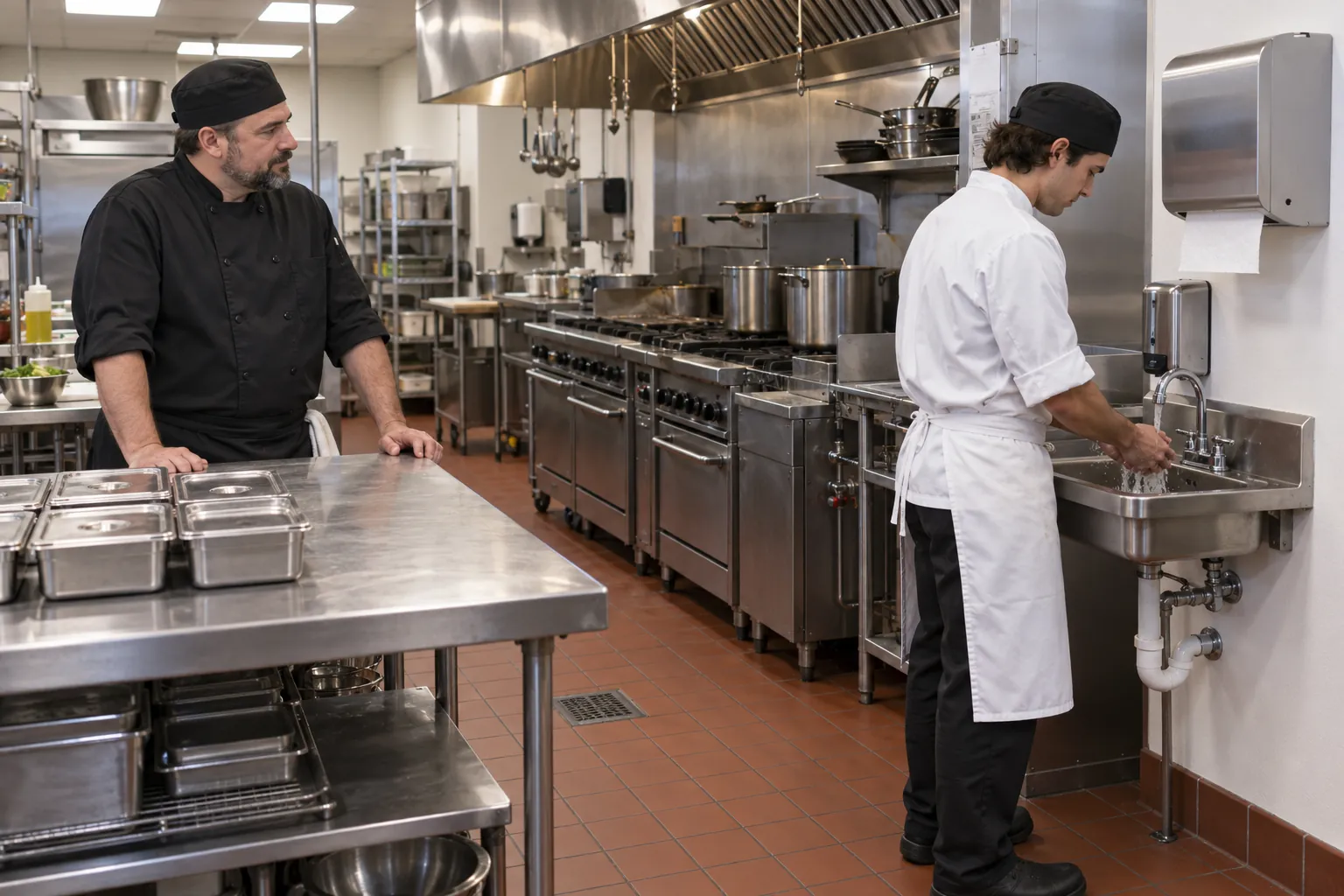
Your health department enforces its own adopted code, not the FDA model itself, so the details vary by state, county and city. This guide covers the law behind the visit, what the inspector marks, how violations are classed and corrected, the records to have ready, and a self-inspection you can run on any day.
01
What a health inspection is, and the code behind it
A restaurant health inspection is carried out by the state, county or city health department that issued the food establishment's permit, usually by an inspector called an environmental health specialist or sanitarian, and the same rules reach school cafeterias, hospital kitchens, contract food service, grocery delis, food trucks and other retail food establishments. There is no single federal restaurant code. The FDA Food Code 2026 is, in FDA's words, a model "offered for adoption by local, state, tribal, territorial, and federal governmental jurisdictions", and each jurisdiction adopts it by law, often with its own amendments.
Adoption lags the model. FDA's summary of Food Code adoption by state and territorial agencies, from its 2024 annual report, found 11 state agencies in 7 states on the 2022 edition, then the latest, and 46 state agencies in 36 states on the 2022, 2017 or 2013 edition. Find the code your health department enforces through FDA's state retail and food service codes and regulations by state. Section numbers below are the 2026 model's.
Three provisions of the model shape the visit:
- Access. Under section 8-402.11 of the full text of the FDA Food Code 2026, once the inspector shows credentials and states the purpose of the inspection, the person in charge must allow access, inspection and the records the code requires "during the food establishment's hours of operation and other reasonable times". Access is a condition of keeping the permit under section 8-304.11(F).
- Frequency. Section 8-401.10 says the regulatory authority "shall inspect a food establishment at least once every 6 months", with a longer interval allowed under a written risk-based schedule or for low-risk operations such as coffee and packaged snacks. Section 8-401.20 adds more frequent inspections for a poor compliance history, valid complaints, riskier foods and processes, and highly susceptible populations.
- Who must be there. Section 2-101.11 requires a person in charge to be present "during all hours of operation", and section 2-102.12 requires that person to be a certified food protection manager; under the 2026 model, both can be waived for an operation the authority deems minimal risk.
02
What health inspectors look for: the inspection report
Annex 7 of the Food Code contains Form 3-A, the model Food Establishment Inspection Report, which FDA calls "the official regulatory authority document regarding compliance of the establishment". Health departments issue their own forms; Texas, for example, publishes its own inspection report and 56-item marking instructions on the Texas DSHS retail food establishment forms and publications page. The model report has two parts.
Foodborne illness risk factors and public health interventions, items 1 to 29. Guide 3-B, the marking instructions, describes risk factors as "food preparation practices and employee behaviors most commonly reported to the Centers for Disease Control and Prevention (CDC) as contributing factors in foodborne illness outbreaks": food from unsafe sources, improper holding temperatures, inadequate cooking, contaminated equipment and poor personal hygiene. The inspector marks each item IN, OUT, not observed or not applicable:
- Supervision: a person in charge who is present, knowledgeable and doing the job; a certified food protection manager.
- Employee health: staff know to report illness; restriction and exclusion used properly; illness documented.
- Hygiene and hands: hands clean and properly washed; no bare hand contact with ready-to-eat food; handwashing sinks supplied and accessible.
- Approved source: food from approved sources, received at the right temperature and in good condition; shellfish and parasite-destruction records.
- Protection from contamination: food separated and protected; food-contact surfaces cleaned and sanitized; unsafe food discarded.
- Time and temperature: cooking, reheating, cooling, hot and cold holding; date marking; time as a public health control.
- The rest: the consumer advisory for raw or undercooked food; rules for highly susceptible populations; additives and toxic substances; and any variance or HACCP plan.
Good retail practices, items 30 to 56. The guide calls these "systems to control basic operational and sanitation conditions within a facility": accurate thermometers; no insects, rodents or animals; wiping cloths and in-use utensils properly stored; warewashing facilities maintained and used, with test strips; clean nonfood-contact surfaces; hot and cold water, plumbing and backflow devices; toilet facilities, garbage and the physical facility clean and maintained; ventilation and lighting. Inspectors are asked to look "for trends versus an isolated incident".
For each item marked OUT, the inspector notes whether it was corrected on site (COS) and whether it repeats a violation on the last report (R). The items reach the walk-in, the dish room, the restrooms and the dumpster area, not only the line.
03
Priority, priority foundation and core violations, and the clock for fixing them
Every provision of the Food Code carries one of three designations, defined in section 1-201.10:
- Priority (P). A provision that "contributes directly to the elimination, prevention or reduction to an acceptable level, hazards associated with foodborne illness or injury", including "cooking, reheating, cooling, handwashing".
- Priority foundation (Pf). A provision that "supports, facilitates or enables one or more priority items", such as "personnel training, infrastructure or necessary equipment, HACCP plans, documentation or record keeping, and labeling".
- Core (C). Everything else, usually "general sanitation, operational controls, sanitation standard operating procedures (SSOPs), facilities or structures, equipment design, or general maintenance".
The designation sets the deadline. Under section 8-405.11 of the 2026 Food Code, a priority or priority foundation violation must be corrected at the time of inspection, unless the inspector agrees to a longer time frame of no more than 72 hours for a priority item or 10 calendar days for a priority foundation item. The inspector then verifies the correction. Under section 8-406.11, core items must be corrected by a date the inspector sets, but "no later than 90 calendar days after the inspection", unless a written compliance schedule is approved.
Some conditions stop the operation. Section 8-404.11 requires the permit holder to "immediately discontinue operations and notify the regulatory authority" if an imminent health hazard may exist, such as a fire, flood, sewage backup, extended loss of power or water, or an apparent foodborne illness outbreak. Areas the hazard does not affect may keep operating, and with an approved written emergency operating plan the authority may agree to continued operations through an extended power or water outage. Operations resume only with the authority's approval.
At the end of the visit the inspector hands over the report and asks for a signed acknowledgment of receipt, which, under section 8-403.40, "is not an agreement with findings". Section 8-403.50 makes the report a public document, and some departments publish inspection reports online.
The model leaves scoring optional, so the headline result varies. Some departments list violations; some score in points or percentages; some post grades. New York City's letter grading for restaurants, for example, gives an A for 0 to 13 points, a B for 14 to 27 and a C for 28 or more, and grade cards "must be posted where they can easily be seen by people passing by". Check how your department scores, re-inspects and hears appeals.
04
The records and people to have ready
Inspectors judge the days they were not there from people and paper. Item 1 on the report asks whether the person in charge keeps active managerial control: section 2-103.11 of the 2026 Food Code includes "routinely monitoring the employees' handwashing" and "daily oversight of the employees' routine monitoring" of cooking, cooling and holding temperatures, which the marking instructions say must be "verified through observation that the systems or controls are actually being implemented". For most kitchens, have these ready:
- The permit, posted where customers can see it under section 8-304.11(A), and the last inspection report with what was done about each violation.
- The food protection manager certificate of each person in charge, and training records, since section 2-103.11(O) requires food safety training "including food allergy awareness".
- A written employee illness policy, new in the 2026 model: section 2-501.11 requires one, "available upon request", covering reportable symptoms and diagnoses, exclusion, restriction and reinstatement.
- Written procedures for cleaning up vomiting and diarrheal events, required by section 2-502.11.
- Temperature records where your system, a HACCP plan or your local code relies on them. They are the simplest evidence of the daily oversight section 2-103.11 asks for.
- Time as a public health control procedures, if you use time instead of temperature; section 3-501.19 requires them in writing, in advance, "made available to the regulatory authority upon request".
- Shellstock tags, kept for 90 calendar days under section 3-203.12, and parasite-destruction records for fish served raw.
- The cleaning schedule and its record, sanitizer test results and pest control service reports; section 6-501.111 requires routine inspection of the premises for evidence of pests.
A HACCP plan is needed only where section 8-201.13 or local law requires one, such as a process that needs a variance. FDA's Managing Food Safety manual for operators of food service and retail establishments shows how to apply HACCP principles voluntarily.
05
A health inspection checklist to run yourself
Because the inspector can arrive on any working day, preparing means running a self-inspection often enough that the ordinary day passes: a manager walks it weekly, and the person in charge covers temperatures and handwashing every shift. The numbers are the 2026 model's; your adopted code may differ.
- Person in charge. A certified food protection manager is on site and can explain how the kitchen cooks, cools, holds and sanitizes, and when an ill employee must be excluded.
- Handwashing. Every handwashing sink is accessible, stocked with soap and a means of drying hands, and used for nothing but handwashing, as section 5-205.11 requires.
- Receiving and storage. Deliveries checked on arrival; raw animal food stored below ready-to-eat food; food covered, labeled and off the floor.
- Cold holding. Time/temperature control for safety (TCS) food is held at 41°F or below, under section 3-501.16, with an accurate thermometer in each unit.
- Cooking and reheating. Under section 3-401.11, 145°F for 15 seconds for intact meat and fish, 155°F for 17 seconds for ground meat, 165°F for poultry; food reheated for hot holding reaches 165°F for 15 seconds, under section 3-403.11.
- Hot holding. TCS food is held at 135°F or above.
- Cooling. Cooked TCS food goes from 135°F to 70°F within 2 hours, and to 41°F or below within 6 hours in total, under section 3-501.14.
- Date marking. Ready-to-eat TCS food held over 24 hours is dated for use within 7 days at 41°F or below, the day of preparation counting as day 1, under section 3-501.17.
- Food-contact surfaces. Cleaned between raw and ready-to-eat work and, with TCS food, "throughout the day at least every four hours", under section 4-602.11(C); sanitizer tested with test strips.
- Chemicals. Toxic materials are labeled, and stored separately from food, equipment, utensils, linens and single-use articles and never above them, under section 7-201.11.
- Pests. No droppings, insects or gaps at doors and pipes; devices checked and dead pests removed; the pest control report acted on.
- Facility. Floors, walls and ceilings clean and in repair; light bulbs shielded or shatter-resistant where food is exposed, under section 6-202.11; restrooms supplied and clean; dumpster lids closed and the area clean; no leaks or standing water.
Record what you find, who will fix it and by when; a repeat means the method or the equipment needs to change. The master sanitation schedule guide covers periodic cleaning, and the restaurant cleaning checklist covers opening, service and closing.
06
Where the record fails, and where SiteClara fits
The inspector reads the records to decide whether the controls run on days nobody is watching. The weak points are familiar: a cleaning chart initialed for the whole week on Monday, a temperature log with the same number on every line, a closing check signed by whoever locked up, and a gap under the back door that three people noticed and nobody reported. A record that cannot be true does more harm than a gap, because it says the person in charge is not in control. As the pest sighting log guide explains, a problem written down and acted on is evidence of control.
SiteClara records routine checks as they happen. A printed QR poster at each location, with an optional NFC tag, lets enrolled staff confirm a scheduled check on their own phone, with no app to install: they answer the task checklist for that place, mark it done, or say what stopped them. They can report an issue, such as a broken door sweep or a dripping drain line, with a note and a photo, and it stays on the team's list of jobs until someone closes it. The supervisor sees what was due, done and missed, reviews the day's report, and the approved report goes to nominated managers or the client at 8am the next morning.
In a kitchen it can be the working record of the cleaning schedule, the walk-through checks and the faults found, each entry made at the place and time by the person who did the work. The records your adopted code requires stay where the business keeps them.
07
Questions people ask
How often do restaurants get health inspections?
At least once every 6 months under section 8-401.10 of the 2026 Food Code, unless the jurisdiction uses a written risk-based schedule, the establishment runs under an approved HACCP plan, or the operation is low risk. Your adopted code sets the actual interval, and complaints or a poor record bring more visits.
Can you fail a health inspection?
It depends on the jurisdiction. The FDA model report has no pass or fail and makes a score optional, so some departments list violations, some score in points or percentages, and some post letter grades. Under the model code, an imminent health hazard such as a sewage backup means stopping operations in the affected area and notifying the health department, and reopening only with its approval; an approved written emergency operating plan can allow some operations to continue through an extended power or water outage.
What are the most common health code violations for restaurants?
FDA's 2017-2018 report on the occurrence of foodborne illness risk factors in fast food and full-service restaurants found that "the two most commonly occurring risk factors were improper holding time and temperature, and poor personal hygiene", while inadequate cooking was the least often out of compliance. It also found that well-developed food safety management systems were "the strongest predictor that risk factors would be minimized". Your health department's own inspection results show which items it cites most locally.
Can you see restaurant inspections online?
Often, yes. The model Food Code makes the inspection report a public document, and many state, county and city health departments publish inspection reports and dates online. New York City's Food Establishment Inspections page, for example, says you can find "health inspection results for New York City's 29,000 restaurants on ABCEats, the City's restaurant inspection lookup tool". Elsewhere, search your health department's website for restaurant inspection results, or ask it for the report on the establishment inspected.
What does C mean on a restaurant?
In New York City, a C is the lowest letter grade. Under the city's letter grading for restaurants, the inspection is scored in points, and "28 or more points is a C", against 0 to 13 for an A and 14 to 27 for a B; the lower the score, the better the grade. Other cities and counties that post grades set their own scales, so check the health department that issued the card.
08
Official guidance, and a health inspection checklist to take away
Start with the code your health department enforces, found through FDA's state retail and food service codes and regulations by state, and ask the department for its inspection form and any self-inspection checklist it publishes. Then read the FDA Food Code 2026, especially Chapter 2 on management and personnel, Chapter 8 on inspections and Annex 7, Guide 3-B, the instructions for marking the Food Establishment Inspection Report, which show what each item on the report covers.
Before the next inspection, check that:
- the permit is posted and every violation on the last report is corrected, with evidence;
- a certified food protection manager is in charge on every shift;
- handwashing sinks are stocked, accessible and used only for handwashing;
- cold food is at 41°F or below, hot food at 135°F or above, and cooling meets the 2-hour and 6-hour limits;
- ready-to-eat TCS food is date marked and used within 7 days;
- food-contact surfaces are cleaned and sanitized on time, and sanitizer is tested;
- the written illness policy and vomit and diarrhea cleanup procedure are on site;
- the cleaning schedule is filled in on the day by the person who did the work.
Sources
Every document this guide quotes or links to, in the order it first cites them.
- FDA Food Code 2026 fda.gov
- Summary of Food Code adoption by state and territorial agencies fda.gov
- State retail and food service codes and regulations by state fda.gov
- The full text of the FDA Food Code 2026 fda.gov
- Texas DSHS retail food establishment forms and publications page dshs.texas.gov
- Letter grading for restaurants nyc.gov
- Managing Food Safety manual for operators of food service and retail establishments fda.gov
- 2017-2018 report on the occurrence of foodborne illness risk factors in fast food and full-service restaurants fda.gov
- Food Establishment Inspections page nyc.gov
Related guides
 CleaningRestaurant cleaning checklist: kitchen, dining room and closing checksA US restaurant cleaning checklist for opening, service and closing, with commercial kitchen tasks, food-contact cleaning, periodic work and supervisor checks.
 CleaningMaster sanitation schedule: building one, running it, and proving it happenedWhat a master sanitation schedule is, how it fits FDA 21 CFR 117 and USDA SSOPs, what goes on it, how often, who signs, and how to keep the record honest.
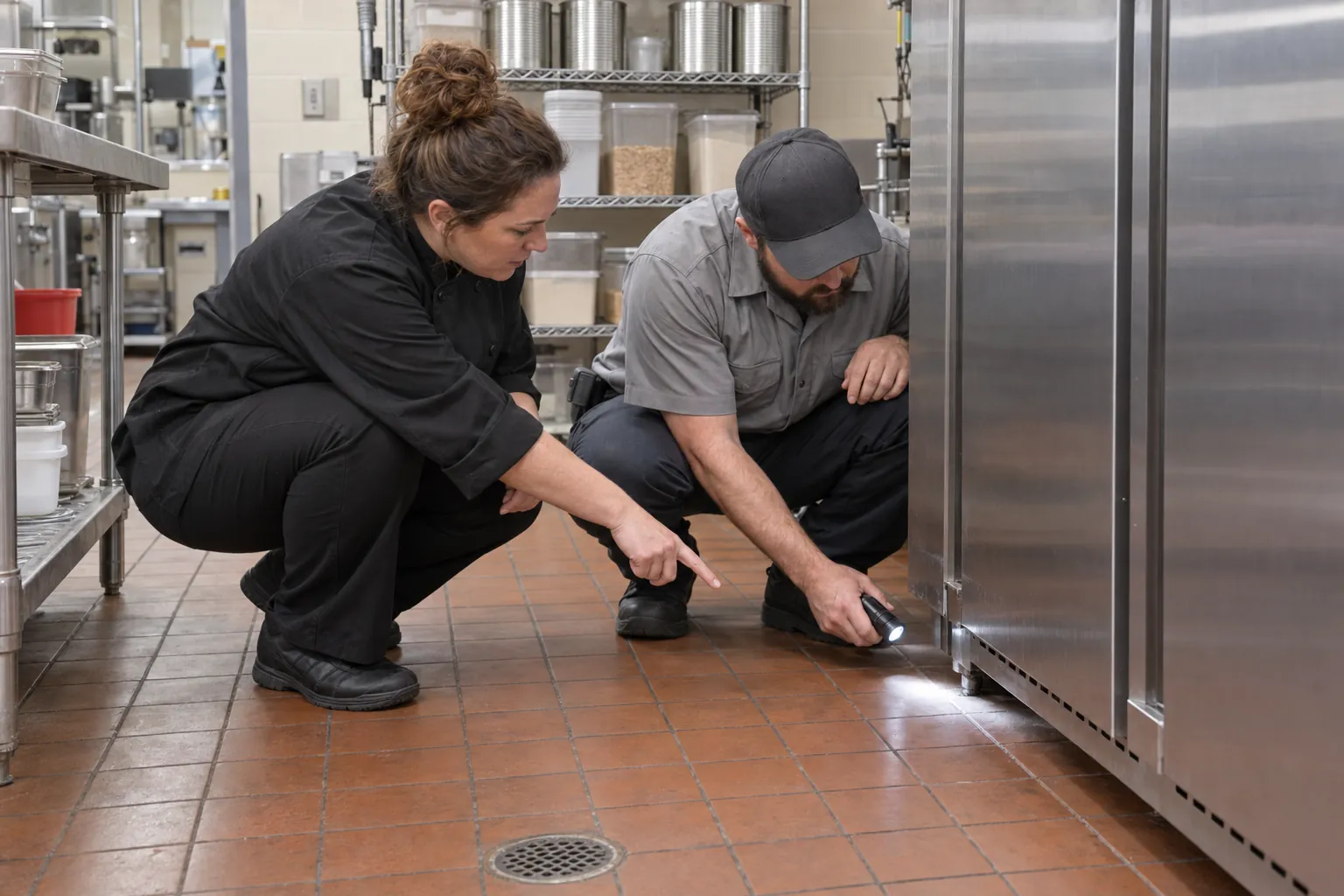 Premises and facilities managementPest sighting log: recording pest activity so it gets dealt withWhat a pest sighting log should record, who fills it in, how sightings reach your pest control provider, and the US rules behind it: FDA Food Code, OSHA and CMS.
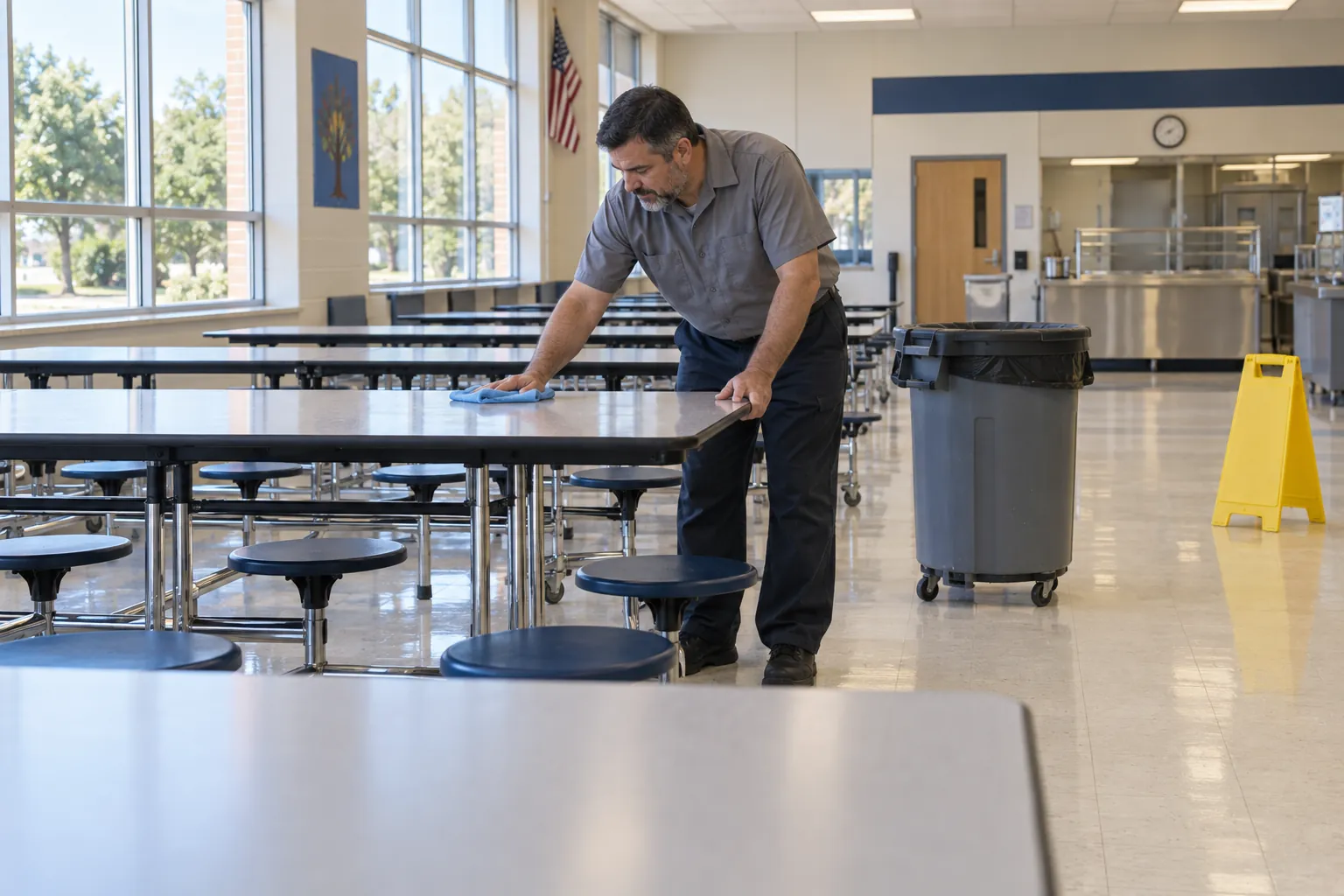 CleaningCafeteria cleaning checklist: what to clean, when, by whom, and how to show it was doneA cafeteria cleaning checklist built on the FDA Food Code: what to clean during service, between meals and at close, who does it, and the record that proves it.