Cleaning
Cleaning sign-off sheet: who signs it, and what a signature means
A cleaning sign-off sheet is a record that a named person finished a defined clean: it names the area and the tasks, and carries the date, the time the work was finished, the cleaner's signature and, where the work is checked, a supervisor's signature.
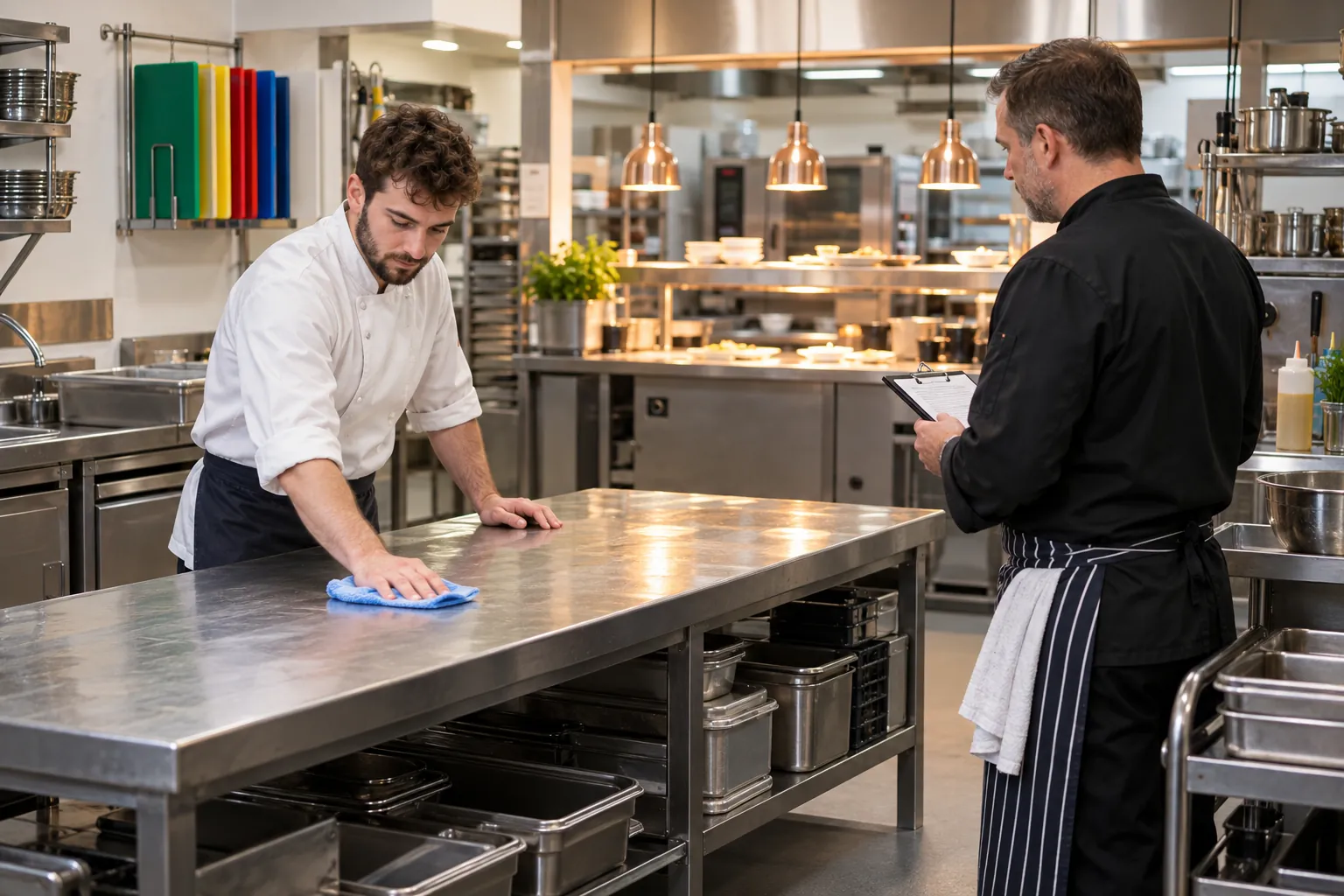
This guide covers where sign-off sheets are used, what they should record, who should sign, and what a signature on one can and cannot prove.
01
What a cleaning sign-off sheet is for
A cleaning sign-off sheet is a record that a defined clean was completed, by a named person, at a time, and, where there is a second signature, that someone else checked it. It differs from a toilet check sheet or a cleaning log that records repeated visits through the day. A sign-off sheet closes something: the end of a kitchen clean, a room made ready, a deep clean finished, an area handed back. It goes by several names – a cleaning sign off sheet, a completion sheet, a cleaning record – but the job is the same.
No regulation requires a sign-off sheet by that name. The duties it helps to evidence are these:
- Workplace cleanliness. In Great Britain, regulation 9 of the Workplace (Health, Safety and Welfare) Regulations 1992 requires every workplace and its furniture, furnishings and fittings to be kept sufficiently clean, and regulations 20 and 21 require toilets and washing facilities, and the rooms containing them, to be kept in a clean and orderly condition. Northern Ireland has equivalent regulations.
- Food hygiene. Food businesses must keep premises and equipment clean and have food safety procedures based on the principles of HACCP, under Regulation (EC) No 852/2004 on the hygiene of foodstuffs as it applies in the UK, and the Food Safety Act 1990. Records should be proportionate to the size of the business, and cleaning is one of the things an environmental health officer will ask about.
- Contracts. A cleaning contract or service level agreement often requires completed work to be recorded and signed, so the client can see that the specification is being delivered.
The value of the sheet lies in the signature. A tick says a box was marked. A name says a person is prepared to stand behind the statement that the work was done.
02
Where sign-off sheets are used
Sign-off sheets turn up wherever a clean needs to be finished before something else can happen:
- Kitchens and food areas. The daily cleaning schedule for a kitchen, café or food production area, and the closing checks at the end of service, signed by the person who did them and reviewed by the manager.
- Food production lines. A hygiene sign-off after the cleaning shift and before production restarts, often with a separate pre-start inspection by quality or production staff.
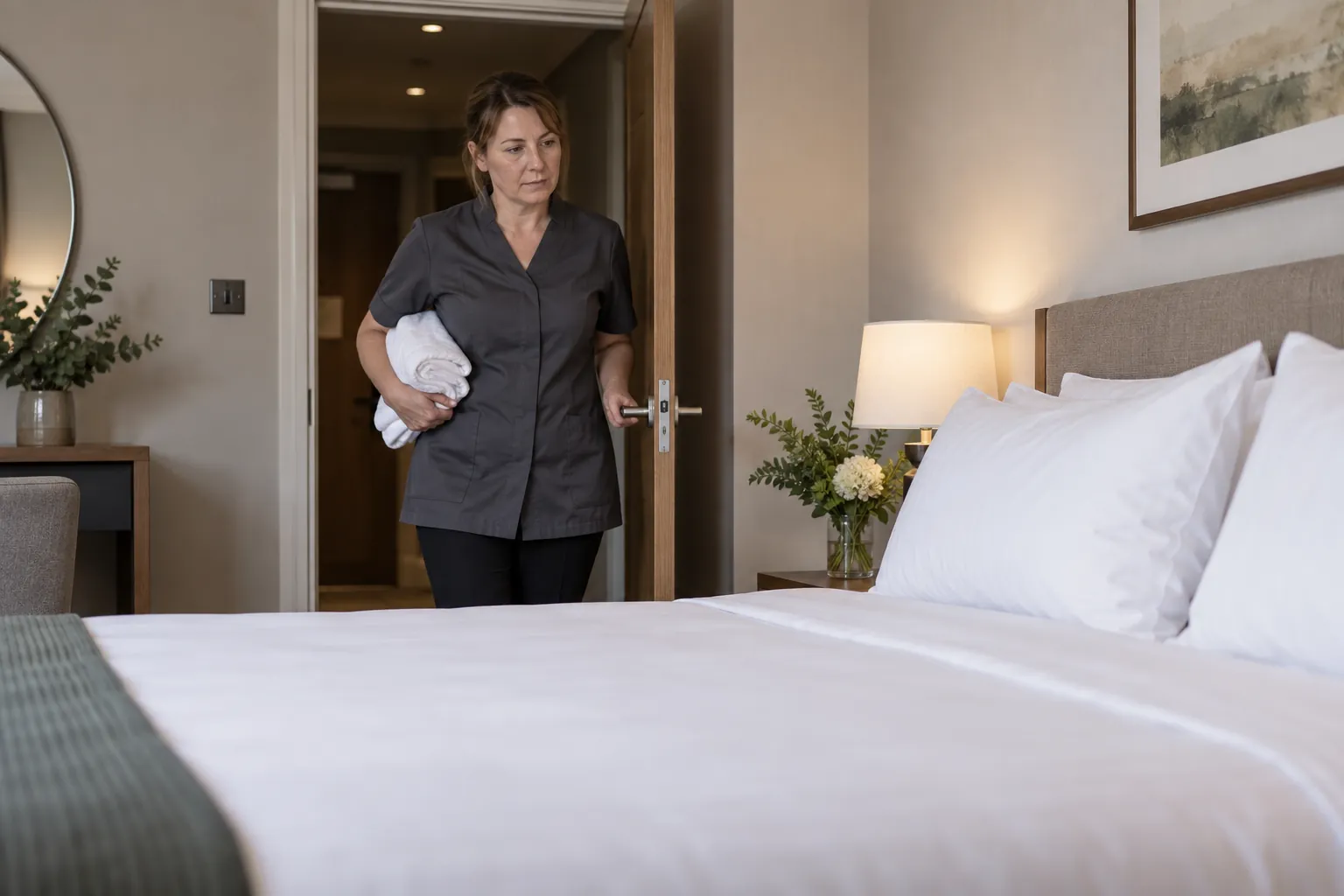
- Hotel rooms and serviced accommodation. A housekeeping sign-off for each bedroom cleaned, with laundry changed and supplies replaced, and a bathroom cleaning checklist for the en-suite, and a supervisor's inspection before the room is released for sale.
- Washrooms. The daily full toilet cleaning in a commercial bathroom or washroom, as distinct from the checks through the day recorded on the door sheet or bathroom cleaning log.
- Clinic rooms, treatment rooms and laboratories. A clean between sessions or at the end of the day, where the next user needs to know the room is ready.
- Deep cleans and periodic work. A kitchen deep clean, a carpet clean, a washroom descale or high-level dusting, signed off when complete so the next one can be scheduled.
- End-of-clean handover. A builders' clean before handover, a void unit made ready for a new tenant, an event venue returned after hire: the point where responsibility for the space passes from one party to another.
In each case the sheet answers a question someone else will ask later: was this done, by whom, when, and did anyone check?
03
What a cleaning sign-off sheet should record
Keep the sheet specific to the area. A printable sheet template, log template or PDF downloaded from the internet is a starting point, not a finished sheet; build a custom sheet for each area from it, and a generic cleaning checklist printed for every room is quicker to produce and slower to believe. Many sites use a daily sheet for frequent cleans and a monthly sheet, with a column for each day of the calendar month, for work done once a day or less. A useful sheet carries:
- The area: the room, kitchen, line or unit, named so there is no doubt which one.
- The tasks: each item listed separately, in the order they are done, with the method or product where it matters, for example the disinfectant and its contact time on a food contact surface.
- The date and the time finished, written when the work was finished.
- The name and signature or initials of the person who did the work, printed clearly enough to identify one person.
- Anything not done, and why: equipment in use, a room locked, a product out of stock.
- Faults and issues found: damage, a leak, pests, a broken seal, and who they were reported to.
- The checker's signature: a separate column for the supervisor or manager who inspected the work, with the time of their inspection.
- Corrective action: what happened when the check found a problem, and who signed it off the second time.
Keep a list of names, initials and signatures for everyone who signs, so that initials can be traced to a person months later. A cleaning log sheet whose initials nobody can identify is a record of nothing.
Where can I find a free cleaning checklist template?
For a catering kitchen, the Food Standards Agency's Safer food, better business for caterers pack, written for restaurants, cafés, takeaways and other small catering businesses and applying in England, Northern Ireland and Wales, includes a cleaning schedule that can be downloaded from GOV.UK as a PDF. In Scotland, Food Standards Scotland's CookSafe manual includes templates for writing house rules, among them a cleaning schedule. Both are food safety documents; for any other area, treat a download as a starting point and build the sheet from your own specification, with the columns listed above.
04
Who signs, and what a signature means
Most arguments about sign-off sheets are really arguments about what a signature was meant to say. It helps to be explicit, on the sheet or in the procedure, about what each signature means:
- The person who did the work signs to say: I completed these tasks, in this area, by this time, using the method specified. They sign for their own work only, never for a colleague, and never before the work is done.
- The supervisor or checker signs to say: I inspected this area at this time to verify that it met the standard. That is a different statement, and it should be made by someone who did not do the clean, after looking, not by initialling the whole sheet at the end of the week.
- The person accepting the space, in a handover, signs to say: I have seen the area and accept it in this condition, subject to any items listed. That transfers responsibility, so it should be done on a walk-round, not at a desk.
Just as important is what a signature does not mean. It does not mean the area is still clean an hour later. It does not mean every surface was disinfected unless the sheet says so. And a supervisor's signature does not turn a clean they never saw into a checked one.
Three practices undermine sign-off more than any others: signing in advance, so that the sheet shows work that has not happened yet; one person signing for a team, so that nobody can say who did which area; and signing the whole sheet at the end of a shift from memory. Each makes the record look complete while removing the thing it was meant to prove.
In food businesses, the Food Standards Agency's Safer Food, Better Business pack in England and Wales, CookSafe in Scotland and Safe Catering in Northern Ireland all rely on the same idea: the person responsible confirms that the daily checks and cleaning were done, and records the exceptions. The review of those records, by the manager of a café or a small business as much as a large kitchen, is what shows the food safety management system is working rather than simply filled in.
05
End-of-clean handover and acceptance
The handover sign-off is where the sheet matters most, because it is the point at which a dispute is either prevented or created. A final clean before a building opens, a rental unit handed back at the end of a lease, a production line released after a hygiene shutdown or a venue returned after an event all move responsibility from one party to another.
A handover that stands up usually has:
- An agreed standard in advance: what the space should look like, taken from the cleaning specification or the contract, not decided at the door.
- A joint walk-round with both parties present, area by area, rather than a signature sent by email.
- Dated photographs of each area as handed over, especially floors, kitchens, washrooms and anything already damaged.
- A snag list for anything not accepted, with a date for it to be put right and a second sign-off when it is.
- Both signatures, with names printed and the time, and a copy kept by each party.
If the receiving party refuses to sign, record that and why. An unsigned handover with a written reason is more useful later than a signature obtained under protest.
How long to keep sign-off sheets depends on the purpose. Food businesses should keep records long enough to show that their procedures are followed over time, and to answer an inspection or a complaint. Cleaning contractors usually keep them for as long as the contract or their insurer requires. Whatever period you choose, write it down, because a record thrown away last month cannot settle this month's disagreement.
06
Where the sign-off record fails, and what SiteClara does about it
Paper sign-off sheets fail in predictable ways. They are signed in batches at the end of a shift, they sit in a folder that the client never sees, the supervisor's column is completed in the office, and a missed clean is noticed only when the next person finds the area dirty. When a dispute arises weeks later, nobody can show whether a signature was written at 16:00 or at 21:00.
SiteClara records the completion at the place where the work was done. A printed QR poster at each area, with an optional NFC tag behind it, lets the member of staff scan or tap with their own phone, with no app to install, and mark the scheduled checks for that location done, or explain what stopped them. Their name and the time are recorded as it happens, and they can add a photo of the finished area. An issue found, such as damage or a fault, goes onto the team's list of jobs until someone closes it.
The supervisor sees what is due, done and missed, and can record the reason a check was missed. At the end of the day they review the totals and photos, add a note, record who was notified and approve the report, which goes to nominated management or client contacts at 8am the next morning, showing what was completed, what is still open and how scheduled checks went.
07
Further reading, and a list to take away
The Food Standards Agency publishes Safer Food, Better Business and guidance on cleaning and on controlling E. coli cross-contamination; Food Standards Scotland publishes CookSafe; and Safe Catering is the Northern Ireland pack. The Health and Safety Executive publishes the Approved Code of Practice Workplace health, safety and welfare (L24). The British Institute of Cleaning Science (BICSc) publishes training and standards for cleaning operatives.
Before you print or revise a cleaning sign-off sheet, check that:
- each sheet is for one named area, with the tasks listed in the order they are done;
- it records the time the work was finished, not the time it was due;
- every signature can be traced to one person, with a signature list kept;
- there is a separate column for a checker who did not do the work;
- tasks not done and faults found have somewhere to go;
- the procedure says what each signature means;
- handovers are signed on a joint walk-round, with photos and a snag list;
- someone reviews the sheets, and you know how long they are kept.
Sources
Every document this guide quotes or links to, in the order it first cites them.
- Workplace (Health, Safety and Welfare) Regulations 1992 legislation.gov.uk
- Regulation (EC) No 852/2004 on the hygiene of foodstuffs legislation.gov.uk
- Food Safety Act 1990 legislation.gov.uk
- Safer food, better business for caterers gov.uk
- CookSafe foodstandards.gov.scot
- Safer Food, Better Business gov.uk
- Safe Catering gov.uk
- Workplace health, safety and welfare hse.gov.uk
Related guides
 CleaningToilet check sheet: what to record and how to make it credibleWhat a washroom check sheet should record, how often to check, the legal duty behind it, and how to keep a record a client or inspector will believe.
 CleaningCleaning quality control: how to inspect, correct and prove the standardHow quality control works in commercial cleaning: QA versus QC, setting standards, running inspections, corrective action and a record that holds up.
 CleaningCommercial cleaning checklist: area by area, and how to use itA commercial cleaning checklist for offices and shared premises, area by area, with how to use it on shift, what to record and how a supervisor checks it.
 CleaningCleaning supervisor duties: what the role involves, and what good looks likeWhat a cleaning supervisor does: the main duties, a typical shift, health and safety, managing the team, checking the work and reporting to the client.