Fire and water checks
TMV testing: the temperature check, the fail-safe test and how often to do them
TMV testing is the routine check, made by a competent person to the manufacturer's instructions, that a thermostatic mixing valve still delivers water at its safe set temperature and shuts off the hot flow when the cold supply fails.
Also written for Australia
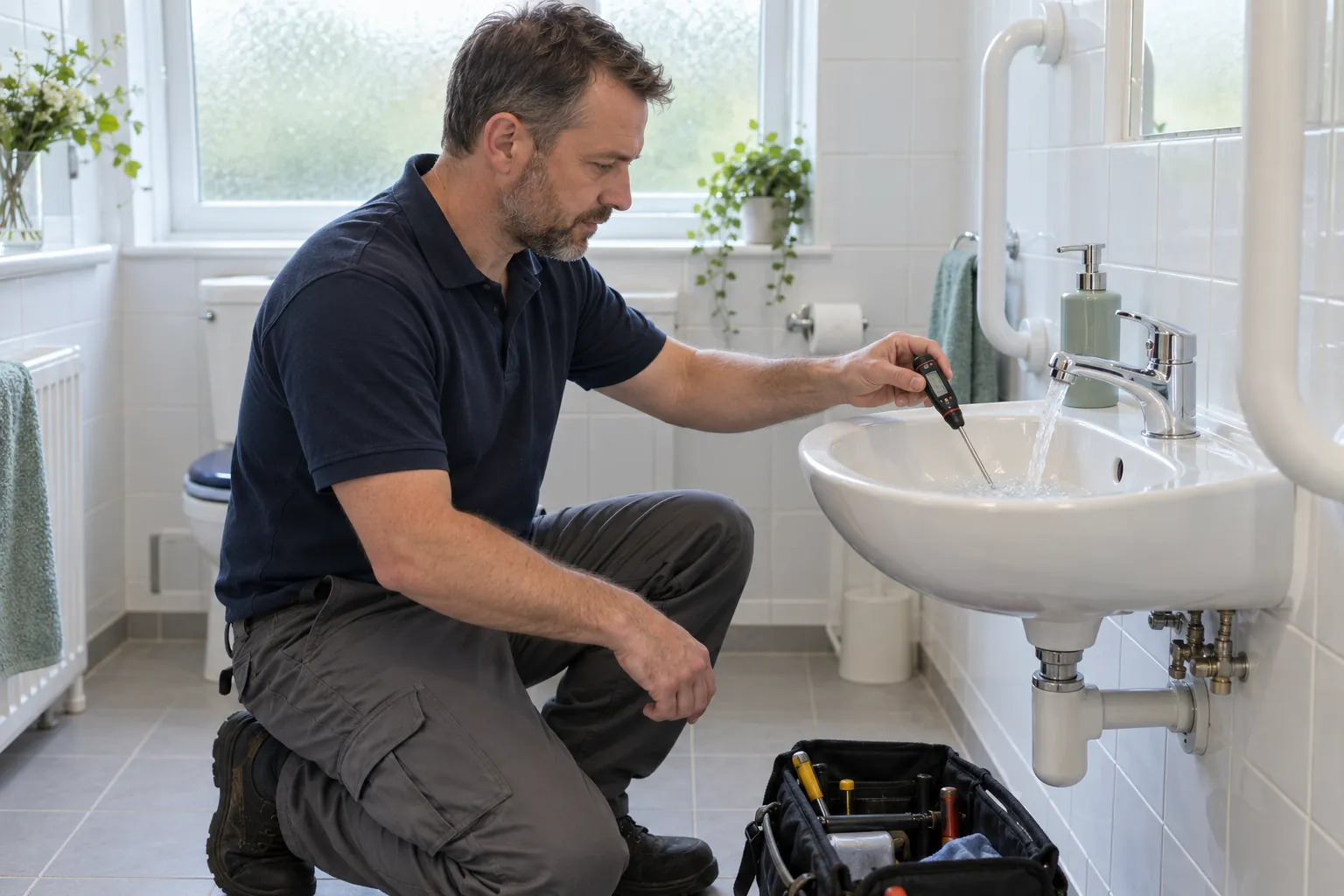
HSE's technical guidance HSG274 calls for that regular maintenance, and the NHS specification D 08 suggests, as a starting point where no other guidance applies, a first in-service test 6 to 8 weeks after commissioning and a second at 12 to 15 weeks. A TMV sits between the hot water a building needs to control legionella and the person under the shower who could be scalded by it. It only protects them while it works, and it drifts with scale, debris and changes in the supply. This guide covers what a TMV test involves, where valves are fitted, how often they are tested and serviced, who does what, and what the record should show.
01
What TMV testing is, and the duty behind it
Thermostatic mixing valves (TMVs) take hot and cold water and blend them to a set temperature. In the words of the Health and Safety Executive's technical guidance HSG274 Part 2: The control of legionella bacteria in hot and cold water systems (2014), TMVs "use a temperature sensitive element and blend hot and cold water to produce water at a temperature that safeguards against the risk of scalding, typically between 38 °C and 46 °C depending on outlet use".
Two risks pull in opposite directions. To control legionella, hot water is stored at 60 °C or above and distributed so that it reaches at least 50 °C at outlets within a minute (55 °C in healthcare premises). Water that hot can scald. HSE's information sheet Managing the risks from hot water and surfaces in health and social care (HSIS6) says that if water used for showering or bathing is above 44 °C there is an increased risk of serious injury or fatality. It says TMVs should ensure only safe water temperatures are available, and that healthcare standard controls and regular safety testing should ensure the equipment remains safe at all times.
No regulation names TMVs or sets a test date for them. The nearest is requirement G3(4) of the Building Regulations 2010, which in England limits the hot water delivered to a fixed bath in a new dwelling, or one formed by a material change of use, to 48 °C (see below); it says nothing about testing. The duty is the general one in health and safety law, which HSIS6 lists for care settings: section 3 of the Health and Safety at Work etc. Act 1974 (the duty to people who are not employees, such as residents, patients and pupils), regulation 3 of the Management of Health and Safety at Work Regulations 1999 (risk assessment) and the Provision and Use of Work Equipment Regulations 1998. The legionella side comes from the Approved Code of Practice L8, Legionnaires' disease: The control of legionella bacteria in water systems (fourth edition, 2013), with HSG274 as its technical guidance.
The guidance is clear about what that duty means for a valve once it is fitted:
- HSG274 Part 2 (paragraph 2.165): "To maintain protection against scald risk, TMVs require regular routine maintenance carried out by competent individuals in accordance with the manufacturer's instructions."
- HSE's page on scalding and burning in health and social care: "Outlet temperatures and TMVs should be monitored and maintained to ensure the controls are effective."
The valve is also a water fitting. In England and Wales regulation 4 of the Water Supply (Water Fittings) Regulations 1999 requires every water fitting to "be of an appropriate quality and standard" and to "be suitable for the circumstances in which it is used".
02
Where TMVs are fitted, and TMV2 against TMV3
Whether a TMV is needed at all is a risk assessment decision. HSG274 says the use and fitting of TMVs "should be informed by a comparative assessment of scalding risk versus the risk of infection from legionella", because the blended water downstream of a valve sits at a temperature where legionella can multiply. Where the scalding risk is insignificant, TMVs are not required. Where they are needed, HSG274 says they belong:
- On baths and showers, where whole-body immersion makes the scalding risk most serious, particularly for the very young and the elderly. HSG274 says TMVs should be fitted at these outlets.
- On washbasins and sinks where the risk assessment finds a significant scalding risk, for example where there are very young, very elderly, infirm or significantly mentally or physically disabled people, or people with sensory loss.
The valves themselves are approved in two classes, usually called TMV2 and TMV3 after the third-party certification schemes that test them:
- Type 2 (TMV2) valves can be overridden by the user. HSG274 notes that where the scalding risk is assessed as low, for example healthy users immersing their whole body, type 2 TMVs are required by building regulations.
- Type 3 (TMV3) valves are pre-set, cannot be overridden by the user and are fail-safe. HSG274 says they should be provided where the scalding risk is significant and are required at healthcare premises. HSIS6 adds that Type 3 is the standard in healthcare under the Department of Health's HTM 04-01, and that Type 3 TMVs should be installed when TMVs are replaced or in new installations.
For the 48 °C limit on a bath in a new home in England, Approved Document G: sanitation, hot water safety and water efficiency (paragraphs 3.65 and 3.66) says to use an in-line blending valve or other appropriate temperature control device, and that a blending valve can show its acceptability by compliance with standards such as BS EN 1111 (thermostatic mixing valves, PN 10) or BS EN 1287 (low pressure thermostatic mixing valves), demonstrating that 48 °C cannot be exceeded in operation and that the product will fail safe.
TMV3 approval means the valve meets Health Technical Memorandum 04-01 Supplement, Performance specification D 08: thermostatic mixing valves (healthcare premises) (2017 edition). Under D 08, Type 3 approval lasts five years before a full re-test, from a certification body accredited by UKAS. It also gives the maximum initial set temperature for each kind of outlet:
- bidet: 38 °C;
- shower and washbasin: 41 °C;
- bath: 44 °C for a valve designated for a 44 °C fill, or 46 °C for one designated for a 46 °C fill;
- bath and shower diverter: the bath fill as above, the shower at 41 °C.
03
What a TMV test involves: the temperature check and the fail-safe test
D 08 separates commissioning, when a new or replaced valve is checked against its supplies and set up, from the in-service test that follows at intervals for the rest of its life. Its stated purpose is "to maintain assured performance and to provide records of the thermal performance of the TMV". The in-service test sequence in D 08 (clause 11.2) runs:
- Measure the mixed water temperature at every outlet the valve serves, at the maximum available flow, and record it. If needed, the temperature may be readjusted up to the maximum for that outlet.
- Isolate the cold water supply to the valve and watch the outlet. This is the fail-safe test: a valve working properly shuts off the hot flow when the cold fails.
- If water is still flowing after 5 seconds, collect it in a graduated measuring vessel for 60 seconds. More than 120 ml means the valve needs recommissioning or service work.
- Restore the cold supply and, after 15 seconds, record the mixed water temperature again.
- Compare the two readings. If the temperature after restoration differs by more than 2 °C from the first reading, recheck the supply conditions or recommission: the valve is then readjusted and recommissioned to the manufacturer's instructions.
D 08's commissioning procedure also suggests checks around the test: the hot and cold supplies within the conditions for normal use (hot at least 55 °C and cold no more than 20 °C), strainers and check valves clean, isolating valves fully open, the valve installed to the manufacturer's instructions, and the valve's designation matching the outlet it serves. Its test record sheet asks about the strainers, check valves and isolating valves at every in-service test.
TMV servicing goes further than the test. HSG274 says the strainers or filters associated with TMVs should be inspected, cleaned, descaled and disinfected annually or at a frequency set by the risk assessment, taking account of the manufacturer's recommendations. Anything beyond that, and any recommissioning, follows the manufacturer's instructions for the valve fitted.
04
How often a TMV should be checked and serviced
No law sets a frequency. The risk assessment, the written scheme and the manufacturer's instructions set it, and the guidance gives a starting point for each kind of check.
The in-service test. Annex F of D 08 offers this procedure "in the absence of any other instruction or guidance":
- test the valve 6 to 8 weeks after commissioning, and again 12 to 15 weeks after commissioning;
- if neither test found a significant change in the mixed water temperature (for example 1 K), the next test can be deferred to 24 to 28 weeks after commissioning;
- if a small change (for example 1 to 2 K) needed adjusting in only one of those periods, the next test can also be deferred to 24 to 28 weeks;
- if small changes needed adjusting in both periods, or a significant change (for example more than 2 K) needed service work in either, the next test should be 18 to 21 weeks after commissioning.
After the first two or three tests, D 08 says the general principle is that "the intervals of future tests should be set to those which previous tests have shown can be achieved with no more than a small change in mixed water temperature". A valve that holds its setting can be tested less often; one that drifts is tested more often. HSIS6 says maintenance schedules should take account of local conditions, such as hard water or limescale, and the risk of valve failure. The interval should come from the valve's own results, not from habit.
Servicing of strainers and filters: annually, or as the risk assessment and the manufacturer say (HSG274).
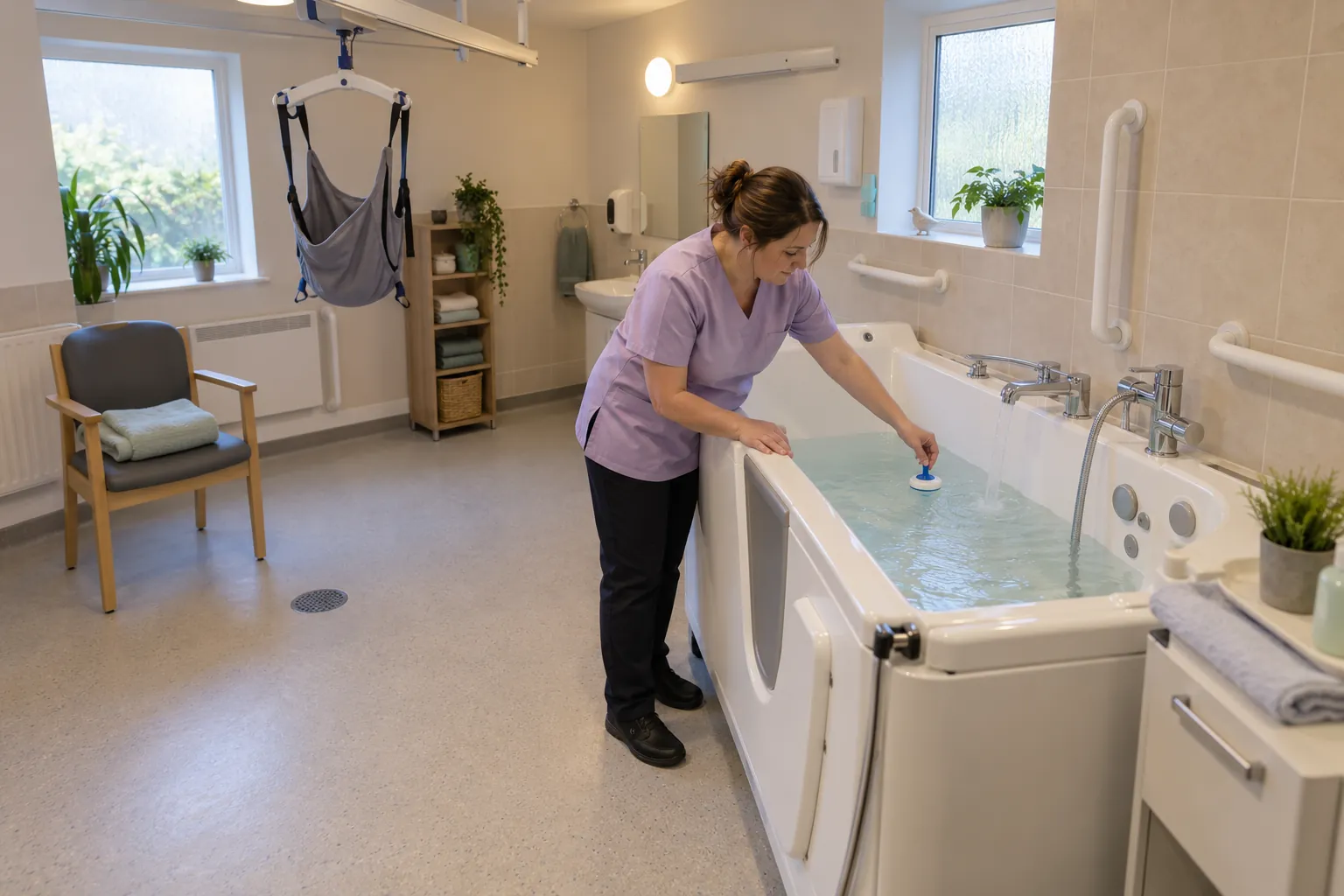
Before bathing a vulnerable person: HSIS6 says that where there are vulnerable individuals and whole-body immersion, widely recognised professional bathing practice involves testing the outlet temperature with a thermometer for additional reassurance, and HSG274 (paragraph 2.163) says the same testing can provide additional reassurance.
Flushing of little-used outlets: HSG274 puts any outlet not used for seven days or more on the legionella scheme's weekly flushing regime, outlets with TMVs included, and says healthcare and care homes may need more frequent flushing. A TMV shower in a little-used assisted bathroom belongs on the legionella checks flushing list.
Whenever something changes: after work on the supplies, or a report that an outlet runs too hot or too cold. HSIS6 says staff should be told to report any obvious defect immediately and to take the facility out of use if necessary.
05
Who does what, and what the TMV record should show
The work is usually shared out like this:
- A competent person, often a water hygiene contractor or a plumber trained on the valves fitted, commissions, tests and services the TMVs to the manufacturer's instructions, as HSG274 requires.
- The premises or maintenance team keeps the list of valves, books the tests and flushes little-used outlets.
- Care or support staff check the temperature at the bath or shower before a vulnerable person uses it, and report a fault at once.
- The responsible person under the legionella scheme, and in healthcare the Water Safety Group, decides where valves are needed, their settings and their test intervals.
HSIS6 says staff who maintain the premises or assist vulnerable people need adequate training and supervision to understand the risks and precautions.
On records, HSG274 Part 2 repeats L8: records of monitoring and inspection should be kept for at least five years, and records "should contain accurate information about who did the work and when it was carried out", signed, verified or authenticated. D 08 includes a TMV test record sheet whose headings make a good model for any TMV log book:
- The valve reference and its location, matching the asset list and the risk assessment.
- The outlet type and blend setting: bath, washbasin or shower, and the temperature it is set to.
- The installation date and the maintenance frequency.
- The supply conditions: hot and cold supply temperatures and pressures, against the previous test.
- The results: mixed water temperature at maximum flow, any flow after the cold was isolated and its volume, the temperature after restoration, and the deviation from the first reading and from the previous test, with more than 1 °C flagged.
- Strainers, check valves and isolating valves: clean and fully open, yes or no.
- The engineer's name and the test date, the final temperature, any remedial action, and the next in-service test date.
06
Where the TMV record fails, and what SiteClara does about it
TMV failures in the record are rarely about the test method. They are a valve missing from the asset list because it was fitted during a refurbishment, an in-service test that slipped from six months to eighteen, a weekly flush of the assisted bathroom shower that stopped when the room was turned into storage, and a care assistant's "bath ran very hot today" that went into a handover note and never reached maintenance.
SiteClara puts a printed QR poster, with an NFC tag behind it if you want staff to tap, at the locations that matter: the assisted bathroom, the shower room, the washbasin row with TMVs, the plant room. Staff scan or tap with their own phone, with no app to install, and see the checks due at that location, such as the weekly flush of a little-used TMV shower or a monthly outlet temperature check. They mark each one done, or say what stopped them, with a photo when one helps, such as the thermometer in the stream. The time and the person are recorded as it happens.
Anyone who finds a fault, a shower running too hot or a tap that will not run warm, reports it at the location, and it goes onto the team's list of jobs until someone closes it, and can be escalated to the building manager. The supervisor sees which checks are due, done and missed. Each day the supervisor approves a report that goes to nominated management or client contacts the next morning.
07
Questions people ask
How do you know if a TMV has failed?
The in-service test shows it: under HTM 04-01 Supplement, Performance specification D 08: thermostatic mixing valves, a valve needs recommissioning or service work if more than 120 ml flows in 60 seconds once the cold supply has been isolated for 5 seconds, and the supply conditions are rechecked or the valve recommissioned if the mixed water temperature 15 seconds after the cold is restored differs by more than 2 °C from the first reading. Between tests, an outlet that runs too hot or too cold is the warning sign, and HSE information sheet HSIS6, Managing the risks from hot water and surfaces in health and social care says staff should report any obvious defect immediately and take the facility out of use if necessary.
When testing a TMV, which temperatures should be measured?
Three: the hot and cold water supplies next to the valve, and the mixed water at every outlet it serves at the maximum available flow, which is the commissioning sequence in clause 11.1.2.2 of HTM 04-01 Supplement, Performance specification D 08: thermostatic mixing valves. For normal use D 08 gives a hot supply of at least 55 °C and a cold supply of no more than 20 °C, and the in-service test records the mixed water temperature at every outlet before the cold supply is isolated, then again 15 seconds after it is restored.
Is a TMV a legal requirement in the UK?
Not by name: in England, requirement G3(4) of the Building Regulations 2010 says the hot water delivered to a fixed bath in a new dwelling, or one formed by a material change of use, must not exceed 48 °C, and Approved Document G: sanitation, hot water safety and water efficiency says to limit it with an in-line blending valve or other appropriate temperature control device. Beyond that no regulation calls for one directly, but the scalding risk must still be controlled under section 3 of the Health and Safety at Work etc. Act 1974, and HSE information sheet HSIS6, Managing the risks from hot water and surfaces in health and social care says engineering controls such as TMVs should stop water hotter than 44 °C reaching outlets where vulnerable people could immerse their whole body.
Do TMVs increase the risk of legionella?
They can: HSG274 Part 2: The control of legionella bacteria in hot and cold water systems (paragraph 2.74) says the blended water downstream of TMVs may provide an environment in which legionella can multiply. That is why it says their use should follow a comparative assessment of scalding risk against legionella risk, with TMVs not required where the scalding risk is insignificant and fitted as close to the point of use as possible to minimise the storage of blended water.
08
Further reading, and a list to take away
HSE publishes HSG274, Legionnaires' disease: Technical guidance, whose Part 2 covers TMVs in hot and cold water systems, the Approved Code of Practice L8, and the information sheet HSIS6 for health and social care, all free on its website. For healthcare premises, the NHS's HTM 04-01 and its supplement D 08 set out TMV3 performance, commissioning and in-service testing.
For the TMVs in your building, make sure that:
- every valve is on an asset list with a reference, its location, its outlet type and its set temperature;
- the risk assessment says why each valve is there, and valves that are not needed are removed;
- each valve has an in-service test date, set from its own results, and a competent person to do it;
- the test includes the fail-safe check with the cold supply isolated, not just a temperature reading;
- staff who bathe vulnerable people check the temperature with a thermometer every time;
- anyone can report a too-hot or too-cold outlet, and the outlet is taken out of use until it is fixed;
- records are kept for at least five years and show who did each check and when.
Sources
Every document this guide quotes or links to, in the order it first cites them.
- HSG274 Part 2: The control of legionella bacteria in hot and cold water systems hse.gov.uk
- Managing the risks from hot water and surfaces in health and social care (HSIS6) hse.gov.uk
- Building Regulations 2010 legislation.gov.uk
- Health and Safety at Work etc. Act 1974 legislation.gov.uk
- Management of Health and Safety at Work Regulations 1999 legislation.gov.uk
- L8, Legionnaires' disease: The control of legionella bacteria in water systems hse.gov.uk
- Scalding and burning in health and social care hse.gov.uk
- Water Supply (Water Fittings) Regulations 1999 legislation.gov.uk
- Approved Document G: sanitation, hot water safety and water efficiency gov.uk
- Health Technical Memorandum 04-01 Supplement, Performance specification D 08: thermostatic mixing valves (healthcare premises) england.nhs.uk
- HSG274, Legionnaires' disease: Technical guidance hse.gov.uk
Related guides
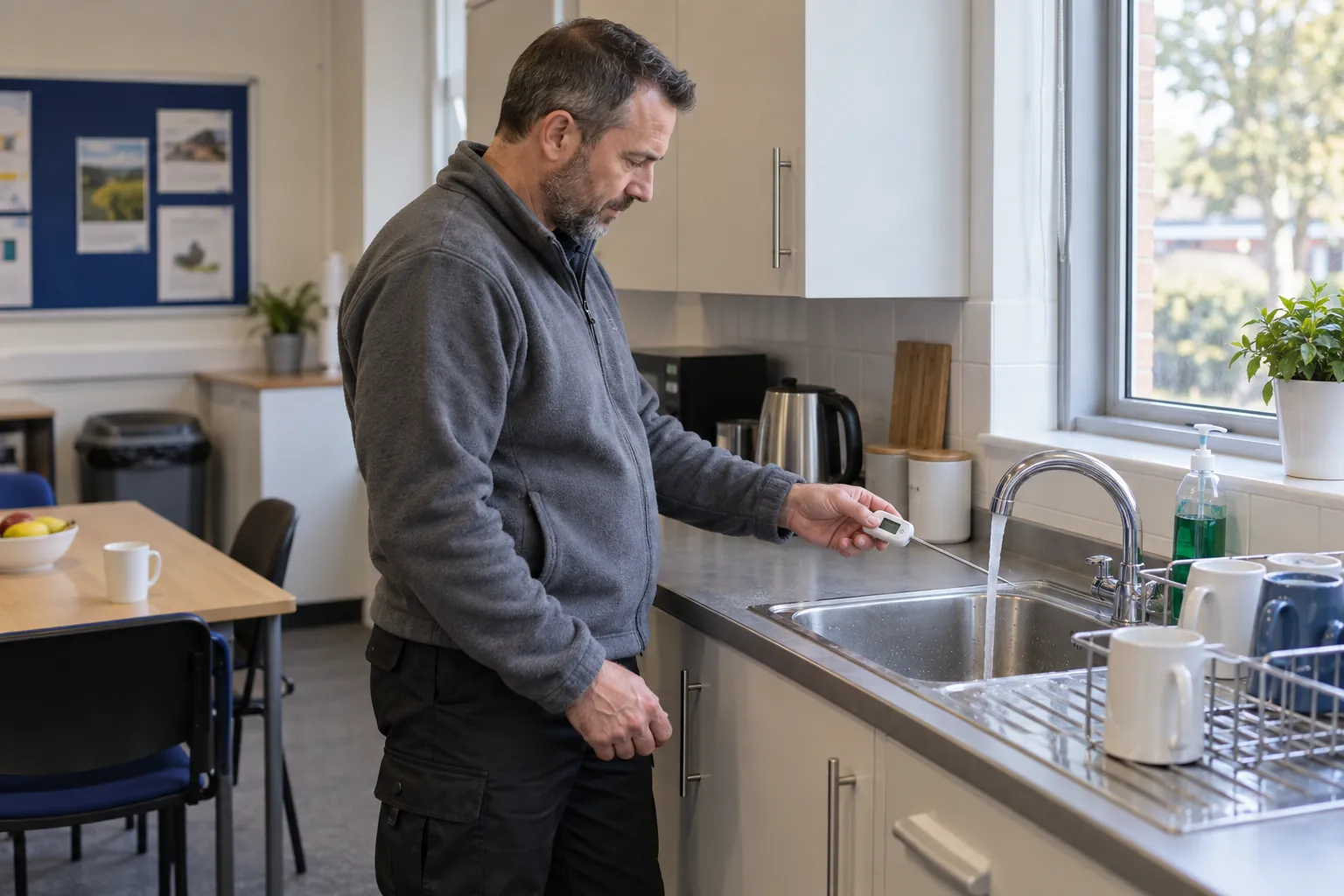 Fire and water checksLegionella checks: the routine monitoring, and the record that shows it was doneThe routine legionella checks in hot and cold water systems under HSE's L8 and HSG274: flushing, temperatures, who does them and what the record should show.
 Premises and facilities managementPlanned preventative maintenance: how to plan it and prove it was donePlanned preventative maintenance (PPM): what it is, how to build an asset register and schedule, statutory versus discretionary tasks, and evidencing the work.
 Premises and facilities managementBuilding maintenance checklist: what to check, how often, and who byA building maintenance checklist for UK non-domestic buildings: daily to annual tasks for fabric, services, safety systems and grounds, and who does each.
 Premises and facilities managementPremises manager: what the job involves, and how to run it wellWhat a premises manager does in a college, charity, housing provider or trust: the compliance calendar, contractors, security, budgets and reporting.