Fire and water checks
Backflow testing: the annual test, who does it, and what the record should show
Backflow testing is a field test, made with a differential pressure gauge, that shows a backflow prevention assembly still stops water and contaminants from flowing back into the public drinking water supply.
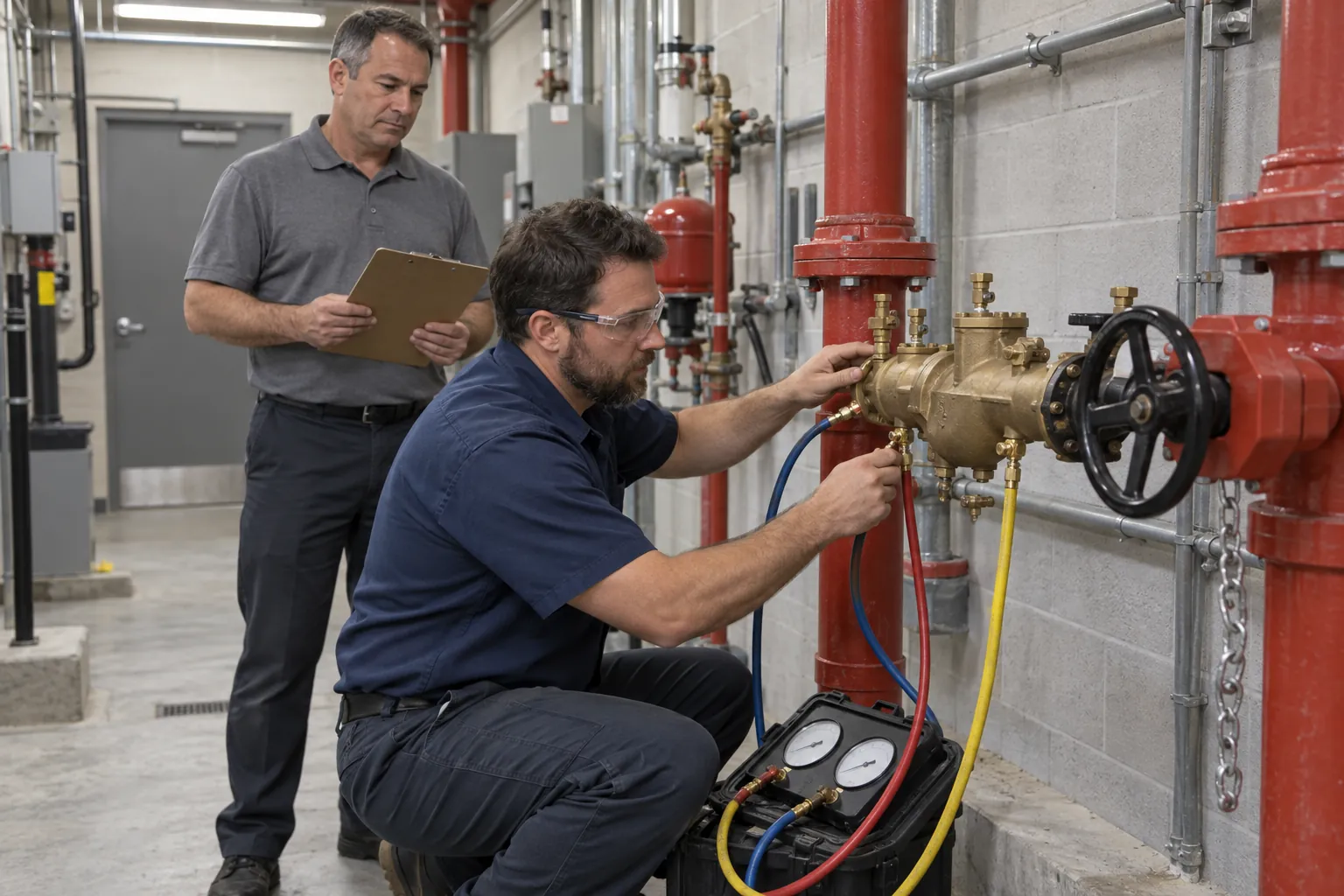
Many commercial buildings in the United States have at least one backflow prevention assembly, and water utilities usually want each one tested every year by a certified or licensed tester. The rule rarely comes from one place: it is usually the state drinking water program, the local water utility's cross-connection control program and the plumbing code working together. This guide explains what backflow testing is, which devices are tested and how often, who may test them, what the test report shows, and what a facility team can do between tests.
01
What backflow testing is, and whose rule requires it
A cross-connection is a link between the drinking water supply and something that could contaminate it: a boiler, a fire sprinkler line, an irrigation system, a chemical dispenser, a hose left in a bucket. The EPA's Cross-Connection Control: A Best Practices Guide (EPA 816-F-06-035, September 2006) defines it as "any actual or potential connection between the public water supply and a source of contamination or pollution." Backflow is water, or anything else, flowing the wrong way into the potable supply. It happens in two ways:
- Backpressure: pressure in the building's downstream piping exceeds the pressure in the supply, from a pump, a boiler or thermal expansion, and pushes water back toward the main.
- Backsiphonage: pressure in the supply drops, during a main break, heavy firefighting draw or a shutdown, and the negative pressure pulls water back from the building.
A backflow prevention assembly stops both. Its springs, seals and valves can foul or wear without anyone noticing, so the testable types are checked in the field with a differential pressure gauge. That is backflow testing.
There is no single federal backflow testing rule for buildings. The EPA's Cross-Connection Control Manual (EPA 816-R-03-002, February 2003) says plainly that "all municipalities with public water supply systems should have cross-connection control programs," and its best practices guide notes that programs "vary by state and municipality." In practice the requirement reaches a building through three routes:
- The state drinking water program, which requires public water systems to run a cross-connection control program and sets the testing standard.
- The water utility (the water purveyor), which carries out that program through its own ordinance or rules and sends each customer the annual test notice.
- The plumbing code adopted by the state or city, which governs backflow protection inside the building and is enforced by the local plumbing official.
Three states show how this works. In California, the State Water Resources Control Board's Cross-Connection Control Policy Handbook (CCCPH) took effect on July 1, 2024 and was amended on April 21, 2026; it is mandatory for every California public water system. In New York, 10 NYCRR Section 5-1.31, Cross connection control, requires the supplier of water to run a containment program. In Texas, the Texas Commission on Environmental Quality (TCEQ) sets the rules for cross-connection control and backflow prevention in Title 30 of the Texas Administrative Code, Chapter 290.
02
Which devices are tested, and where they are in a building
The main types of backflow prevention devices, and what each is suited to, are below. The degree of hazard decides which one a connection needs:
- Air gap: a physical space between the water outlet and the receiving vessel, at least twice the supply pipe diameter and never less than one inch. It has no moving parts, so it is inspected rather than tested, and the EPA's best practices guide calls it useful for all hazard levels.
- Reduced pressure principle assembly (RP, RPZ or RPBA): two check valves with a relief valve between them that discharges to atmosphere if either check leaks. The EPA manual calls it "the backbone of cross-connection control programs" and gives high hazard examples such as plating plants, car washes, funeral parlors and hospital autopsy rooms.
- Double check valve assembly (DC or DCVA): two spring-loaded check valves with test cocks and shutoff valves, for low to medium hazards. The EPA manual gives food processing steam kettles and apartment projects as examples.
- Detector assemblies (DCDA and RPDA): versions used mainly on fire sprinkler lines, with a bypass meter that shows any water movement in the fire line.
- Pressure vacuum breaker (PVB) and spill-resistant vacuum breaker (SVB): protect against backsiphonage only, never backpressure, and are common on irrigation systems.
- Atmospheric and hose bibb vacuum breakers: simple backsiphonage devices with no test cocks, fitted to hose connections and some fixtures. They are not field tested, but they can be looked at.
California's handbook lists the field-testable types as RP, RPDA, DC, DCDA, PVB and SVB, including their type II variants, and that is a good working list of what goes on your annual testing schedule.
In an ordinary commercial or institutional building, testable assemblies are typically found in these places:
- the domestic water service, just after the meter, where the utility requires containment of the whole premises;
- the fire sprinkler or standpipe connection, guarding against fire line additives, backpressure and stagnant water;
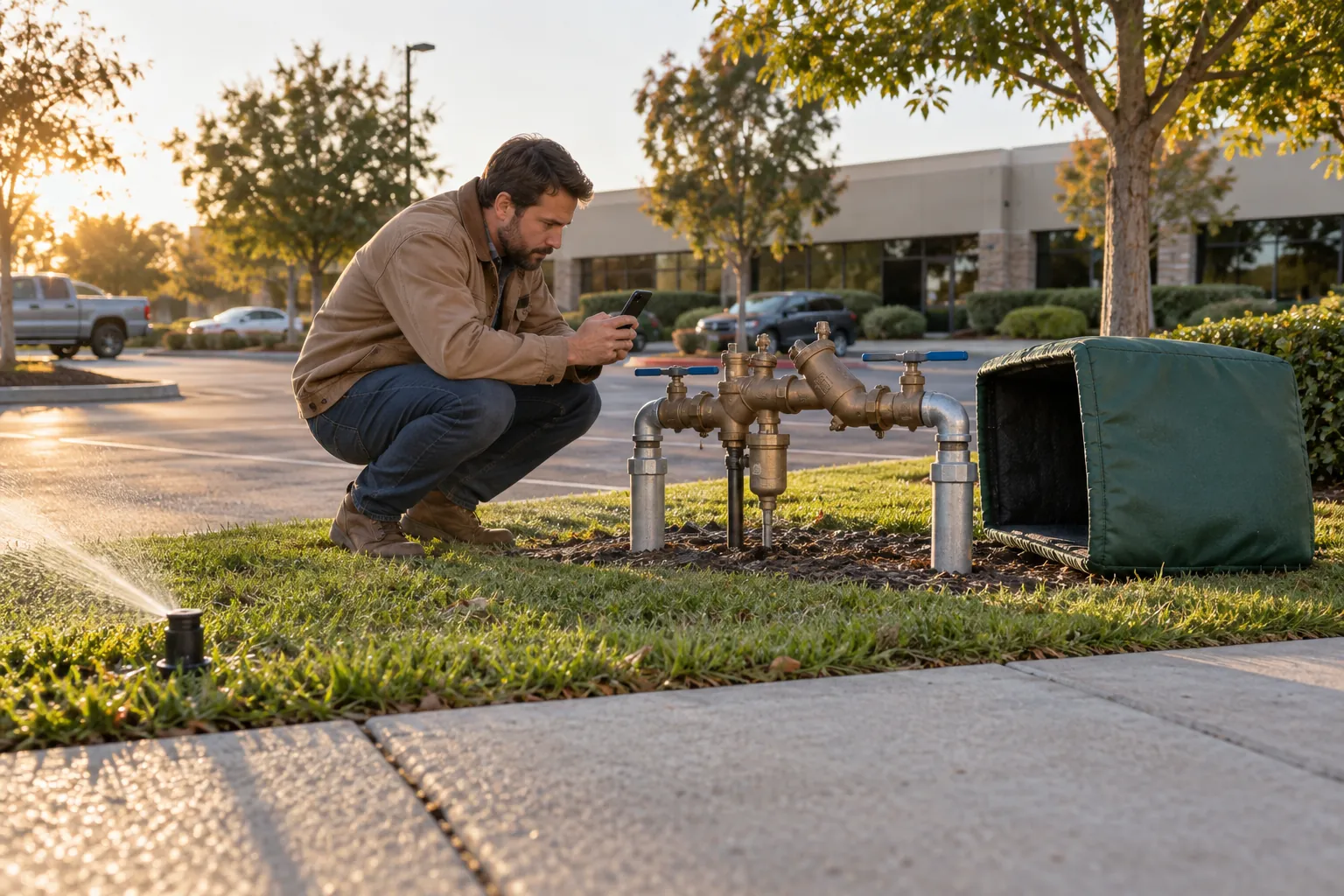
- the irrigation system, often a PVB or DC outside the building;
- the boiler, chilled water or closed-loop makeup, where treatment chemicals are a hazard;
- kitchens, beverage equipment, laboratories and process equipment, where the plumbing code requires internal protection.
The EPA's examples of what goes wrong include carbonated water from a restaurant soda dispenser entering the water system by backpressure, and boiler corrosion control chemicals flowing back into an office building's water supply.
03
How often assemblies are tested, and who may test them
Annual testing is the usual minimum, with tests also required at installation and after a repair. The state rules say so in their own words:
- California: under CCCPH section 3.3.3, backflow prevention assemblies "must be field tested at least annually," and also after installation, repair, depressurization for winterizing, or permanent relocation. Air gaps must be visually inspected at least annually. A water system, the State Water Board or a local health agency may require more frequent testing for high hazard premises or assemblies at increased risk of failure.
- New York: under 10 NYCRR 5-1.31(a)(3), all protective devices are inspected and tested by a certified backflow prevention device tester "at the time of initial installation, after each repair, and annually thereafter."
- Texas: the instructions to TCEQ Form 20700, Backflow Prevention Assembly Test and Maintenance Report, say that annual testing of assemblies installed to protect against health hazards "is to occur no more than 12 months from the last test date."
Local rules can be stricter. The sample ordinance in the EPA manual, for example, has reduced pressure devices tested at least semi-annually and allows more frequent testing where there is a history of failures. Your utility's ordinance decides.
The tester must hold the credential your state recognizes, and the name varies. California requires each assembly to be field tested by a person with a valid certification from a certifying organization the State Water Board recognizes; from three years after the handbook took effect, only certifications from organizations accredited to ISO/IEC 17024 through the ANSI National Accreditation Board (ANAB), or a body with a mutual recognition arrangement with ANAB, will count, although a local health agency may still run its own tester certification program within its jurisdiction. New York's certified backflow prevention device testers are certified by a department-approved entity after an approved training course, and the certification is valid for three years. Texas uses licensed backflow prevention assembly testers, and TCEQ notes that a tester's license is based on the test procedures in the University of Southern California's Manual of Cross-Connection Control, 10th edition, the same procedures California's handbook points to.
The tester closes the downstream shutoff valve, connects a differential pressure gauge to the test cocks, and checks that each check valve holds and, on an RP, that the relief valve opens. TCEQ requires the gauge itself to be checked for accuracy annually. The protected system loses supply while the valve is closed; the EPA manual recommends parallel assemblies where water must not stop.
04
The test report, failed tests, and who keeps the record
Each assembly tested gets its own test report, completed and signed by the tester. The Texas form shows what a good report contains, and most utilities' forms follow the same pattern:
- the water system and the address of service;
- the type of assembly (RP, RPDA, DC, DCDA, PVB or SVB), its manufacturer, model, size and serial number, and where it is installed;
- the initial test readings for each check valve and, on an RP, the relief valve;
- any repairs and the materials used, and the readings from the test after repairs;
- the tester's name, license or certification number and the test date;
- the test gauge's serial number and the date it was last checked for accuracy.
The TCEQ instructions say the form "is intended to be completed on-site while testing is occurring," and that a signed and dated original must be submitted to the public water supplier for recordkeeping. The official record of the test is the report the utility holds.
Under CCCPH section 3.5.1, each California public water system must keep the details of every assembly and the results of all field tests for the previous three calendar years, including the tester's name, certification number, test date and repair date. New York's rule says test records "shall be made available to, reviewed by, and maintained by the supplier of water."
A failed test starts a clock. California requires assemblies that fail to be repaired or replaced within 30 days of notification of the failure, unless the water system's plan allows an extension, and the EPA sample ordinance uses the same 30 days, adding that high hazard situations "will not be allowed to continue unprotected" if the assembly cannot be repaired at once. If a tester sees a backflow incident or an unprotected cross-connection, California requires them to tell the water system within 24 hours, and the water system must investigate and, if backflow is confirmed, discontinue service until a passing test is received.
Keep your own copy of every report, even when the utility holds the original, so you can see an assembly's history across testing contractors and spot one that fails every year.
05
What the facility team can do between annual tests
The annual test is a snapshot. For the other 364 days, the assembly depends on the building. None of the checks below replaces the certified test or needs a license, and none is a legal requirement in itself; they are good practice that a building engineer, maintenance technician or custodian can do on a routine walk:
- Keep an inventory. List every testable assembly with its location, type, size, serial number, what it protects and its next test date. Match it to the utility's list; the utility only tests or chases what it knows about.
- Watch the relief port on every RP. The EPA manual says malfunction "should always be indicated by a discharge of water from the relief port," and that under no circumstances should the port be plugged. A dripping or discharging RP is a fault to report, not a nuisance to hide.
- Keep assemblies accessible. Storage piled against an assembly in a mechanical room delays the test and hides a leak. California's handbook requires RPs and DCs installed after its adoption to have at least 12 inches of side clearance, and 24 inches on the test cock side.
- Check the outdoor assemblies. Look for damage, missing or loose enclosures, and signs of freezing. In California, an assembly depressurized for winterizing must be field tested again.
- Check hose connections. Hose bibbs, service sinks and chemical dispensers with a hose attached need a vacuum breaker or other protection. A hose left submerged in a bucket or a floor drain is a cross-connection.
- Report plumbing changes. A new beverage machine, lab sink, boiler treatment system or irrigation zone may need protection and a permit, so raise it before the work.
Schedule the annual test well ahead of the deadline, with time to plan any shutdown and to repair and retest a failed assembly inside the utility's window.
06
Where the record fails, and what SiteClara does about it
The annual test report is usually solid: a certified or licensed tester signs it and the utility holds it. The weak part is everything around it: the relief port dripping since spring, the assembly behind a stack of boxes, the hose left in a bucket in the custodial closet. The walks that should catch these are often done from memory or checked off in advance on a sheet on the mechanical room door, and a fault spotted in passing is mentioned to whoever is nearby and forgotten.
SiteClara records the routine checks at the place they happen. A printed QR poster, with an optional NFC tag behind it, goes beside each assembly or mechanical room on the schedule. The building engineer or technician scans or taps with their own phone, with no app to install, sees the checks due there, and marks each one done or says what stopped them. The time and the named person are recorded as it happens, with a photo when one is asked for, such as the relief port or the enclosure. A fault they report, such as a discharging RP or a blocked assembly, goes onto the team's list of open jobs until someone closes it.
A supervisor sees what is due, done and missed, records the reason a check was missed, and reviews and approves a daily report that goes to designated managers or clients the next morning, showing what was reported, what was completed and what is still open.
07
Questions people ask
What is a backflow test?
A backflow test is a field test of a backflow prevention assembly, run with the water shut off downstream, to show that its check valves hold and, on a reduced pressure assembly, that its relief valve opens. Chapter five of the EPA's Cross-Connection Control Manual says testing is done "under no-flow conditions" with a differential pressure gauge, and that an RP is tested to show that the first check valve is tight and maintains a minimum of 5 psi differential pressure, that the second check valve is tight against backpressure, and that the relief valve opens at a minimum of 2 psi below inlet supply pressure.
Can I do backflow testing myself?
Not unless you hold the tester credential your state recognizes. In California, section 3.4.1 of the Cross-Connection Control Policy Handbook says a public water system "must ensure that each BPA required by this Chapter to protect the public water system is field tested by a person with valid certification from a certifying organization recognized by the State Water Board." In Texas, the TCEQ's page on cross-connection control and backflow prevention tells someone who installs their own irrigation system to "have a licensed BPA tester confirm that the BPA is installed and operating properly." The property owner's part is to book the test, keep the assembly accessible and keep a copy of the report.
Do all plumbers do backflow testing?
No. The test must be done by someone who holds the backflow tester certification or license your state recognizes, so ask for it rather than assume a plumbing license covers it. In Texas, the TCEQ Form 20700, Backflow Prevention Assembly Test and Maintenance Report, "must be printed and signed by the Licensed Tester that performed the work" unless TCEQ-approved electronic recordkeeping is in use, and it asks for the tester's BPAT license number and its expiration date.
08
Where to read more, and a list to take away
The EPA's Cross-Connection Control Manual remains the clearest plain-language explanation of backflow, the devices and how they are tested, and includes a sample ordinance and a sample test report. The shorter Cross-Connection Control: A Best Practices Guide lists what a program involves. For state rules, read your own state drinking water program; the California, New York and Texas rules cited above show how they are written. The American Water Works Association publishes M14 Backflow Prevention and Cross-Connection Control: Recommended Practices (fifth edition), a paid manual for those who run programs, and the University of Southern California's Foundation for Cross-Connection Control and Hydraulic Research publishes the Manual of Cross-Connection Control.
Before your next backflow test is due, check that:
- you know which rules apply: the utility's program, the state drinking water rules and the local plumbing code;
- every testable assembly is on an inventory that matches the utility's list;
- the test is scheduled with a tester who holds your state's certification or license, well before the deadline;
- failed assemblies are repaired and retested inside the utility's deadline;
- you keep your own copy of every test report, not only the utility;
- RP relief ports, enclosures, access and hose connections are checked between tests, and faults followed up until closed;
- plumbing changes are reported before the work is done.
Sources
Every document this guide quotes or links to, in the order it first cites them.
- Cross-Connection Control: A Best Practices Guide epa.gov
- Cross-Connection Control Manual epa.gov
- Cross-Connection Control Policy Handbook waterboards.ca.gov
- 10 NYCRR Section 5-1.31, Cross connection control regs.health.ny.gov
- Cross-connection control and backflow prevention tceq.texas.gov
- TCEQ Form 20700, Backflow Prevention Assembly Test and Maintenance Report tceq.texas.gov
- Cross-Connection Control Policy Handbook waterboards.ca.gov
Related guides
 Fire and water checksFire sprinkler inspection: what NFPA 25 asks of the buildingWhat a sprinkler system inspection involves under NFPA 25, who does the weekly, monthly and annual checks, how impairments work, and what the record should show.
 Fire and water checksFire pump testing: what NFPA 25 asks, week by weekWhat fire pump testing involves under NFPA 25: the weekly inspection, the weekly or monthly churn test, the annual flow test, who does each, and what to record.
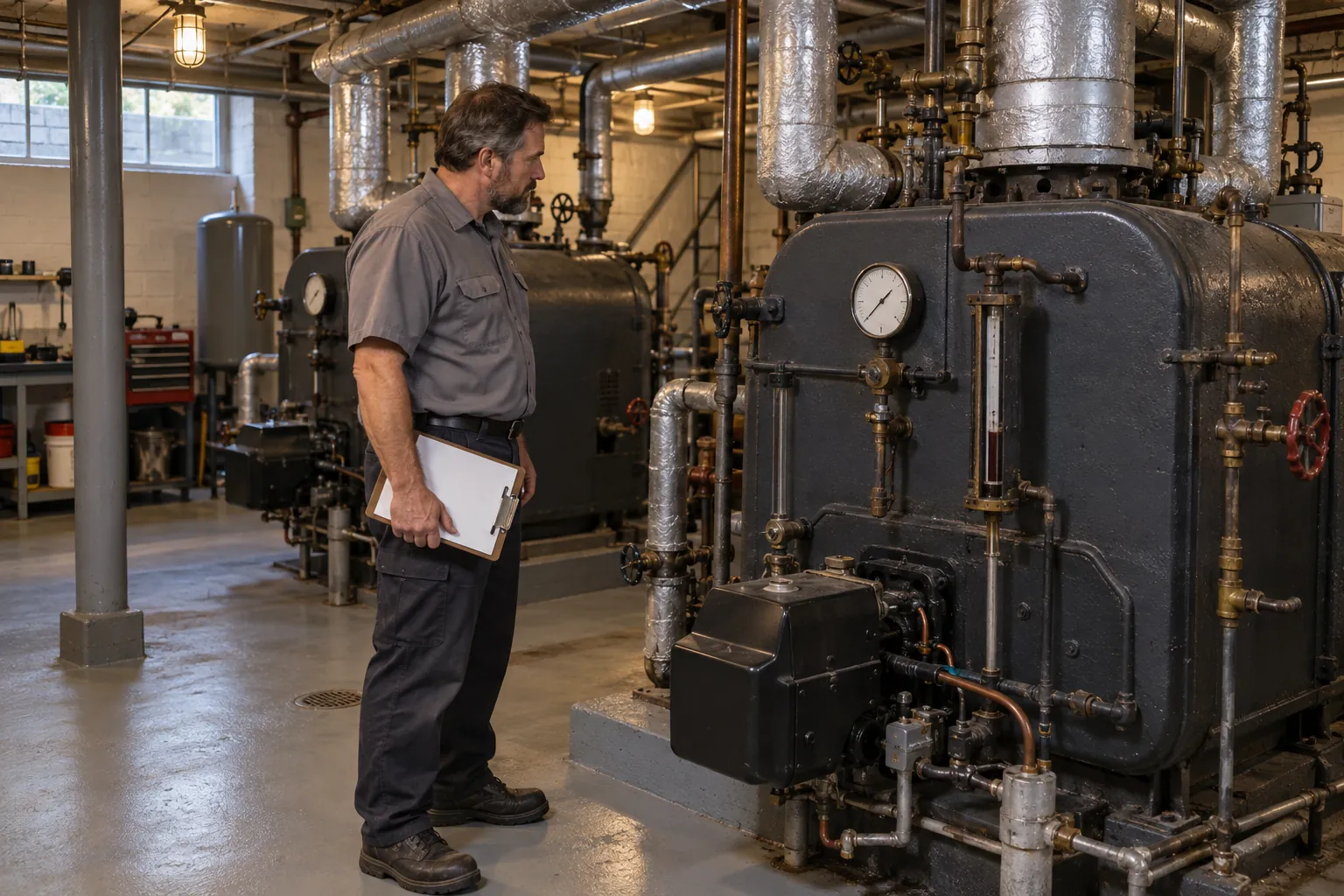 Premises and facilities managementBoiler log: what to record, how often, and what the state expectsWhat a boiler log should record, how often to take readings and test the low-water cutoff, what state boiler rules and ASME CSD-1 expect, and where logs fail.
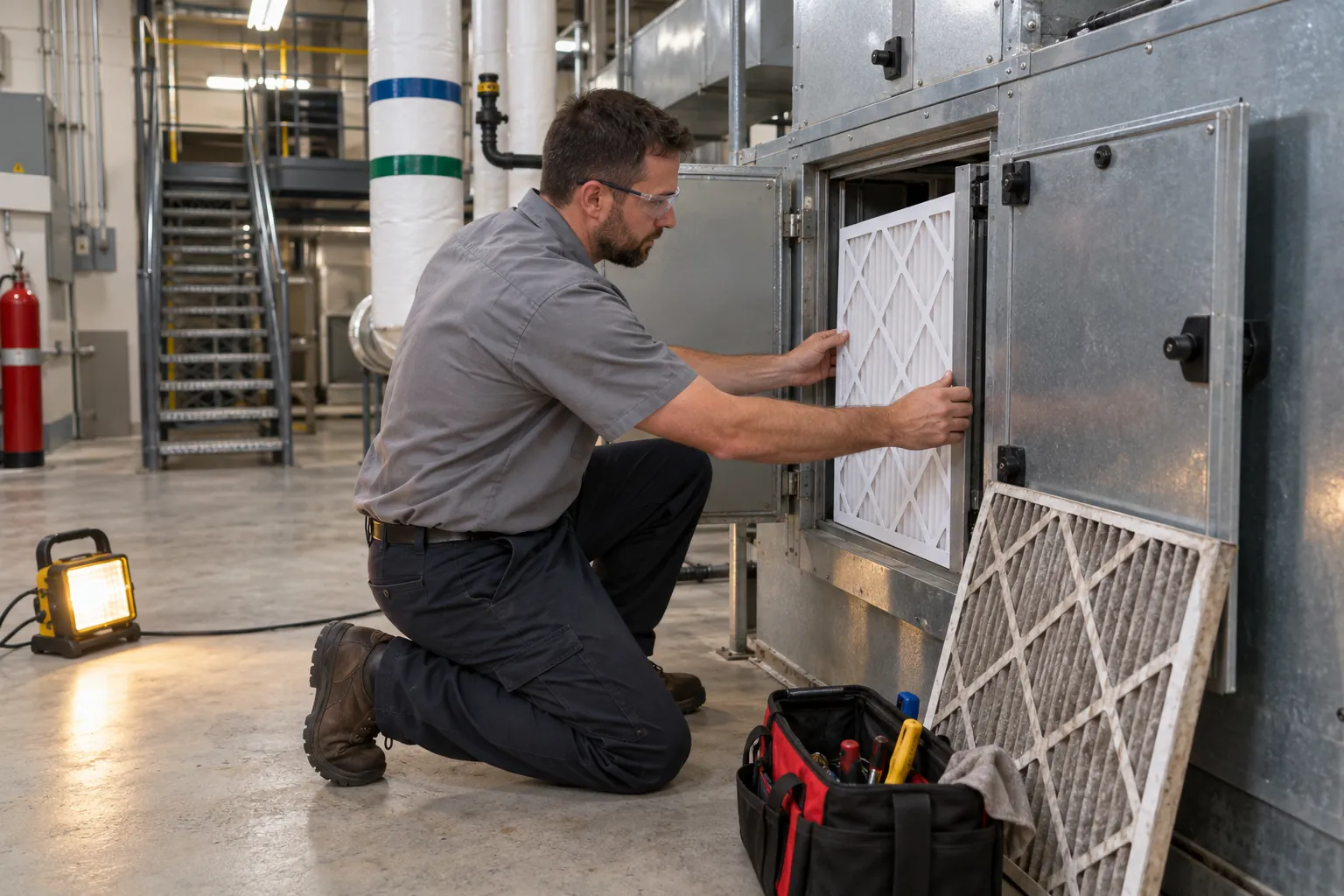 Premises and facilities managementPreventive maintenance checklist: what to check in a commercial building, how often, and how to prove itA preventive maintenance checklist for commercial buildings: HVAC, electrical, fire and life safety, plumbing, how often, and what the record should show.