Fire and water checks
Fire pump testing: what NFPA 25 asks, week by week
Fire pump testing is the routine NFPA 25 sets for a building's fire pump: a weekly inspection of the pump and its room, a no-flow (churn) test every week or month, and an annual fire pump flow test that shows whether the pump still delivers the water it was designed to deliver.
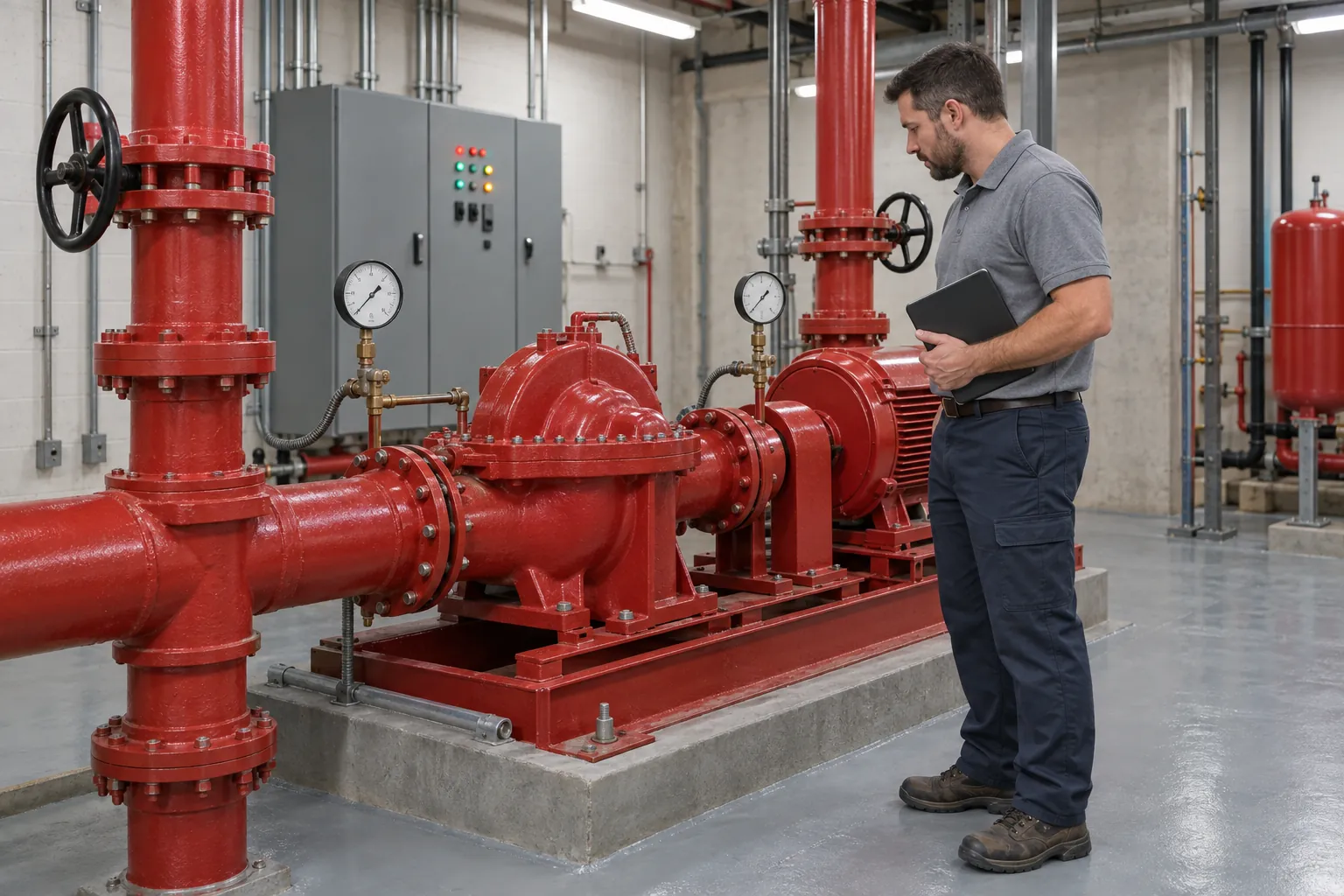
A fire pump sits idle for years and then has one job: to start on its own and push water through the sprinklers and standpipes at the pressure they were designed for. This guide covers where the rule comes from, what each check involves, who can do it, what happens when the pump is out of service, and what the record should show.
01
The rule: NFPA 25, Chapter 8, and the code that adopts it
In the United States, fire pump testing follows NFPA 25, Standard for the Inspection, Testing, and Maintenance of Water-Based Fire Protection Systems, published by the National Fire Protection Association. Chapter 8 covers fire pumps. The current edition is 2026, with the next scheduled for 2029. NFPA 20 governs how a pump is installed; NFPA 25 how it is kept working.
NFPA's article Weekly Inspections of Electric Fire Pumps explains why: the acceptance test proves the pump works on handover day, but after that "there is no guarantee that the pump will remain in a ready state to work as designed unless it undergoes routine inspection, testing, and maintenance (ITM)."
NFPA 25 is a standard, not a law, until a jurisdiction adopts it. Most states and cities do so through their fire code, usually the International Fire Code or NFPA 1, often with local amendments. The fire marshal or fire code official who enforces it is the authority having jurisdiction (AHJ), and the edition of NFPA 25 that applies to your building is the one your AHJ enforces, which may be older than the current one. Your insurer can act as an AHJ too, and may have its own expectations for the pump.
Local codes can add to the standard. In the New York City Fire Code (2022), Chapter 9, Fire Protection Systems, as published by the FDNY, FC 913.5 says fire pumps "shall be operated and maintained in compliance with the requirements of this section, FC 901.6 and NFPA 25, including all required inspection, testing and servicing." For standpipe and sprinkler systems, FC 901.6.2.1 adds a monthly visual inspection by the certificate of fitness holder in accordance with NFPA 25.
Whoever the AHJ is, NFPA puts the duty in one place. In Responsibilities of the Building Owner for Fire Sprinkler System Inspection, Testing, and Maintenance, NFPA says: "While often the performance of these activities are contracted with a service provider, the ultimate responsibility for ITM falls on the building owner." A designated representative named in a lease or management contract can carry it for the owner.
02
The weekly fire pump inspection
NFPA 25 separates an inspection from a test. NFPA's article on weekly inspections quotes the definition of inspection, "a visual observation of a system or portion thereof to verify that it appears to be in operating condition and is free of physical damage," and draws out two points: it is visual, with no manipulating of the system, and it does not prove the pump works, only that it appears to. A test operates the equipment.
NFPA 25 defines weekly as once per calendar week. For an electric fire pump, NFPA's article lists what the weekly inspection covers:
- The pump house or room: heat is adequate, not less than 40°F (4°C); excessive water does not collect on the floor; the coupling guard is in place.
- The pump system: the pump suction, discharge and bypass valves are fully open; piping is free of leaks; the suction line pressure gauge reading is within the acceptable range; the suction reservoir has the required water level; wet pit suction screens are unobstructed and in place; waterflow test valves are closed, the hose connection valve is closed, and the line to the test valves is free of water.
- The electrical system: the controller pilot light (power on) is illuminated; the transfer switch normal pilot light is illuminated; the isolation switch to the standby (emergency) source is closed; the reverse phase alarm pilot light is off, or the normal phase rotation pilot light is on; the oil level in a vertical motor's sight glass is within range; and the pressure maintenance (jockey) pump has power.
A diesel-driven pump adds inspection items of its own for the engine and its supplies. Read the table for your driver in the edition of NFPA 25 your AHJ enforces, and use the pump manufacturer's instructions alongside it.
Boxes stored against the controller, a heater that failed over a cold weekend, a valve left half closed after other work: this is what the weekly round catches, and what an annual visit finds too late.
03
The churn test: weekly or monthly, and what to observe
The no-flow test, usually called the churn test, runs the pump without flowing water through the system. NFPA's article Weekly or Monthly No Flow Tests of Fire Pumps sets out what it involves, and its companion article on weekly inspections says these tests "confirm that the pump can automatically start and will not overheat."
How often. In NFPA's words, "Generally, diesel fire pumps must be no-flow (churn) tested on a weekly basis," and "Most electric fire pumps can be no-flow (churn) tested at a monthly frequency." An electric pump needs the weekly test instead when it serves systems in a building beyond the pumping capacity of the fire department, has a limited service controller, is a vertical turbine pump, or takes suction from ground level tanks or a water source without enough pressure to be of material value without the pump, unless a redundant fire pump is provided. Both kinds have allowances to extend the interval on an approved risk analysis.
How it starts. The pump is started automatically, "by drawing water from the sensing line to simulate a pressure drop in the system rather than using the 'start' button on the front panel of the fire pump controller." NFPA 25 allows an automatic timer to do this.
How long. "Electric pumps must be run for a minimum of 10 minutes while diesel pumps must be run for a minimum of 30 minutes."
Who attends. "Qualified personnel must be in attendance whenever the pump is in operation unless automated inspection and testing is performed in accordance with the requirements of NFPA 25."
NFPA lists what is observed. Before the pump runs, record the suction and discharge gauge readings, and, where the controller uses electronic pressure sensors, the highest and lowest pressures in its event log. While it runs, record or check:
- The pump: the starting pressure and the suction and discharge readings; the packing glands for slight discharge; unusual noise or vibration; overheating at the packing boxes, bearings or casing; and, for electric and radiator-cooled diesel pumps, that the circulation relief valve discharges water.
- An electric driver: the time for the motor to reach full speed, and the time on the first step of a reduced voltage or reduced current starter.
- A diesel engine: the time to crank and to reach running speed; the oil pressure, speed, and water and oil temperature indicators; and cooling waterflow through the heat exchanger.
The discharge water temperature is watched throughout, and the pump shut down if it gets too hot. NFPA also says that where the discharge and suction readings "show a difference that is greater than 95 percent of the rated pump pressure, the situation needs to be investigated and corrected." A reading means little alone and a great deal beside last month's.
04
The annual flow test, the rest of the year, and who does what
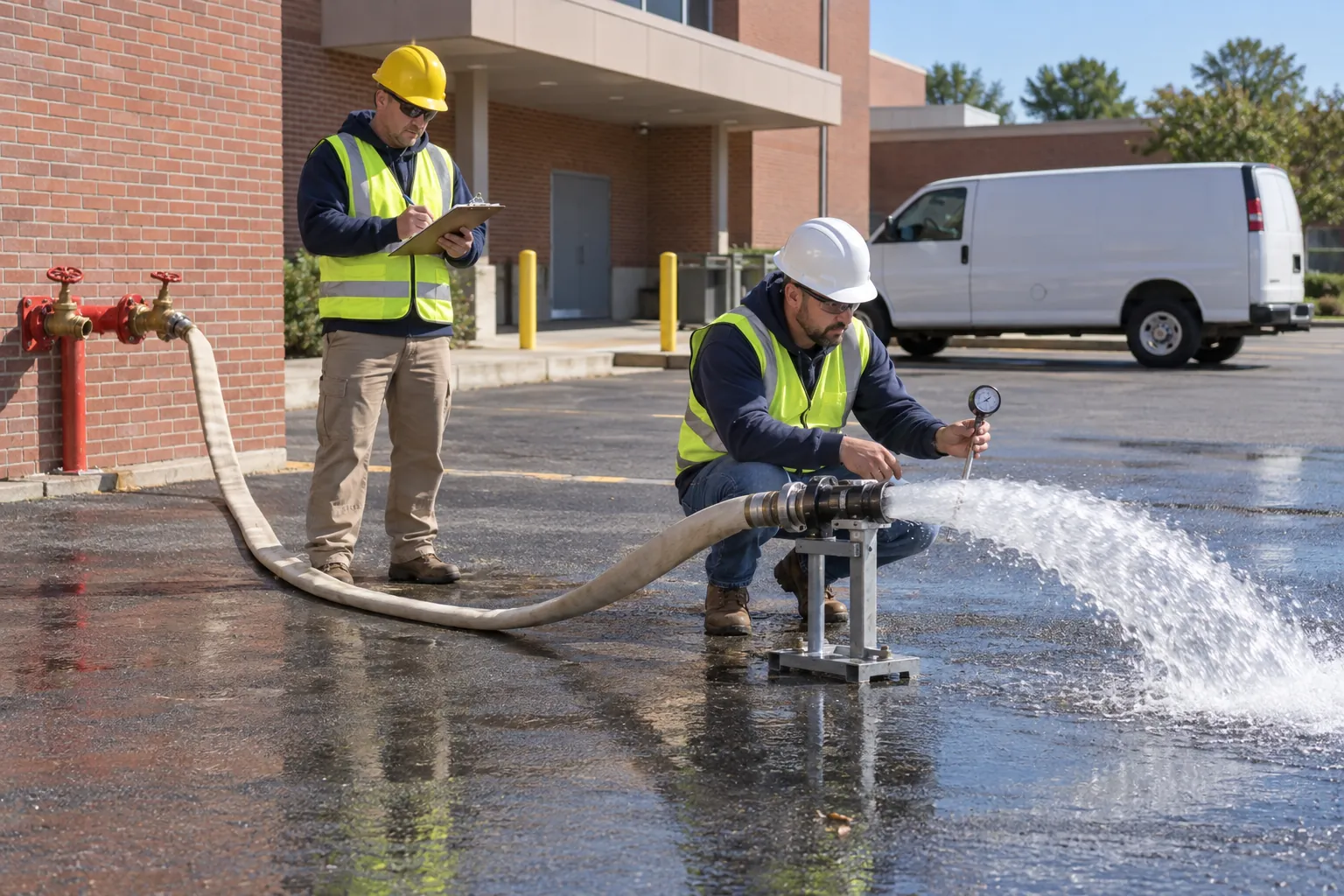
The churn test proves the pump starts and runs. Once a year, a flow test shows whether it still delivers the water it was built to deliver. In NFPA 25 and Properly Maintaining a Sprinkler System (August 2024), NFPA summarizes the major fire pump activities by frequency:
- Weekly and monthly: the inspection and churn tests above (an electric pump weekly where section 8.3.1.2.1 of NFPA 25 applies), and monthly, exercising the automatic transfer switch and emergency or standby generators, with a 36-month test that may be required under NFPA 110.
- Annual inspection: pump and driver alignment, shaft movement or endplay, the fuel tank vent and overflow, and cable and wire insulation.
- Annual test: the diesel fuel test, the main pressure relief valve, the fire pump alarm signals, and full flow pump performance.
- Annual maintenance: batteries, the circulating water filter, checking the fuel tank for foreign material, and the pump and motor bearings and coupling; the engine lubricating oil, oil filter and fuel filter every 50 operating hours or annually.
The full flow test runs the pump with water flowing, to show what it delivers at its rated capacity rather than only that it starts; keep each year's figures beside the last. NFPA's summary is a starting point: read the tables in the edition your AHJ enforces, because they change between editions.
Who does which part. NFPA 25 requires ITM to be done by "qualified" people: a competent and capable person "who has met the requirements and training for a given field acceptable to the AHJ." NFPA's article on weekly inspections says they "can normally be performed by facility managers or their staff with relatively little training." In practice the building engineer or maintenance team often does the weekly round, and in many buildings attends the churn test too. The annual flow test and repairs are normally a fire protection contractor's work, by technicians holding the license or certification your state or city requires.
Automated testing. NFPA's article Automated and Remote Inspection and Testing of Water-Based Fire Protection Systems explains that NFPA 25 allows this with conditions: a failed automated test must produce a supervisory signal, and under section 4.6.1 of the 2026 edition an automated test must be observed or manually conducted at least every 3 years. It does not remove the weekly inspection or the annual flow test.
05
When the pump is out of service
A failed pump is not a maintenance note. In NFPA 25, a system that is out of order is an impairment, whether planned or not, and NFPA's article Impairment Procedures for Sprinkler Systems That Are Out of Order names "a fire pump has failed" among the situations that leave a building with "a compromised sprinkler system." Chapter 15 of NFPA 25 sets out what to do:
- an impairment coordinator, assigned by the owner, authorizes any planned impairment in advance;
- a tag goes on each fire department connection and system control valve, and wherever else the AHJ requires;
- the extent, expected duration and increased risks are assessed, and the fire department, insurer, alarm company and affected supervisors notified;
- beyond 10 hours in a 24-hour period, one or more of these follow: evacuation of the affected area, an approved fire watch, a temporary water supply, or an approved program to eliminate ignition sources and limit fuel;
- on restoration, the necessary tests are done, everyone is told, and the tags come off.
06
Where the record fails, and what SiteClara does about it
The contractor's annual report is usually thorough. The weak part is the weekly routine between visits: the pump room log filled in for a month at a sitting, the same pressures copied line after line, a churn test started with the button because it is quicker, a diesel skipped over a holiday week.
SiteClara records the checks at the location. A printed QR poster, with an optional NFC tag behind it, sits at each place a check is scheduled, such as the fire pump room or the riser room. Staff scan the code or tap the tag on their own phone, with no app to install, see the checks due there, and mark each one done or say what stopped them, such as a locked room or a pump already out of service. The time and the named person are recorded as it happens, with a photo when one is asked for, for example of the suction and discharge gauges during the churn test. A problem, such as a closed valve or water on the floor, is reported there with a photo and goes onto the team's list of jobs until someone closes it.
The supervisor sees what is due, done and missed, and can record the reason a check was missed. A job that needs the building manager can be escalated to them to answer. Each day the supervisor reviews and approves a report that goes to nominated management or client contacts at 8 a.m. the next morning, showing what was reported, completed and still open, and how the scheduled checks went, for example 5 of 5 completed.
07
Questions people ask
How often do fire pumps need to be tested?
Under NFPA 25, a diesel fire pump is churn tested every week and most electric fire pumps every month, according to NFPA's article Weekly or Monthly No Flow Tests of Fire Pumps. On top of that, the pump room and pump are inspected weekly, and a full flow pump performance test is done once a year, as listed in NFPA's NFPA 25 and Properly Maintaining a Sprinkler System.
What are the requirements for an annual fire pump test?
NFPA's NFPA 25 and Properly Maintaining a Sprinkler System lists the annual tests as the diesel fuel test, the main pressure relief valve, the fire pump alarm signals, and full flow pump performance, alongside annual inspection of the pump and driver alignment, shaft movement or endplay, the fuel tank vent and overflow, and cable and wire insulation. NFPA's article Weekly Inspections of Electric Fire Pumps notes that annual flow testing is among the more complex activities, so it needs someone qualified for it and acceptable to the AHJ.
What are the NFPA 20 requirements for fire pumps?
NFPA 20, the Standard for the Installation of Stationary Pumps for Fire Protection, covers the selection and installation of the pump. In NFPA's words, it "protects life and property by providing requirements for the selection and installation of pumps to ensure that systems will work as intended to deliver adequate and reliable water supplies in a fire emergency." Once the pump is installed, its inspection, testing and maintenance follow NFPA 25.
How do you test a fire pump?
The routine test is the churn test described in NFPA's Weekly or Monthly No Flow Tests of Fire Pumps: the pump is started automatically by drawing water from the sensing line to simulate a pressure drop, not with the start button; an electric pump runs for at least 10 minutes and a diesel pump for at least 30; qualified personnel attend unless automated testing meets NFPA 25; and the starting pressure and the suction and discharge readings are recorded while the motor or engine is observed. The annual flow test, which runs the pump with water flowing, is normally done by a fire protection contractor.
08
Where to read more, and a list to take away
Read Chapter 8 of NFPA 25 through NFPA's free read-only access, in the edition your AHJ enforces. NFPA's articles cited above are a plain-language way in. Your fire marshal can tell you which fire code and edition apply and what local amendments add. For the rest of the water-based system, see our guides to fire sprinkler inspection and standpipe inspection.
Before the next contractor visit, check that:
- you know the pump's driver (electric, diesel or steam), and whether its churn test is weekly or monthly;
- you know which fire code and edition of NFPA 25 your AHJ enforces;
- someone is named as the owner's representative, and someone as impairment coordinator;
- the weekly inspection is scheduled, assigned to someone trained for it and recorded as it happens;
- the churn test is started by a pressure drop, not the start button, and runs at least 10 minutes (electric) or 30 minutes (diesel) with qualified people present;
- suction and discharge readings are recorded each time and compared with the last;
- the pump room stays at 40°F or above, dry and clear of storage;
- every deficiency on the last annual report has a date it was corrected, or a plan;
- the impairment procedure, tags and fire watch arrangements are ready before they are needed;
- the records are kept together and can be shown to the AHJ on request.
Sources
Every document this guide quotes or links to, in the order it first cites them.
- NFPA 25, Standard for the Inspection, Testing, and Maintenance of Water-Based Fire Protection Systems nfpa.org
- Weekly Inspections of Electric Fire Pumps nfpa.org
- New York City Fire Code (2022), Chapter 9, Fire Protection Systems nyc.gov
- 42 CFR 482.41, Condition of participation: Physical environment ecfr.gov
- Responsibilities of the Building Owner for Fire Sprinkler System Inspection, Testing, and Maintenance nfpa.org
- Sprinkler System Inspections, Testing, and Maintenance Frequencies Explained nfpa.org
- Weekly or Monthly No Flow Tests of Fire Pumps nfpa.org
- NFPA 25 and Properly Maintaining a Sprinkler System nfpa.org
- Automated and Remote Inspection and Testing of Water-Based Fire Protection Systems nfpa.org
- Impairment Procedures for Sprinkler Systems That Are Out of Order nfpa.org
- Standard for the Installation of Stationary Pumps for Fire Protection nfpa.org
Related guides
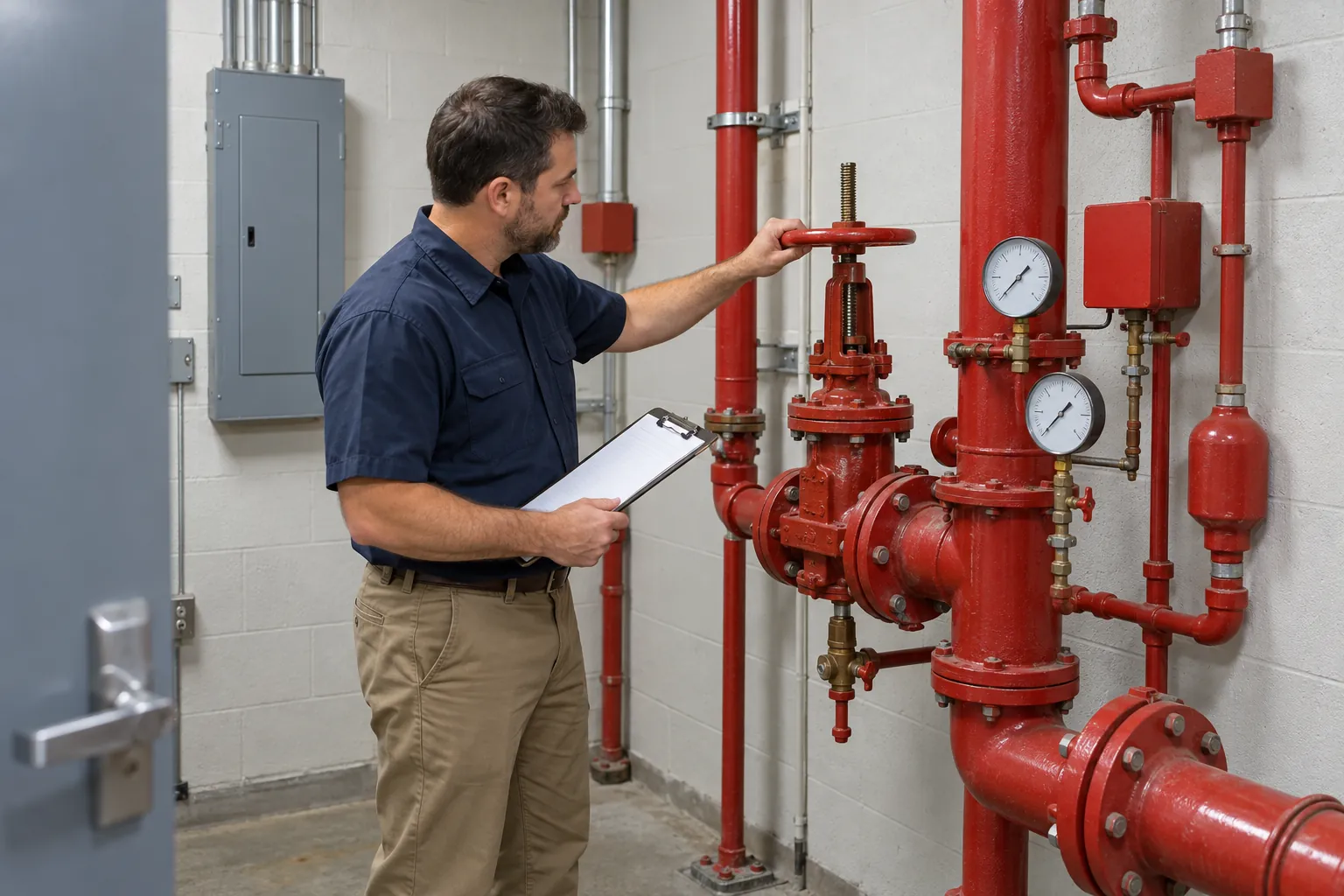 Fire and water checksFire sprinkler inspection: what NFPA 25 asks of the buildingWhat a sprinkler system inspection involves under NFPA 25, who does the weekly, monthly and annual checks, how impairments work, and what the record should show.
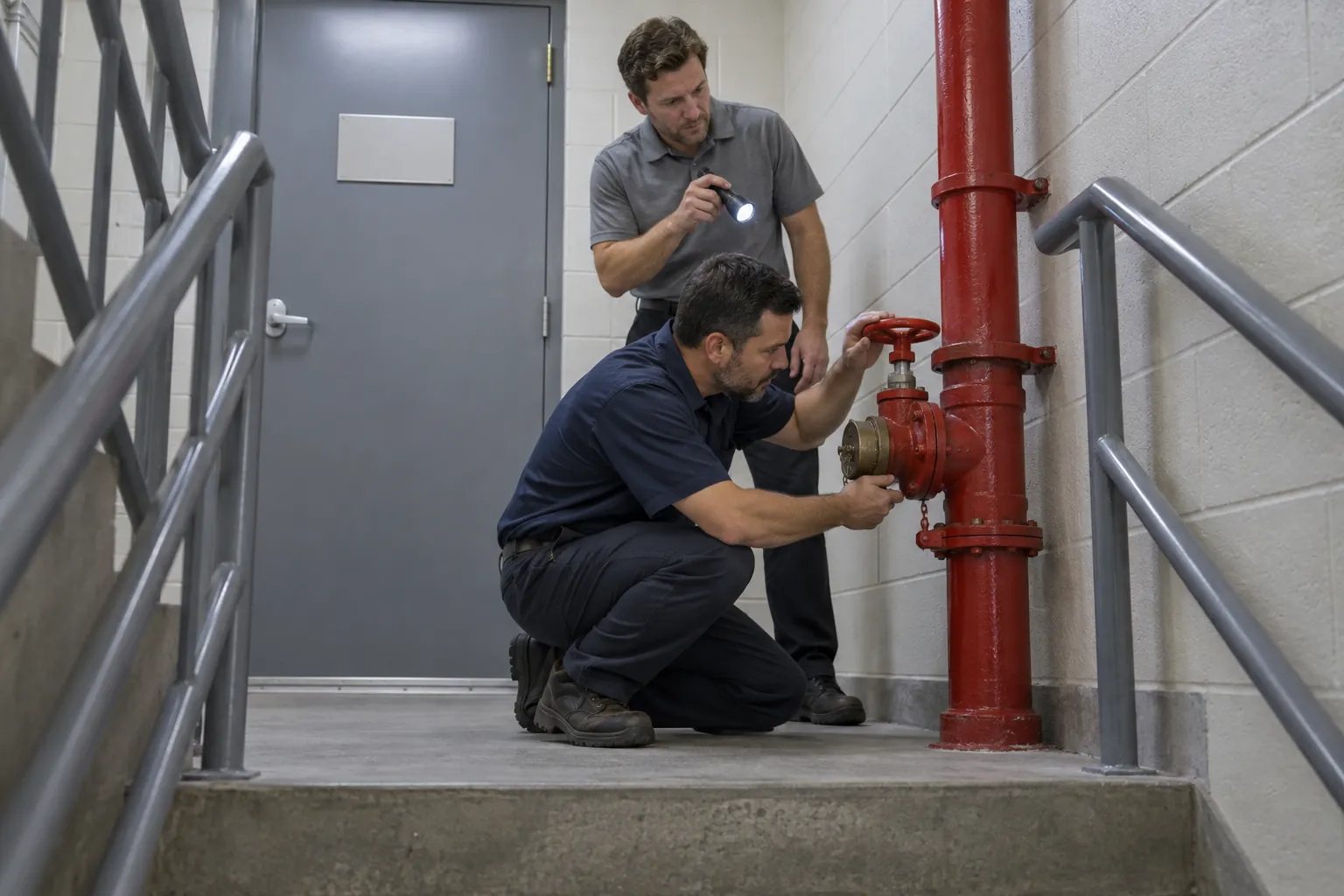 Fire and water checksStandpipe inspection and testing: keeping the fire department's water readyWhat standpipe inspection and testing involve under NFPA 25 and the fire code, what building staff check between contractor visits, and what the record shows.
 Fire and water checksFire watch logs: patrolling a building while its fire protection is out of serviceWhen a fire watch is required under IFC 901.7 and NFPA 25, who can stand it, how often to patrol, and what a fire watch log should show the fire marshal.
 Premises and facilities managementGenerator testing: what NFPA 110 asks, and what to write downEmergency generator testing under NFPA 110: the weekly inspection, the monthly exercise under load, batteries, fuel, the 36-month test, and what the record shows.