Cleaning
Cafeteria cleaning checklist: what to clean, when, by whom, and how to show it was done
A cafeteria cleaning checklist lists every cleaning task for the serving line, kitchen, dish room and dining room, says when each is done (before, during and between meal services, at close, and weekly) and names who does it, so that food-contact surfaces are cleaned and sanitized on the FDA Food Code's schedule and the front-of-house stays clean for the people eating there.
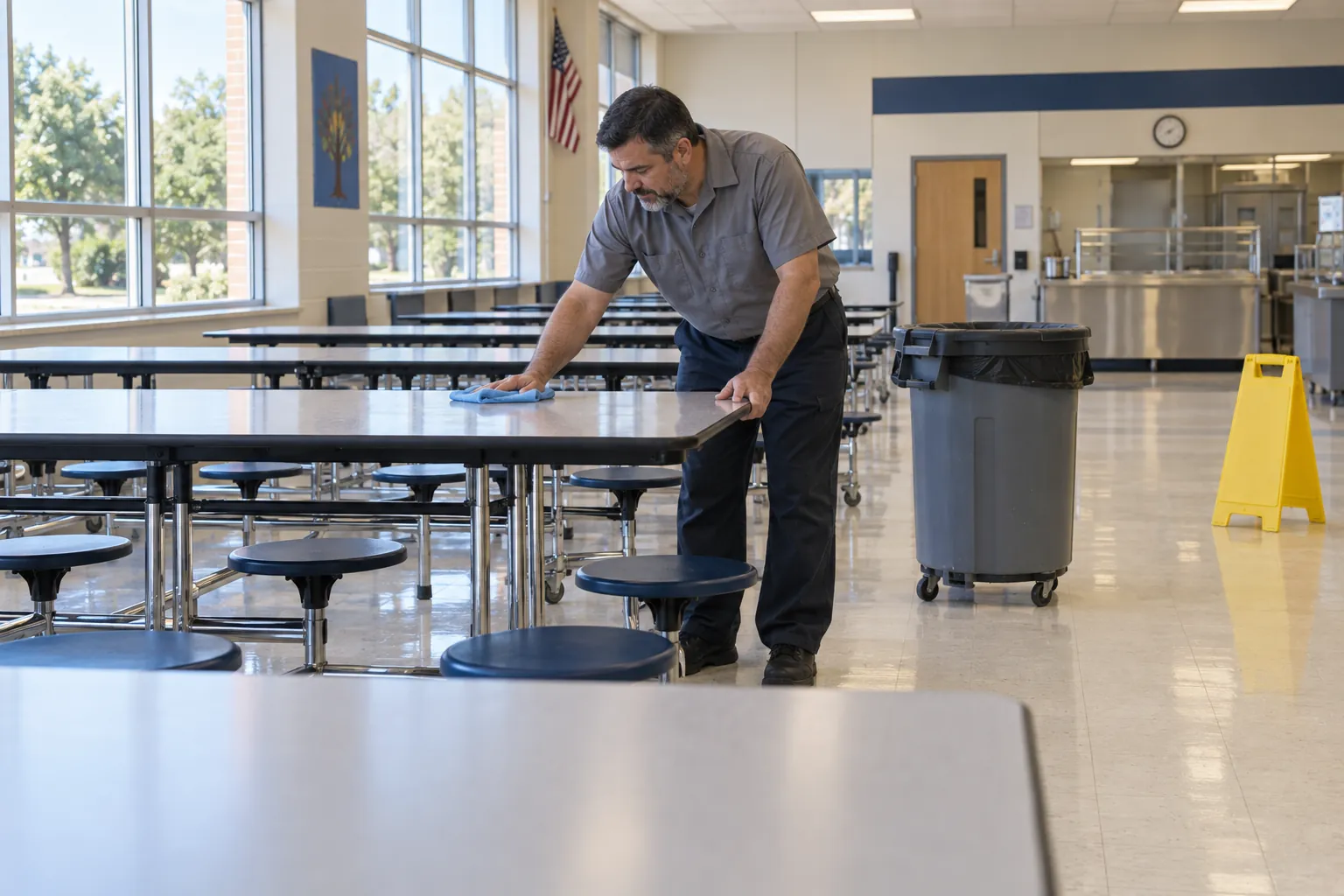
A cafeteria is cleaned by two teams under two sets of rules. The food service crew keeps the kitchen, the serving line and the dish room to the food code the health department enforces; the custodial crew keeps the dining room, the floors, the trash and the restrooms to the standard the building sets. The checklist fails at the edge between them. This guide covers what the FDA Food Code says about cleaning frequency, the extra duties of a school cafeteria under the USDA school meal rules, a cafeteria cleaning checklist by area and by time of day, who does each task, and what a record looks like that an inspector, a school district or a client can believe.
01
The rules a cafeteria is cleaned under
There is no federal cafeteria cleaning standard. A cafeteria that prepares or serves food is a food establishment, and its cleaning rules come from the retail food code your state, county or city health department enforces. Most of those codes are built on the FDA Food Code, which FDA describes as "a model that assists food control jurisdictions at all levels of government". In FDA's words, "Local, state, tribal, and federal regulators use the FDA Food Code as a model to develop or update their own food safety rules." The Food Code becomes law only where a jurisdiction adopts it, often an older edition and often with local amendments, so read the code your health department enforces before you quote a section number.
The quotations below are from the FDA Food Code 2026, the current edition. The sections that shape a cafeteria cleaning checklist are these:
- The objective, 4-601.11. Food-contact surfaces of equipment and utensils "shall be clean to sight and touch", and nonfood-contact surfaces of equipment "shall be kept free of an accumulation of dust, dirt, food residue, and other debris."
- The four-hour rule, 4-602.11(C). Where equipment and utensils are used with time/temperature control for safety food, such as cooked meats, dairy and cut produce, their food-contact surfaces "shall be cleaned throughout the day at least every four hours", with limited exceptions in paragraph (D) for refrigerated rooms, storage containers and similar cases.
- The serving line, 4-602.11(D)(3). Containers "in serving situations such as salad bars, delis, and cafeteria lines" that are topped up with more of the same food held at the right temperature must be "cleaned at least every 24 hours".
- Self-service, 4-602.11(E). Consumer self-service utensils "such as tongs, scoops, or ladles" and iced tea dispensers are cleaned at least every 24 hours, and condiment dispensers and display containers are cleaned "before restocking". Ice bins and beverage dispensing nozzles follow the manufacturer's frequency, covered in our guide to ice machine cleaning.
- Sanitizing, 4-702.11 and 4-703.11. Utensils and food-contact surfaces "shall be sanitized before use after cleaning", by hot water or by a chemical sanitizer at the concentration and contact time the code and the EPA-registered label set.
- The room, 6-501.12. Physical facilities "shall be cleaned as often as necessary to keep them clean", and, except for a spill or other accident, cleaning "shall be done during periods when the least amount of food is exposed such as after closing."
- Trash, 5-501.116. Soiled refuse and recycling receptacles are cleaned "at a frequency necessary to prevent them from developing a buildup of soil or becoming attractants for insects and rodents."
Two more duties sit behind every checklist. Section 2-502.11 requires a food establishment to "have written procedures for employees to follow when responding to vomiting or diarrheal events", and section 6-501.111 requires the premises to be kept free of pests, including by "routinely inspecting the premises for evidence of pests". For the workers doing the cleaning, OSHA's walking-working surfaces rule, 29 CFR 1910.22, requires the floor of each workroom to be "maintained in a clean and, to the extent feasible, in a dry condition", and requires walking-working surfaces to be kept free of hazards such as "leaks, spills, snow, and ice". Public school staff are covered only where the state runs an OSHA-approved state plan, so check before you cite it.
02
School cafeterias: the USDA meal program rules on top
A school that serves meals under the National School Lunch Program has federal duties as well as the local food code. They are in 7 CFR 210.13, Facilities management, which requires the school food authority and its schools to:
- "ensure that food storage, preparation and service is in accordance with the sanitation and health standards established under State and local law and regulations";
- obtain "a minimum of two food safety inspections during each school year conducted by a State or local governmental agency responsible for food safety inspections", and "post in a publicly visible location a report of the most recent inspection conducted";
- "develop a written food safety program that covers any facility or part of a facility where food is stored, prepared, or served", based either on traditional HACCP principles or on the process approach to HACCP, which must include "Standard operating procedures to provide a food safety foundation", monitoring, corrective action and "Recordkeeping procedures".
Cleaning and sanitizing is one of those standard operating procedures. USDA's nutrition agency, which its reorganization notice says is now the Food and Nutrition Administration (formerly the Food and Nutrition Service), publishes Guidance for SFAs: Developing a School Food Safety Program Based on the Process Approach to HACCP Principles. The Institute of Child Nutrition publishes sample SOPs that many districts adapt, including Cleaning and Sanitizing Food Contact Surfaces (Sample SOP). It tells school nutrition employees to wash, rinse and sanitize food-contact surfaces of "sinks, tables, equipment, utensils, thermometers, carts, and equipment" before each use, between raw animal foods and ready-to-eat foods, and "Any time contamination occurs or is suspected".
So the school's food safety program already names the kitchen's cleaning procedures and records. A custodial checklist for the same cafeteria should fit alongside it, with the handoff between the two departments written down.
03
What a cafeteria cleaning checklist covers
Write the checklist by area, so that each task has one place and one owner. A typical cafeteria has these areas:
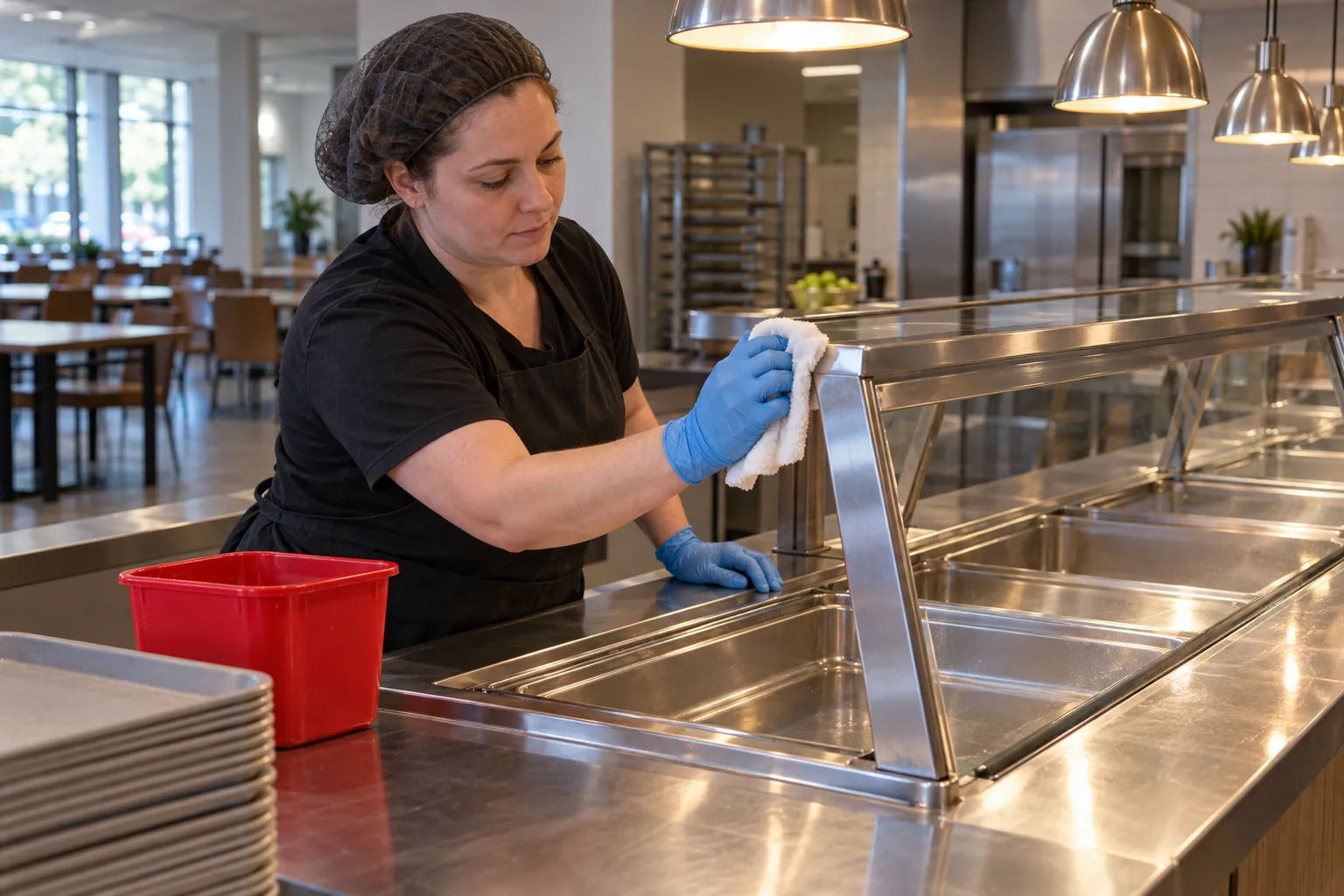
- Serving line: hot wells, cold wells and sneeze guards, pans and inserts, serving utensils, tray rails, point-of-sale counter, and the floor behind and in front of the line.
- Salad bar and self-service: containers, tongs and ladles, condiment dispensers, napkin and utensil dispensers, beverage and iced tea dispensers, and the ice bin.
- Kitchen and prep: prep tables and cutting boards, slicers and mixers, ovens, steamers and kettles, reach-in and walk-in coolers, shelving, handwashing sinks and their soap and paper towels.
- Dish room: the dishmachine and its curtains and screens, the three-compartment sink, drainboards, tray return and carts.
- Dining room: tables, seats and benches, ledges, doors at hand height, diners' microwaves and water fountains.
- Trash and recycling: dining room receptacles and their lids, tray-return waste stations, liners, and the dumpster or compactor area outside.
- Floors: sweep and mop the dining room, serving line, kitchen and dish room, including floor drains, mats and the corners under equipment.
- Restrooms and support rooms that serve the cafeteria: restrooms, the janitor's closet, the mop sink and the chemical store.
- Pest watch: droppings, insects, gaps and the pest control contractor's reports.
Each line on the checklist should say what "clean" means for that item, not only its name. "Tables" is a line nobody can fail. "Tables and seats wiped with the approved product after each lunch period, no food residue on tops, edges or seat pans" is a line a supervisor can check.
04
The checklist by time of day
The Food Code sets a few fixed intervals and leaves the rest to "as often as necessary", so treat this as a starting point to adjust to your code, menu and building.
Before service
- Cleaning supplies stocked, and sanitizer buckets and wiping cloths set up at the right strength, checked with a test strip.
- Serving line, sneeze guards, trays and utensils clean, sanitized and dry.
- Handwashing sinks stocked with soap and paper towels and not blocked.
- Dining room tables and seats clean, floor clear and dry, trash receptacles lined.
During service
- Spills on the line and in the dining room cleaned up at once, and a wet floor sign put out until the floor is dry.
- Utensils and food-contact surfaces used with time/temperature control for safety food cleaned at least every four hours (4-602.11(C)).
- Wiping cloths for counters and equipment held in sanitizer between uses (3-304.14), and the solution changed when it is soiled or below strength.
- Condiment dispensers and display containers cleaned before they are restocked.
- Trash receptacles emptied before they overflow.
Between meal periods (between breakfast and lunch, or between lunch waves in a school)
- Tables and seats wiped, and crumbs swept from under them.
- Tray return and waste station cleared and wiped.
- Floors spot-mopped around the line and the tray return.
At close
- Serving line containers, self-service utensils and iced tea dispensers cleaned (at least every 24 hours).
- Cooking equipment food-contact surfaces and microwave cavities cleaned (at least every 24 hours, 4-602.12).
- Dishmachine drained, screens and curtains cleaned; three-compartment sink cleaned.
- Kitchen, dish room and dining room floors swept and mopped with dustless methods, drains cleared.
- All trash removed, receptacles cleaned when soiled, dumpster area checked.
- Wiping cloths sent for laundering (the Food Code says daily).
Weekly and periodic
- Walk-in and reach-in coolers emptied section by section and cleaned; shelving wiped.
- Walls, doors, light switches and window ledges washed.
- Floor machine scrubbing, and grout and drain treatment where needed.
- Ice machine and beverage nozzles on the manufacturer's interval.
- Hood filters on the schedule your operation needs, and the full exhaust system by a contractor on the fire code's schedule.
- Pest control visits, with the contractor's report read and acted on.
Weekly and periodic tasks belong on a master sanitation schedule with dates, not on a daily sheet where they are easily initialed and never done.
05
Who does what, and the products they use
Most cafeteria cleaning failures are handoff failures: the cook assumes the custodian mops behind the line, and the custodian assumes the kitchen does. Put one owner on every line. A common split:
- Food service staff: everything that touches food, from prep surfaces and the serving line to self-service utensils, the dish room and the coolers, and usually the kitchen floor at close.
- Custodians or the janitorial contractor: the dining room, tables and seats between periods where the contract says so, floors outside the kitchen, trash, restrooms and periodic floor care.
- Day porter: in an office or campus cafeteria, spill response, table resets and trash runs during service.
- Building engineer or maintenance: leaks, drains, broken tiles and gaps where pests get in, since 6-501.11 requires physical facilities to be "maintained in good repair".
- Contractors: pest control, hood and duct cleaning, dishmachine and ice machine service, each leaving a service report on site.
Chemicals need the same care as the cleaning. A food-contact sanitizer is used "in accordance with the EPA registered label use instructions" (4-501.114), at the concentration the label and the code set, and tested with the right test kit. A disinfectant used in the dining room follows its own label: EPA's List G: EPA's Registered Antimicrobial Products Effective Against Norovirus explains that "The contact time is the time the product must be applied to the treated surface for it to be effective", and marks the products that need a potable water rinse on food-contact surfaces. Under OSHA's Hazard Communication standard, 29 CFR 1910.1200, the employer must keep a safety data sheet for each hazardous chemical "readily accessible during each work shift", and train employees "at the time of their initial assignment, and whenever a new chemical hazard" is introduced.
Vomit in a cafeteria is a job for someone trained, not whoever is nearest, following the written procedure 2-502.11 requires. The CDC's How to Prevent Norovirus page advises gloves, wiping the entire area with paper towels into a plastic trash bag, and disinfecting with "a chlorine bleach solution with a concentration of 1,000 to 5,000 ppm" or "an EPA-registered disinfecting product against norovirus". Our guide to vomit cleanup covers the procedure step by step.
06
Where the record fails, and what SiteClara does about it
A cafeteria cleaning record usually fails in one of three ways. The sheet on the kitchen door is initialed for the whole week in one pen. The dining room is "done by the night crew" with nothing to show which tables, floors and when. And the leak under the dishmachine, or the droppings behind the milk cooler, is mentioned to whoever was passing and never reaches anyone who can fix it.
SiteClara records the checks where the work is done. A printed QR poster, with an optional NFC tag behind it, goes up at each area: the serving line, the dish room, the dining room, the trash room, the restrooms. The food service worker, custodian or day porter scans or taps it on their own phone, with no app to install, sees the checks due there, and marks each one done or says what stopped them. The time and the named person are recorded as it happens, with a photo when the check asks for one, such as the underside of the serving line after the close. A problem someone finds, like a blocked floor drain or a torn door sweep, goes onto the team's list of jobs until it is closed.
A supervisor sees what is due, done and missed across the cafeteria, and records the reason a check was missed or held up. Each day they review it, add a note and approve a report that goes to the building's nominated contacts the next morning, 8:00 by default, showing what was completed, what was not, and what is still open. Where a janitorial contractor cleans the dining room, the same record shows the client which areas its crew covered and when.
07
Questions people ask
What is the correct order of cleaning tasks?
For a food-contact surface the order is wash, rinse, sanitize, then air-dry. The Institute of Child Nutrition's Cleaning and Sanitizing Food Contact Surfaces (Sample SOP) sets it out as "Wash surface with detergent solution", "Rinse surface with clean water", sanitize at the concentration on the manufacturer's label, and "Place wet items in a manner to allow air drying." The annex to the FDA Food Code 2026 explains why the order matters: "It is important that surfaces be clean before being sanitized to allow the sanitizer to achieve its maximum benefit." For the room itself, section 6-501.12 puts the cleaning, other than a spill, "during periods when the least amount of food is exposed such as after closing."
What are the steps involved in a cleaning checklist for a restaurant?
The FDA Food Code publishes no checklist, but it sets what one has to build in. The annex to the FDA Food Code 2026 says "A regular cleaning schedule should be established and followed to maintain the facility in a clean and sanitary manner", with primary cleaning done "when food is not being served or prepared." So list each area and task, set its frequency (at least every four hours for surfaces used with time/temperature control for safety food, every 24 hours for serving line containers, as often as necessary for floors and walls), name who does it, and record it when it is done. In a school kitchen, the Institute of Child Nutrition's Cleaning and Sanitizing Food Contact Surfaces (Sample SOP) adds washing, rinsing and sanitizing between raw animal foods and ready-to-eat foods, and a log the school nutrition manager reviews, initials and dates.
08
Further reading, and a list to take away
Read sections 4-601.11, 4-602.11, 4-602.13, 4-703.11 and 6-501.12 in the edition of the FDA Food Code your health department enforces. For school meals, read 7 CFR 210.13 and the Guidance for SFAs, and adapt the Institute of Child Nutrition's Cleaning and Sanitizing Food Contact Surfaces (Sample SOP) and its Food Contact Surfaces Cleaning and Sanitizing Log. The ICN log's instructions have the school nutrition manager review, initial and date it daily and keep it for a minimum of one year.
Before you sign off a cafeteria cleaning checklist, check that:
- every area is on the checklist, and each line says what clean means;
- the four-hour and 24-hour Food Code intervals are built into the day;
- every line has one owner, and the split between food service and custodial staff is written down;
- sanitizer strength is tested and recorded, and safety data sheets are at hand;
- there is a written procedure and a kit for vomiting and diarrheal events, and staff know it;
- weekly and periodic tasks are on a dated schedule, not the daily sheet;
- repairs and pest sightings go to someone who closes them;
- the record shows who did each task and when, recorded when it was done;
- a missed task is recorded with a reason, and a supervisor reviews the record every day.
Sources
Every document this guide quotes or links to, in the order it first cites them.
- FDA Food Code fda.gov
- FDA Food Code 2026 fda.gov
- 29 CFR 1910.22 osha.gov
- 7 CFR 210.13, Facilities management ecfr.gov
- Reorganization notice fna.usda.gov
- Guidance for SFAs: Developing a School Food Safety Program Based on the Process Approach to HACCP Principles fna.usda.gov
- Cleaning and Sanitizing Food Contact Surfaces (Sample SOP) theicn.org
- List G: EPA's Registered Antimicrobial Products Effective Against Norovirus epa.gov
- Hazard Communication standard, 29 CFR 1910.1200 osha.gov
- How to Prevent Norovirus cdc.gov
- Food Contact Surfaces Cleaning and Sanitizing Log theicn.org
Related guides
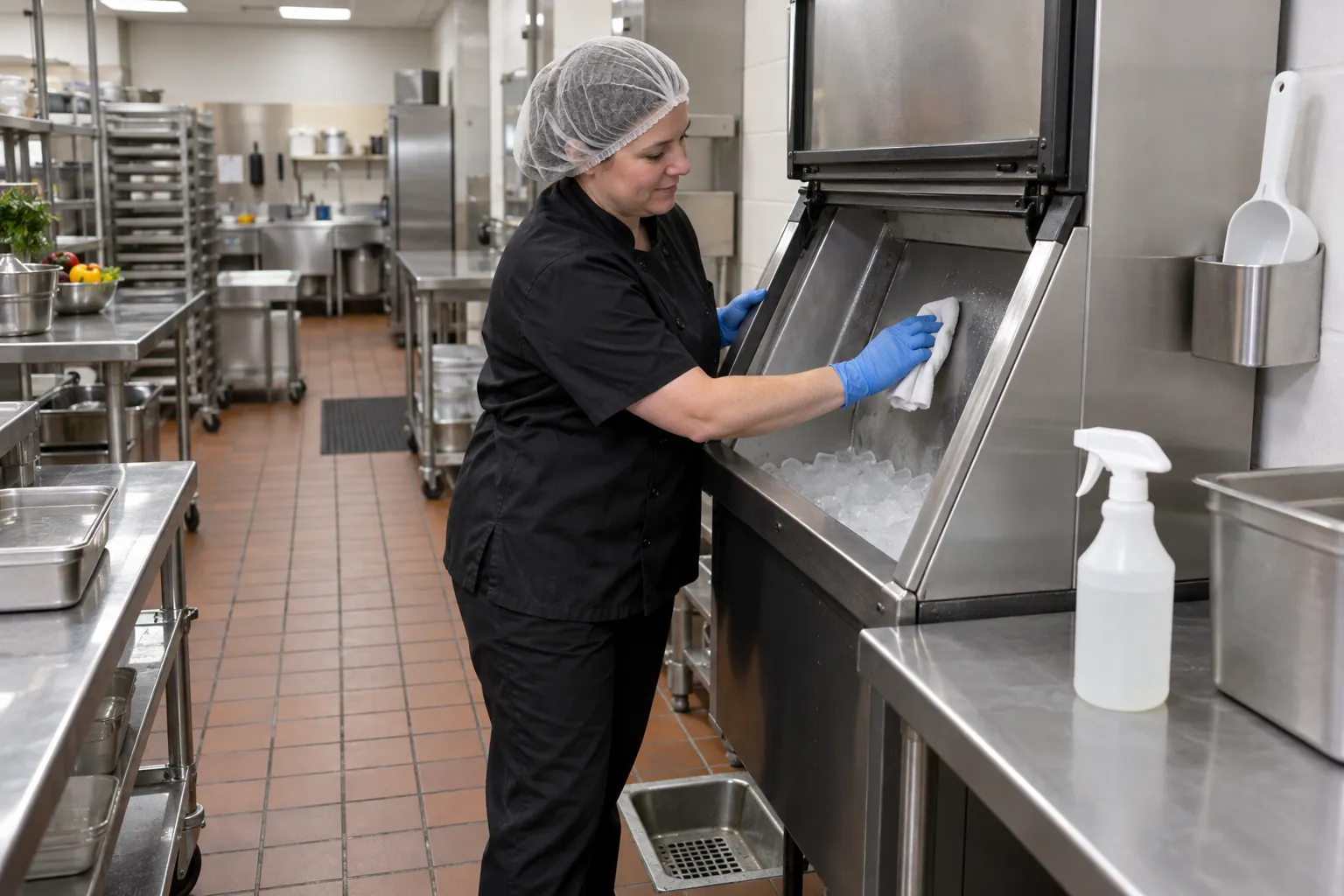 CleaningIce machine cleaning schedule: how often, who does it, and proving it was doneHow often to clean an ice machine under FDA Food Code 4-602.11 and the manufacturer's manual, who does each task, CDC guidance for hospitals, and keeping the log.
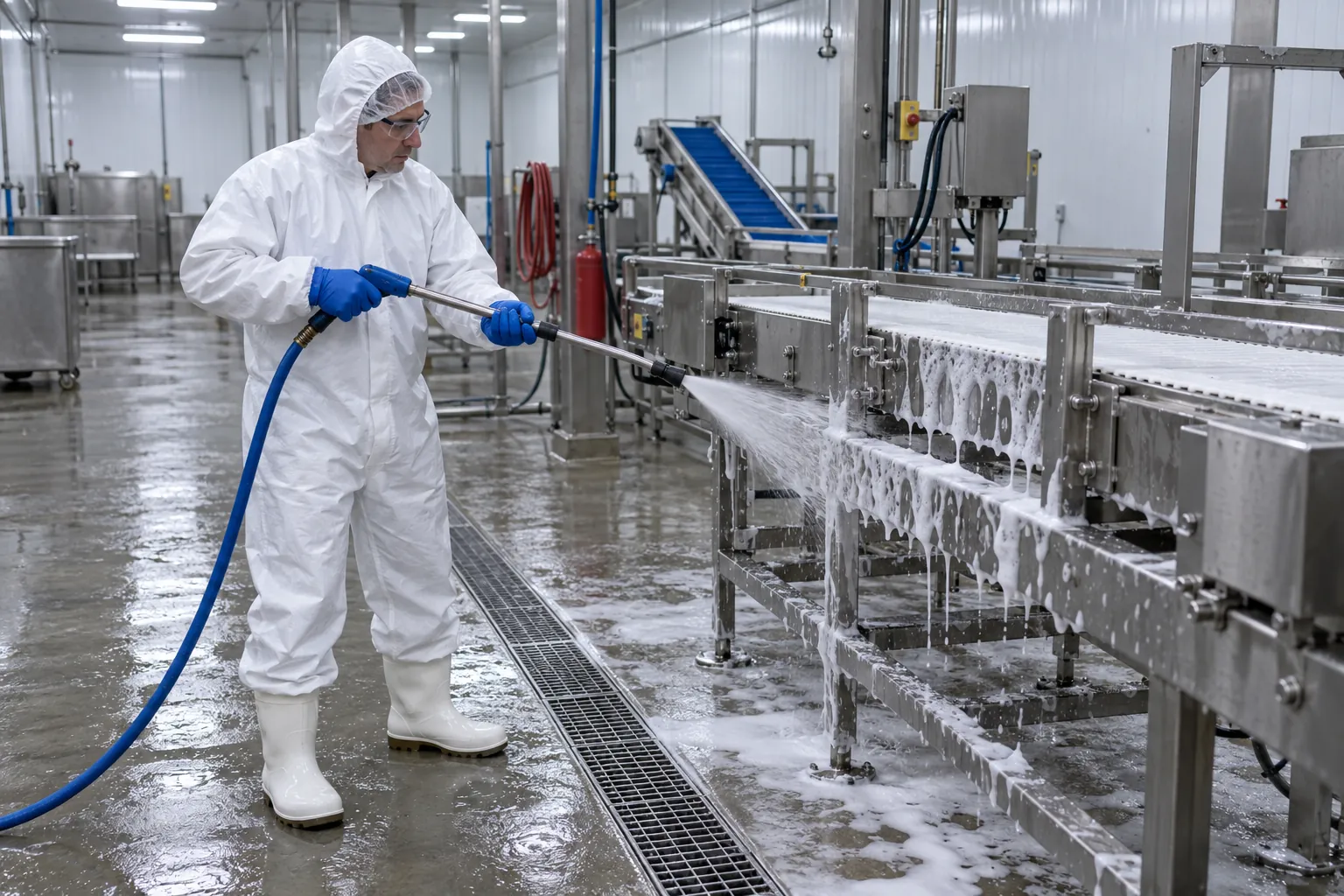 CleaningMaster sanitation schedule: building one, running it, and proving it happenedWhat a master sanitation schedule is, how it fits FDA 21 CFR 117 and USDA SSOPs, what goes on it, how often, who signs, and how to keep the record honest.
 CleaningBreakroom cleaning checklist: what to clean, how often, and who owns the refrigeratorA breakroom cleaning checklist by surface and frequency, the OSHA sanitation rules behind it, who cleans the refrigerator, and how to show the work was done.
 CleaningNorovirus cleanup: how to deal with vomit and diarrhea without spreading the virusHow to clean up vomit and diarrhea so norovirus does not spread: the CDC steps, bleach strength, EPA List G, the Food Code plan, OSHA duties and the record.