Cleaning
Ice machine cleaning schedule: how often, who does it, and proving it was done
An ice machine cleaning schedule sets a daily wipe and sanitize of the outside, dispenser and scoop, a weekly look inside the bin, and a full clean and sanitize of the ice-making section at the interval the manufacturer specifies, which is the frequency the FDA Food Code asks for.
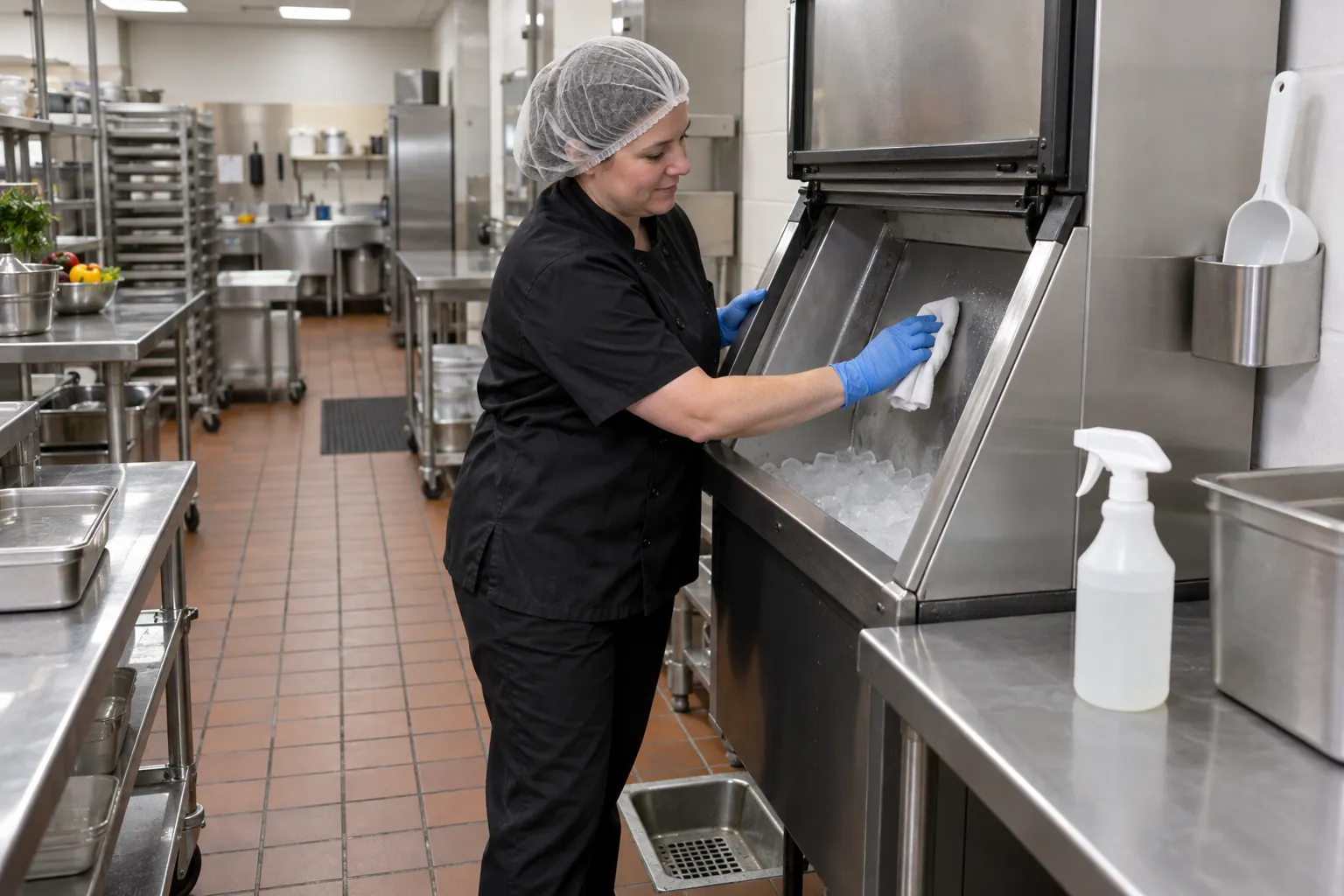
Ice is food. The FDA Food Code, the model for state and local food codes, defines food to include ice, and an inspector who lifts the door of an ice bin and runs a gloved finger under the deflector is looking for the slime, mold and mineral buildup that collect when nobody has cleaned the parts you cannot see. This guide covers what the FDA Food Code says, what the CDC advises for hospitals, how to split the work between kitchen staff, custodial crews, the building engineer and the service contractor, and what a useful record looks like.
01
What the FDA Food Code says about cleaning ice machines
In a restaurant, cafeteria, hotel kitchen or any other licensed food establishment, the rule on ice machine cleaning comes from the retail food code your state or local health department enforces. Most of those codes are built on the FDA Food Code, which FDA publishes as a model: under FDA's own description on its FDA Food Code page, local, state, tribal and federal regulators "use the FDA Food Code as a model to develop or update their own food safety rules". It is not federal law in itself; it becomes law where a jurisdiction adopts it.
The frequency rule for ice machines is in section 4-602.11. The wording below is from the FDA Food Code 2026. Paragraph (E)(4) says that surfaces contacting food that is not time/temperature control for safety food shall be cleaned "In EQUIPMENT such as ice bins and BEVERAGE dispensing nozzles and enclosed components of EQUIPMENT such as ice makers":
- "(a) At a frequency specified by the manufacturer, or"
- "(b) Absent manufacturer specifications, at a frequency necessary to preclude accumulation of soil or mold."
The Food Code's Annex 3 explains why: ice makers and ice bins "must be cleaned on a routine basis to prevent the development of slime, mold, or soil residues that may contribute to an accumulation of microorganisms". Where the manufacturer gives no cleaning specifications for surfaces that are not readily visible, "the person in charge should develop a cleaning regimen that is based on the soil that may accumulate in those particular items of equipment."
So the Food Code does not give you a number of days. It points you to the manual first, and to your own judgment second, and it holds the person in charge responsible for either. That is what an ice machine cleaning schedule is for.
02
What an ice machine cleaning schedule covers
An ice machine is several pieces of equipment in one box: water supply and filter, evaporator, water trough, bin or dispenser, drain, and a refrigeration system with a condenser. A complete schedule covers:
- The outside of the machine: doors, handles, push pads and dispenser levers, which are touched all day. Wiped and sanitized daily, more often in a busy self-serve area.
- The dispenser chute and nozzle on a self-serve or hotel-floor machine, where splashes and hands meet the ice path.
- The ice scoop and its holder. Section 3-304.12 of the Food Code allows ice scoops used only with food that is not time/temperature control for safety food to be kept "In a clean, protected location" between uses. The scoop and holder need their own cleaning, usually daily.
- The inside of the bin: walls, floor, door gasket and the underside of the deflector or curtain, where mold tends to start.
- The ice-making section: evaporator, water trough, distribution tube, float or sensor and water pump, the food-contact surfaces nobody sees, cleaned with the cleaner the manufacturer names, often a scale remover, and then sanitized. This is the periodic clean the manual schedules.
- The water filter, changed at the interval on the filter housing or in the manual, and sooner if ice production drops.
- The condenser on an air-cooled machine, where dust and grease cut performance and push up running temperature.
- The drain, floor sink and surrounding area: standing water, leaks, debris under the unit, and signs of pests.
Add two Food Code construction rules to the inspection side, because crews often notice first when something changes. Section 4-204.17 says "Liquid waste drain lines may not pass through an ice machine or ice storage bin", and section 4-204.16 keeps beverage tubing and cold-plate cooling devices out of contact with stored ice, except cold plates built into the bin. Section 5-402.11 prohibits a direct connection between the sewage system and a drain from equipment in which food is placed, which is why an ice machine normally drains through an air gap to a floor sink. A drain hose pushed down into the floor sink goes on the building engineer's list.
Ice itself has one more rule. Section 3-202.16 says "Ice for use as a FOOD or a cooling medium shall be made from DRINKING WATER", and section 3-303.11 says ice that has been used to cool the outside of packaged foods, canned beverages or equipment coils "may not be used as FOOD". Ice from the bar's bottle cooler does not go back in the drinks.
03
Setting the frequency: daily, weekly and the manufacturer's interval
Start with the manual for each commercial ice machine on site, not a rule of thumb. It sets the periodic clean-and-sanitize interval, names the cleaner and sanitizer the machine is built to take, and often says to shorten the interval for hard water, where mineral scale builds up faster, dusty or greasy air, or heavy use. The Food Code puts the manufacturer's frequency first, so an inspector will usually ask to see it. If the manual is lost, the manufacturer or an authorized service company can usually supply it.
A practical ice machine cleaning schedule then looks like this:
- Every shift or every day: wipe and sanitize the exterior, handles, push pads and dispenser chute; clean and sanitize the scoop and its holder; check the bin door closes and the area is dry.
- Weekly: look inside the bin with a flashlight, under the deflector and around the gasket; clear debris from the air intake; check the drain and air gap.
- At the manufacturer's interval: the full clean and sanitize of the ice-making section and bin, using the named products and the machine's cleaning cycle where it has one; discard all ice made during the cycle.
- At the filter interval: change the water filter and write the date on the housing as well as in the record.
- At the condenser interval, or when dirty: clean the condenser on an air-cooled unit, usually a job for the building engineer or service contractor.
- Whenever contamination may have occurred: glass or a foreign object in the bin, a pest sighting, a flood or backup in the floor sink, a boil-water notice, a long power or water outage. Empty the bin, clean, sanitize and follow any instructions from your health department before making ice again.
Tighten a frequency wherever the machine shows it needs it. Pink or black residue under the deflector a week after a periodic clean means the interval is too long for that location. Open bins that staff reach into need more attention than dispensers, and a hotel ice machine on a guest floor needs more than one in a staff breakroom. Cloudy or soft ice, slow harvests and falling production can also point to scale on the evaporator or a dirty condenser, which cost the machine efficiency as well as hygiene; if a clean does not bring them back, call the service contractor for a repair visit rather than stretching the next interval.
04
Who does what: kitchen staff, custodial crews, engineers and service contractors
Ice machines fall between trades. The kitchen thinks the service company cleans it, the service company comes when it breaks, and the filter gets changed when someone remembers. Put a named role against every task:
- Kitchen, bar or cafeteria staff: the daily exterior, dispenser and scoop tasks and the weekly bin check, under the person in charge.
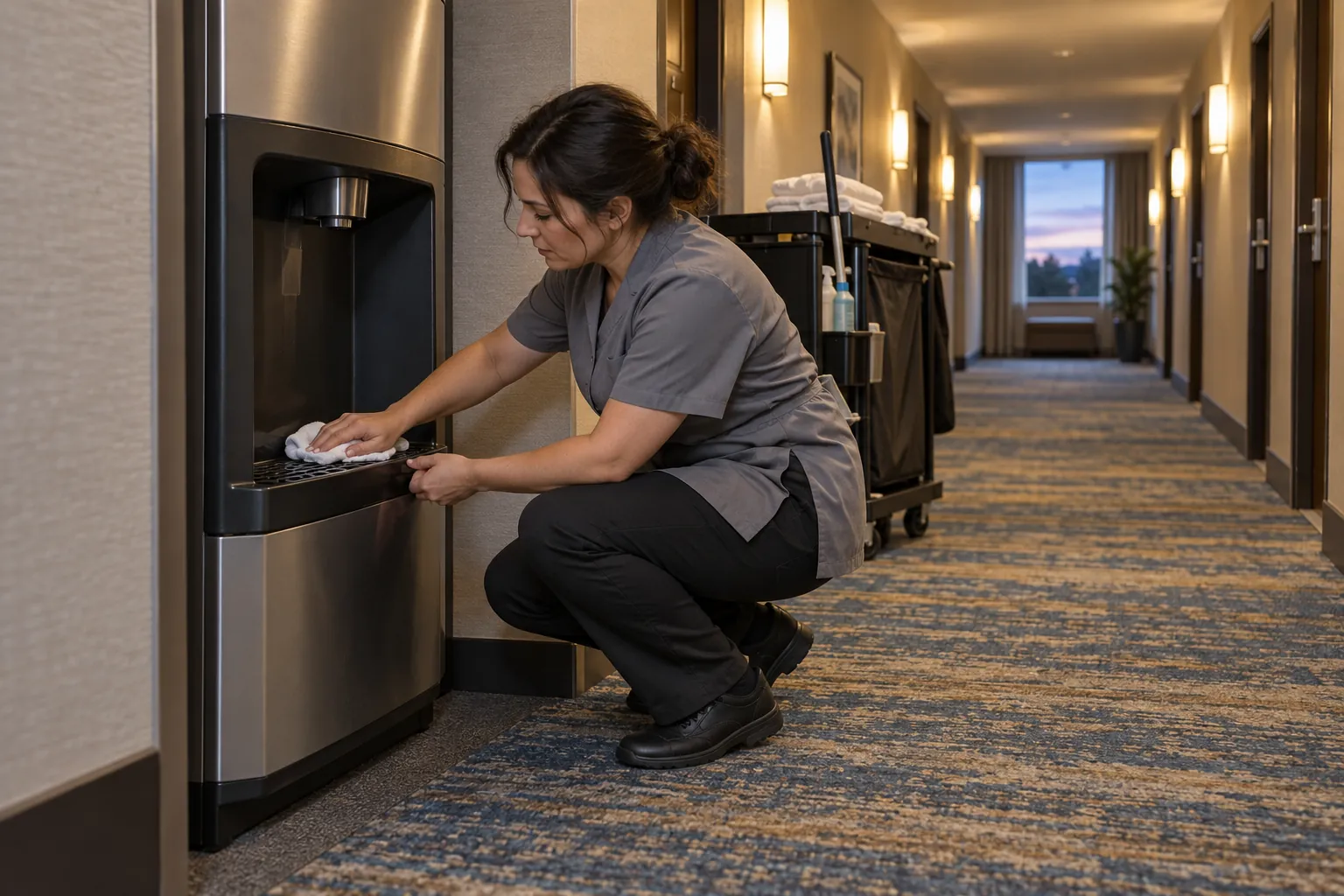
- Custodial or housekeeping crews: machines in breakrooms, hotel floors, office pantries and locker rooms that no kitchen owns, each with its own line on the route.
- The building engineer or maintenance technician: filters, condensers, drains, air gaps, water supply valves and anything that needs tools.
- The ice machine service contractor: the periodic clean and repairs, if the contract says so, leaving a service record on site.
- The facility manager or person in charge: owns the schedule and acts when a line is not done.
The periodic clean is real work on refrigeration equipment. OSHA's lockout/tagout standard, 29 CFR 1910.147, excludes work on cord and plug connected equipment where the hazard "is controlled by the unplugging of the equipment from the energy source and by the plug being under the exclusive control of the employee performing the servicing or maintenance." A hard-wired machine, or one where the plug is behind the unit out of the worker's control, needs the site's lockout procedure. The cleaners are chemicals too: under the Hazard Communication Standard, 29 CFR 1910.1200, the employer must keep safety data sheets "readily accessible during each work shift" and train employees on the hazardous chemicals in their work area "at the time of their initial assignment". If your state runs an OSHA-approved State Plan, check its version of both rules.
Sanitizers and disinfectants are regulated as pesticides. EPA's page on selected EPA-registered disinfectants says plainly that "Disinfectants are pesticides", and EPA's Introduction to Pesticide Labels quotes the label statement that "It is a violation of Federal law to use this product in a manner inconsistent with its labeling." Use the product the manufacturer names at the dilution and contact time on its label, and never mix a descaler with a chlorine sanitizer.
05
Hospitals, clinics and what a good record looks like
Health-care facilities have their own reference. The CDC's Guidelines for Environmental Infection Control in Health-Care Facilities (2003, updated July 2019) notes that "Ice from contaminated ice machines has been associated with patient colonization, blood stream infections, pulmonary and gastrointestinal illnesses, and pseudoinfections." Its recommendations for ice machines and ice include:
- "Do not handle ice directly by hand, and wash hands before obtaining ice."
- Use a smooth-surface scoop, keep it on a short chain or a clean, hard surface, and "Do not store the ice scoop in the ice bin."
- Machines that dispense ice are preferred to bins or chests that need a scoop.
- "Clean, disinfect, and maintain ice-storage chests on a regular basis", following the manufacturer's instructions and using an EPA-registered disinfectant suitable for ice machines in accordance with its label.
- "Install proper air gaps where the condensate lines meet the waste lines."
- Do not store pharmaceuticals or medical solutions on ice intended for consumption.
The guideline also says that "Culturing of ice machines is not routinely recommended", though it may help during an epidemiologic investigation. The evidence that a machine is looked after is the cleaning and maintenance record, not a lab result.
Whatever the building, a useful ice machine cleaning record, kept alongside the contractor's service reports, shows for each machine:
- which machine, by location and asset number, since a hotel or campus may have dozens;
- which task: daily exterior and scoop, weekly bin check, periodic clean and sanitize, filter change, condenser;
- the date and time it was done, recorded when it was done, not at the end of the week;
- the name of the person who did it, and the company if a contractor did;
- the products used for the periodic clean, and that the cycle's ice was discarded;
- anything found: mold under the deflector, a leaking gasket, a drain hose in the floor sink, low production, and what happened next;
- a task that could not be done, with the reason and a new date, rather than a blank.
06
Where the record fails, and what SiteClara does about it
Most ice machine records fail quietly. A sticker on the side has a column of dates, or a sheet on the wall is initialed for the week in one pen. Nobody can say when the bin was last looked inside, the filter date is only on the housing, and the periodic clean is "done by the service company" with no service report seen. The first sign of trouble is the health inspector's flashlight.
SiteClara records the checks at the machine. A printed QR poster, with an optional NFC tag behind it, goes on or beside each ice machine. The kitchen staff member, custodian or engineer scans or taps it on their own phone, with no app to install, sees the tasks due at that machine, and marks each one done or says what stopped them. The time and the named person are recorded as it happens, with a photo when the task asks for one, such as the underside of the deflector after the periodic clean. A problem someone finds, like a leaking door gasket or a drain hose in the floor sink, goes onto the team's list of jobs until it is closed.
A supervisor sees what is due, done and missed across the building, and records the reason a check was missed. Each day they review it, add a note and approve a report that goes to the building's designated contacts the next morning, 8:00 by default, showing what was completed, what was not, and what is still open. For a janitorial or facilities contractor, the same record shows the client which machines its crew looked after and when.
07
Questions people ask
How often should ice machines be cleaned?
In a food establishment, as often as the manufacturer specifies. Section 4-602.11(E)(4) of the FDA Food Code 2026 says ice bins and the enclosed components of ice makers are cleaned "At a frequency specified by the manufacturer" or, absent manufacturer specifications, "at a frequency necessary to preclude accumulation of soil or mold." The outside, dispenser and scoop need attention daily on top of that.
How long does a cleaning cycle take on an ice machine?
It depends on the model, so the manual is the answer for your machine. Where a health-care facility has neither the manufacturer's instructions nor a suitable EPA-registered disinfectant, Box 12 of the CDC's Guidelines for Environmental Infection Control in Health-Care Facilities gives a general regimen that circulates a sodium hypochlorite solution through the ice-making and storage systems "for 2 hours (100 ppm solution), or 4 hours (50 ppm solution)", before draining, flushing and letting the surfaces dry.
What happens if you don't clean your ice maker?
Slime, mold and soil build up where you cannot see them. Annex 3 of the FDA Food Code 2026 says ice makers and ice bins must be cleaned routinely "to prevent the development of slime, mold, or soil residues that may contribute to an accumulation of microorganisms." In health care the CDC's Guidelines for Environmental Infection Control in Health-Care Facilities note that ice from contaminated ice machines "has been associated with patient colonization, blood stream infections, pulmonary and gastrointestinal illnesses, and pseudoinfections."
08
Further reading, and a list to take away
For food establishments, read section 4-602.11 in the edition of the FDA Food Code your health department enforces, and find that edition through FDA's list of State Retail and Food Service Codes and Regulations by State. For hospitals and clinics, read the ice machine section and Box 12 of the CDC's Guidelines for Environmental Infection Control in Health-Care Facilities. For worker safety, read 29 CFR 1910.147 and 29 CFR 1910.1200. Most of all, read the manual for each machine on site.
Before you sign off an ice machine cleaning schedule, check that:
- every ice machine in the building is on it, including breakrooms, hotel floors and locker rooms;
- each machine's manual is on file and its periodic clean interval is on the schedule;
- the daily, weekly, periodic, filter and condenser tasks each have a named role;
- the service contract says which tasks the contractor does and that a service report is left on site;
- the cleaner and sanitizer are the ones the manufacturer names, with safety data sheets on hand and staff trained;
- the machine is unplugged under the worker's control, or locked out, for the periodic clean;
- the drain discharges through an air gap and no drain line passes through the bin;
- the record shows the date, time and person for each task, recorded when it was done;
- a missed task, or anything found, is recorded with a reason and a next step;
- someone reviews the record every week and shortens the interval where the machine shows it needs it.
Sources
Every document this guide quotes or links to, in the order it first cites them.
- FDA Food Code fda.gov
- FDA Food Code page fda.gov
- Adoption of the FDA Food Code by State and Territorial Agencies fda.gov
- 29 CFR 1910.147 osha.gov
- Hazard Communication Standard, 29 CFR 1910.1200 osha.gov
- OSHA-approved State Plan osha.gov
- Selected EPA-registered disinfectants epa.gov
- Introduction to Pesticide Labels epa.gov
- Guidelines for Environmental Infection Control in Health-Care Facilities (2003, updated July 2019) cdc.gov
- State Retail and Food Service Codes and Regulations by State fda.gov
Related guides
 CleaningCafeteria cleaning checklist: what to clean, when, by whom, and how to show it was doneA cafeteria cleaning checklist built on the FDA Food Code: what to clean during service, between meals and at close, who does it, and the record that proves it.
 CleaningBreakroom cleaning checklist: what to clean, how often, and who owns the refrigeratorA breakroom cleaning checklist by surface and frequency, the OSHA sanitation rules behind it, who cleans the refrigerator, and how to show the work was done.
 CleaningMaster sanitation schedule: building one, running it, and proving it happenedWhat a master sanitation schedule is, how it fits FDA 21 CFR 117 and USDA SSOPs, what goes on it, how often, who signs, and how to keep the record honest.
 CleaningCleaning log sheet: what to record, who initials it, and what it provesWhat a cleaning log sheet should record in offices, break rooms, kitchens and clinics, the OSHA and Food Code rules behind it, and what each set of initials proves.