Premises and facilities management
Chiller maintenance: the checklist, the daily log and the refrigerant records
Chiller maintenance is the routine of logging a chiller's temperatures, pressures, oil and electrical readings, checking its controls, water and refrigerant, and servicing its tubes, compressor and oil system on a calendar set by the manufacturer, while the owner keeps the refrigerant records the EPA requires for a chiller holding 50 or more pounds of an ozone-depleting refrigerant or, since January 1, 2026, 15 or more pounds of an HFC.

This guide covers what goes on the chiller log sheet, how often each task comes around, who may do what, and the leak rate and repair records federal law asks for.
01
What chiller maintenance is, and which rules apply
In the words of the Department of Energy's Federal Energy Management Program O&M Best Practices Guide, Release 3.0, chapter 9, "a chiller can be generally classified as a refrigeration system that cools water." Chiller maintenance has three strands: the operating log the building engineer keeps on each round, the scheduled inspection and service tasks, often shared with a service contractor, and the refrigerant records the owner must keep under federal law.
No federal rule sets a chiller maintenance schedule. The manufacturer's instructions come first. The industry minimum for commercial buildings is ANSI/ASHRAE/ACCA Standard 180-2018, Standard Practice for Inspection and Maintenance of Commercial Building HVAC Systems, which ASHRAE says "establishes minimum HVAC inspection and maintenance requirements"; its Standards 180 and 211 fact sheet adds that it "defines the tasks needed to meet the required minimum standard." Standard 180 is voluntary until an adopted code, a lease, a service contract or the owner's own policy makes it binding.
The refrigerant rules are law. The EPA's definitions in 40 CFR 82.152 say comfort cooling appliances "include but are not limited to chillers," so a building's chiller falls under the comfort cooling rules. Which rule applies depends on the refrigerant and the full charge:
- Ozone-depleting refrigerants. 40 CFR 82.157, the Clean Air Act Section 608 leak repair rule, applies "only to appliances with a full charge of 50 or more pounds of any class I or class II refrigerant," such as an HCFC.
- HFCs and higher-GWP substitutes. 40 CFR 84.106, under the American Innovation and Manufacturing (AIM) Act, has applied since January 1, 2026, to appliances with a full charge of 15 or more pounds of a refrigerant containing an HFC or a substitute with a global warming potential greater than 53. It excludes the residential and light commercial air conditioning subsector, but the EPA's fact sheet on AIM Act leak repair requirements (January 2026) notes that "chillers and certain variable refrigerant flow systems are covered under their own subsectors" and not under that exclusion.
Chiller work also means opening starters, motors and pumps that a controller could start at any moment. OSHA's lockout/tagout standard, 29 CFR 1910.147, covers servicing where "unexpected energization or start up" could injure employees. In a state that runs its own OSHA plan, check the state's equivalent rule.
02
What a chiller maintenance checklist covers
List each chiller by its unit tag, refrigerant and full charge, because the refrigerant rules turn on the last two. Drawing on the FEMP guide's chiller checklist and sample log, a chiller maintenance checklist for a water-cooled chiller covers:
- Evaporator and condenser: tube fouling, water flow through each, and temperatures and pressures on both sides.
- Compressor and motor: motor temperature, volts and amps, alignment, seals and lubrication.
- Oil system: compressor oil level, pressures and temperatures, oil and filter analysis, the oil pump, the oil heater and its thermostat, strainers and valves.
- Refrigerant circuit: refrigerant level and condition, and leak testing of compressor fittings, oil pump joints and relief valves.
- Purge unit, on a low-pressure chiller: purge pressure, purge oil level, starts and run hours.
- Controls and safeties: setpoints, chilled water reset, vane control, the motor load limit, load balance, the lockout setpoint, hot gas bypass and liquid injection.
- Electrical: starters, contactors, relays and the tightness of every connection.
- Water and insulation: water quality and chemical balance, since deposits from the circulated water foul the tubes, and the condition of the insulation, including on chilled water piping.
A low-pressure appliance, in the EPA's definition, uses a refrigerant "with a liquid phase saturation pressure below 45 psia at 104 °F," such as R-11, R-123 or R-245fa. Parts of these machines run below atmospheric pressure, so a leak can let air and moisture in, and the purge unit removes them. A high-pressure appliance, among the EPA's examples one using R-22, R-407C or R-410A, has no purge, and a leak shows as refrigerant lost.
An air-cooled chiller drops the condenser water and tower and adds outdoor condenser coils and fans to keep clean. A water-cooled chiller brings the condenser water loop with it, maintained on its own schedule: see the guides to cooling tower inspection and the water management program.
Industrial chiller maintenance follows much the same checklist when the chiller cools a process rather than a building. If an industrial chiller is directly linked to an industrial process, or 50 percent or more of its operating capacity serves one, the EPA's definitions in 82.152 and 84.102 count it as industrial process refrigeration; under both leak repair rules its threshold is then 30 percent rather than the 10 percent for comfort cooling, with up to 120 days to repair a leak if an industrial process shutdown is needed.
03
The chiller log: what to record on each round
The chiller log, or chiller log sheet, is the operating record: one entry per chiller per round. The FEMP guide's Sample Chiller Operation Log (section 9.4.11) is a sound starting point. Its header names the job, date, time, unit tag, model and serial number, and puts the full-load design values beside the operating readings, so each reading can be compared with what the machine was built to do. Its lines are:
- Status: operating code, last diagnostic, the leaving chilled water setpoint, the current limit setpoint, starts and run hours.
- Electrical: volts across each pair of phases, amps on each line and the average, and percent of rated load amps (RLA).
- Oil: sump temperature, oil temperature to the bearings, oil level, low and high oil pressure, and net oil pressure.
- Purge: operating purge pressure, purge oil level, purge starts and run hours.
- Chilled water: pressure drop and flow, temperature in, out and the difference, makeup water, and evaporator temperature and pressure.
- Condenser water: pressure drop and flow, temperature in, out and the difference, condenser temperature and pressure, and cooling tower makeup water.
- Operator initials on every entry.
Add a line for anything abnormal found on the round and what was done about it. Then read the log against the design and the days before. The FEMP guide notes that chillers are typically set to supply chilled water at 42 °F to 45 °F, and that raising the chilled water temperature by 1 °F reduces chiller energy use by 1.7 percent for centrifugal compressors and 1.2 percent for reciprocating ones. As general practice rather than anything FEMP states, rising condenser pressure at a steady load points to fouled tubes, and a purge running longer than it used to points to a leak.
Controllers and building automation systems store many of these values; the hand log shows that someone stood in the mechanical room and saw what a sensor cannot, such as oil on the floor.
04
How often: a chiller maintenance schedule
The FEMP guide says to inspect the chiller "as recommended by the chiller manufacturer. Typically, this should be done at least quarterly." Its Chillers Checklist (section 9.4.10) sets out the routine by frequency, always subject to the manufacturer:
- Daily: turn off or sequence unnecessary chillers; an overall visual inspection "to be sure all equipment is operating and safety systems are in place"; check all setpoints.
- Weekly: assess evaporator and condenser fouling; check compressor motor temperature; test water quality; leak-test compressor fittings, oil pump joints and relief valves; check insulation; verify control operation, including hot gas bypass and liquid injection.
- Semiannually: check vane control settings, the motor load limit, load balance, and chilled water reset settings, each to the manufacturer's specification.
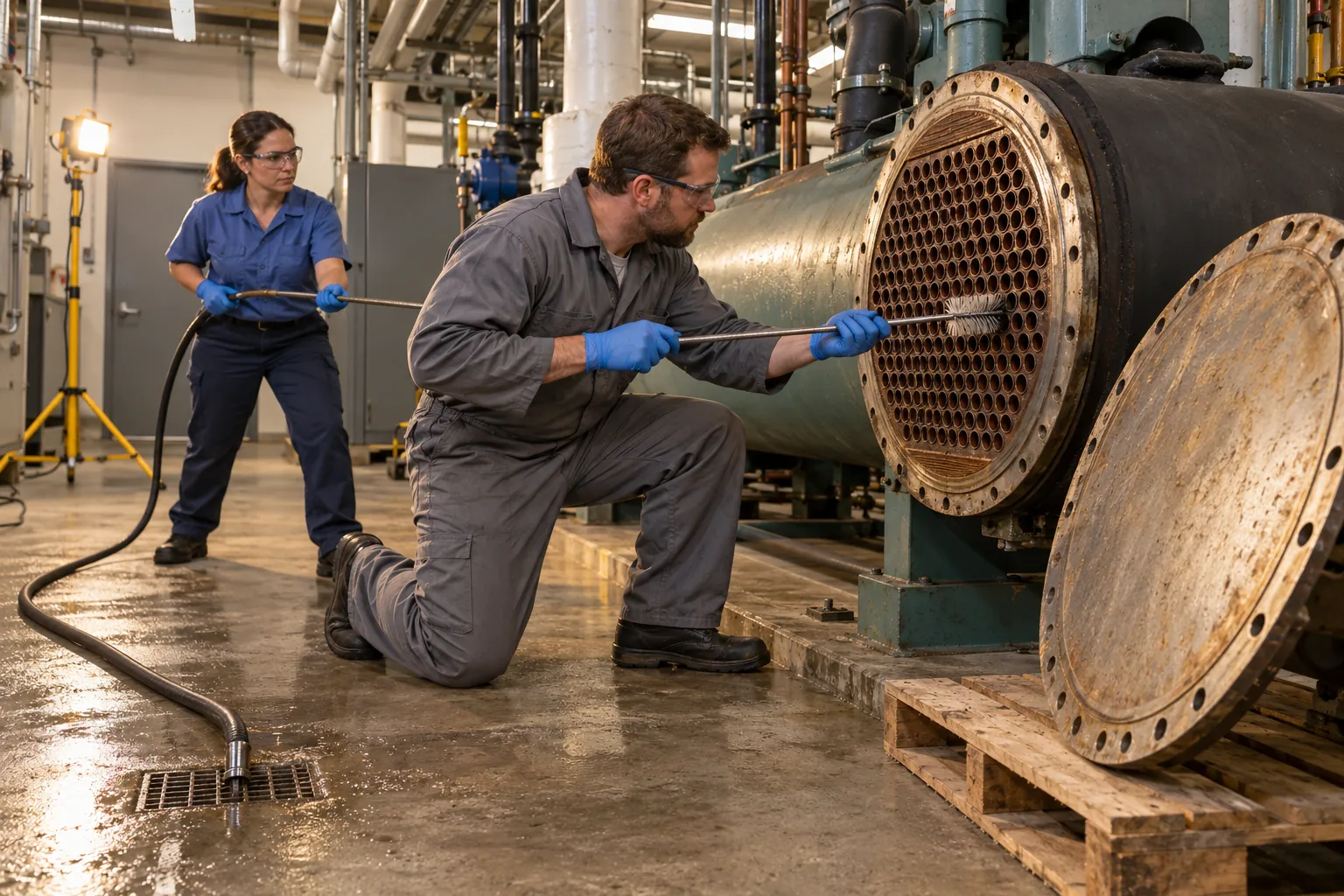
- Annually: check the lockout setpoint; clean condenser and evaporator tubes "at least annually as part of shutdown procedure"; eddy current test the tubes as required; check compressor alignment and seals; analyze the oil and filter; check the oil pump, heater, strainers and valves; check electrical connections; assess water flows; check refrigerant level and condition, recording any amounts added.
The annual tasks usually fall at the seasonal shutdown. Tube cleaning matters for performance as well as reliability: the FEMP guide explains that mineral and sludge deposits on the heat transfer surfaces insulate the tubes, "causing a decrease in heat exchanger efficiency," so the chiller uses more energy for the same cooling. Write the schedule down for each chiller, name who owns each line, and keep a reason against any task missed.
The building engineer usually keeps the log and the daily and weekly checks (see building engineer duties); a chiller service contractor typically takes the teardown, oil analysis and eddy current testing. Refrigerant work needs a technician certified under Section 608: the EPA's Section 608 Technician Certification Requirements list Type II "for servicing or disposing of high- or very high-pressure appliances" and Type III "for servicing or disposing of low-pressure appliances." Both leak repair rules require the leak inspections on a leaking appliance to be done by a certified technician, and 84.106 says the same of the repairs. Under 29 CFR 1910.147 the employer must also inspect the energy control procedure "at least annually."
05
The refrigerant records: leak rate, repairs and inspections
Under both 82.157 and 84.106 the duties fall on the owner or operator, not only the contractor, and records are kept "for at least three years in electronic or paper format, unless otherwise specified." For each covered chiller that means:
- The full charge and how it was determined, with any revisions, kept until three years after the chiller is retired.
- A service record each time it is serviced or repaired: the date, the parts and work, who did it, the amount and type of refrigerant added, the full charge, and the leak rate with its method. A contractor must hand the owner a record of the work.
- Leak inspection records: the date, the methods, each leak found, and "a certification that all visible and accessible parts" were inspected.
- Verification test records: the dates, the leaks tested, the types of test and the results.
The leak rate must be calculated every time refrigerant is added, with narrow exceptions such as a seasonal variance. The annualizing method in 82.152 divides the pounds added by the full charge, divides that by the days since the last addition (365 at most) over 365, and multiplies by 100. As a worked example, a chiller with a full charge of 1,000 pounds that takes 50 pounds 120 days after its last addition gives 0.05 divided by 0.329, about 15.2 percent a year.
For comfort cooling, including chillers, the threshold under both rules is a 10 percent leak rate. Above it, a certified technician's leak inspection must find the leaks and they must be repaired within 30 days of the refrigerant addition, unless the owner chooses to retrofit or retire the chiller under a written plan created within 30 days and finished within one year. Each repair needs an initial verification test and a follow-up within 10 days of it. Leak inspections are then due once a year until the chiller has gone a year under the threshold: "once per calendar year" under 82.157, a year from the successful follow-up test under 84.106.
A chiller that leaks 125 percent or more of its full charge in a calendar year must be reported to the EPA by March 1 of the following year. Under both 82.157 and 84.106 an automatic leak detection system audited or calibrated annually can replace the leak inspections for the parts it monitors, though the installation mandate in 40 CFR 84.108 covers commercial and industrial process refrigeration of 1,500 pounds or more, not comfort cooling.
06
Where the record fails, and what SiteClara does about it
Chiller records usually fail between the contractor's visits. The annual report and the refrigerant service tickets arrive in good order, but the daily log is filled in at the desk from the controller's screen, or copied from yesterday's line. A drip of oil under the compressor is mentioned to whoever was passing and never written down, so nobody connects it with the refrigerant added three weeks later.
SiteClara records the checks at the location. A printed QR poster, with an optional NFC tag behind it, sits at each place a check is scheduled, such as the chiller mechanical room. Staff scan the code or tap the tag on their own phone, with no app to install, see the checks due there, and mark each one done or say what stopped them, such as a chiller torn down for service. The time and the named person are recorded as it happens, with a photo when one is asked for, for example of the control panel or the oil sight glass. A problem, such as an oil stain under the compressor, is reported there with a photo and goes onto the team's list of jobs until someone closes it.
The supervisor sees what is due, done and missed, and can record the reason a check was missed. A job that needs the building manager can be escalated to them to answer. Each day the supervisor reviews and approves a report that goes to designated management or client contacts at 8 a.m. the next morning, showing what was reported, completed and still open, and how the scheduled checks went, for example 2 of 2 chiller plant rounds completed.
07
Questions people ask
What is chiller maintenance?
The FEMP O&M Best Practices Guide, chapter 9 says effective maintenance of chillers requires two activities: "first, bring the chiller to peak efficiency and second, maintain that peak efficiency." Its basic steps include inspecting the chiller as the manufacturer recommends, routine inspection for refrigerant leaks, and checking compressor operating pressures, oil levels and pressures, motor voltages and amps, and electrical starters, contactors and relays.
How often should a chiller be serviced?
As often as the manufacturer recommends, which the FEMP O&M Best Practices Guide, chapter 9 says is typically at least quarterly for an inspection. Its checklist adds daily visual and setpoint checks, weekly leak and water tests, semiannual control checks and an annual shutdown that includes cleaning the tubes.
What are common chiller problems?
The FEMP O&M Best Practices Guide, chapter 9 names the ones that cost efficiency: mineral and sludge deposits that insulate the tubes and cut heat transfer, air trapped in the condenser that raises the pressure at the compressor discharge, a blocked condenser water filter that raises the condenser refrigerant temperature, and a chiller so oversized for its load that it suffers "surging and poor efficiency." Its diagnostic tools also look for refrigerant leaks and for bearing wear in chilled water pumping systems.
Does the EPA leak repair rule apply to my chiller?
It does if the chiller holds 50 or more pounds of an ozone-depleting refrigerant, under 40 CFR 82.157, or, since January 1, 2026, 15 or more pounds of a refrigerant containing an HFC or a substitute with a global warming potential above 53, under 40 CFR 84.106. The EPA's fact sheet on AIM Act leak repair requirements says appliances using a substitute with a global warming potential of 53 or below are not covered by the leak repair requirements.
08
Further reading, and a list to take away
Start with the manufacturer's manual for each chiller. Chapter 9 of the FEMP O&M Best Practices Guide has a free chiller checklist and sample operation log; ASHRAE Standard 180-2018 is a paid document. For refrigerant, read 40 CFR 82.157 and 40 CFR 84.106 on the eCFR, and the EPA's AIM Act leak repair fact sheet, which the EPA says is for information only.
Before the cooling season, check that:
- every chiller is listed with its unit tag, refrigerant and full charge, and you know whether 82.157, 84.106 or neither applies;
- the chiller log has a line for every reading on the FEMP sample log that applies, with the design values beside them;
- the log is filled in on the round, initialed, and read against the days before;
- the daily to annual tasks are written down for each chiller, with a named owner;
- the tubes were cleaned at the last shutdown;
- every refrigerant addition comes with the technician's record and a leak rate calculation;
- a chiller over 10 percent is repaired within 30 days, with both verification tests on file;
- refrigerant records are kept at least three years, and full-charge records until three years after retirement.
Sources
Every document this guide quotes or links to, in the order it first cites them.
- Federal Energy Management Program O&M Best Practices Guide, Release 3.0, chapter 9 www1.eere.energy.gov
- ANSI/ASHRAE/ACCA Standard 180-2018, Standard Practice for Inspection and Maintenance of Commercial Building HVAC Systems ashrae.org
- Standards 180 and 211 fact sheet ashrae.org
- 40 CFR 82.152 ecfr.gov
- 40 CFR 82.157 ecfr.gov
- 40 CFR 84.106 ecfr.gov
- Fact sheet on AIM Act leak repair requirements (January 2026) epa.gov
- Lockout/tagout standard, 29 CFR 1910.147 osha.gov
- Section 608 Technician Certification Requirements epa.gov
- 40 CFR 84.108 ecfr.gov
Related guides
 Premises and facilities managementCommercial HVAC maintenance checklist: what to check, how often, and what to recordA commercial HVAC maintenance checklist by equipment and frequency, rooftop units to chillers, with ASHRAE 180, the EPA refrigerant rules and the records to keep.
 Fire and water checksCooling tower inspection: the weekly checks, the 90-day inspection, and a record that holds upCooling tower inspection in the US: weekly checks, the 90-day compliance inspection under NYC rules, Legionella sampling, cleaning, and a record that holds up.
 Premises and facilities managementBoiler log: what to record, how often, and what the state expectsWhat a boiler log should record, how often to take readings and test the low-water cutoff, what state boiler rules and ASME CSD-1 expect, and where logs fail.
 Premises and facilities managementBuilding engineer duties: what the job covers, and how to show it is doneBuilding engineer duties in a commercial building: running the plant, rounds and logs, lockout, refrigerant and boiler rules, vendors, and a record that holds up.