Premises and facilities management
Commercial HVAC maintenance checklist: what to check, how often, and what to record
An HVAC maintenance checklist is the written list of inspection and maintenance tasks for each piece of heating, ventilating and air conditioning equipment in a building, with how often each task is done and who does it, and for commercial buildings in the United States the recognized minimum is ANSI/ASHRAE/ACCA Standard 180-2018.
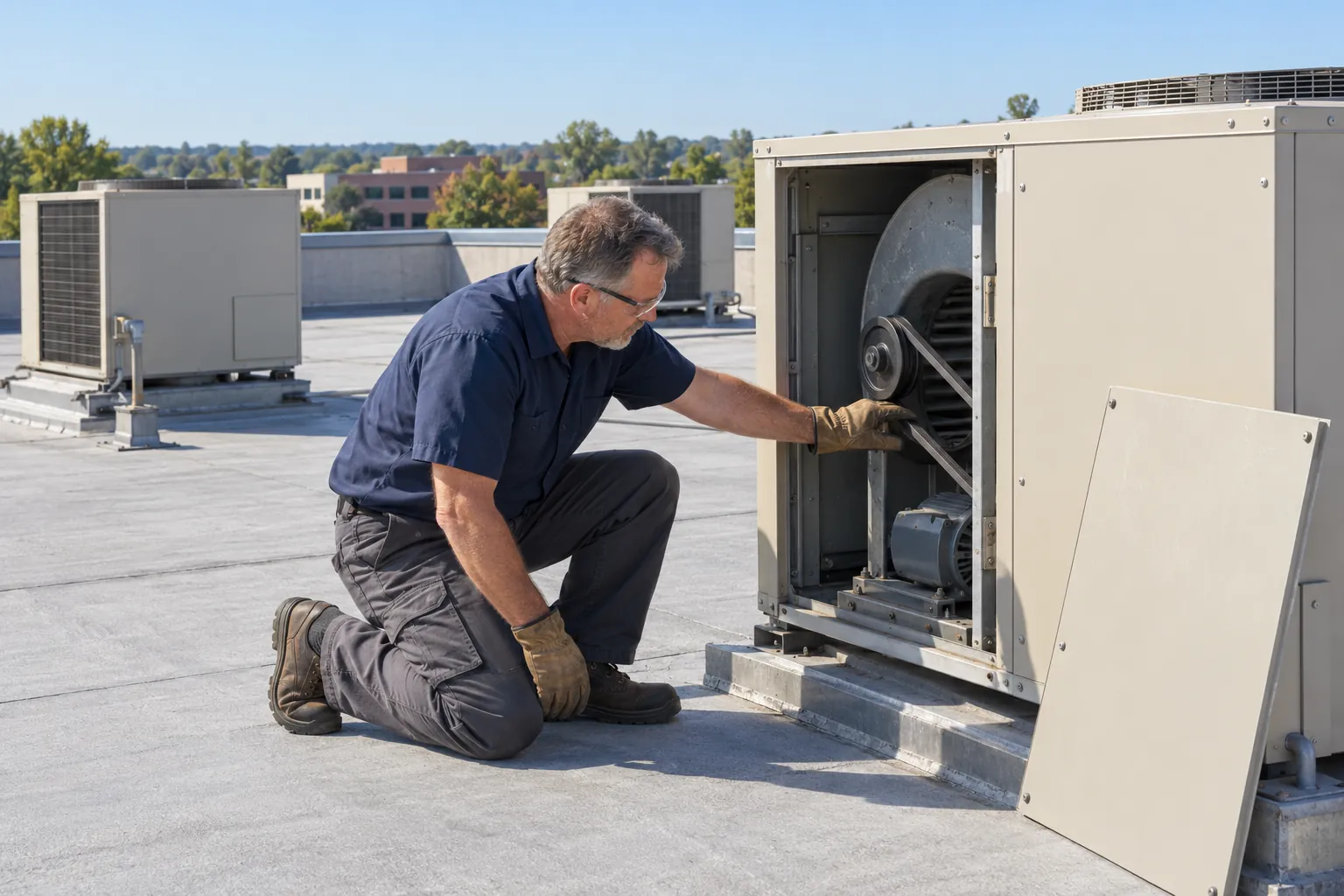
The checklists that come up first in a search are mostly written for homeowners: change the filter, hose off the condenser, book a tune-up in spring and fall. A commercial building has more equipment, more people breathing its air, federal refrigerant rules that apply to its larger systems, and in some states a legal duty to inspect. This guide sets out what a commercial checklist covers, a sample schedule from daily to annual, who does each task, and what the record should show.
01
What a commercial HVAC maintenance checklist is, and which rules stand behind it
A commercial HVAC maintenance checklist turns a building's heating, ventilating and air conditioning system into a list of tasks: each unit by its asset tag, what to inspect, clean, adjust, test or replace, how often, and who is responsible. It is the HVAC part of the building's wider preventive maintenance checklist, and usually the largest part.
The industry standard of care is ANSI/ASHRAE/ACCA Standard 180-2018, Standard Practice for Inspection and Maintenance of Commercial Building HVAC Systems. ASHRAE says it "establishes minimum HVAC inspection and maintenance requirements that preserve a system's ability to achieve acceptable thermal comfort, energy efficiency, and indoor air quality in new and existing commercial buildings." ASHRAE's Standards 180 and 211 fact sheet adds that it "defines the tasks needed to meet the required minimum standard". The 2018 edition can be viewed free through ASHRAE's read-only versions of ASHRAE standards.
Standard 180 is voluntary until something makes it binding: a code your jurisdiction has adopted, a lease, a service contract, a green building certification or the owner's own policy. The same is true of ANSI/ASHRAE Standard 62.1-2025, Ventilation and Acceptable Indoor Air Quality, which ASHRAE says includes requirements for "filtration, controls, air cleaning systems, and building operations and maintenance". Check which edition applies before calling either one "required".
Some rules are law, not good practice:
- Refrigerant leaks, federal. Under the EPA's Section 608 rules, 40 CFR 82.157 applies to appliances with a full charge of 50 or more pounds of an ozone-depleting refrigerant, such as an HCFC, and sets a 10 percent annual leak rate for comfort cooling. Under the AIM Act, 40 CFR 84.106 has applied since January 1, 2026, to appliances with a full charge of 15 or more pounds of an HFC refrigerant, or a substitute with a global warming potential above 53, with the same 10 percent leak rate for comfort cooling.
- Ventilation, California. Cal/OSHA's Title 8, section 5142, Mechanically Driven HVAC Systems to Provide Minimum Building Ventilation, says "The HVAC system shall be inspected at least annually, and problems found during these inspections shall be corrected within a reasonable time", with records kept for at least five years.
A residential checklist is a different thing. The ENERGY STAR maintenance checklist is written for homes; its "annual pre-season check-ups" to keep a system at "peak performance", cooling in the spring and heating in the fall, are a starting point, not a commercial program.
02
What a commercial HVAC maintenance checklist covers
Build the checklist from the HVAC equipment actually in the building, not from a generic template: walk every roof, mechanical room and ceiling space, and list each unit with an asset tag and its location. Most commercial checklists cover:
- Packaged rooftop units (RTUs): filters, belts, fan bearings and motors, coils, the condensate drain pan and trap, economizer dampers, the refrigerant circuit, and on gas-fired units the burners, flue and heat exchanger.
- Air handling units and make-up air units: filter banks, coils, drain pans, fans and belts, dampers, humidifiers and casing seals.
- Terminal units: VAV boxes, fan coils, unit ventilators and heat pumps, each with its own filter, coil, drain and control.
- Chillers: setpoints, temperatures, pressures, oil and refrigerant levels, condenser and evaporator tubes, and leak checks.
- Boilers and furnaces: water level and pressure, safety controls, burners, combustion and venting (see the boiler log guide).
- Cooling towers and evaporative condensers: water treatment, basin, fill, fans and the Legionella water management program (see cooling tower inspection).
- Pumps, piping and valves: seals, couplings, strainers, insulation and leaks.
- Ductwork, grilles and exhaust fans: clear, clean, attached and dry.
- Controls and the building automation system (BAS): schedules, setpoints, alarms, sensors and outdoor air volumes.
OSHA's booklet Indoor Air Quality in Commercial and Institutional Buildings (OSHA 3430, 2011) includes, in Appendix C, an HVAC System Maintenance Checklist. For almost every component it starts with a "Written maintenance and inspection program", and then adds what the inspection must find: for drain pans, "Drains maintained in free-flowing condition" and "No accumulation of stagnant water"; for humidifiers, "No visual buildup of mold or slime"; and for filtration, "Provision for measuring pressure drops across the filtration system".
Filter changes are one line on the checklist but the most frequent task on it; the HVAC filter change log guide covers them in detail.
03
A sample HVAC maintenance schedule, from daily to annual
There is no single federal maintenance schedule for commercial HVAC. The intervals below are typical examples from the Department of Energy's Federal Energy Management Program O&M Best Practices Guide, Release 3.0, chapter 9 and OSHA 3430. The FEMP guide says it "will first defer to the manufacturer's recommendations", so set each interval from the manufacturer's instructions, the adopted codes and your own equipment history.
Daily, usually on the building engineer's rounds:
- check BAS alarms, schedules, setpoints and space temperatures, and that units are running when the building is occupied;
- a walk-through of the mechanical rooms for leaks, noise, vibration, smells and tripped equipment, which the FEMP checklists call an "overall visual inspection to be sure all equipment is operating and safety systems are in place";
- log chiller and boiler readings where the plant has them;
- follow up comfort complaints.
Weekly:
- inspect humidifiers while they are in use (OSHA 3430 says "Inspected weekly during operation");
- check rooftop units and roof drains after storms, high winds or snow.
Monthly:
- check filters and their pressure gauges, and change them when loaded so they do not restrict airflow; the FEMP fans checklist puts it as "Check for gaps, replace when dirty";
- inspect cooling coils and drain pans during the cooling season (OSHA 3430: "Monthly (or, as required) inspections during operation");
- inspect cooling towers (OSHA 3430: "Inspected regularly (monthly, or as required)") and record water treatment;
- check belts for tension, wear and alignment, and dampers and actuators for full travel.
Quarterly and seasonal:
- lubricate bearings and motors as the manufacturer specifies;
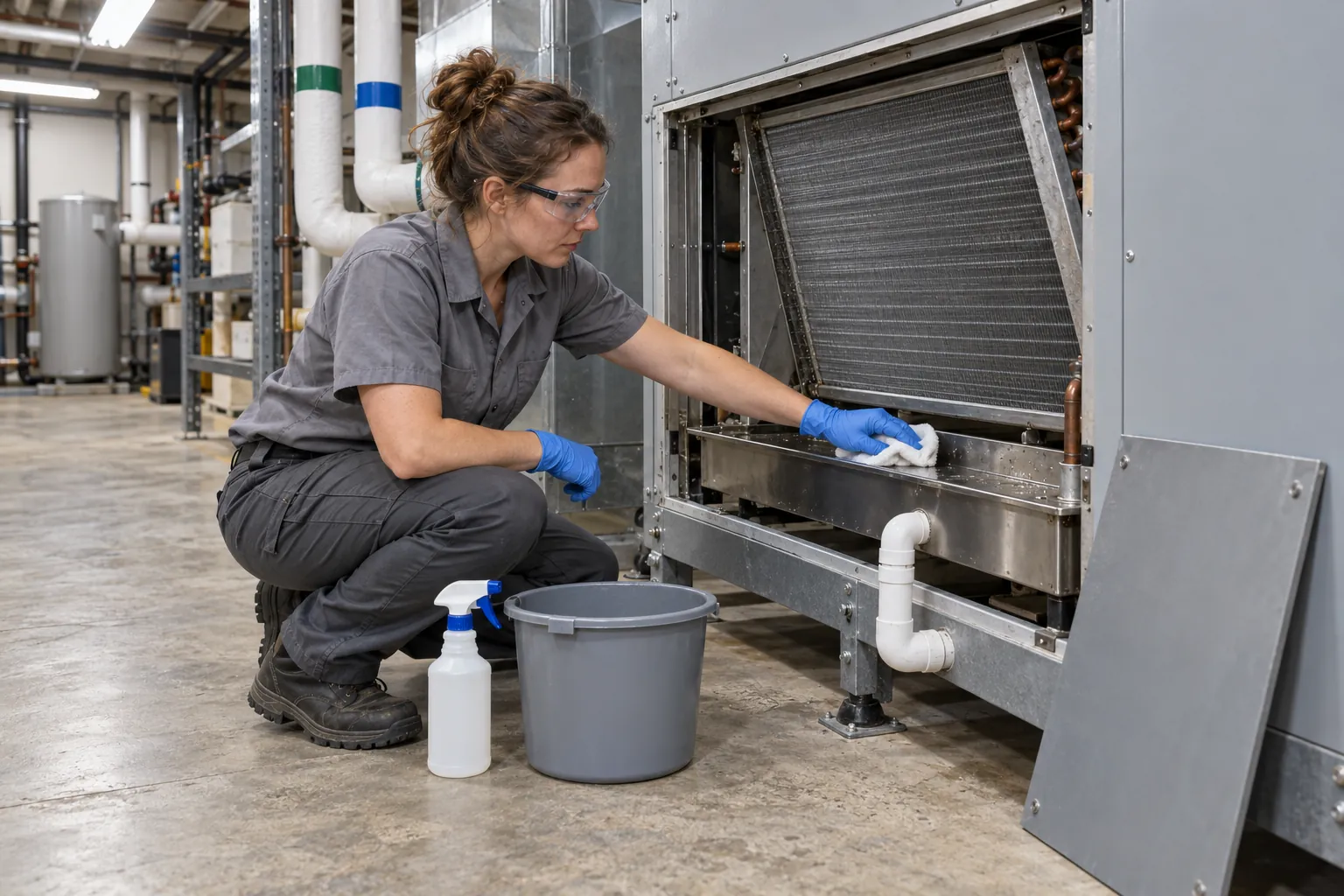
- clean condenser and evaporator coils where dirt is building up; the FEMP guide notes that as dirt and debris build up on hot water and chilled water coils they inhibit heat transfer, "thus reducing the efficiency of the HVAC system", and that each facility should set its coil cleaning schedules from its own inspections;
- a spring start-up of the cooling equipment and a fall start-up of the heating equipment, including economizer operation, controls, safeties, electrical connections and motor current;
- inspect ductwork and grilles for debris and microbial growth (OSHA 3430 suggests "semi-annually" as an example).
Annually:
- a full inspection of the system against Standard 180 or your contract, and in California the section 5142 inspection with its record;
- chiller shutdown maintenance: the FEMP chiller checklist says to clean condenser and evaporator tubes "at least annually as part of shutdown procedure";
- combustion tests and safety control checks on boilers, furnaces and gas-fired rooftop units;
- calibrate sensors and check outdoor air volumes against the design;
- the periodic inspection of each energy control procedure, which 29 CFR 1910.147 requires "at least annually";
- a review of the checklist itself against the equipment and the records.
04
Who does each task: the building engineer, the contractor and the certified technician
A commercial HVAC checklist is shared between people with very different qualifications, and it should say who owns each line:
- The building engineer or chief engineer runs the daily rounds, the BAS and most monthly checks, lubrication and belt work. See building engineer duties.
- Maintenance technicians and custodians often change terminal unit filters and report anything wet, noisy or moldy.
- An HVAC service contractor carries out the contract's preventive maintenance visits, start-ups, combustion checks and repairs, and leaves a service report.
- An EPA-certified technician does any work that opens the refrigerant circuit. The EPA's Section 608 technician certification page says technicians who "maintain, service, repair, or dispose of equipment that could release ozone depleting refrigerants into the atmosphere must be certified", and both leak repair rules require a certified technician for leak inspections.
- The facility or property manager owns the checklist, the contracts and the records.
The refrigerant rules put duties on the owner or operator, not only on the contractor. Under 40 CFR 82.157(b) and 84.106(b), whoever adds refrigerant must give the owner or operator documentation, and the owner or operator must "calculate the leak rate every time refrigerant is added to an appliance", with a few exceptions. If a comfort cooling appliance is over 10 percent, the leaks must be repaired within 30 days of the addition and confirmed by initial and follow-up verification tests. The EPA's fact sheet on leak repair for appliances containing HFCs (January 2026) notes that the "residential and light commercial air conditioning and heat pumps subsector", cooling for "individual rooms, single-family homes, and small commercial buildings", is outside the HFC leak repair rule; chillers and certain variable refrigerant flow systems sit in their own subsectors and are not. Ask your contractor which rule covers each unit.
OSHA's lockout/tagout standard, 29 CFR 1910.147, "covers the servicing and maintenance of machines and equipment in which the unexpected energization or start up of the machines or equipment, or release of stored energy could cause injury to employees", which describes most work inside a unit that the BAS could start. Plan roof access and edge protection too.
05
What the maintenance record should show
For each task, the record should show the unit, the date, who did it, what was found (readings, condition, faults) and what was done about it, including a reason when a task was not done. California sets this out as law for the section 5142 inspection: records must include "the name of the individual(s) inspecting and/or maintaining the system, the date of the inspection and/or maintenance, and the specific findings and actions taken", kept for at least five years and produced within 48 hours of a request.
The refrigerant records are the most detailed, and they belong to the owner or operator. Under 40 CFR 82.157(l), and in nearly the same words 40 CFR 84.106(l), records are kept "for at least three years in electronic or paper format" and include:
- the full charge of each covered appliance and how it was determined, kept until three years after the appliance is retired;
- for each service: the appliance, the date, the parts and work, who did it, the refrigerant added, and the leak rate with its method;
- leak inspections: the date, the methods, each leak found, and a certification that all visible and accessible parts were inspected;
- the dates and results of verification tests, and any retrofit or retirement plan.
An appliance that leaks 125 percent or more of its full charge in a calendar year must be reported to the EPA by March 1 of the following year (82.157(j) and 84.106(j)).
Signs of a maintenance record you can trust:
- entries made on the day, at the unit, with times that match the route and the day's other work;
- a reason against every missed task, and a later entry showing it was caught up;
- contractor service reports that match the checklist's dates and units;
- faults found on a check, such as a wet drain pan or a slipping belt, turned into work orders that were closed.
06
Where the record fails, and what SiteClara does about it
HVAC records are usually strongest for the contractor's quarterly visit, which arrives as a service report, and weakest for the small, frequent checks in between. The month's filter and drain pan checks are initialed in one sitting at the desk. A rooftop unit is marked as checked in January when nobody went up in the snow. A dripping drain pan is mentioned to whoever was passing and never reaches the list of jobs, until the ceiling tile below it stains.
SiteClara records those routine checks at the location. A printed QR poster, with an optional NFC tag behind it, sits at each place a check is scheduled, such as a mechanical room, a roof hatch or the access panel of an air handler. Staff scan the code or tap the tag on their own phone, with no app to install, see the checks due there, and mark each one done or say what stopped them, such as no access to the roof or the unit locked out. The time and the named person are recorded as it happens, with a photo when one is asked for, such as a clean drain pan. A problem, such as a wet plenum, is reported there with a photo and goes onto the team's list of jobs until someone closes it.
The supervisor sees what is due, done and missed, and can record the reason a check was missed. Each day the supervisor reviews and approves a report that goes to nominated management or client contacts at 8 a.m. the next morning, showing what was reported, completed and still open, and how the scheduled checks went, for example 11 of 12 HVAC checks completed.
07
Questions people ask
What maintenance is needed for an HVAC system?
Every HVAC system needs regular air filter checks and a professional check-up before each cooling and heating season. The ENERGY STAR Maintenance Checklist, written for homes, says to "Inspect, clean, or change air filters once a month" because "A dirty filter can increase energy costs and damage your equipment, leading to early failure", and to check "the cooling system in the spring and the heating system in the fall", before contractors get busy in summer and winter. Its check-up list includes cleaning the coils, checking the refrigerant level, cleaning and adjusting blower components "to provide proper system airflow", checking thermostat settings and inspecting the condensate drain; a commercial building adds its larger equipment and a written program.
What is included in HVAC preventive maintenance?
HVAC preventive maintenance is the scheduled inspection, cleaning, adjustment and replacement of components before they fail: filters, belts, bearings, coils, drain pans, dampers, controls, refrigerant, combustion and safety checks, and cooling tower water treatment. Chapter 9 of the FEMP O&M Best Practices Guide, Release 3.0 gives checklists for equipment including boilers, chillers, cooling towers, building automation systems, air handling systems, fans and pumps, and says proper maintenance for air handling systems "includes scheduled filter replacement, coil cleaning, duct integrity evaluation, damper cleanliness and function."
What should I include in my annual HVAC maintenance checklist?
An annual HVAC maintenance checklist should include a full inspection of the system, written down with what was found and what was done, plus the plant tasks that come once a year. In California, Cal/OSHA Title 8, section 5142 says "The HVAC system shall be inspected at least annually" and that inspections and maintenance "shall be documented in writing". The FEMP O&M Best Practices Guide, chapter 9 says to clean chiller condenser and evaporator tubes "at least annually as part of shutdown procedure", and that "boilers should be tuned at least annually; high use boilers at least twice annually."
08
Further reading, and a list to take away
Read the sources in the original: ASHRAE's Standards 180 and 211 fact sheet and the read-only Standard 180-2018 for the minimum practice; chapter 9 of the FEMP O&M Best Practices Guide, Release 3.0 for equipment checklists; Appendix C of OSHA 3430 for the HVAC System Maintenance Checklist; the EPA's stationary refrigeration leak repair requirements page, 40 CFR 82.157 and 40 CFR 84.106 for refrigerant; and Cal/OSHA section 5142 if your building is in California.
Before you rely on your HVAC maintenance checklist, check that:
- every rooftop unit, air handler, terminal unit, chiller, boiler, tower, pump and exhaust fan is listed with an asset tag and a location;
- each task has a frequency taken from the manufacturer, the adopted code, Standard 180 or your own history, and a named owner;
- the refrigerant type and full charge of each unit are known, and you know which units 82.157 or 84.106 covers;
- refrigerant work is done by a Section 608 certified technician, and every addition is followed by a leak rate calculation;
- every check is recorded on the day with the name, the findings and a reason for anything missed;
- records are kept at least three years for refrigerant, five in California for section 5142, and longer if your contract says so;
- the checklist is reviewed at least once a year.
Sources
Every document this guide quotes or links to, in the order it first cites them.
- ANSI/ASHRAE/ACCA Standard 180-2018, Standard Practice for Inspection and Maintenance of Commercial Building HVAC Systems ashrae.org
- Standards 180 and 211 fact sheet ashrae.org
- Read-only versions of ASHRAE standards ashrae.org
- ANSI/ASHRAE Standard 62.1-2025, Ventilation and Acceptable Indoor Air Quality ashrae.org
- 40 CFR 82.157 ecfr.gov
- 40 CFR 84.106 ecfr.gov
- Title 8, section 5142, Mechanically Driven HVAC Systems to Provide Minimum Building Ventilation dir.ca.gov
- Maintenance checklist energystar.gov
- Indoor Air Quality in Commercial and Institutional Buildings (OSHA 3430, 2011) osha.gov
- Federal Energy Management Program O&M Best Practices Guide, Release 3.0, chapter 9 www1.eere.energy.gov
- Section 608 technician certification epa.gov
- Fact sheet on leak repair for appliances containing HFCs (January 2026) epa.gov
- Lockout/tagout standard, 29 CFR 1910.147 osha.gov
- Stationary refrigeration leak repair requirements epa.gov
Related guides
 Premises and facilities managementHVAC filter change log: what to record, how often, and who signs itWhat an HVAC filter change log should record, how often to check and change filters, which ASHRAE standards and state rules apply, and where filter logs go wrong.
 Premises and facilities managementPreventive maintenance checklist: what to check in a commercial building, how often, and how to prove itA preventive maintenance checklist for commercial buildings: HVAC, electrical, fire and life safety, plumbing, how often, and what the record should show.
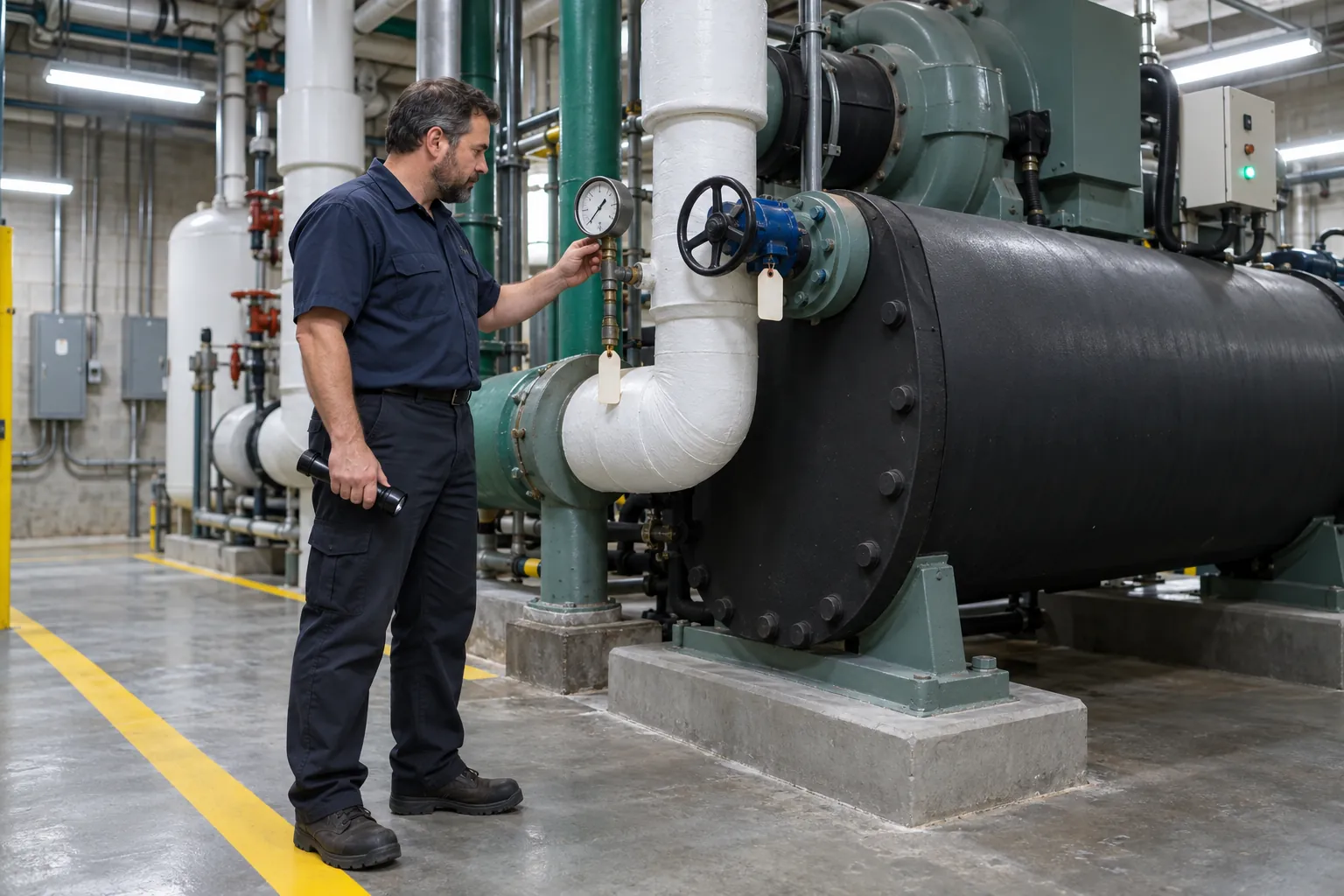 Premises and facilities managementBuilding engineer duties: what the job covers, and how to show it is doneBuilding engineer duties in a commercial building: running the plant, rounds and logs, lockout, refrigerant and boiler rules, vendors, and a record that holds up.
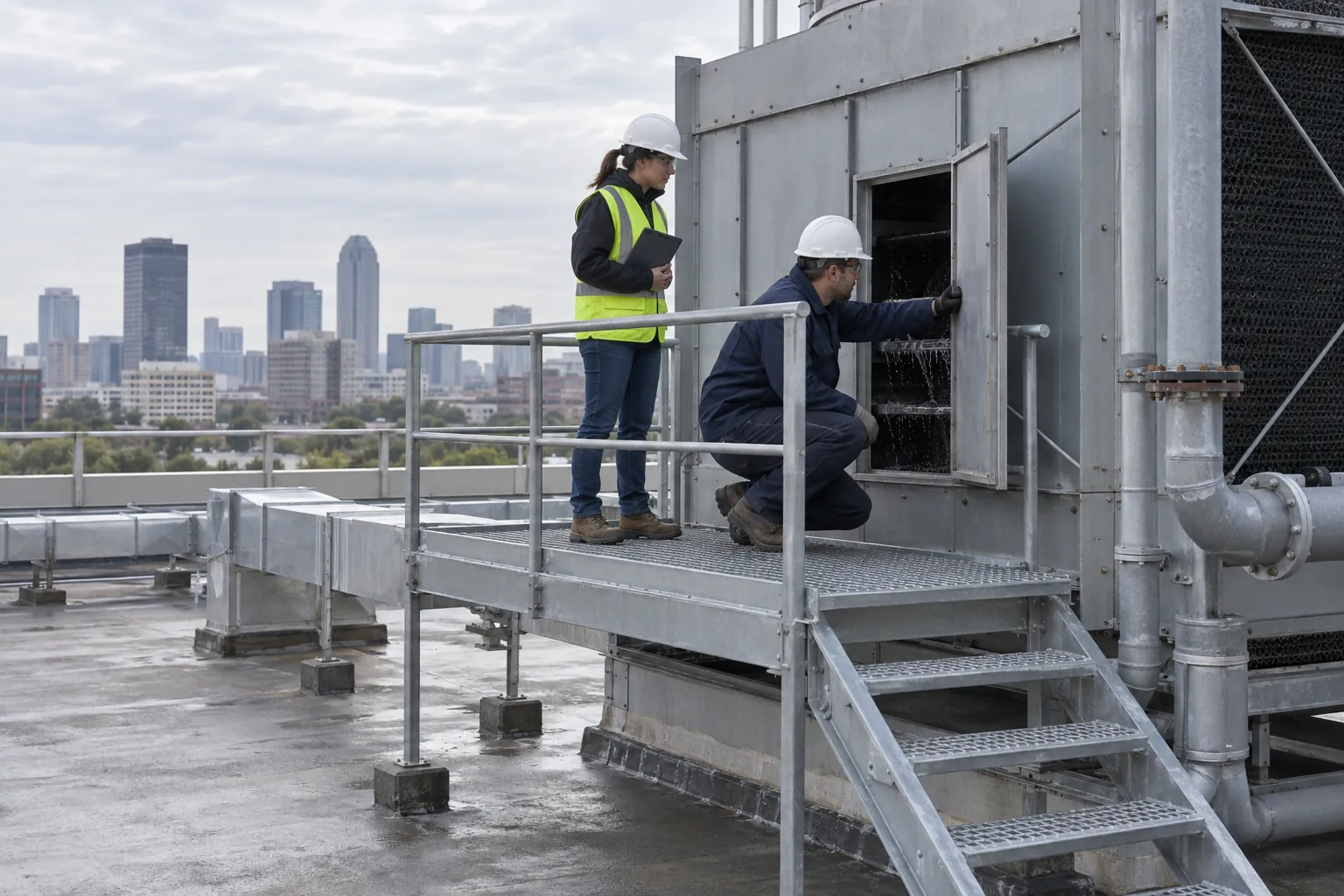 Fire and water checksCooling tower inspection: the weekly checks, the 90-day inspection, and a record that holds upCooling tower inspection in the US: weekly checks, the 90-day compliance inspection under NYC rules, Legionella sampling, cleaning, and a record that holds up.