Cleaning
CIMS certification: what the cleaning management standard is, and what it shows
CIMS certification is ISSA's quality certification for cleaning organizations, awarded when an independent, accredited assessor finds that a building service contractor or in-house cleaning department runs a management system meeting the Cleaning Industry Management Standard.

The phrase "CIMS certified" turns up in janitorial RFPs, contractor proposals and facility management contracts across the United States. This guide explains what ISSA's Cleaning Industry Management Standard is, what its five sections cover, how an organization gets certified and keeps it, what building service contractors, in-house custodial departments and buyers use it for, and what a management certificate can and cannot tell you about the cleaning in a building on a given night.
01
What CIMS is
The Cleaning Industry Management Standard (CIMS) is a management standard for cleaning organizations, published by ISSA, the cleaning industry association. ISSA's CIMS standard overview calls it "the first consensus-based framework built to define what makes a cleaning organization truly effective," and describes it as a blueprint for building a management system around what customers need, with documented policies and procedures and measurable results. In ISSA's words, "The CIMS Standard is designed to assist cleaning organizations in setting up a management system to meet its goals."
The important word is management. CIMS does not tell a custodian how to damp mop a corridor or which cloth to use in a restroom. It asks whether the organization that employs the custodian has the systems a well-run cleaning operation needs: a defined scope, a quality plan, workloading and budgeting, hiring and training, safety and chemical management, emergency plans, and leadership that owns all of it. According to the CIMS frequently asked questions, the standard "applies to all facility service provider organizations – building service contractors (BSCs) and in-house organizations – regardless of organization size." A janitorial contractor with forty employees and a university custodial department with four hundred can both be certified.
CIMS is voluntary. No federal or state law requires a janitorial company to hold it, and a contractor can run an excellent operation without it. What the law does require sits elsewhere. OSHA's Hazard Communication Standard, 29 CFR 1910.1200, requires employers to "develop, implement, and maintain at each workplace, a written hazard communication program" and to train employees "at the time of their initial assignment, and whenever a new chemical hazard the employees have not previously been trained about is introduced." The walking-working surfaces standard, 29 CFR 1910.22, requires that "The floor of each workroom is maintained in a clean and, to the extent feasible, in a dry condition." A CIMS management system is one way to organize how those duties are met and to show that they are, but it does not replace them.
02
What the standard covers in practice
The CIMS FAQ says the standard "is based on universally accepted management principles and consists of five sections of management best practices." In practice, each section asks for policies, procedures and evidence that they are followed:
- Quality Systems: a defined scope of work for each account or building, a quality plan, inspection routines, how deficiencies are corrected, and how customer satisfaction is measured and acted on.
- Service Delivery: workloading and staffing, budgeting and bidding, supplies, equipment and inventory, and the procedures that turn a specification into nightly work.
- Human Resources: hiring practices, job descriptions, onboarding, training and retraining, performance review and recognition.
- Health, Safety, and Environmental Stewardship: hazard communication, safety data sheets, personal protective equipment, injury reporting, regulatory compliance, and environmental practices such as chemical selection and dilution control.
- Management Commitment: mission, values and vision, communication plans, financial controls, risk management, and leadership that reviews how the system is working.
ISSA's page for building service contractors lists the documentation areas an organization will need to address, including "defining cleaning service requirements, quality planning, workloading, budgeting, bidding processes, emergency response, disaster planning," product, equipment and inventory maintenance, financial controls, hiring, training, regulatory compliance, risk management, green cleaning policies and infectious disease preparedness.
Not every element is compulsory. The FAQ explains that the standard "was designed to focus on performance and recognizes the need for flexibility and practical application," and that organizations "must demonstrate compliance with all mandatory provisions and at least 60%, per section, of those provisions that are included as recommended elements." The standard itself is available from ISSA through its CIMS standard download page, and anyone preparing for certification should work from the current text rather than a summary like this one.
03
How CIMS certification works
Certification, in the words of the FAQ, "indicates that an organization conforms to the requirements set forth in the Standard and has successfully demonstrated compliance to an independent, accredited assessor." The CIMS certification overview sets out the route, which in practice runs like this:
- Decide and prepare: commit to building a management system that meets the standard, talk to ISSA about pricing and timeline, and run an internal review against each section to find the gaps.
- Apply: complete the application with a deposit; once paid in full, an assessor is assigned.
- Documentation review: once the assessment is scheduled, the assessor begins reviewing your written policies, procedures and records against the mandatory and recommended elements.
- Assessment: the organization "undergoes a comprehensive assessment by an independent third party and demonstrates compliance with CIMS," in the words of ISSA's page on the certification process; ask ISSA or your assessor what the assessment of your organization will include.
- Approval: the assessor sends approval to ISSA, and the organization receives its certification and begins telling its stakeholders.
Certified organizations are listed in ISSA's CIMS directory. Certification does not last indefinitely. ISSA's CIMS certification renewal terms say a certification is "valid for two (2) years from the Certification Anniversary Date," and that the re-certification fees must be paid and the renewal process completed before that date. The directory lists each organization's headquarters, service area and markers such as GB, but not its certification dates, so ask for the certificate itself.
Two related programs are easy to confuse with the main certification:
- CIMS Green Building (CIMS-GB) is an optional add-on for organizations that want to show green cleaning practice. ISSA says it is aligned with LEED for Existing Buildings: Operations and Maintenance and supports clients working toward LEED points. ISSA also describes a newer CIMS Sustainability framework beyond it.
- The CIMS Certified Expert (CCE) is a credential for individuals, not organizations: people trained through an online course to help organizations meet the standard and prepare for assessment. It is renewed every two years. A company with a CCE on staff is not, for that reason, CIMS certified.
04
What contractors and in-house teams use CIMS for
For a building service contractor, the most visible reason is bids. ISSA's contractor page says "Many government, healthcare, and education clients require or prefer CIMS-certified vendors," and a proposal that answers the quality, safety and training questions with an assessed system scores better than one that answers them with promises. The preparation can be worth as much as the certificate:
- Written procedures: the knowledge that lives in one operations manager's head, how a new account is workloaded, how a call-out is covered, how a complaint is closed, gets written down so it survives that manager's vacation or departure.
- Consistency across accounts: every building runs the same inspection routine and the same corrective action process, so a regional manager can compare one site with another.
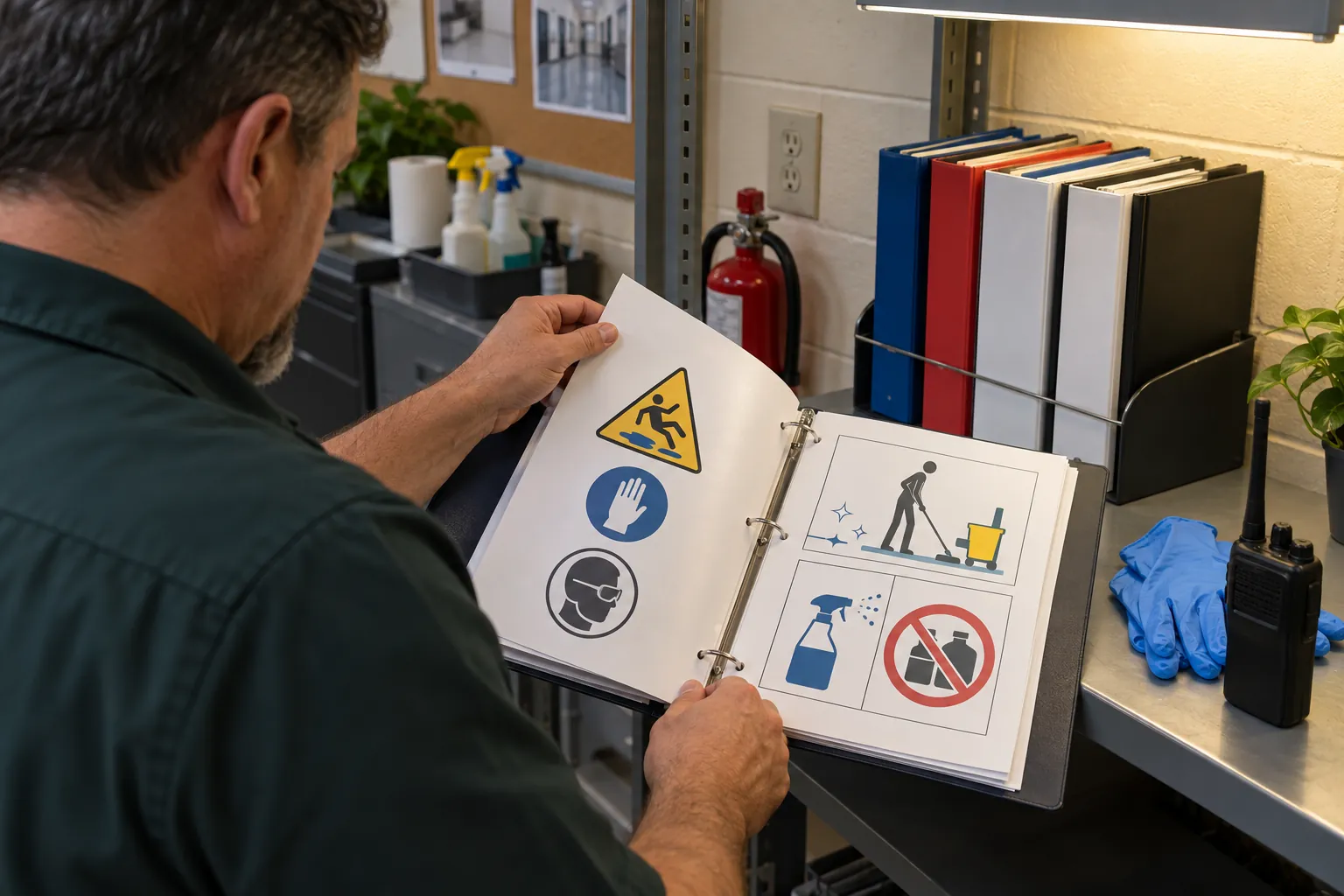
- Safety that is organized: the hazard communication program, safety data sheets, PPE assessments and injury reporting are tied into one system instead of sitting in separate binders.
- Training with a record: onboarding and retraining are defined, dated and tracked, which matters in a trade with high turnover and many part-time night shifts.
- Management attention: leadership reviews how the system is performing on a schedule, not only when a customer threatens to rebid.
For an in-house custodial or environmental services department, CIMS is a way to show a school board, a hospital administrator or a university's facilities leadership that the department is run to the same standard a contractor would be asked to meet, which can matter when outsourcing is being discussed. The FAQ says in-house organizations use the standard to "operate more efficiently" and "validate performance and quality,"
Certification takes work. Allow time to write or rewrite policies, train supervisors to use them, and build up enough records for an assessor to see the system in use. The two-year renewal means the system has to keep running after the certificate arrives: a quality plan nobody has followed since the assessment is exactly what a renewal should find.
05
What facility managers and buyers should ask for
ISSA's page for facility managers suggests they "Use CIMS as a baseline in RFPs and vendor contracts." That can be reasonable, but a few habits make the requirement fairer and more useful:
- Say "or equivalent". A contractor can run a sound, documented quality system without CIMS, for example under ISO 9001 or its own audited program. Federal buyers in particular are bound by FAR 11.002, which requires agencies to specify needs to "Promote full and open competition" and to "Only include restrictive provisions or conditions to the extent necessary to satisfy the needs of the agency or as authorized by law."
- Ask for the certificate, not the logo: the organization's legal name, the certification date, the next renewal, and whether GB applies. Check it against the directory.
- Ask what applies to your building: which parts of the system the account manager and night supervisor will actually use on your contract, and what the inspection frequency will be.
- Match it to your sector: a hospital's environmental services, a school's custodial program and an office tower's janitorial contract each carry their own requirements. CIMS does not replace, for example, the housekeeping duties in OSHA's Bloodborne Pathogens Standard, 29 CFR 1910.1030, which requires employers to "determine and implement an appropriate written schedule for cleaning and method of decontamination."
- Ask about green claims: if a contractor offers green cleaning, ask whether it holds CIMS-GB and which products it uses. EPA's Safer Choice program "helps consumers, businesses, and purchasers find products that perform and contain ingredients that are safer for human health and the environment."
Above all, keep certification in its place. It is an input, like training. The outputs a facility manager cares about, a clean building and a service delivered as specified, are measured by inspections (see our guide to janitorial quality control), customer feedback and records of work done, written into the janitorial scope of work and checked against it.
06
Where the certificate stops, and where SiteClara fits
A CIMS certificate shows that a contractor has a quality plan. It does not show whether the third-floor restrooms were serviced at 2 p.m. today, or whether the lobby was checked before the tenants arrived. That gap is where most disputes between property managers and janitorial contractors sit: a certified contractor, a good inspection score last month, and a complaint this morning that nobody can answer with evidence. The usual record does not help much: a restroom cleaning log on the back of the door, initialed for the whole shift at the start of it, or a supervisor's walk that leaves nothing behind but a memory.
SiteClara records the day-to-day delivery that a management system relies on. A printed QR code poster at each location, with an optional NFC tag behind it, lets custodians confirm a scheduled check with a scan or a tap on their own phone, with no app to install. They see the checks due at that location and mark them done, or say what stopped them, and can report a problem, such as a leak or an empty dispenser, with a photo; it goes onto the team's list of jobs until someone closes it.
The supervisor sees what is due, done and missed, reviews the day's totals and photos, adds a note and approves the daily report, which goes to nominated managers or customer contacts at 8 a.m. the next morning. For an organization preparing for a CIMS assessment or renewal, that is a dated record showing that the quality plan is being followed, location by location.
07
Questions people ask
What does CIMS stand for?
CIMS stands for Cleaning Industry Management Standard. ISSA's CIMS frequently asked questions say it "was created for facility service provider (FSP) organizations and applies to an organization's management structure and performance systems and processes."
What is a CIMS certification?
It is certification of a whole cleaning organization, not of a person. The CIMS FAQ says certification "indicates that an organization conforms to the requirements set forth in the Standard and has successfully demonstrated compliance to an independent, accredited assessor." Under ISSA's CIMS certification renewal terms it is valid for two years.
What is CIMS used for?
Companies use it to organize and prove how they manage cleaning. The CIMS FAQ says building service contractors use it to "distinguish themselves from their competitors, improve their bottom line, better meet the demands of their customers" and improve their quality, and in-house organizations use it to "develop an organization master plan, operate more efficiently, develop best practices" and validate performance and quality.
What is CIMS training?
The training is for individuals rather than organizations. ISSA's CIMS Certified Expert page describes an online course for people who help organizations prepare for CIMS certification, and says "An individual applies for certification every two years." Completing the course does not make the person's employer CIMS certified.
08
Further reading, and a list to take away
ISSA publishes the CIMS standard overview, the CIMS FAQ, the renewal terms and the directory of certified organizations on its own site. OSHA publishes the Hazard Communication Standard and the Bloodborne Pathogens Standard that sit underneath any cleaning management system; check the State Plans page to see whether your state's version applies instead. For the standards a cleaning program is measured against, see our guide to cleaning standards.
If you run a janitorial operation, or buy one, check that:
- the contractor or in-house department names its quality system, CIMS or equivalent, and can show the certificate and its renewal date;
- the certificate is in the legal name of the organization you are contracting with;
- the hazard communication program, safety data sheets and training records are current for the products in use at your building;
- the scope of work, inspection frequency and corrective action process are written down for this account, not only for the company;
- supervisors are named, and someone checks the work on the job, night by night;
- RFPs and contracts say "or equivalent" where a certification is asked for;
- certification sits alongside inspections, customer feedback and records of work done, never in place of them.
Sources
Every document this guide quotes or links to, in the order it first cites them.
- CIMS standard overview cims.issa.com
- CIMS frequently asked questions cims.issa.com
- Hazard Communication Standard, 29 CFR 1910.1200 osha.gov
- Walking-working surfaces standard, 29 CFR 1910.22 osha.gov
- State Plans osha.gov
- ISSA's page for building service contractors cims.issa.com
- CIMS standard download page cims.issa.com
- CIMS certification overview cims.issa.com
- The certification process cims.issa.com
- CIMS directory cims.issa.com
- CIMS certification renewal cims.issa.com
- CIMS Green Building (CIMS-GB) cims.issa.com
- CIMS Certified Expert (CCE) cims.issa.com
- ISSA's page for facility managers cims.issa.com
- FAR 11.002 acquisition.gov
- Bloodborne Pathogens Standard, 29 CFR 1910.1030 osha.gov
- Safer Choice program epa.gov
Related guides
 CleaningJanitorial quality control: how to inspect, score and fix the cleaningHow janitorial quality control works: QA versus QC, building a cleaning inspection checklist, APPA appearance levels, sampling, scoring and corrective action.
 CleaningCleaning standards in the US: a map, and how to chooseA map of US cleaning standards: OSHA, CDC and CMS rules for healthcare, the FDA Food Code, EPA disinfectant labels, APPA levels, CIMS and GS-42, and how to choose.
 CleaningHow to get janitorial contracts, and keep themHow commercial and government janitorial contracts are bought in the US, what buyers check, how to write a proposal that scores, how to price it and how to keep it.
 CleaningJanitorial supervisor duties: what the job involves, and what good looks likeWhat a janitorial supervisor does: the core duties, a typical night shift, the OSHA rules behind the work, inspecting the cleaning and reporting to the client.