Cleaning
Janitorial supervisor duties: what the job involves, and what good looks like
A janitorial supervisor is responsible for directing the custodial staff who clean a building or group of facilities: scheduling and assigning the work, training janitors, inspecting the cleaning against the scope of work, keeping supplies and equipment ready, enforcing safety rules and reporting to the customer.
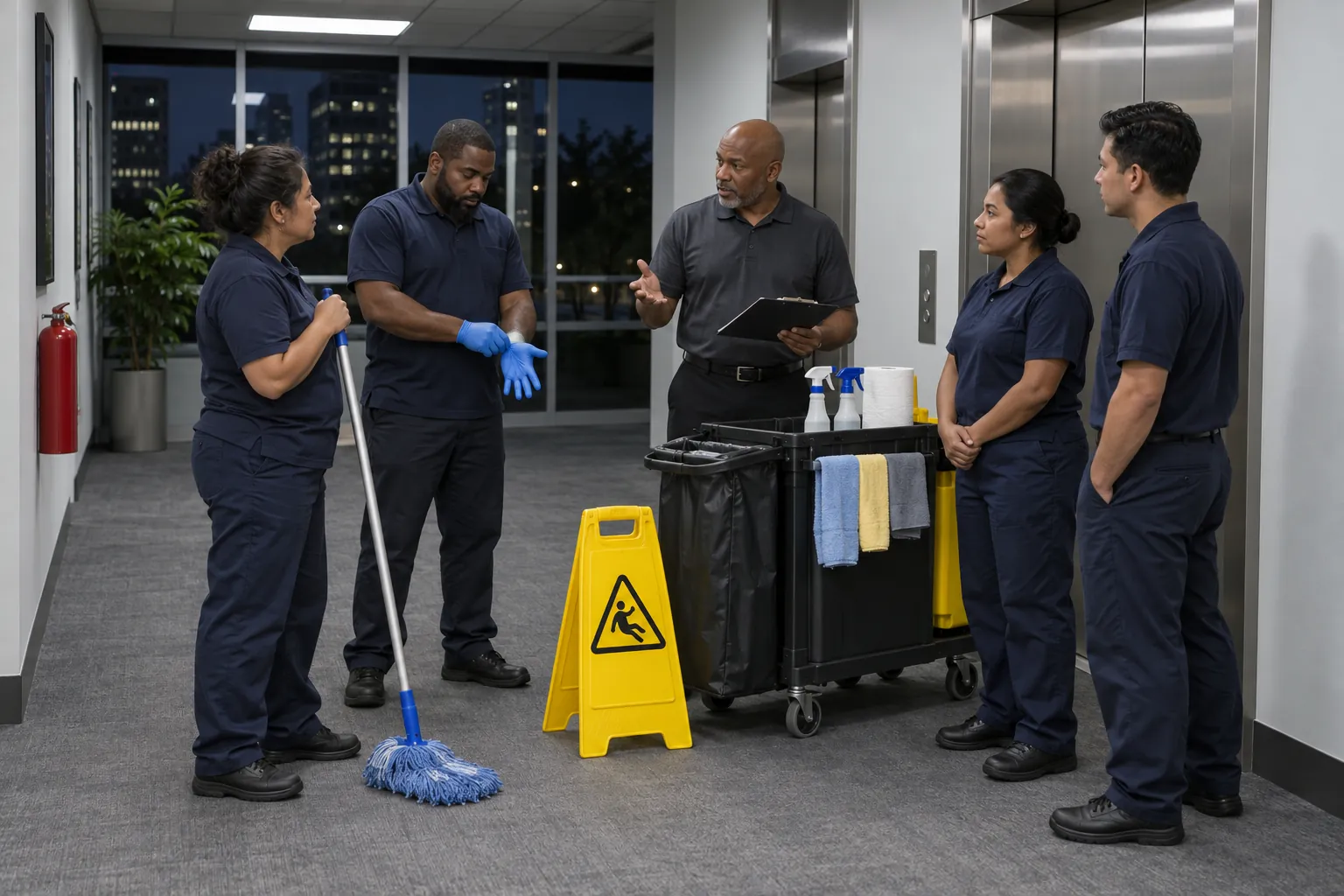
The job is part crew lead, part inspector, part safety officer and part account contact: the person the facility manager calls when a restroom was missed. This guide covers the core duties, what a typical shift looks like, the federal OSHA standards the supervisor makes work on the floor, how the cleaning gets inspected, and the records a good supervisor keeps.
01
What a janitorial supervisor is
A janitorial supervisor runs a crew of janitors or custodians on one building or a group of buildings, and answers for whether the cleaning in the scope of work actually got done, safely and on time. The federal occupational classification puts it plainly. O*NET's profile of First-Line Supervisors of Housekeeping and Janitorial Workers (37-1011.00), published for the U.S. Department of Labor, describes the job as: "Directly supervise and coordinate work activities of cleaning personnel in hotels, hospitals, offices, and other establishments." The job titles it lists show how many names the same role goes by: building services supervisor, custodian supervisor, environmental services (EVS) supervisor, executive housekeeper, housekeeping supervisor and janitorial supervisor.
The work the crew does is the work the Bureau of Labor Statistics Occupational Outlook Handbook entry for janitors and building cleaners sets out: they "keep many types of buildings clean, sanitary, orderly, and in good condition," gathering trash, cleaning and stocking restrooms, cleaning up spills and other hazards, disinfecting frequently touched surfaces, ordering supplies, reporting when a building needs major repairs and locking doors to secure it. The supervisor makes sure all of that happens across every floor in the hours the contract allows.
On a small account the supervisor is a working lead, cleaning alongside the crew. On a large one, such as an office tower, a hospital or a school district, the supervisor spends the shift allocating work, inspecting and dealing with problems. Either way, they sit between the janitors and the operations manager, and are usually the person the client's facility manager sees most.
The legal duties sit with the employer, but the supervisor is how they are carried out on site. For most private employers, federal OSHA sets the rules. 29 CFR 1910.22, Walking-working surfaces, general requirements requires that "All places of employment, passageways, storerooms, service rooms, and walking-working surfaces are kept in a clean, orderly, and sanitary condition," and 29 CFR 1910.141, Sanitation requires that "All places of employment shall be kept clean to the extent that the nature of the work allows." Those are the outcomes the client is paying for. The rules the crew works under are covered in section 04.
02
The core duties and responsibilities
Job postings differ by employer and by building type, but most janitorial supervisor job descriptions come down to the same list. O*NET's task list for the occupation includes to "Inspect work performed to ensure that it meets specifications and established standards," "Plan and prepare employee work schedules," "Perform or assist with cleaning duties as necessary" and "Inventory stock to ensure that supplies and equipment are available in adequate amounts." In practice that means:
- Running the work: dividing the building into runs or routes and assigning each janitor an area, so everything in the scope of work is covered in the hours on the contract.
- Staffing the shift: covering call-outs and no-shows, moving people between areas, and helping the operations manager hire and onboard new janitors.
- Training: showing new hires the methods, the equipment and the building, and spotting when someone needs a refresher on a floor machine or a chemical.
- Inspecting: walking the building to check work against the scope and the standard, and getting anything missed put right the same night.
- Project work: scheduling carpet extraction, strip and wax, burnishing and high dusting around tenants and events.
- Safety: making sure the crew follows the hazard communication program, wears the PPE required, puts out wet floor signs and reports every injury and near miss.
- Equipment and supplies: keeping floor machines and vacuums working, ordering chemicals, paper and liners, and keeping janitor closets stocked and locked.
- Client contact: being the first call for the facility manager or property manager, taking work orders and complaints, and reporting back on what was done.
- Records: inspection forms, restroom logs, training sign-offs, incident reports and the shift report to the operations manager.
- Security and access: keys, badges and alarm codes, locking up, and reporting anything wrong with the building, from a propped fire door to a leak.
The building shapes the job. In hospitals the role becomes an EVS supervisor, with isolation and discharge cleaning and infection prevention protocols. In K–12 schools and universities it works around the school day and summer cleaning. In an office tower, the night crew does the heavy cleaning and a day porter handles restrooms and the lobby while tenants are in.
03
What a typical shift looks like
Most commercial janitorial work happens at night, after the tenants leave. A supervisor's shift on a contract account often runs like this:
- Before the shift: check call-outs and how the gap will be covered, and read the day's work orders and tenant requests.
- Huddle: five minutes with the crew at the start, covering changes, special requests, safety reminders and who is doubling up on an open run.
- During the shift: walk the floors, check work in progress, help where a run is behind, and deal with spills and urgent calls.
- Inspections: carry out the planned inspections for the night and confirm the scheduled work, such as restroom checks, trash removal and floor care, actually happened.
- Problems: report leaks, broken fixtures, clogged toilets and burned-out lights to building engineering or through the work order system, and follow up on the ones still open.
- End of shift: confirm everything scheduled was done or record why not, secure equipment, chemicals and keys, and hand over anything outstanding.
Day supervisors in hospitals, airports and malls spend more of the shift on restroom rounds and spills. Supervisors who cover several small accounts spend part of the night driving between them, which makes it harder to know what happened at the buildings they were not in.
04
Keeping the crew safe: the OSHA standards on the floor
Much of the supervisor's safety role is making four federal standards work on the night shift. The written programs belong to the employer; the supervisor sees whether they are followed.
- Chemicals: 29 CFR 1910.1200, Hazard Communication (amended in May 2024), requires employers to "provide employees with effective information and training on hazardous chemicals in their work area at the time of their initial assignment, and whenever a new chemical hazard the employees have not previously been trained about is introduced." Safety data sheets must be "readily accessible during each work shift to employees when they are in their work area(s)," which on a night shift means at the building, not in the office across town. The supervisor makes sure every bottle is labeled, dilution systems are used as set up, and nobody mixes products.
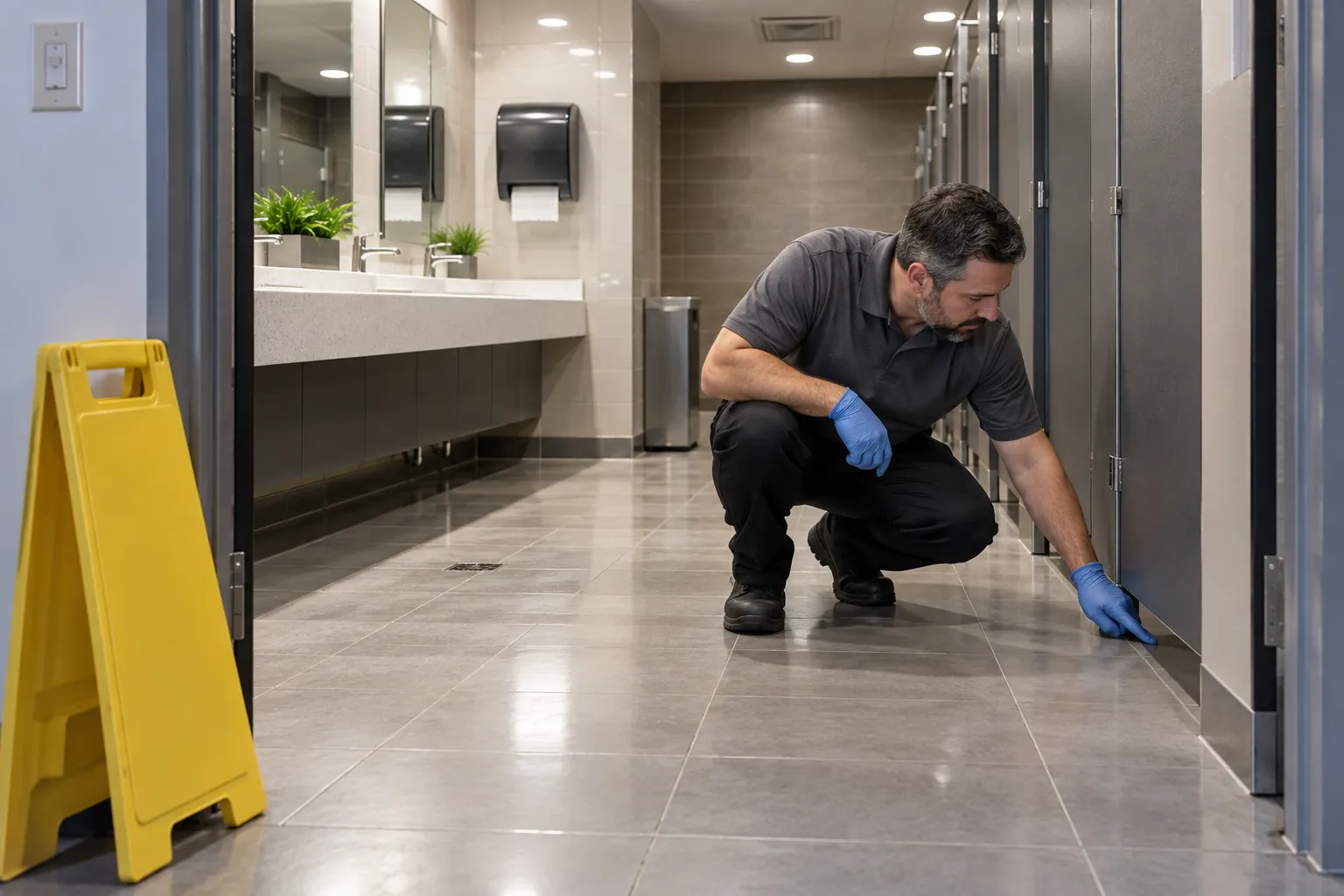
- Floors: under 29 CFR 1910.22, walking-working surfaces must be "inspected, regularly and as necessary, and maintained in a safe condition," and hazardous conditions "corrected or repaired before an employee uses the walking-working surface again," or guarded until they are. Wet floor signs, cords managed across corridors and spills dealt with at once are how that happens during cleaning. OSHA's walking-working surfaces page notes that "Falls from heights and on the same level (a working surface) are among the leading causes of serious work-related injuries and deaths."
- Blood and body fluids: 29 CFR 1910.1030, Bloodborne Pathogens, applies to "all occupational exposure to blood or other potentially infectious materials." Where janitors can reasonably be expected to meet that exposure, as in restrooms with sharps, clinics and hospitals, the employer needs an exposure control plan, training "at no cost to the employee and during working hours," the hepatitis B vaccine offered, and "an appropriate written schedule for cleaning and method of decontamination." Contaminated surfaces are to be decontaminated "immediately or as soon as feasible when surfaces are overtly contaminated or after any spill of blood or other potentially infectious materials."
- Restrooms and waste: 29 CFR 1910.141 requires waste receptacles that do not leak and can be kept sanitary, waste removed "in such a manner as to avoid creating a menace to health," and lavatories with "hand soap or similar cleansing agents" and individual hand towels or air blowers.
Two more things belong to the supervisor on almost every account: floor machines checked before use and run only by people trained on them, and every injury and near miss written up the same night. Under 29 CFR 1904.39, Reporting fatalities, hospitalizations, amputations, and losses of an eye as a result of work-related incidents to OSHA, the employer must report a work-related fatality to OSHA within eight hours, and an in-patient hospitalization, amputation or loss of an eye within 24 hours. The supervisor is often the first to know, so they need to know who to call.
Pay, discipline and hiring usually sit with the operations manager or HR, and a good supervisor knows when to pass something up.
05
Inspecting the work and reporting to the client
Keeping the building clean is the point of the job, so a janitorial supervisor should know, at any moment, whether the building is clean and whether the scheduled work was done. That takes two kinds of checking, and they are not the same thing:
- Inspecting quality: regular inspections against the scope of work and the standard in the contract, sampling different floors, room types and nights, scoring or noting what fails, and getting it put right. Many contracts add joint inspections with the facility manager.
- Confirming delivery: that each scheduled task, round and check actually happened, when and by whom, and that anything missed is known and explained rather than found by the client in the morning.
The first tells you how well the building was cleaned; the second tells you whether it was cleaned at all. A spotless inspection of three restrooms says nothing about the fourth floor nobody reached because a janitor called out.
Reporting to the client is where a supervisor earns trust. A short, honest report of what was done, what was missed and why, and what is still open is worth more than one that says everything went fine. Facility managers rarely mind an explained gap; they mind finding it themselves.
06
Where the supervisor's record fails, and what SiteClara does about it
Much of a janitorial supervisor's night is spent finding out what happened: whether the restroom checks were done, whether the clogged toilet on the ninth floor was reported. On paper that means reading sheets on the backs of restroom doors, initialed every hour and as easy to fill in ahead of time as at the time, and writing the shift report from memory. When the property manager asks what happened last Tuesday, the answer depends on who remembers.
SiteClara is built to give the supervisor that picture without the walk. Each location, such as a restroom, a break room, a lobby or a trash room, has a printed QR code poster, with an optional NFC tag behind it. Janitors scan the code or tap the tag on their own phone, with no app to install, see the checks due there, and mark each one done or say what stopped them, with a photo when one is asked for or helps. The time and the named person are recorded as it happens. A problem found on the round, such as a leak, a broken dispenser or a stall that will not lock, is reported on the spot and goes onto the team's list of open jobs until someone closes it.
The supervisor sees what is due, done and missed across the building, records the reason a check was missed, and works from a queue of open jobs grouped by building and floor, escalating a job to the building manager when it needs them. At the end of the day they review the totals and photos, add a note and approve the daily report, which goes to the nominated facility manager, property manager or client contacts at 8 a.m. the next morning: what was reported, what was completed, what is still open, and how the scheduled checks went, for example 22 of 24 restroom checks completed, with the reason for the two that were not.
07
Questions people ask
What are the duties and responsibilities of a cleaning supervisor?
They are the same as a janitorial supervisor's: O*NET's profile of First-Line Supervisors of Housekeeping and Janitorial Workers (37-1011.00) treats housekeeping, custodian, building services and janitorial supervisors as one occupation. Its task list includes to "Plan and prepare employee work schedules," "Inspect work performed to ensure that it meets specifications and established standards," "Instruct staff in work policies and procedures, and the use and maintenance of equipment" and "Investigate complaints about service and equipment, and take corrective action." It also lists screening applicants and hiring, evaluating employee performance and preparing reports on work performed, though on many contract accounts hiring and discipline sit with the operations manager instead.
What are the typical duties of a janitor or custodian?
The Bureau of Labor Statistics Occupational Outlook Handbook entry for janitors and building cleaners lists gathering and emptying trash, sweeping, mopping or vacuuming floors, cleaning and stocking restrooms, cleaning spills and other hazards, washing windows, walls and glass, disinfecting frequently touched surfaces, ordering supplies, making minor repairs, telling managers when a building needs major repairs, and locking doors. It adds: "Some clean only, while others have a wide range of duties."
What is the difference between a janitor and a custodian?
Mostly the setting, not the work. The Bureau of Labor Statistics Occupational Outlook Handbook entry for janitors and building cleaners says: "Custodians are janitors or cleaning workers who typically maintain institutional facilities, such as schools and hospitals." O*NET's profile of Janitors and Cleaners, Except Maids and Housekeeping Cleaners (37-2011.00) lists custodian, school custodian and janitor as titles for the same occupation.
What are some examples of janitorial job descriptions?
The federal occupational profiles give the standard wording. O*NET's profile of Janitors and Cleaners (37-2011.00) describes the job as: "Keep buildings in clean and orderly condition. Perform heavy cleaning duties, such as cleaning floors, shampooing rugs, washing walls and glass, and removing rubbish." O*NET's profile of First-Line Supervisors of Housekeeping and Janitorial Workers (37-1011.00) describes the supervisor's job as: "Directly supervise and coordinate work activities of cleaning personnel in hotels, hospitals, offices, and other establishments." An employer's own job description adds the building, the shift and the scope of work.
08
Skills, training and further reading
Most janitorial supervisors come up through the crew. The BLS notes that most janitors "learn on the job" and that "Beginners typically work with a more experienced janitor, learning how to use and maintain equipment such as vacuums, floor buffers, and other equipment and tools," which is why the experienced janitor who trains others well is often the one promoted. The skills employers look for are practical: knowledge of cleaning methods, chemicals and floor care; organizing a crew and a shift; clear communication, in more than one language on many crews; and reliability. Pay varies widely by region, sector, union status and the size of the account, so current janitorial supervisor job postings in your area are the best guide to it.
Useful training includes the employer's own hazard communication and bloodborne pathogens training, floor care and equipment training from the manufacturer or distributor, first aid and CPR, and a short general industry safety course for supervisors. The primary sources for the federal rules are the OSHA standards linked above, read with OSHA's State Plans page to check whether a state plan covers the account instead.
A good janitorial supervisor, at the end of each shift, can say:
- who worked, and how any call-out was covered;
- that every area in the scope of work was assigned to someone;
- which scheduled tasks and checks were done, and why any were not;
- what was inspected, what failed and what was put right;
- which leaks, fixtures and other problems were reported, to whom, and which are still open;
- that any injury, near miss or blood spill was handled and written up;
- that equipment, chemicals and keys are secure;
- what the client has been told.
Sources
Every document this guide quotes or links to, in the order it first cites them.
- O*NET's profile of First-Line Supervisors of Housekeeping and Janitorial Workers (37-1011.00) onetonline.org
- Bureau of Labor Statistics Occupational Outlook Handbook entry for janitors and building cleaners bls.gov
- 29 CFR 1910.22, Walking-working surfaces, general requirements osha.gov
- 29 CFR 1910.141, Sanitation osha.gov
- OSHA's State Plans page osha.gov
- 29 CFR 1910.1200, Hazard Communication osha.gov
- Walking-working surfaces page osha.gov
- 29 CFR 1910.1030, Bloodborne Pathogens osha.gov
- 29 CFR 1904.39, Reporting fatalities, hospitalizations, amputations, and losses of an eye as a result of work-related incidents to OSHA osha.gov
- O*NET's profile of Janitors and Cleaners, Except Maids and Housekeeping Cleaners (37-2011.00) onetonline.org
Related guides
 Premises and facilities managementCustodian duties: what the job involves, and how to show it was doneCustodian duties in schools, offices, churches and public buildings: cleaning, restrooms, opening and locking, safety checks, OSHA rules and a record of the work.
 CleaningJanitorial quality control: how to inspect, score and fix the cleaningHow janitorial quality control works: QA versus QC, building a cleaning inspection checklist, APPA appearance levels, sampling, scoring and corrective action.
 CleaningDay porter duties: what the job covers, and how to prove the roundsWhat a day porter does in an occupied building, a sample daily route, the OSHA rules behind the work, and how to show a client the rounds really happened.
 CleaningJanitorial daily report: what goes in it, and how to make it worth readingWhat a janitorial daily report should cover, how custodians and supervisors fill it in, what facility managers read in it, and where the daily record falls short.