Cleaning
Cleaning standards in the US: a map, and how to choose
US cleaning standards are the rules, benchmarks and contract terms that set how clean a building must be kept, how often and how that is checked: OSHA sets the legal floor for most workplaces, healthcare and food service add their own rules, and most other buildings follow their janitorial scope of work.
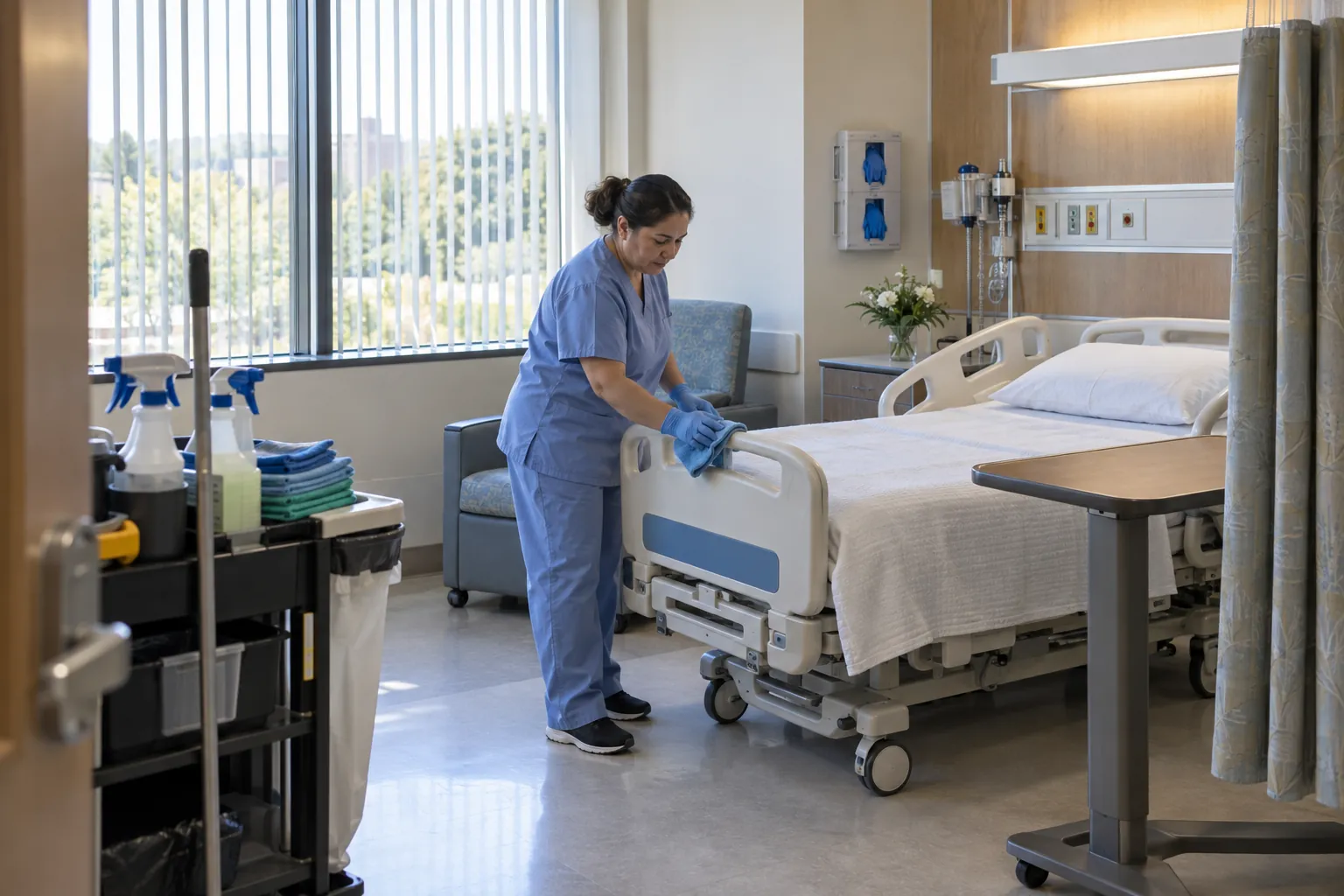
A hospital patient room, a nursing home dining room, a school cafeteria and an office restroom each answer to different rules, and most buildings answer to more than one. This guide maps the cleaning standards that exist in the United States, says who they bind and who merely borrows them, and shows how to decide which should shape your own scope of work and inspections.
01
What "cleaning standards" means in the United States
People use "cleaning standards" for three different things: the law that says a place must be kept clean, published benchmarks and certifications that say how clean, how often and how it is measured, and the contract standard written into a particular janitorial scope of work. Only the first is compulsory, and even that depends on the employer and the state.
For most private employers the legal floor is federal OSHA. 29 CFR 1910.22, General requirements (walking-working surfaces) requires that "all places of employment, passageways, storerooms, service rooms, and walking-working surfaces are kept in a clean, orderly, and sanitary condition", and that walking-working surfaces are kept free of hazards such as "leaks, spills, snow, and ice". 29 CFR 1910.141, Sanitation adds that "all places of employment shall be kept clean to the extent that the nature of the work allows", and that the floor of every workroom be kept, so far as practicable, dry.
Those two rules say that a building must be clean, not how clean or how often. OSHA's other rules govern doing the work safely: the Hazard Communication standard for the chemicals custodians use, and the bloodborne pathogens standard wherever staff may meet blood or other potentially infectious materials.
Above that floor, the sector decides. Hospitals and nursing homes have federal Conditions of Participation and CDC guidelines behind them. Restaurants, cafeterias and other food service answer to the food code their state or local health department has adopted. Most offices, schools, stores, churches and apartment common areas have no sector standard at all, and their cleaning standard is whatever the owner or facility manager writes into the janitorial contract, often borrowing from the others.
02
The map of US cleaning standards
The rules, guidelines and benchmarks you are most likely to meet are:
- OSHA's general industry rules: 1910.22 and 1910.141 for a clean, sanitary and dry workplace, the Hazard Communication standard for chemicals, and 29 CFR 1910.1030, Bloodborne pathogens, which requires a written cleaning schedule for work areas where blood or other potentially infectious materials may be present.
- The CDC's Guidelines for Environmental Infection Control in Health-Care Facilities (2003), still the reference for environmental services (EVS) in hospitals, clinics and long-term care.
- The CMS Conditions of Participation for hospitals (42 CFR 482.42, infection prevention and control) and for nursing homes (42 CFR 483.10 and 42 CFR 483.80), which bind any facility that takes Medicare or Medicaid. Accreditors such as The Joint Commission survey against their own paid standards on top.
- The FDA Food Code, a model that state, local and tribal health departments adopt, often with amendments, as the enforceable rule for restaurants, cafeterias and other retail food service.
- EPA disinfectant registration and labels. EPA registers disinfectants as pesticides, and the product label sets the surfaces, the dilution and the contact time. See EPA's Selected EPA-Registered Disinfectants.
- APPA's custodial guidelines, the five appearance levels that schools, colleges and many public owners use to say how clean a space should look for the staffing they fund. See our guide to custodial staffing.
- ISSA's Cleaning Industry Management Standard (CIMS), a management certification for janitorial contractors and in-house departments. See our guide to CIMS certification.
- Green Seal's GS-42, Commercial and Institutional Cleaning Services, a voluntary environmental and health standard for cleaning services.
- The owner's scope of work, which in most buildings is the cleaning standard in practice.
OSHA's rules and the CMS Conditions of Participation carry legal force for the employers and facilities they cover, the food code does once a state or local health department has adopted it, and the EPA label is legally enforceable wherever the product is used. The CDC guideline is guidance, not law, though a hospital's infection control program must "demonstrate adherence to nationally recognized infection prevention and control guidelines". APPA's levels, CIMS and GS-42 are voluntary until a contract, a grant, a lease or an accreditor makes them binding.
03
Hospitals and nursing homes: the most developed rules
Healthcare is where US cleaning standards are most developed, and the model other sectors borrow from. Three layers sit on top of each other.
The Conditions of Participation. Under 42 CFR 482.42, "the hospital must have active hospital-wide programs for the surveillance, prevention, and control of HAIs and other infectious diseases". For nursing homes, 42 CFR 483.10 requires "a safe, clean, comfortable and homelike environment" and "housekeeping and maintenance services necessary to maintain a sanitary, orderly, and comfortable interior", and 42 CFR 483.80 requires an infection prevention and control program "designed to provide a safe, sanitary, and comfortable environment". None of these sets a cleaning frequency. They require a program, and surveyors look at whether it works.
The CDC guideline. The CDC's environmental infection control guideline is where the working rules come from. Its environmental services section says that high-touch housekeeping surfaces in patient-care areas, such as doorknobs, bedrails, light switches, wall areas around the toilet and the edges of privacy curtains, "should be cleaned and/or disinfected more frequently than surfaces with minimal hand contact". Horizontal surfaces with little hand contact, such as window sills and hard floors, "require cleaning on a regular basis, when soiling or spills occur, and when a patient is discharged from the facility". Where a proprietary detergent or disinfectant is used, it says the manufacturer's instructions should be followed.
The bloodborne pathogens standard. In any workplace covered by 1910.1030, the employer must keep the worksite "in a clean and sanitary condition" and "determine and implement an appropriate written schedule for cleaning and method of decontamination based upon the location within the facility, type of surface to be cleaned, type of soil present, and tasks or procedures being performed in the area". Contaminated work surfaces must be decontaminated after procedures, immediately or as soon as feasible after a spill, and at the end of the shift if they may have become contaminated since the last cleaning.
In practice, a hospital EVS department turns those layers into a written program: which spaces are cleaned how often (a patient room daily and at discharge, an operating room between cases and at the end of the day), who owns each item (EVS, nursing or biomedical engineering), which EPA-registered products are used at what contact time, and how cleaning is checked, whether by visual inspection, fluorescent marking or ATP testing. The Joint Commission then surveys that program as part of the environment of care.
04
Food areas, schools and everyday commercial buildings
Food areas. The FDA describes the Food Code as "a model for safeguarding public health and ensuring food is unadulterated and honestly presented when offered to the consumer", and says local, state, tribal and federal regulators use it "as a model to develop or update their own food safety rules". The current model is the 2026 Food Code, which followed the 2022 edition. What binds a restaurant, a school cafeteria or an office cafe is the code its state or local health department has adopted, which may be an older edition with local amendments. That code sets how food-contact surfaces and equipment are cleaned and sanitized, and the local health inspector checks it. The scope of work should say whether kitchen staff or the janitorial contractor owns which surfaces.
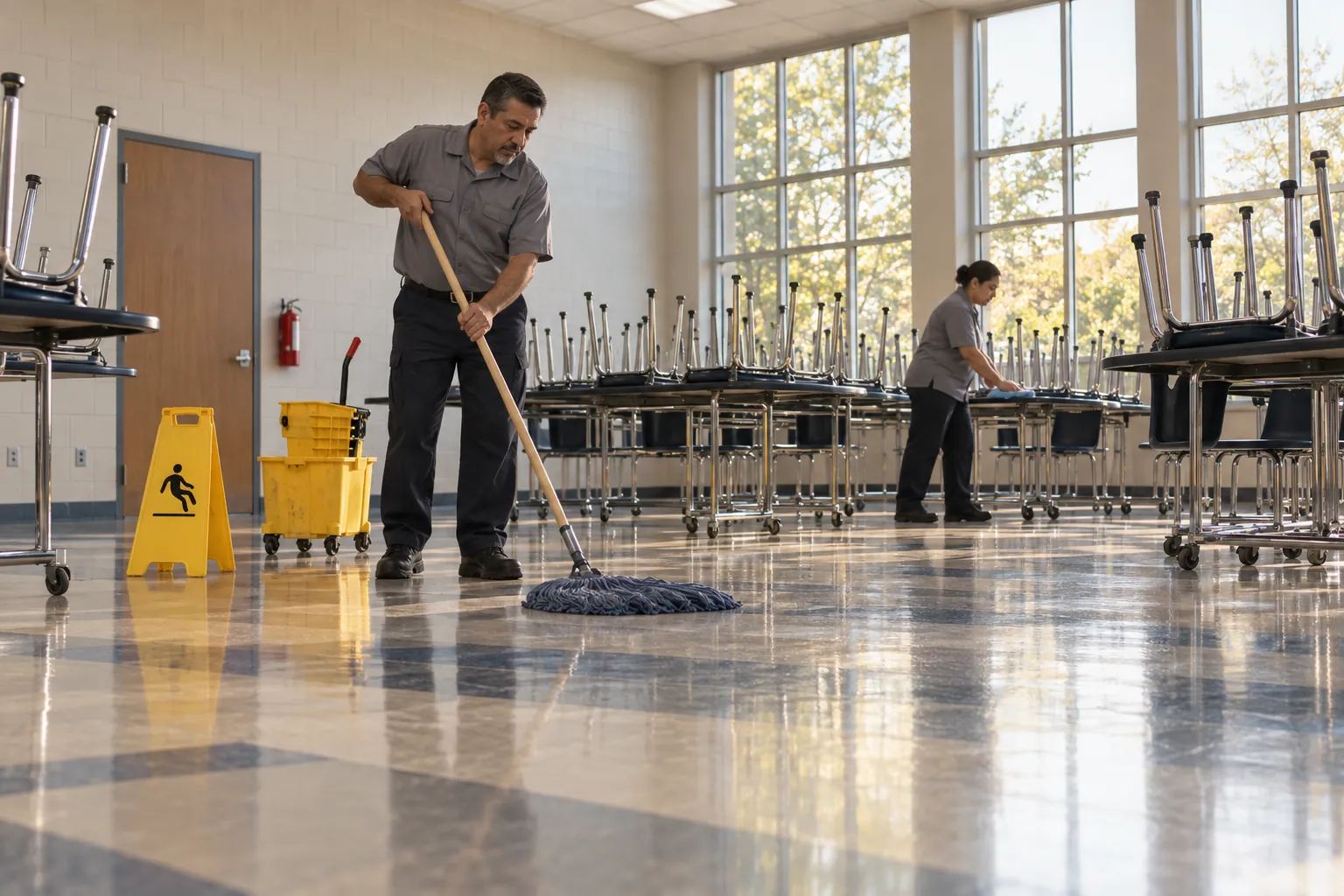
Schools. No federal rule sets how often a classroom or a school restroom is cleaned. Private schools fall under OSHA's general rules; public schools fall under a state plan or under state law alone. Many districts write their standard in APPA's terms. APPA's Operational Guidelines page describes the custodial volume as "the industry benchmark for custodial staffing, with service-level standards, task frequencies, and matrices covering every space type on campus". APPA's Facilities Manager article Operational Guidelines for Educational Facilities – Custodial (January/February 2013) names the five appearance levels: Level 1 Orderly Spotlessness, Level 2 Ordinary Tidiness, Level 3 Casual Inattention, Level 4 Moderate Dinginess and Level 5 Unkempt Neglect. A district that funds Level 3 and expects Level 2 has a mismatch no amount of effort will close.
Offices, stores, churches and common areas. Here the legal standard is OSHA's "clean, orderly, and sanitary" and the working standard is the scope of work. The CDC's page on When and How to Clean and Disinfect a Facility is the plain-language reference for non-healthcare buildings: cleaning "decreases the number of germs on surfaces and reduces risk of infection from surfaces", disinfecting "can kill harmful germs that remain on surfaces after cleaning", and high-touch surfaces such as door handles, stair rails, elevator buttons, restroom fixtures and desks need regular cleaning. See cleaning vs. disinfecting for when each is called for.
Contractor certifications. ISSA describes CIMS as a way to "elevate your organization's credibility and uphold hygiene standards for all occupants". It certifies how a cleaning organization is managed, not how clean a given restroom was on Tuesday. Green Seal's GS-42 "establishes environmental and health requirements for commercial and institutional cleaning services", in-house or contracted, for indoor areas of commercial, public and industrial buildings. Neither replaces the scope of work.
Disinfectants everywhere. Whatever the building, the EPA label is the instruction for a disinfectant. EPA's guidance says "it is important to read and understand the product label before you use it", and that "the surface should be visibly wet for the entire contact time". A standard that says "disinfect restroom fixtures daily" is met only if the product stays on long enough to do it.
05
Choosing which cleaning standards apply to your building
Work through the building area by area, not as a whole, because one site often carries several regimes: a medical office building with a cafe, a school with a health room and a kitchen, an office tower with a fitness center.
- Start with the law that covers the employer. Federal OSHA or the state plan for private employers; the state plan or state law for a public one. Note how 1910.22, 1910.141 and the Hazard Communication standard, or the state's equivalents, are met.
- Find any bloodborne pathogens exposure. A clinic, a school nurse's office, a first-aid room or a custodian who cleans up blood spills brings 1910.1030 and its written cleaning schedule. See our guide to blood spill cleanup.
- Identify regulated care. Hospitals and nursing homes that take Medicare or Medicaid follow the Conditions of Participation, the CDC guideline and their accreditor.
- Find the food areas. Kitchens, serveries and break-room food prep follow the locally adopted food code and the operator's food safety procedures, whoever cleans them.
- Check the contract, lease and grant. An owner, a landlord or a public funder may require an APPA level, a CIMS-certified contractor or Green Seal products and methods.
- Set the rest by risk. Group the remaining spaces into a few levels (restrooms, entrances and high-touch surfaces highest; offices and storage lowest), give each a frequency and an inspectable standard, and write it into the janitorial scope of work.
- Decide how it will be measured. Inspections for quality, records for delivery, and a small set of indicators to report. See janitorial quality control.
If you start from a template or a benchmark, check every frequency against your own building before you adopt it. Borrowing is fine and often wise. An office that adopts the hospital logic of high-touch surfaces cleaned more often, scaled down, will usually have a clearer standard than one that says "clean to industry standards", which nobody can inspect against.
06
Where standards fail in practice, and where SiteClara fits
Every standard on the map assumes the work was done as scheduled. Inspections then sample the result. The weak link is the gap between the two: the restroom check that should happen every two hours, the high-touch surfaces wiped twice a day under an infection prevention program, the written cleaning schedule required by the bloodborne pathogens standard, the cafeteria cleaning log initialed at the end of the shift for the whole day. When a surveyor, a health inspector, a client or an infection preventionist asks whether the frequency was met, the answer is often a sheet filled in afterward.
SiteClara records the scheduled checks as they happen. A printed QR poster at each location, with an optional NFC tag behind it, lets custodians and EVS staff confirm a check with a scan or a tap on their own phone, with no app to install. They see what is due there and mark it done, or say what stopped them, with a photo when one is asked for, and can report a problem such as a leak or an empty dispenser, which goes onto the team's list of jobs until someone closes it.
The supervisor sees what is due, done and missed, records the reason for a miss, and approves a daily report that goes to nominated contacts, such as the facility manager or the client, at 8 a.m. the next morning, showing, for example, 12 of 12 checks completed and what is still open.
07
Further reading, and a list to take away
The primary sources are OSHA's rules at 29 CFR 1910.22, 1910.141 and 1910.1030 and its Hazard Communication pages, with your state plan where there is one; the CDC's Guidelines for Environmental Infection Control in Health-Care Facilities and its facility cleaning guidance; the CMS Conditions of Participation on the eCFR; the FDA Food Code and the edition your state or local health department has adopted; EPA's disinfectant pages and the product label; and, for voluntary benchmarks, APPA's operational guidelines, ISSA's CIMS and Green Seal's GS-42.
To settle which cleaning standards apply:
- list every space and its use, not just the building type;
- confirm whether federal OSHA, a state plan or neither covers the employer;
- note the rules that apply to each space: workplace, bloodborne pathogens, food, or healthcare Conditions of Participation;
- use the current text of any rule, and the edition of the food code your jurisdiction has actually adopted;
- group the remaining spaces by risk and set frequencies accordingly;
- write an inspectable standard for each space into the scope of work;
- agree how quality is inspected and how delivery is recorded;
- review the choice when the building's use changes.
Sources
Every document this guide quotes or links to, in the order it first cites them.
- 29 CFR 1910.22, General requirements (walking-working surfaces) osha.gov
- 29 CFR 1910.141, Sanitation osha.gov
- Hazard Communication standard osha.gov
- OSHA-approved State Plans osha.gov
- 29 CFR 1910.1030, Bloodborne pathogens osha.gov
- Guidelines for Environmental Infection Control in Health-Care Facilities cdc.gov
- 42 CFR 482.42 ecfr.gov
- 42 CFR 483.10 ecfr.gov
- 42 CFR 483.80 ecfr.gov
- FDA Food Code fda.gov
- Selected EPA-Registered Disinfectants epa.gov
- GS-42, Commercial and Institutional Cleaning Services greenseal.org
- Operational Guidelines appa.org
- Operational Guidelines for Educational Facilities – Custodial www1.appa.org
- When and How to Clean and Disinfect a Facility cdc.gov
Related guides
 CleaningCustodial staffing: how many custodians a building needs, and how to show itHow to work out custodial staffing: cleanable square feet, APPA's five levels, ISSA cleaning times, labor hours to FTEs, and checking the numbers hold up.
 CleaningJanitorial quality control: how to inspect, score and fix the cleaningHow janitorial quality control works: QA versus QC, building a cleaning inspection checklist, APPA appearance levels, sampling, scoring and corrective action.
 CleaningJanitorial scope of work: what it should say, and how to show it is metWhat a janitorial scope of work should cover, how to set cleaning frequencies by room type, output versus input standards, and how to show the work is being done.
 CleaningCleaning, sanitizing and disinfecting: what each one does, and when a building needs itCleaning, sanitizing and disinfecting defined by the CDC, EPA and FDA Food Code: when each is needed, how to do it right, and what the record should show.