Premises and facilities management
Electrical panel clearance: the working space rules, and how to keep the space clear
Electrical panel clearance is the clear working space that has to stay open in front of a panelboard or switchboard: under OSHA's electrical standard and the National Electrical Code, at least 3 feet (36 inches) deep for a typical 120/208-volt or 120/240-volt panel, 30 inches wide or the width of the equipment if greater, and 6.5 feet high in installations built on or after August 13, 2007.
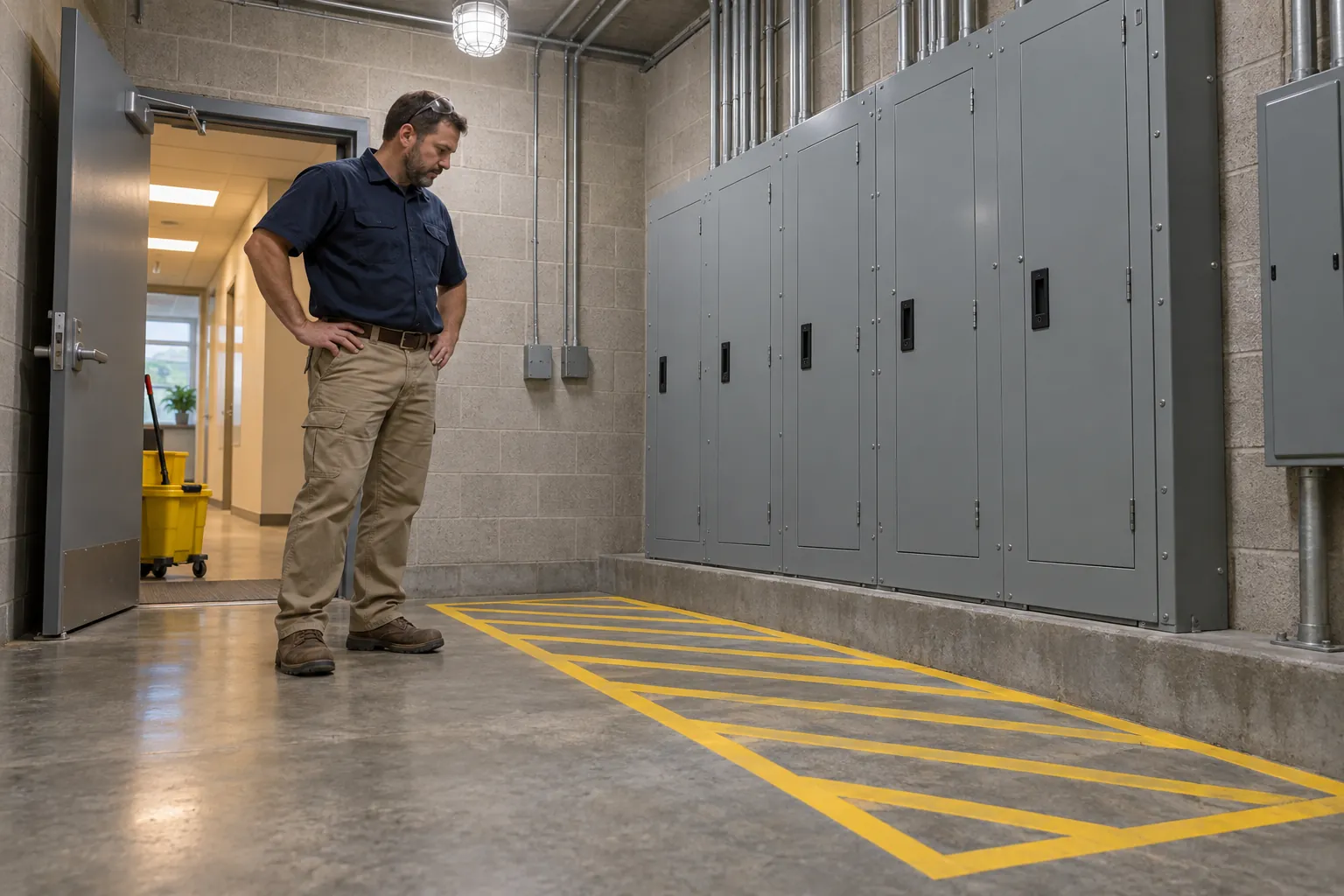
The space lets a qualified electrician work on the equipment safely and lets anyone reach a breaker in a hurry, and it may not be used for storage. The rule is simple; keeping it true every day, in a building full of boxes, carts and deliveries, is the hard part. This guide covers what the rules require, what the space looks like in practice, who should check it and how often, and what a useful record shows.
01
What OSHA and the NEC require around an electrical panel
For most private employers the federal rule is OSHA's general electrical standard, 29 CFR 1910.303, General. Paragraph (g)(1) opens with the duty itself: "Sufficient access and working space shall be provided and maintained about all electric equipment to permit ready and safe operation and maintenance of such equipment." Note the word maintained: the space is a condition the employer keeps up every day, not a design feature satisfied once when the building was wired.
Paragraph (g)(1)(i) then sets the dimensions for equipment "likely to require examination, adjustment, servicing, or maintenance while energized", which in practice is what a panelboard is: breakers get reset, circuits get traced and covers come off with the power on. Paragraph (g)(1)(ii) is one short sentence that facility teams should know by heart: "Working space required by this standard may not be used for storage."
The second source is NFPA 70, the National Electrical Code (NEC), published by the National Fire Protection Association. Section 110.26 covers working space about electrical equipment of 1,000 volts or less, with its own depth table, a width and height for the space, a rule against storage in 110.26(B), and a separate dedicated equipment space above and below the equipment in 110.26(E). The NEC is a model code: it becomes law where a state or city adopts it, often with amendments, and the electrical inspector or other authority having jurisdiction (AHJ) enforces the edition adopted there. NFPA's NFPA 70 (NEC) page lists the 2026 edition as current, and NFPA notes that the code is being reorganized across the 2023, 2026 and 2029 editions, so check the section numbers in the edition your jurisdiction actually uses.
Where you are matters too. OSHA's page on State Plans says there are currently 22 State Plans covering both private sector and state and local government workers, and seven covering only state and local government workers, each required to be at least as effective as federal OSHA. California is one: its Electrical Safety Orders set the same kind of rule in Title 8, section 2340.16, Work Space About Electric Equipment, which also says the working space "shall not be used for storage." The NEC and the fire code, by contrast, are enforced locally, so a blocked panel can be a problem for OSHA, the electrical inspector and the fire marshal at once.
02
The clearance in practice: depth, width, height and access
OSHA's Table S-1 sets the minimum depth of clear working space, measured in the direction of access to the live parts, for equipment of 600 volts or less. It depends on the voltage to ground and on what is across the space from the equipment:
- 0 to 150 volts to ground, which covers a typical 120/208-volt or 120/240-volt panel: 3 feet (36 inches) in every condition.
- 151 to 600 volts to ground, which covers a 277/480-volt panel: 3 feet in Condition A (exposed live parts on one side and no live or grounded parts on the other), 3.5 feet (42 inches) in Condition B (grounded parts on the other side, and OSHA counts concrete, brick and tile walls as grounded), and 4 feet (48 inches) in Condition C (exposed live parts on both sides with the worker between). OSHA's Note 2 treats insulated wire or busbars at not over 300 volts as not live parts.
- Width: under (g)(1)(i)(B), the width of the equipment or 30 inches, whichever is greater.
- Height: the space must be clear from the floor to the headroom in (g)(1)(vi), which is 6.5 feet (78 inches) for installations built on or after August 13, 2007, and 6.25 feet for those built before.
- Entrance: at least one entrance of sufficient area to reach the working space, and for equipment rated 1,200 amperes or more and over 6 feet wide, one entrance at least 24 inches wide and 6.5 feet high at each end.
- Lighting: illumination for working spaces about service equipment, switchboards, panelboards and motor control centers installed indoors.
- Dedicated space: under (g)(1)(vii)(A)(1), the space equal to the width and depth of the equipment, from the floor to 6 feet above the equipment or to the structural ceiling, whichever is lower, is dedicated to the electrical installation. Piping and ducts foreign to it are kept out unless the rule's conditions are met; a dropped or suspended ceiling is not a structural ceiling.
Older buildings have some allowances. OSHA's Note 1 permits minimum clear distances of 2.5 feet for installations built before April 16, 1981, and 29 CFR 1910.302 explains which requirements apply according to when an installation was made or overhauled. None of this makes storage in the working space acceptable at any age.
The NEC's own numbers are in Table 110.26(A)(1) and its subsections. NFPA's blog Electrical Room Basics, Part 1, on the 2023 edition, summarizes them: a depth set by the voltage to ground and what is opposite, a width of at least 30 inches, a height of 6.5 feet, a floor kept clear and as level as practical, and open equipment doors that do not impede access or egress. California's section 2340.16 adds that the working space must allow equipment doors or hinged panels to open 90 degrees.
The fire code often asks for the same thing. The International Fire Code, where a jurisdiction has adopted it, carries its own working-space rule. The Village of Hillside, Illinois, which adopted the 2021 IFC, summarizes it for businesses on its International Fire Code page as a working space of not less than 30 inches in width, 36 inches in depth and 78 inches in height in front of electrical service equipment. The section number differs between IFC editions and local amendments, so ask your fire marshal which applies.
Few people on a patrol or a cleaning round will know a panel's voltage to ground. Have your electrician or building engineer mark the clear zone once, and let everyone else check against the marking.
03
What ends up in front of electrical panels, and why temporary is not an excuse
Panels are rarely blocked on purpose. The space in front of them looks empty and useful, and in a busy building empty space fills up. The usual culprits are familiar to any facility manager:
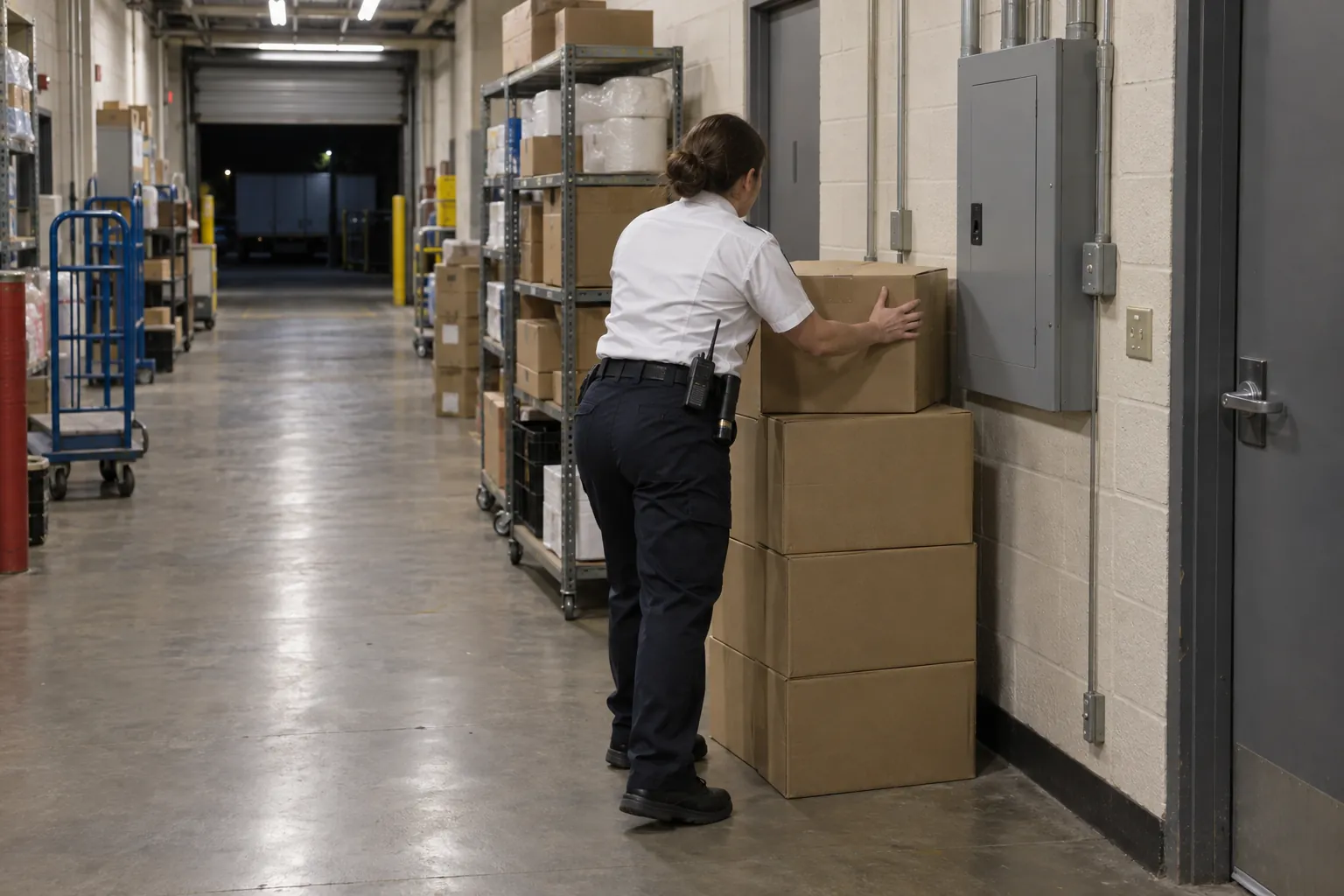
- Storage creep in electrical rooms and closets: cartons of paper, spare ceiling tiles, old monitors and furniture waiting for disposal.
- Custodial equipment: janitorial carts, floor machines, trash and recycling bins and mop buckets parked in the nearest open corner, which is often the panel's.
- Deliveries and moves: pallets and boxes left in a back hallway or a loading area, tenant move-ins and events that need somewhere to stage.
- Furniture and build-outs: a desk, a file cabinet or a new partition placed against a wall with a panel on it, or a panel boxed into a closet during a remodel.
- Foreign equipment above: a new pipe, duct or drain routed through the dedicated space over the panel, where a leak would land on the equipment.
The argument heard most often is that the items are only there for a day. OSHA addressed it in a 1999 letter of interpretation, Access and working space requirements for electric equipment (600V or less): "This access and working space shall be kept clear at all times for operation and maintenance personnel and may not be used for intermittent/incidental storage of nonpermanent equipment or furniture, which could interfere with ready access to the electric equipment in the event of an emergency." A cart parked for an hour is still in the way if a breaker has to be reached during that hour.
The second argument is that nobody ever works on this panel live. NFPA's blog A Better Understanding of NFPA 70E: Electrical Equipment Working Space answers it: both OSHA and NFPA 70E require equipment that is not in a verified electrically safe work condition to be considered energized, and the NEC working space still applies even if the equipment will be put in that condition.
In NFPA's blog Electrical space: the final frontier, a former electrical inspector says he wrote up storage in the working space many times, mostly on remodels. When a building changes, panels get blocked.
04
Who checks the clearance, and how often
No federal rule sets a frequency for checking panel clearance. The duty is to provide and maintain the space, so the practical answer is to check often enough that a blockage is found before it matters, and to check again whenever the building changes. A pattern that works in many facilities:
- Every day, in passing, where panels sit in public or shared areas: corridors, back-of-house hallways, stockrooms, loading areas and garages. A security officer on patrol, a day porter or a custodian on the evening round can look at each one in seconds.
- Every week, for electrical rooms and closets that are locked or rarely visited, as part of the building engineer's or maintenance technician's rounds, including the dedicated space above the equipment, the lighting and the door.
- Before and after events, deliveries, move-ins, remodels and seasonal changes, when storage appears fastest.
- At each safety walkthrough, alongside exits, extinguishers and extension cords.
Be clear about who does what. Checking the clearance is an outside-the-panel job: look, move what can safely be moved, and report the rest. Opening a panel, testing a circuit or judging whether an installation meets the code is work for a qualified person under the employer's electrical safety program. NFPA's Electrical Room Basics blog notes that electrical rooms are in most cases locked, which helps ensure only qualified persons have access to energized equipment; a custodian or officer checking the room should not be the one who opens the equipment.
Ownership matters as much as frequency. In a multi-tenant building the chief engineer may own the electrical rooms while a tenant controls the stockroom with the sub-panel. Agree who checks which panels and who is told when a blockage cannot be moved, and write it into the post orders, the janitorial scope of work or the tenant rules.
05
What a useful clearance record shows
Nothing in 29 CFR 1910.303 requires a written log of panel clearance checks. A record still shows that the space is maintained rather than cleared the morning before an inspection. For each check, a good record answers:
- Which panel: its location and designation, so two panels in the same room are not confused.
- When: the date and time of the check.
- Who: the name of the person who looked, not a set of initials added later.
- What was found: clear, or blocked, with what was in the way and a photo.
- What was done: moved on the spot, or reported, to whom, and when it was cleared.
- Anything beyond clearance: a missing cover, a damaged enclosure, a light out in the electrical room, a leak above the equipment, or an unlabeled circuit, each passed to the building engineer or electrician.
The pattern over time is as useful as each entry. The same stockroom panel blocked every Monday tells you a delivery routine needs to change, and a photo of a blockage shows what was actually there when the question comes up later.
06
Where the record fails, and what SiteClara does about it
Panel clearance checks fail quietly. The round sheet says every electrical room was checked, but it was filled in at the end of the shift. The officer who saw pallets in front of the loading dock panel told whoever was at the desk, and nobody wrote it down. When the fire marshal finds the blocked panel, there is nothing to show when it was last clear or who was told.
SiteClara puts a printed QR poster at each panel location or electrical room, with an optional NFC tag behind it. Staff scan the code or tap the tag on their own phone, with no app to install, and sign in with a link. They see the checks due at that location, such as a daily clearance check in a corridor or a weekly one in an electrical room, and mark each one done, or say what stopped them, such as a locked door. A blocked panel, a missing cover or a light out is reported there with a photo and goes onto the team's list of jobs until someone closes it.
The supervisor sees what is due, done and missed, and can record why a check was missed; a job that needs the building manager, such as a tenant's stock that the team cannot move, can be escalated to them to answer. Each day the supervisor reviews and approves a report that goes to nominated management or client contacts at 8 a.m. the next morning, showing what was reported, completed and still open, and how the scheduled checks went, for example 14 of 14 completed.
07
Questions people ask
What is the OSHA rule for electrical panel clearance?
For most private employers it is paragraph (g)(1) of OSHA's general electrical standard, 29 CFR 1910.303, General: "Sufficient access and working space shall be provided and maintained about all electric equipment to permit ready and safe operation and maintenance of such equipment." For equipment likely to be worked on while energized, it sets a depth from Table S-1, a width of "the width of the equipment or 762 mm (30 in.), whichever is greater", and headroom of 6.5 feet for installations built on or after August 13, 2007, and paragraph (g)(1)(ii) says the working space "may not be used for storage." A State Plan state such as California sets its own rule, which must be at least as effective.
Are electrical panels required to have 36 inches of clearance?
Yes, for most panels. Table S-1 in 29 CFR 1910.303 sets a minimum depth of 3 feet, which is 36 inches, for equipment of 0 to 150 volts to ground in every condition, and 3 feet is the smallest depth in the table at any voltage up to 600. Paragraph (g)(1)(i)(A) says the distance is measured "from the live parts if they are exposed or from the enclosure front or opening if they are enclosed." Some panels need more, and OSHA's Note 1 allows 2.5 feet only for installations built before April 16, 1981.
How much clearance does a 480V panel need?
A 480-volt panel on a 277/480-volt wye system has 277 volts to ground, so it falls in the 151 to 600 volt row of Table S-1 in 29 CFR 1910.303: 3 feet deep in Condition A, 3.5 feet (42 inches) in Condition B, where grounded parts or a concrete, brick or tile wall face the equipment, and 4 feet in Condition C, with exposed live parts on both sides. The width is still 30 inches or the width of the equipment, whichever is greater. Ask your electrician which condition applies to each panel and mark the zone to match.
08
Where to read the rules, and a list to take away
Start with OSHA's text of 29 CFR 1910.303, paragraph (g), and the Subpart S Electrical Standard eTool for which rules apply to an installation of a given age. OSHA's 1999 letter, Access and working space requirements for electric equipment (600V or less), settles the question of temporary storage. In California, read Title 8, section 2340.16; in another State Plan state, find its rule through OSHA's State Plans page. For the NEC and the fire code, ask your electrical inspector and fire marshal which editions and amendments apply where your building is.
To keep electrical panel clearance true every day, check that:
- every panel, switchboard and electrical room is on a list, with its location and designation;
- the clear zone in front of each is marked, with at least the width of the equipment or 30 inches and the depth your electrician has confirmed, usually 3 feet or more;
- nothing is stored in the working space or the dedicated space above the equipment, even for a day;
- equipment doors and covers can open fully, and the room is lit;
- panels in shared and public areas are checked daily and electrical rooms at least weekly;
- checks happen before and after events, deliveries, move-ins and remodels;
- whoever finds a blockage knows who moves it and who is told when they cannot;
- each check is recorded with a name, a time and a photo when something is wrong;
- anything inside the panel is left to a qualified person.
Sources
Every document this guide quotes or links to, in the order it first cites them.
- 29 CFR 1910.303, General osha.gov
- NFPA 70 (NEC) page nfpa.org
- State Plans osha.gov
- Title 8, section 2340.16, Work Space About Electric Equipment dir.ca.gov
- 29 CFR 1910.302 osha.gov
- Electrical Room Basics, Part 1 nfpa.org
- International Fire Code page hillside-il.org
- Access and working space requirements for electric equipment (600V or less) osha.gov
- A Better Understanding of NFPA 70E: Electrical Equipment Working Space nfpa.org
- Electrical space: the final frontier nfpa.org
- Subpart S Electrical Standard eTool osha.gov
Related guides
 Premises and facilities managementOSHA inspection checklist: what to check before OSHA doesAn OSHA self-inspection checklist for a building: the duty behind it, what to check under each standard, how often, and how to record hazards through to correction.
 Premises and facilities managementSafety walkthroughs: how to walk a building, talk to the crew and fix what you findWhat a safety walk is under OSHA's Recommended Practices, what to look at in a commercial building, how often to walk, how to record findings and close them out.
 Premises and facilities managementBuilding engineer duties: what the job covers, and how to show it is doneBuilding engineer duties in a commercial building: running the plant, rounds and logs, lockout, refrigerant and boiler rules, vendors, and a record that holds up.
 Fire and water checksExtension cords at work: what OSHA and the fire code allowWhat OSHA 29 CFR 1910.305 and 1910.334 and local fire codes say about extension cords at work: allowed uses, power strips, inspection before each shift.