Fire and water checks
Extension cords at work: what OSHA and the fire code allow
OSHA, the federal Occupational Safety and Health Administration, allows extension cords at work only for portable equipment and temporary wiring, never as a substitute for a building's permanent wiring, and requires them to be visually inspected for damage before use on any shift.
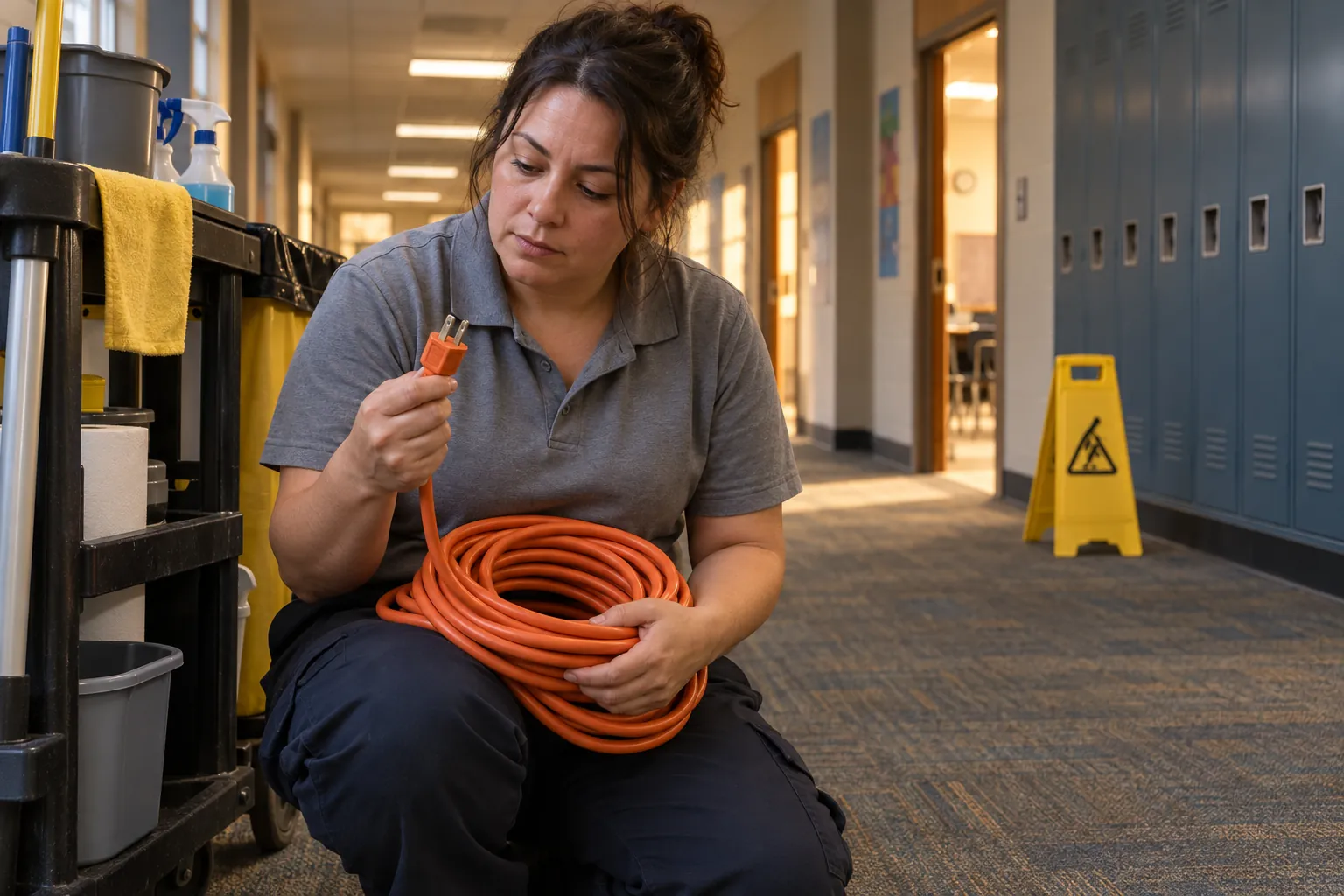
They are also one of the most ordinary electrical hazards in a building: the cord run under an office door to a space heater, the power strip plugged into another power strip, the floor machine dragged by its cord down a stairwell. OSHA's general industry electrical standard sets out when a flexible cord may be used and when it may not. Local fire codes add their own rules, and fire inspectors check them. This guide covers what the rules say, what they mean in an office, school, store or apartment building, and how to keep a record of the checks that shows what was actually found.
01
What OSHA and the fire code say about extension cords
For most private employers, the federal rules on extension cords are in Subpart S of 29 CFR 1910, the general industry electrical standard.
The first is 29 CFR 1910.305(g), flexible cords and cables. It permits flexible cords for uses including the "connection of portable lamps or appliances" and "temporary wiring as permitted in paragraph (a)(2) of this section." Unless a use is specifically permitted, they may not be used:
- "As a substitute for the fixed wiring of a structure";
- "Where run through holes in walls, ceilings, or floors";
- "Where run through doorways, windows, or similar openings";
- "Where attached to building surfaces";
- "Where concealed behind building walls, ceilings, or floors"; or
- "Where installed in raceways, except as otherwise permitted in this subpart."
The same paragraph says cords "may be used only in continuous lengths without splice or tap" (with a narrow exception for hard-service and junior hard-service cord, No. 14 and larger, repaired with a splice that keeps the cord's insulation, outer sheath properties and usage characteristics) and must have strain relief at devices and fittings.
The second is 29 CFR 1910.334(a), portable electric equipment. It says: "Portable cord- and plug-connected equipment and flexible cord sets (extension cords) shall be visually inspected before use on any shift for external defects (such as loose parts, deformed and missing pins, or damage to outer jacket or insulation) and for evidence of possible internal damage (such as pinched or crushed outer jacket)." If there is a defect or damage that might injure someone, "the defective or damaged item shall be removed from service," and nobody may use it until it has been repaired and tested.
The third is the temporary wiring rule in 1910.305(a)(2). Temporary power and lighting at 600 volts or less may be used only during remodeling, maintenance or repair and similar work, "for a period not to exceed 90 days for Christmas decorative lighting, carnivals, and similar purposes," or for experimental work and emergencies, and "temporary wiring shall be removed immediately upon completion of the project or purpose for which the wiring was installed."
On top of OSHA sits the fire code the jurisdiction has adopted, usually a version of the International Fire Code (IFC) or NFPA 1 with local amendments, enforced by the authority having jurisdiction (AHJ). In chapter 6 of the 2024 International Fire Code, section 603.6 (also 603.6 in the 2021 edition) says "extension cords shall not be a substitute for permanent wiring," must be listed and labeled to UL 817, "shall not be affixed to structures, extended through walls, ceilings or floors, or under doors or floor coverings," and "shall be used only with portable appliances." Each cord must plug directly into an approved receptacle, relocatable power tap or current tap and, except for approved multiplug cords, serve only one portable appliance; its ampacity must be not less than the appliance's rating; it must be kept "in good condition without splices, deterioration or damage"; and it must be grounded where it serves a grounded appliance. Section 603.5 requires power strips (relocatable power taps) to be listed to UL 1363 and "directly connected to a permanently installed receptacle" (603.5.2), with two narrow exceptions: approved temporary use in assembly occupancies and in meeting rooms of business occupancies, where up to five may be connected together or to an extension cord to power electronic equipment, and use for 90 days or less to test the devices themselves.
02
What is allowed and what is not, in practice
Fire departments that publish their inspection checklists put the rule in a line. The Hillside Fire Department in Illinois, which enforces the 2021 International Fire Code, lists extension cords among its 25 most common International Fire Code violations for business: "Extension cords are for temporary use only and are not to be used in lieu of permanent wiring," they "cannot pass through doorways, walls, floors, or ceilings," and they "shall show no signs of damage and not be plugged into each other." The San Marcos, California, Fire & Life-Safety Inspection Checklist for Businesses asks the same of "extension cords and multi-plug adapters."
Walk any building with those lines in mind and the same scenes turn up:
- The permanent temporary cord. A cord feeding a printer, a vending machine or a break room refrigerator for years. If the equipment needs power there every day, it needs a receptacle.
- Cords through doorways and walls. A cord closed in a door to reach the next office, or fed through a ceiling tile to a projector.
- Cords attached to the building or under floor coverings. Stapled along a baseboard, tied to a pipe, or taped down under carpet or a mat, out of sight of the next inspection.
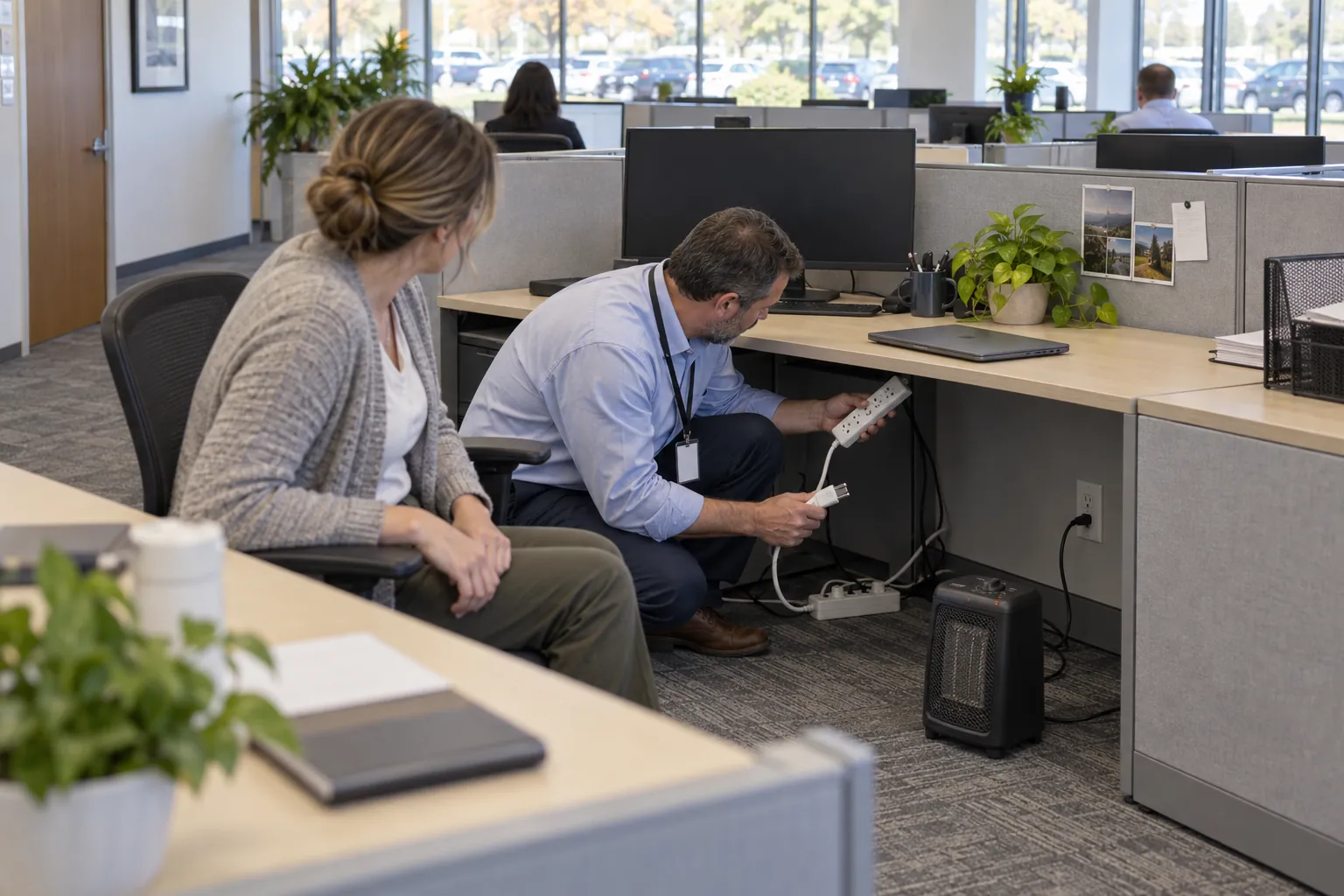
- Daisy chains. A power strip plugged into another power strip, or into an extension cord. OSHA's 2002 letter on compliance requirements for relocatable power taps or "power strips" explains that the UL instructions "require UL-listed RPTs to be directly connected to a permanently installed branch circuit receptacle; they are not to be series-connected to other RPTs or connected to extension cords." The IFC's section 603.5 says the same, outside its narrow exceptions.
- High-power loads on power strips. The same letter says power strips "are not designed for high power loads such as space heaters, refrigerators and microwave ovens, which can easily exceed the recommended ampere ratings." Space heaters are the classic case; see the guide to a space heater policy.
- Damaged and altered cords. A cut or crushed jacket, tape over a nick, a missing or bent grounding pin, a replacement plug fitted to a household cord, or a two-prong adapter on a grounded appliance.
- Cords as trip hazards. Across a corridor, a stair landing or an exit route.
- Seasonal and event power. Holiday lighting or a fundraiser in the gym. OSHA's 90-day limit applies to Christmas decorative lighting and similar purposes; the AHJ may set its own.
03
Choosing the right cord: rating, grounding and wet locations
Many cord problems start at the purchase, with a light household cord rated for less than the load it will carry. Get these right:
- Listed equipment, used as listed. 29 CFR 1910.303 says equipment is acceptable only if approved, and that "listed or labeled equipment shall be installed and used in accordance with any instructions included in the listing or labeling."
- A rating to match the load. IFC 603.6.2 requires a cord's ampacity to be not less than the rating of the appliance it supplies. Check the cord's marking against the equipment's nameplate.
- A grounding conductor where the equipment is grounded. Under 1910.334(a)(3), "a flexible cord used with grounding-type equipment shall contain an equipment grounding conductor," and plugs and receptacles may not be altered so as to break the grounding path. A cut-off grounding pin fails that test, as does a two-prong adapter.
- Hard-service cord for work equipment. In construction, 29 CFR 1926.405 requires extension cord sets used with portable electric tools and appliances to be "of three-wire type" and "designed for hard or extra-hard usage." Outside construction it is still the sensible standard for a maintenance or janitorial cart.
- Cords approved for wet locations. 1910.334(a)(4) requires cords used where workers are likely to contact water or conductive liquids, as in carpet extraction and wet floor care, to be approved for those locations; (a)(5) forbids wet hands when plugging and unplugging energized equipment.
- GFCI protection on temporary power. Under 29 CFR 1910.304(b)(3)(ii), 125-volt, single-phase, 15-, 20- and 30-ampere receptacle outlets that are not part of the permanent wiring and are in use by personnel must have ground-fault circuit-interrupter protection. This applies to temporary wiring used during construction-like activities, including certain maintenance, remodeling or repair work.
Buy the right cords centrally, label them to the crew or department, and take household-grade cords out of the building.
04
Inspecting extension cords: before each shift, and on the rounds
The inspection OSHA requires is visual and frequent: before use on any shift, looking for "loose parts, deformed and missing pins, or damage to outer jacket or insulation" and signs of internal damage, such as a pinched or crushed jacket. There is one practical exception in 1910.334(a)(2)(i): cords and equipment "which remain connected once they are put in place and are not exposed to damage need not be visually inspected until they are relocated." A cord on a janitor's cart is checked every shift; one left in place and not exposed to damage waits until it is moved.
In practice a building has two kinds of check:
- The user's check before each shift. The custodian, day porter or technician looks over the jacket, plug and pins before plugging in. OSHA's booklet OSHA 3075, Controlling Electrical Hazards notes that insulation covering flexible cords such as extension cords "is particularly vulnerable to damage."
- The building check on the rounds. A walk through offices, classrooms, break rooms and back-of-house corridors looking for the scenes listed above, by the building engineer, a safety committee member or a security officer on an evening patrol.
OSHA does not set a frequency for the building walk. A reasonable pattern is weekly in break rooms, copy rooms and front desks, monthly elsewhere, and around events and the first cold snap, when the space heaters appear. A fire department checklist, such as the City of Charlotte's self inspection checklist with its line "Extension cords not used in place of permanent wiring," fits neatly into a monthly walk.
When a check finds a problem, the rule is simple: under 1910.334(a)(2)(ii) a damaged item that might injure someone is removed from service until repaired and tested, and IFC 603.2.1 says damaged or modified wiring, devices and appliances that are a shock or fire hazard "shall not be used until repaired or replaced." Tag it and take it off the floor. Where the problem is a cord used as fixed wiring, the fix is a work order for a receptacle, not a better cord.
05
What a useful extension cord record shows
The paragraphs quoted above require the inspection and the removal from service; they do not prescribe a form. But when a fire inspector finds a daisy chain, or someone trips on a cord, the first questions are when the area was last checked, by whom, and what happened to the last problem found. A useful record shows:
- Where: the room, floor or area walked, not just "building."
- When and who: the date, the time and the named person who did the check, recorded at the time rather than filled in later.
- What was found: nothing, or each issue in a few plain words, such as "power strip into extension cord behind desk 4B" or "vacuum cord jacket cut near plug."
- A photograph of anything found, which settles later arguments about what it looked like.
- What was done: cord removed from service, power strip replaced, occupant told, work order raised for a receptacle.
- When it was closed, and by whom, so an open item does not quietly become permanent.
- Temporary installations with an end date, so holiday lighting and event power come down on time, as 1910.305(a)(2)(ii) requires.
06
Where the record fails, and what SiteClara does about it
Extension cord checks fail quietly. The monthly walk sheet was filled in at the end of the month. The custodian who saw a heater on a power strip told whoever was at the front desk, and nobody wrote it down. The damaged vacuum cord went back in the closet with tape on it. When the fire inspector writes the violation, there is nothing to show when the area was last looked at, what was found, or who was told.
SiteClara puts a printed QR poster at each location where a check is scheduled, such as a break room, a copy room or a janitor's closet, with an optional NFC tag behind it. Staff scan the code or tap the tag on their own phone, with no app to install, and sign in with a link. They see the checks due at that location, such as a weekly cord and power strip check in a break room, and mark each one done, or say what stopped them, such as a locked office. A daisy chain, a damaged cord or a cord run under a door is reported there with a photo and goes onto the team's list of jobs until someone closes it.
The supervisor sees what is due, done and missed, and can record why a check was missed; a job that needs the building manager, such as a tenant's heater the crew cannot remove, can be escalated to them to answer. Each day the supervisor reviews and approves a report that goes to nominated management or client contacts at 8 a.m. the next morning, showing what was reported, completed and still open, and how the scheduled checks went, for example 9 of 9 completed.
07
Questions people ask
Is daisy chaining extension cords against OSHA regulations?
Plugging a power strip into another power strip or into an extension cord is. OSHA's 2002 letter on compliance requirements for relocatable power taps or "power strips" explains that UL-listed power strips "are not to be series-connected to other RPTs or connected to extension cords," and 29 CFR 1910.303(b)(2) requires listed equipment to be used in accordance with its listing.
How long does OSHA say you can use an extension cord?
OSHA sets no fixed number of days for a cord that supplies a portable appliance, but a cord may never stand in for the fixed wiring of a structure. Where cords form part of a temporary installation, 29 CFR 1910.305(a)(2), temporary wiring allows it during remodeling, maintenance, repair and similar work, for experiments and emergencies, and "for a period not to exceed 90 days for Christmas decorative lighting, carnivals, and similar purposes," and says it "shall be removed immediately upon completion of the project or purpose for which the wiring was installed."
What is an OSHA approved extension cord?
OSHA does not test or list cords itself. Under 29 CFR 1910.399, the definitions for the electrical standard, equipment is acceptable, and so approved, if it is "accepted, or certified, or listed, or labeled, or otherwise determined to be safe by a nationally recognized testing laboratory" that OSHA recognizes, such as UL. The cord must then be used as its listing says and, where it serves grounding-type equipment, contain an equipment grounding conductor, as 1910.334(a)(3) requires.
Does OSHA allow electrical tape on extension cords?
OSHA's rules do not name electrical tape, but they leave little room for it on a damaged cord. 29 CFR 1910.305(g)(2)(ii), flexible cords and cables says cords "may be used only in continuous lengths without splice or tap," and lets only hard-service and junior hard-service cord of No. 14 and larger be spliced, "so that the splice retains the insulation, outer sheath properties, and usage characteristics of the cord being spliced." Under 29 CFR 1910.334(a)(2)(ii), portable electric equipment, a cord with damage that might injure someone is removed from service until "repairs and tests necessary to render the equipment safe have been made."
08
Where to read the rules, and a list to take away
OSHA publishes the full text of 29 CFR 1910.305 and 29 CFR 1910.334 on its own site, with its letters of interpretation, including the 2015 letter on requirements for the use of flexible cords and cables. The ICC publishes a free read-only view of the International Fire Code. Ask your local fire marshal's office which edition and amendments it enforces, and whether it publishes a self-inspection checklist. In a State Plan state, read its electrical rules as well.
Before you sign off an extension cord check, make sure that:
- no cord is standing in for a receptacle that the equipment needs every day;
- no cord runs through a wall, ceiling, floor, doorway or window, under a door or floor covering, or across an exit, or is fixed to the building;
- every power strip plugs directly into a wall receptacle, never into another power strip or an extension cord;
- no space heater, refrigerator or microwave runs from a power strip;
- every cord's rating matches the load, and grounded equipment has a three-wire cord with its grounding pin intact;
- cords used for maintenance and cleaning are approved for wet locations where they are used wet, and are preferably hard-service, with GFCI protection on any temporary power;
- damaged cords are tagged, removed from service and not repaired with tape;
- each check records where, when, who, what was found and what was done, with a photo of anything found.
Sources
Every document this guide quotes or links to, in the order it first cites them.
- 29 CFR 1910.305(g), flexible cords and cables osha.gov
- 29 CFR 1910.334(a), portable electric equipment osha.gov
- State Plans page osha.gov
- Chapter 6 of the 2024 International Fire Code codes.iccsafe.org
- 25 most common International Fire Code violations for business hillside-il.org
- San Marcos, California, Fire & Life-Safety Inspection Checklist for Businesses sanmarcosca.gov
- Compliance requirements for relocatable power taps or "power strips" osha.gov
- 29 CFR 1910.303 osha.gov
- 29 CFR 1926.405 osha.gov
- 29 CFR 1910.304(b)(3)(ii) osha.gov
- OSHA 3075, Controlling Electrical Hazards osha.gov
- City of Charlotte's self inspection checklist charlottenc.gov
- 29 CFR 1910.399, the definitions for the electrical standard osha.gov
- Requirements for the use of flexible cords and cables osha.gov
Related guides
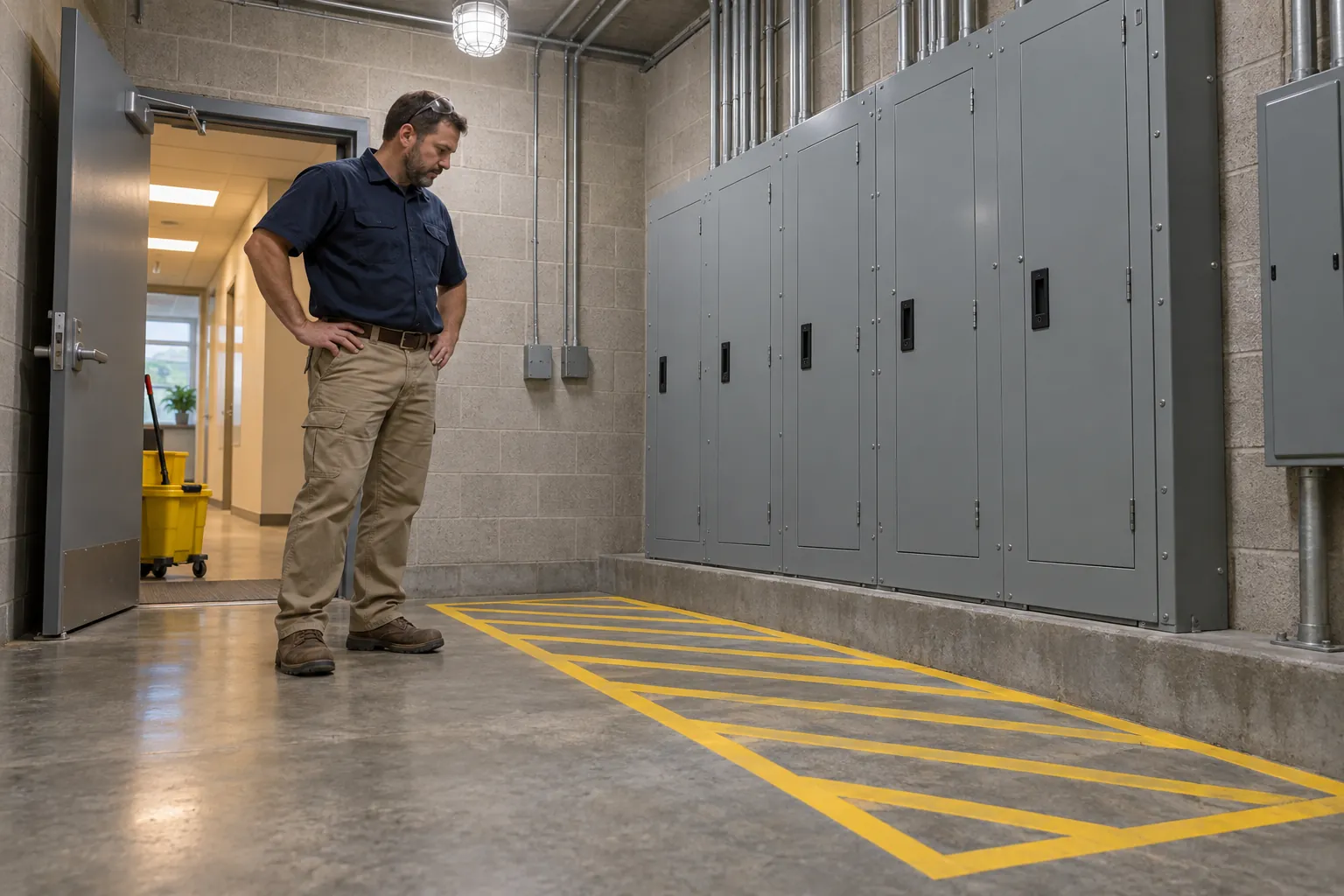 Premises and facilities managementElectrical panel clearance: the working space rules, and how to keep the space clearElectrical panel clearance under OSHA 29 CFR 1910.303(g) and NEC 110.26: the 36-inch depth, 30-inch width and headroom, why storage is out, and how to keep it clear.
 Fire and water checksSpace heaters in the workplace: the rules, a policy and the checksWhat the International Fire Code, OSHA and CMS say about space heaters at work, what a workplace space heater policy should cover, and how to check it.
 Fire and water checksWorkplace fire safety checklist: what to check, how often, and who does itA fire safety checklist for a US workplace: the daily, monthly and annual checks behind OSHA Subparts E and L and the local fire code, who does each, and the record.
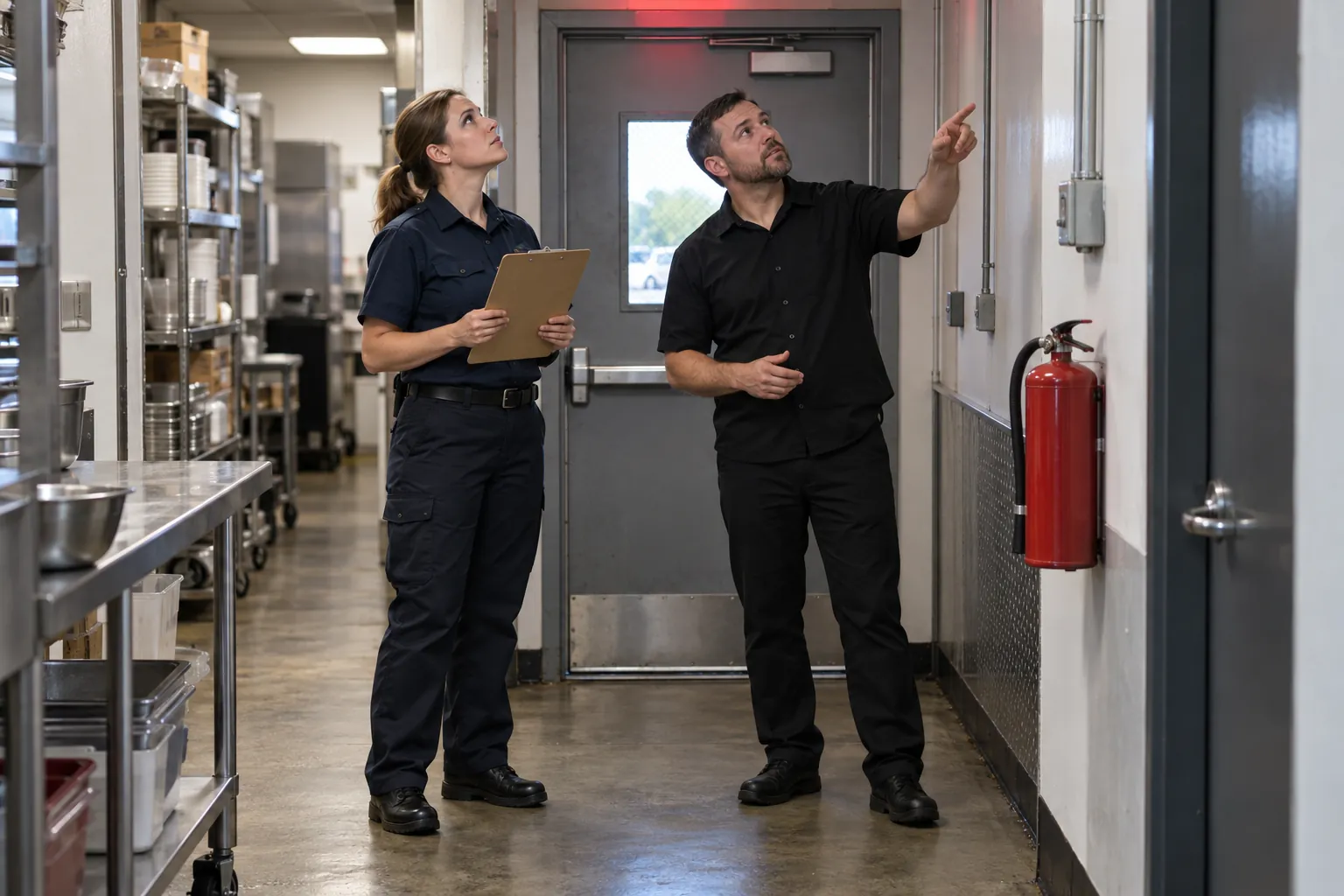 Fire and water checksFire inspection checklist: what the fire marshal looks at, and how to be readyA fire inspection checklist for US businesses: what the fire marshal checks, the records to have ready, who prepares what, and how to stay ready between visits.