Fire and water checks
Space heaters in the workplace: the rules, a policy and the checks
Space heaters are allowed in most workplaces under the fire code, as long as each one is listed, plugged directly into a wall receptacle and kept at least 3 feet from anything that can burn, while in hospitals and nursing homes only low-temperature models are allowed, and only in staff areas.
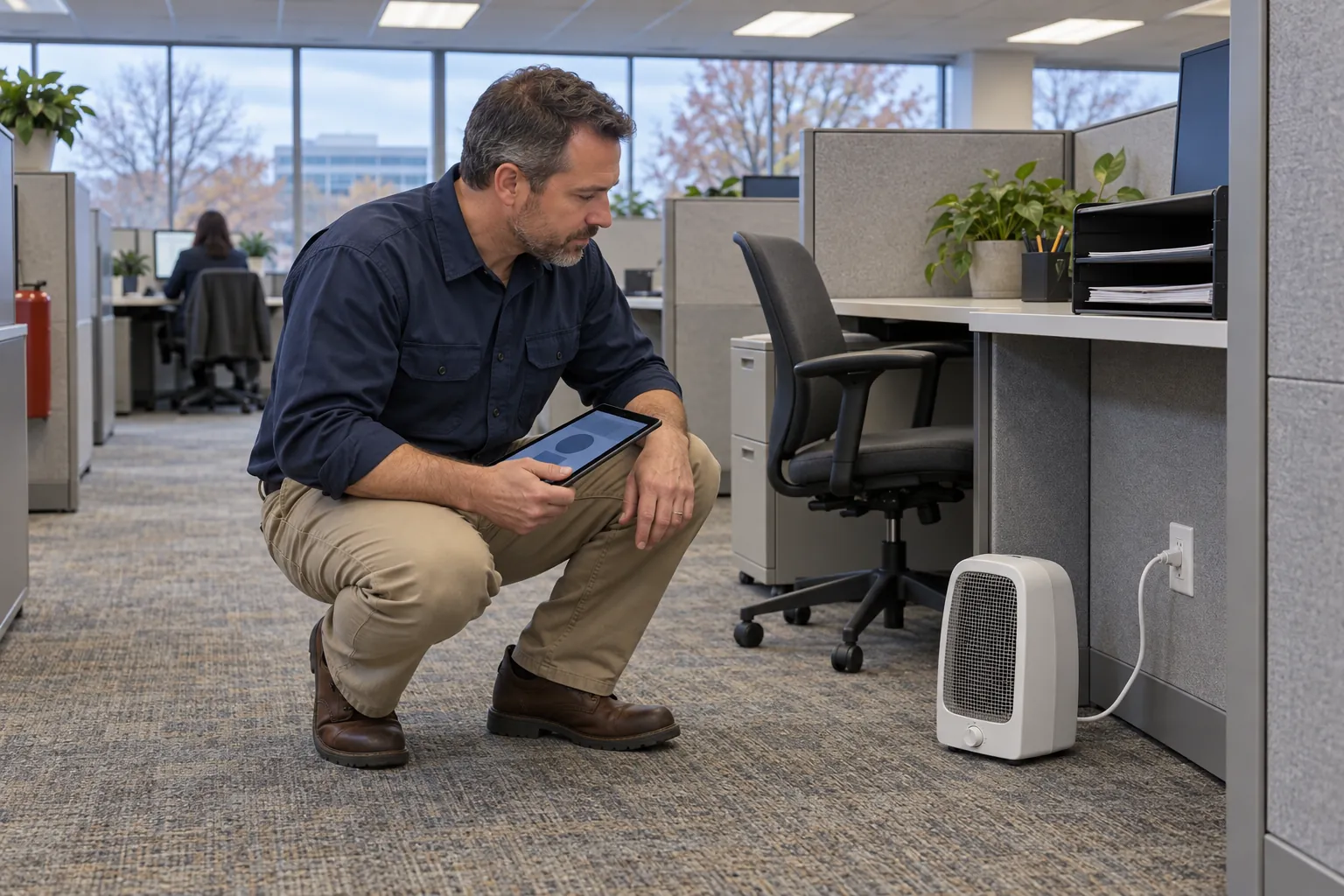
Every fall the space heaters come out: under the reception desk, beside the security post, in the corner office that the HVAC never quite reaches. Most are harmless. The ones that are not are plugged into a power strip, pushed against a stack of paper or a curtain, or left running in an empty room overnight. The International Fire Code sets the rules for portable electric space heaters, OSHA's electrical standard says listed equipment must be used as its listing instructs, and CMS holds hospitals and nursing homes to a stricter rule of its own. This guide covers what those rules say, what a workable space heater policy looks like, and how to check it on the rounds with a record that shows what was found.
01
What the fire code and OSHA say about space heaters
There is no single federal rule that bans or allows space heaters at work. The rules come from three places: the fire code your jurisdiction has adopted, OSHA's general industry electrical standard, and, for hospitals and nursing homes, the Life Safety Code that CMS enforces.
The International Fire Code. Most jurisdictions adopt a version of the International Fire Code (IFC), often with local amendments, and the authority having jurisdiction (AHJ), usually the fire marshal's office, enforces it. Which edition applies matters, because the space heater section has moved. In chapter 6 of the 2021 International Fire Code, section 603.9, headed "Portable, electric space heaters," says that "where not prohibited by other sections of this code, portable, electric space heaters shall be permitted to be used in all occupancies," subject to five rules:
- 603.9.1 Listed and labeled: "Only listed and labeled portable, electric space heaters shall be used."
- 603.9.2 Power supply: they "shall be plugged directly into an approved receptacle."
- 603.9.3 Extension cords: they "shall not be plugged into extension cords."
- 603.9.4 Prohibited areas: they "shall not be operated within 3 feet (914 mm) of any combustible materials" and "shall be operated only in locations for which they are listed."
- 603.9.5 Group I-2 occupancies and ambulatory care facilities: there, heaters are limited to "those having a heating element that cannot exceed a temperature of 212°F (100°C)," and "shall only be used in nonsleeping staff and employee areas."
The same five rules appear as section 604.10 in chapter 6 of the 2018 International Fire Code. In the 2024 edition the same five rules moved out of chapter 6 to section 4102.1 in chapter 41 of the 2024 International Fire Code, which says that "where not prohibited by other sections of this code, portable, electric space heaters shall be permitted to be used in all occupancies in accordance with Sections 4102.1.1 through 4102.1.5." The general electrical rules in chapter 6 of the 2024 International Fire Code also reach every heater: under 603.1.1, all electrical equipment, devices and appliances "shall be tested; listed and labeled; and installed, used and maintained in accordance with NFPA 70 and all instructions included as part of such listing"; under 603.2.1, damaged or modified appliances that are a shock or fire hazard "shall not be used until repaired or replaced"; and under 603.5.2, power strips (relocatable power taps) "shall be directly connected to a permanently installed receptacle." In chapter 3 of the 2024 International Fire Code, section 305.1 adds that "clearance between ignition sources, such as luminaires, heaters, flame-producing devices and combustible materials, shall be maintained in an approved manner." Ask your fire marshal's office which edition it enforces and whether it has amended these sections.
OSHA. For most private employers, 29 CFR 1910.303 says electrical equipment is acceptable only if approved, and that "listed or labeled equipment shall be installed and used in accordance with any instructions included in the listing or labeling." A heater used against its own instructions, for example on a power strip the instructions warn against, falls foul of that. 29 CFR 1910.334(a) requires portable cord-and-plug-connected equipment to be "visually inspected before use on any shift for external defects" (equipment that stays plugged in where it is put and is not exposed to damage need not be inspected until it is moved), and a damaged item that might injure someone "shall be removed from service." OSHA's 2002 letter on compliance requirements for relocatable power taps or "power strips" is direct: "Power strips are not designed for high power loads such as space heaters, refrigerators and microwave ovens, which can easily exceed the recommended ampere ratings on many power strips."
Hospitals and nursing homes. Facilities that take Medicare and Medicaid are surveyed against the 2012 Life Safety Code (NFPA 101). The CMS Fire Safety Survey Report, form CMS-2786R, sets out tag K781, Portable Space Heaters: "Portable space heating devices shall be prohibited in all health care occupancies. Unless used in nonsleeping staff and employee areas where the heating elements do not exceed 212 degrees Fahrenheit (100 degrees Celsius)," citing sections 18.7.8 and 19.7.8. In practice that means no heaters in patient or resident rooms, and only low-temperature models in staff areas.
02
Why the heaters appear, and where they cause trouble
A space heater under a desk is usually a sign of a building problem, not a personal preference. OSHA's 2003 letter reiterating its policy on office temperature and humidity says "OSHA has no regulations specifically addressing temperature and humidity in an office setting," but that it "recommends temperature control in the range of 68-76° F and humidity control in the range of 20%-60%." When an office, a guard booth or a front desk by a revolving door sits below that range, people bring heaters from home. A policy that only bans heaters, without fixing the cold spot, drives them under desks where nobody checks them.
Walk a building in the first cold snap and the same scenes turn up:
- Heater on a power strip or extension cord. The most common finding, and the one the 2002 OSHA letter and the 2021 IFC both address. The strip or cord feels warm; the plug may be discolored. See the guide to extension cord rules.
- Heater against combustibles. Under a desk against a trash can, paper files or a modesty panel, beside a curtain or a coat on a hook, or facing a cubicle fabric wall.
- Heater running in an empty room. Left on over a weekend, a holiday or overnight in an office, a classroom or a security post that is unstaffed between patrols.
- Heater in the wrong place. In a storage room, a janitor's closet with chemicals and paper goods, an electrical room, a restroom or a wet area it is not listed for, or in a corridor or doorway where it blocks the exit route. Under 29 CFR 1910.37(a)(3), "exit routes must be free and unobstructed. No materials or equipment may be placed, either permanently or temporarily, within the exit route."
- Unlisted or damaged heaters. No listing mark, a cracked housing, a missing guard, a frayed cord, or a two-prong adapter on a grounded plug.
- Fuel-burning heaters indoors. Propane and kerosene heaters brought into an office, a warehouse or a loading dock. These are a different hazard with their own rules; most workplace policies ban them outright inside the building unless the AHJ has approved a specific use.
- Heaters in patient or resident areas. In a hospital or nursing home, any heater in a room where patients or residents sleep, and any staff heater that is not a low-temperature model.
The U.S. Fire Administration's heating fire safety advice is written for homes but applies just as well at work: "Keep anything that can burn at least 3 feet from all heat sources including fireplaces, wood stoves, radiators, space heaters or candles," and "Turn space heaters off when leaving the room or going to bed."
03
Writing a space heater policy that people follow
A space heater policy should be short enough to fit on one page and specific enough that a custodian or security officer can apply it on a walk without calling a manager. Start from the fire code your AHJ enforces and your insurer's or landlord's requirements, then decide the points below.
- Allowed, restricted or banned. Some organizations ban personal heaters and fix the cold spots; others allow approved heaters in named areas. In a hospital or nursing home, the CMS rule decides most of this for you. Whatever you choose, say it in the first line.
- Approval before use. Heaters are approved by facilities, not brought in unannounced. The approval records the location, the model and the person responsible. Many organizations supply the heaters themselves, so every unit in the building is a known, listed model.
- What an approved heater must have. A listing mark, because the IFC allows "only listed and labeled" heaters. Most policies also require a tip-over switch, overheat protection, a thermostat and a guarded element, and ban heaters with exposed glowing elements. Fuel-burning heaters are excluded.
- How it is plugged in. Directly into a wall receptacle, never into a power strip, extension cord or multi-plug adapter, and never with a cheater plug on a grounded cord. If the heater trips a breaker, stop using it and call facilities; do not move it to another circuit.
- Where it may stand. At least 3 feet from anything that can burn, on the floor on a hard, level surface, clear of walkways and exit routes, and never in storage rooms, closets, electrical and mechanical rooms, restrooms, wet areas, or anywhere its listing does not cover.
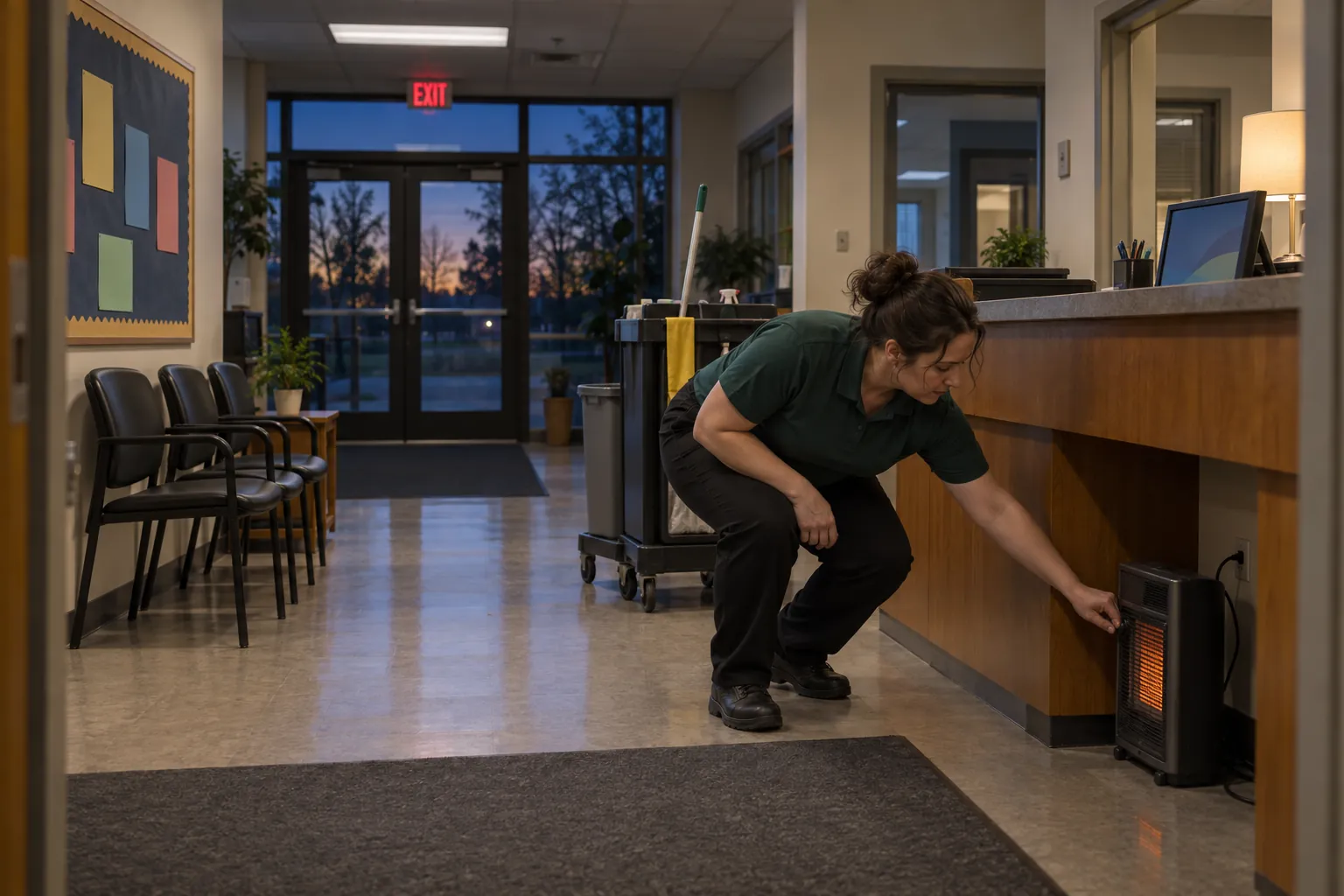
- When it is on. Only while the person responsible is in the room. Off, and preferably unplugged, when they leave, at the end of the day and before weekends and holidays.
- Who checks and what happens when it fails. Name who walks the building (custodians on the evening clean, security on the last patrol, the building engineer on the rounds), how often, and what they do with a heater that breaks the rules: switch it off, unplug it, tag it, report it, and who talks to the occupant.
- How the cold spot gets fixed. Every approved heater, and every heater removed, raises a work order to look at the HVAC in that area. The policy should aim to need fewer heaters each winter, not more.
In a multi-tenant office building, the lease and the building rules decide whose policy applies inside a suite. The property manager can publish building rules on space heaters and ask tenants to follow them, but a custodial crew or a security officer should not remove a tenant's heater without the authority to do so. Agree in advance what they do instead: switch it off where safe, photograph it, and report it to the property manager to take up with the tenant.
04
Checking space heaters: on the rounds, and at the end of the day
Neither the fire code nor OSHA sets a frequency for checking space heaters in a building. The IFC sets the rules a heater must meet, and 29 CFR 1910.334(a)(2)(i) requires portable cord-and-plug equipment to be visually inspected before use on any shift, though equipment that stays connected where it is put and is not exposed to damage need not be inspected until it is moved. The building check is yours to set. A pattern that works in most offices, schools and stores:
- Daily, at close. The last custodian, day porter or security officer through an area confirms that heaters are off and, where the policy says so, unplugged. This is the check that matters most, because a heater left on in an empty room is the scenario the USFA advice is written against.
- Weekly, on the rounds. A walk through offices, front desks, security posts, break rooms and classrooms, looking at each heater: listed, on a wall receptacle, 3 feet clear, not in an exit route, cord and plug undamaged, not warm at the outlet.
- At the first cold snap. A full sweep the week the weather turns, when unapproved heaters arrive, often alongside the building's winterization checklist.
- Before long closures. The day before a holiday weekend, winter break or a building shutdown, a check that every heater is off and unplugged.
A heater check fits easily into an existing workplace fire safety checklist or a monthly fire inspection checklist, because the inspector from the fire marshal's office will look at the same things: the heater, the cord, the power strip and what is stacked around them.
When a check finds a problem, act in proportion. A heater running too close to paper is moved and the occupant told. A heater on a power strip is unplugged and the occupant told why. An unlisted, damaged or fuel-burning heater is switched off, tagged out of use and reported, in line with IFC 603.2.1 and 29 CFR 1910.334(a)(2)(ii). A heater in a patient area is removed at once. In every case, a warm outlet, a scorched plug or a discolored power strip is reported to the building engineer or an electrician, because the damage may be in the wiring as well as the heater.
05
What a useful space heater record shows
None of the rules above prescribes a form for heater checks. But when a fire inspector writes a violation, a heater is found running on a Monday morning, or an insurer asks after a fire, the questions are the same: which heaters were approved, when each area was last checked, by whom, what was found and what was done about it. A useful record shows:
- A register of approved heaters: location, model, listing mark, the person responsible and the date approved.
- Where and when: the room, floor or post checked, and the date and time, recorded at the time rather than filled in at the end of the month.
- Who: the named person who did the check.
- What was found: nothing, or each issue in a few plain words, such as "heater on power strip under desk 3C" or "heater left on, room 214 empty at 7 p.m."
- A photograph of anything found, which settles later arguments about what it looked like and where it was.
- What was done: switched off, unplugged, tagged out, occupant told, property manager told, work order raised for the heating.
- When it was closed, and by whom, so a heater that was reported does not simply reappear the next day.
- End-of-day and pre-closure checks, recorded separately, because they answer the most important question: was the heater off when the building emptied?
06
Where the record fails, and what SiteClara does about it
Space heater checks fail in familiar ways. The policy was emailed in October and never checked. The evening custodian noticed a heater running in an empty office, switched it off and mentioned it to whoever was at the security desk, and nobody wrote it down. The monthly fire safety sheet has a tick beside "space heaters" in handwriting that matches every other tick, all made on the same afternoon. When the fire inspector finds a heater on a power strip behind reception, there is nothing to show when the area was last looked at or what happened the last time.
SiteClara puts a printed QR poster at each location where a check is scheduled, such as a front desk, a security post, a floor of offices or a classroom corridor, with an optional NFC tag behind it. Staff scan the code or tap the tag on their own phone, with no app to install, and sign in with a link. They see the checks due at that location, such as an end-of-day check that heaters are off, and mark each one done, or say what stopped them, such as a locked suite. A heater on a power strip, too close to paper or left running is reported there with a photo and goes onto the team's list of jobs until someone closes it.
The supervisor sees what is due, done and missed, and can record why a check was missed; a job that needs the building manager, such as a tenant's heater the crew has no authority to remove, can be escalated to them to answer. Each day the supervisor reviews and approves a report that goes to nominated management or client contacts at 8 a.m. the next morning, showing what was reported, completed and still open, and how the scheduled checks went, for example 12 of 12 completed.
07
Questions people ask
Are space heaters an OSHA violation?
Not in themselves: no OSHA standard bans space heaters at work. How one is used can be. Under 29 CFR 1910.303(b)(2), "listed or labeled equipment shall be installed and used in accordance with any instructions included in the listing or labeling," and OSHA's letter on compliance requirements for relocatable power taps or "power strips" says that "power strips are not designed for high power loads such as space heaters." A heater run on a power strip or against its own instructions is the usual problem.
What are the OSHA rules for heat in the workplace?
For offices, there is no temperature rule. OSHA's letter reiterating its policy on office temperature and humidity says "OSHA has no regulations specifically addressing temperature and humidity in an office setting," and that it "recommends temperature control in the range of 68-76° F and humidity control in the range of 20%-60%." A heater under a desk is often a sign that an area sits below that range.
Is it legal to have employees work with no heat?
In an office, OSHA does not set a minimum temperature. The same 2003 OSHA letter on office temperature and humidity says these conditions "are generally a matter of human comfort rather than hazards that could cause death or serious physical harm," and that "OSHA cannot cite the General Duty Clause for personal discomfort." Fixing the cold spot is still the best way to keep unapproved heaters out of the building.
Are space heaters a fire hazard in work cubicles?
They can be, because a cubicle puts paper, fabric walls and trash cans within reach of the heater. The U.S. Fire Administration's heating fire safety advice is to "keep anything that can burn at least 3 feet from all heat sources including fireplaces, wood stoves, radiators, space heaters or candles," and to "turn space heaters off when leaving the room or going to bed." In a cubicle, that means a clear 3 feet around the heater and switching it off whenever the desk is empty.
08
Where to read the rules, and a list to take away
The ICC publishes a free read-only view of the International Fire Code: the space heater section is 603.9 in chapter 6 of the 2021 edition 604.10 in the 2018 edition and 4102.1 in chapter 41 of the 2024 edition, with the general electrical rules in chapter 6 and the clearance rule in section 305.1. Ask your local fire marshal's office which edition and amendments it enforces, and whether it publishes a self-inspection checklist. OSHA publishes 29 CFR 1910.303 and 29 CFR 1910.334 on its own site with its letters of interpretation; in a State Plan state, read the state's electrical rules as well. Hospitals and nursing homes should read tag K781 in the CMS Fire Safety Survey Report alongside their accreditor's standards.
Before you sign off a space heater check, make sure that:
- every heater in the area is approved, listed and on the register, and no fuel-burning heater is in use indoors;
- each one plugs directly into a wall receptacle, never into a power strip, extension cord or adapter;
- each one stands at least 3 feet from anything that can burn, on the floor, clear of walkways and exit routes;
- none is in a storage room, closet, electrical or mechanical room, restroom or wet area, or in a patient or resident room;
- cords, plugs and housings are undamaged, and no outlet, plug or strip is warm or discolored;
- heaters are off, and unplugged where the policy says so, at the end of the day and before every closure;
- anything found was switched off, tagged or reported, the occupant or property manager was told, and a work order was raised for the cold spot;
- each check records where, when, who, what was found and what was done, with a photo of anything found.
Sources
Every document this guide quotes or links to, in the order it first cites them.
- Chapter 6 of the 2021 International Fire Code codes.iccsafe.org
- Chapter 6 of the 2018 International Fire Code codes.iccsafe.org
- Chapter 41 of the 2024 International Fire Code codes.iccsafe.org
- Chapter 6 of the 2024 International Fire Code codes.iccsafe.org
- Chapter 3 of the 2024 International Fire Code codes.iccsafe.org
- 29 CFR 1910.303 osha.gov
- 29 CFR 1910.334(a) osha.gov
- Compliance requirements for relocatable power taps or "power strips" osha.gov
- State Plans page osha.gov
- Fire Safety Survey Report, form CMS-2786R cms.gov
- Reiterating its policy on office temperature and humidity osha.gov
- 29 CFR 1910.37(a)(3) osha.gov
- Heating fire safety usfa.fema.gov
Related guides
 Fire and water checksExtension cords at work: what OSHA and the fire code allowWhat OSHA 29 CFR 1910.305 and 1910.334 and local fire codes say about extension cords at work: allowed uses, power strips, inspection before each shift.
 Fire and water checksWorkplace fire safety checklist: what to check, how often, and who does itA fire safety checklist for a US workplace: the daily, monthly and annual checks behind OSHA Subparts E and L and the local fire code, who does each, and the record.
 Fire and water checksFire inspection checklist: what the fire marshal looks at, and how to be readyA fire inspection checklist for US businesses: what the fire marshal checks, the records to have ready, who prepares what, and how to stay ready between visits.
 Premises and facilities managementWinterization checklist: getting a commercial building ready for freezing weatherA winterization checklist for commercial buildings: freeze protection, sprinklers, heating, roofs, snow and ice, when to check, who does it, and what to record.