Premises and facilities management
OSHA eyewash station requirements: the rule, the 10-second reach and the weekly flush
OSHA requires suitable facilities for flushing the eyes and body under 29 CFR 1910.151(c) wherever the eyes or body of any person may be exposed to injurious corrosive materials, and when it decides whether a station is suitable it may refer to ANSI/ISEA Z358.1, which calls for equipment reachable within 10 seconds, a 15-minute tepid flush and a weekly activation of every plumbed unit.
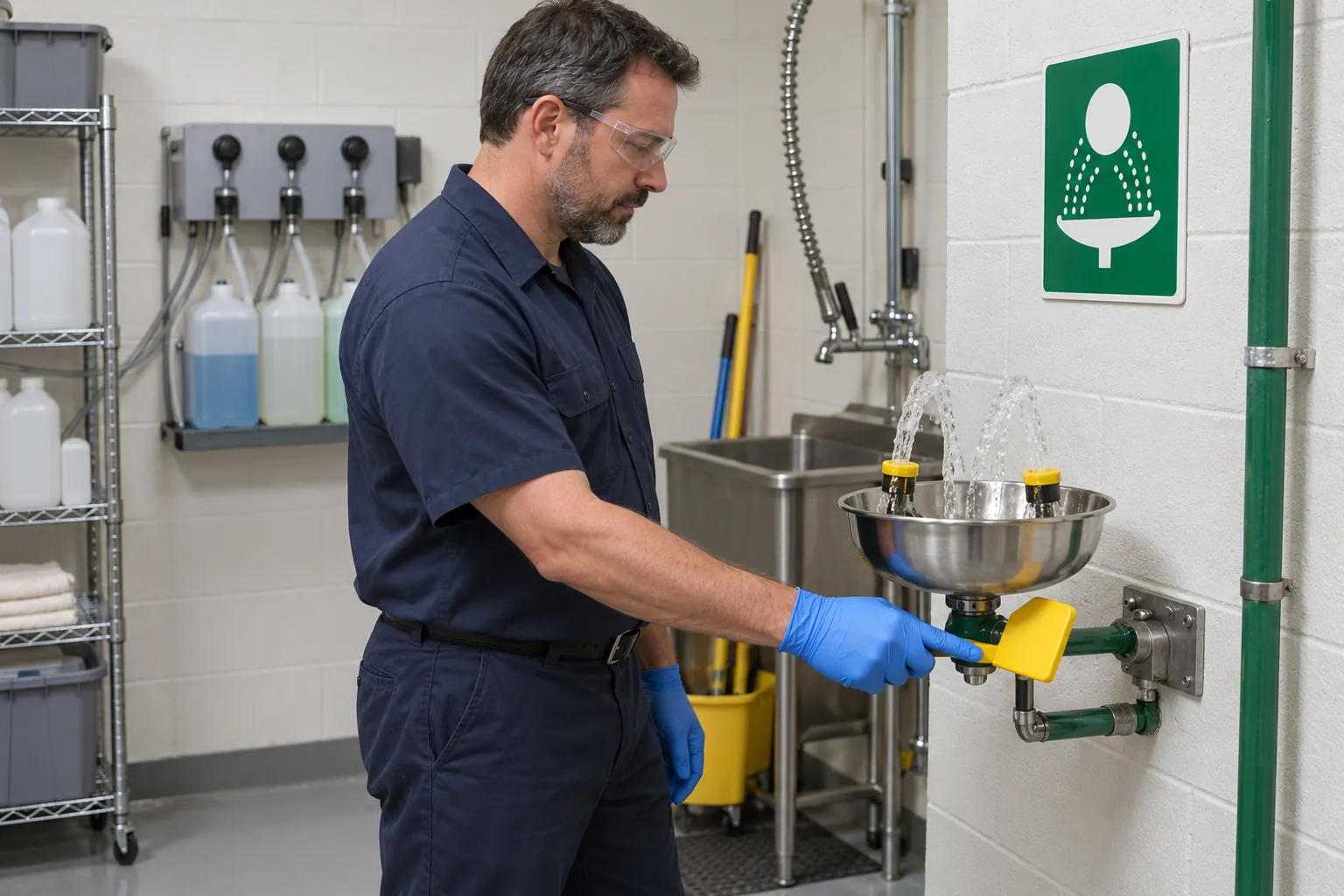
The federal rule is one sentence long. The detail that decides whether a station would actually help someone with a chemical splash in their eyes, and whether an inspector would call it suitable, sits in the consensus standard, in some state plans and in the manufacturer's instructions. This guide covers what each of them says, where a station has to go, what it must deliver, how often to check it, and what the weekly eyewash record should show.
01
The OSHA rule: 29 CFR 1910.151(c), and what "suitable" means
The federal requirement for general industry is paragraph (c) of 29 CFR 1910.151, Medical services and first aid: "Where the eyes or body of any person may be exposed to injurious corrosive materials, suitable facilities for quick drenching or flushing of the eyes and body shall be provided within the work area for immediate emergency use." The construction standard, 29 CFR 1926.50, Medical services and first aid (construction), repeats the same sentence word for word in paragraph (g).
Two other OSHA standards also call for eyewash facilities. OSHA's InfoSheet Health Effects from Contaminated Water in Eyewash Stations (OSHA 3818) lists them: HIV and HBV research laboratories and production facilities (1910.1030(e)(3)(i)), and workplaces where there is any possibility that an employee's eyes may be splashed with solutions containing 0.1 percent or more formaldehyde (1910.1048(i)(3)).
The OSHA text does not say what "suitable" means, how far away "within the work area" can be, or how often the equipment must be tested. For those, OSHA refers employers to a consensus standard it has not adopted.
ANSI/ISEA Z358.1. The American National Standard for Emergency Eyewash and Shower Equipment is published by the International Safety Equipment Association (ISEA). The current edition is ANSI/ISEA Z358.1-2014, reaffirmed in 2020 and written as Z358.1-2014 (R2020). ISEA's Emergency Eyewash & Shower Equipment page summarizes what it covers: flow rates, temperature, valves that open in one second or less, a 15-minute supply, installation within 10 seconds of the hazard, signage, testing and training. The standard itself is a paid document.
In a November 1, 2002 letter of interpretation on ANSI Z358.1 and 1910.151(c), OSHA explained how the two fit together. "ANSI standards become mandatory OSHA standards only if, and when, OSHA adopts them," and OSHA has not adopted Z358.1. But OSHA "has often referred employers to ANSI Z358.1 as a recognized source of guidance for protecting employees who are exposed to injurious corrosive materials," and when deciding whether facilities are suitable at a particular worksite, it "may refer to the most recent consensus standard." It adds that "If an eyewash or shower is considered to be unsuitable, a serious citation could be issued."
Your state. According to OSHA's State Plans page, "There are currently 22 State Plans covering both private sector and state and local government workers, and seven State Plans covering only state and local government workers." Some of them write the eyewash rule out in more detail than the federal sentence:
- California: Title 8, California Code of Regulations, section 5162, Emergency Eyewash and Shower Equipment covers substances that "can cause corrosion, severe irritation or permanent tissue damage or which is toxic by absorption," sets a 10-second reach, and requires plumbed units to be "activated at least monthly to flush the line and to verify proper operation."
- Washington: WAC 296-800-15030 and WAC 296-800-15035 cover "corrosives, strong irritants, or toxic chemicals," set the 10-second reach, and require that "plumbed emergency eyewashes and hand-held drench hoses are activated weekly" and that all plumbed facilities are "inspected once a year."
02
Where an eyewash station is required, and which kind
The trigger is the chemical in the workplace, not the type of building. The safety data sheet (SDS) for each product is where to start: under OSHA's hazard communication standard, Section 4 of every SDS, First-aid measures, must give a "Description of necessary measures, subdivided according to the different routes of exposure, i.e., inhalation, skin and eye contact, and ingestion" (29 CFR 1910.1200, Appendix D). If that section, or the hazard classification, points to corrosive damage to the eyes, the work area where the product is handled needs a suitable eyewash.
In an ordinary commercial building, the places that most often need one are where concentrated chemicals are opened, poured or mixed, not where ready-to-use products are simply stored:
- janitorial chemical rooms where concentrates are dispensed or diluted, including floor stripper and heavy-duty degreaser;
- battery charging areas for forklifts, floor scrubbers and other industrial trucks;
- pool and spa chemical rooms, and boiler or cooling tower water treatment areas;
- maintenance shops using acids, caustic cleaners or drain openers;
- laboratories, school science prep rooms and healthcare areas covered by the bloodborne pathogens or formaldehyde standards.
The ISEA's Emergency Eyewash & Shower Equipment: Selection, Installation & Use Guide (2024) describes the main types of equipment and what each must deliver under Z358.1-2014 (R2020):
- Eyewash, plumbed or self-contained: flushes both eyes at once, at no less than 0.4 gallons per minute for 15 minutes.
- Eye/face wash: a wider stream of at least 3.0 gallons per minute that covers the eyes and face.
- Emergency shower: at least 20 gallons per minute over the body, where more than the eyes may be splashed.
- Drench hose and personal wash unit: supplementary only. The guide says personal wash units "are not replacements for ANSI/ISEA Z358.1-2014 (R2020) compliant emergency eyewashes and showers, but supplement their use."
Whatever the type, the valve matters as much as the flow. In a 1993 letter of interpretation on faucet-mount emergency eyewash units, OSHA said "The flow valve must be simple to operate and must go 'on' in 1 second or less and remain 'on' during the eyewash procedure," and that whether a faucet-mount unit meets 1910.151(c) is decided case by case. A sink faucet or a hose is not an eyewash: California's section 5162 says so directly: "Water hoses, sink faucets, or showers are not acceptable eyewash facilities."
03
Where it must be located: 10 seconds, the same level and a clear path
Z358.1 sets the reach by time, not distance. The ISEA guide's annual inspection checklist asks whether the equipment can "be reached in 10 seconds when traveling from the location of the hazard," whether it is "on the same level as the hazard," and whether the path to it is "free of obstructions." The guide puts the distance most able-bodied people cover in 10 seconds at about 55 feet, and says special consideration should be given to employees with disabilities and to work areas with highly injurious materials. Washington's rule adds a note that "The travel distance to an emergency washing facility should be no more than fifty feet (15.25 meters)."
In practice that means measuring from where the chemical is actually handled, walking the route as someone who cannot see well would have to, and asking what could block access on a busy day:
- Same floor. A station up or down a flight of stairs is not on the same level as the hazard, however close it is on the plan.
- A clear route. Carts, pallets, mop buckets and supply deliveries are the usual obstructions in a janitor closet or a loading area. California requires the area of the equipment to be "maintained free of items which obstruct their use."
- Seen and lit. The checklist asks "Is there a highly visible sign indicating location of equipment?" and "Is the area around the equipment well-lit?" The ISEA guide adds that the owner "should correct any and all situations that prevent a clear path to reach the equipment and ensure that the area remains well-lit and is easily identifiable."
Temperature belongs to location too. Z358.1 requires flushing fluid at a safe, tepid temperature so that an injured person can bear the full 15 minutes, and the ISEA guide gives the acceptable range as 60 to 100°F (16 to 38°C). A unit on an unheated dock or in a parking garage needs freeze protection, and one in a hot mechanical room may deliver water that is too hot.
04
How often: the weekly activation, the annual inspection and self-contained units
Federal OSHA sets no test interval. The interval comes from Z358.1, from a state plan where it has one, and from the manufacturer's instructions.
Weekly, for plumbed units. The ISEA guide summarizes the standard: "Plumbed devices must be tested weekly for a period long enough to verify operation and to ensure that flushing fluid is available." The weekly activation is not a full 15-minute flow test. Its purpose is to get water to the head, clear sediment from the supply line and flush out water that has been standing in the "dead leg" between the last circulating pipe and the unit, so how long to run it depends on how much pipe and how much unit there is. Washington makes the weekly activation a legal requirement for plumbed eyewashes and drench hoses; California's legal minimum is monthly, which is less often than Z358.1 calls for.
Why it matters. OSHA's InfoSheet on contaminated water in eyewash stations explains that "Water found in improperly maintained eyewash stations is more likely to contain organisms (e.g., Acanthamoeba, Pseudomonas, Legionella) that thrive in stagnant or untreated water and are known to cause infections," and that a worker whose eye is already injured by a chemical is more susceptible. It adds that manufacturer instructions say how often and how long to activate each plumbed system, and generally reference Z358.1-2014.
Annually, for every unit. In the ISEA guide's words, "All equipment must be inspected annually to ensure the device conforms to installation requirements," plumbed and self-contained alike. The annual inspection goes further than the weekly flush: installation to the manufacturer's instructions, the 10-second reach, the same level, a clear path, signage and lighting, the spray pattern, tepid water, the flow rate and a valve that stays open hands-free. Washington requires plumbed facilities to be inspected once a year and self-contained units to be checked for proper operation once a year.
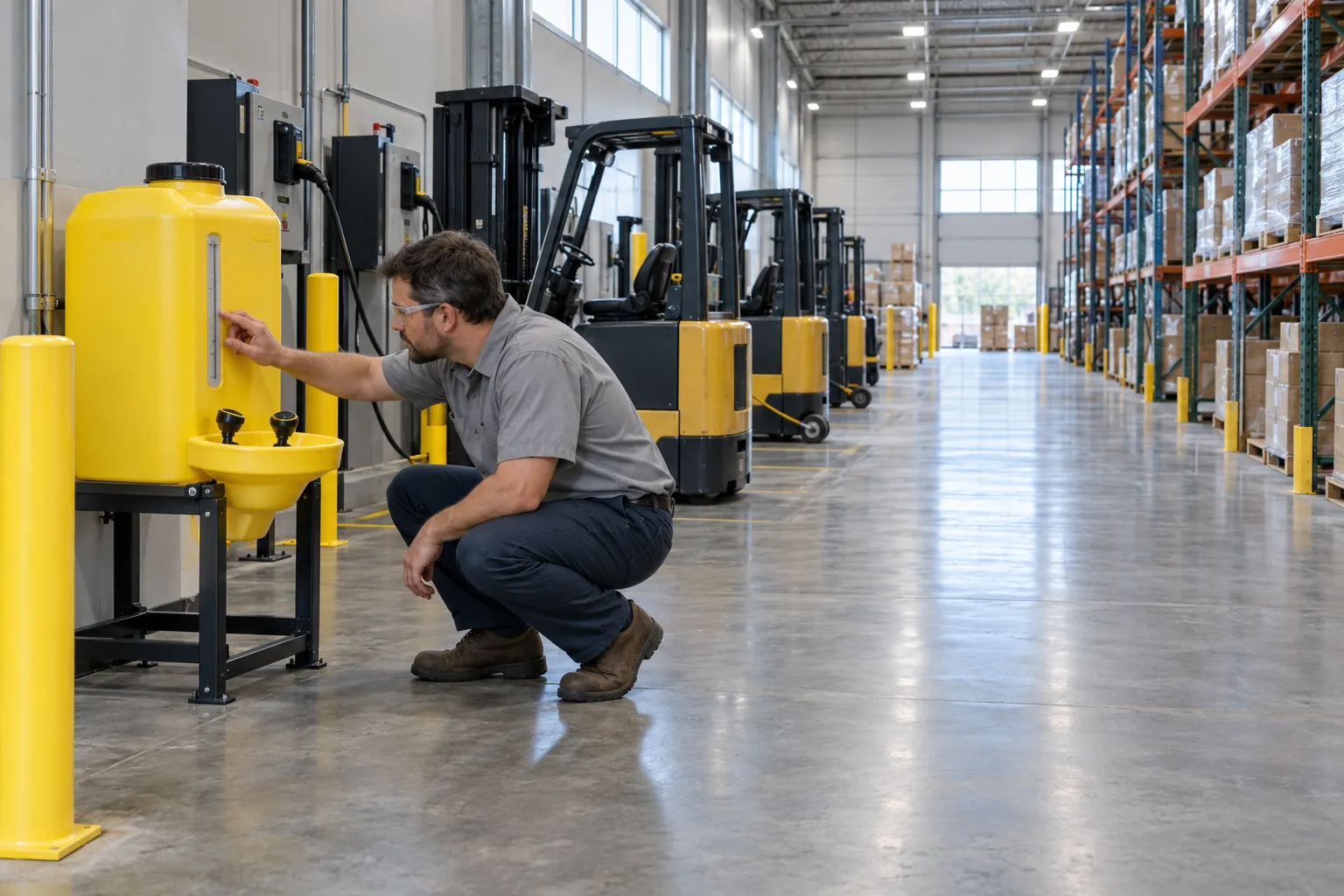
Self-contained and personal units. These cannot be flushed every week without emptying them, so they are checked visually to the manufacturer's instructions, which matter especially here because the care criteria vary with the flushing fluid: the fluid level, the seal, the expiration date of the cartridge or preservative, and the cleanliness of the unit. Washington requires that "Sealed personal eyewashes must be replaced after the manufacturer's expiration date," and notes that most manufacturers recommend replacing fluid in open self-contained units every six months and sealed containers typically every two years.
05
A weekly eyewash inspection checklist, and what the record should show
The weekly check takes a minute or two per unit and can be done by a custodian, a building engineer or a maintenance technician who has been shown what good looks like. For a plumbed eyewash or eye/face wash:
- Approach. The route from the chemical area is clear, the unit is on the same level, the sign can be seen and the area is lit.
- Covers. The dust covers are on the heads and pop off when the water flows. The ISEA guide says dust covers "are required to prevent build-up of particulates, which could enter the eye."
- Activation. One push of the paddle or pull of the handle starts the flow within a second, and it stays on without holding it.
- Flow. Water reaches both heads, the streams look even and rise to a similar height, and the water runs clear before you shut it off.
- Temperature. The water feels neither cold nor warm; where there is a mixing valve, any fault goes to the building engineer.
- Condition. No leaks, corrosion, missing parts or bowl full of debris, and the drain or catch basin copes with the water.
- Report. Anything wrong is reported the same day and the unit is marked out of use until it is fixed, with people told where the nearest working one is.
For a self-contained unit, swap activation and flow for the fluid level, the seal and the expiration date, and write the date down.
A tag of initials on the unit shows little and disappears when the unit is replaced. Whatever form the record takes, the ISEA guide advises that "Site evaluation and testing results should be recorded and maintained." It should answer these questions without anyone having to remember:
- Which unit: its location and type, matched to a list of every eyewash and shower in the building.
- When: the date and time of each weekly activation and each annual inspection.
- Who: the name of the person who did it.
- What was found: flow, clear water and temperature for plumbed units; fluid level and expiration date for self-contained ones.
- What was wrong, and what was done: the fault, who was told, when the unit was out of use and when it was fixed.
Training is part of the standard too: the ISEA's Emergency Eyewash & Shower Equipment page says "employee instruction and training is required." Anyone who handles the chemical should have seen the valve opened, know the way to the nearest unit without thinking, and know to start flushing immediately and keep going for the full 15 minutes.
06
Where the record fails, and what SiteClara does about it
Eyewash checks fail quietly. The tag is initialed for every week in the same pen. The janitor closet station is behind the floor machine again, the dust covers went missing in the spring, and the unit in the battery charging area has not been run since March. Nobody notices until the day someone needs it and the first water out is brown.
SiteClara puts a printed QR poster at each eyewash location, with an optional NFC tag behind it. Staff scan the code or tap the tag on their own phone, with no app to install. They see the checks due at that location, such as the weekly eyewash activation, and mark each one done, or say what stopped them, such as a locked room. A problem, such as a valve that will not stay open, a blocked route or missing dust covers, is reported there with a photo and goes onto the team's list of jobs until someone closes it.
The supervisor sees what is due, done and missed, and can record why a check was missed; a job that needs the building manager can be escalated to them to answer. Each day the supervisor reviews and approves a report that goes to nominated management or client contacts at 8 a.m. the next morning, showing what was reported, completed and still open, and how the scheduled checks went, for example 9 of 9 eyewash checks completed.
07
Questions people ask
What is the OSHA rule for eye wash stations?
Under 29 CFR 1910.151(c), wherever the eyes or body of any person may be exposed to injurious corrosive materials, the employer must provide "suitable facilities for quick drenching or flushing of the eyes and body" within the work area for immediate emergency use. The rule does not define suitable; OSHA's 2002 letter of interpretation on ANSI Z358.1 and 1910.151(c) says it may refer to the most recent consensus standard when it decides.
Where must an eyewash station be located?
Where it can be reached in no more than 10 seconds from the hazard, on the same level and along a path free of obstructions. The ISEA's Emergency Eyewash & Shower Equipment: Selection, Installation & Use Guide puts 10 seconds at approximately 55 feet for most able-bodied people, and Washington's WAC 296-800-15030 notes that the travel distance should be no more than fifty feet.
How often do eyewash stations need to be inspected?
Plumbed eyewash stations should be activated weekly and every unit inspected once a year, under ANSI/ISEA Z358.1-2014 (R2020). Federal OSHA sets no interval, but Washington's WAC 296-800-15035 makes weekly activation and a yearly inspection law, and California's section 5162 requires plumbed units to be activated at least monthly.
Does OSHA require eyewash stations to be flushed weekly?
Not in the federal text: 29 CFR 1910.151(c) says nothing about testing. The weekly flush comes from ANSI/ISEA Z358.1, which OSHA uses as guidance when deciding whether facilities are suitable, and from state plans such as Washington's.
Are portable eyewash stations OSHA approved?
The OSHA rule names no products: it asks for suitable facilities, and when OSHA decides whether they are suitable it may refer to ANSI/ISEA Z358.1. The ISEA's Selection, Installation & Use Guide describes self-contained eyewash units, fixed or portable, as designed to provide a continuous 15-minute flow, and treats personal wash units such as bottles as supplemental because they cannot keep up a 15-minute supply. California's section 5162 says personal eyewash units "may support plumbed or self-contained units but shall not be used in lieu of them." In a 2020 letter of interpretation on eyewash for bloodborne pathogen exposures, OSHA found that "four-ounce bottles are insufficient to meet the requirement that blood or OPIM be flushed from the eyes."
08
Where to read more, and a list to take away
Start with 29 CFR 1910.151 and OSHA's 2002 letter of interpretation on ANSI Z358.1. The ISEA's free Emergency Eyewash & Shower Equipment: Selection, Installation & Use Guide summarizes ANSI/ISEA Z358.1-2014 (R2020) and includes an annual inspection checklist; the standard itself is sold by ISEA and ANSI. OSHA's InfoSheet OSHA 3818 explains why the weekly flush matters. In a State Plan state, read that state's rule too, such as California's Title 8 section 5162, and then the manufacturer's instructions for each unit.
An eyewash station checklist to take away:
- list every eyewash, eye/face wash, shower and drench hose in the building, with its location and type;
- check each chemical's safety data sheet, and put a suitable unit wherever corrosive products are handled;
- walk the route from each hazard: no more than 10 seconds, the same level, a clear path, a visible sign and good light;
- activate every plumbed unit weekly until the water runs clear, and look over every self-contained unit on the same round;
- replace self-contained fluid and sealed bottles by their dates, and treat bottles as a supplement only;
- have every unit inspected once a year against Z358.1, including flow, spray pattern and tepid water;
- record who checked which unit, when, what they found and what was fixed, every week;
- show everyone who handles the chemicals where the nearest unit is and how to use it for the full 15 minutes.
Sources
Every document this guide quotes or links to, in the order it first cites them.
- 29 CFR 1910.151, Medical services and first aid osha.gov
- 29 CFR 1926.50, Medical services and first aid (construction) osha.gov
- Health Effects from Contaminated Water in Eyewash Stations (OSHA 3818) osha.gov
- Emergency Eyewash & Shower Equipment safetyequipment.org
- November 1, 2002 letter of interpretation on ANSI Z358.1 and 1910.151(c) osha.gov
- State Plans osha.gov
- Title 8, California Code of Regulations, section 5162, Emergency Eyewash and Shower Equipment dir.ca.gov
- WAC 296-800-15030 app.leg.wa.gov
- WAC 296-800-15035 app.leg.wa.gov
- 29 CFR 1910.1200, Appendix D osha.gov
- Emergency Eyewash & Shower Equipment: Selection, Installation & Use Guide safetyequipment.org
- 1993 letter of interpretation on faucet-mount emergency eyewash units osha.gov
- 2020 letter of interpretation on eyewash for bloodborne pathogen exposures osha.gov
Related guides
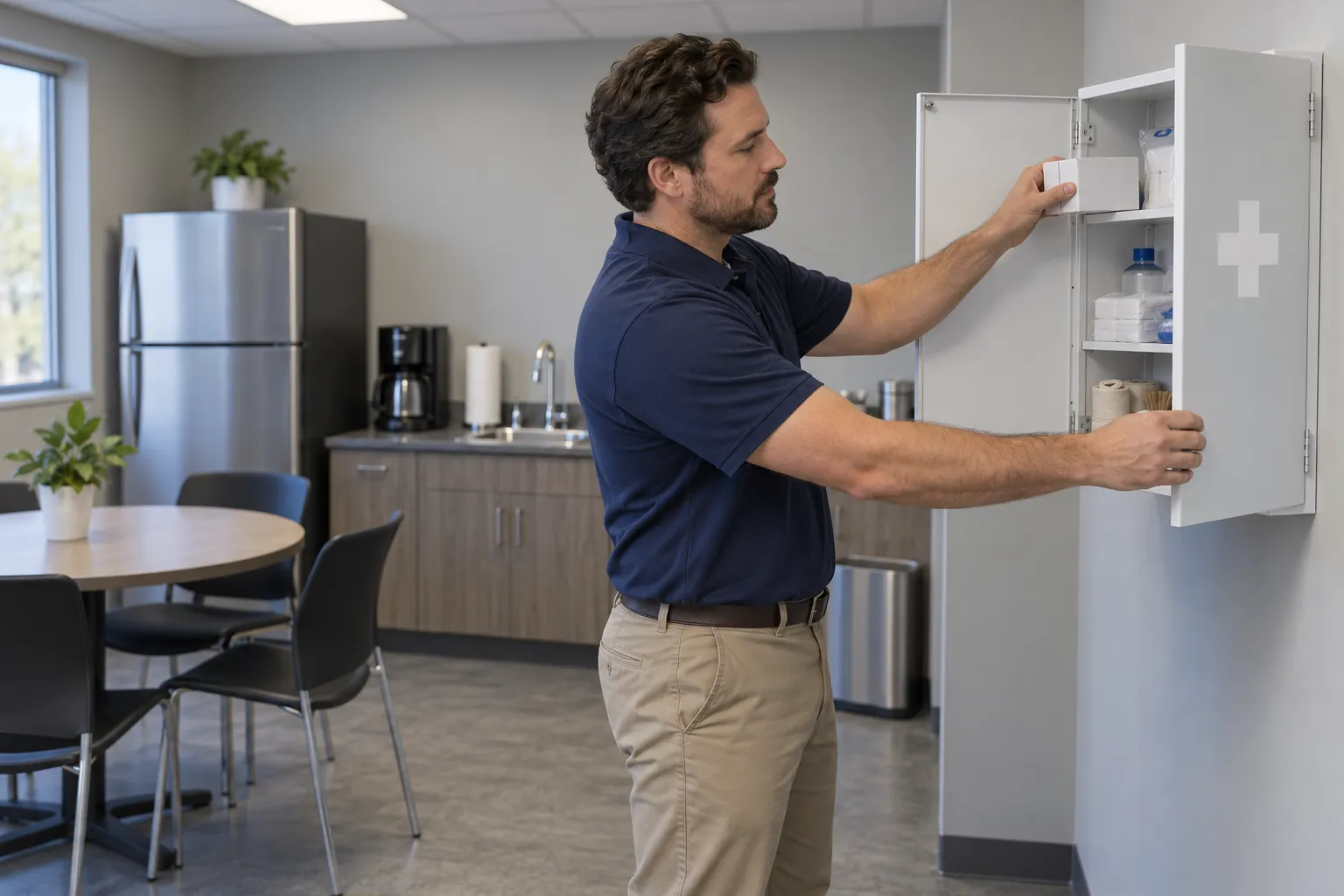 Premises and facilities managementOSHA first aid kit requirements: what the rule says, what goes in the kit and how to keep it stockedOSHA first aid kit requirements under 29 CFR 1910.151(b) and 1926.50, the ANSI/ISEA Z308.1 kit, Cal/OSHA's rules, how often to check a kit and what to record.
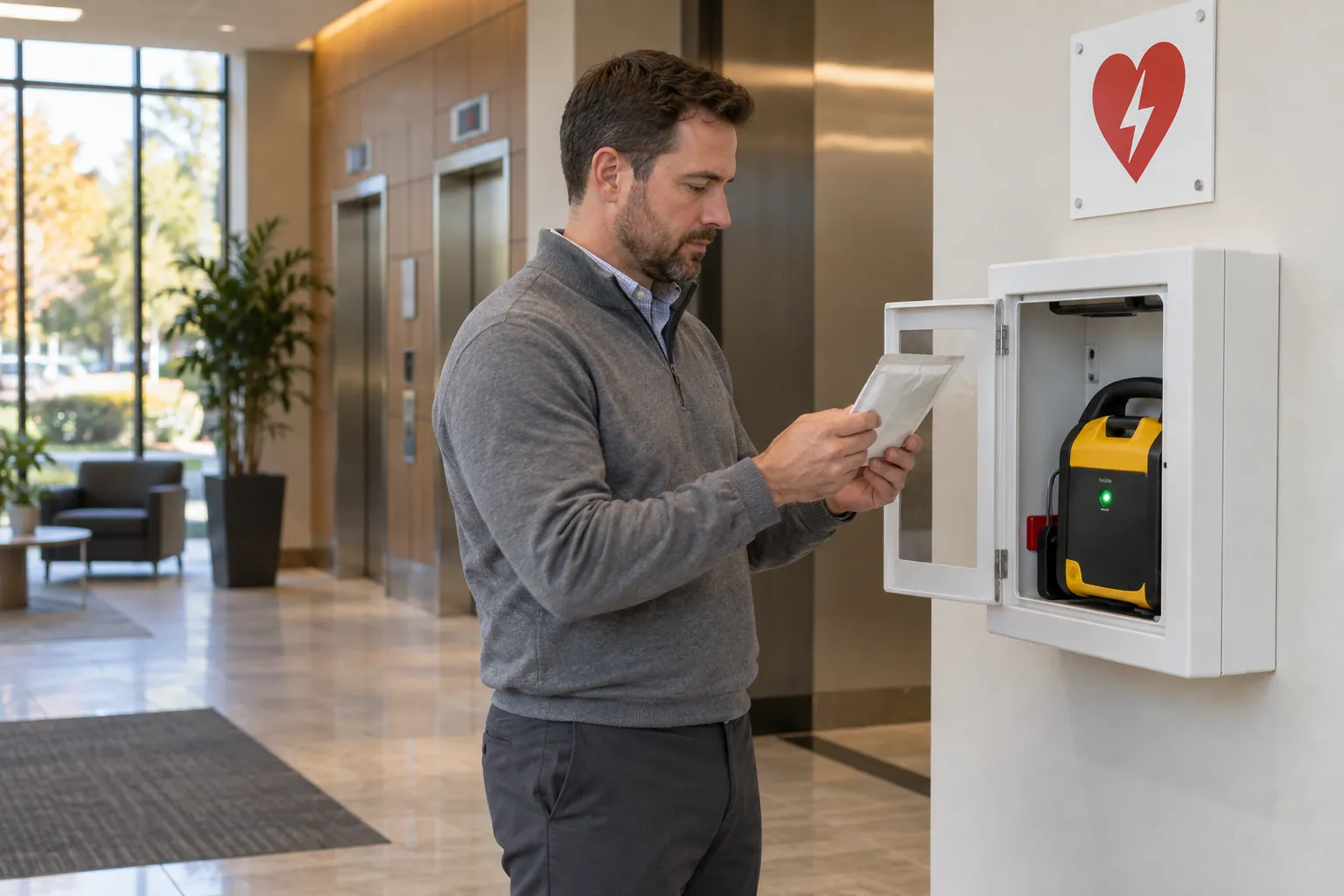 Premises and facilities managementAED inspection checklist: keeping a defibrillator ready to useAn AED inspection checklist for US workplaces: the status light, pads, battery and cabinet, how often to check, state rules such as California's, and what to record.
 CleaningChemical dilution control: getting the mix right, every bottle, every shiftHow a chemical dilution control system works, what OSHA HazCom and EPA labels require, how to check dispensers and bottles, and what the record should show.
 CleaningJanitorial closet requirements: the sink, the chemicals and the daily checkWhat US codes and OSHA require of a janitorial closet: the service sink, chemical storage, SDS, eyewash, clear panels and housekeeping, and a routine closet check.