Premises and facilities management
OSHA first aid kit requirements: what the rule says, what goes in the kit and how to keep it stocked
OSHA's first aid kit requirement for general industry, 29 CFR 1910.151(b), is one sentence: where there is no infirmary, clinic or hospital in near proximity to the workplace, someone must be adequately trained to render first aid and "adequate first aid supplies shall be readily available," with the voluntary ANSI/ISEA Z308.1 standard as OSHA's example of what a basic kit should hold.
Also written for United Kingdom · Ireland · Canada · Australia · New Zealand · South Africa
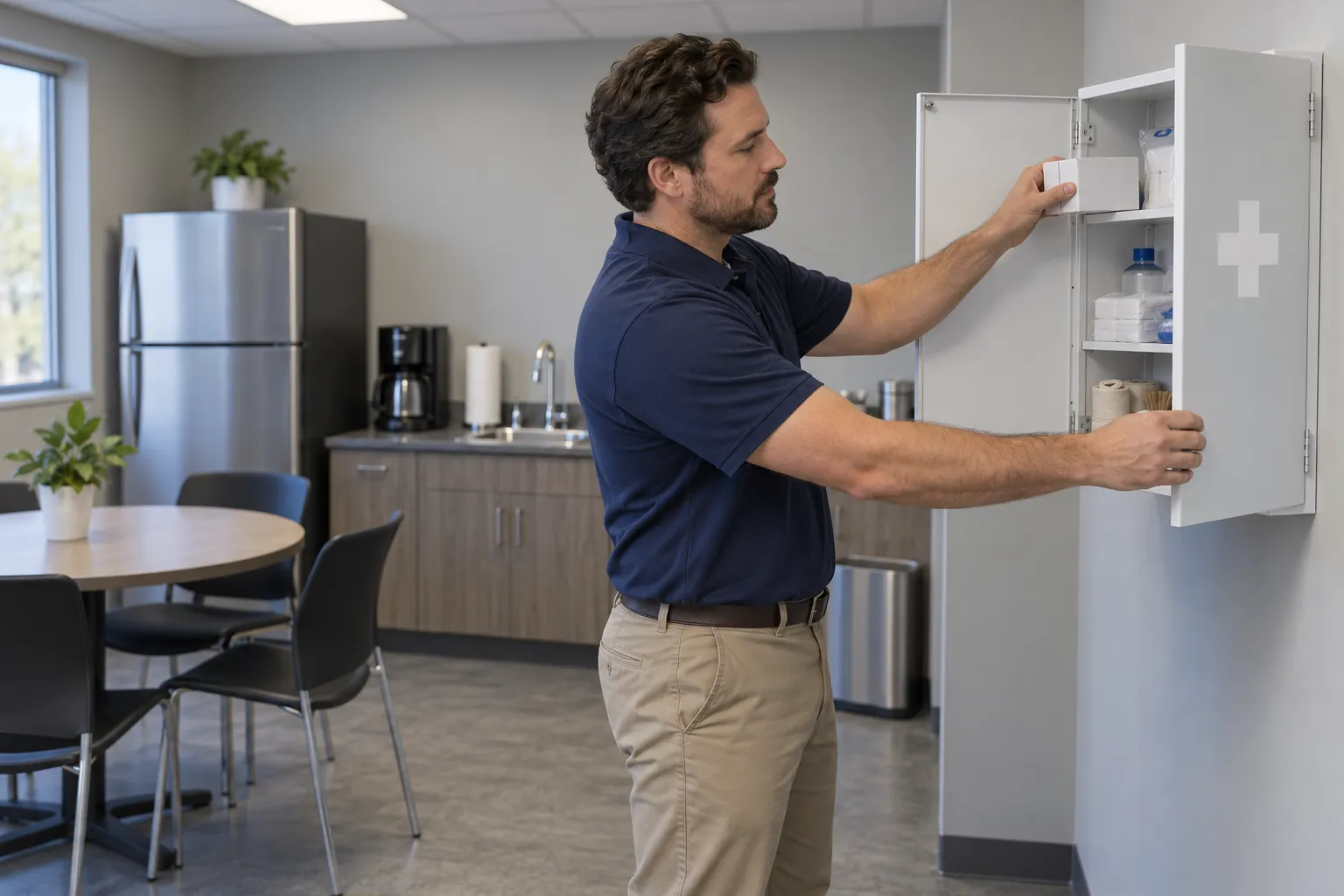
The rule sets no item list and no inspection interval for most workplaces. Construction is different: 29 CFR 1926.50 requires the kit to be checked before each job and at least weekly. California and other state plans add their own wording. This guide covers what each rule says, what a workplace kit should contain, how many kits a building needs and where, how often to check and restock them, and what the record should show.
01
The OSHA rule: 29 CFR 1910.151(b) and 1926.50(d)
For most workplaces, the first aid requirement of federal OSHA, the Occupational Safety and Health Administration in the U.S. Department of Labor, is 29 CFR 1910.151, Medical services and first aid. Paragraph (b) reads: "In the absence of an infirmary, clinic, or hospital in near proximity to the workplace which is used for the treatment of all injured employees, a person or persons shall be adequately trained to render first aid. Adequate first aid supplies shall be readily available." It does not list contents, set a number of kits or say how often they must be checked.
OSHA's detail is in Appendix A to 1910.151, First aid kits (Non-Mandatory): "An example of the minimal contents of a generic first aid kit is described in American National Standard (ANSI) Z308.1-1998," which "should be adequate for small worksites," while larger or multiple operations should decide whether they need more kits and more supplies. Employers "should assess the specific needs of their worksite periodically and augment the first aid kit appropriately," using the OSHA 300 log, 301 reports or other records.
Construction has a firmer rule. Under 29 CFR 1926.50, Medical services and first aid, supplies "shall be easily accessible when required," and paragraph (d)(2) says the contents "shall be placed in a weatherproof container with individual sealed packages for each type of item, and shall be checked by the employer before being sent out on each job and at least weekly on each job to ensure that the expended items are replaced." Its Appendix A to 1926.50 (Non-Mandatory) points to the 1978 edition of ANSI Z308.1.
02
State plans, and Cal/OSHA's first aid kit rules
According to OSHA's State Plans page, there are currently 22 state plans covering both private sector and state and local government workers, and seven covering only state and local government workers. A state plan can be stricter than federal OSHA, so check your own state's rule.
California's first aid kit requirements start with Title 8, section 3400, Medical Services and First Aid, in the General Industry Safety Orders, which says more about supplies than the federal rule. Subsection (c) requires "adequate first-aid materials, approved by the consulting physician, readily available for employees on every job," and adds: "Such materials shall be kept in a sanitary and usable condition. A frequent inspection shall be made of all first-aid materials, which shall be replenished as necessary."
For construction, line crews and other short or transient jobs, Title 8, section 1512, Emergency Medical Services, requires at least one kit in a weatherproof container, whose contents "shall be inspected regularly to ensure that the expended items are promptly replaced." It is the one rule here that lists minimum contents: unless an employer-authorized, licensed physician sets them, a table does, by crew size (1 to 5, 6 to 15, 16 to 200 and over 200), from adhesive dressings, gauze, triangular bandages, tweezers and scissors for all to portable oxygen for the largest. Subsection (c)(3) bars drugs, antiseptics, eye irrigation solutions and medicines from the kit "unless specifically approved, in writing, by an employer-authorized, licensed physician."
03
What goes in the kit: ANSI/ISEA Z308.1 and your own hazards
The benchmark for kit contents is ANSI/ISEA Z308.1, the American National Standard for Minimum Requirements for Workplace First Aid Kits and Supplies, published by the International Safety Equipment Association (ISEA). OSHA's April 18, 2002 letter clarifying 1910.151 explains that "ANSI standards become mandatory OSHA standards only when, and if, they are adopted by OSHA; ANSI Z308.1, Minimum Requirements for Workplace First Aid Kits, was not adopted by OSHA," but that "OSHA has often referred employers to ANSI Z308.1 as a source of guidance for the minimum requirements for first aid kits."
OSHA's appendices name old editions. The current edition, according to ISEA's page on ANSI/ISEA Z308.1-2026, "establishes minimum requirements for kit contents, classification, labeling, and performance across a variety of work environments." ISEA lists what is new in it: "bilingual English and Spanish first aid guides, and clearer criteria for arterial tourniquets" among the minimum kit requirements, and expanded guidance on supplemental supplies "including naloxone and anti-choking devices," on mobile workers, on hazard assessment and on first aid training. The 2015 edition introduced Class A and Class B kits, and the 2021 edition made a foil blanket mandatory. The standard is a paid document, so ask your supplier which edition and class a kit is labeled to meet.
A labeled kit is a starting point. Typical workplace kits hold:
- Wound care: adhesive bandages, sterile gauze pads, roller and triangular bandages, adhesive tape and wound-cleaning wipes.
- Bleeding control: trauma pads and, depending on the kit, a tourniquet; some sites keep a separate bleeding control kit beside it.
- Burns and eyes: burn dressings, eye pads and eye wash or eye covering. A bottle of eye wash is not an emergency eyewash station, which has its own requirement under 1910.151(c); see eyewash station requirements.
- Protection for the first aider: exam gloves, a CPR breathing barrier and, as Appendix A notes, the protective equipment 1910.1030(d)(3) requires when exposure to blood is reasonably anticipated.
- General supplies: cold packs, a foil blanket, scissors or shears, and a first aid guide.
Then add what your own hazards call for. OSHA's 2007 letter says "OSHA allows employers to provide first aid supplies specific to the needs of their workplace." A kitchen needs more burn dressings, a warehouse more trauma supplies, and a building with a fitness center or a large public area should consider an AED alongside the kit (see the AED inspection checklist).
04
How many kits, and where to put them
OSHA sets no ratio of kits to employees. Its 2002 letter says 1910.151(b) "does not specifically address the placement of first aid kits and/or cabinets based on employee numbers, density, or geography," so "it is the employer's responsibility to assess the particular needs of the workplace and tailor first aid kits and their placement to the specific needs of the workplace."
"Readily available" is not defined either, but the letter says the first aid provider "must be able to quickly access the first aid supplies" and "generally should not have to travel through several doorways, hallways and/or stairways to access first aid supplies."
In its January 16, 2007 letter on first aid, CPR and bloodborne pathogens, OSHA said it "has long interpreted the term 'near proximity' to mean that emergency care must be available within no more than 3-4 minutes from the workplace" where serious accidents such as falls, electrocution or amputation are possible, and that up to 15 minutes "may be reasonable in workplaces, such as offices," where such injuries are more remote.
In a multi-story office building, a school or a campus, that usually means:
- a kit on every floor and in every wing or building, where people pass rather than in a locked office;
- an additional kit wherever the risks are higher: the loading dock, the kitchen, the engineering shop, the custodial closet where chemicals are mixed;
- a kit in every company vehicle and with every mobile crew, such as patrol officers and maintenance technicians;
- a sign showing where the kit is, and the location written into the emergency action plan and new-hire orientation;
- kits that can be reached on every shift, including nights and weekends.
05
How often to check a first aid kit, and how to restock it
The interval depends on the rule that applies to you:
- Federal general industry (1910.151): no interval is set. Appendix A asks for periodic reassessment of needs, and OSHA's 2002 letter advises that you "periodically assess your kit and increase your supplies as needed."
- Federal construction (1926.50(d)(2)): before the kit is sent out on each job, and at least weekly on each job.
- California general industry (8 CCR 3400(c)): "A frequent inspection," with materials kept sanitary and usable and replenished as necessary.
- California construction (8 CCR 1512(c)): inspected regularly so expended items are promptly replaced.
Where no interval is set, check fixed kits monthly, kits in high-use areas, vehicles and crews weekly, and every kit after it is used.
A first aid kit checklist for each check:
- The kit is where it should be, visible, signed and not blocked or locked away.
- The container is intact, clean and closes properly; for outdoor or vehicle kits, still weatherproof.
- Every item is present in the quantities on the contents list.
- Sterile packages are sealed and undamaged; anything opened, wet or soiled is replaced.
- Nothing is past its expiration date: wipes, ointments, eye wash and burn gel all date. Note the earliest date on the record.
- Nothing has been added that should not be there, such as loose tablets.
- Used items are reported and replaced: if the kit is short, find out whether an injury went unreported.
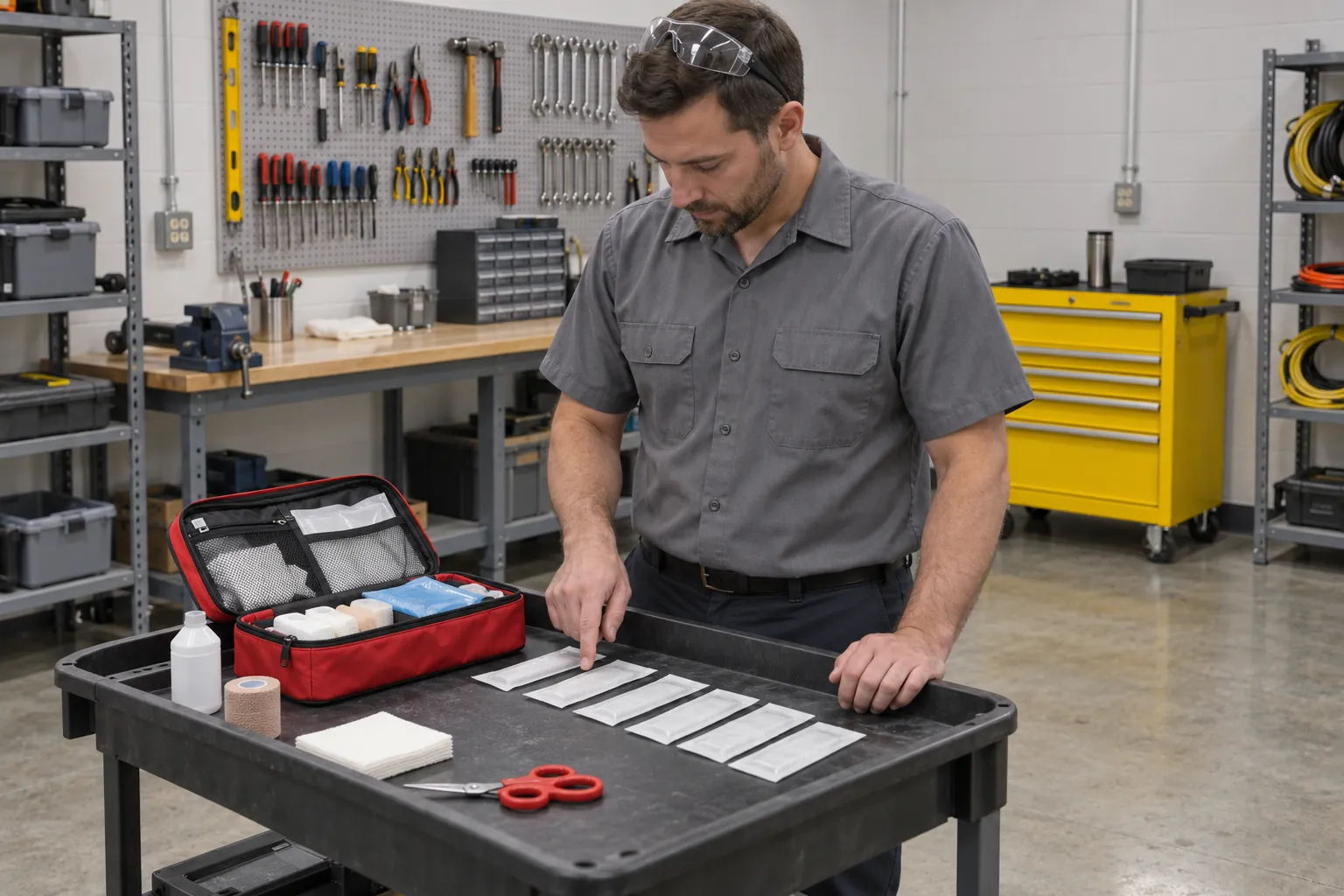
Restock with items that match the kit's contents list, so it still meets the standard after the first refill. OSHA's Best Practices Guide: Fundamentals of a Workplace First-Aid Program (OSHA 3317) says "It is advisable for the employer to give a specific person the responsibility for choosing the types and amounts of first-aid supplies and for maintaining these supplies."
06
Who checks the kits, and what the record should show
The kit check belongs to a named person, such as the safety coordinator, facility manager or building engineer, with the walk often delegated to a custodian, day porter or security officer on a round. Give each kit an owner and a backup.
Federal OSHA does not require a first aid kit inspection log, and nor do California's sections, although section 1512's table lists "Appropriate record forms" among the supplies for every crew size. A record is still the only way to show that "readily available" and "frequent inspection" happened. A useful first aid kit inspection log answers, for every kit:
- Which kit: its location and an ID, matched to a list of every kit in the building.
- When: the date and time of each check.
- Who: the name of the person who checked it, not initials on a card inside the lid.
- What was found: complete, or what was missing, used, damaged or out of date, with the earliest expiration date.
- What was done: restocked on the spot, or ordered, by whom, and when the kit was complete again.
- Uses: when a kit was used, so the injury can be checked against the injury records.
That last point matters for recordkeeping. Under 29 CFR 1904.7, General recording criteria, treatments such as "Using wound coverings such as bandages, Band-Aids™, gauze pads, etc.," cleaning or flushing surface wounds, hot or cold therapy and using eye patches count as first aid, and OSHA says this is "a complete list of all treatments considered first aid." An injury treated only with first aid is not recordable on that basis alone, but one that needs treatment beyond the list is, and belongs on the OSHA 300 log.
07
Where the record fails, and what SiteClara does about it
First aid kits fail between checks. The card inside the lid has a neat column of initials, some added the afternoon before an audit. The gauze went on a cut finger three weeks ago and nobody said so, the third-floor kit is now behind a locked door, and the burn gel expired last year.
SiteClara puts a printed QR poster at each kit location, with an optional NFC tag behind it. Staff scan the code or tap the tag on their own phone, with no app to install, see the checks due there, such as the monthly kit check, and mark each one done or say what stopped them. A problem, such as a kit that is short of supplies or missing, is reported there with a photo and goes onto the team's list of jobs until someone closes it.
The supervisor sees what is due, done and missed, and can record why a check was missed. Each day the supervisor reviews and approves a report that goes to nominated management or client contacts at 8 a.m. the next morning, showing what was reported, completed and still open, and how the scheduled checks went, for example 9 of 9 completed.
08
Questions people ask
What are the OSHA rules regarding first aid?
For general industry they are in 29 CFR 1910.151, Medical services and first aid, in Subpart K of the Occupational Safety and Health Standards. Paragraph (a) requires the ready availability of medical personnel for advice and consultation, paragraph (b) requires a person or persons adequately trained to render first aid and adequate first aid supplies where no infirmary, clinic or hospital is in near proximity, and paragraph (c) requires facilities for quick drenching or flushing where the eyes or body may be exposed to injurious corrosive materials. Construction follows 29 CFR 1926.50.
Is there a mandatory list for a first aid kit?
Not under federal OSHA. Appendix A to 1910.151, First aid kits (Non-Mandatory) names ANSI Z308.1 only as an example of minimal contents and says employers "should assess the specific needs of their worksite periodically and augment the first aid kit appropriately." California construction is the exception: 8 CCR 1512, Emergency Medical Services sets minimum kit contents in a table by crew size, from 1 to 5 employees up to over 200.
What is the ANSI standard for first aid kits in the workplace?
ANSI/ISEA Z308.1, the American National Standard for Minimum Requirements for Workplace First Aid Kits and Supplies. ISEA's page on ANSI/ISEA Z308.1-2026 says the current edition "establishes minimum requirements for kit contents, classification, labeling, and performance across a variety of work environments." It is voluntary, not an OSHA standard: OSHA's April 18, 2002 letter clarifying 1910.151 says ANSI Z308.1 "was not adopted by OSHA," although OSHA often refers employers to it for guidance.
How often should a first aid kit be inspected under OSHA?
For construction, at least weekly: 29 CFR 1926.50(d)(2) requires the kit to be checked before it is sent out on each job and at least weekly on each job. Federal general industry sets no interval, so check monthly and restock after every use.
Can a workplace first aid kit contain pain relievers?
Federal OSHA's first aid standard does not address medicines, and under 29 CFR 1904.7 using a non-prescription medication at non-prescription strength counts as first aid for recordkeeping. In California construction, though, 8 CCR 1512(c)(3) bars medicines from the kit unless an employer-authorized, licensed physician approves them in writing.
Does every employee need to be trained in first aid?
No. OSHA's January 16, 2007 letter says that OSHA "recommends, but does not require, that every workplace include one or more employees who are trained and certified in first aid, including CPR," where emergency care is within reach in time; otherwise 1910.151(b) requires "a person or persons" adequately trained to render first aid.
09
Where to read more, and a list to take away
Start with 29 CFR 1910.151 and its Appendix A for general industry, and 29 CFR 1926.50 for construction. OSHA 3317 covers the program around the kit, and ISEA describes the current standard on its ANSI/ISEA Z308.1-2026 page. In California, read 8 CCR 3400 and, for construction, 8 CCR 1512; elsewhere, check OSHA's State Plans page.
A short first aid kit checklist to take away:
- confirm which rule applies: federal general industry, construction, or your state plan;
- list every kit by location, with an owner and a backup;
- start from a kit labeled to the current ANSI/ISEA Z308.1 edition and class, then add what your own hazards need;
- make sure every shift has someone with first aid training who knows where the kits are;
- place kits so a first aider can reach one quickly on every floor and every shift, and in every vehicle and mobile crew;
- check fixed kits at least monthly, construction and vehicle kits at least weekly, and every kit after it is used;
- record who checked each kit, when, what was missing or out of date, and when it was complete again;
- review the kit contents against your injury records at least once a year, and whenever the work changes.
Sources
Every document this guide quotes or links to, in the order it first cites them.
- 29 CFR 1910.151, Medical services and first aid osha.gov
- Appendix A to 1910.151, First aid kits (Non-Mandatory) osha.gov
- 29 CFR 1926.50, Medical services and first aid osha.gov
- Appendix A to 1926.50 (Non-Mandatory) osha.gov
- February 2, 2007 letter of interpretation on first aid supplies osha.gov
- State Plans osha.gov
- Title 8, section 3400, Medical Services and First Aid dir.ca.gov
- Title 8, section 1512, Emergency Medical Services dir.ca.gov
- April 18, 2002 letter clarifying 1910.151 osha.gov
- ANSI/ISEA Z308.1-2026 safetyequipment.org
- 2021 edition safetyequipment.org
- January 16, 2007 letter on first aid, CPR and bloodborne pathogens osha.gov
- Best Practices Guide: Fundamentals of a Workplace First-Aid Program (OSHA 3317) osha.gov
- 29 CFR 1904.7, General recording criteria osha.gov
Related guides
 Premises and facilities managementOSHA eyewash station requirements: the rule, the 10-second reach and the weekly flushOSHA eyewash station requirements under 29 CFR 1910.151(c) and ANSI/ISEA Z358.1: where a station goes, what it must deliver, the weekly flush and what to record.
 Premises and facilities managementAED inspection checklist: keeping a defibrillator ready to useAn AED inspection checklist for US workplaces: the status light, pads, battery and cabinet, how often to check, state rules such as California's, and what to record.
 Premises and facilities managementThe OSHA 300 log: what to record, when, and how to keep it honestWho must keep the OSHA 300 log, which injuries are recordable under 29 CFR 1904, the seven-day rule, the 300A posting and what the working record needs.
 Fire and water checksEmergency action plan: what OSHA requires, and how to keep the plan workingWhat an emergency action plan must contain under OSHA 1910.38, who needs one, how alarms, wardens, drills and reviews fit in, and what the record should show.