Fire and water checks
Fire lane requirements: what the fire code asks, and how to keep the lane clear
Under the International Fire Code, the model most US states and cities adopt with their own amendments, a fire lane must be at least 20 feet wide with 13 feet 6 inches of vertical clearance, surfaced to carry a fire engine in all weather, marked where the fire code official requires it, and kept clear of parked vehicles and everything else at all times.
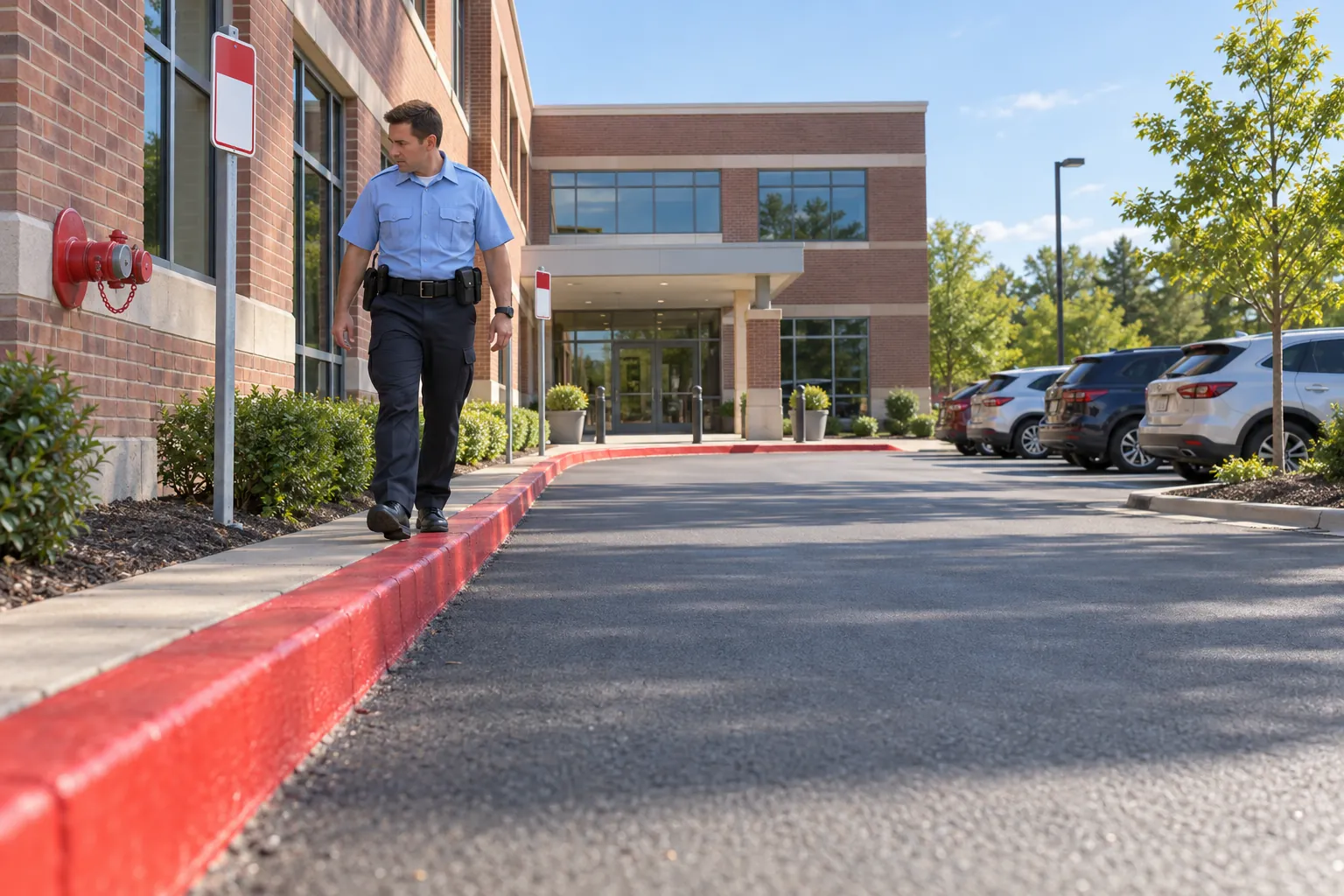
It is the route a fire engine needs to reach your building, set up and get water in. Its width, surface and turnarounds are fixed when the site is designed; whether it is clear on a Tuesday afternoon depends on the people who run the building. This guide covers where fire lane requirements come from, what the International Fire Code says about access roads, signs and red curbs, what obstructs them in practice, and how to check them and keep a record that shows it was done.
01
Where fire lane requirements come from
There is no single national fire lane law in the United States. Fire codes are adopted by states, counties and cities, usually with local amendments, and the fire code official of the jurisdiction (the fire chief, fire marshal or someone they designate, often called the authority having jurisdiction or AHJ) decides what applies to your site. Most jurisdictions base their rules on the International Fire Code (IFC) published by the International Code Council; some use NFPA 1, Fire Code, instead. This guide quotes the 2021 International Fire Code, Chapter 5: Fire Service Features. Your jurisdiction may be on an earlier or later edition, or have changed the numbers, so check the adopted version before relying on any figure here.
The IFC does not use "fire lane" as its main term. Its Chapter 2 definitions define a fire apparatus access road as "a road that provides fire apparatus access from a fire station to a facility, building or portion thereof", and say it is "a general term inclusive of all other terms such as fire lane, public street, private street, parking lot lane and access roadway." A fire lane is "a road or other passageway developed to allow the passage of fire apparatus", not necessarily intended for other traffic. In practice, the fire lane at an office park, school, hospital or apartment complex is usually the marked part of a private drive or parking lot that the fire department approved as the access road.
Section 503.1.1 requires approved access roads for new buildings, extending "to within 150 feet (45 720 mm) of all portions of the facility and all portions of the exterior walls of the first story", a distance the fire code official may increase, for example for a fully sprinklered building.
For an existing building, the design of the lane was settled when the site was permitted, and changing it is a matter for the fire code official. The maintenance duty is continuing: section 503.1 says access roads "shall be provided and maintained", and section 503.4 says they "shall not be obstructed in any manner, including the parking of vehicles."
02
What the access road requirements cover
Section 503.2 of the 2021 IFC sets the specifications, and the optional IFC Appendix D, Fire Apparatus Access Roads adds detail. Appendix D states that its provisions "are not mandatory unless specifically referenced in the adopting ordinance or legislation of the jurisdiction", so treat its figures as the common model, not as the rule, until you know your jurisdiction adopted it. The main requirements are:
- Width: an unobstructed width of not less than 20 feet, exclusive of shoulders, except at approved security gates (section 503.2.1). Where a fire hydrant is on the access road, Appendix D asks for 26 feet (D103.1).
- Vertical clearance: an unobstructed vertical clearance of not less than 13 feet 6 inches (section 503.2.1). Tree limbs, canopies, banners and signs all count.
- Surface: designed and maintained to support the imposed loads of fire apparatus and surfaced for all-weather driving (section 503.2.3). Appendix D names an asphalt, concrete or other approved surface capable of supporting apparatus weighing up to 75,000 pounds (D102.1).
- Turning radius, grade and dead ends: radius and grade are set by the fire code official for the department's own apparatus (sections 503.2.4 and 503.2.7), and a dead end longer than 150 feet needs an approved turnaround (section 503.2.5). Appendix D limits grade to 10 percent (D103.2) and gives turnaround shapes in Table D103.4.
- Marking: signs or markings where the fire code official requires them, kept clean and legible (section 503.3).
- No obstruction: the minimum widths and clearances "shall be maintained at all times" (section 503.4), and traffic calming devices are prohibited unless approved (section 503.4.1).
- Security gates: they need the official's approval and "an approved means of emergency operation", and "the security gates and the emergency operation shall be maintained operational at all times" (section 503.6).
Chapter 5 also covers what the lane leads to. Section 504.1 requires exterior doors and openings to be "maintained readily accessible for emergency access by the fire department". Section 507.5.4 requires unobstructed access to fire hydrants "at all times", and section 507.5.5 a 3-foot clear space around each hydrant. In IFC Chapter 9, section 912.4 requires immediate access to fire department connections "at all times and without obstruction by fences, bushes, trees, walls or any other fixed or moveable object", and section 912.4.2 a clear working space at least 36 inches wide, 36 inches deep and 78 inches high.
03
Fire lane signs, red curbs and markings
Section 503.3 says that where the fire code official requires it, approved signs, notices or markings that include the words NO PARKING and FIRE LANE "shall be provided for fire apparatus access roads to identify such roads or prohibit the obstruction thereof." The same section adds the part that falls to building staff: "The means by which fire lanes are designated shall be maintained in a clean and legible condition at all times and be replaced or repaired when necessary to provide adequate visibility."
Where a jurisdiction adopts Appendix D, section D103.6 sets the sign itself: permanent signs at least 12 inches wide by 18 inches high, with red letters on a white reflective background. They go on both sides of access roads 20 to 26 feet wide (D103.6.1), and on one side of roads more than 26 feet and less than 32 feet wide (D103.6.2). Follow your city's own sign and curb standard where it has one.
State vehicle codes often set how a fire lane must be marked before a parking ban can be enforced. In California, California Vehicle Code section 22500.1 prohibits stopping, parking or leaving a vehicle standing, attended or unattended, in a place designated as a fire lane by the fire department or fire district, including in "a publicly or privately owned or operated off-street parking facility." The designation must be shown in one of three ways: a sign "clearly stating in letters not less than one inch in height that the place is a fire lane"; outlining or painting the place in red and marking it with the words FIRE LANE in a contrasting color; or a red curb or red paint on the edge of the roadway with the words FIRE LANE clearly marked.
So faded markings are more than cosmetic: a red curb worn pink or a sign knocked flat makes the lane harder to keep clear, and in some places harder to enforce. Check that:
- every sign is in place, upright and not hidden by landscaping or a dumpster;
- red paint and FIRE LANE lettering are readable from a driver's seat, including after plowing;
- markings still match the approved fire lane after restriping, with any change to the lane agreed with the fire code official first;
- no bollards or planters have been added inside the lane without approval.
04
Keeping the fire lane clear day to day
Almost every fire lane problem is an operational one. The code's minimum width and vertical clearance have to hold "at all times", and the things that take them away are ordinary parts of running a building:
- Parked and idling vehicles: rideshare and food delivery drivers, parcel vans, contractors' pickups by the entrance, moving trucks and school pickup lines.
- Deliveries and waste: box trucks waiting for a dock, pallets staged outside, dumpsters left in the lane after collection.
- Construction: scaffolding, material storage, a lift set up across the lane, barricades from a paving job.
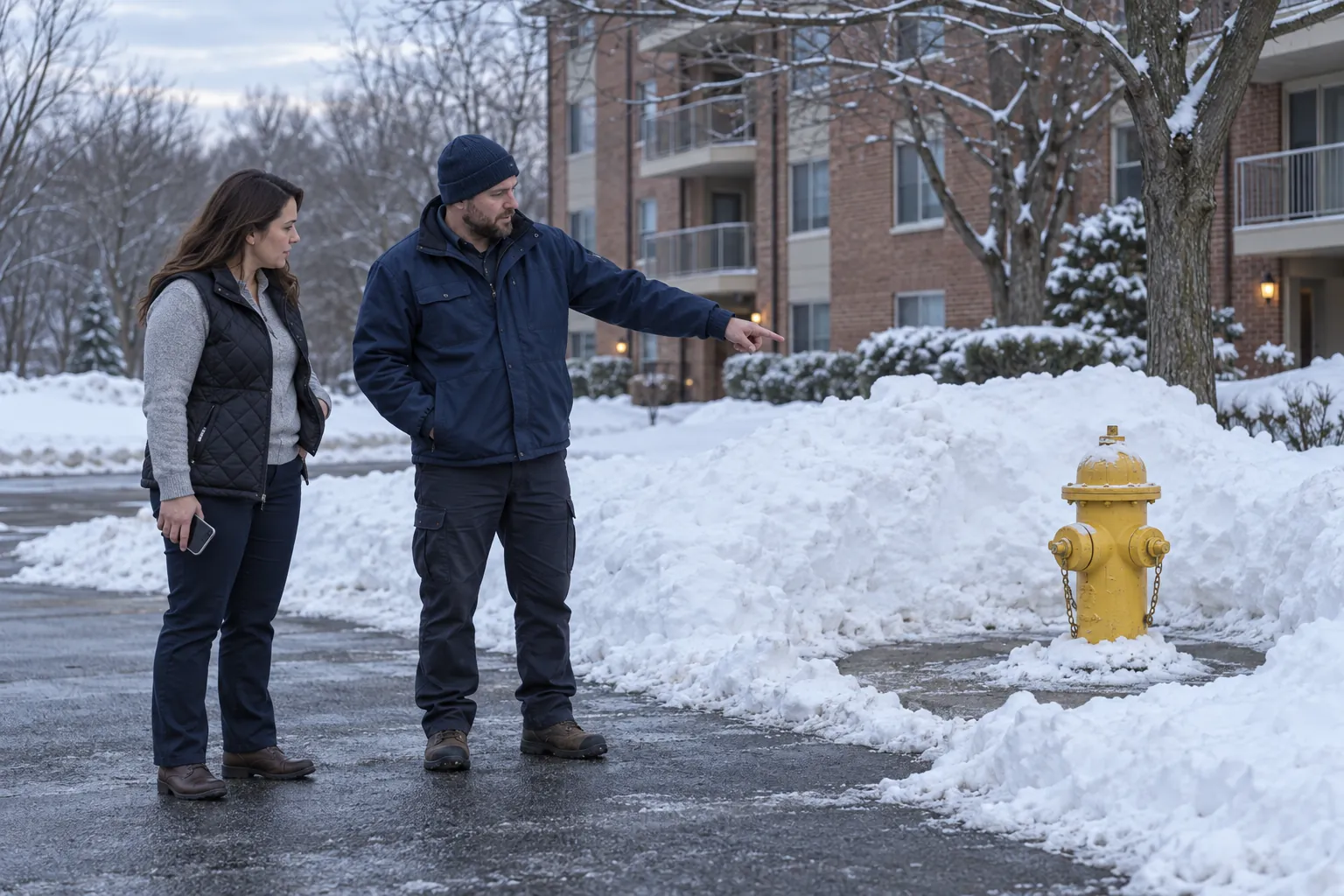
- Snow: plowed piles pushed into the lane or onto hydrants and fire department connections.
- Landscaping: tree limbs below 13 feet 6 inches, shrubs grown over a hydrant or connection.
- Events: tents, food trucks and stages set up on a drive or parking lot lane.
- Gates: a security gate stuck closed, or an emergency opening device that no longer works.
The owner and whoever manages the site answer to the fire code official, but the daily work falls to the people on site: the property or facility manager who briefs tenants and contractors, security officers whose post orders include the lane, the day porter or custodial crew who move carts and dumpsters, the building engineer who looks after gates, and the snow contractor. Write the fire lane into each of their instructions.
Plan temporary obstructions such as construction staging, a tent or a paving closure before they happen. They may need the fire code official's approval and an alternative route. Ask early, and record what was agreed.
05
How often to check, and what the record should show
The IFC does not set a frequency for checking a fire lane; it requires the lane to be clear at all times. Set the frequency by risk. A useful pattern for most commercial, institutional and multifamily sites is:
- Every patrol or building round: the lane end to end, the fire department connection, hydrants and any security gate.
- At the busy times: deliveries, school pickup, trash collection.
- After snow: every lane, hydrant and connection once plowing is finished.
- Around events or construction: at setup, while it runs, and after teardown.
- Monthly: a slower walk of signs, red curbs, vertical clearance and gate operation, with photos.
A check that leaves no trace is hard to show later to a fire marshal, an insurer or a client. A good record for each check shows:
- Where: which lane segment, gate, hydrant or connection, named consistently so the same place is always called the same thing.
- When and who: the time and the named person, recorded at the time, not filled in at the end of the shift.
- What was found: clear, or what was in the way, with a photo when the lane was obstructed or a sign was damaged.
- What was done: driver asked to move and moved, reported to the property manager, dumpster returned by the hauler, work order raised for a faded curb or a failed gate.
- What is still open: anything not fixed by the end of the shift, and who has it.
Security teams usually carry the result in the daily activity report or pass-down log. What matters is that a blocked lane or broken gate becomes a job someone owns and closes, and that repeats are visible: the same dock lane blocked every weekday at 10 a.m. is a scheduling problem to fix with the tenant or carrier, not a string of separate incidents.
06
Where the record fails, and what SiteClara does about it
Fire lane checks tend to be the most informal part of a building's fire routine. An officer writes "fire lanes clear" once for the whole shift, and the faded red curb by the dock is mentioned at three monthly meetings without becoming a work order. When someone asks later whether the lane was checked, the answer is a line of text with no time, no place and no picture.
SiteClara records the checks at the location. A printed QR poster, with an optional NFC tag behind it, sits at each place a check is scheduled, such as the fire department connection, the security gate or the loading dock. Staff scan the code or tap the tag on their own phone, with no app to install, see the checks due there, and mark each one done or say what stopped them, such as a delivery truck in the lane. The time and the named person are recorded as it happens, with a photo when one is asked for, for example of a clear lane or a legible sign. A problem, such as a blocked hydrant, a damaged sign or a gate that will not open, is reported there with a photo and goes onto the team's list of jobs until someone closes it.
The supervisor sees what is due, done and missed, and can record the reason a check was missed. A job that needs the building manager, such as a tenant's carrier blocking the lane every morning, can be escalated to them to answer. Each day the supervisor reviews and approves a report that goes to nominated management or client contacts at 8 a.m. the next morning, showing what was reported, completed and still open, and how the scheduled checks went, for example 18 of 18 completed.
07
Questions people ask
What is the required width for a fire lane?
Under the 2021 International Fire Code, a fire apparatus access road must have an unobstructed width of not less than 20 feet, exclusive of shoulders, except at approved security gates, and an unobstructed vertical clearance of not less than 13 feet 6 inches (section 503.2.1, reproduced in a 2021 proposal to the Washington State Building Code Council on IFC Section 503, Fire Apparatus Access Roads). Section 503.2.2 lets the fire code official require or permit changes to the required widths where they are inadequate for fire or rescue operations, and section 503.4 says the minimum widths and clearances "shall be maintained at all times", so a lane that is 20 feet wide on the plan but has a van parked along one side no longer meets it.
Does a fire lane need to be paved?
The model code does not use the word paved. Section 503.2.3 of the 2021 International Fire Code says access roads "shall be designed and maintained to support the imposed loads of fire apparatus and shall be surfaced so as to provide all-weather driving capabilities" (see the text reproduced in a 2021 proposal to the Washington State Building Code Council on IFC Section 503). Dallas Fire-Rescue's Fire Apparatus Access Roads (Fire Lanes) handout puts it as a material "substantial enough to support any fire department vehicle" that must "remain structurally unaffected by bad weather." Whether a surface other than asphalt or concrete is acceptable is for the fire code official to approve, and the duty to maintain it continues after the lane is built.
What are the legal requirements for fire lanes in Texas?
In Texas, as elsewhere, the detailed rules come from the fire code adopted locally, usually by the city, so they differ from place to place. Dallas is one example. Dallas Fire-Rescue's Fire Apparatus Access Roads (Fire Lanes) handout, revised June 2021 and based on the city's amendments to the 2015 IFC, asks for a fire lane at least 20 feet wide with an overhead clearance of at least 13 feet 6 inches, with all portions of the building's first-story exterior walls within 150 feet of a public street or designated fire lane. It is marked either by 6-inch red lines with "NO PARKING FIRE LANE" or "FIRE LANE NO PARKING" in 4-inch white letters at 25-foot intervals, or by signs at least 12 by 18 inches with 2-inch red letters on a white background, no more than 50 feet apart along both sides. The handout also says red curbs, red pavement striping or red wheel stops may be used only to designate approved fire lanes. Ask your own city's fire marshal for its standard.
08
Where to read the rules, and a list to take away
The International Code Council publishes a free read-only view of the 2021 International Fire Code, Chapter 5 (sections 503 to 507), IFC Appendix D and IFC Chapter 9 for fire department connections. Your state or city will have adopted an edition with amendments, as Washington did in WAC 51-54A-0503, and a state vehicle code, such as California Vehicle Code section 22500.1, may set how the lane is marked. The fire marshal's office for your address has the final word.
To keep a fire lane compliant and clear, check that:
- you know which fire code, edition and local standard apply, and have the approved site plan;
- every sign and red curb is in place, readable and matches that plan;
- the lane keeps its full width and vertical clearance;
- hydrants and fire department connections have their clear space;
- security gates open by their approved emergency means;
- tenants, carriers, contractors and the snow contractor know where they cannot stop or store anything;
- rounds cover the lane at the times it is most likely to be blocked;
- each check records where, when, who, what was found and what was done;
- temporary closures are agreed with the fire code official first.
Sources
Every document this guide quotes or links to, in the order it first cites them.
- 2021 International Fire Code, Chapter 5: Fire Service Features codes.iccsafe.org
- Chapter 2 definitions codes.iccsafe.org
- WAC 51-54A-0503, Fire apparatus access roads app.leg.wa.gov
- IFC Appendix D, Fire Apparatus Access Roads codes.iccsafe.org
- IFC Chapter 9 codes.iccsafe.org
- California Vehicle Code section 22500.1 leginfo.legislature.ca.gov
- 2021 proposal to the Washington State Building Code Council on IFC Section 503, Fire Apparatus Access Roads sbcc.wa.gov
- Fire Apparatus Access Roads (Fire Lanes) handout dallascityhall.com
Related guides
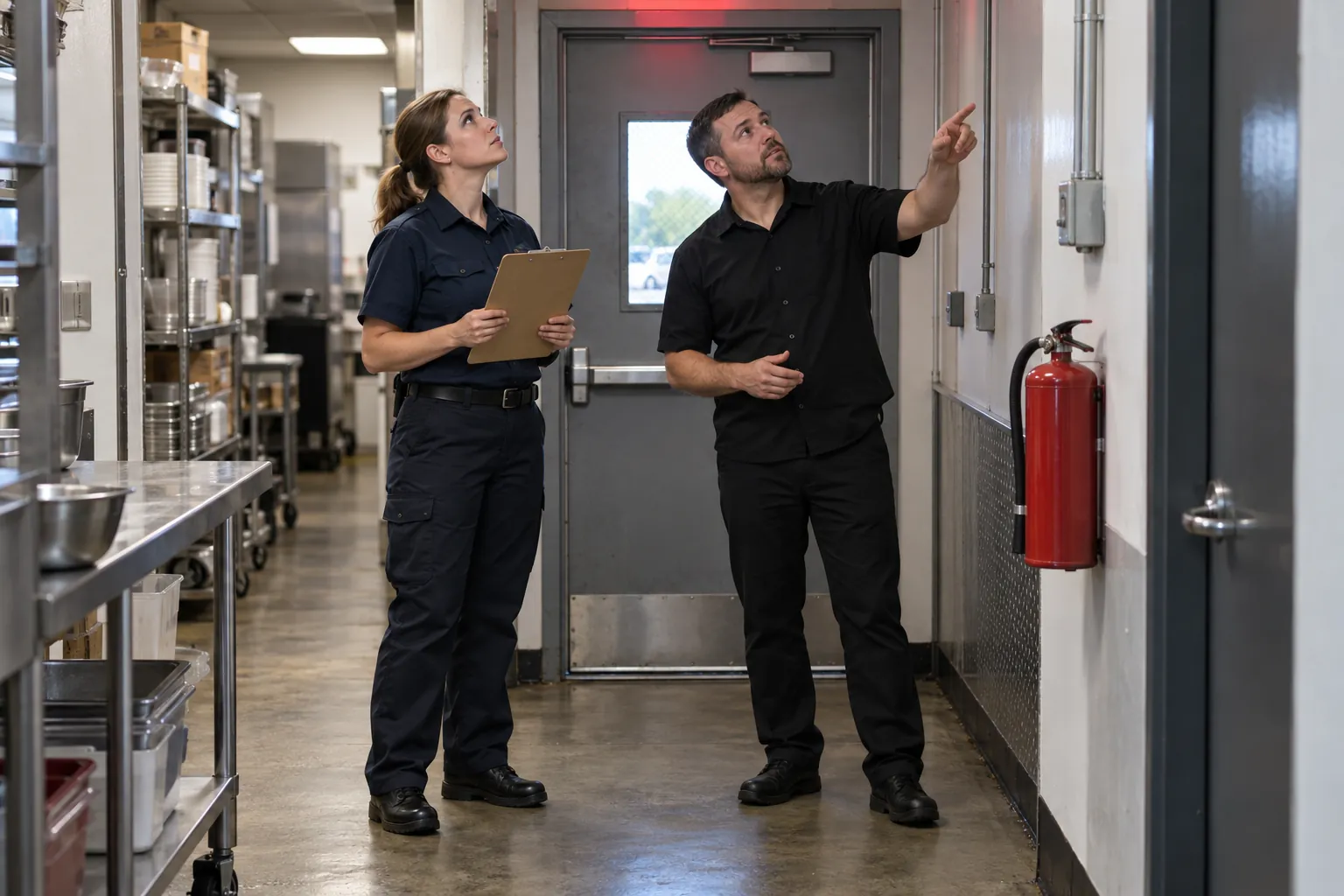 Fire and water checksFire inspection checklist: what the fire marshal looks at, and how to be readyA fire inspection checklist for US businesses: what the fire marshal checks, the records to have ready, who prepares what, and how to stay ready between visits.
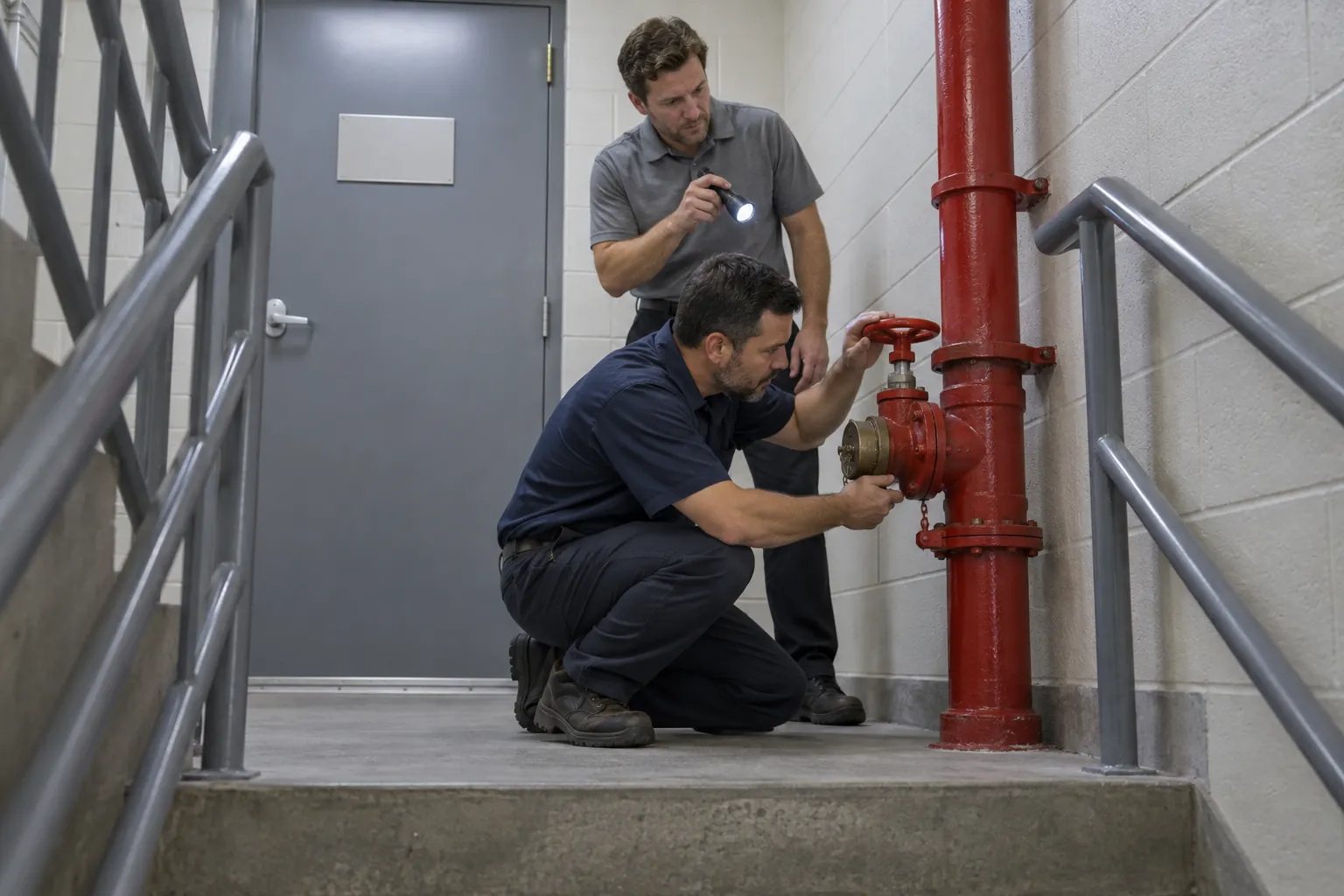 Fire and water checksStandpipe inspection and testing: keeping the fire department's water readyWhat standpipe inspection and testing involve under NFPA 25 and the fire code, what building staff check between contractor visits, and what the record shows.
 Fire and water checksOSHA exit sign and exit route requirements, and how to keep every route clearWhat OSHA 1910.36 and 1910.37 require of exit routes, exit doors and exit signs, how the fire code fits in, and how to check and record that routes stay clear.
 Premises and facilities managementParking lot inspection checklist: what to check, how often, and what to recordA parking lot inspection checklist for commercial property: pavement, striping, ADA spaces, lighting and drainage, how often to check, and a record that holds up.