Fire and water checks
Standpipe inspection and testing: keeping the fire department's water ready
Standpipe testing verifies that a building's standpipe system, the fixed piping that carries water to hose connections for firefighters, can still deliver the water flow and pressure it was designed for, through the inspections, flow tests and hydrostatic tests set out in NFPA 25 and the local fire code.
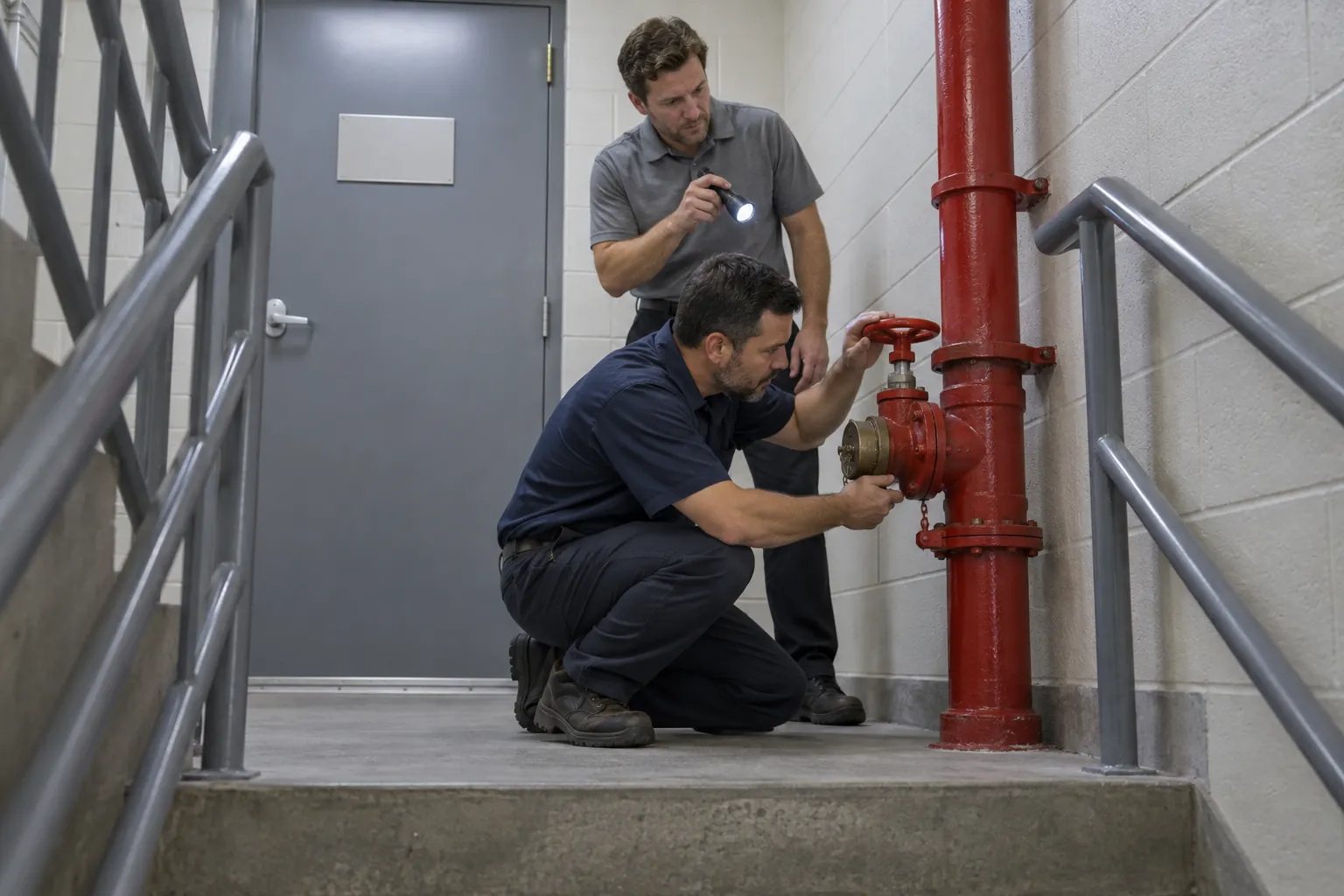
In effect a standpipe is the building's own water main for firefighting: pipe running up the stairwells with a hose valve on every landing, so firefighters can connect on the floor below a fire instead of dragging hose up from the street. Nobody uses it for years, and then everything depends on it. This guide covers where the inspection and testing rules come from, what a standpipe system includes, who does which part, what building staff can check between contractor visits, what happens when the system is out of service, and what the record should show.
01
The rule: NFPA 25, the local fire code and OSHA
Standpipes are installed to one standard and maintained to another. NFPA 14, the Standard for the Installation of Standpipe and Hose Systems, governs the design. NFPA 25, Standard for the Inspection, Testing, and Maintenance of Water-Based Fire Protection Systems, governs what happens afterward, and its Chapter 6 deals with standpipe and hose systems. An NFPA article on the standard lists standpipe systems alongside sprinklers, fire pumps, private fire service mains and water storage tanks, and puts the duty plainly: the property owner or designated representative is responsible for making sure inspection, testing, maintenance and impairment management are done by a qualified person (NFPA, "NFPA 25 and Properly Maintaining a Sprinkler System").
NFPA 25 is a standard, not a law, until a jurisdiction adopts it, usually through the International Fire Code or NFPA 1. The authority having jurisdiction (AHJ), normally the fire marshal, decides which edition applies. NFPA's article on standpipes in high-rise buildings sets out the split: NFPA 25 gives the procedures, frequencies and documentation, the owner keeps the system in good working condition, and the AHJ confirms through the owner that the work was done.
Some cities go further than NFPA 25. New York City is the clearest example. Chapter 9 of the 2022 New York City Fire Code requires standpipe systems to be maintained in accordance with FC 905.12, FC 901.6 and NFPA 25, requires a monthly visual inspection by a certificate of fitness holder (FC 901.6.2.1), and requires that, "upon order of the commissioner, but at least once every 5 years, the standpipe system shall be subjected to a hydrostatic pressure test and a flow test to demonstrate its suitability for department use" (FC 905.12.1).
Federal OSHA has its own, narrower rule. 29 CFR 1910.158, Standpipe and hose systems, applies to small hose, Class II and Class III systems "installed to meet the requirements of a particular OSHA standard" and does not apply to Class I systems. Where it applies, the employer must have hose systems inspected "at least annually and after each use" and must designate trained persons to do the inspections. In the 22 jurisdictions (21 states and Puerto Rico) with an OSHA-approved State Plan covering private employers, the state's own standard applies instead, and it may differ.
02
What a standpipe system includes, and why the class matters
NFPA describes standpipe systems as "fixed piping systems with associated equipment that transports water from a reliable water supply to designated areas of buildings" (NFPA, "Where are standpipes required?"). There are three classes, and the class tells you who the system is for and what equipment you should expect to find:
- Class I: 2½-inch hose connections for the fire department, with no hose kept on site. These are the systems in stairwells of most high-rise buildings, usually at each floor landing or intermediate landing of the required stairs, with extra connections at horizontal exits and on the roof where the stairs do not reach it.
- Class II: 1½-inch hose stations for use by trained personnel or the fire department, traditionally with a hose, nozzle and rack or reel at each connection.
- Class III: both kinds of connection, for full-scale and first-aid firefighting.
Systems are also described as wet or dry (whether the pipe is full of water) and as automatic, semiautomatic or manual (whether the water arrives by itself from a city main, tank or fire pump, or has to be pumped in by a fire engine through the fire department connection). NFPA's article on standpipe system design sets out the classes and types in more detail. A manual dry standpipe in an unheated parking garage and an automatic wet system fed by a fire pump in an office tower need very different care. On a round you will meet hose valves on the stair landings, pressure-regulating devices at the lower hose valves of tall buildings, cabinets, control valves and gauges on the risers, and the fire department connection (FDC) outside, the inlet a fire engine pumps into.
Many older buildings still have occupant-use hose racks. NFPA 1 now lets the AHJ approve removing that hose where neither the fire code nor the building code requires it and it will not be used by trained personnel or the fire department, because untrained occupants should evacuate rather than fight a fire. The rest of the standpipe stays and must still be maintained.
03
Who does which part: the owner, the contractor and building staff
Almost every building splits the work three ways.
- The owner carries the responsibility, whoever does the work: knowing what systems the building has, making sure inspections and tests happen on time, correcting deficiencies, managing impairments and keeping the records.
- A qualified contractor usually does anything that involves flowing water or pressurizing the system: flow tests, hydrostatic tests, testing pressure-regulating devices, and repairs. Some states license the firms and technicians who do this work: Texas, for example, makes a licensed responsible managing employee (RME-I) responsible for conducting sprinkler inspection, testing and maintenance in accordance with NFPA 25, according to the Texas State Fire Marshal's Office FAQ.
- Building staff, such as the building engineer, maintenance technician or a trained security officer, do the routine visual checks between contractor visits, keep the equipment accessible, and report what they find.
NFPA 25 expects the owner's own people to do much of the routine inspection. As NFPA puts it, "the intent of NFPA 25 is that the owner or the owner's designated representative(s) perform many of the required inspections", provided they are trained to a level acceptable to the AHJ (NFPA, "NFPA 25 and Properly Maintaining a Sprinkler System"). Who counts as qualified is shifting toward local law. NFPA's journal reported that under changes proposed for the 2026 edition the prescriptive qualifications move into the annex as guidance, leaving it "to the local jurisdiction through the legislative process to determine what the requirements are for qualified personnel" (NFPA Journal, on changes to the 2026 edition of NFPA 25).
Where local law sets the qualification, it can be strict. In New York City, FC 901.6.3 requires the inspection, testing, servicing and maintenance of standpipe systems to be personally conducted by a certificate of fitness holder, and the FDNY states that anyone who "inspects, tests, and maintains standpipe systems in buildings or structures in New York City is required to hold a Certificate of Fitness", the FDNY Certificate of Fitness S-13 (Citywide Standpipe System).
Whatever the split, write it down: who does the routine rounds, who the contractor is, who represents the owner, and who coordinates when the system is out of service.
04
What building staff can check between contractor visits
The frequency table in Chapter 6 of NFPA 25 sets how often each of the system components is inspected, tested and maintained; read it in the edition your AHJ enforces, because the items and intervals change between editions. What building staff add is a routine that catches problems between the contractor's visits. A stairwell round typically looks at:
- Access: nothing stored on the landing in front of the hose valve, no furniture, carts or construction material blocking it. New York City's FC 905.7 says cabinets containing firefighting equipment "shall not be obstructed from use or obscured from view".
- Hose valves: caps in place, handwheels present, no visible leaks, corrosion or damage, and no sign that someone has used the valve for cleaning or construction water.
- Pressure-regulating devices: present where they should be and not visibly tampered with or damaged. Only the contractor adjusts or tests them.
- Cabinets: doors open freely and the contents are complete.
- Hose and nozzles, where the building has them: racked properly, not missing, cut or stained, and nozzle in place. Under OSHA's rule, hose systems covered by 1910.158 are inspected at least annually and after each use.
- Control valves: open, and locked or sealed or supervised as the building's arrangement requires. OSHA's 1910.158(e)(2)(ii) requires valves in the main connections to the automatic water supply to be "kept fully open at all times except during repair".
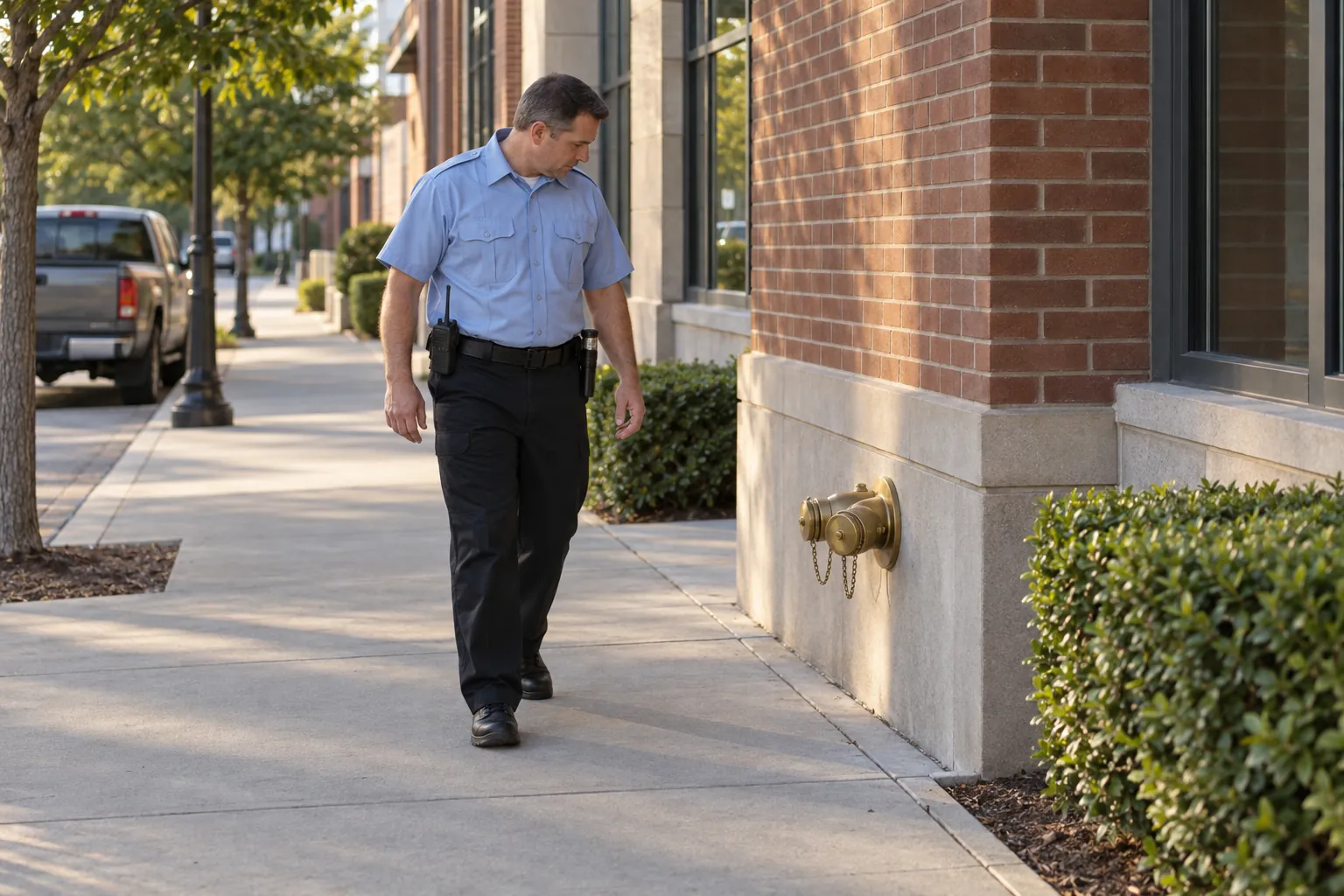
Outside, add the fire department connection. The fire department needs to find it and connect to it fast. The 2022 New York City Fire Code requires immediate access to be kept "at all times, without obstruction by fences, posts, bushes, trees, rubbish containers, vehicles, walls or other objects" (FC 912.3), and a clear working space of at least 36 inches wide, 36 inches deep and 78 inches high in front of and around the connection (FC 912.3.2). On a round, check that the caps are on, the swivels are not damaged, nothing is parked or piled in front of it, landscaping has not grown over it, and the sign is legible.
Two more things are worth watching. NFPA's journal reported a change proposed for the 2026 edition of NFPA 25 that treats a water-based system containing ice as impaired until it is completely thawed, which matters for dry standpipes in unheated areas. And after any hose valve has been used, check that it is closed, capped and not leaking.
05
Flow tests, hydrostatic tests, and when the system is out of service
Testing is contractor work. A standpipe flow test checks that the system still delivers the water flow and residual water pressure it was designed for at the hydraulically most remote hose connections. Hydrostatic testing holds the piping at high pressure to find leaks and weak points, and is especially relevant for dry and manual systems that are not full of water day to day. Chapter 6 of NFPA 25 sets which systems need which test and how often. In New York City, FC 905.12.1 requires both a hydrostatic pressure test and a flow test at least once every five years, conducted at the owner's risk before a representative of the FDNY, and FC 912.6 requires the fire department connection to be hydrostatically tested at least once every five years as well.
OSHA's standard adds its own tests for the systems it covers: under 1910.158(e)(1), Class II and Class III piping installed after January 1, 1981 is hydrostatically tested for at least two hours at not less than 200 psi, and hose on systems installed after that date is tested at not less than 200 psi before it is placed in service.
When something is wrong, how urgent it is depends on the finding. NFPA 25 separates deficiencies, which need correcting, from impairments, where the system cannot perform as intended. A noncritical deficiency does not materially affect how the system performs; a critical deficiency, if left uncorrected, can. NFPA's article on deficiencies and impairments explains the grading and the yellow, orange and red tags that go with it. A missing cap needs correcting; a closed control valve, a broken riser or a fire department connection that cannot be used may leave floors without water for firefighting.
OSHA is direct about the response: when a system covered by 1910.158 or any part of it is found not serviceable, "the employer shall remove it from service immediately and replace it with equivalent protection such as extinguishers and fire watches" (1910.158(e)(2)(iv)). Local codes add their own steps. New York City requires the owner to designate an impairment coordinator (FC 901.7.1), requires evacuation or a fire watch when a standpipe is out of service unless the FDNY directs otherwise (FC 901.7.2), and requires the fire department to be notified "whenever a standpipe system is or will be out of service for any period of time" (FC 901.7.5.1). See our guide to fire watch for how the patrol works and what its log should show.
06
Where the record fails, and what SiteClara does about it
The contractor's test report is usually thorough. The weak part is the routine in between: the stairwell round initialed for the month in one sitting, a hose valve used for washdown water and left dripping, flooring stored on a landing during a build-out, a fire department connection behind a delivery truck every afternoon.
SiteClara records the checks at the location. A printed QR poster, with an optional NFC tag behind it, sits at each place a check is scheduled, such as a stairwell landing, the riser room or the fire department connection. Staff scan the code or tap the tag on their own phone, with no app to install, see the checks due there, and mark each one done or say what stopped them, such as a locked stair door. The time and the named person are recorded as it happens, with a photo when one is asked for, for example of a clear landing or a capped connection. A problem, such as a missing cap, a leaking valve or storage in front of a hose connection, is reported there with a photo and goes onto the team's list of jobs until someone closes it.
The supervisor sees what is due, done and missed, and can record the reason a check was missed. A job that needs the building manager can be escalated to them to answer. Each day the supervisor reviews and approves a report that goes to nominated management or client contacts at 8 a.m. the next morning, showing what was reported, completed and still open, and how the scheduled checks went, for example 24 of 24 completed.
07
Questions people ask
How often do standpipes need to be tested?
The frequencies come from Chapter 6 of NFPA 25, in the edition your fire marshal enforces, and local codes can add to them. Chapter 9 of the 2022 New York City Fire Code, for example, requires a monthly visual inspection (FC 901.6.2.1) and, "at least once every 5 years", a hydrostatic pressure test and a flow test (FC 905.12.1). Where OSHA's rule applies, 29 CFR 1910.158 requires hose systems to be inspected "at least annually and after each use".
What are the NFPA standards for standpipes?
Two standards do most of the work: NFPA 14, the Standard for the Installation of Standpipe and Hose Systems, for design and installation, and NFPA 25 for inspection, testing and maintenance. NFPA's article "Where are standpipes required?" says that specific details for inspection, testing and maintenance "are found in NFPA 25" and that the owner is responsible for keeping the system in good working condition.
What are the three types of standpipes?
NFPA 14 recognizes three classes, as NFPA's article on standpipe system design and calculations explains. Class I provides 2½-inch hose connections for the fire department; Class II provides 1½-inch hose stations for trained personnel or the fire department; and Class III combines both, for full-scale and first-aid firefighting.
What are the flow test requirements for a standpipe?
A flow test checks that the system still meets the demand it was designed for. NFPA's article on standpipe system design and calculations gives the design figures under NFPA 14: a minimum residual pressure of 100 psi at the hydraulically most remote 2½-inch hose connection of a Class I system, with 500 gpm flowing through the two most remote connections, and 65 psi at 100 gpm for a Class II system. Which systems need a flow test, and how often, is set by Chapter 6 of NFPA 25 and any local code.
08
Where to read more, and a list to take away
NFPA offers free read-only access to its codes and standards, including NFPA 25, from the standard's own page; Chapter 6 covers standpipe and hose systems, and Chapter 4 sets general requirements that apply to every water-based system. Read the edition your AHJ enforces. Read 29 CFR 1910.158 for systems installed to meet an OSHA standard, or your State Plan's version. In New York City, read Chapter 9 of the 2022 Fire Code. Anywhere else, your fire marshal can tell you which fire code and which edition of NFPA 25 apply, and what local amendments add.
Before the next contractor visit, check that:
- you know which standpipe systems the building has, their class, and whether each is wet or dry, automatic or manual;
- someone is named as the owner's representative, and someone as impairment coordinator;
- the in-house rounds of stair landings, cabinets and the fire department connection are scheduled, assigned and recorded as they happen;
- the fire department connection is visible, unobstructed and capped;
- the dates of the last flow test and hydrostatic test are known, and the next ones are booked;
- every deficiency on the last report has a date it was corrected, or a plan;
- the impairment procedure, the fire department notification and the fire watch arrangements are ready before they are needed;
- the records are kept together and can be shown to the AHJ on request.
Sources
Every document this guide quotes or links to, in the order it first cites them.
- NFPA 25, Standard for the Inspection, Testing, and Maintenance of Water-Based Fire Protection Systems nfpa.org
- NFPA, "NFPA 25 and Properly Maintaining a Sprinkler System" nfpa.org
- Article on standpipes in high-rise buildings nfpa.org
- Chapter 9 of the 2022 New York City Fire Code nyc.gov
- 29 CFR 1910.158, Standpipe and hose systems osha.gov
- State Plan osha.gov
- NFPA, "Where are standpipes required?" nfpa.org
- Article on standpipe system design nfpa.org
- Texas State Fire Marshal's Office FAQ tdi.texas.gov
- NFPA Journal, on changes to the 2026 edition of NFPA 25 nfpa.org
- FDNY Certificate of Fitness S-13 (Citywide Standpipe System) nyc.gov
- Article on deficiencies and impairments nfpa.org
Related guides
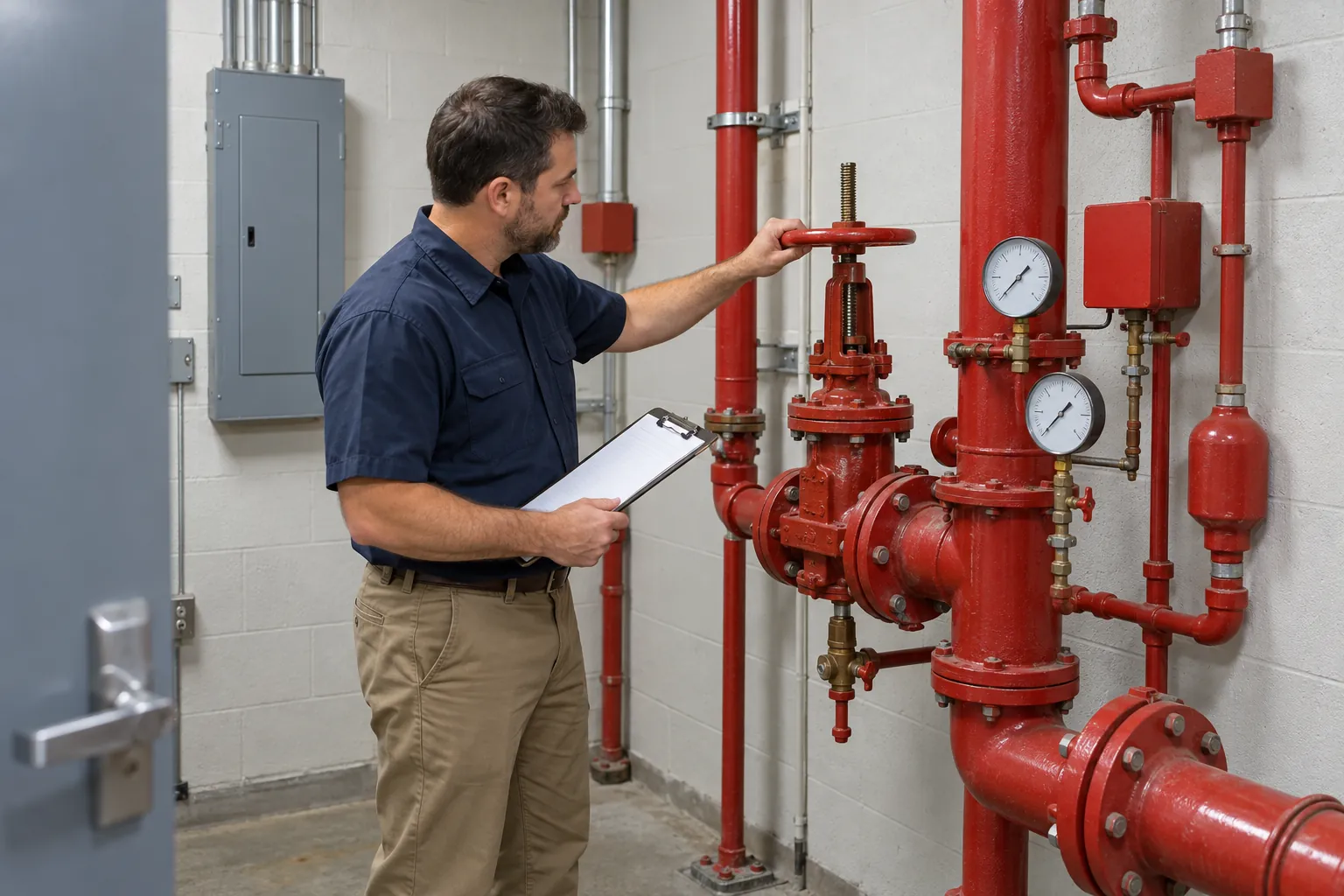 Fire and water checksFire sprinkler inspection: what NFPA 25 asks of the buildingWhat a sprinkler system inspection involves under NFPA 25, who does the weekly, monthly and annual checks, how impairments work, and what the record should show.
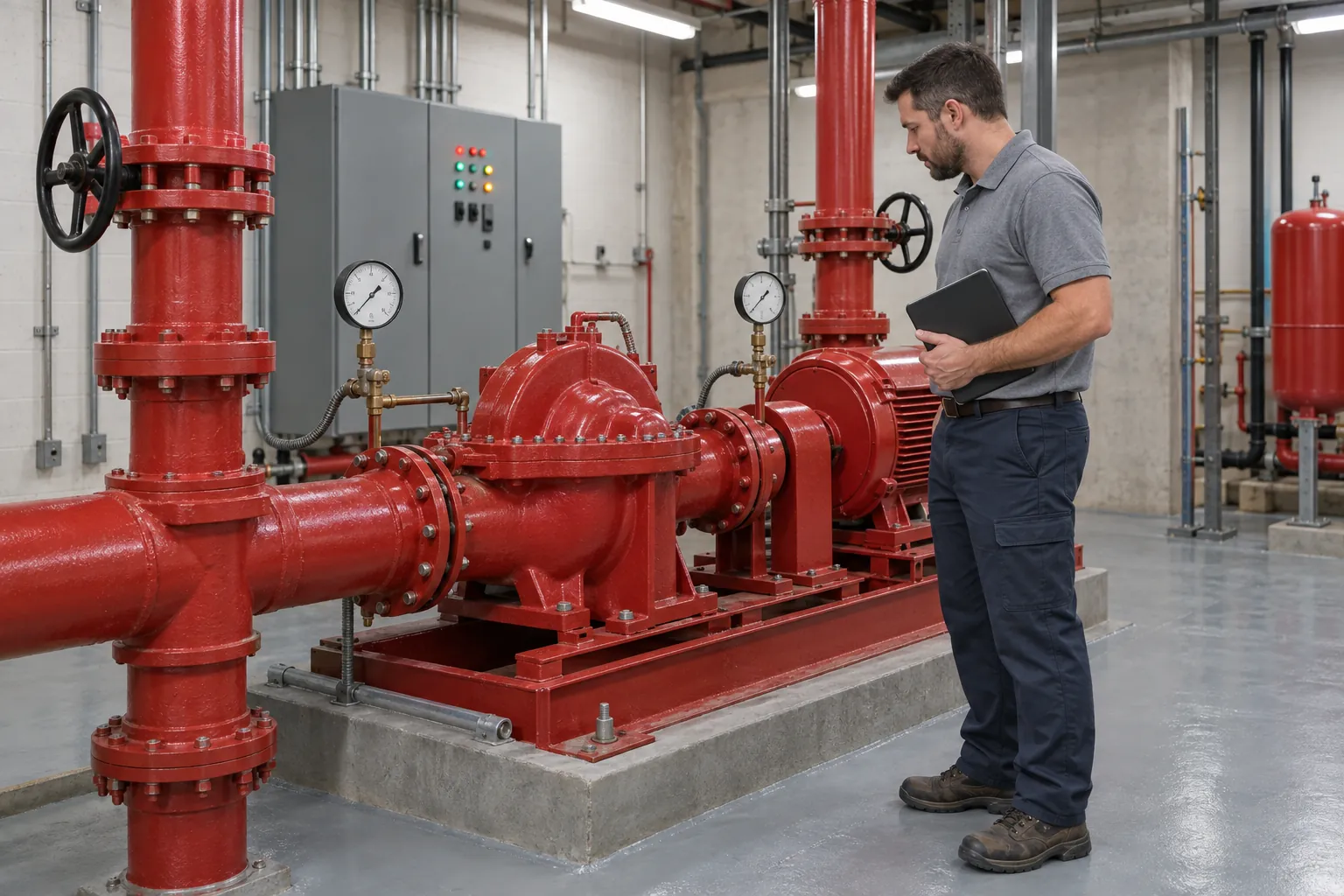 Fire and water checksFire pump testing: what NFPA 25 asks, week by weekWhat fire pump testing involves under NFPA 25: the weekly inspection, the weekly or monthly churn test, the annual flow test, who does each, and what to record.
 Fire and water checksFire watch logs: patrolling a building while its fire protection is out of serviceWhen a fire watch is required under IFC 901.7 and NFPA 25, who can stand it, how often to patrol, and what a fire watch log should show the fire marshal.
 Fire and water checksFire inspection checklist: what the fire marshal looks at, and how to be readyA fire inspection checklist for US businesses: what the fire marshal checks, the records to have ready, who prepares what, and how to stay ready between visits.