Premises and facilities management
Loading dock safety: what OSHA requires, and the checks that keep a dock safe
Loading dock safety is the set of practices that stops a trailer moving while it is loaded or unloaded, keeps people and forklifts from falling off the dock edge, and keeps dockboards, floors and traffic lanes safe to use.
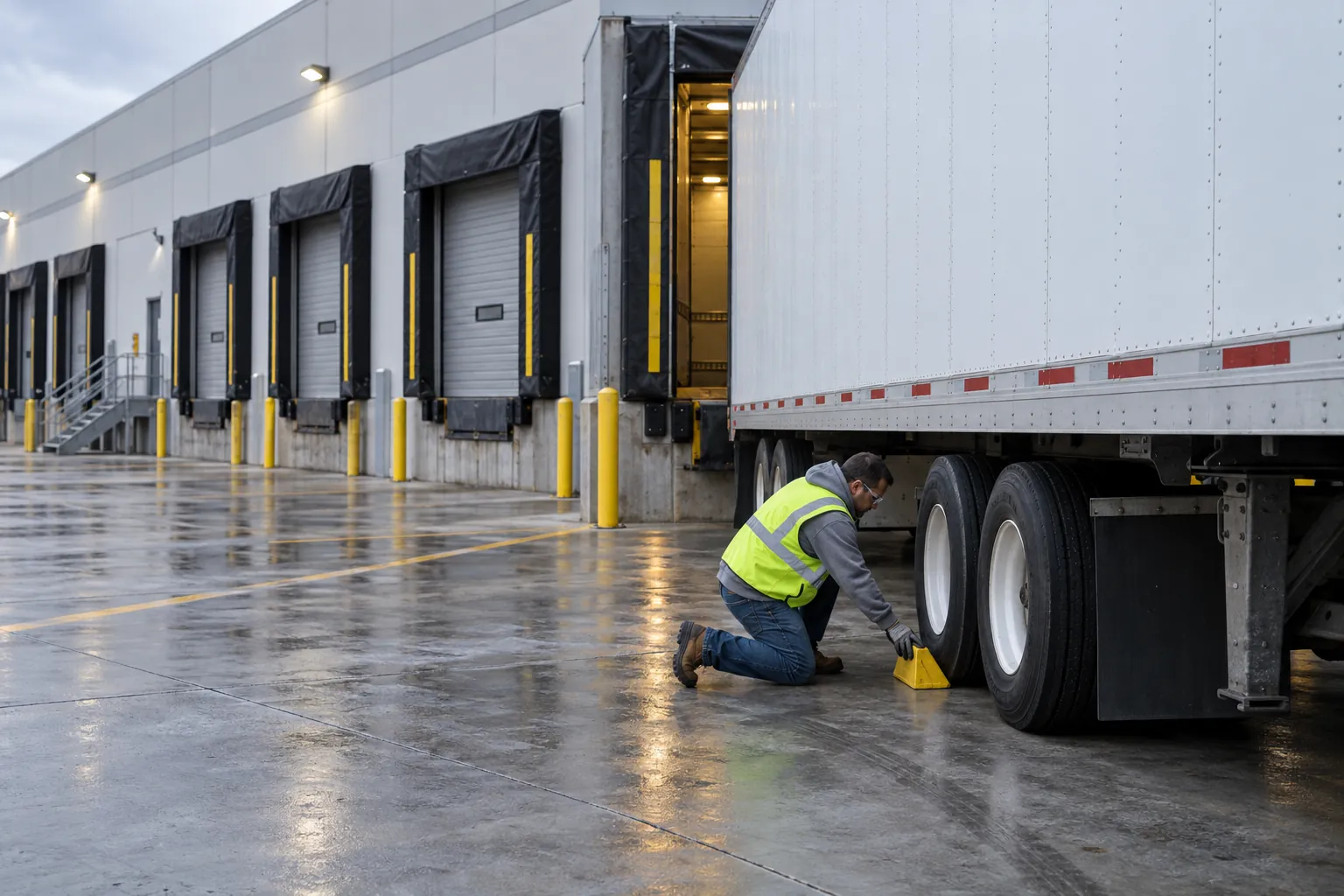
A loading dock puts forklifts, pedestrians, trailers and an open drop at the dock edge in the same few square yards, and there is no single OSHA standard for it: the rules are spread across the walking-working surfaces, dockboard, fall protection, materials handling and forklift standards. This guide gathers them in one place, sets out what a dock safety check should cover at each door, and explains how to keep a record that shows the dock was checked, not just that a form exists.
01
What OSHA requires at a loading dock
Federal OSHA has no standard called "loading docks." The duties that apply at a dock come from five places in 29 CFR Part 1910, the general industry standards, and a dock safety program has to cover all of them:
- 29 CFR 1910.22, Walking-working surfaces: general requirements. Surfaces must be kept "in a clean, orderly, and sanitary condition" and free of hazards "such as sharp or protruding objects, loose boards, corrosion, leaks, spills, snow, and ice." Under 1910.22(d), they must be "inspected, regularly and as necessary, and maintained in a safe condition," and a hazardous condition must be "corrected or repaired before an employee uses the walking-working surface again."
- 29 CFR 1910.26, Dockboards: capacity, run-off protection, securing portable plates, and keeping the transport vehicle from moving while employees are on the dockboard.
- 29 CFR 1910.28, Duty to have fall protection and falling object protection: the 4-foot rule for unprotected sides and edges, with a narrow exception for the working side of a loading dock, and a separate paragraph for dockboards.
- 29 CFR 1910.176, Handling materials: general: "Where mechanical handling equipment is used, sufficient safe clearances shall be allowed for aisles, at loading docks, through doorways and wherever turns or passage must be made."
- 29 CFR 1910.178, Powered industrial trucks: paragraph (k) on trucks and railroad cars, (m)(6) and (m)(7) on elevated docks and loading, and (n)(11) on driving over a dockboard.
The sentence most people mean when they talk about dock safety is 1910.178(k)(1): "The brakes of highway trucks shall be set and wheel chocks placed under the rear wheels to prevent the trucks from rolling while they are boarded with powered industrial trucks." Paragraph (m)(7) repeats the idea for any loading: "Brakes shall be set and wheel blocks shall be in place to prevent movement of trucks, trailers, or railroad cars while loading or unloading." Paragraph (k)(3) adds that "fixed jacks may be necessary to support a semitrailer and prevent upending during the loading or unloading when the trailer is not coupled to a tractor."
Check whose rules apply before you write your program. According to OSHA's State Plans page, "there are currently 22 State Plans covering both private sector and state and local government workers, and seven State Plans covering only state and local government workers." A state plan can word things differently. In California, for example, Title 8, section 3650, Industrial Trucks. General says in subsection (t)(22) that vehicles "shall not be driven in and out of highway trucks and trailers at loading docks until such trucks or trailers are securely blocked or restrained and the brakes set."
02
What loading dock safety covers in practice
OSHA's pocket guide Worker Safety Series: Warehousing sums up the dock in one line: "Injuries happen here when forklifts run off the dock, products fall on employees or equipment strikes a person." In a warehouse or distribution center, a dock safety routine deals with these hazards:
- Trailer movement: a trailer that creeps away from the dock under the braking and acceleration of a forklift, or a driver who pulls away while a forklift is still inside. Both open a gap between dock and trailer that a forklift can drop into.
- Trailer upending and collapse: a trailer parked without a tractor can tip forward when a loaded forklift drives into its nose, and a worn trailer floor can give way under the load.
- Falls from the dock edge: an open door with no trailer behind it, a forklift reversed off the edge, or a person who jumps down rather than using the steps.
- Dockboards and levelers: a plate that shifts, is too light for the load, or has no curb to stop a wheel running off the side.
- Forklift and pedestrian traffic: drivers, receivers and forklift operators sharing a busy apron with blind corners, stacked freight and noise.
- Surfaces and weather: shrink-wrap, broken pallets and other debris, oil and hydraulic leaks, rain blown in through open doors, and snow and ice on the approach and the dock plate itself.
- Light and air: poor visibility in the dark interior of a trailer, and exhaust where engines run in an enclosed dock.
None of them is solved once: a dock is safe for one trailer at one door, so the checks happen at that door, every time.
03
Securing the trailer: the check at every door
The trailer check happens before anyone enters the trailer, and it is the one most often skipped when the yard is busy. A workable sequence, written for your site and posted at the door, looks like this:
- The truck is at the door and stopped. The driver has set the brakes, and your procedure says who controls the departure.
- The trailer is held. Wheel chocks are placed under the rear wheels, as 1910.178(k)(1) requires, or the dock's vehicle restraint is engaged and its indicator light shows it has caught the trailer. If you rely on a restraint alone, confirm that it meets the wording that applies to you.
- An uncoupled trailer is supported. Where the tractor has gone, put trailer stands or fixed jacks under the nose, as 1910.178(k)(3) contemplates, before a forklift drives in.
- The trailer is looked at from inside. Look for holes, soft boards and a load that has shifted in transit.
- The dockboard or leveler is in place and secure. Under 1910.178(n)(11), "dockboard or bridgeplates, shall be properly secured before they are driven over." The lip rests on the trailer bed.
- The inside is lit. Under 1910.178(h)(2), "where general lighting is less than 2 lumens per square foot, auxiliary directional lighting shall be provided on the truck"; many docks also use a fixed or swing-arm dock light.
- Release happens in reverse, by one named person. The forklift is out, the plate is stored, then the restraint is released or the chocks are removed, and only then is the driver told the trailer is free to leave.
Railroad cars follow the same idea. Under 1910.178(k)(2), "wheel stops or other recognized positive protection shall be provided to prevent railroad cars from moving during loading or unloading operations," and (k)(4) requires positive protection while dockboards or bridge plates are in position.
Communication is where the sequence usually breaks: a driver who was never told a forklift is inside will pull away when the paperwork is signed. Signal lights, a trailer-release tag held at the dock desk, or a rule that nobody signs out a driver until the door is closed all close that gap. Write it down and brief every driver who uses your dock.
04
Dock edges, open doors and dockboards
Dock height is often around four feet, which is where the fall protection rule begins. Under 1910.28(b)(1), each employee on a walking-working surface with an unprotected side or edge that is 4 feet or more above a lower level must be protected from falling by a guardrail system, safety net system or personal fall protection system.
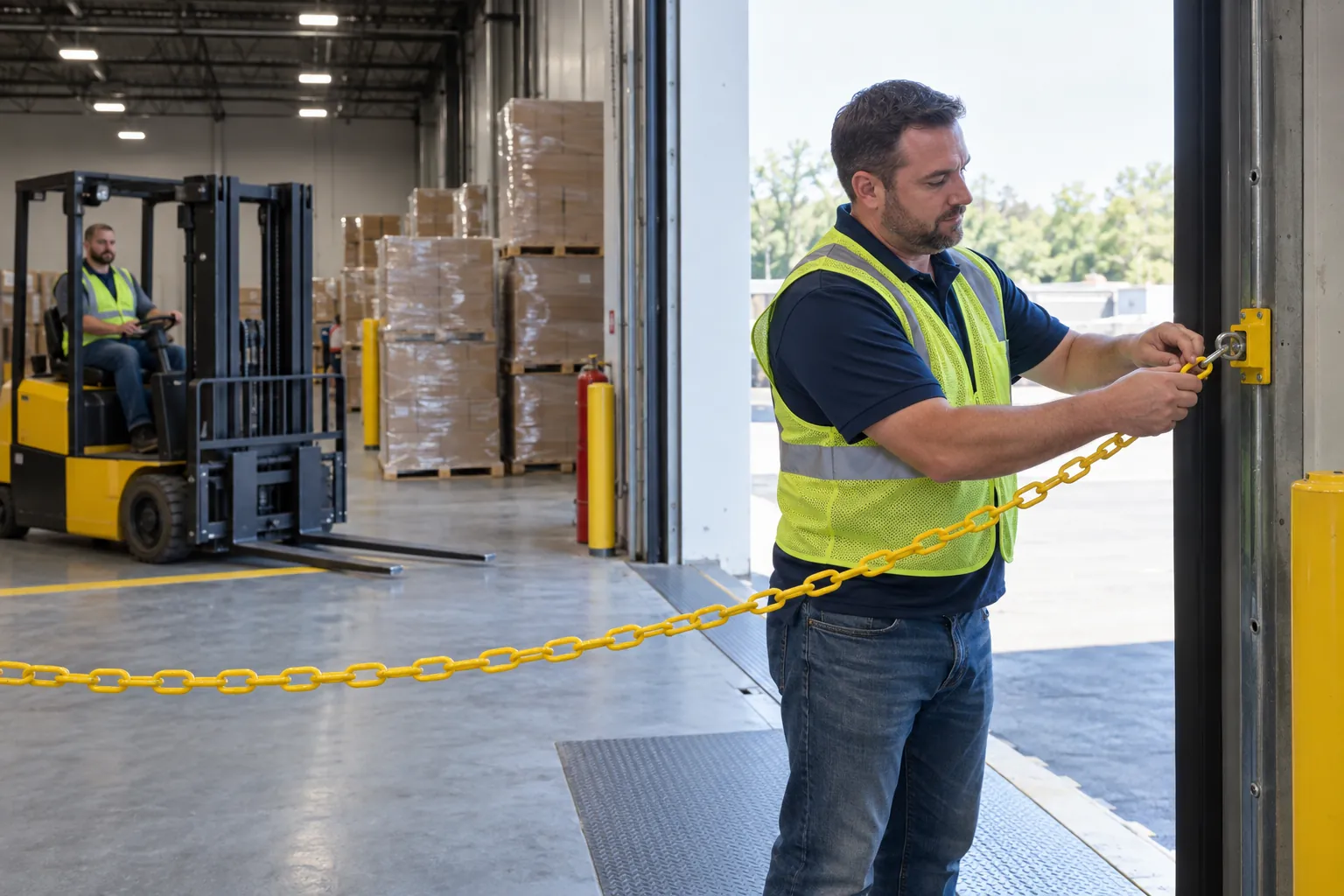
Paragraph 1910.28(b)(1)(iii) makes a narrow exception for the working side of a loading dock. Where the employer can demonstrate that fall protection is not feasible on the working side, the work may be done without it, provided "the work operation for which fall protection is infeasible is in process," "access to the platform is limited to authorized employees," and "the authorized employees are trained in accordance with § 1910.30." It covers a door while it is being worked, not an open door with nobody loading, or visitors.
In practice that means:
- doors are closed when no trailer is at them, or the opening is blocked. OSHA's warehousing checklist says exposed or open loading dock doors "should be chained off, roped off or otherwise blocked";
- dock edges are marked with a painted or taped warning line, so the edge is visible to forklift operators and to anyone on foot, and the pocket guide adds "provide visual warnings near dock edges";
- forklift operators keep a safe distance from the edge of ramps and platforms on any elevated dock, as 1910.178(m)(6) requires, and, in OSHA's warehousing guidance, "never back up a forklift to the dock's edge";
- people use the steps or ladder, never jump. The pocket guide's word is "prohibit" dock jumping;
- employees who work at the dock edge are trained under 29 CFR 1910.30, Training requirements, by a qualified person, and retrained when changes at the dock or in the fall protection systems or equipment make their training obsolete or inadequate, or when they show they no longer have the understanding needed.
For dockboards, 1910.26 sets four duties. The board must support the maximum intended load. A dockboard put into initial service on or after January 17, 2017 must be "designed, constructed, and maintained to prevent transfer vehicles from running off the dockboard edge," unless the employer can show there is no run-off hazard. A portable dockboard must be anchored or held by a device that stops it moving out of a safe position (or, where the employer shows securing is not feasible, have enough contact with the surface to stay in place), and it must have handholds or another safe means of handling. And while employees are on the dockboard, measures "such as wheel chocks or sand shoes" must stop the transport vehicle moving.
Fall protection on the dockboard itself is in 1910.28(b)(4). A guardrail or handrails are required for a fall of 4 feet or more, except where the dockboard is used exclusively for materials handling with motorized equipment, the fall is no more than 10 feet, and the employees are trained under 1910.30.
05
Who checks what, and how often
OSHA's walking-working surfaces rule asks for inspection "regularly and as necessary" and leaves the frequency to the employer. At a busy dock the check falls naturally into three layers:
- Every trailer, by the person who loads or unloads it: the securing sequence above, before the first forklift goes in.
- Every shift, by the dock lead or shift supervisor: a walk of the whole dock. Doors closed or blocked where no trailer is present, edges marked and visible, dockboards stored, restraint and leveler controls working, dock lights working, chocks at every door, aisles clear under 1910.176, spills and leaks cleaned up, the approach sanded or salted in winter, and no idling engines in an enclosed dock.
- Periodically, by a competent technician: planned maintenance of dock levelers, vehicle restraints, doors and seals to the manufacturer's schedule. Under 1910.22(d)(3), when a repair "involves the structural integrity of the walking-working surface, a qualified person performs or supervises the correction or repair."
Forklifts used at the dock also get their own examination before being placed in service, under 1910.178(q)(7); see the forklift daily inspection guide for that check. And if a truck is found to be defective, 1910.178(p)(1) says it "shall be taken out of service until it has been restored to safe operating condition."
What happens to a failure matters more than the check mark. A leveler that will not raise, a restraint that no longer catches, or a gouge in the dock plate has to be tagged out at the door and reported the same shift, with the door closed or blocked until it is fixed. 1910.22(d)(2) says a hazardous surface is corrected "before an employee uses the walking-working surface again," so the dock lead needs to know which doors are out of use, not find out when a trailer arrives.
Good evidence shows, door by door and shift by shift, that the walk happened, who did it and when, what was wrong, and when it was put right. Near misses and other incidents, such as a trailer that moved, belong in your near-miss reporting routine, alongside the slip and fall prevention work that keeps the dock floor clear.
06
Where the record fails, and what SiteClara does about it
Dock safety records fail in familiar ways. The shift checklist on the dock office clipboard is checked off at the end of the shift, for every door, in one pen. A restraint that has not caught a trailer properly for a week is reported to whoever happened to be walking past, and the next shift finds out when a trailer moves. Door 7 has been tagged out for a broken leveler lip since Monday, but nothing says so beyond a strip of tape.
SiteClara records routine checks and reports at the place they happen. A printed QR poster goes at each location where a check is scheduled, such as each dock door or the dock office, with an optional NFC tag behind it. The dock lead scans the code or taps the tag on their own phone, with no app to install, sees the check due there, and marks it done or says what stopped them. A fault, such as a restraint that will not engage or a damaged dock plate, is reported there with a photo and goes onto the team's list of jobs until someone closes it.
The supervisor sees what is due, done and missed, and can record why a check was missed; a job that needs the building manager can be escalated to them to answer. Each day the supervisor reviews and approves a report that goes to nominated management or client contacts at 8 a.m. the next morning, showing what was reported, completed and still open, and how the scheduled checks went. After an incident, that record shows who walked the dock, when, and which faults were open at which door.
07
Questions people ask
What are the OSHA requirements for loading docks?
There is no single loading dock standard: the duties come from the general industry rules in 29 CFR Part 1910. The main ones are to keep dock surfaces clean, inspected and repaired, to make dockboards strong enough for the load and secure, with run-off protection on newer ones, to set the brakes and chock the wheels of a trailer being loaded or unloaded, with measures such as wheel chocks or sand shoes while employees are on the dockboard, and to protect employees at an edge 4 feet or more above a lower level. OSHA's Warehousing: Hazards and Solutions page lists these dock duties in plain words and adds that exposed or open loading dock doors should be blocked, and 29 CFR 1910.28, Duty to have fall protection and falling object protection sets the 4-foot rule and its narrow exception for the working side of a loading dock.
What is the OSHA 6 foot rule?
The 6-foot rule is the fall protection trigger in construction. Under 29 CFR 1926.501, Duty to have fall protection, each employee on a walking/working surface with an unprotected side or edge 6 feet or more above a lower level must be protected by guardrail systems, safety net systems or personal fall arrest systems. A warehouse loading dock is general industry, so 29 CFR 1910.28, Duty to have fall protection and falling object protection applies instead, and there protection starts at 4 feet.
What is most likely to cause an injury at a loading dock?
OSHA's pocket guide Worker Safety Series: Warehousing (OSHA 3220-10N, 2004) names three causes: "Injuries happen here when forklifts run off the dock, products fall on employees or equipment strikes a person." Its solutions are to drive forklifts slowly on docks and dock plates, secure dock plates and check that they can support the load, keep clear of dock edges and never back a forklift up to the edge, provide visual warnings near dock edges, prohibit dock jumping, and make sure dock ladders and stairs meet OSHA specifications.
08
Where to read more, and a list to take away
The rules are all on OSHA's site: 1910.22 for surfaces and inspection, 1910.26 for dockboards, 1910.28 for dock edges and dockboard fall protection, 1910.176 for clearances at loading docks, and 1910.178 for trucks, trailers and railroad cars. OSHA's Warehousing: Hazards and Solutions page and its pocket guide Worker Safety Series: Warehousing (OSHA 3220-10N, 2004) put the dock hazards in plain words, with a checklist. If your state runs its own plan, read its rules alongside; in California that is Title 8, section 3650. For the whole-building walk the dock sits inside, see the safety walkthrough guide.
Before the next shift, check that:
- every door has chocks, or a working vehicle restraint, and a written sequence for securing and releasing a trailer;
- one named person releases each trailer, and drivers know not to leave until told;
- uncoupled trailers are supported with stands or jacks before a forklift enters;
- dockboards are rated for the load, secured before use, and have run-off protection where required;
- doors with no trailer are closed, chained or blocked, and every dock edge is marked;
- nobody jumps from the dock, and everyone who works the edge is trained under 1910.30;
- aisles and the apron are clear, lit, dry and free of ice;
- a door with a faulty leveler, restraint or plate is tagged out and reported the same shift;
- the shift walk is recorded at the dock, and a missed walk shows as missed.
Sources
Every document this guide quotes or links to, in the order it first cites them.
- 29 CFR 1910.22, Walking-working surfaces: general requirements osha.gov
- 29 CFR 1910.26, Dockboards osha.gov
- 29 CFR 1910.28, Duty to have fall protection and falling object protection osha.gov
- 29 CFR 1910.176, Handling materials: general osha.gov
- 29 CFR 1910.178, Powered industrial trucks osha.gov
- State Plans osha.gov
- Title 8, section 3650, Industrial Trucks. General dir.ca.gov
- 29 CFR 1910.30, Training requirements osha.gov
- Warehousing: Hazards and Solutions osha.gov
- 29 CFR 1926.501, Duty to have fall protection osha.gov
- Worker Safety Series: Warehousing (OSHA 3220-10N, 2004) osha.gov
Related guides
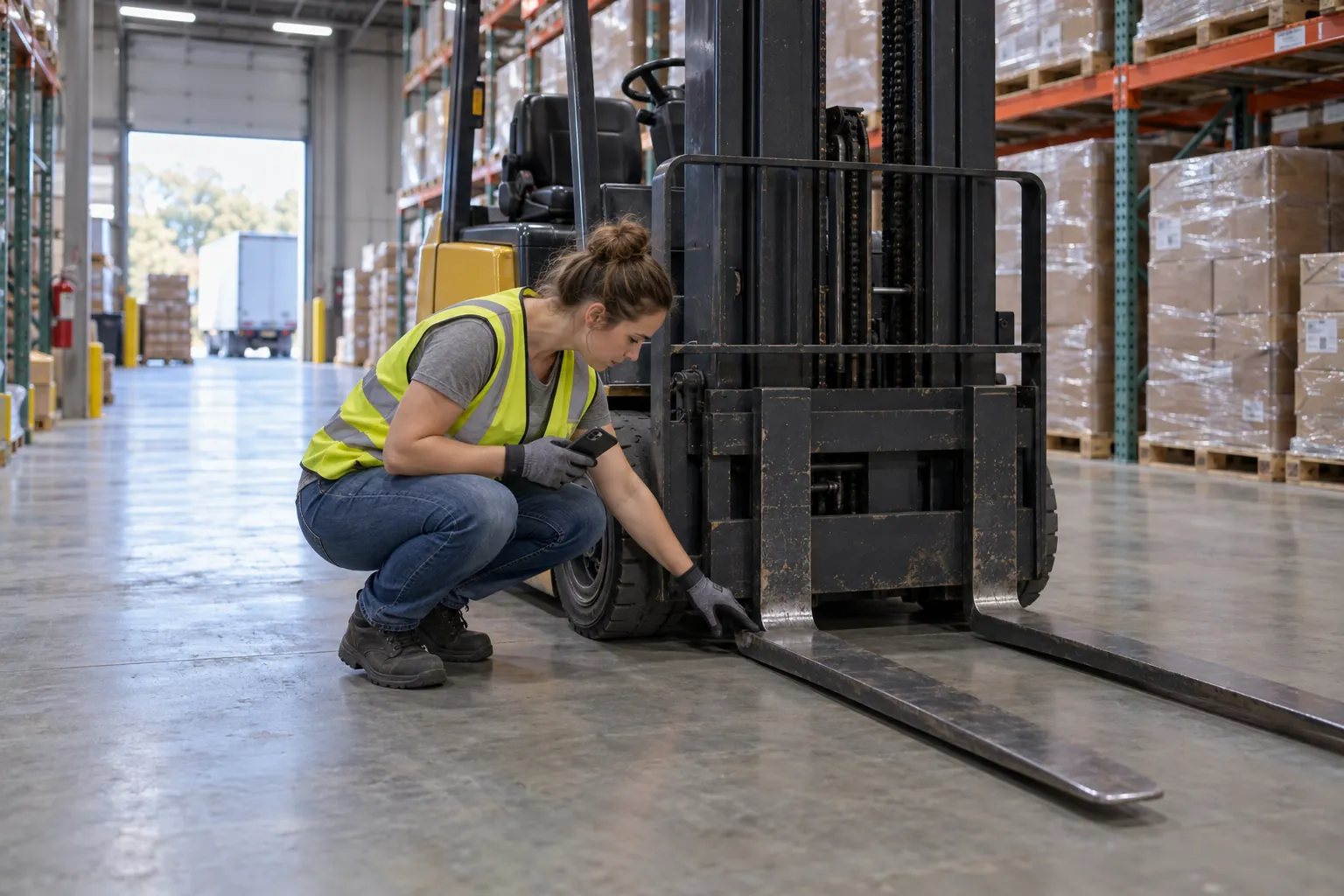 Premises and facilities managementThe forklift daily inspection: what OSHA requires, and a checklist that gets usedWhat OSHA 29 CFR 1910.178(q)(7) requires before a forklift is used, a daily inspection checklist by truck type, and what to do with a defect.
 Premises and facilities managementSlip, trip, and fall prevention: keeping floors, stairs, and walkways safe every daySlip, trip, and fall prevention in a commercial building: what OSHA 1910.22 requires, where people fall, the controls that work, and how to check and record them.
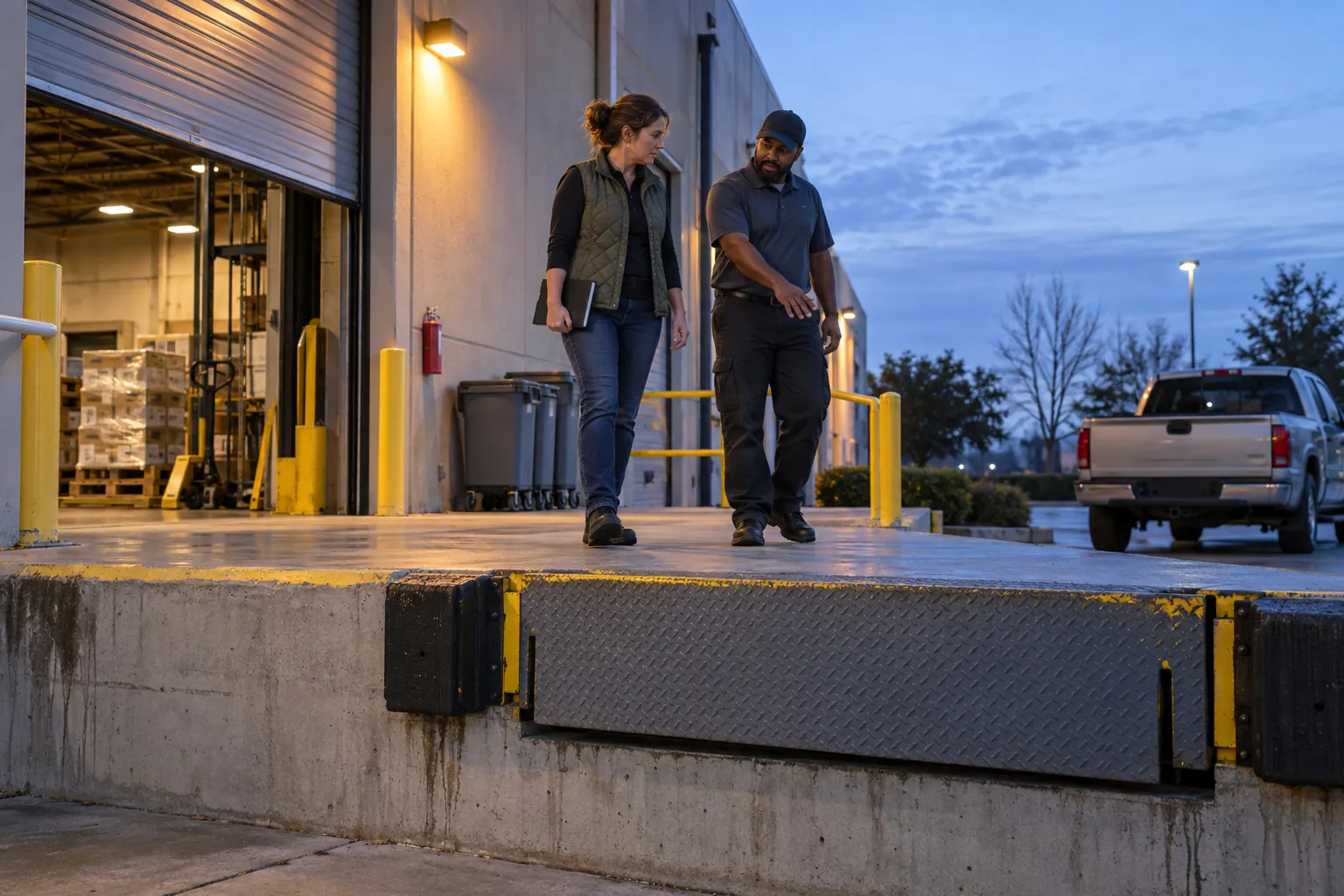 Premises and facilities managementSafety walkthroughs: how to walk a building, talk to the crew and fix what you findWhat a safety walk is under OSHA's Recommended Practices, what to look at in a commercial building, how often to walk, how to record findings and close them out.
 Premises and facilities managementNear miss reporting: catching the close calls before they become injuriesWhat counts as a near miss, what OSHA recommends, what a near miss report should capture, and how to follow it up so people keep reporting in your buildings.